Drug Interaction
Drug X → Warfarin
Other Antidepressants Drugs Fluvoxamine, Fluoxetine
Antidepressants Drugs Paroxetine
Biopharmaceutics
Warfarin
CYP2C9
inhibition
Paroxetine
−
↑ INR
mild ↑ bleeding
risk, but no
change in PT
Effects
“an increased bleeding tendency
[may occur with] the
coadministration of paroxetine and
warfarin.”
Warfarin
CYP1A2,
CYP2C9,
CYP2C19,
CYP3A4
inhibition
−
Fluvoxamin
e
↑ INR
CYP2C9,
CYP2C19,
and
CYP3A4
inhibition
Fluoxetine
−
↑ INR
Effects
Interactions between fluoxetine and
warfarin may occur, leading to
increased therapeutic response and
toxicity.
Fluvoxamine exhibits the highest
potential for the inhibition of
warfarin through the 2C9 isoenzyme.
fluvoxamine and fluoxetine appear
to harbor the highest potential risk
for inhibiting warfarin metabolism.
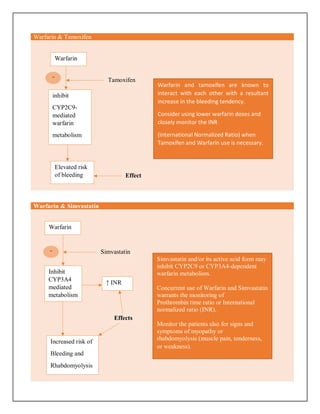
Warfarin & Tamoxifen
Warfarin & Simvastatin
Warfarin
inhibit
CYP2C9-
mediated
warfarin
metabolism
Elevated risk
of bleeding
Tamoxifen
−
Warfarin and tamoxifen are known to
interact with each other with a resultant
increase in the bleeding tendency.
Consider using lower warfarin doses and
closely monitor the INR
(International Normalized Ratio) when
Tamoxifen and Warfarin use is necessary.
Effect
Warfarin
Inhibit
CYP3A4
mediated
metabolism
Simvastatin
Increased risk of
Bleeding and
Rhabdomyolysis
Effects
−
Simvastatin and/or its active acid form may
inhibit CYP2C9 or CYP3A4-dependent
warfarin metabolism.
Concurrent use of Warfarin and Simvastatin
warrants the monitoring of
Prothrombin time ratio or International
normalized ratio (INR).
Monitor the patients also for signs and
symptoms of myopathy or
rhabdomyolysis (muscle pain, tenderness,
or weakness).
↑ INR
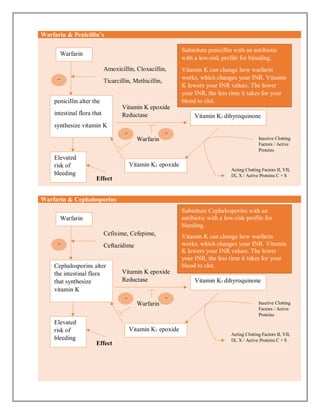
Warfarin & Penicillin’s
Warfarin & Cephalosporins
Warfarin
Amoxicillin, Cloxacillin,
Ticarcillin, Methicillin,
penicillin alter the
intestinal flora that
synthesize vitamin K
Elevated
risk of
bleeding
Vitamin K epoxide
Reductase Vitamin K1 dihyroquinone
Vitamin K1 epoxide
Acting Clotting Factors II, VII,
IX, X / Active Proteins C + S
Inactive Clotting
Factors / Active
Proteins
Warfarin
Effect
−
− −
Substitute penicillin with an antibiotic
with a low-risk profile for bleeding.
Vitamin K can change how warfarin
works, which changes your INR. Vitamin
K lowers your INR values. The lower
your INR, the less time it takes for your
blood to clot.
Warfarin
Cefixime, Cefepime,
Ceftazidime
Cephalosporins alter
the intestinal flora
that synthesize
vitamin K
Elevated
risk of
bleeding
Vitamin K epoxide
Reductase Vitamin K1 dihyroquinone
Vitamin K1 epoxide
Acting Clotting Factors II, VII,
IX, X / Active Proteins C + S
Inactive Clotting
Factors / Active
Proteins
Warfarin
Effect
−
− −
Substitute Cephalosporins with an
antibiotic with a low-risk profile for
bleeding.
Vitamin K can change how warfarin
works, which changes your INR. Vitamin
K lowers your INR values. The lower
your INR, the less time it takes for your
blood to clot.
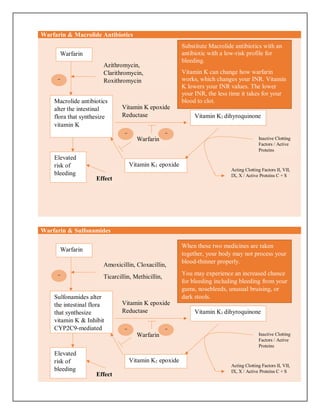
Warfarin & Macrolide Antibiotics
Warfarin & Sulfonamides
Warfarin
Azithromycin,
Clarithromycin,
Roxithromycin
Macrolide antibiotics
alter the intestinal
flora that synthesize
vitamin K
Elevated
risk of
bleeding
Vitamin K epoxide
Reductase Vitamin K1 dihyroquinone
Vitamin K1 epoxide
Acting Clotting Factors II, VII,
IX, X / Active Proteins C + S
Inactive Clotting
Factors / Active
Proteins
Warfarin
Effect
−
− −
Substitute Macrolide antibiotics with an
antibiotic with a low-risk profile for
bleeding.
Vitamin K can change how warfarin
works, which changes your INR. Vitamin
K lowers your INR values. The lower
your INR, the less time it takes for your
blood to clot.
Warfarin
Amoxicillin, Cloxacillin,
Ticarcillin, Methicillin,
Sulfonamides alter
the intestinal flora
that synthesize
vitamin K & Inhibit
CYP2C9-mediated
metabolism of
warfarin
Elevated
risk of
bleeding
Vitamin K epoxide
Reductase Vitamin K1 dihyroquinone
Vitamin K1 epoxide
Acting Clotting Factors II, VII,
IX, X / Active Proteins C + S
Inactive Clotting
Factors / Active
Proteins
Warfarin
Effect
−
− −
When these two medicines are taken
together, your body may not process your
blood-thinner properly.
You may experience an increased chance
for bleeding including bleeding from your
gums, nosebleeds, unusual bruising, or
dark stools.
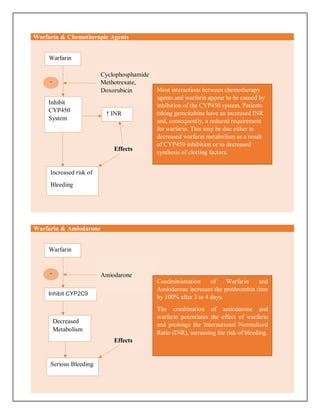
Warfarin & Chemotherapic Agents
Warfarin & Amiodarone
Warfarin
Inhibit
CYP450
System
Cyclophosphamide
Methotrexate,
Doxorubicin
Increased risk of
Bleeding
Effects
−
Most interactions between chemotherapy
agents and warfarin appear to be caused by
inhibition of the CYP450 system. Patients
taking gemcitabine have an increased INR
and, consequently, a reduced requirement
for warfarin. This may be due either to
decreased warfarin metabolism as a result
of CYP450 inhibition or to decreased
synthesis of clotting factors.
↑ INR
Warfarin
Inhibit CYP2C9
Amiodarone
Serious Bleeding
Effects
−
Coadministration of Warfarin and
Amiodarone increases the prothrombin time
by 100% after 3 to 4 days.
The combination of amiodarone and
warfarin potentiates the effect of warfarin
and prolongs the International Normalized
Ratio (INR), increasing the risk of bleeding.
Decreased
Metabolism
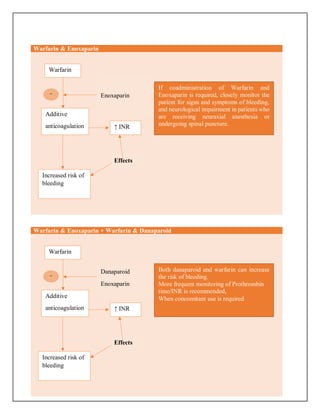
Warfarin & Enoxaparin
Warfarin & Enoxaparin + Warfarin & Danaparoid
Warfarin
Additive
anticoagulation
Enoxaparin
Increased risk of
bleeding
Effects
−
If coadministration of Warfarin and
Enoxaparin is required, closely monitor the
patient for signs and symptoms of bleeding,
and neurological impairment in patients who
are receiving neuraxial anesthesia or
undergoing spinal puncture.
↑ INR
Warfarin
Additive
anticoagulation
Danaparoid
Enoxaparin
Increased risk of
bleeding
Effects
−
Both danaparoid and warfarin can increase
the risk of bleeding.
More frequent monitoring of Prothrombin
time/INR is recommended,
When concomitant use is required
↑ INR
Warfarin & Antiplanets
Warfarin & Fish oil
Warfarin
Additive
anticoagulation
Aspirin
Clopidogrel
Increased risk of
bleeding
Effects
−
Warfarin
Vitamin K
(reduced)
Vitamin K
(oxidized)
Reductase
CO2 and O2
Descarboxyprothrombin Prothrombin
Carboxylase
Warfarin and antiplatelet drugs increase the risk of bleeding, their
combination can put patients at risk of a major haemorrhage.
Monitor patients closely for signs or symptoms of bleeding.
Warfarin
Eicosapentaenoic Acid
(EPA) of fish oil decreases
the availability of the
Thromboxane precursor in
the phospholipids of
the cell membrane
Fish oil (Omega 3
Fatty Acids)
supplements
Increased risk of
bleeding
Effects
−
omega-3 polyunsaturated fatty acid, consists
of eicosapentaenoic acid & docosahexaenoic
acid. This fatty acid may affect platelet
aggregation and/or vitamin K—dependent
coagulation factors. Omega-3 fatty acids
may lower thromboxane A2 supplies within
the platelet as well as decrease factor VII
levels
Decreased
Thromboxane
A2 levels
Decreased
platelet
aggregation
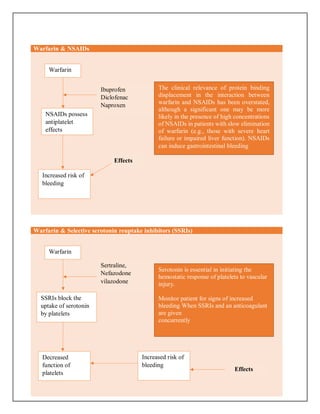
Warfarin & NSAIDs
Warfarin & Selective serotonin reuptake inhibitors (SSRIs)
Warfarin
NSAIDs possess
antiplatelet
effects
Ibuprofen
Diclofenac
Naproxen
Increased risk of
bleeding
Effects
The clinical relevance of protein binding
displacement in the interaction between
warfarin and NSAIDs has been overstated,
although a significant one may be more
likely in the presence of high concentrations
of NSAIDs in patients with slow elimination
of warfarin (e.g., those with severe heart
failure or impaired liver function). NSAIDs
can induce gastrointestinal bleeding
Warfarin
SSRIs block the
uptake of serotonin
by platelets
Sertraline,
Nefazodone
vilazodone
Decreased
function of
platelets
Effects
Serotonin is essential in initiating the
hemostatic response of platelets to vascular
injury.
Monitor patient for signs of increased
bleeding When SSRIs and an anticoagulant
are given
concurrently
Increased risk of
bleeding
Warfarin & NSAIDs
Drug Interaction
Drug X → Cimetidine
Effects

Warfarin Drug drug interactions

  • 1.
    Drug Interaction Drug X→ Warfarin Other Antidepressants Drugs Fluvoxamine, Fluoxetine Antidepressants Drugs Paroxetine Biopharmaceutics Warfarin CYP2C9 inhibition Paroxetine − ↑ INR mild ↑ bleeding risk, but no change in PT Effects “an increased bleeding tendency [may occur with] the coadministration of paroxetine and warfarin.” Warfarin CYP1A2, CYP2C9, CYP2C19, CYP3A4 inhibition − Fluvoxamin e ↑ INR CYP2C9, CYP2C19, and CYP3A4 inhibition Fluoxetine − ↑ INR Effects Interactions between fluoxetine and warfarin may occur, leading to increased therapeutic response and toxicity. Fluvoxamine exhibits the highest potential for the inhibition of warfarin through the 2C9 isoenzyme. fluvoxamine and fluoxetine appear to harbor the highest potential risk for inhibiting warfarin metabolism.
  • 2.
    Warfarin & Tamoxifen Warfarin& Simvastatin Warfarin inhibit CYP2C9- mediated warfarin metabolism Elevated risk of bleeding Tamoxifen − Warfarin and tamoxifen are known to interact with each other with a resultant increase in the bleeding tendency. Consider using lower warfarin doses and closely monitor the INR (International Normalized Ratio) when Tamoxifen and Warfarin use is necessary. Effect Warfarin Inhibit CYP3A4 mediated metabolism Simvastatin Increased risk of Bleeding and Rhabdomyolysis Effects − Simvastatin and/or its active acid form may inhibit CYP2C9 or CYP3A4-dependent warfarin metabolism. Concurrent use of Warfarin and Simvastatin warrants the monitoring of Prothrombin time ratio or International normalized ratio (INR). Monitor the patients also for signs and symptoms of myopathy or rhabdomyolysis (muscle pain, tenderness, or weakness). ↑ INR
  • 3.
    Warfarin & Penicillin’s Warfarin& Cephalosporins Warfarin Amoxicillin, Cloxacillin, Ticarcillin, Methicillin, penicillin alter the intestinal flora that synthesize vitamin K Elevated risk of bleeding Vitamin K epoxide Reductase Vitamin K1 dihyroquinone Vitamin K1 epoxide Acting Clotting Factors II, VII, IX, X / Active Proteins C + S Inactive Clotting Factors / Active Proteins Warfarin Effect − − − Substitute penicillin with an antibiotic with a low-risk profile for bleeding. Vitamin K can change how warfarin works, which changes your INR. Vitamin K lowers your INR values. The lower your INR, the less time it takes for your blood to clot. Warfarin Cefixime, Cefepime, Ceftazidime Cephalosporins alter the intestinal flora that synthesize vitamin K Elevated risk of bleeding Vitamin K epoxide Reductase Vitamin K1 dihyroquinone Vitamin K1 epoxide Acting Clotting Factors II, VII, IX, X / Active Proteins C + S Inactive Clotting Factors / Active Proteins Warfarin Effect − − − Substitute Cephalosporins with an antibiotic with a low-risk profile for bleeding. Vitamin K can change how warfarin works, which changes your INR. Vitamin K lowers your INR values. The lower your INR, the less time it takes for your blood to clot.
  • 4.
    Warfarin & MacrolideAntibiotics Warfarin & Sulfonamides Warfarin Azithromycin, Clarithromycin, Roxithromycin Macrolide antibiotics alter the intestinal flora that synthesize vitamin K Elevated risk of bleeding Vitamin K epoxide Reductase Vitamin K1 dihyroquinone Vitamin K1 epoxide Acting Clotting Factors II, VII, IX, X / Active Proteins C + S Inactive Clotting Factors / Active Proteins Warfarin Effect − − − Substitute Macrolide antibiotics with an antibiotic with a low-risk profile for bleeding. Vitamin K can change how warfarin works, which changes your INR. Vitamin K lowers your INR values. The lower your INR, the less time it takes for your blood to clot. Warfarin Amoxicillin, Cloxacillin, Ticarcillin, Methicillin, Sulfonamides alter the intestinal flora that synthesize vitamin K & Inhibit CYP2C9-mediated metabolism of warfarin Elevated risk of bleeding Vitamin K epoxide Reductase Vitamin K1 dihyroquinone Vitamin K1 epoxide Acting Clotting Factors II, VII, IX, X / Active Proteins C + S Inactive Clotting Factors / Active Proteins Warfarin Effect − − − When these two medicines are taken together, your body may not process your blood-thinner properly. You may experience an increased chance for bleeding including bleeding from your gums, nosebleeds, unusual bruising, or dark stools.
  • 5.
    Warfarin & ChemotherapicAgents Warfarin & Amiodarone Warfarin Inhibit CYP450 System Cyclophosphamide Methotrexate, Doxorubicin Increased risk of Bleeding Effects − Most interactions between chemotherapy agents and warfarin appear to be caused by inhibition of the CYP450 system. Patients taking gemcitabine have an increased INR and, consequently, a reduced requirement for warfarin. This may be due either to decreased warfarin metabolism as a result of CYP450 inhibition or to decreased synthesis of clotting factors. ↑ INR Warfarin Inhibit CYP2C9 Amiodarone Serious Bleeding Effects − Coadministration of Warfarin and Amiodarone increases the prothrombin time by 100% after 3 to 4 days. The combination of amiodarone and warfarin potentiates the effect of warfarin and prolongs the International Normalized Ratio (INR), increasing the risk of bleeding. Decreased Metabolism
  • 6.
    Warfarin & Enoxaparin Warfarin& Enoxaparin + Warfarin & Danaparoid Warfarin Additive anticoagulation Enoxaparin Increased risk of bleeding Effects − If coadministration of Warfarin and Enoxaparin is required, closely monitor the patient for signs and symptoms of bleeding, and neurological impairment in patients who are receiving neuraxial anesthesia or undergoing spinal puncture. ↑ INR Warfarin Additive anticoagulation Danaparoid Enoxaparin Increased risk of bleeding Effects − Both danaparoid and warfarin can increase the risk of bleeding. More frequent monitoring of Prothrombin time/INR is recommended, When concomitant use is required ↑ INR
  • 7.
    Warfarin & Antiplanets Warfarin& Fish oil Warfarin Additive anticoagulation Aspirin Clopidogrel Increased risk of bleeding Effects − Warfarin Vitamin K (reduced) Vitamin K (oxidized) Reductase CO2 and O2 Descarboxyprothrombin Prothrombin Carboxylase Warfarin and antiplatelet drugs increase the risk of bleeding, their combination can put patients at risk of a major haemorrhage. Monitor patients closely for signs or symptoms of bleeding. Warfarin Eicosapentaenoic Acid (EPA) of fish oil decreases the availability of the Thromboxane precursor in the phospholipids of the cell membrane Fish oil (Omega 3 Fatty Acids) supplements Increased risk of bleeding Effects − omega-3 polyunsaturated fatty acid, consists of eicosapentaenoic acid & docosahexaenoic acid. This fatty acid may affect platelet aggregation and/or vitamin K—dependent coagulation factors. Omega-3 fatty acids may lower thromboxane A2 supplies within the platelet as well as decrease factor VII levels Decreased Thromboxane A2 levels Decreased platelet aggregation
  • 8.
    Warfarin & NSAIDs Warfarin& Selective serotonin reuptake inhibitors (SSRIs) Warfarin NSAIDs possess antiplatelet effects Ibuprofen Diclofenac Naproxen Increased risk of bleeding Effects The clinical relevance of protein binding displacement in the interaction between warfarin and NSAIDs has been overstated, although a significant one may be more likely in the presence of high concentrations of NSAIDs in patients with slow elimination of warfarin (e.g., those with severe heart failure or impaired liver function). NSAIDs can induce gastrointestinal bleeding Warfarin SSRIs block the uptake of serotonin by platelets Sertraline, Nefazodone vilazodone Decreased function of platelets Effects Serotonin is essential in initiating the hemostatic response of platelets to vascular injury. Monitor patient for signs of increased bleeding When SSRIs and an anticoagulant are given concurrently Increased risk of bleeding
  • 9.
    Warfarin & NSAIDs DrugInteraction Drug X → Cimetidine Effects