By,
Akilamani Saradha
ANTICOAGULATION THERAPY
 Anticoagulants are a type of drug that reduces the
body's ability to form clots in the blood. They do
this by inhibiting the production of vitamin K in
the liver. This increases the time your blood takes to
clot. Although they are sometimes called blood
thinners, they do not actually thin the blood. This type
of medicine will not dissolve clots that already have
formed, although it will help to stop an existing clot
from getting larger.
ORAL ANTICOAGULANTS
 The oral anticoagulants available are warfarin,
acenocoumarol.
 Trade name:
1. Warf
2. Acitrom.
MECHANISM OF ACTION
 Oral anticoagulants are Coumadin derivative.
 Inhibits Vitamin K epoxide reductase, an enzyme that
that recycles oxidized vitamin K.
 Vitamin K is an activator of coagulating factors II, VII,
IX and X, so by decreasing the availability of Vitamin K
synthesis of these factors are decreased.
 Hence helps in prolonging the clotting time of the
blood.
INDICATIONS
 You may need to take warfarin, or other anticoagulants, if
you have been diagnosed with or treated for one or more of
the following:
1. Atrial fibrillation (AF)
2. Artificial heart valve
3. Deep vein thrombosis (DVT)
4. Pulmonary embolism (PE)
5. Prevention of blood clots e.g. genetic clotting disorders
6. Stroke
7. Heart Attack
8. Post HeartValve Replacement
INVESTIGATIONS
 PROTHROMBIN TIME:
Prothrombin time (PT) is a blood test that
measures how long it takes blood to clot. A
prothrombin time test can be used to check for
bleeding problems. PT is also used to check whether
medicine to prevent blood clots is working.
INVESTIGATIONS
 INR:
INR (international normalized ratio) stands
for a way of standardizing the results of
prothrombin time tests, no matter the testing
method. It lets us understand results in the same
way even when they come from different labs and
different test methods. In some labs, only the INR
is reported and the PT is not reported.
TARGET INR FOR EACH VALVES (AHA CRITERIA)
[2017]
VALVE TARGET INR VKA ASPIRIN DURATION
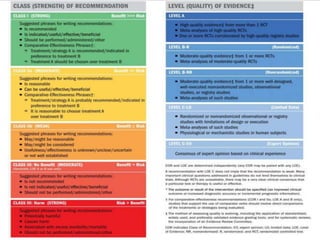
•Anticoagulation with a
VKA and INR
monitoring is
recommended in
patients with a
mechanical prosthetic
valve
According to
COR – I,
LOE – A.
•Mechanical
valve(Bileaflet or Tilting
disc)AVR with no risk
for thrombo-embolism
2.5 + [I,B] + [I,A]
(75 – 100mg)
Life long
•Mech. AVR with risk
for thrombo-embolism
(AF, previous
thromboembolism, LV
3.0 + [I,B] + [I,A]
(75 – 100mg)
Life long
VALVE TARGET INR VKA ASPIRIN DURATION
Mechanical MVR 3.0 + [I,B] + [I,A]
(75 – 100mg)
Life long
Bioprosthetic MVR or
AVR in patients at low
risk of bleeding
2.5 + [IIa,B-NR] + [IIa,B]
(75 – 100mg)
At least 3 mths
as long as 6
mths.
Mechanical On-X
AVR and no
thromboembolic risk
factors
1.5 – 2.0 + [IIb, B-R
]
+
(low dose)
Life long
After TAVR in patients at
low risk of bleeding
2.5 + [IIa,B-NR] +(75-100mg)
along with
T.Clopilet
75mg for 1st
6mths [IIb,C ]
At least 3
months
Anticoagulant therapy
with oral direct
thrombin inhibitors or
anti-Xa agents should
According to
COR - III:Harm,
LOE - B.
CONTRAINDICATION
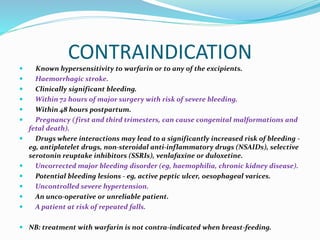
 Known hypersensitivity to warfarin or to any of the excipients.
 Haemorrhagic stroke.
 Clinically significant bleeding.
 Within 72 hours of major surgery with risk of severe bleeding.
 Within 48 hours postpartum.
 Pregnancy (first and third trimesters, can cause congenital malformations and
fetal death).
 Drugs where interactions may lead to a significantly increased risk of bleeding -
eg, antiplatelet drugs, non-steroidal anti-inflammatory drugs (NSAIDs), selective
serotonin reuptake inhibitors (SSRIs), venlafaxine or duloxetine.
 Uncorrected major bleeding disorder (eg, haemophilia, chronic kidney disease).
 Potential bleeding lesions - eg, active peptic ulcer, oesophageal varices.
 Uncontrolled severe hypertension.
 An unco-operative or unreliable patient.
 A patient at risk of repeated falls.
 NB: treatment with warfarin is not contra-indicated when breast-feeding.
DRUG INTERACTION
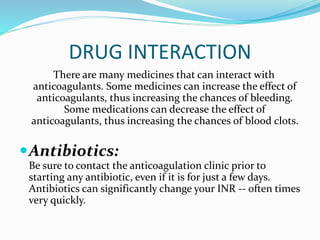
There are many medicines that can interact with
anticoagulants. Some medicines can increase the effect of
anticoagulants, thus increasing the chances of bleeding.
Some medications can decrease the effect of
anticoagulants, thus increasing the chances of blood clots.
Antibiotics:
Be sure to contact the anticoagulation clinic prior to
starting any antibiotic, even if it is for just a few days.
Antibiotics can significantly change your INR -- often times
very quickly.
DRUG INTERACTION
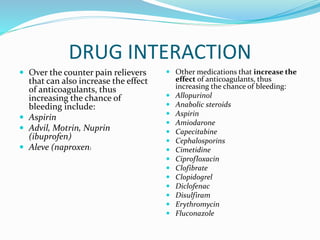
 Over the counter pain relievers
that can also increase the effect
of anticoagulants, thus
increasing the chance of
bleeding include:
 Aspirin
 Advil, Motrin, Nuprin
(ibuprofen)
 Aleve (naproxen)
 Other medications that increase the
effect of anticoagulants, thus
increasing the chance of bleeding:
 Allopurinol
 Anabolic steroids
 Aspirin
 Amiodarone
 Capecitabine
 Cephalosporins
 Cimetidine
 Ciprofloxacin
 Clofibrate
 Clopidogrel
 Diclofenac
 Disulfiram
 Erythromycin
 Fluconazole
DRUG INTERACTION
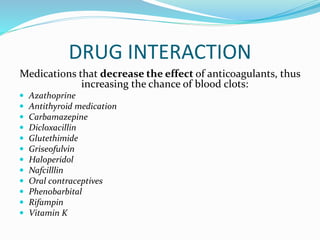
Medications that decrease the effect of anticoagulants, thus
increasing the chance of blood clots:
 Azathoprine
 Antithyroid medication
 Carbamazepine
 Dicloxacillin
 Glutethimide
 Griseofulvin
 Haloperidol
 Nafcilllin
 Oral contraceptives
 Phenobarbital
 Rifampin
 Vitamin K
DIETARY ADVICE
 Avoid sudden changes in the intake of foods and
vitamins containing vitamin K.
 Limit the amount of alcohol you drink.
 Avoid vitamins that contain high doses of vitamin K
and E.
 Fish oil may increase the INR level.
DIETARY ADVICE
Foods and beverages high in vitamin K include:
 Beef liver
 Broccoli
 Brussel sprouts
 Cabbage
 Cheese
 Collard greens
 Green tea
 Kale
 Lentils
 Lettuce
 Spinach
 Soybean oil
 Turnip greens
OTHER NEWER ORAL ANTICOAGULANTS
 Other newer Direct oral anticoagulants (DOACs)
approved by FDA and are available includes,
Rivaroxaban (Xarelto)
Dabigatran (Pradaxa)
Apixaban (Eliquis)
Betrixaban (BevyxXa)
Edoxaban (Savaysa)
Still a few other newer oral anticoagulants are in trail.
These DOACs are found as an alternative for some
specified patients requiring Anticoagulation therapy.
OTHER NEWER ORAL ANTICOAGULANTS
The newer DOACs do not require any specified
periodical blood investigation.
When compared to Warfarin/ Acitrom, these drugs are
short acting (patient should not miss the doses as
prescribed) and are also expensive.
Idarucizumab (Praxbind) was approved in 2015 by FDA
as a reversal of Dabigatran.
Andexanet alfa (AndexXa) was approved on May 4th
2018 by FDA as a reversal of Apixaban.
Thank
You

Oral Anticoagulation

  • 1.
  • 2.
    ANTICOAGULATION THERAPY  Anticoagulantsare a type of drug that reduces the body's ability to form clots in the blood. They do this by inhibiting the production of vitamin K in the liver. This increases the time your blood takes to clot. Although they are sometimes called blood thinners, they do not actually thin the blood. This type of medicine will not dissolve clots that already have formed, although it will help to stop an existing clot from getting larger.
  • 3.
    ORAL ANTICOAGULANTS  Theoral anticoagulants available are warfarin, acenocoumarol.  Trade name: 1. Warf 2. Acitrom.
  • 4.
    MECHANISM OF ACTION Oral anticoagulants are Coumadin derivative.  Inhibits Vitamin K epoxide reductase, an enzyme that that recycles oxidized vitamin K.  Vitamin K is an activator of coagulating factors II, VII, IX and X, so by decreasing the availability of Vitamin K synthesis of these factors are decreased.  Hence helps in prolonging the clotting time of the blood.
  • 5.
    INDICATIONS  You mayneed to take warfarin, or other anticoagulants, if you have been diagnosed with or treated for one or more of the following: 1. Atrial fibrillation (AF) 2. Artificial heart valve 3. Deep vein thrombosis (DVT) 4. Pulmonary embolism (PE) 5. Prevention of blood clots e.g. genetic clotting disorders 6. Stroke 7. Heart Attack 8. Post HeartValve Replacement
  • 6.
    INVESTIGATIONS  PROTHROMBIN TIME: Prothrombintime (PT) is a blood test that measures how long it takes blood to clot. A prothrombin time test can be used to check for bleeding problems. PT is also used to check whether medicine to prevent blood clots is working.
  • 7.
    INVESTIGATIONS  INR: INR (internationalnormalized ratio) stands for a way of standardizing the results of prothrombin time tests, no matter the testing method. It lets us understand results in the same way even when they come from different labs and different test methods. In some labs, only the INR is reported and the PT is not reported.
  • 9.
    TARGET INR FOREACH VALVES (AHA CRITERIA) [2017] VALVE TARGET INR VKA ASPIRIN DURATION •Anticoagulation with a VKA and INR monitoring is recommended in patients with a mechanical prosthetic valve According to COR – I, LOE – A. •Mechanical valve(Bileaflet or Tilting disc)AVR with no risk for thrombo-embolism 2.5 + [I,B] + [I,A] (75 – 100mg) Life long •Mech. AVR with risk for thrombo-embolism (AF, previous thromboembolism, LV 3.0 + [I,B] + [I,A] (75 – 100mg) Life long
  • 10.
    VALVE TARGET INRVKA ASPIRIN DURATION Mechanical MVR 3.0 + [I,B] + [I,A] (75 – 100mg) Life long Bioprosthetic MVR or AVR in patients at low risk of bleeding 2.5 + [IIa,B-NR] + [IIa,B] (75 – 100mg) At least 3 mths as long as 6 mths. Mechanical On-X AVR and no thromboembolic risk factors 1.5 – 2.0 + [IIb, B-R ] + (low dose) Life long After TAVR in patients at low risk of bleeding 2.5 + [IIa,B-NR] +(75-100mg) along with T.Clopilet 75mg for 1st 6mths [IIb,C ] At least 3 months Anticoagulant therapy with oral direct thrombin inhibitors or anti-Xa agents should According to COR - III:Harm, LOE - B.
  • 11.
    CONTRAINDICATION  Known hypersensitivityto warfarin or to any of the excipients.  Haemorrhagic stroke.  Clinically significant bleeding.  Within 72 hours of major surgery with risk of severe bleeding.  Within 48 hours postpartum.  Pregnancy (first and third trimesters, can cause congenital malformations and fetal death).  Drugs where interactions may lead to a significantly increased risk of bleeding - eg, antiplatelet drugs, non-steroidal anti-inflammatory drugs (NSAIDs), selective serotonin reuptake inhibitors (SSRIs), venlafaxine or duloxetine.  Uncorrected major bleeding disorder (eg, haemophilia, chronic kidney disease).  Potential bleeding lesions - eg, active peptic ulcer, oesophageal varices.  Uncontrolled severe hypertension.  An unco-operative or unreliable patient.  A patient at risk of repeated falls.  NB: treatment with warfarin is not contra-indicated when breast-feeding.
  • 12.
    DRUG INTERACTION There aremany medicines that can interact with anticoagulants. Some medicines can increase the effect of anticoagulants, thus increasing the chances of bleeding. Some medications can decrease the effect of anticoagulants, thus increasing the chances of blood clots. Antibiotics: Be sure to contact the anticoagulation clinic prior to starting any antibiotic, even if it is for just a few days. Antibiotics can significantly change your INR -- often times very quickly.
  • 13.
    DRUG INTERACTION  Overthe counter pain relievers that can also increase the effect of anticoagulants, thus increasing the chance of bleeding include:  Aspirin  Advil, Motrin, Nuprin (ibuprofen)  Aleve (naproxen)  Other medications that increase the effect of anticoagulants, thus increasing the chance of bleeding:  Allopurinol  Anabolic steroids  Aspirin  Amiodarone  Capecitabine  Cephalosporins  Cimetidine  Ciprofloxacin  Clofibrate  Clopidogrel  Diclofenac  Disulfiram  Erythromycin  Fluconazole
  • 14.
    DRUG INTERACTION Medications thatdecrease the effect of anticoagulants, thus increasing the chance of blood clots:  Azathoprine  Antithyroid medication  Carbamazepine  Dicloxacillin  Glutethimide  Griseofulvin  Haloperidol  Nafcilllin  Oral contraceptives  Phenobarbital  Rifampin  Vitamin K
  • 15.
    DIETARY ADVICE  Avoidsudden changes in the intake of foods and vitamins containing vitamin K.  Limit the amount of alcohol you drink.  Avoid vitamins that contain high doses of vitamin K and E.  Fish oil may increase the INR level.
  • 16.
    DIETARY ADVICE Foods andbeverages high in vitamin K include:  Beef liver  Broccoli  Brussel sprouts  Cabbage  Cheese  Collard greens  Green tea  Kale  Lentils  Lettuce  Spinach  Soybean oil  Turnip greens
  • 17.
    OTHER NEWER ORALANTICOAGULANTS  Other newer Direct oral anticoagulants (DOACs) approved by FDA and are available includes, Rivaroxaban (Xarelto) Dabigatran (Pradaxa) Apixaban (Eliquis) Betrixaban (BevyxXa) Edoxaban (Savaysa) Still a few other newer oral anticoagulants are in trail. These DOACs are found as an alternative for some specified patients requiring Anticoagulation therapy.
  • 18.
    OTHER NEWER ORALANTICOAGULANTS The newer DOACs do not require any specified periodical blood investigation. When compared to Warfarin/ Acitrom, these drugs are short acting (patient should not miss the doses as prescribed) and are also expensive. Idarucizumab (Praxbind) was approved in 2015 by FDA as a reversal of Dabigatran. Andexanet alfa (AndexXa) was approved on May 4th 2018 by FDA as a reversal of Apixaban.
  • 19.