ENFORCING RULES AND
CONSEQUENCES IN THE
CLASSROOM
From the Psychoeducation for Teachers
Series
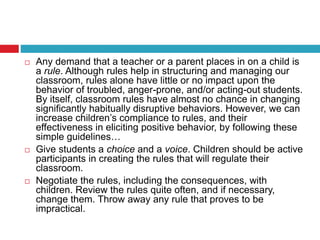
 Any demand that a teacher or a parent places in on a child is
a rule. Although rules help in structuring and managing our
classroom, rules alone have little or no impact upon the
behavior of troubled, anger-prone, and/or acting-out students.
By itself, classroom rules have almost no chance in changing
significantly habitually disruptive behaviors. However, we can
increase children’s compliance to rules, and their
effectiveness in eliciting positive behavior, by following these
simple guidelines…
 Give students a choice and a voice. Children should be active
participants in creating the rules that will regulate their
classroom.
 Negotiate the rules, including the consequences, with
children. Review the rules quite often, and if necessary,
change them. Throw away any rule that proves to be
impractical.
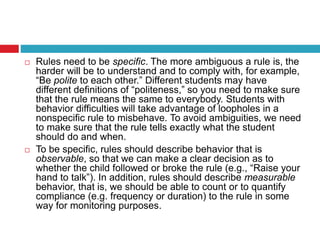
 Rules need to be specific. The more ambiguous a rule is, the
harder will be to understand and to comply with, for example,
“Be polite to each other.” Different students may have
different definitions of “politeness,” so you need to make sure
that the rule means the same to everybody. Students with
behavior difficulties will take advantage of loopholes in a
nonspecific rule to misbehave. To avoid ambiguities, we need
to make sure that the rule tells exactly what the student
should do and when.
 To be specific, rules should describe behavior that is
observable, so that we can make a clear decision as to
whether the child followed or broke the rule (e.g., “Raise your
hand to talk”). In addition, rules should describe measurable
behavior, that is, we should be able to count or to quantify
compliance (e.g. frequency or duration) to the rule in some
way for monitoring purposes.
 State each rule in behavioral terms, that is, the rule must
describe behavior. Some examples are, raising the hand to
talk, remaining seated for 30 minutes, or keeping a safe
distance (arm’s length) in the line.
 State rules using positive terms, that is, telling children what
they need to do to comply (e.g., “Walk in the hall”) rather than
telling what not to do or using negative terms, e.g., “Do not
run in the hall.” When we give positive directions, we are
guiding children toward alternative behaviors that are more
appropriate, for example, “If you want to hit, try punching this
toy.”
 Post the classroom rules in a visible place, this way, they are
more likely to be followed.
 When developing the classroom’s rules, discuss with
students the reason for each rule. Both the teacher and the
students should benefit from the rule.
 Make sure that children understand the rules. Have
students tell the rule, and have them state the reason for
the rule.
 Make fewer rules. It is better to get 100% compliance to
five rules than 50% compliance to ten rules.
 When introducing a rule, give examples and non-
examples.
 Practice the rule until your students understand your
expectation, for example, for the rule, “Raise your hand
if you want to talk,” you can say, “Show me what to do
when you have something you want to say.” To line up to
go to lunch, you say, “Show me how to get our lunch
boxes and line up.” (Rief, 1993). Do frequent reviews
 Include the compliance rule, “Do what your
teacher asks immediately.” (Rhode, Jenson, and
Reavis, 1995)
 State rules impersonally, e.g., “The rule in this
(classroom, library, or house) is no chewing gum.”
This way, we make sure that we do not take
ownership of the rule. When we use impersonal
wording, it is no longer our personal rule, and we
will be able to reframe any conflict as happening
between the child and the impersonal rule, not
between the adult and the child.
 Ask the student for a quick plan of a more appropriate
behavior, examples:
 I know you did not mean to push Walter, but the rule in this
classroom is “Keep your hands to yourself (impersonal
wording).” Walter thinks that you pushed him on purpose, and
now he is upset (cause and effect learning: Walter is upset
(effect) because he was pushed). Alternatively, somebody
may get hurt accidentally (cause and effect learning).What
can you do to prevent pushing when we come from the lunch
tomorrow? (Plan)
 Second Example:
 I know you are trying to help me when you yell at the other
students to walk faster in line, but they think you are bossy
(cause and effect learning). How can you help without yelling
or pushing? (Plan)
 Expect compliance and project your
confidence that the classroom rules will be
achieved.
 Individualize the rules to accommodate for the
child’s age level, level of maturity, and
personality.
 Use the students that comply with the rules as
models for the children having difficulty
complying. Smile at the child and praise her
compliance, however, do not compare the
children.
Using Prompts
 We can use prompts to remind children of the
rules. Silent or verbal prompting reminds the
child either to begin a wanted behavior or to
stop an unwanted behavior. The goal of
prompting is to increase the probability that the
wanted behavior will happen. Prompts should
remain friendly, and the teacher shows no tone
of anger or impatience. Basically, a prompt
reminds the child of the rule he has forgotten.
Some examples…
 Ruben, what do we do after we finish silent reading?
 Gregory, what is the rule about _____?
 Alexis, what do we do at 9’o clock?
 Brenda, what is the rule when we go to the listening center?
 Remember Lisa, we agreed that there will be no gum chewing in the
classroom.
 Lunch in five minutes.
 Nancy, can you tell the class what we discussed yesterday about
wearing caps in school?
 Drake, what are you doing? (Implying that the child is doing
something wrong.)
 Sometimes a one-word prompting will be enough, e.g.,
“Book,” “Toy,” (Put away the toy) or “Cut.” (Stop talking) On
other occasions, a silent (nonverbal) signal will send the
message. Signals like frowning, coughing, or switching lights
are used frequently in the classroom, but for other signals, we
need to explain in advance what the signal means.
 Examples:
 Tapping your head: Think before you talk
 Finger on lips: Be quiet
 Finger scissors: Cut, stop what you are doing, or stop talking
 Hand palm down and lowered by degrees: Lower your voices
 Tapping a student’s desk: Back to work
 When we use prompts, we can avoid
identifying the same children as
“troublemakers.” In the following example, the
teacher is training the class to comply with the
rule, “When I talk, you listen” by stating the
rule repeatedly. When one student interrupts,
the teacher prompts, “When I talk…” and the
class completes “…We listen!” This way the
teacher does not single out any individual
student, and the children learn the rule by
hearing and saying it aloud. (Reif, 1993)
Enforcing Consequences
 When disciplining troubled, anger-prone, and acting-out
children, remember that actions speak louder than
words, so let your actions do most of the talking for you.
With these children, it is imperative that we consistently
administer positive and negative consequences. A
positive consequence (any kind of internal or external
reward) should follow compliance, for example, praising
the child, smiling, thanking the child for complying, or
earning a token. A negative consequence such as time
out or losing privileges must follow noncompliance. In
addition, we need to make sure that our rules are
enforceable, simply put, throw away any rule that you do
not intend to enforce 100% of the time.
Additional guidelines…
 Troubled, anger-prone, and acting-out students
need to see the consequences caused by their
behavior. These children need to understand that
an unwanted consequence will follow a negative
behavior; the opposite is also true, children must
see the positive consequences that follow their
positive behaviors.
 Students with developmental delays and/or
behavior difficulties do not see the link between a
disruptive behavior (cause) and the negative
consequence (effect), that is, “If you do ‘X’ then ‘Y’
will happen.” When we consistently use warnings
and the enforcement of consequences, we
enhance cause and effect learning.
 Most children with recurrent behavior problems are not
aware of the relationship between their behaviors and
the consequences that follow those behaviors, lacking
the awareness that their own actions determine what
happens to them. Teachers need to make this
connection behavior-consequence explicitly apparent to
the child, reminding children that their choice of
continued disruptive and acting-out behaviors will bring
about a negative outcome or a negative consequence.
To reinforce the connection behavior-consequence, the
teacher can say, “If you do _____ (desired behavior),
you can _____ (positive consequence); if you do not,
you choose _____ (negative consequence).”
 Tie compliance to rules with consequences, that
is, what students earn for complying with the rule,
and what they lose if they do not follow the rule.
Students need to know which specific behaviors
result in unpleasant consequences.
 Use a “when… then…” format, for example,
“When you sit on your chair, (then) I will give you
the coloring materials” or “When you sit up
straight, then we can move on.”
 Make the “penalty fit the crime,” and do not match
harsh consequences with minor infractions.
 Not all students need to receive identical consequences for similar
behaviors. A teacher can individualize both the class rules and the
rules consequences to fit each particular child’s socio-emotional
development and socio-emotional needs. Make it easier, not harder,
for troubled, anger-prone, and acting-out children to succeed and to
earn rewards. In addition, you can implement negative
consequences by levels- from less severe to most severe. You
should have a range of negative consequences available for
different misbehaviors.
 Have a range of positive consequences for appropriate behavior
and negative consequences for inappropriate behavior to use at any
time and in different settings, including the classroom, in school,
and out of school.
 Make sure that your class routines are predictable and
that students know which behaviors are followed by
which consequences.
 Consistently use the three-penalty technique:
ignoring, time out, and loss of privileges.
 When you are ignoring a student, make sure that
you:
1. Make no eye contact
2. Make no verbal contact (i.e. comment)
3. Make no physical contact (e.g. touching)
4. Give non-verbal cues like rolling your eyes, sighing,
or making a gesture that signals that you feel
annoyed or frustrated with the child’s behavior
 Time out or time away should be brief, that is, five minutes for
younger children and up to fifteen minutes for older students. The
student is welcomed back to the group after the time out. One
procedure that you can use is to give the child three warnings, and
after the third warning, the child goes to the “Think-About-It-Chair
(or Corner)” This place is for “Oops… I have to think about what I
am supposed to do now.” (Rief, 1993)
 Any consequence that we give should be as close in time to the
misbehavior as possible. We need to be firm, but not punitive or
vindictive.
 The first time a non-compliant or difficult student breaks the rule,
ask the child to tell which rule was broken. If the child cannot
identify the rule broken, calmly, you state the rule, the infraction, and
the consequence. Then ask the child again which rule was broken.
Do not apply a penalty only after a second infraction.
 When enforcing consequences, remain cool, and use an un-
emotional, business-like style.
 Let the difficult child know in advance about the
penalty plan. For example:
 Each time you choose to throw a tantrum, I’m going to
ignore you. By ignoring, I mean that I’m not going to
look at you or talk to you. Immediately after you
choose to stop the tantrum, you have to go to the time
out area for five minutes. After you return from the
time out area and you join the class calmly, I will talk
with you again.
 In this example, the teacher is also using choice
language (“You choose to throw a tantrum” and “You
choose to stop the tantrum”) to help the child
understand that his behavior is his choice and
responsibility. In addition, the teacher uses an indirect
suggestion (“Join the class calmly”).
 Use Schaefer’s (1994) six-step approach:
1. Point out the behavior that must change
2. Explain the reason, for example, “Throwing markers in the classroom
makes a mess”
3. Tell the penalty
4. Point out an acceptable alternative, for example, “Markers are for
coloring, not for playing with”
5. Ask for feedback of how well the child understood, example, “Now, what
did I just tell you?”
6. Quickly reestablish your bond with the child
 We can add:
1. If the child does not comply, repeat the initial command, beginning with
“You need to…”
2. After administering the consequence, ask the child what he can learn
from the mistake
 Increase your tolerance to the frustration and discomfort you will
feel when the child gets upset over the penalty.
 When giving a penalty, do not try to reason or to use logic with the
child. In a well-managed consequence system, the student knows
the consequence in advance. After the infraction, the teacher simply
needs to restate the known consequence.
 Penalties need to accommodate the way the child is feeling, for
example, the child may be too angry to comply with the penalty
immediately, so you may need to postpone the penalty. In addition,
you can make adjustments according to the situation, that is,
according to any special circumstances and triggers.
Consequences, negative and positive, are set to train and to guide
the child in learning appropriate behavior; consequences are not
given to punish or to “get even” with the child. Again, if the child
seems too angry and/or too upset at that particular time, simply
postpone the penalty.
 Allow the student to grumble a little when she
complies with an unwanted consequence.
Give room for the expression of feeling
statements like, “I hate doing _____!” as long
as the child complies.
 Make sure that you maintain a positive
relationship with the student. Children respond
best to correction and to negative
consequences when they have a positive
relationship with the adult.
References
 Rhode, G., Jenson, W. R., & Reavis, H. K. (1995). The
tough kid book: Practical classroom management
strategies. Longmont, CO: Sopris West.
 Rief, S. F. (1993). How to reach and teach ADD/ADHD
children: Practical techniques, strategies, and
interventions for helping children with attention problems
and hyperactivity. West Nyack, NY: Center for Applied
Research in Education.
 Schaefer, C. E. (1994). How to influence children: A
handbook of practical child guidance skills (Second
Edition). Northvale, NJ: Jason Aronson.
Child guidance, an essential skill for
teachers and school counselors
 OUR FACEBOOK PAGES
AND GROUPS
 PSYCHOEDUCATION FOR
TEACHERS (Page)
 https://www.facebook.com/ps
ychoeducationalteacher
 FREE OR CHEAP
TEACHING RESOURCES
(Page)
 https://www.facebook.com/fre
eresourcesforteachers/
 WE TEACH THE WORLD
(Group)
 https://facebook.com/groups/
222247571474300
 BOOKS IN CHILD
GUIDANCE
 THE
PSYCHOEDUCATIONAL
TEACHER
 https://www.amazon.com/aut
hor/thepsychoeducationalteac
her/

Enforcing Rules and Consequences in the Classroom

  • 1.
    ENFORCING RULES AND CONSEQUENCESIN THE CLASSROOM From the Psychoeducation for Teachers Series
  • 2.
     Any demandthat a teacher or a parent places in on a child is a rule. Although rules help in structuring and managing our classroom, rules alone have little or no impact upon the behavior of troubled, anger-prone, and/or acting-out students. By itself, classroom rules have almost no chance in changing significantly habitually disruptive behaviors. However, we can increase children’s compliance to rules, and their effectiveness in eliciting positive behavior, by following these simple guidelines…  Give students a choice and a voice. Children should be active participants in creating the rules that will regulate their classroom.  Negotiate the rules, including the consequences, with children. Review the rules quite often, and if necessary, change them. Throw away any rule that proves to be impractical.
  • 3.
     Rules needto be specific. The more ambiguous a rule is, the harder will be to understand and to comply with, for example, “Be polite to each other.” Different students may have different definitions of “politeness,” so you need to make sure that the rule means the same to everybody. Students with behavior difficulties will take advantage of loopholes in a nonspecific rule to misbehave. To avoid ambiguities, we need to make sure that the rule tells exactly what the student should do and when.  To be specific, rules should describe behavior that is observable, so that we can make a clear decision as to whether the child followed or broke the rule (e.g., “Raise your hand to talk”). In addition, rules should describe measurable behavior, that is, we should be able to count or to quantify compliance (e.g. frequency or duration) to the rule in some way for monitoring purposes.
  • 4.
     State eachrule in behavioral terms, that is, the rule must describe behavior. Some examples are, raising the hand to talk, remaining seated for 30 minutes, or keeping a safe distance (arm’s length) in the line.  State rules using positive terms, that is, telling children what they need to do to comply (e.g., “Walk in the hall”) rather than telling what not to do or using negative terms, e.g., “Do not run in the hall.” When we give positive directions, we are guiding children toward alternative behaviors that are more appropriate, for example, “If you want to hit, try punching this toy.”  Post the classroom rules in a visible place, this way, they are more likely to be followed.  When developing the classroom’s rules, discuss with students the reason for each rule. Both the teacher and the students should benefit from the rule.
  • 5.
     Make surethat children understand the rules. Have students tell the rule, and have them state the reason for the rule.  Make fewer rules. It is better to get 100% compliance to five rules than 50% compliance to ten rules.  When introducing a rule, give examples and non- examples.  Practice the rule until your students understand your expectation, for example, for the rule, “Raise your hand if you want to talk,” you can say, “Show me what to do when you have something you want to say.” To line up to go to lunch, you say, “Show me how to get our lunch boxes and line up.” (Rief, 1993). Do frequent reviews
  • 6.
     Include thecompliance rule, “Do what your teacher asks immediately.” (Rhode, Jenson, and Reavis, 1995)  State rules impersonally, e.g., “The rule in this (classroom, library, or house) is no chewing gum.” This way, we make sure that we do not take ownership of the rule. When we use impersonal wording, it is no longer our personal rule, and we will be able to reframe any conflict as happening between the child and the impersonal rule, not between the adult and the child.
  • 7.
     Ask thestudent for a quick plan of a more appropriate behavior, examples:  I know you did not mean to push Walter, but the rule in this classroom is “Keep your hands to yourself (impersonal wording).” Walter thinks that you pushed him on purpose, and now he is upset (cause and effect learning: Walter is upset (effect) because he was pushed). Alternatively, somebody may get hurt accidentally (cause and effect learning).What can you do to prevent pushing when we come from the lunch tomorrow? (Plan)  Second Example:  I know you are trying to help me when you yell at the other students to walk faster in line, but they think you are bossy (cause and effect learning). How can you help without yelling or pushing? (Plan)
  • 8.
     Expect complianceand project your confidence that the classroom rules will be achieved.  Individualize the rules to accommodate for the child’s age level, level of maturity, and personality.  Use the students that comply with the rules as models for the children having difficulty complying. Smile at the child and praise her compliance, however, do not compare the children.
  • 9.
    Using Prompts  Wecan use prompts to remind children of the rules. Silent or verbal prompting reminds the child either to begin a wanted behavior or to stop an unwanted behavior. The goal of prompting is to increase the probability that the wanted behavior will happen. Prompts should remain friendly, and the teacher shows no tone of anger or impatience. Basically, a prompt reminds the child of the rule he has forgotten.
  • 10.
    Some examples…  Ruben,what do we do after we finish silent reading?  Gregory, what is the rule about _____?  Alexis, what do we do at 9’o clock?  Brenda, what is the rule when we go to the listening center?  Remember Lisa, we agreed that there will be no gum chewing in the classroom.  Lunch in five minutes.  Nancy, can you tell the class what we discussed yesterday about wearing caps in school?  Drake, what are you doing? (Implying that the child is doing something wrong.)
  • 11.
     Sometimes aone-word prompting will be enough, e.g., “Book,” “Toy,” (Put away the toy) or “Cut.” (Stop talking) On other occasions, a silent (nonverbal) signal will send the message. Signals like frowning, coughing, or switching lights are used frequently in the classroom, but for other signals, we need to explain in advance what the signal means.  Examples:  Tapping your head: Think before you talk  Finger on lips: Be quiet  Finger scissors: Cut, stop what you are doing, or stop talking  Hand palm down and lowered by degrees: Lower your voices  Tapping a student’s desk: Back to work
  • 12.
     When weuse prompts, we can avoid identifying the same children as “troublemakers.” In the following example, the teacher is training the class to comply with the rule, “When I talk, you listen” by stating the rule repeatedly. When one student interrupts, the teacher prompts, “When I talk…” and the class completes “…We listen!” This way the teacher does not single out any individual student, and the children learn the rule by hearing and saying it aloud. (Reif, 1993)
  • 13.
    Enforcing Consequences  Whendisciplining troubled, anger-prone, and acting-out children, remember that actions speak louder than words, so let your actions do most of the talking for you. With these children, it is imperative that we consistently administer positive and negative consequences. A positive consequence (any kind of internal or external reward) should follow compliance, for example, praising the child, smiling, thanking the child for complying, or earning a token. A negative consequence such as time out or losing privileges must follow noncompliance. In addition, we need to make sure that our rules are enforceable, simply put, throw away any rule that you do not intend to enforce 100% of the time.
  • 14.
    Additional guidelines…  Troubled,anger-prone, and acting-out students need to see the consequences caused by their behavior. These children need to understand that an unwanted consequence will follow a negative behavior; the opposite is also true, children must see the positive consequences that follow their positive behaviors.  Students with developmental delays and/or behavior difficulties do not see the link between a disruptive behavior (cause) and the negative consequence (effect), that is, “If you do ‘X’ then ‘Y’ will happen.” When we consistently use warnings and the enforcement of consequences, we enhance cause and effect learning.
  • 15.
     Most childrenwith recurrent behavior problems are not aware of the relationship between their behaviors and the consequences that follow those behaviors, lacking the awareness that their own actions determine what happens to them. Teachers need to make this connection behavior-consequence explicitly apparent to the child, reminding children that their choice of continued disruptive and acting-out behaviors will bring about a negative outcome or a negative consequence. To reinforce the connection behavior-consequence, the teacher can say, “If you do _____ (desired behavior), you can _____ (positive consequence); if you do not, you choose _____ (negative consequence).”
  • 16.
     Tie complianceto rules with consequences, that is, what students earn for complying with the rule, and what they lose if they do not follow the rule. Students need to know which specific behaviors result in unpleasant consequences.  Use a “when… then…” format, for example, “When you sit on your chair, (then) I will give you the coloring materials” or “When you sit up straight, then we can move on.”  Make the “penalty fit the crime,” and do not match harsh consequences with minor infractions.
  • 17.
     Not allstudents need to receive identical consequences for similar behaviors. A teacher can individualize both the class rules and the rules consequences to fit each particular child’s socio-emotional development and socio-emotional needs. Make it easier, not harder, for troubled, anger-prone, and acting-out children to succeed and to earn rewards. In addition, you can implement negative consequences by levels- from less severe to most severe. You should have a range of negative consequences available for different misbehaviors.  Have a range of positive consequences for appropriate behavior and negative consequences for inappropriate behavior to use at any time and in different settings, including the classroom, in school, and out of school.
  • 18.
     Make surethat your class routines are predictable and that students know which behaviors are followed by which consequences.  Consistently use the three-penalty technique: ignoring, time out, and loss of privileges.  When you are ignoring a student, make sure that you: 1. Make no eye contact 2. Make no verbal contact (i.e. comment) 3. Make no physical contact (e.g. touching) 4. Give non-verbal cues like rolling your eyes, sighing, or making a gesture that signals that you feel annoyed or frustrated with the child’s behavior
  • 19.
     Time outor time away should be brief, that is, five minutes for younger children and up to fifteen minutes for older students. The student is welcomed back to the group after the time out. One procedure that you can use is to give the child three warnings, and after the third warning, the child goes to the “Think-About-It-Chair (or Corner)” This place is for “Oops… I have to think about what I am supposed to do now.” (Rief, 1993)  Any consequence that we give should be as close in time to the misbehavior as possible. We need to be firm, but not punitive or vindictive.  The first time a non-compliant or difficult student breaks the rule, ask the child to tell which rule was broken. If the child cannot identify the rule broken, calmly, you state the rule, the infraction, and the consequence. Then ask the child again which rule was broken. Do not apply a penalty only after a second infraction.  When enforcing consequences, remain cool, and use an un- emotional, business-like style.
  • 20.
     Let thedifficult child know in advance about the penalty plan. For example:  Each time you choose to throw a tantrum, I’m going to ignore you. By ignoring, I mean that I’m not going to look at you or talk to you. Immediately after you choose to stop the tantrum, you have to go to the time out area for five minutes. After you return from the time out area and you join the class calmly, I will talk with you again.  In this example, the teacher is also using choice language (“You choose to throw a tantrum” and “You choose to stop the tantrum”) to help the child understand that his behavior is his choice and responsibility. In addition, the teacher uses an indirect suggestion (“Join the class calmly”).
  • 21.
     Use Schaefer’s(1994) six-step approach: 1. Point out the behavior that must change 2. Explain the reason, for example, “Throwing markers in the classroom makes a mess” 3. Tell the penalty 4. Point out an acceptable alternative, for example, “Markers are for coloring, not for playing with” 5. Ask for feedback of how well the child understood, example, “Now, what did I just tell you?” 6. Quickly reestablish your bond with the child  We can add: 1. If the child does not comply, repeat the initial command, beginning with “You need to…” 2. After administering the consequence, ask the child what he can learn from the mistake
  • 22.
     Increase yourtolerance to the frustration and discomfort you will feel when the child gets upset over the penalty.  When giving a penalty, do not try to reason or to use logic with the child. In a well-managed consequence system, the student knows the consequence in advance. After the infraction, the teacher simply needs to restate the known consequence.  Penalties need to accommodate the way the child is feeling, for example, the child may be too angry to comply with the penalty immediately, so you may need to postpone the penalty. In addition, you can make adjustments according to the situation, that is, according to any special circumstances and triggers. Consequences, negative and positive, are set to train and to guide the child in learning appropriate behavior; consequences are not given to punish or to “get even” with the child. Again, if the child seems too angry and/or too upset at that particular time, simply postpone the penalty.
  • 23.
     Allow thestudent to grumble a little when she complies with an unwanted consequence. Give room for the expression of feeling statements like, “I hate doing _____!” as long as the child complies.  Make sure that you maintain a positive relationship with the student. Children respond best to correction and to negative consequences when they have a positive relationship with the adult.
  • 24.
    References  Rhode, G.,Jenson, W. R., & Reavis, H. K. (1995). The tough kid book: Practical classroom management strategies. Longmont, CO: Sopris West.  Rief, S. F. (1993). How to reach and teach ADD/ADHD children: Practical techniques, strategies, and interventions for helping children with attention problems and hyperactivity. West Nyack, NY: Center for Applied Research in Education.  Schaefer, C. E. (1994). How to influence children: A handbook of practical child guidance skills (Second Edition). Northvale, NJ: Jason Aronson.
  • 25.
    Child guidance, anessential skill for teachers and school counselors  OUR FACEBOOK PAGES AND GROUPS  PSYCHOEDUCATION FOR TEACHERS (Page)  https://www.facebook.com/ps ychoeducationalteacher  FREE OR CHEAP TEACHING RESOURCES (Page)  https://www.facebook.com/fre eresourcesforteachers/  WE TEACH THE WORLD (Group)  https://facebook.com/groups/ 222247571474300  BOOKS IN CHILD GUIDANCE  THE PSYCHOEDUCATIONAL TEACHER  https://www.amazon.com/aut hor/thepsychoeducationalteac her/