Railway Asset Maintenance and Management
Wagon Maintenance
Moving From Scheduled to Condition Based Maintenance
By Bruce Brymer
Wagon Maintenance Coordinator
Rollingstock Business Unit
Coal and Freight Services Group
QR
Summary
QR is on course to increase coal haul tonnages in Queensland over the next three years by
more than 20%. With current rail systems approaching saturation point, increases in haulage
have to be achieved through improved cycle times and better asset utilisation. QR can rail
higher tonnages with existing assets by increasing the maintenance interval through smarter
use of wayside detectors and Condition Initiated Maintenance. Current maintenance
strategies have to be challenged and by focusing the maintenance effort on wagons that
require action, QR can achieve improved wagon availability and reduce overall wagon
downtime required for maintenance activities and therefore higher returns on working assets.
Background
QR is Australia’s only fully integrated
railway combining an array of passenger
services, general freight, and heavy haul
mineral traffics while maintaining control
over all aspects of the operations. QR
provides these services with over 9,500
km of narrow gauge track situated
throughout Queensland.
Currently, QR is moving in excess of 160
million tonnes of freight each year, with
140 million tonnes of this freight being coal.
Roughly 55 percent of the coal is being
moved through the Goonyella Corridor.
Soon these tonnages will increase with
railings in Queenlsand set to reach 168
million tons and 30 million tons in NSW.
The Goonyella System is located in Central
Queensland, and services the Central
Queensland coal mines in the Mackay
hinterland region of the Bowen Basin, with
the longest cycle approximately 500 miles
(800 km) round trip. Export coal is
transported to the ports of Hay Point and
Dalrymple Bay where it is unloaded prior
to shipment overseas. The Goonyella
System is electrified by an autotransformer
system with the overhead line equipment
operating at 25 KVa, 50 hertz, AC supply.
This overhead equipment supplies current
to enable the use of electric locomotives
throughout the system.
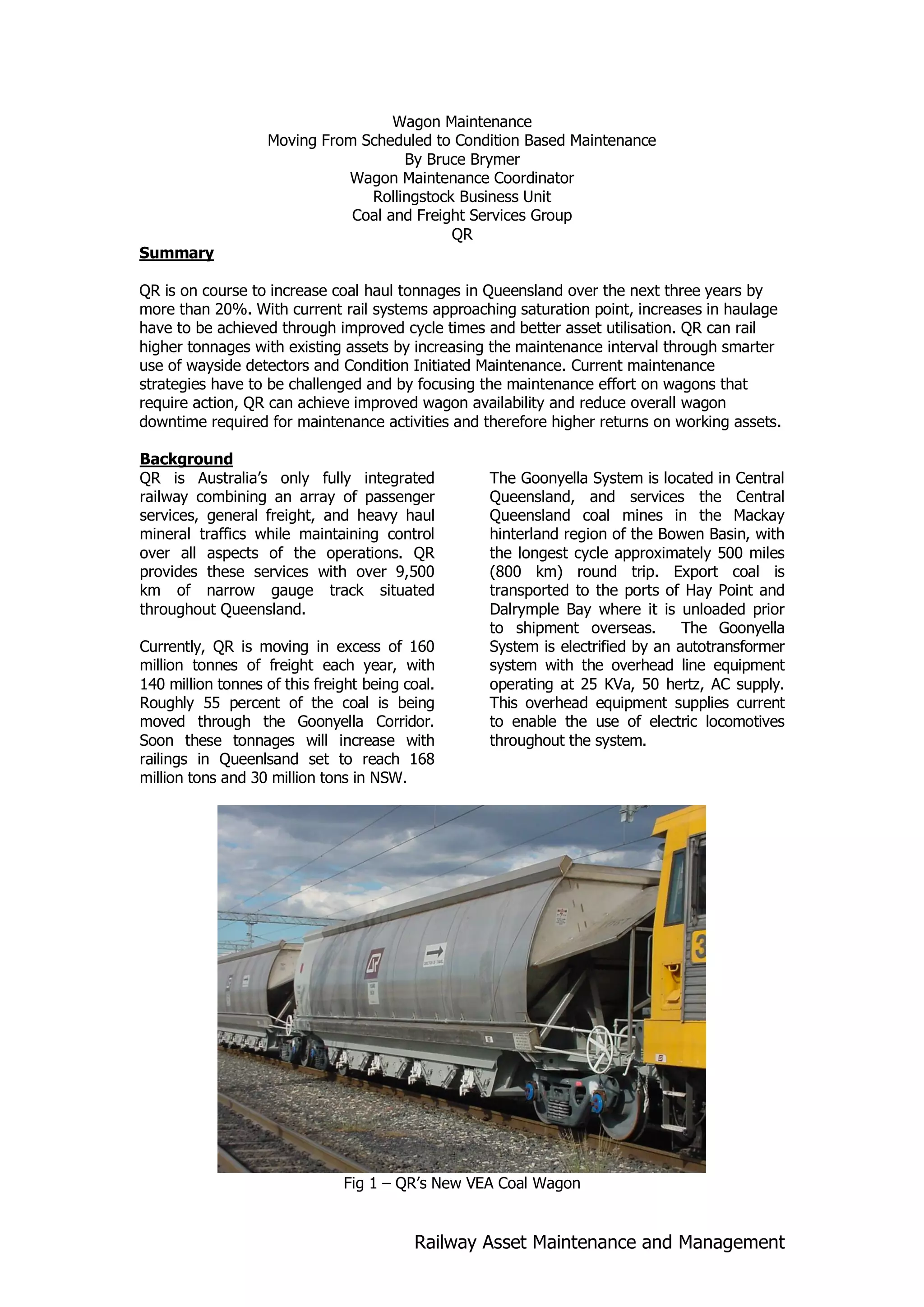
Fig 1 – QR’s New VEA Coal Wagon
Wagon Maintenance - Moving from Scheduled to Condition Based Rollingstock BU CFS QR
Railway Asset Maintenance & Management 30 Aug 2004 Page 2 of 9
1. Current Wagon Maintenance Practices Based on RCM
Maintenance
Activity
Current Maintenance
Schedule
Future Maintenance Based on Condition
Rollby Inspection Every Trip
Only 1 Side
Slow Speed
Difficulty in accurately
recording defect events
Every Trip
Both Sides
Train Speed
Automatic data recording and reporting
Reliability
Examination
Every 2-3 Weeks
2-4 Hours duration
Relies on visual
inspection
Increase interval based on reliability data
Reduce Time taken by targeting defects
required for action.
Accurate defect data
Allows for focused maintenance effort and
less time spent on wagons that don’t require
attention.
Scheduled Level 1
Maintenance
8 Months
Component change based
on Scheduled Tasks.
Increase Interval
Accurate Defect Information
Component Change based on condition.
Improved Utilisation of resources.
Improved Maintenance Planning
Labour
Materials
Overhaul 8-12 Years
General Scope Of Works
Fixed Price
Scheduled on Condition and Demand
Specific Scope for Each Wagon based on
accurate defect data.
Actual Costs for work completed.
Table 1
Ratio of Scheduled to Unscheduled Work
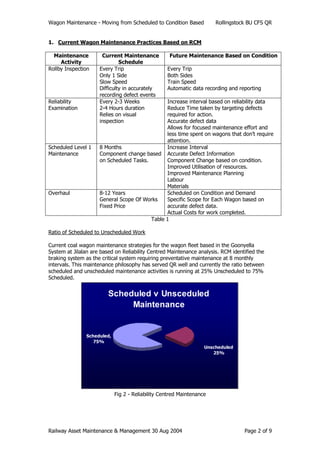
Current coal wagon maintenance strategies for the wagon fleet based in the Goonyella
System at Jilalan are based on Reliability Centred Maintenance analysis. RCM identified the
braking system as the critical system requiring preventative maintenance at 8 monthly
intervals. This maintenance philosophy has served QR well and currently the ratio between
scheduled and unscheduled maintenance activities is running at 25% Unscheduled to 75%
Scheduled.
Scheduled v Unsceduled
Maintenance
Scheduled,
75%
Unscheduled
25%
Fig 2 - Reliability Centred Maintenance
Wagon Maintenance - Moving from Scheduled to Condition Based Rollingstock BU CFS QR
Railway Asset Maintenance & Management 30 Aug 2004 Page 3 of 9
2. The Challenges of Using Remote Wayside Equipment for Condition Based
Monitoring.
The use of wayside detectors for condition
based monitoring can provide above rail
operators with many benefits which
include reducing derailments and costs of
catastrophic failures which result in safer
operation and improved customer
confidence. QR have utilised Wayside
Detectors since 1995 with the introduction
of the Teknis Wheel Impact Load Detector
(WILD). Hot Bearing Detectors (HBD) and
Hot/Cold Wheel Detectors (H/CWD) were
installed in the Goonyella System in 1999
and the Trackside Acoustic Detector
(TADS) in 2001. Dragging equipment
detectors have also been in use for many
years and have prevented many incidents
from escalating to derailments. QR has
recently developed the iTrigger for
monitoring the closing force of hopper
doors to allow for their maintenance to be
based on condition.
Many of these systems have had a high
component of R & D during this period.
Only now are some of these systems
stabilising and if adopted as part of any
maintenance strategy Rail Operators
should be aware that ongoing support will
be required. QR has opted for
maintenance contracts with suppliers
which allow for 24hr telephone support.
These agreements will become more
critical as these systems become relied
upon for maintenance intelligence.
Consideration of future support should be
included in contract documentation. Even
during warranty periods, changes to
systems to provide optimisation can be
hindered if some flexibility is not available.
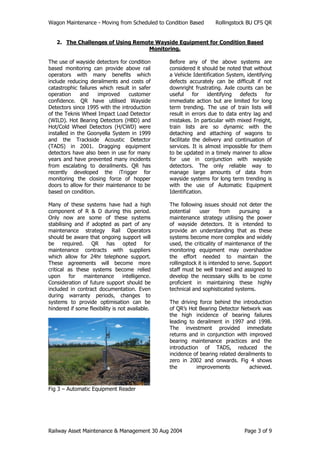
Fig 3 – Automatic Equipment Reader
Before any of the above systems are
considered it should be noted that without
a Vehicle Identification System, identifying
defects accurately can be difficult if not
downright frustrating. Axle counts can be
useful for identifying defects for
immediate action but are limited for long
term trending. The use of train lists will
result in errors due to data entry lag and
mistakes. In particular with mixed Freight,
train lists are so dynamic with the
detaching and attaching of wagons to
facilitate the delivery and continuation of
services. It is almost impossible for them
to be updated in a timely manner to allow
for use in conjunction with wayside
detectors. The only reliable way to
manage large amounts of data from
wayside systems for long term trending is
with the use of Automatic Equipment
Identification.
The following issues should not deter the
potential user from pursuing a
maintenance strategy utilising the power
of wayside detectors. It is intended to
provide an understanding that as these
systems become more complex and widely
used, the criticality of maintenance of the
monitoring equipment may overshadow
the effort needed to maintain the
rollingstock it is intended to serve. Support
staff must be well trained and assigned to
develop the necessary skills to be come
proficient in maintaining these highly
technical and sophisticated systems.
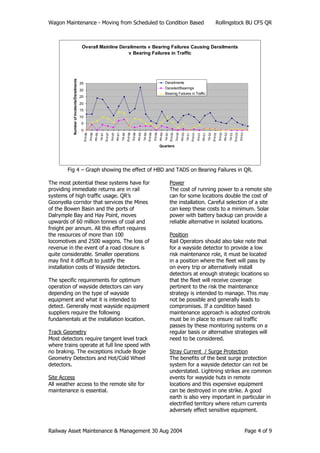
The driving force behind the introduction
of QR’s Hot Bearing Detector Network was
the high incidence of bearing failures
leading to derailment in 1997 and 1998.
The investment provided immediate
returns and in conjunction with improved
bearing maintenance practices and the
introduction of TADS, reduced the
incidence of bearing related derailments to
zero in 2002 and onwards. Fig 4 shows
the improvements achieved.
Wagon Maintenance - Moving from Scheduled to Condition Based Rollingstock BU CFS QR
Railway Asset Maintenance & Management 30 Aug 2004 Page 4 of 9
Overall Mainline Derailments v Bearing Failures Causing Derailments
v Bearing Failures in Traffic
0
5
10
15
20
25
30
352nd-96
3rd-96
4th-96
1st-97
2nd-97
3rd-97
4th-97
1st-98
2nd-98
3rd-98
4th-98
1st-99
2nd-99
3rd-99
4th-99
1st-00
2nd-00
3rd-00
4th-00
1st-01
2nd-01
3rd-01
4th-01
1st-02
2nd-02
3rd-02
4th-02
1st-03
2nd-03
3rd03
Quarters
NumberofIncidents/Derailments
Derailments
Derailed/Bearings
Bearing Failures in Traffic
Fig 4 – Graph showing the effect of HBD and TADS on Bearing Failures in QR.
The most potential these systems have for
providing immediate returns are in rail
systems of high traffic usage. QR’s
Goonyella corridor that services the Mines
of the Bowen Basin and the ports of
Dalrymple Bay and Hay Point, moves
upwards of 60 million tonnes of coal and
freight per annum. All this effort requires
the resources of more than 100
locomotives and 2500 wagons. The loss of
revenue in the event of a road closure is
quite considerable. Smaller operations
may find it difficult to justify the
installation costs of Wayside detectors.
The specific requirements for optimum
operation of wayside detectors can vary
depending on the type of wayside
equipment and what it is intended to
detect. Generally most wayside equipment
suppliers require the following
fundamentals at the installation location.
Track Geometry
Most detectors require tangent level track
where trains operate at full line speed with
no braking. The exceptions include Bogie
Geometry Detectors and Hot/Cold Wheel
detectors.
Site Access
All weather access to the remote site for
maintenance is essential.
Power
The cost of running power to a remote site
can for some locations double the cost of
the installation. Careful selection of a site
can keep these costs to a minimum. Solar
power with battery backup can provide a
reliable alternative in isolated locations.
Position
Rail Operators should also take note that
for a wayside detector to provide a low
risk maintenance role, it must be located
in a position where the fleet will pass by
on every trip or alternatively install
detectors at enough strategic locations so
that the fleet will receive coverage
pertinent to the risk the maintenance
strategy is intended to manage. This may
not be possible and generally leads to
compromises. If a condition based
maintenance approach is adopted controls
must be in place to ensure rail traffic
passes by these monitoring systems on a
regular basis or alternative strategies will
need to be considered.
Stray Current / Surge Protection
The benefits of the best surge protection
system for a wayside detector can not be
understated. Lightning strikes are common
events for wayside huts in remote
locations and this expensive equipment
can be destroyed in one strike. A good
earth is also very important in particular in
electrified territory where return currents
adversely effect sensitive equipment.
Wagon Maintenance - Moving from Scheduled to Condition Based Rollingstock BU CFS QR
Railway Asset Maintenance & Management 30 Aug 2004 Page 5 of 9
Communications
Reliable Communications is another
essential element that is required for an
effective wayside detector system. Equally
important is a reliable bearer and stable
modems.
Security
Network security can provide the system
with the appropriate access to transfer
data to the correct server computers.
Network security can also remove this
access without warning and bring a
system down. Network administrators
seem to have some difficulty dealing with
the data issues with wayside systems.
From non-human log ons to significant
hard disk usage, Network Administration
provides another opportunity for systems
to be adversely effected.
Aside from the predictable challenges,
there are many that prove Murphy was
really an optimist. These are some of the
problems QR has had to resolve.
Changes to Standard Operating Systems
Almost every software change brings with
it a ripple effect that will result in another
anomaly with data collection or system
operation. System changes should be
thoroughly investigated and only installed
if totally necessary and never on a Friday.
This is also the case with new versions of
software.
The Capability of Data Bases
When selecting a database to manage
data, if a Railroad is serious about
condition monitoring, it would be wise to
verify the capabilities of the options
available. Access or other standard off the
shelf databases do not perform in these
circumstances.
Electrified Territory
Some difficulties have been experienced
with the installation of wayside detectors
in electrified territory. Positioning of sites
close to transformers can result in
excessive electrical noise and the need for
shielded cabling. Induced currents can
initiate spurious alarms and require re-
configuration of equipment to minimise
the effect of return currents on wheel
switches etc.
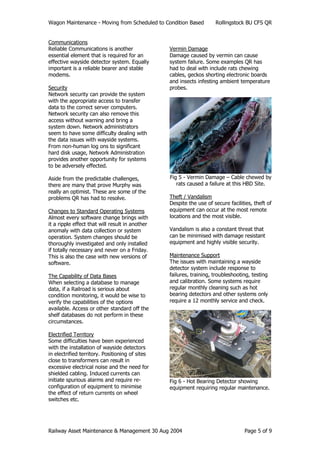
Vermin Damage
Damage caused by vermin can cause
system failure. Some examples QR has
had to deal with include rats chewing
cables, geckos shorting electronic boards
and insects infesting ambient temperature
probes.
Fig 5 - Vermin Damage – Cable chewed by
rats caused a failure at this HBD Site.
Theft / Vandalism
Despite the use of secure facilities, theft of
equipment can occur at the most remote
locations and the most visible.
Vandalism is also a constant threat that
can be minimised with damage resistant
equipment and highly visible security.
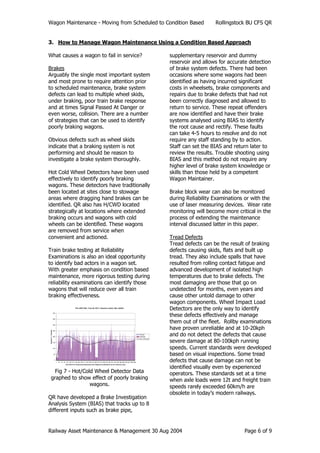
Maintenance Support
The issues with maintaining a wayside
detector system include response to
failures, training, troubleshooting, testing
and calibration. Some systems require
regular monthly cleaning such as hot
bearing detectors and other systems only
require a 12 monthly service and check.
Fig 6 - Hot Bearing Detector showing
equipment requiring regular maintenance.
Wagon Maintenance - Moving from Scheduled to Condition Based Rollingstock BU CFS QR
Railway Asset Maintenance & Management 30 Aug 2004 Page 6 of 9
3. How to Manage Wagon Maintenance Using a Condition Based Approach
What causes a wagon to fail in service?
Brakes
Arguably the single most important system
and most prone to require attention prior
to scheduled maintenance, brake system
defects can lead to multiple wheel skids,
under braking, poor train brake response
and at times Signal Passed At Danger or
even worse, collision. There are a number
of strategies that can be used to identify
poorly braking wagons.
Obvious defects such as wheel skids
indicate that a braking system is not
performing and should be reason to
investigate a brake system thoroughly.
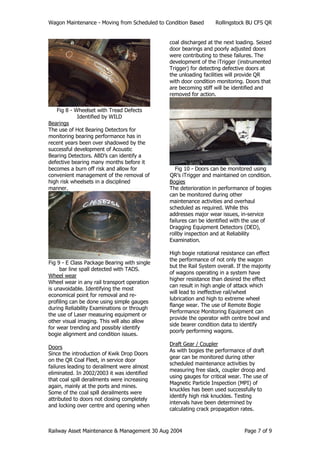
Hot Cold Wheel Detectors have been used
effectively to identify poorly braking
wagons. These detectors have traditionally
been located at sites close to stowage
areas where dragging hand brakes can be
identified. QR also has H/CWD located
strategically at locations where extended
braking occurs and wagons with cold
wheels can be identified. These wagons
are removed from service when
convenient and actioned.
Train brake testing at Reliability
Examinations is also an ideal opportunity
to identify bad actors in a wagon set.
With greater emphasis on condition based
maintenance, more rigorous testing during
reliability examinations can identify those
wagons that will reduce over all train
braking effectiveness.
File:-DE271001, Train ID:-EV11, Direction:-North, Site:-GA033
0
50
100
150
200
250
300
350
400
1 22 43 64 85 106 127 148 169 190 211 232 253 274 295 316 337 358 379 400 421 442 463 484 505 526 547 568 589
Each Block of Tempratures Represents One Wagon/Loco(Numbers are for reference only)
DegreesC>Ambient
WhlLeft
WhlRight
Poly. (WhlLeft)
Fig 7 - Hot/Cold Wheel Detector Data
graphed to show effect of poorly braking
wagons.
QR have developed a Brake Investigation
Analysis System (BIAS) that tracks up to 8
different inputs such as brake pipe,
supplementary reservoir and dummy
reservoir and allows for accurate detection
of brake system defects. There had been
occasions where some wagons had been
identified as having incurred significant
costs in wheelsets, brake components and
repairs due to brake defects that had not
been correctly diagnosed and allowed to
return to service. These repeat offenders
are now identified and have their brake
systems analysed using BIAS to identify
the root cause and rectify. These faults
can take 4-5 hours to resolve and do not
require any staff standing by to action.
Staff can set the BIAS and return later to
review the results. Trouble shooting using
BIAS and this method do not require any
higher level of brake system knowledge or
skills than those held by a competent
Wagon Maintainer.
Brake block wear can also be monitored
during Reliability Examinations or with the
use of laser measuring devices. Wear rate
monitoring will become more critical in the
process of extending the maintenance
interval discussed latter in this paper.
Tread Defects
Tread defects can be the result of braking
defects causing skids, flats and built up
tread. They also include spalls that have
resulted from rolling contact fatigue and
advanced development of isolated high
temperatures due to brake defects. The
most damaging are those that go on
undetected for months, even years and
cause other untold damage to other
wagon components. Wheel Impact Load
Detectors are the only way to identify
these defects effectively and manage
them out of the fleet. Rollby examinations
have proven unreliable and at 10-20kph
and do not detect the defects that cause
severe damage at 80-100kph running
speeds. Current standards were developed
based on visual inspections. Some tread
defects that cause damage can not be
identified visually even by experienced
operators. These standards set at a time
when axle loads were 12t and freight train
speeds rarely exceeded 60km/h are
obsolete in today’s modern railways.
Wagon Maintenance - Moving from Scheduled to Condition Based Rollingstock BU CFS QR
Railway Asset Maintenance & Management 30 Aug 2004 Page 7 of 9
Fig 8 - Wheelset with Tread Defects
Identified by WILD
Bearings
The use of Hot Bearing Detectors for
monitoring bearing performance has in
recent years been over shadowed by the
successful development of Acoustic
Bearing Detectors. ABD’s can identify a
defective bearing many months before it
becomes a burn off risk and allow for
convenient management of the removal of
high risk wheelsets in a disciplined
manner.
Fig 9 - E Class Package Bearing with single
bar line spall detected with TADS.
Wheel wear
Wheel wear in any rail transport operation
is unavoidable. Identifying the most
economical point for removal and re-
profiling can be done using simple gauges
during Reliability Examinations or through
the use of Laser measuring equipment or
other visual imaging. This will also allow
for wear trending and possibly identify
bogie alignment and condition issues.
Doors
Since the introduction of Kwik Drop Doors
on the QR Coal Fleet, in service door
failures leading to derailment were almost
eliminated. In 2002/2003 it was identified
that coal spill derailments were increasing
again, mainly at the ports and mines.
Some of the coal spill derailments were
attributed to doors not closing completely
and locking over centre and opening when
coal discharged at the next loading. Seized
door bearings and poorly adjusted doors
were contributing to these failures. The
development of the iTrigger (instrumented
Trigger) for detecting defective doors at
the unloading facilities will provide QR
with door condition monitoring. Doors that
are becoming stiff will be identified and
removed for action.
Fig 10 - Doors can be monitored using
QR’s iTrigger and maintained on condition.
Bogies
The deterioration in performance of bogies
can be monitored during other
maintenance activities and overhaul
scheduled as required. While this
addresses major wear issues, in-service
failures can be identified with the use of
Dragging Equipment Detectors (DED),
rollby inspection and at Reliability
Examination.
High bogie rotational resistance can effect
the performance of not only the wagon
but the Rail System overall. If the majority
of wagons operating in a system have
higher resistance than desired the effect
can result in high angle of attack which
will lead to ineffective rail/wheel
lubrication and high to extreme wheel
flange wear. The use of Remote Bogie
Performance Monitoring Equipment can
provide the operator with centre bowl and
side bearer condition data to identify
poorly performing wagons.
Draft Gear / Coupler
As with bogies the performance of draft
gear can be monitored during other
scheduled maintenance activities by
measuring free slack, coupler droop and
using gauges for critical wear. The use of
Magnetic Particle Inspection (MPI) of
knuckles has been used successfully to
identify high risk knuckles. Testing
intervals have been determined by
calculating crack propagation rates.
Wagon Maintenance - Moving from Scheduled to Condition Based Rollingstock BU CFS QR
Railway Asset Maintenance & Management 30 Aug 2004 Page 8 of 9
Body
The wagon body can be affected by
corrosion, fatigue cracks and operator
damage. These are all detectable during
other routine maintenance. Photo imaging
may detect structural changes due to
collision with loading equipment.
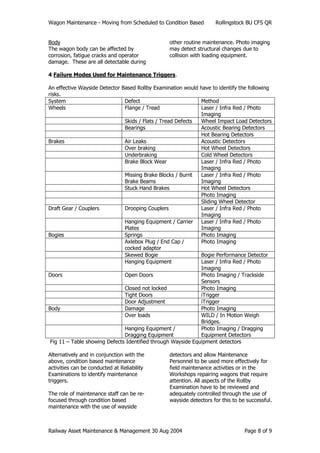
4 Failure Modes Used for Maintenance Triggers.
An effective Wayside Detector Based Rollby Examination would have to identify the following
risks.
System Defect Method
Wheels Flange / Tread Laser / Infra Red / Photo
Imaging
Skids / Flats / Tread Defects Wheel Impact Load Detectors
Bearings Acoustic Bearing Detectors
Hot Bearing Detectors
Brakes Air Leaks Acoustic Detectors
Over braking Hot Wheel Detectors
Underbraking Cold Wheel Detectors
Brake Block Wear Laser / Infra Red / Photo
Imaging
Missing Brake Blocks / Burnt
Brake Beams
Laser / Infra Red / Photo
Imaging
Stuck Hand Brakes Hot Wheel Detectors
Photo Imaging
Sliding Wheel Detector
Draft Gear / Couplers Drooping Couplers Laser / Infra Red / Photo
Imaging
Hanging Equipment / Carrier
Plates
Laser / Infra Red / Photo
Imaging
Bogies Springs Photo Imaging
Axlebox Plug / End Cap /
cocked adaptor
Photo Imaging
Skewed Bogie Bogie Performance Detector
Hanging Equipment Laser / Infra Red / Photo
Imaging
Doors Open Doors Photo Imaging / Trackside
Sensors
Closed not locked Photo Imaging
Tight Doors iTrigger
Door Adjustment iTrigger
Body Damage Photo Imaging
Over loads WILD / In Motion Weigh
Bridges.
Hanging Equipment /
Dragging Equipment
Photo Imaging / Dragging
Equipment Detectors
Fig 11 – Table showing Defects Identified through Wayside Equipment detectors
Alternatively and in conjunction with the
above, condition based maintenance
activities can be conducted at Reliability
Examinations to identify maintenance
triggers.
The role of maintenance staff can be re-
focused through condition based
maintenance with the use of wayside
detectors and allow Maintenance
Personnel to be used more effectively for
field maintenance activities or in the
Workshops repairing wagons that require
attention. All aspects of the Rollby
Examination have to be reviewed and
adequately controlled through the use of
wayside detectors for this to be successful.
Wagon Maintenance - Moving from Scheduled to Condition Based Rollingstock BU CFS QR
Railway Asset Maintenance & Management 30 Aug 2004 Page 9 of 9
5 Stretching the Maintenance Interval
Extending the Reliability Examination (RE)
Period
Managing the risk involved with extending
the maintenance interval is critical in
today’s litigious environment. The events
following the Waterfall tragedy clearly
demonstrate that rail safety must not be
compromised and once having knowledge
of a defect, action must be taken to
control the effect and risk involved. As we
move to extend our maintenance interval
with the support of wayside equipment it
is important to document the process
carefully and evaluate the risk with all
stakeholders at regular intervals
throughout the process.
The critical service factors have to be
identified and controlled. These can
include days between RE, trips, km,
defects and reported incidents. As the
process evolves the critical failure modes
will present themselves and any
maintenance plan must be vigilant to
identify these well in advance of additional
risk being introduced.
QR have recently extended Reliability
Examinations in some systems using a risk
based methodology where all hazards are
identified and strategies initiated to control
these issues. Only after an extensive trial
period where any variations in safety
critical failure modes can be identified are
changes adopted.
Moving from Scheduled to Condition
initiated Maintenance (CIM).
The current scheduled maintenance for QR
Coal Wagons requires every wagon to visit
a Wagon Depot on a set time basis. This
results in many wagons receiving attention
that still have significant service potential
available. Consequently, the majority of
wagons are over serviced leaving fewer
resources to facilitate more economical
field maintenance activities and repairing
problem wagons. This results in early
replacement of wheelsets, brake
equipment and other ancillary components
which are required to provide the
maximum service potential when the
wagons returns to revenue service.
Using CIM requires one of the critical
maintenance elements to reach an alarm
threshold before a wagon is scheduled for
a maintenance activity. This way the
reliability of the wagon will set the
maintenance interval. This must be
balanced during the trial period with a
time based maintenance cap that ensures
the balance of scheduled v unscheduled
does not get out of control. Monitoring key
performance areas of this process will
assist the Maintenance Manager to quickly
identify any area of concern.
Incremental Scheduled / Unscheduled
targets would need to be met prior to
further extensions to ensure the fleet
condition is not compromised. This has the
potential to provide additional wagon
availability and fewer intrusions to
Operations.
The current balance of 25/75 for
unscheduled v scheduled events should
remain the bench mark when extending
the maintenance interval. Upon
implementation wagons should be
returned for service for CIM or at 12
Months. If the maintenance balance is not
compromised or returns to the benchmark
balance following a suitable trial period,
then the upper limit can be extended
again. This process can be repeated until
CIM safely sets the reliability period for the
wagon class and time based maintenance
is eliminated.
Bruce Brymer
Wagon Maintenance Coordinator
Rollingstock Business Unit
Coal and Freight Services Group
QR
PO Box 198
Rockhampton Qld 4700
Floor 2
320 Murray Street
Rockhampton 4700
Phone (07) 49320357 Ph
(07) 49320496 Fax
0417 794 722 Mb

Wagon Maintenance_1

  • 1.
    Railway Asset Maintenanceand Management Wagon Maintenance Moving From Scheduled to Condition Based Maintenance By Bruce Brymer Wagon Maintenance Coordinator Rollingstock Business Unit Coal and Freight Services Group QR Summary QR is on course to increase coal haul tonnages in Queensland over the next three years by more than 20%. With current rail systems approaching saturation point, increases in haulage have to be achieved through improved cycle times and better asset utilisation. QR can rail higher tonnages with existing assets by increasing the maintenance interval through smarter use of wayside detectors and Condition Initiated Maintenance. Current maintenance strategies have to be challenged and by focusing the maintenance effort on wagons that require action, QR can achieve improved wagon availability and reduce overall wagon downtime required for maintenance activities and therefore higher returns on working assets. Background QR is Australia’s only fully integrated railway combining an array of passenger services, general freight, and heavy haul mineral traffics while maintaining control over all aspects of the operations. QR provides these services with over 9,500 km of narrow gauge track situated throughout Queensland. Currently, QR is moving in excess of 160 million tonnes of freight each year, with 140 million tonnes of this freight being coal. Roughly 55 percent of the coal is being moved through the Goonyella Corridor. Soon these tonnages will increase with railings in Queenlsand set to reach 168 million tons and 30 million tons in NSW. The Goonyella System is located in Central Queensland, and services the Central Queensland coal mines in the Mackay hinterland region of the Bowen Basin, with the longest cycle approximately 500 miles (800 km) round trip. Export coal is transported to the ports of Hay Point and Dalrymple Bay where it is unloaded prior to shipment overseas. The Goonyella System is electrified by an autotransformer system with the overhead line equipment operating at 25 KVa, 50 hertz, AC supply. This overhead equipment supplies current to enable the use of electric locomotives throughout the system. Fig 1 – QR’s New VEA Coal Wagon
  • 2.
    Wagon Maintenance -Moving from Scheduled to Condition Based Rollingstock BU CFS QR Railway Asset Maintenance & Management 30 Aug 2004 Page 2 of 9 1. Current Wagon Maintenance Practices Based on RCM Maintenance Activity Current Maintenance Schedule Future Maintenance Based on Condition Rollby Inspection Every Trip Only 1 Side Slow Speed Difficulty in accurately recording defect events Every Trip Both Sides Train Speed Automatic data recording and reporting Reliability Examination Every 2-3 Weeks 2-4 Hours duration Relies on visual inspection Increase interval based on reliability data Reduce Time taken by targeting defects required for action. Accurate defect data Allows for focused maintenance effort and less time spent on wagons that don’t require attention. Scheduled Level 1 Maintenance 8 Months Component change based on Scheduled Tasks. Increase Interval Accurate Defect Information Component Change based on condition. Improved Utilisation of resources. Improved Maintenance Planning Labour Materials Overhaul 8-12 Years General Scope Of Works Fixed Price Scheduled on Condition and Demand Specific Scope for Each Wagon based on accurate defect data. Actual Costs for work completed. Table 1 Ratio of Scheduled to Unscheduled Work Current coal wagon maintenance strategies for the wagon fleet based in the Goonyella System at Jilalan are based on Reliability Centred Maintenance analysis. RCM identified the braking system as the critical system requiring preventative maintenance at 8 monthly intervals. This maintenance philosophy has served QR well and currently the ratio between scheduled and unscheduled maintenance activities is running at 25% Unscheduled to 75% Scheduled. Scheduled v Unsceduled Maintenance Scheduled, 75% Unscheduled 25% Fig 2 - Reliability Centred Maintenance
  • 3.
    Wagon Maintenance -Moving from Scheduled to Condition Based Rollingstock BU CFS QR Railway Asset Maintenance & Management 30 Aug 2004 Page 3 of 9 2. The Challenges of Using Remote Wayside Equipment for Condition Based Monitoring. The use of wayside detectors for condition based monitoring can provide above rail operators with many benefits which include reducing derailments and costs of catastrophic failures which result in safer operation and improved customer confidence. QR have utilised Wayside Detectors since 1995 with the introduction of the Teknis Wheel Impact Load Detector (WILD). Hot Bearing Detectors (HBD) and Hot/Cold Wheel Detectors (H/CWD) were installed in the Goonyella System in 1999 and the Trackside Acoustic Detector (TADS) in 2001. Dragging equipment detectors have also been in use for many years and have prevented many incidents from escalating to derailments. QR has recently developed the iTrigger for monitoring the closing force of hopper doors to allow for their maintenance to be based on condition. Many of these systems have had a high component of R & D during this period. Only now are some of these systems stabilising and if adopted as part of any maintenance strategy Rail Operators should be aware that ongoing support will be required. QR has opted for maintenance contracts with suppliers which allow for 24hr telephone support. These agreements will become more critical as these systems become relied upon for maintenance intelligence. Consideration of future support should be included in contract documentation. Even during warranty periods, changes to systems to provide optimisation can be hindered if some flexibility is not available. Fig 3 – Automatic Equipment Reader Before any of the above systems are considered it should be noted that without a Vehicle Identification System, identifying defects accurately can be difficult if not downright frustrating. Axle counts can be useful for identifying defects for immediate action but are limited for long term trending. The use of train lists will result in errors due to data entry lag and mistakes. In particular with mixed Freight, train lists are so dynamic with the detaching and attaching of wagons to facilitate the delivery and continuation of services. It is almost impossible for them to be updated in a timely manner to allow for use in conjunction with wayside detectors. The only reliable way to manage large amounts of data from wayside systems for long term trending is with the use of Automatic Equipment Identification. The following issues should not deter the potential user from pursuing a maintenance strategy utilising the power of wayside detectors. It is intended to provide an understanding that as these systems become more complex and widely used, the criticality of maintenance of the monitoring equipment may overshadow the effort needed to maintain the rollingstock it is intended to serve. Support staff must be well trained and assigned to develop the necessary skills to be come proficient in maintaining these highly technical and sophisticated systems. The driving force behind the introduction of QR’s Hot Bearing Detector Network was the high incidence of bearing failures leading to derailment in 1997 and 1998. The investment provided immediate returns and in conjunction with improved bearing maintenance practices and the introduction of TADS, reduced the incidence of bearing related derailments to zero in 2002 and onwards. Fig 4 shows the improvements achieved.
  • 4.
    Wagon Maintenance -Moving from Scheduled to Condition Based Rollingstock BU CFS QR Railway Asset Maintenance & Management 30 Aug 2004 Page 4 of 9 Overall Mainline Derailments v Bearing Failures Causing Derailments v Bearing Failures in Traffic 0 5 10 15 20 25 30 352nd-96 3rd-96 4th-96 1st-97 2nd-97 3rd-97 4th-97 1st-98 2nd-98 3rd-98 4th-98 1st-99 2nd-99 3rd-99 4th-99 1st-00 2nd-00 3rd-00 4th-00 1st-01 2nd-01 3rd-01 4th-01 1st-02 2nd-02 3rd-02 4th-02 1st-03 2nd-03 3rd03 Quarters NumberofIncidents/Derailments Derailments Derailed/Bearings Bearing Failures in Traffic Fig 4 – Graph showing the effect of HBD and TADS on Bearing Failures in QR. The most potential these systems have for providing immediate returns are in rail systems of high traffic usage. QR’s Goonyella corridor that services the Mines of the Bowen Basin and the ports of Dalrymple Bay and Hay Point, moves upwards of 60 million tonnes of coal and freight per annum. All this effort requires the resources of more than 100 locomotives and 2500 wagons. The loss of revenue in the event of a road closure is quite considerable. Smaller operations may find it difficult to justify the installation costs of Wayside detectors. The specific requirements for optimum operation of wayside detectors can vary depending on the type of wayside equipment and what it is intended to detect. Generally most wayside equipment suppliers require the following fundamentals at the installation location. Track Geometry Most detectors require tangent level track where trains operate at full line speed with no braking. The exceptions include Bogie Geometry Detectors and Hot/Cold Wheel detectors. Site Access All weather access to the remote site for maintenance is essential. Power The cost of running power to a remote site can for some locations double the cost of the installation. Careful selection of a site can keep these costs to a minimum. Solar power with battery backup can provide a reliable alternative in isolated locations. Position Rail Operators should also take note that for a wayside detector to provide a low risk maintenance role, it must be located in a position where the fleet will pass by on every trip or alternatively install detectors at enough strategic locations so that the fleet will receive coverage pertinent to the risk the maintenance strategy is intended to manage. This may not be possible and generally leads to compromises. If a condition based maintenance approach is adopted controls must be in place to ensure rail traffic passes by these monitoring systems on a regular basis or alternative strategies will need to be considered. Stray Current / Surge Protection The benefits of the best surge protection system for a wayside detector can not be understated. Lightning strikes are common events for wayside huts in remote locations and this expensive equipment can be destroyed in one strike. A good earth is also very important in particular in electrified territory where return currents adversely effect sensitive equipment.
  • 5.
    Wagon Maintenance -Moving from Scheduled to Condition Based Rollingstock BU CFS QR Railway Asset Maintenance & Management 30 Aug 2004 Page 5 of 9 Communications Reliable Communications is another essential element that is required for an effective wayside detector system. Equally important is a reliable bearer and stable modems. Security Network security can provide the system with the appropriate access to transfer data to the correct server computers. Network security can also remove this access without warning and bring a system down. Network administrators seem to have some difficulty dealing with the data issues with wayside systems. From non-human log ons to significant hard disk usage, Network Administration provides another opportunity for systems to be adversely effected. Aside from the predictable challenges, there are many that prove Murphy was really an optimist. These are some of the problems QR has had to resolve. Changes to Standard Operating Systems Almost every software change brings with it a ripple effect that will result in another anomaly with data collection or system operation. System changes should be thoroughly investigated and only installed if totally necessary and never on a Friday. This is also the case with new versions of software. The Capability of Data Bases When selecting a database to manage data, if a Railroad is serious about condition monitoring, it would be wise to verify the capabilities of the options available. Access or other standard off the shelf databases do not perform in these circumstances. Electrified Territory Some difficulties have been experienced with the installation of wayside detectors in electrified territory. Positioning of sites close to transformers can result in excessive electrical noise and the need for shielded cabling. Induced currents can initiate spurious alarms and require re- configuration of equipment to minimise the effect of return currents on wheel switches etc. Vermin Damage Damage caused by vermin can cause system failure. Some examples QR has had to deal with include rats chewing cables, geckos shorting electronic boards and insects infesting ambient temperature probes. Fig 5 - Vermin Damage – Cable chewed by rats caused a failure at this HBD Site. Theft / Vandalism Despite the use of secure facilities, theft of equipment can occur at the most remote locations and the most visible. Vandalism is also a constant threat that can be minimised with damage resistant equipment and highly visible security. Maintenance Support The issues with maintaining a wayside detector system include response to failures, training, troubleshooting, testing and calibration. Some systems require regular monthly cleaning such as hot bearing detectors and other systems only require a 12 monthly service and check. Fig 6 - Hot Bearing Detector showing equipment requiring regular maintenance.
  • 6.
    Wagon Maintenance -Moving from Scheduled to Condition Based Rollingstock BU CFS QR Railway Asset Maintenance & Management 30 Aug 2004 Page 6 of 9 3. How to Manage Wagon Maintenance Using a Condition Based Approach What causes a wagon to fail in service? Brakes Arguably the single most important system and most prone to require attention prior to scheduled maintenance, brake system defects can lead to multiple wheel skids, under braking, poor train brake response and at times Signal Passed At Danger or even worse, collision. There are a number of strategies that can be used to identify poorly braking wagons. Obvious defects such as wheel skids indicate that a braking system is not performing and should be reason to investigate a brake system thoroughly. Hot Cold Wheel Detectors have been used effectively to identify poorly braking wagons. These detectors have traditionally been located at sites close to stowage areas where dragging hand brakes can be identified. QR also has H/CWD located strategically at locations where extended braking occurs and wagons with cold wheels can be identified. These wagons are removed from service when convenient and actioned. Train brake testing at Reliability Examinations is also an ideal opportunity to identify bad actors in a wagon set. With greater emphasis on condition based maintenance, more rigorous testing during reliability examinations can identify those wagons that will reduce over all train braking effectiveness. File:-DE271001, Train ID:-EV11, Direction:-North, Site:-GA033 0 50 100 150 200 250 300 350 400 1 22 43 64 85 106 127 148 169 190 211 232 253 274 295 316 337 358 379 400 421 442 463 484 505 526 547 568 589 Each Block of Tempratures Represents One Wagon/Loco(Numbers are for reference only) DegreesC>Ambient WhlLeft WhlRight Poly. (WhlLeft) Fig 7 - Hot/Cold Wheel Detector Data graphed to show effect of poorly braking wagons. QR have developed a Brake Investigation Analysis System (BIAS) that tracks up to 8 different inputs such as brake pipe, supplementary reservoir and dummy reservoir and allows for accurate detection of brake system defects. There had been occasions where some wagons had been identified as having incurred significant costs in wheelsets, brake components and repairs due to brake defects that had not been correctly diagnosed and allowed to return to service. These repeat offenders are now identified and have their brake systems analysed using BIAS to identify the root cause and rectify. These faults can take 4-5 hours to resolve and do not require any staff standing by to action. Staff can set the BIAS and return later to review the results. Trouble shooting using BIAS and this method do not require any higher level of brake system knowledge or skills than those held by a competent Wagon Maintainer. Brake block wear can also be monitored during Reliability Examinations or with the use of laser measuring devices. Wear rate monitoring will become more critical in the process of extending the maintenance interval discussed latter in this paper. Tread Defects Tread defects can be the result of braking defects causing skids, flats and built up tread. They also include spalls that have resulted from rolling contact fatigue and advanced development of isolated high temperatures due to brake defects. The most damaging are those that go on undetected for months, even years and cause other untold damage to other wagon components. Wheel Impact Load Detectors are the only way to identify these defects effectively and manage them out of the fleet. Rollby examinations have proven unreliable and at 10-20kph and do not detect the defects that cause severe damage at 80-100kph running speeds. Current standards were developed based on visual inspections. Some tread defects that cause damage can not be identified visually even by experienced operators. These standards set at a time when axle loads were 12t and freight train speeds rarely exceeded 60km/h are obsolete in today’s modern railways.
  • 7.
    Wagon Maintenance -Moving from Scheduled to Condition Based Rollingstock BU CFS QR Railway Asset Maintenance & Management 30 Aug 2004 Page 7 of 9 Fig 8 - Wheelset with Tread Defects Identified by WILD Bearings The use of Hot Bearing Detectors for monitoring bearing performance has in recent years been over shadowed by the successful development of Acoustic Bearing Detectors. ABD’s can identify a defective bearing many months before it becomes a burn off risk and allow for convenient management of the removal of high risk wheelsets in a disciplined manner. Fig 9 - E Class Package Bearing with single bar line spall detected with TADS. Wheel wear Wheel wear in any rail transport operation is unavoidable. Identifying the most economical point for removal and re- profiling can be done using simple gauges during Reliability Examinations or through the use of Laser measuring equipment or other visual imaging. This will also allow for wear trending and possibly identify bogie alignment and condition issues. Doors Since the introduction of Kwik Drop Doors on the QR Coal Fleet, in service door failures leading to derailment were almost eliminated. In 2002/2003 it was identified that coal spill derailments were increasing again, mainly at the ports and mines. Some of the coal spill derailments were attributed to doors not closing completely and locking over centre and opening when coal discharged at the next loading. Seized door bearings and poorly adjusted doors were contributing to these failures. The development of the iTrigger (instrumented Trigger) for detecting defective doors at the unloading facilities will provide QR with door condition monitoring. Doors that are becoming stiff will be identified and removed for action. Fig 10 - Doors can be monitored using QR’s iTrigger and maintained on condition. Bogies The deterioration in performance of bogies can be monitored during other maintenance activities and overhaul scheduled as required. While this addresses major wear issues, in-service failures can be identified with the use of Dragging Equipment Detectors (DED), rollby inspection and at Reliability Examination. High bogie rotational resistance can effect the performance of not only the wagon but the Rail System overall. If the majority of wagons operating in a system have higher resistance than desired the effect can result in high angle of attack which will lead to ineffective rail/wheel lubrication and high to extreme wheel flange wear. The use of Remote Bogie Performance Monitoring Equipment can provide the operator with centre bowl and side bearer condition data to identify poorly performing wagons. Draft Gear / Coupler As with bogies the performance of draft gear can be monitored during other scheduled maintenance activities by measuring free slack, coupler droop and using gauges for critical wear. The use of Magnetic Particle Inspection (MPI) of knuckles has been used successfully to identify high risk knuckles. Testing intervals have been determined by calculating crack propagation rates.
  • 8.
    Wagon Maintenance -Moving from Scheduled to Condition Based Rollingstock BU CFS QR Railway Asset Maintenance & Management 30 Aug 2004 Page 8 of 9 Body The wagon body can be affected by corrosion, fatigue cracks and operator damage. These are all detectable during other routine maintenance. Photo imaging may detect structural changes due to collision with loading equipment. 4 Failure Modes Used for Maintenance Triggers. An effective Wayside Detector Based Rollby Examination would have to identify the following risks. System Defect Method Wheels Flange / Tread Laser / Infra Red / Photo Imaging Skids / Flats / Tread Defects Wheel Impact Load Detectors Bearings Acoustic Bearing Detectors Hot Bearing Detectors Brakes Air Leaks Acoustic Detectors Over braking Hot Wheel Detectors Underbraking Cold Wheel Detectors Brake Block Wear Laser / Infra Red / Photo Imaging Missing Brake Blocks / Burnt Brake Beams Laser / Infra Red / Photo Imaging Stuck Hand Brakes Hot Wheel Detectors Photo Imaging Sliding Wheel Detector Draft Gear / Couplers Drooping Couplers Laser / Infra Red / Photo Imaging Hanging Equipment / Carrier Plates Laser / Infra Red / Photo Imaging Bogies Springs Photo Imaging Axlebox Plug / End Cap / cocked adaptor Photo Imaging Skewed Bogie Bogie Performance Detector Hanging Equipment Laser / Infra Red / Photo Imaging Doors Open Doors Photo Imaging / Trackside Sensors Closed not locked Photo Imaging Tight Doors iTrigger Door Adjustment iTrigger Body Damage Photo Imaging Over loads WILD / In Motion Weigh Bridges. Hanging Equipment / Dragging Equipment Photo Imaging / Dragging Equipment Detectors Fig 11 – Table showing Defects Identified through Wayside Equipment detectors Alternatively and in conjunction with the above, condition based maintenance activities can be conducted at Reliability Examinations to identify maintenance triggers. The role of maintenance staff can be re- focused through condition based maintenance with the use of wayside detectors and allow Maintenance Personnel to be used more effectively for field maintenance activities or in the Workshops repairing wagons that require attention. All aspects of the Rollby Examination have to be reviewed and adequately controlled through the use of wayside detectors for this to be successful.
  • 9.
    Wagon Maintenance -Moving from Scheduled to Condition Based Rollingstock BU CFS QR Railway Asset Maintenance & Management 30 Aug 2004 Page 9 of 9 5 Stretching the Maintenance Interval Extending the Reliability Examination (RE) Period Managing the risk involved with extending the maintenance interval is critical in today’s litigious environment. The events following the Waterfall tragedy clearly demonstrate that rail safety must not be compromised and once having knowledge of a defect, action must be taken to control the effect and risk involved. As we move to extend our maintenance interval with the support of wayside equipment it is important to document the process carefully and evaluate the risk with all stakeholders at regular intervals throughout the process. The critical service factors have to be identified and controlled. These can include days between RE, trips, km, defects and reported incidents. As the process evolves the critical failure modes will present themselves and any maintenance plan must be vigilant to identify these well in advance of additional risk being introduced. QR have recently extended Reliability Examinations in some systems using a risk based methodology where all hazards are identified and strategies initiated to control these issues. Only after an extensive trial period where any variations in safety critical failure modes can be identified are changes adopted. Moving from Scheduled to Condition initiated Maintenance (CIM). The current scheduled maintenance for QR Coal Wagons requires every wagon to visit a Wagon Depot on a set time basis. This results in many wagons receiving attention that still have significant service potential available. Consequently, the majority of wagons are over serviced leaving fewer resources to facilitate more economical field maintenance activities and repairing problem wagons. This results in early replacement of wheelsets, brake equipment and other ancillary components which are required to provide the maximum service potential when the wagons returns to revenue service. Using CIM requires one of the critical maintenance elements to reach an alarm threshold before a wagon is scheduled for a maintenance activity. This way the reliability of the wagon will set the maintenance interval. This must be balanced during the trial period with a time based maintenance cap that ensures the balance of scheduled v unscheduled does not get out of control. Monitoring key performance areas of this process will assist the Maintenance Manager to quickly identify any area of concern. Incremental Scheduled / Unscheduled targets would need to be met prior to further extensions to ensure the fleet condition is not compromised. This has the potential to provide additional wagon availability and fewer intrusions to Operations. The current balance of 25/75 for unscheduled v scheduled events should remain the bench mark when extending the maintenance interval. Upon implementation wagons should be returned for service for CIM or at 12 Months. If the maintenance balance is not compromised or returns to the benchmark balance following a suitable trial period, then the upper limit can be extended again. This process can be repeated until CIM safely sets the reliability period for the wagon class and time based maintenance is eliminated. Bruce Brymer Wagon Maintenance Coordinator Rollingstock Business Unit Coal and Freight Services Group QR PO Box 198 Rockhampton Qld 4700 Floor 2 320 Murray Street Rockhampton 4700 Phone (07) 49320357 Ph (07) 49320496 Fax 0417 794 722 Mb