All Hands on Deck: Social
Justice, Empathy in the Age of
Information Literacy
Ilana Stonebraker
Purdue University
@librarianilana
#waal2018
Extra credit: Think of an ideal information literate
person. Write down some attributes of that person.
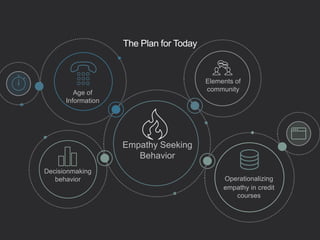
Empathy Seeking
Behavior
Operationalizing
empathy in credit
courses
Decisionmaking
behavior
Elements of
community
Age of
Information
The Plan for Today
We have lived in the age of information.
But people don’t seem to be any better at
understanding that information. What is going
wrong?
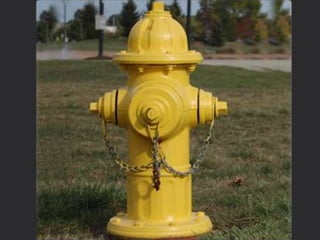
More information is not better when it comes to
making decisions.
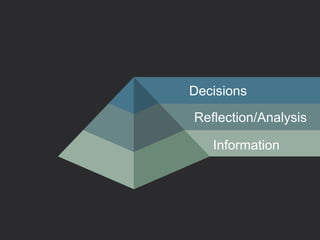
Reflection/Analysis
Information
Decisions
At the same time, things are changing in our
communities as well
Human beings want
and need connection,
and the internet is the
ultimate connection
machine.
DANIEL WEITZNER
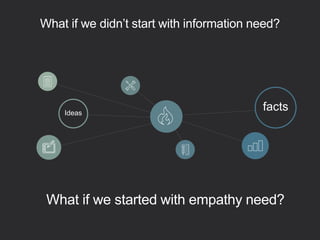
What if we didn’t start with information need?
Ideas
facts
What if we started with empathy need?
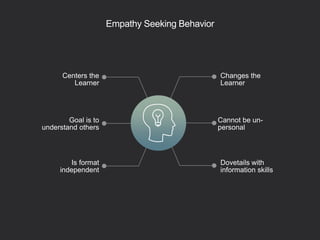
Centers the
Learner
Goal is to
understand others
Is format
independent
Changes the
Learner
Cannot be un-
personal
Dovetails with
information skills
Empathy Seeking Behavior
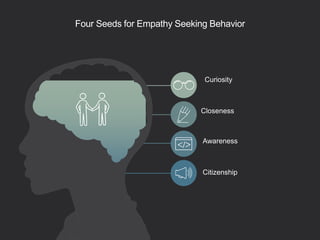
Four Seeds for Empathy Seeking Behavior
Curiosity
Closeness
Awareness
Citizenship
Empathy Behavior 1: Curiosity
Curiosity
• Rekindling the Human Connection with Digital Holiday Cards-
Thursday 3:30
• Social Media and Persistent Question Asking- Thursday 3:30
• The Alternative Truth Project and Banned Books: La Crosse
Librarians Unite to Tell the Forgotten Story of a Librarian Hero-
Thursday 10:45
Empathy Seeking Behavior 2: Closeness
Why was business information always
about increasing the success of the
individual and not the community?
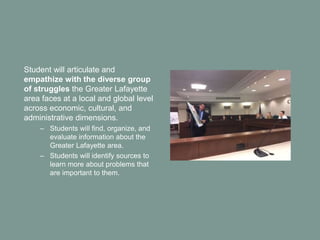
Student will articulate and
empathize with the diverse group
of struggles the Greater Lafayette
area faces at a local and global level
across economic, cultural, and
administrative dimensions.
– Students will find, organize, and
evaluate information about the
Greater Lafayette area.
– Students will identify sources to
learn more about problems that
are important to them.
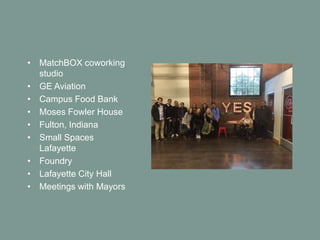
• MatchBOX coworking
studio
• GE Aviation
• Campus Food Bank
• Moses Fowler House
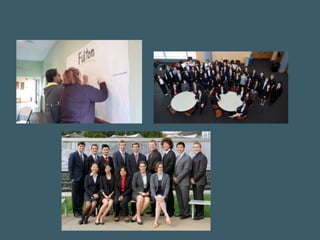
• Fulton, Indiana
• Small Spaces
Lafayette
• Foundry
• Lafayette City Hall
• Meetings with Mayors
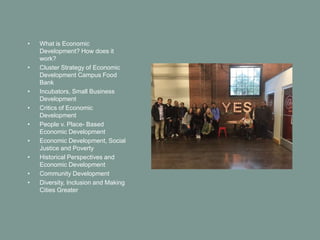
• What is Economic
Development? How does it
work?
• Cluster Strategy of Economic
Development Campus Food
Bank
• Incubators, Small Business
Development
• Critics of Economic
Development
• People v. Place- Based
Economic Development
• Economic Development, Social
Justice and Poverty
• Historical Perspectives and
Economic Development
• Community Development
• Diversity, Inclusion and Making
Cities Greater
Closeness
• LGBTQ+ Archives in Wisconsin- Thursday 10:45
• Advocacy, Outreach, Assessment: Launching the Library
Ambassador Program at UW- Madison- Thursday 3:30
• You’ve Got Real Mail! A Creative Global Experiment on the Value of
Libraries- Thursday 3:30
Empathy Seeking Behavior 3: Awareness
What do I know? What do I want to know?
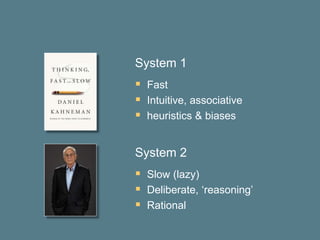
System 1
 Fast
 Intuitive, associative
 heuristics & biases
System 2
 Slow (lazy)
 Deliberate, ‘reasoning’
 Rational
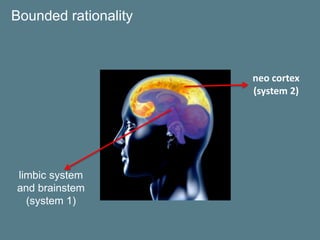
Bounded rationality
limbic system
and brainstem
(system 1)
neo cortex
(system 2)
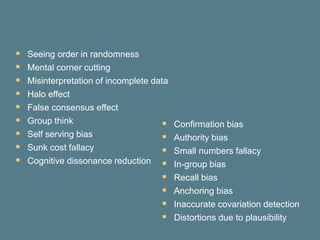
 Seeing order in randomness
 Mental corner cutting
 Misinterpretation of incomplete data
 Halo effect
 False consensus effect
 Group think
 Self serving bias
 Sunk cost fallacy
 Cognitive dissonance reduction
 Confirmation bias
 Authority bias
 Small numbers fallacy
 In-group bias
 Recall bias
 Anchoring bias
 Inaccurate covariation detection
 Distortions due to plausibility
Why do I even care? Why don’t I even care?
“We have used our research to
determine our decisions. We have
thought more dynamically and
creatively and used our facts gathered
from research to make better and
more thoughtful decisions.”
Awareness
• Fake news and Government Information: Using the ACRL
Framework to Grapple with Credibility- Thursday 10:45
• Structures of Whiteness: Colonialism and Diversity in Academic
Libraries- Friday 9am
• Finding and Evaluating Online Sources in an Evolving Digital
World- Thursday 3:30
Empathy Seeking Behavior 4: Citizenship
If the goal is to make
students more
responsible, they need to
understand first that their
decisions hold power, and
that information holds
power over them.
And if we want the
students to understand
that their decisions have
power, we must also give
power to them.
Citizenship
• Integrating social justice in policy, practice, and culture: A
panel discussion- Thursday 2:30
• From Peer to Professional– An Evolution of Teaching
Information Literacy Instruction- Friday 2:15
• TEDx and Eliminating Library Fines: An Idea Worth
Spreading- Friday 2:15
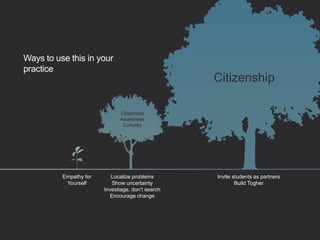
Ways to use this in your
practice
Citizenship
Closeness
Awareness
Curiosity
Empathy for
Yourself
Localize problems
Show uncertainty
Investiage, don’t search
Encourage change
Invite students as partners
Build Togher
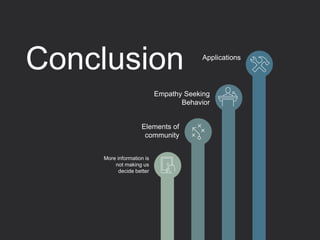
Conclusion Applications
Empathy Seeking
Behavior
Elements of
community
More information is
not making us
decide better
X
Knowledge emerges only
through invention and re-
invention, through the
restless, impatient,
continuing, hopeful
inquiry human beings
pursue in the world, with
the world, and with each
other.
-Pablo Freire
Thank you!
Ilana Stonebraker- Purdue
University
stonebraker@purdue.edu
@librarianilana
www.ilanastonebraker.com
Blog- Teaching on
Purpose
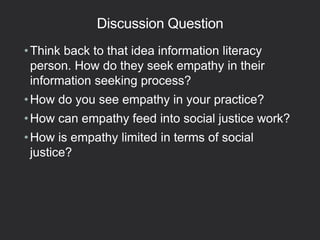
Discussion Question
•Think back to that idea information literacy
person. How do they seek empathy in their
information seeking process?
•How do you see empathy in your practice?
•How can empathy feed into social justice work?
•How is empathy limited in terms of social
justice?
Works Cited
• Anderson, Janna, and Lee Rainie. “The Future of Well-Being in a Tech-Saturated World.” Pew Research Center:
Internet, Science & Tech, 17 Apr. 2018, www.pewinternet.org/2018/04/17/the-future-of-well-being-in-a-tech-saturated-
world/# .
• Bruner, Jerome S., and Mary C. Potter. "Interference in visual recognition." Science 144.3617 (1964): 424-425.
• Freire, Paulo. Pedagogy of the oppressed. Bloomsbury Publishing USA, 2018.
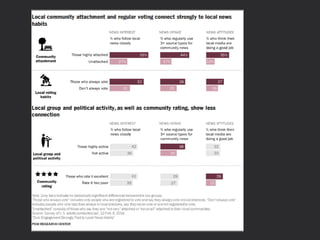
• Greenwood, Shannon. “Local Community Attachment and Regular Voting Connect Strongly to Local News Habits,
While Local Group and Political Activity, as Well as Community Rating, Show Less Connection.” Pew Research
Center's Journalism Project, 31 Oct. 2016, www.journalism.org/2016/11/03/civic-engagement-strongly-tied-to-local-
news-habits/pj_2016-11-02_civic-engagement_0-01/ .
• Kahneman, Daniel. Thinking, fast and slow. Macmillan, 2011.
• Oskamp, S. (1965). “Overconfidence in case-study judgments”. Journal of Consulting Psychology. US: American
Psychological Association. doi:10.1037/h0022125
• Taleb, Nassim Nicholas. The black swan: The impact of the highly improbable. Vol. 2. Random house, 2007.
• Fake news is dominating Facebook. (2016, November 23). Retrieved May 17, 2017, from http://6abc.com/news/fake-
news-is-dominating-facebook/1621221/
• How Americans Navigate the Modern Information Environment. (2016). Retrieved May 17, 2017, from
http://www.norc.org/PDFs/75th%20Anniversary%20Research%20Project.pdf

Waal 2018: All Hands on Deck: Social Justice, Empathy in the Age of Information Literacy

  • 1.
    All Hands onDeck: Social Justice, Empathy in the Age of Information Literacy Ilana Stonebraker Purdue University @librarianilana #waal2018 Extra credit: Think of an ideal information literate person. Write down some attributes of that person.
  • 4.
    Empathy Seeking Behavior Operationalizing empathy incredit courses Decisionmaking behavior Elements of community Age of Information The Plan for Today
  • 10.
    We have livedin the age of information.
  • 11.
    But people don’tseem to be any better at understanding that information. What is going wrong?
  • 15.
    More information isnot better when it comes to making decisions.
  • 16.
  • 17.
    At the sametime, things are changing in our communities as well
  • 18.
    Human beings want andneed connection, and the internet is the ultimate connection machine. DANIEL WEITZNER
  • 21.
    What if wedidn’t start with information need? Ideas facts What if we started with empathy need?
  • 22.
    Centers the Learner Goal isto understand others Is format independent Changes the Learner Cannot be un- personal Dovetails with information skills Empathy Seeking Behavior
  • 23.
    Four Seeds forEmpathy Seeking Behavior Curiosity Closeness Awareness Citizenship
  • 24.
  • 27.
    Curiosity • Rekindling theHuman Connection with Digital Holiday Cards- Thursday 3:30 • Social Media and Persistent Question Asking- Thursday 3:30 • The Alternative Truth Project and Banned Books: La Crosse Librarians Unite to Tell the Forgotten Story of a Librarian Hero- Thursday 10:45
  • 28.
  • 29.
    Why was businessinformation always about increasing the success of the individual and not the community?
  • 30.
    Student will articulateand empathize with the diverse group of struggles the Greater Lafayette area faces at a local and global level across economic, cultural, and administrative dimensions. – Students will find, organize, and evaluate information about the Greater Lafayette area. – Students will identify sources to learn more about problems that are important to them.
  • 31.
    • MatchBOX coworking studio •GE Aviation • Campus Food Bank • Moses Fowler House • Fulton, Indiana • Small Spaces Lafayette • Foundry • Lafayette City Hall • Meetings with Mayors
  • 32.
    • What isEconomic Development? How does it work? • Cluster Strategy of Economic Development Campus Food Bank • Incubators, Small Business Development • Critics of Economic Development • People v. Place- Based Economic Development • Economic Development, Social Justice and Poverty • Historical Perspectives and Economic Development • Community Development • Diversity, Inclusion and Making Cities Greater
  • 33.
    Closeness • LGBTQ+ Archivesin Wisconsin- Thursday 10:45 • Advocacy, Outreach, Assessment: Launching the Library Ambassador Program at UW- Madison- Thursday 3:30 • You’ve Got Real Mail! A Creative Global Experiment on the Value of Libraries- Thursday 3:30
  • 34.
  • 35.
    What do Iknow? What do I want to know?
  • 36.
    System 1  Fast Intuitive, associative  heuristics & biases System 2  Slow (lazy)  Deliberate, ‘reasoning’  Rational
  • 37.
    Bounded rationality limbic system andbrainstem (system 1) neo cortex (system 2)
  • 38.
     Seeing orderin randomness  Mental corner cutting  Misinterpretation of incomplete data  Halo effect  False consensus effect  Group think  Self serving bias  Sunk cost fallacy  Cognitive dissonance reduction  Confirmation bias  Authority bias  Small numbers fallacy  In-group bias  Recall bias  Anchoring bias  Inaccurate covariation detection  Distortions due to plausibility
  • 39.
    Why do Ieven care? Why don’t I even care?
  • 40.
    “We have usedour research to determine our decisions. We have thought more dynamically and creatively and used our facts gathered from research to make better and more thoughtful decisions.”
  • 41.
    Awareness • Fake newsand Government Information: Using the ACRL Framework to Grapple with Credibility- Thursday 10:45 • Structures of Whiteness: Colonialism and Diversity in Academic Libraries- Friday 9am • Finding and Evaluating Online Sources in an Evolving Digital World- Thursday 3:30
  • 42.
  • 43.
    If the goalis to make students more responsible, they need to understand first that their decisions hold power, and that information holds power over them.
  • 44.
    And if wewant the students to understand that their decisions have power, we must also give power to them.
  • 47.
    Citizenship • Integrating socialjustice in policy, practice, and culture: A panel discussion- Thursday 2:30 • From Peer to Professional– An Evolution of Teaching Information Literacy Instruction- Friday 2:15 • TEDx and Eliminating Library Fines: An Idea Worth Spreading- Friday 2:15
  • 48.
    Ways to usethis in your practice Citizenship Closeness Awareness Curiosity Empathy for Yourself Localize problems Show uncertainty Investiage, don’t search Encourage change Invite students as partners Build Togher
  • 51.
    Conclusion Applications Empathy Seeking Behavior Elementsof community More information is not making us decide better
  • 52.
    X Knowledge emerges only throughinvention and re- invention, through the restless, impatient, continuing, hopeful inquiry human beings pursue in the world, with the world, and with each other. -Pablo Freire
  • 53.
    Thank you! Ilana Stonebraker-Purdue University stonebraker@purdue.edu @librarianilana www.ilanastonebraker.com Blog- Teaching on Purpose
  • 54.
    Discussion Question •Think backto that idea information literacy person. How do they seek empathy in their information seeking process? •How do you see empathy in your practice? •How can empathy feed into social justice work? •How is empathy limited in terms of social justice?
  • 55.
    Works Cited • Anderson,Janna, and Lee Rainie. “The Future of Well-Being in a Tech-Saturated World.” Pew Research Center: Internet, Science & Tech, 17 Apr. 2018, www.pewinternet.org/2018/04/17/the-future-of-well-being-in-a-tech-saturated- world/# . • Bruner, Jerome S., and Mary C. Potter. "Interference in visual recognition." Science 144.3617 (1964): 424-425. • Freire, Paulo. Pedagogy of the oppressed. Bloomsbury Publishing USA, 2018. • Greenwood, Shannon. “Local Community Attachment and Regular Voting Connect Strongly to Local News Habits, While Local Group and Political Activity, as Well as Community Rating, Show Less Connection.” Pew Research Center's Journalism Project, 31 Oct. 2016, www.journalism.org/2016/11/03/civic-engagement-strongly-tied-to-local- news-habits/pj_2016-11-02_civic-engagement_0-01/ . • Kahneman, Daniel. Thinking, fast and slow. Macmillan, 2011. • Oskamp, S. (1965). “Overconfidence in case-study judgments”. Journal of Consulting Psychology. US: American Psychological Association. doi:10.1037/h0022125 • Taleb, Nassim Nicholas. The black swan: The impact of the highly improbable. Vol. 2. Random house, 2007. • Fake news is dominating Facebook. (2016, November 23). Retrieved May 17, 2017, from http://6abc.com/news/fake- news-is-dominating-facebook/1621221/ • How Americans Navigate the Modern Information Environment. (2016). Retrieved May 17, 2017, from http://www.norc.org/PDFs/75th%20Anniversary%20Research%20Project.pdf

Editor's Notes

  • #13  Bruner, Jerome S., and Mary C. Potter. "Interference in visual recognition." Science 144.3617 (1964): 424-425. In 1963, Oskamp studied clinical psychologist diagnostic capabilities. In the study, psychologists were supplied with excessive files, each containing an increasing amount of information about the patients. The study observed that “(a) their confidence about the case increases markedly and steadily but (b) the accuracy of their conclusions about the case quickly reaches a ceiling” (Oskamp, 1965, p. 261).
  • #14 In 1963, Oskamp studied clinical psychologist diagnostic capabilities. In the study, psychologists were supplied with excessive files, each containing an increasing amount of information about the patients. The study observed that “(a) their confidence about the case increases markedly and steadily but (b) the accuracy of their conclusions about the case quickly reaches a ceiling” (Oskamp, 1965, p. 261).
  • #15 Bruner, Jerome S., and Mary C. Potter. "Interference in visual recognition." Science 144.3617 (1964): 424-425. In 1963, Oskamp studied clinical psychologist diagnostic capabilities. In the study, psychologists were supplied with excessive files, each containing an increasing amount of information about the patients. The study observed that “(a) their confidence about the case increases markedly and steadily but (b) the accuracy of their conclusions about the case quickly reaches a ceiling” (Oskamp, 1965, p. 261).
  • #16 In 1963, Oskamp studied clinical psychologist diagnostic capabilities. In the study, psychologists were supplied with excessive files, each containing an increasing amount of information about the patients. The study observed that “(a) their confidence about the case increases markedly and steadily but (b) the accuracy of their conclusions about the case quickly reaches a ceiling” (Oskamp, 1965, p. 261).
  • #18 A Pew Research poll conducted in December 2016 found that 64% of U.S. adults believed completely made-up news had caused "a great deal of confusion" about the basic facts of current events, while 24% claimed it had caused "some confusion" and 11% said it had caused "not much or no confusion" (Pew Research).  At the same time, about 6 in 10 report being better informed than they were five years ago (NORC, 2016),
  • #25 The Alternative Truth Project and Banned Books: La Crosse Librarians Unite to Tell the Forgotten Story of a Librarian Hero
  • #28 The Alternative Truth Project and Banned Books: La Crosse Librarians Unite to Tell the Forgotten Story of a Librarian Hero
  • #29 LGBTQ+ Archives in Wisconsin
  • #30 LGBTQ+ Archives in Wisconsin
  • #34 The Alternative Truth Project and Banned Books: La Crosse Librarians Unite to Tell the Forgotten Story of a Librarian Hero
  • #35 Student Success 1:1
  • #43 Integrating social justice in policy, practice, and culture: A panel discussion
  • #48 The Alternative Truth Project and Banned Books: La Crosse Librarians Unite to Tell the Forgotten Story of a Librarian Hero