

Ethics in Publishing Conference
George Washington University
Washington, DC
Ethics and the Publishing
Start-up
June 15, 2015
John W. Warren
In any start-up, there are many questions
• What is your organization’s vision/mission?
• What are the foundations of the business in terms of
leadership/partners/funders?
• How important is the pursuit of profit vs. social
good?
• What opportunities are there for growth and
innovation?
• What contribution(s) do you want to make to the
world?
• What is the ideal composition and characteristics of
your staff?
• What kind of leader are you/do you want to
Particular questions are relevant to a
publishing start-up
• What is the role and makeup of the advisory or
editorial board?
• Open access versus commercial sales?
• What kind of books do you want to publish?
• What kind of books do you not want to publish?
• What other products?
• For all these questions, what weight should you give
to personal relationships/preferences?
• How much weight to the preferences of others?
• How much purely objective aspects?
In business, money is either
very important, or it is
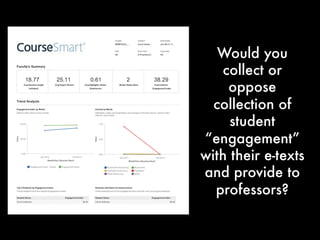
everything
What is very important in
scholarly publishing?
Start by asking, what is important
to your stakeholders and
audience
Flickr user: The Open University
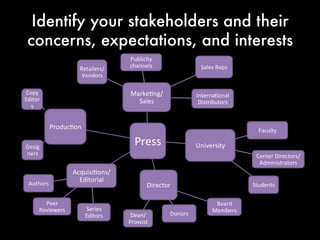
Identify your stakeholders and their
concerns, expectations, and interests
Press
Marketing/Sal
es
Sales Reps
International
Distributors
Retailers/
Vendors
Publicity
channels
University
Faculty
Center
Directors/Adminis
trators
StudentsDirector
Board
Members
DonorsDean/Pro
vost
Acquisitions/E
ditorialAuthors
Series
Editors
Peer
Reviewers
Production
Copy
Editor
s
Desig
ners
Stakeholders include management, key
peers, allies, customers & suppliers
LEVEL OF INTEREST
Low High
POWER
High
Keep Satisfied
(Medium effort)
Manage Closely
(Maximum Effort)
Low
Monitor
(Minimum Effort)
Keep informed
(Medium effort)
Power/Interest Grid for Stakeholder Prioritization
Possible strategic priorities of a
university press
• Contribute to overall mission/strengths of the
University
• Reinforce reputation of press in order to attract
highly respected scholars and subject experts
• Increase sales revenue
• Impact research, pedagogy, and/or public debate
• Collaborate with University departments/centers
• Increase digital dissemination, innovation
• Contribution to the bottom line, increase surplus
• Engage with communities in core academic and
professional fields
What can ethics teach us about
business, profit, and start-ups?
• Philosophical / normative ethics: moral
philosophy, guides individuals and organizations
on how they should behave, ‘what ought to be,’
matter of individual choice, deontology
• Empirical / descriptive ethics: management
and business, explains and predicts individuals
actual behavior, predictive, ‘what is,’ influence on
behavior is both internal and external, corporate
social responsibility
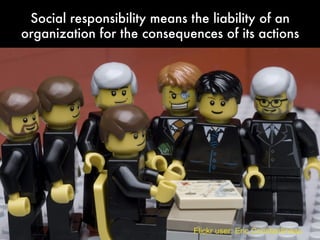
Social responsibility means the liability of an
organization for the consequences of its actions
Flickr user: Eric Constantineau
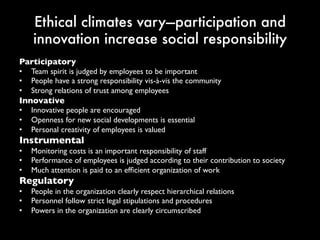
Ethical climates vary—participation and
innovation increase social responsibility
Participatory
• Team spirit is judged by employees to be important
• People have a strong responsibility vis-à-vis the community
• Strong relations of trust among employees
Innovative
• Innovative people are encouraged
• Openness for new social developments is essential
• Personal creativity of employees is valued
Instrumental
• Monitoring costs is an important responsibility of staff
• Performance of employees is judged according to their contribution to
society
• Much attention is paid to an efficient organization of work
Regulatory
• People in the organization clearly respect hierarchical relations
• Personnel follow strict legal stipulations and procedures
• Powers in the organization are clearly circumscribed
Don’t be afraid of your dark side—embracing
the whole self (“Teddy effect”) has benefits to
organizations and society
Flickr user: Jasperdo
Deviance
can be a
problem but
there is also
a positive
side of
standing
above the
crowd
Flickr user: Paulo Brandao
“Is it not possible that an individual may
be right and a government wrong? Are
laws to be enforced simply because
they were made? or declared by any
number of men to be good, if they are
not good? Is there any necessity for a
man's being a tool to perform a deed of
which his better nature disapproves?”
— Henry David Thoreau, “ A Plea for
Captain John Brown”
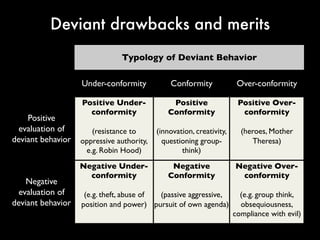
Deviant drawbacks and merits
Typology of Deviant Behavior
Under-conformity Conformity Over-conformity
Positive
evaluation of
deviant behavior
Positive Under-
conformity
(resistance to
oppressive authority,
e.g. Robin Hood)
Positive
Conformity
(innovation,
creativity,
questioning group-
think)
Positive Over-
conformity
(heroes, Mother
Theresa)
Negative
evaluation of
deviant behavior
Negative Under-
conformity
(e.g. theft, abuse of
position and power)
Negative
Conformity
(passive aggressive,
pursuit of own
agenda)
Negative Over-
conformity
(e.g. group think,
obsequiousness,
compliance with
evil)
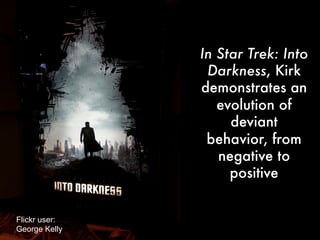
In Star Trek: Into
Darkness, Kirk
demonstrates an
evolution of
deviant behavior,
from negative to
positive
Flickr user:
George Kelly
Stories connect to readers and can impart
ethics and purposeful direction to organizations
Flickr user: Jeremy
Hall
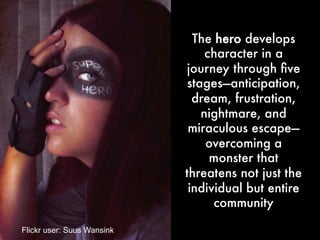
The hero develops
character in a
journey through five
stages—anticipation,
dream, frustration,
nightmare, and
miraculous escape—
overcoming a
monster that
threatens not just the
individual but entire
community
Flickr user: Suus Wansink
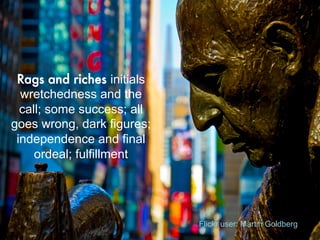
Rags and riches initials
wretchedness and the
call; some success; all
goes wrong, dark figures;
independence and final
ordeal; fulfillment
Flickr user: Martin Goldberg
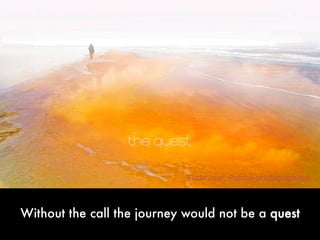
Without the call the journey would not be a quest
Flickr user: Patrice-photographiste
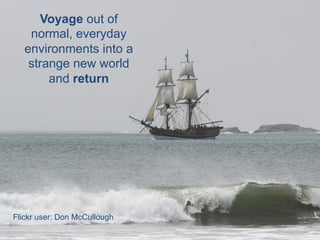
Voyage out of
normal, everyday
environments into a
strange new world
and return
Flickr user: Don McCullough
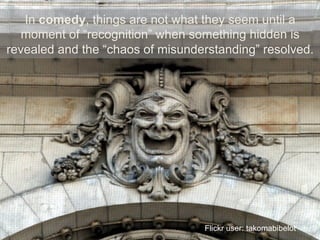
In comedy, things are not what they seem until a
moment of “recognition” when something hidden is
revealed and the “chaos of misunderstanding” resolved.
Flickr user: takomabibelot
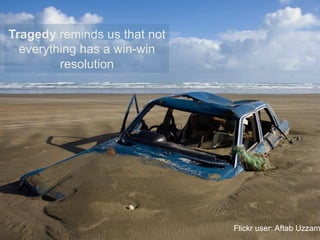
Tragedy reminds us that not
everything has a win-win
resolution
Flickr user: Aftab Uzzam
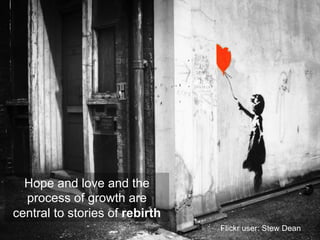
Hope and love and the
process of growth are
central to stories of rebirth
Flickr user: Stew Dean
“Mr. Miller demonstrates that great action
filmmaking is not only a matter of physics
but of ethics as well. There is cause and
effect; there are choices and
consequences.”
A.O. Scott, Review of Mad Max: Fury Road, in The New
York Times, May 15, 2015
The quest is to challenge what it means
to be a scholarly publisher
• Challenge the status quo and conventional wisdom;
generate new ideas, new ways of doing things
• Focus on partnerships—on and off campus—that
add mutual value
• Think of digital possibilities from project genesis—
not as an afterthought
• Integrate social media throughout the press to
engage core audience(s)
• Make workflow more efficient
• Pursue analytics, such as aggregate, anonymous
performance data, to improve texts
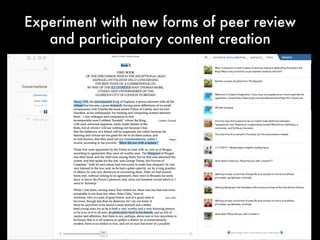
Experiment with new forms of peer review
and participatory content creation
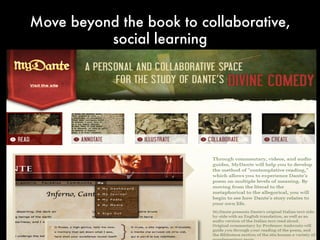
Move beyond the book to collaborative,
social learning
Create the right environment
• Foster a culture of meaning and learning
• Ensure that everyone’s voice is heard and
everyone makes a contribution
• Instill a culture of high expectations—for people
and content
• Experiment with intent and don’t be afraid to
make mistakes
• Be environmentally sensitive
• Intuition plus analysis: don’t overanalyze or put
too much faith into analysis alone
• "Do what you love. Know your own bone;
gnaw at it, bury it, unearth it, and gnaw it still.
Do not be too moral. You may cheat yourself
out of much life so. Aim above morality. Be not
simply good—be good for something."
— Henry David Thoreau, Letters to a Spiritual
Seeker
Three Quick Questions
Would you publish The Al-Qaeda Reader?
• Doubleday’s Al-Qaeda Reader, edited by Raymond
Ibrahim, includes material written by al-Qaeda’s
second-in-command Ayman al-Zawahiri and Osama
bin Laden predating 9/11/01 terror attacks
• Doubleday: “We firmly believe we are doing a great
service to America… we knew there would be many
responses, but the overriding issue is to get these
writes to a wide audience.”
• Houghton-Mifflin, publisher of Hitler’s Mein Kampf,
puts the profits in a fund dispersed to organizations
that combat ideas put forth in the book
Would you retract On the Run?
• On the Run: Fugitive Life in an American City, by
sociologist Alice Goffman—heralded for its timely
subject matter and 6 years of immersive fieldwork
• Glowing reviews in the New Yorker in the New York
Times; TED Talk viewed more than 800,000 times
• Critiques have debated facts, methods, but also
privileged white outsider’s studying of minority
community
• Accusation that author included in a footnote details
showing she may have broken state law when
driving a planned getaway car; although no assault
took place in the end there are ethical concerns
Would you
collect or oppose
collection of
student
“engagement”
with their e-texts
and provide to
professors?
Discussion/Questions
Please contact me with any questions:
John W. Warren
703.993.3636
jwarre13@gmu.edu
johnwwarren@gmail.com
@john_w_warren
Johnwwarren.com
Sources and further reading (1)
Branin, Joseph, et al., “A Statement of Ethics for Editors of Library and
Information Science Journals,” Library &Information Science Editors, July
2009, Revised September 2010: http://www.lis-
editors.org/ethics/index.shtml
Bouckaert, Luk and Jan Vandenhove, “Business Ethics and the Management of
Non-Profit Institutions,” Journal of Business Ethics, 17: 1073-1081, 1998
Furneaux, Jonathan and Craig Furneaux, “Into Darkness: Deviance in Star
Trek” pgs 112-115; in Michael Schwartz and Howard Harris, eds, The
Contribution of Fiction to Organizational Ethics, Emerald Publishing, 2014
Guillibeau, Chris, The Art of Non-Conformity: Set Your Own Rules, Live the Life
You Want, and Change the World, Perigee Books, 2010
Illes, Katalin and Howard Harris, “How Stories Can Be Used in Organisations
Seeking to Teach the Virtues” pgs 112-115; in Michael Schwartz and
Howard Harris, eds, The Contribution of Fiction to Organizational Ethics,
Emerald Publishing, 2014
Sources and further reading (2)
Kashdan, Todd B. and Robert Biswas-Diener, The Upside of Your Dark Side:
Why Being Your Whole Self—Not Just Your “Good Self”—Drives Success
and Fulfillment, Hudson Street Press, 2014
Liston-Heyes, Catherine and Gordon Liu, “A study of non-profit organisations in
cause-related marketing: Stakeholder concerns and safeguarding
strategies,” European Journal of Marketing, Vol 47, No. 11/12, 2013
Schuessler, Jennifer, “Heralded Book on Crime Disputed,” New York Times,
June 6, 2015
Streitfeld, David, “Teacher Knows if You’ve Done the E-Reading,” New York
Times, April 8, 2013
Thiel, Peter with Blake Masters, Zero to One: Notes on Startups, or How to
Build the Future, Crown Business, New York, 2014

Ethics and the Publishing Start-up

  • 1.
    Ethics in PublishingConference George Washington University Washington, DC Ethics and the Publishing Start-up June 15, 2015 John W. Warren
  • 2.
    In any start-up,there are many questions • What is your organization’s vision/mission? • What are the foundations of the business in terms of leadership/partners/funders? • How important is the pursuit of profit vs. social good? • What opportunities are there for growth and innovation? • What contribution(s) do you want to make to the world? • What is the ideal composition and characteristics of your staff? • What kind of leader are you/do you want to
  • 3.
    Particular questions arerelevant to a publishing start-up • What is the role and makeup of the advisory or editorial board? • Open access versus commercial sales? • What kind of books do you want to publish? • What kind of books do you not want to publish? • What other products? • For all these questions, what weight should you give to personal relationships/preferences? • How much weight to the preferences of others? • How much purely objective aspects?
  • 4.
    In business, moneyis either very important, or it is everything
  • 5.
    What is veryimportant in scholarly publishing? Start by asking, what is important to your stakeholders and audience Flickr user: The Open University
  • 6.
    Identify your stakeholdersand their concerns, expectations, and interests Press Marketing/Sal es Sales Reps International Distributors Retailers/ Vendors Publicity channels University Faculty Center Directors/Adminis trators StudentsDirector Board Members DonorsDean/Pro vost Acquisitions/E ditorialAuthors Series Editors Peer Reviewers Production Copy Editor s Desig ners
  • 7.
    Stakeholders include management,key peers, allies, customers & suppliers LEVEL OF INTEREST Low High POWER High Keep Satisfied (Medium effort) Manage Closely (Maximum Effort) Low Monitor (Minimum Effort) Keep informed (Medium effort) Power/Interest Grid for Stakeholder Prioritization
  • 8.
    Possible strategic prioritiesof a university press • Contribute to overall mission/strengths of the University • Reinforce reputation of press in order to attract highly respected scholars and subject experts • Increase sales revenue • Impact research, pedagogy, and/or public debate • Collaborate with University departments/centers • Increase digital dissemination, innovation • Contribution to the bottom line, increase surplus • Engage with communities in core academic and professional fields
  • 9.
    What can ethicsteach us about business, profit, and start-ups? • Philosophical / normative ethics: moral philosophy, guides individuals and organizations on how they should behave, ‘what ought to be,’ matter of individual choice, deontology • Empirical / descriptive ethics: management and business, explains and predicts individuals actual behavior, predictive, ‘what is,’ influence on behavior is both internal and external, corporate social responsibility
  • 10.
    Social responsibility meansthe liability of an organization for the consequences of its actions Flickr user: Eric Constantineau
  • 11.
    Ethical climates vary—participationand innovation increase social responsibility Participatory • Team spirit is judged by employees to be important • People have a strong responsibility vis-à-vis the community • Strong relations of trust among employees Innovative • Innovative people are encouraged • Openness for new social developments is essential • Personal creativity of employees is valued Instrumental • Monitoring costs is an important responsibility of staff • Performance of employees is judged according to their contribution to society • Much attention is paid to an efficient organization of work Regulatory • People in the organization clearly respect hierarchical relations • Personnel follow strict legal stipulations and procedures • Powers in the organization are clearly circumscribed
  • 12.
    Don’t be afraidof your dark side—embracing the whole self (“Teddy effect”) has benefits to organizations and society Flickr user: Jasperdo
  • 13.
    Deviance can be a problembut there is also a positive side of standing above the crowd Flickr user: Paulo Brandao
  • 14.
    “Is it notpossible that an individual may be right and a government wrong? Are laws to be enforced simply because they were made? or declared by any number of men to be good, if they are not good? Is there any necessity for a man's being a tool to perform a deed of which his better nature disapproves?” — Henry David Thoreau, “ A Plea for Captain John Brown”
  • 15.
    Deviant drawbacks andmerits Typology of Deviant Behavior Under-conformity Conformity Over-conformity Positive evaluation of deviant behavior Positive Under- conformity (resistance to oppressive authority, e.g. Robin Hood) Positive Conformity (innovation, creativity, questioning group- think) Positive Over- conformity (heroes, Mother Theresa) Negative evaluation of deviant behavior Negative Under- conformity (e.g. theft, abuse of position and power) Negative Conformity (passive aggressive, pursuit of own agenda) Negative Over- conformity (e.g. group think, obsequiousness, compliance with evil)
  • 16.
    In Star Trek:Into Darkness, Kirk demonstrates an evolution of deviant behavior, from negative to positive Flickr user: George Kelly
  • 17.
    Stories connect toreaders and can impart ethics and purposeful direction to organizations Flickr user: Jeremy Hall
  • 18.
    The hero develops characterin a journey through five stages—anticipation, dream, frustration, nightmare, and miraculous escape— overcoming a monster that threatens not just the individual but entire community Flickr user: Suus Wansink
  • 19.
    Rags and richesinitials wretchedness and the call; some success; all goes wrong, dark figures; independence and final ordeal; fulfillment Flickr user: Martin Goldberg
  • 20.
    Without the callthe journey would not be a quest Flickr user: Patrice-photographiste
  • 21.
    Voyage out of normal,everyday environments into a strange new world and return Flickr user: Don McCullough
  • 22.
    In comedy, thingsare not what they seem until a moment of “recognition” when something hidden is revealed and the “chaos of misunderstanding” resolved. Flickr user: takomabibelot
  • 23.
    Tragedy reminds usthat not everything has a win-win resolution Flickr user: Aftab Uzzam
  • 24.
    Hope and loveand the process of growth are central to stories of rebirth Flickr user: Stew Dean
  • 25.
    “Mr. Miller demonstratesthat great action filmmaking is not only a matter of physics but of ethics as well. There is cause and effect; there are choices and consequences.” A.O. Scott, Review of Mad Max: Fury Road, in The New York Times, May 15, 2015
  • 26.
    The quest isto challenge what it means to be a scholarly publisher • Challenge the status quo and conventional wisdom; generate new ideas, new ways of doing things • Focus on partnerships—on and off campus—that add mutual value • Think of digital possibilities from project genesis— not as an afterthought • Integrate social media throughout the press to engage core audience(s) • Make workflow more efficient • Pursue analytics, such as aggregate, anonymous performance data, to improve texts
  • 27.
    Experiment with newforms of peer review and participatory content creation
  • 28.
    Move beyond thebook to collaborative, social learning
  • 29.
    Create the rightenvironment • Foster a culture of meaning and learning • Ensure that everyone’s voice is heard and everyone makes a contribution • Instill a culture of high expectations—for people and content • Experiment with intent and don’t be afraid to make mistakes • Be environmentally sensitive • Intuition plus analysis: don’t overanalyze or put too much faith into analysis alone
  • 30.
    • "Do whatyou love. Know your own bone; gnaw at it, bury it, unearth it, and gnaw it still. Do not be too moral. You may cheat yourself out of much life so. Aim above morality. Be not simply good—be good for something." — Henry David Thoreau, Letters to a Spiritual Seeker
  • 31.
  • 32.
    Would you publishThe Al-Qaeda Reader? • Doubleday’s Al-Qaeda Reader, edited by Raymond Ibrahim, includes material written by al-Qaeda’s second-in-command Ayman al-Zawahiri and Osama bin Laden predating 9/11/01 terror attacks • Doubleday: “We firmly believe we are doing a great service to America… we knew there would be many responses, but the overriding issue is to get these writes to a wide audience.” • Houghton-Mifflin, publisher of Hitler’s Mein Kampf, puts the profits in a fund dispersed to organizations that combat ideas put forth in the book
  • 33.
    Would you retractOn the Run? • On the Run: Fugitive Life in an American City, by sociologist Alice Goffman—heralded for its timely subject matter and 6 years of immersive fieldwork • Glowing reviews in the New Yorker in the New York Times; TED Talk viewed more than 800,000 times • Critiques have debated facts, methods, but also privileged white outsider’s studying of minority community • Accusation that author included in a footnote details showing she may have broken state law when driving a planned getaway car; although no assault took place in the end there are ethical concerns
  • 34.
    Would you collect oroppose collection of student “engagement” with their e-texts and provide to professors?
  • 35.
    Discussion/Questions Please contact mewith any questions: John W. Warren 703.993.3636 jwarre13@gmu.edu johnwwarren@gmail.com @john_w_warren Johnwwarren.com
  • 36.
    Sources and furtherreading (1) Branin, Joseph, et al., “A Statement of Ethics for Editors of Library and Information Science Journals,” Library &Information Science Editors, July 2009, Revised September 2010: http://www.lis- editors.org/ethics/index.shtml Bouckaert, Luk and Jan Vandenhove, “Business Ethics and the Management of Non-Profit Institutions,” Journal of Business Ethics, 17: 1073-1081, 1998 Furneaux, Jonathan and Craig Furneaux, “Into Darkness: Deviance in Star Trek” pgs 112-115; in Michael Schwartz and Howard Harris, eds, The Contribution of Fiction to Organizational Ethics, Emerald Publishing, 2014 Guillibeau, Chris, The Art of Non-Conformity: Set Your Own Rules, Live the Life You Want, and Change the World, Perigee Books, 2010 Illes, Katalin and Howard Harris, “How Stories Can Be Used in Organisations Seeking to Teach the Virtues” pgs 112-115; in Michael Schwartz and Howard Harris, eds, The Contribution of Fiction to Organizational Ethics, Emerald Publishing, 2014
  • 37.
    Sources and furtherreading (2) Kashdan, Todd B. and Robert Biswas-Diener, The Upside of Your Dark Side: Why Being Your Whole Self—Not Just Your “Good Self”—Drives Success and Fulfillment, Hudson Street Press, 2014 Liston-Heyes, Catherine and Gordon Liu, “A study of non-profit organisations in cause-related marketing: Stakeholder concerns and safeguarding strategies,” European Journal of Marketing, Vol 47, No. 11/12, 2013 Schuessler, Jennifer, “Heralded Book on Crime Disputed,” New York Times, June 6, 2015 Streitfeld, David, “Teacher Knows if You’ve Done the E-Reading,” New York Times, April 8, 2013 Thiel, Peter with Blake Masters, Zero to One: Notes on Startups, or How to Build the Future, Crown Business, New York, 2014

Editor's Notes

  • #3 When you look at these questions, it’s obvious they are questions that should be frequently reexamined in the life of a company and its leadership, but they are critical to be clear about these and get them right from the very beginning of a start-up/
  • #4 Example, Determining advisory board How much of a factor personal relationships/preferences How much purely objective aspects No A hole factor (how do you identify beforehand)   Don’t have to agree Some people though disagree with everything as a matter of practice or preference Squeaky wheel—gets the grease but is often someone you don't want to work with Diversity—not just token
  • #7 Press Marketing Marketing /Sales Sales Reps International Distributors Publicity/Exhibits Mktg Coordinator Digital Manager Website Administrator University Faculty Center Directors/Administrators Students Director Board Members Donors Dean Acquisitions/Editorial Authors Series Editors Production Copy Editors Designers Printers
  • #11 Corporate social responsibility and cause related marketing Causes of concern in organizational identity, alliance risks, prioritization of corporate stakeholders Management focus on planning and preparation, finding the right fit between potential partners, and communications strategies that promote and publicize organizational priorities.
  • #12 The main purpose of a non-profit institution is to make a ‘social profit’ Available capital is used in a cost-efficient manner to achieve social objectives—as defined by the organizational authority Luk Bouckaert and Jan Vandenhove, “Business Ethics and the Management of Non-Profit Institutions,: Journal of Business Ethics, 17: 1073-1081, 1998
  • #13 Importance of the whole self. a bit of occasional discomfort, anxiety or guilt can propel you to do great things. Teddy effect, Theodore Roosevelt able to tap his light side and dark side to become one of the most successful presidents—possessed many qualities, not all positive, but beloved by family and friends. Machiavellian, narcissist, and psychopathic behaviors have dark side and also positive attributes: being tough when necessary, high achievement, innovation, creativity, not being afraid of what others think
  • #14 Deviant behavior is a real problem for managers. Tend to focus on the dark side (illegal behavior) However there is a positive side of deviance, such as whistle blowing, performing above the call of duty, refusal to support an unethical use of power
  • #15 Think about this: Hitler did not break any laws of Germany, ever. He may certainly have broken what we now call crimes against humanity but he didn’t break any of Germany’s laws at the time because he made the laws.
  • #16 Deviance has to do with behavior, and such behavior is evaluated in a social context like an organization, can be viewed as in-line with (conformity) or under/over achievement against, the organizational norms (deviance). Positive under–conformity: deviance admired by organizational members, resistance to oppressive authority, refusing to obey an unlawful directive Negative under–conformity: the form typically understood as deviance, failure to meet societal norms and expectations of an organization Positive conformity: innovation, experimentation, a change in organizational product or processes, i.e. continuous improvement, causes deviation from the historic norm. Not accepting “what we’ve always done around here” Board member who speaks against a motion which the other board members endorse—challenging group-think Negative conformity: obedience to organizational rules, but involves some negative aspects such as passive aggressive behavior, or pursuing organizational activities solely to achieve a personal subversive goal Positive over-conformity: performing above and beyond the call of duty, folk or cultural heroes, Mother Theresa. Employee awards, prizes, and endorsements acknowledge that this behavior rises above “average” Negative over-conformity: over-conformity to organizational rules, group think, silent compliance with organizational evil, being obsequiousness Jonathan Furneaux and Craig Furneaux, “Into Darkness: Deviance in Star Trek” pgs 112-115; in Michael Schwartz and Howard Harris, eds, The Contribution of Fiction to Organizational Ethics, Emerald Publishing, 2014
  • #17 in Star Trek: Into Darkness, at the beginning of the movie Kirk disobeys Star Fleet’s Prime Directive (organizational rules) and received negative evaluations of his behavior (negative under-conformist). After he is rebuked and demoted, Kirk initially refuses to contribute to the Starfleet emergency session (negative over-conformity). Pressed Admiral Marcus, he relents (positive conformity). Later, Kirk contradicts the unethical orders of Marcus, receiving praise from his peers (positive under-conformity). Finally, Starfleet gives Kirk the privilege of embarking on a 5 year mission; Kirks heroism of willingly sacrificing himself to save his crew, coupled with the positive evaluation of his superiors, demonstrates positive over-conformity. Jonathan Furneaux and Craig Furneaux, “Into Darkness: Deviance in Star Trek” pgs 112-115; in Michael Schwartz and Howard Harris, eds, The Contribution of Fiction to Organizational Ethics, Emerald Publishing, 2014
  • #18 Stories are useful to connect with readers—stories are also useful in organizations to teach ethics and virtues, among other things. Motivation comes from three sources—inspiration, education, and entertainment. In thinking how to train your army, its good to combine 2 or 3, but inspiration is the one that will keep your army coming back. Thomas Booker –the Seven Basic Plots: Why we Tell Stories (2004) concludes that there are “only a handful of basic plots to stories”
  • #19 Hero: Overcome a monster that threatens not just individual but community—hero displays or develops character in overcoming, like police chief overcoming great white shark in Jaws; Steve Jobs bringing together IT and design at Apple. Erin Brockovich, Nelson Mandela (‘we saw in him what we see in ourselves’). Five stages: Anticipation, Dream, Frustration, Nightmare, and Miraculous Escape.
  • #20 Rags to Riches: Ordinary or even insignificant person overcomes difficulty and is revealed as exceptional and worthy of admiration. Cinderella (more than 1,000 versions and found in almost every culture, 9th century China and native America). My Fair Lady, Clark Kent > Superman. Motivational, self-help—development of persistence, integrity, and judgment—and is the most widely linked to ethics, short case scenarios in business. Dark version- dishonesty and lack of virtues brings inevitable punishment. Five stages: initial wretchedness at home and “the call”; initial success; central crisis- all goes wrong, dark figures; independence and final ordeal; final union, completion and fulfillment
  • #21 Quest: Concept of “the call.” Luke Skywalker—without the call the journey would not be a quest. Link between these stories and ethics. Accompanied by companions who need to be “brought along with” the leader –going through nearly fatal ordeals, regain their energy and rest before next set of difficulties, alien terrain, wild and unfriendly. Hero and companions also meet helpers during the journey. CEO turning a business around (Steve Jobs returning to Apple to revitalize it after his former “disgrace”). Goal as focus and motivator. Homer’s Odyssey, Tokien’s Lord of the Rings, Spielberg’s Raiders of the Lost Ark. Dark version: hero’s aim is to destroy (Moby Dick)—actions have consequences, it’s Ahab and not the whale that is killed
  • #22 Voyage and Return: Hero, heroine, or central characters travel out of normal, everyday environments into a strange new world; find new environment exciting and bizarre; some danger or shadow intrudes; hero or heroine feels trapped and wants to escape; finally after twists and turns they manage to escape into their safe familiar environment, but transformed. Similar but different to the Quest. CS Lewis Lion, the Witch and the Wardrobe, or Baum’s Wonderful Wizard of Oz. From familiar physical location to fantastic or strange physical location (or variation, a strange social milieu, like different class or culture). Don’t have a “call” but the hero/heroine are transformed by their experience (Robinson Crusoe). Senge’s continuous learning organization. Personal transformation of global leaders “inquisitiveness is the essence of global leadership, leaders are constantly curious and eager for knowledge.”
  • #23 Comedy: Not so much about being funny as things not being what they seem. Jigsaw puzzle –process or moment of “recognition” when something hidden is revealed and the “chaos of misunderstanding” is resolved. Resolution of misunderstanding is a model for exploration of cross-cultural differences, corporate missions and onboarding. Shakespeare’s Comedy of Errors; Four Weddings and A Funeral; Trading Places; The Office
  • #24 Tragedy: Shows that there are some circumstances that can not be resolved with a “win.”—not everything is “win-win situation.” Inability to find ethical way out, forced to choose between lesser-of-two-evils—problem of “dirty hands.” These problems occur real life and not limited to academic papers or training room—others have found themselves in similar territory—dirty hands might be unavoidable. Macbeth, Carmen, Anna Karenina. Tragedy originates from a Greek word meaning goat—ritual practice of the scapegoat… sacrifice. “There has been much tragedy in my life; at least half of it actually happened.” —Mark Twain
  • #25 Rebirth: Hope and love and the process of growth are central to rebirth. What happens when the hero/heroine becomes possessed by the dark part of him/herself. Shows redemption is possible. Everyone can do better, no one should be “written off.” AA meetings. Burnt out workaholic CEO in the CITY who after redemptive experiences comes back to lead a more complete and balanced life.
  • #27 The quest is to change the way we publish—from the beginning of the process, thinking digitally from the outset, diverse funding sources, dissemination and marketing.
  • #28 Planned Obsolescence by Kathleen
  • #29 I will give some examples in my next presentation of interesting, interactive ebooks and etextbooks. Here is one example from CNDLS at Georgetown, which is doing interesting things in digital, collaborative learning: This platform called Ellipsis offers an example of shared, collaborative, social learning. My Dante: A Personal and Collaborative Space for the Study of Dante’s Divine Comedy
  • #30 You can say a lot about this. It’s important to get the culture right at the beginning Look for ideas everywhere Keep growing and learning expect people to stretch their skills and their thinking Allow people to challenge your ideas, reveal shortcomings, and tell it like it is Give responsibility and autonomy Focus on growth Identify hidden talents
  • #33 If there are profits, where should they go? http://www.amazon.com/Qaeda-Reader-Essential-Terrorist-Organization-ebook/dp/B000UOJTY4
  • #34 Criticisms include her interpretations of facts, for example claims police run names of patients and their visitors at hospital through criminal databases, so some men don’t go to births of their sons. Appears there is no actual evidence for this but those men may still have these fears. Debate about her driving a car that may have ended up involved in a revenge killing though in the end no shots were fired. What was her role? One academic said: “It should be possible to say, ‘Here’s a promising young scholar who did a really impressive project. Her book is flawed. Let’s learn from the mistakes and move on.’” Jennifer Schuessler, “Heralded Book on Crime Disputed,” New York Times, June 6, 2015
  • #35 Streitfeld, David, “Teacher Knows if You’ve Done the E-Reading,” New York Times, April 8, 2013