Becoming Information Literate:
The Transition from Academia to the
Workplace
James McCloskey
DLA/MLA Conference
May 2016
1. What does IL in the academy
have to do with the workplace?
2. What is Workplace IL?
3. Why should I care?
Motivating Questions
Texas Lt. Governor Patrick Launches Initiative to Enhance
Classroom to Career Transition – Feb 2016
Learning by Doing: The Wagner Plan from Classroom
to Career – Peer Review, Fall 2010, 12(4)
OhioMeansJobs K-12
The place to plan your future.
Delaware Department of Education is
committed to serving every student and
ensuring that all children are career and
college ready.
Maryland Career
Development Framework
“I am interested in education that takes place between the attainment
of the literacies, on the one hand, and the acquisition of a job or
vocation, on the other.”
Howard Gardner, Psychologist (https://www.edge.org/conversation/howard_gardner-liberal-arts-and-sciences-in-the-21st-century)
“Is there still one skill we can count on, one skill we can master to fulfill our
workplace dreams, regardless of what we do? The answer is yes, and that skill is
information literacy, which is being able to locate, access, select, and apply
information.”
Tom W. Goad, organizational consultant, trainer and author from his book
Information Literacy and Workplace Performance (2002)
Content
Knowledge
Soft Skills
Career Readiness
AACU Survey of Employers
• 68% of employers rate
the ability to engage
competently with
information as one of
those “very important”
expectations for
employability.
• When it comes to
“locating, organizing,
evaluating information,”
64% of students feel
they are well prepared.
• Only 29% of employers,
indicating that college
graduates are prepared.
"Falling Short? College Learning and Career Success" (January, 2015)
Information literacy and Life
Long Learning
Lifelong Learning
Independent Thinking
Information Literacy
Digital IL
Workplace IL
Information literacy Standards
ANZIL
Learning
& Literacy
Employability Skills Standards
Information literacy Skills
Expert Thinking Complex Communication
Information literacy as Process
digging
locating
uncovering
reading
evaluating
synthesizing
recalibrating
asking for help
Searching again in a different place
Classroom/Academic
IL
Using &
Experiencing
Information
Information To
Learn
Workplace IL
Practices
My Question: What is the relationship between
information literacy instruction in the academic
realm and the application of information literacy in a
workplace experience?
Work-related performances couldn’t be accomplished.
• Career-oriented undergraduate and graduate degree
programs for a growing and diverse student population.
• Faculty drawn from the workplace to ensure that the
university’s programs prepare students to begin or continue
their career, improve their competitiveness in the job
market, and engage in lifelong learning.
Wilmington University Mission
Information Literacy
“Using information in any format to research,
evaluate, and ethically utilize information effectively
and with appropriate attribution.”
Wilmington University Graduation
Competencies
Information Literacy
“Using information in any format to research,
evaluate, and ethically utilize information effectively
and with appropriate attribution.”
Work Integrated Learning Modalities
Service
Learning/Student
Teaching/Clinical
Rotations
Community
Service/Volunteer
Apprenticeships/Field
work/Practicum
Internships/Cooperative
Education
The central place that information creation, production, reproduction, circulation,
and dissemination plays in their workplace performance
Work-Integrated Learning Reinforces
Academic Concepts
(Work-Integrated Learning and Career-Ready Students. Kramer, 2011)
Career-Ready Students:
Examining the Evidence
)
Work-Integrated Learning Provides
Career Preparation
Achievement of Goals
AACU Survey of Employers
Hiring preference to
college grads with skills
contributing to
workplace innovation –
95%
Hire college grads who
demonstrate ethical
judgment and integrity,
intercultural skills, and
capacity for continued
new learning – 90%
Colleges should place
more emphasis on
critical thinking,
complex problem
solving, written/oral
communication, applied
knowledge in real-world
settings – 75%
Source: It Takes More than a Major: Employer Priorities for College Learning and Student Success
2013. Washington, DC: Association of American Colleges and Universities & Hart Research Assoc
Source: The American Freshman: National Norms Fall 2015
Higher Education Research Institute, Feb 2016
Greater employment opportunities
Greater career advancement
Financial reward
Survey of Incoming Freshmen
96% of college and university chief academic officers
are confident that their institution prepares students for the workforce.
11% percent of business leaders strongly agree today’s college graduates
have the skills and competencies that their business needs
M
I
S
A
L
I
G
N
M
E
N
T
Novice - needing a set of rules to guide their actions
Expert - someone who is fully engaged emotionally in the situated
elements of a community of practice
Community of Practice &
“Legitimate Peripheral Participation”
Old-Timers
Mature
Practice
Periphery
Newcomers
to
Situated
Learning
Social
Practice
Through:
• Engagement
• Interaction
• Collaboration
• Learning of
Knowledgeable skills
Full
Participation
Boundary
(flexible, dynamic)
Lave & Wenger, 1991, 2000
Outside of the library profession
“Information Literacy” is a
relatively unknown term and not
well understood.
Kirton & Barham, 2005
Effective Use of Information
Managing Information
Keeping Up to Date
Using Information for Problem Solving
Using Information for Decision Making
Environmental Scanning
Workplace IL places a greater emphasis
on:
• Social, informal, contextualized
processing of information.
• The transformation of information to
knowledge.
• Information creation, packaging,
organization
IL in Education & Workplace
(Lloyd, et al. 2013)
Educational
Setting
Part of the formal learning
process. Specific
Assignments
Routine Tasks that are the
subject of assessment
practices
Workplace
Setting
A learner strategizes and
seeks solutions through deep
analysis & multi-tiered
application
Assessment practices focused
on productivity and
development of expertise.
Key Differences?
Key Workplace IL Differences
Less
emphasis
on search
skills and
finding
information
People are
key
information
sources
No Need
for
everyone
to have all
IL skills
Information
processing
a shared
activity
Learning Transfer as metaphor for the
IL Experience
Academic
IL Skills
Near
Transfer
Far
Transfer
Workplace
Civic/Home
Settings
Information Literacy is more
than just an academic skill…
…is much more than an understanding of the student
research process or the development and application
of information skills.
…is not confined to formal learning environments but
is part of every human activity including the social
processes that shape information and how it is used
within a given context.
Engaging team
members during
research process
Retrieving
information
using a variety
of formats
Finding
patterns and
making
connections
Exploring a
topic
thoroughly
Employer identified information
competency gaps
Is social and
socially
iterative
Seeks
Patterns
Synthesizes a
variety of
sources and
formats
Requires
persistence
and openness
to continuous
learning
Workplace Information Literacy
(Project Information Literacy)
Information Use in the
Workplace
• Social process: People learning together to develop
collective & common understandings
• Aligned with workplace culture & profession-specific
practices
• Transformative
Lloyd, 2010
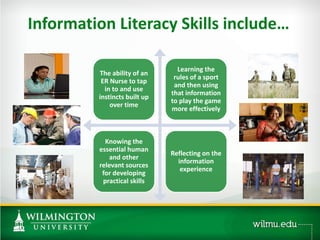
Information Literacy Skills include…
The ability of an
ER Nurse to tap
in to and use
instincts built up
over time
Learning the
rules of a sport
and then using
that information
to play the game
more effectively
Knowing the
essential human
and other
relevant sources
for developing
practical skills
Reflecting on the
information
experience
The process of becoming information literate
Requires the whole person to be aware of themselves
within the world
Leads to an experience of context-specific information
opportunities
Recognizes that these experiences contribute to learning
Helps one develop information practices enabling
negotiation of context
Takes into account the constraints of a context’s practices
on information use
ACRL Info Lit Standards
• The standards are focused more on academic settings and
centered upon the measurement of changes in user behavior
against expert models.
• emphasis on the individual’s acquisition of generic
information skills
• The focus on measurement that is inherent within behaviorist
research often leads to an assessment of individual actions
(and actors) within new settings
Addison C, Meyers E. Perspectives on information literacy: A framework for conceptual understanding. Information
Research 2013; 18(3): 1–13.
ACRL Info Lit Standards
In the light of the Drefus Model, this approach
works best at the Novice or Advanced Beginner
levels.
New ACRL Info Lit Framework seems to embody the
social dimension of workplace IL
Situates information literacy
within real life experiences
Seeks to provide spaces for
creative, integrative, flexible
thinking about the dynamic
information ecosystem in
which all students live, study,
and work.
Focuses more attention on the
vital role of collaboration and
its potential for increasing
student understanding of the
processes of knowledge
creation and scholarship.
Emphasizes student creativity
and participation, highlighting
the importance of their
contributions made possible
through many formal academic
experiences as well as many
daily non-academic experiences
“The contextuality of actual work processes
severely curtails naıve expectations of
unproblematic generic transfer.”
Hager (2009), p. 625
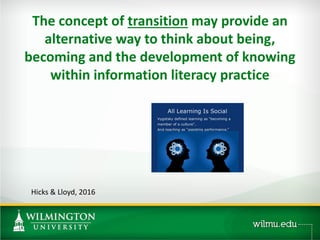
The concept of transition may provide an
alternative way to think about being,
becoming and the development of knowing
within information literacy practice
Hicks & Lloyd, 2016
Lave & Wenger 2012
Dreyfus, 1980
Using a Rubric to Sequence the IL Experience
through to the workplace
Gen Ed Discipline Workplace Community
Information Literacy Program Outcomes
1. Students will be able to frame a research question.
2. Students will be able to access needed information effectively
and efficiently.
3. Students will be able to evaluate information sources and
content.
4. Students will be able to use information for a specific purpose.
5. Students will understand ethical and legal issues affecting the
use of information.
6. Students will be able to use technology to communicate
information.
Using a Rubric to Sequence the IL Experience
through to the workplace
Competency Novice Developing Competent Proficient Accomplished
Professional/Workplace
Information Practices:
Students will engage with
information in ways they will
be expected to on the job in
order to provide more
concrete and situationally
determined opportunities to
develop those information
practices proper to the
specific contexts of the
workplace landscapes.
Uses immediately
available information
with little
discrimination.
Limited awareness of
important/relevant
information and how
to navigate the
information culture
of a workplace.
Can seek out and
locate critical
information with
minimal support.
Does not always
discriminate
effectively between
sources of
information.
Usually able to locate,
understand, organize,
and evaluate
information from
familiar and unfamiliar
sources using criteria
most relevant to the
task and setting. Has
awareness that
authority is a type of
influence recognized or
exerted within a specific
organization.
Independently seeks
out and locates
required information.
Understands that
authority of
information is based
on culturally-specific
influences. Is
selective and
discriminates
between sources of
information. Adopts
effective processes
for storage and
retrieval of
information.
Makes significant
contribution to the
organization through
judicious use of academic
and context-specific
information. Understands
how information based
decisions are influenced by
corporate or workplace
culture. Is frequently called
on to explain to, or assist
others in locating,
understanding, organizing,
or evaluating the quality
and relevance of
information from multiple
sources.
Using a Rubric to Sequence the IL Experience
through to the workplace
• Consider developing an assessment plan that will provide
evidence of the impact and outcomes of your efforts.
• Authentic – reflect real world expectations
• Not many employers measure success through multiple choice
tests
• What are employers expecting of graduates?
• What do faculty and students think they need?
Assessing
• A time to rethink our implementation of an information
literacy program in the context of this Framework
• Reconfigure team-based assignments
• Revise library reference services
• Include the use of people as “sources.”
• Incorporate social media into research assignments
• Go beyond coursework
• Consider developing an assessment plan that will provide
evidence of the impact and outcomes of a new program.
IL and Experiential Learning
Information
Use
Gives
form or
shape
to...
Learning
“I think one of the things I loved the most
about being here was the feeling that anything
was possible. Just infinite choices ahead of you.
You get out of school and anything could
happen…”
• CUNY Working Document for Developing IL guidelines across the disciplines
• Student Skill Acquisition
• Information Literacy at the juncture between education and employment
• Do employers want information literacy skills?
• Information Literacy meets Employability
• Introduction to communities of practice
• ‘Industries of the Future’: Alec Ross Unveils the Winners
• What America Needs to Know About Higher Education Redesign
• Project Information Literacy
• Patricia Benner's Theory
Links
• Bruce C. (1999). Workplace experiences of information literacy. International Journal
of Information Management, 19(1), 33-47.
• Farrell, Robert. (2013) “Reconsidering the Relationship between Generic and Situated
IL Approaches: The Dreyfus Model of Skill Acquisition in Formal Information Literacy
Learning Environments, Part II. Library Philosophy and Practice (e-journal). Paper
1049. http://digitalcommons.unl.edu/libphilprac/1049
• Hager, P. & P. Hodkinson. (2009) Moving beyond the metaphor of transfer of
learning. British Educational Research Journal 35(4), 619-638.
• Hall-Ellis, S. & Deborah Grealy. (2013) The Dreyfus Model of Skill Acquisition: A Career
Development Framework for Succession Planning and Management in Academic
Libraries. College & Research Libraries 74(6); 587-603.
• Hicks, Alison (2015) "Drinking on the Job: Integrating Workplace Information Literacy
into the Curriculum," LOEX Quarterly: Vol. 41(4), Article 4.
Available at: http://commons.emich.edu/loexquarterly/vol41/iss4/4
• Hoyer, J. (2011). Information is social: information literacy in context. Reference
Services Review. 39(1), 10-23.
Bibliography
• Ipperciel, D & Samara ElAtia. (2014) Assessing Graduate Attributes: Building a Criteria-
Based Competency Model. International Journal of Higher Education. 3(3); 27-38.
• Jackson, D. (2013). The contribution of work-integrated learning to undergraduate
employability skill outcomes. Asia-Pacific Journal of Cooperative Education 14(2), 99-
115.
• Jastram, I., et. al. (2014). Situating information literacy within the curriculum: Using
a rubric to shape a program. Portal: Libraries & the Academy 14(2), 165-186.
• Kirton & Barham. (2005) Information literacy in the workplace. The Australian Library
Journal Vol. 54 (4).
• Lave, J. & Wenger, E. (2008). Situated Learning: Legitimate peripheral participation.
Cambridge, UK: Cambridge University Press.
• Lloyd, A. (2010). Framing information literacy as information practice: Site ontology
and practice theory. Journal of Documentation, 66(2), 245-258.
• Lloyd, A (2012). Information literacy as a socially enacted practice: Sensitising
themes for an emerging people in practice perspective. Journal of Documentation 68
(6) 772-223.
Bibliography
• Lloyd, A (2013). Building information resilient workers: The critical ground of
workplace information literacy. What have we learnt? European Commission for
Information Literacy: Communications in Computer and Information Science. Vol
0397, Springer
• Lloyd, A. and Hicks, A. (2016). It takes a community to build a framework: Information
literacy within intercultural settings. Journal of Information Science. Special Issue – i3
Conference – Abderdeen.
• Lundh, A, Limberg, L., Lloyd, A (2013). Swapping Settings. Researching Information
literacy in workplace and in educational contexts. Information Research, Vol 18 No.
3, C05.
• Monge, R. & E Frisicaro-Pawlowski. (2014). Redefining information literacy to
prepare students for the 21st century workforce. Innovative Higher Education 39 (1),
59-73.
• Morgan PK. (2015) Pausing at the threshold. Portal; 15(1).
Bibliography
• Moring, C. (2011). Newcomer information practice: negotiations on information
seeking in and across communities of practice. Human IT, 11(2), 1-20
• Moring, C. & Lloyd A. (2013). Analytical implications of using practice theory in
workplace information literacy research. Information Research, Vol 18 No. 3,C35.
• Weiner, Sharon A., "Information Literacy and the Workforce: A Review" (2011).
Libraries Faculty and Staff Scholarship and Research. Paper 86.
http://docs.lib.purdue.edu/lib_fsdocs/86
• Widén, G., Steinerová, J. and Voisey, P. (2014). Conceptual modelling of workplace
information practices: a literature review. In Proceedings of ISIC, the Information
Behaviour Conference, Leeds, 2-5 September, 2014: Part 1, (paper isic08). Retrieved
from http://InformationR.net/ir/19-4/isic/isic08.html
Bibliography
• Monge, R. & E Frisicaro-Pawlowski. (2014). Redefining information literacy to
prepare students for the 21st century workforce. Innovative Higher Education 39 (1),
59-73.
• Morgan PK. (2015) Pausing at the threshold. Portal; 15(1).
• Mornig, C & Lloyd A (2013). Analytical implications of using practice theory in
workplace information literacy research. Information Research, Vol 18 No. 3,C35.
• Weiner, Sharon A., "Information Literacy and the Workforce: A Review" (2011).
Libraries Faculty and Staff Scholarship and Research. Paper 86.
http://docs.lib.purdue.edu/lib_fsdocs/86
• Widén, G., Steinerová, J. and Voisey, P. (2014). Conceptual modelling of workplace
information practices: a literature review. In Proceedings of ISIC, the Information
Behaviour Conference, Leeds, 2-5 September, 2014: Part 1, (paper isic08). Retrieved
from http://InformationR.net/ir/19-4/isic/isic08.html
Bibliography

Information Literacy Workshop McCloskey MLA/DLA 2016

  • 1.
    Becoming Information Literate: TheTransition from Academia to the Workplace James McCloskey DLA/MLA Conference May 2016
  • 2.
    1. What doesIL in the academy have to do with the workplace? 2. What is Workplace IL? 3. Why should I care? Motivating Questions
  • 3.
    Texas Lt. GovernorPatrick Launches Initiative to Enhance Classroom to Career Transition – Feb 2016 Learning by Doing: The Wagner Plan from Classroom to Career – Peer Review, Fall 2010, 12(4) OhioMeansJobs K-12 The place to plan your future. Delaware Department of Education is committed to serving every student and ensuring that all children are career and college ready. Maryland Career Development Framework
  • 4.
    “I am interestedin education that takes place between the attainment of the literacies, on the one hand, and the acquisition of a job or vocation, on the other.” Howard Gardner, Psychologist (https://www.edge.org/conversation/howard_gardner-liberal-arts-and-sciences-in-the-21st-century) “Is there still one skill we can count on, one skill we can master to fulfill our workplace dreams, regardless of what we do? The answer is yes, and that skill is information literacy, which is being able to locate, access, select, and apply information.” Tom W. Goad, organizational consultant, trainer and author from his book Information Literacy and Workplace Performance (2002)
  • 5.
  • 6.
    AACU Survey ofEmployers • 68% of employers rate the ability to engage competently with information as one of those “very important” expectations for employability. • When it comes to “locating, organizing, evaluating information,” 64% of students feel they are well prepared. • Only 29% of employers, indicating that college graduates are prepared. "Falling Short? College Learning and Career Success" (January, 2015)
  • 7.
    Information literacy andLife Long Learning Lifelong Learning Independent Thinking Information Literacy Digital IL Workplace IL
  • 8.
  • 9.
  • 10.
    Information literacy Skills ExpertThinking Complex Communication
  • 11.
    Information literacy asProcess digging locating uncovering reading evaluating synthesizing recalibrating asking for help Searching again in a different place
  • 12.
    Classroom/Academic IL Using & Experiencing Information Information To Learn WorkplaceIL Practices My Question: What is the relationship between information literacy instruction in the academic realm and the application of information literacy in a workplace experience? Work-related performances couldn’t be accomplished.
  • 13.
    • Career-oriented undergraduateand graduate degree programs for a growing and diverse student population. • Faculty drawn from the workplace to ensure that the university’s programs prepare students to begin or continue their career, improve their competitiveness in the job market, and engage in lifelong learning. Wilmington University Mission
  • 14.
    Information Literacy “Using informationin any format to research, evaluate, and ethically utilize information effectively and with appropriate attribution.” Wilmington University Graduation Competencies
  • 15.
    Information Literacy “Using informationin any format to research, evaluate, and ethically utilize information effectively and with appropriate attribution.”
  • 17.
    Work Integrated LearningModalities Service Learning/Student Teaching/Clinical Rotations Community Service/Volunteer Apprenticeships/Field work/Practicum Internships/Cooperative Education The central place that information creation, production, reproduction, circulation, and dissemination plays in their workplace performance
  • 18.
    Work-Integrated Learning Reinforces AcademicConcepts (Work-Integrated Learning and Career-Ready Students. Kramer, 2011) Career-Ready Students: Examining the Evidence )
  • 19.
  • 20.
    Achievement of Goals AACUSurvey of Employers Hiring preference to college grads with skills contributing to workplace innovation – 95% Hire college grads who demonstrate ethical judgment and integrity, intercultural skills, and capacity for continued new learning – 90% Colleges should place more emphasis on critical thinking, complex problem solving, written/oral communication, applied knowledge in real-world settings – 75% Source: It Takes More than a Major: Employer Priorities for College Learning and Student Success 2013. Washington, DC: Association of American Colleges and Universities & Hart Research Assoc
  • 21.
    Source: The AmericanFreshman: National Norms Fall 2015 Higher Education Research Institute, Feb 2016 Greater employment opportunities Greater career advancement Financial reward Survey of Incoming Freshmen
  • 22.
    96% of collegeand university chief academic officers are confident that their institution prepares students for the workforce. 11% percent of business leaders strongly agree today’s college graduates have the skills and competencies that their business needs M I S A L I G N M E N T
  • 23.
    Novice - needinga set of rules to guide their actions Expert - someone who is fully engaged emotionally in the situated elements of a community of practice
  • 25.
    Community of Practice& “Legitimate Peripheral Participation” Old-Timers Mature Practice Periphery Newcomers to Situated Learning Social Practice Through: • Engagement • Interaction • Collaboration • Learning of Knowledgeable skills Full Participation Boundary (flexible, dynamic) Lave & Wenger, 1991, 2000
  • 26.
    Outside of thelibrary profession “Information Literacy” is a relatively unknown term and not well understood. Kirton & Barham, 2005 Effective Use of Information Managing Information Keeping Up to Date Using Information for Problem Solving Using Information for Decision Making Environmental Scanning
  • 27.
    Workplace IL placesa greater emphasis on: • Social, informal, contextualized processing of information. • The transformation of information to knowledge. • Information creation, packaging, organization
  • 28.
    IL in Education& Workplace (Lloyd, et al. 2013) Educational Setting Part of the formal learning process. Specific Assignments Routine Tasks that are the subject of assessment practices Workplace Setting A learner strategizes and seeks solutions through deep analysis & multi-tiered application Assessment practices focused on productivity and development of expertise.
  • 29.
    Key Differences? Key WorkplaceIL Differences Less emphasis on search skills and finding information People are key information sources No Need for everyone to have all IL skills Information processing a shared activity
  • 30.
    Learning Transfer asmetaphor for the IL Experience Academic IL Skills Near Transfer Far Transfer Workplace Civic/Home Settings
  • 31.
    Information Literacy ismore than just an academic skill… …is much more than an understanding of the student research process or the development and application of information skills. …is not confined to formal learning environments but is part of every human activity including the social processes that shape information and how it is used within a given context.
  • 32.
    Engaging team members during researchprocess Retrieving information using a variety of formats Finding patterns and making connections Exploring a topic thoroughly Employer identified information competency gaps
  • 33.
    Is social and socially iterative Seeks Patterns Synthesizesa variety of sources and formats Requires persistence and openness to continuous learning Workplace Information Literacy (Project Information Literacy)
  • 34.
    Information Use inthe Workplace • Social process: People learning together to develop collective & common understandings • Aligned with workplace culture & profession-specific practices • Transformative Lloyd, 2010
  • 35.
    Information Literacy Skillsinclude… The ability of an ER Nurse to tap in to and use instincts built up over time Learning the rules of a sport and then using that information to play the game more effectively Knowing the essential human and other relevant sources for developing practical skills Reflecting on the information experience
  • 36.
    The process ofbecoming information literate Requires the whole person to be aware of themselves within the world Leads to an experience of context-specific information opportunities Recognizes that these experiences contribute to learning Helps one develop information practices enabling negotiation of context Takes into account the constraints of a context’s practices on information use
  • 37.
    ACRL Info LitStandards • The standards are focused more on academic settings and centered upon the measurement of changes in user behavior against expert models. • emphasis on the individual’s acquisition of generic information skills • The focus on measurement that is inherent within behaviorist research often leads to an assessment of individual actions (and actors) within new settings Addison C, Meyers E. Perspectives on information literacy: A framework for conceptual understanding. Information Research 2013; 18(3): 1–13.
  • 38.
    ACRL Info LitStandards In the light of the Drefus Model, this approach works best at the Novice or Advanced Beginner levels.
  • 39.
    New ACRL InfoLit Framework seems to embody the social dimension of workplace IL Situates information literacy within real life experiences Seeks to provide spaces for creative, integrative, flexible thinking about the dynamic information ecosystem in which all students live, study, and work. Focuses more attention on the vital role of collaboration and its potential for increasing student understanding of the processes of knowledge creation and scholarship. Emphasizes student creativity and participation, highlighting the importance of their contributions made possible through many formal academic experiences as well as many daily non-academic experiences
  • 40.
    “The contextuality ofactual work processes severely curtails naıve expectations of unproblematic generic transfer.” Hager (2009), p. 625
  • 41.
    The concept oftransition may provide an alternative way to think about being, becoming and the development of knowing within information literacy practice Hicks & Lloyd, 2016
  • 42.
  • 43.
  • 44.
    Using a Rubricto Sequence the IL Experience through to the workplace Gen Ed Discipline Workplace Community
  • 45.
    Information Literacy ProgramOutcomes 1. Students will be able to frame a research question. 2. Students will be able to access needed information effectively and efficiently. 3. Students will be able to evaluate information sources and content. 4. Students will be able to use information for a specific purpose. 5. Students will understand ethical and legal issues affecting the use of information. 6. Students will be able to use technology to communicate information.
  • 46.
    Using a Rubricto Sequence the IL Experience through to the workplace Competency Novice Developing Competent Proficient Accomplished Professional/Workplace Information Practices: Students will engage with information in ways they will be expected to on the job in order to provide more concrete and situationally determined opportunities to develop those information practices proper to the specific contexts of the workplace landscapes. Uses immediately available information with little discrimination. Limited awareness of important/relevant information and how to navigate the information culture of a workplace. Can seek out and locate critical information with minimal support. Does not always discriminate effectively between sources of information. Usually able to locate, understand, organize, and evaluate information from familiar and unfamiliar sources using criteria most relevant to the task and setting. Has awareness that authority is a type of influence recognized or exerted within a specific organization. Independently seeks out and locates required information. Understands that authority of information is based on culturally-specific influences. Is selective and discriminates between sources of information. Adopts effective processes for storage and retrieval of information. Makes significant contribution to the organization through judicious use of academic and context-specific information. Understands how information based decisions are influenced by corporate or workplace culture. Is frequently called on to explain to, or assist others in locating, understanding, organizing, or evaluating the quality and relevance of information from multiple sources.
  • 47.
    Using a Rubricto Sequence the IL Experience through to the workplace
  • 48.
    • Consider developingan assessment plan that will provide evidence of the impact and outcomes of your efforts. • Authentic – reflect real world expectations • Not many employers measure success through multiple choice tests • What are employers expecting of graduates? • What do faculty and students think they need? Assessing
  • 49.
    • A timeto rethink our implementation of an information literacy program in the context of this Framework • Reconfigure team-based assignments • Revise library reference services • Include the use of people as “sources.” • Incorporate social media into research assignments • Go beyond coursework • Consider developing an assessment plan that will provide evidence of the impact and outcomes of a new program. IL and Experiential Learning
  • 50.
  • 51.
    “I think oneof the things I loved the most about being here was the feeling that anything was possible. Just infinite choices ahead of you. You get out of school and anything could happen…”
  • 52.
    • CUNY WorkingDocument for Developing IL guidelines across the disciplines • Student Skill Acquisition • Information Literacy at the juncture between education and employment • Do employers want information literacy skills? • Information Literacy meets Employability • Introduction to communities of practice • ‘Industries of the Future’: Alec Ross Unveils the Winners • What America Needs to Know About Higher Education Redesign • Project Information Literacy • Patricia Benner's Theory Links
  • 53.
    • Bruce C.(1999). Workplace experiences of information literacy. International Journal of Information Management, 19(1), 33-47. • Farrell, Robert. (2013) “Reconsidering the Relationship between Generic and Situated IL Approaches: The Dreyfus Model of Skill Acquisition in Formal Information Literacy Learning Environments, Part II. Library Philosophy and Practice (e-journal). Paper 1049. http://digitalcommons.unl.edu/libphilprac/1049 • Hager, P. & P. Hodkinson. (2009) Moving beyond the metaphor of transfer of learning. British Educational Research Journal 35(4), 619-638. • Hall-Ellis, S. & Deborah Grealy. (2013) The Dreyfus Model of Skill Acquisition: A Career Development Framework for Succession Planning and Management in Academic Libraries. College & Research Libraries 74(6); 587-603. • Hicks, Alison (2015) "Drinking on the Job: Integrating Workplace Information Literacy into the Curriculum," LOEX Quarterly: Vol. 41(4), Article 4. Available at: http://commons.emich.edu/loexquarterly/vol41/iss4/4 • Hoyer, J. (2011). Information is social: information literacy in context. Reference Services Review. 39(1), 10-23. Bibliography
  • 54.
    • Ipperciel, D& Samara ElAtia. (2014) Assessing Graduate Attributes: Building a Criteria- Based Competency Model. International Journal of Higher Education. 3(3); 27-38. • Jackson, D. (2013). The contribution of work-integrated learning to undergraduate employability skill outcomes. Asia-Pacific Journal of Cooperative Education 14(2), 99- 115. • Jastram, I., et. al. (2014). Situating information literacy within the curriculum: Using a rubric to shape a program. Portal: Libraries & the Academy 14(2), 165-186. • Kirton & Barham. (2005) Information literacy in the workplace. The Australian Library Journal Vol. 54 (4). • Lave, J. & Wenger, E. (2008). Situated Learning: Legitimate peripheral participation. Cambridge, UK: Cambridge University Press. • Lloyd, A. (2010). Framing information literacy as information practice: Site ontology and practice theory. Journal of Documentation, 66(2), 245-258. • Lloyd, A (2012). Information literacy as a socially enacted practice: Sensitising themes for an emerging people in practice perspective. Journal of Documentation 68 (6) 772-223. Bibliography
  • 55.
    • Lloyd, A(2013). Building information resilient workers: The critical ground of workplace information literacy. What have we learnt? European Commission for Information Literacy: Communications in Computer and Information Science. Vol 0397, Springer • Lloyd, A. and Hicks, A. (2016). It takes a community to build a framework: Information literacy within intercultural settings. Journal of Information Science. Special Issue – i3 Conference – Abderdeen. • Lundh, A, Limberg, L., Lloyd, A (2013). Swapping Settings. Researching Information literacy in workplace and in educational contexts. Information Research, Vol 18 No. 3, C05. • Monge, R. & E Frisicaro-Pawlowski. (2014). Redefining information literacy to prepare students for the 21st century workforce. Innovative Higher Education 39 (1), 59-73. • Morgan PK. (2015) Pausing at the threshold. Portal; 15(1). Bibliography
  • 56.
    • Moring, C.(2011). Newcomer information practice: negotiations on information seeking in and across communities of practice. Human IT, 11(2), 1-20 • Moring, C. & Lloyd A. (2013). Analytical implications of using practice theory in workplace information literacy research. Information Research, Vol 18 No. 3,C35. • Weiner, Sharon A., "Information Literacy and the Workforce: A Review" (2011). Libraries Faculty and Staff Scholarship and Research. Paper 86. http://docs.lib.purdue.edu/lib_fsdocs/86 • Widén, G., Steinerová, J. and Voisey, P. (2014). Conceptual modelling of workplace information practices: a literature review. In Proceedings of ISIC, the Information Behaviour Conference, Leeds, 2-5 September, 2014: Part 1, (paper isic08). Retrieved from http://InformationR.net/ir/19-4/isic/isic08.html Bibliography
  • 57.
    • Monge, R.& E Frisicaro-Pawlowski. (2014). Redefining information literacy to prepare students for the 21st century workforce. Innovative Higher Education 39 (1), 59-73. • Morgan PK. (2015) Pausing at the threshold. Portal; 15(1). • Mornig, C & Lloyd A (2013). Analytical implications of using practice theory in workplace information literacy research. Information Research, Vol 18 No. 3,C35. • Weiner, Sharon A., "Information Literacy and the Workforce: A Review" (2011). Libraries Faculty and Staff Scholarship and Research. Paper 86. http://docs.lib.purdue.edu/lib_fsdocs/86 • Widén, G., Steinerová, J. and Voisey, P. (2014). Conceptual modelling of workplace information practices: a literature review. In Proceedings of ISIC, the Information Behaviour Conference, Leeds, 2-5 September, 2014: Part 1, (paper isic08). Retrieved from http://InformationR.net/ir/19-4/isic/isic08.html Bibliography