Suresh Sagadevan Int. Journal of Engineering Research and Applications www.ijera.com
ISSN : 2248-9622, Vol. 4, Issue 4( Version 9), April 2014, pp.126-130
www.ijera.com 126 | P a g e
AC and DC Electrical Conductivity Measurements on Glycine
Family of Nonlinear Optical (NLO) Single Crystals
Suresh Sagadevan*
*Department of Physics, Sree Sastha Institute of Engineering and Technology, Chembarambakkam, Chennai,
600123
Abstract
In the present work, the AC/DC conductivity studies were carried out on Glycine family of NLO single crystals such
as Trisglycine Zinc Chloride (TGZC), Triglycine Acetate (TGAc) and Glycine Lithium Sulphate (GLS). The AC
conductivity measurements were carried out using HIOKI 3532-50 LCR HITESTER in the frequency range of
50 Hz to 5 MHz for the grown NLO single crystals. The DC electrical conductivity measurements were also carried
out for the crystals using the conventional two – probe technique in the temperature range of 313 – 423 K. The
present study indicates that both the AC and DC conductivity of the samples increase with the increase in
temperature. The activation energies were also calculated from AC/DC conductivity studies.
Keywords AC conductivity, DC conductivity, Glycine family of NLO Single Crystal
I. Introduction
Extensive studies have been made on the
synthesis and crystal growth of nonlinear optical (NLO)
materials over the past decade because of their potential
applications in the field of telecommunications, optical
signal processing and optical switching [1]. Organic
nonlinear optical materials are attracting a great deal of
attention due to their potentially high nonlinearities and
rapid response in the electro-optic effect compared to
inorganic NLO materials. The development of optical
devices such as photonic integrated circuitry depends
strongly on the design of highly efficient NLO
materials. Among such NLO materials, organic
materials are known to be superior to their inorganic
counterparts in terms of synthesis, crystal fabrication,
potential to create large devices and much faster optical
nonlinearities [2, 3]. Operation of electro-optic devices
is based on the Pockel’s effect, in which the change in
the dielectric constant is a linear function of the applied
field [4]. Microelectronics industry needs replacement
of dielectric materials in multilevel interconnect
structures with new low dielectric constant(εr)
materials, as an interlayer dielectric (ILD) which
surrounds and insulates interconnect wiring. Lowering
the dielectric constant values of the ILD decreases the
RC delay, lowers power consumptions, and reduces
‘cross-talk’ between nearby interconnects [5]. The
electrical conduction in dielectrics is mainly a defect
controlled process in the low temperature region. The
presence of impurities and vacancies mainly determine
the behaviour in this region. The energy needs to form
the defect is much larger than the energy needed for its
drift. The conductivity of the crystal in the higher
temperature region is determined by the intrinsic
defects caused due to the thermal fluctuations in the
crystal [6]. The low temperature conduction region
seems to be connected to the mobility of vacancies. If
the probability of occupation of an interstitial is f, then
the probability of finding a vacant neighbour site is
(1–f). Even for very high concentrations, of the order of
1020
cm–3
, f does not exceed 10–2
so that in real cases
with concentration of interstitials of the order of
1015
–1020
cm–3
, (1–f ) » 1[7]. Electrical conductivity
may be influenced by the proton transport within the
framework of hydrogen bonds. The conductivity is
associated with the incorporation of impurity into the
crystal lattice (of impurities) and the formation of
corresponding defects in ionic crystals [8-10]. The
proton conduction may be accounted for the motion of
protons accompanied by a D defect (excess of positive
charge). Migration of these defects may only modify
electric polarization and may not change the charge at
an electrode. In the present investigation, the AC/DC
conductivity studies were carried out on Glycine family
of NLO single crystals such as Trisglycine Zinc
Chloride (TGZC), Triglycine Acetate (TGAc), and
Glycine Lithium Sulphate (GLS). The activation
energies were also calculated from AC/DC conductivity
studies.
II. Materials and Methods
The NLO single crystals were grown by slow
evaporation technique. Growth, Single crystal X-ray
diffraction, UV analysis, FTIR, SHG, Thermal and
Mechanical analysis, and Photoconductivity studies
have been reported earlier by Suresh et al [11-13]. The
RESEARCH ARTICLE OPEN ACCESS
Suresh Sagadevan Int. Journal of Engineering Research and Applications www.ijera.com
ISSN : 2248-9622, Vol. 4, Issue 4( Version 9), April 2014, pp.126-130
www.ijera.com 127 | P a g e
conductivity of the material depends on its overall
characteristics such as chemical composition, purity
and crystal structure. Measurements taken with
continuous currents provide only total conductivity.
However, simultaneous information on conductivity
and on the material’s electrode interface effects can be
partially offset by impedance measurements.
Impedance measurement is a flexible tool for electrical
characterization of materials. The compacted pellet
(diameter 8 mm) of the sample is dried at 100ºC for few
hours. In the present study, electric ohmic contacts were
made using air drying silver paint on the opposite faces.
Electrical measurements were taken in the frequency
range from 50 Hz to 5 MHz using HIOKI 3532 LCR
HITESTER. The AC impedance measurements were
taken in the thermal range of 313 to 423 K. A chromel-
Alumel thermocouple was employed to record the
sample temperature. A time interval 30 minutes was
taken prior to thermal stabilization after each measuring
temperature. All the measurements were carried out in
atmospheric air.
2.1. AC CONDUCTIVITY STUDY
A capacitor when charged under AC voltage
will have some loss current due to ohmic resistance or
impedance by heat absorption. If Q be the charge in
Coulomb due to a potential difference of V volts
between two plates of a condenser of area, A, and inter-
plate distance d, then AC conductivity (ζac) due to AC
voltage is given by the relation
EJac / (1)
J is the current density and is the electric field strength
vector. But the electric field vector, E

= D

/ε,
where is the displacement field vector of the dipole
charges and ε is the complex permittivity of the
material. For a parallel plate capacitor, the electric field
intensity ( E

) is the ratio of potential difference
between the plates of the capacitor and the inter-plate
distance. i.e.
dVE /

(2)
The current density, where Q is given by
dAVQ /
Therefore,
dtdVddVdtddtdQAJ /./)/(//)/1(  
(3)
dtdVdJ /)/( (4)
Substituting for and J in (1)
 jEJac 

/ (5)
where ε is a complex quantity
''')'''(   jjjac (6)
In order that the AC conductivity may be a real
quantity, the term containing j has to be neglected.
Hence,
'' ac (7)
In any dielectric material, there will be power
loss because of the work done to overcome the
frictional damping forces encountered by the dipoles
during their rotation. If AC field is considered, then in
an ideal case the charging current IC will be 90º out of
phase with the voltage. But in most of the capacitors
due to the absorption of electrical energy some loss
current, IL will also be produced, which will be in phase
with the voltage. Charging current, IC, and loss current,
IL, will make angles δ and θ, respectively with the total
current (I), passing through the capacitor. The loss
current is represented by sin δ with respect to the total
current (I). Generally, sin δ is called the loss factor, but
when δ is small then, sin δ = δ = tan δ. But the two
components ε’ and ε’’ of the complex dielectric constant
(ε,) will be frequency dependent and is given by
00 /cos)(' ED

 
00 /sin)('' ED

  (8)
Since the displacement vector in a time varying field
will not be in phase with E

there will be a phase
difference δ between them. From (7) and (8), we have
)('/)(''tan   (9)
Substituting the value of (ω) from (6) and (9) we have
)('tan  ac (10)
where ω = 2πf and r 0' , where εr is the relative
permittivity of the material and ε0 the permittivity of the
free space. So
rac f  0tan2 (11)
This equation is used to calculate the AC
conductivity using dielectric constant and tan δ at a
given frequency. It is to be noted that both tan δ and εr
were available from dielectric measurement. The plots
between ln(ζac) and 1000/ T were found to be very
linear. Hence, the conductivity values can be fitted to
the relation
]/exp[0 kTEac

 (12)
Where is the activation energy, k, the
Boltzmann constant, T, the absolute temperature and ζ0
the parameter depending on the material. Activation
energy was estimated using the slopes of the above line
plots [ E

= -(slope)k x1000].
2.2. DC CONDUCTIVITY STUDY
The DC conductivity of the grown crystals
was measured using the two-probe technique. The
samples (rectangular shaped crystals) were cut parallel
Suresh Sagadevan Int. Journal of Engineering Research and Applications www.ijera.com
ISSN : 2248-9622, Vol. 4, Issue 4( Version 9), April 2014, pp.126-130
www.ijera.com 128 | P a g e
to the cleavage plane to the desired thickness of 1-2 mm
and polished using silicon carbide paper. They were
annealed for two hours at 423 K to remove the
resistance moisture content. Opposite faces of the
crystals were coated with good quality graphite to
obtain a good ohmic contact with the electrodes. The
samples were again annealed in the holder assembly at
423 K before making observations. The resistance of
the crystal was measured using a megohmmeter. The
observations were made while cooling the sample and
temperature was controlled to an accuracy of ± 1°C.
The dimensions of the crystal were measured using a
travelling microscope. The DC conductivity (ζdc) of the
crystal was calculated using the relation,
RAtdc / (13)
where R is the measured resistance, t is the thickness of
the sample and A is the area of the face in contact with
the electrode. The above procedure was used to
determine the DC electrical conductivity. The general
relation for the temperature variation of conductivity is
given by
 kTEdc /exp0   (14)
where ζ0 is a constant depending on material, E is the
activation energy, T the absolute temperature and k is
the Boltzmann’s constant. The above equation can be
rewritten as
kTEdc /lnln 0   (15)
A plot of lnζdc versus 1000/T gives - E/k as the slope
and lnζdc as the intercept. It is customary to plot lnζdc
versus 1000/T, from the slope of which activation
energy (E) can be calculated.
III. Results and Discussion
3.1. AC conductivity studies
Dielectrics exhibit a combined conduction,
especially ionic and electronic conduction. Ionic
conductivity studies provide valuable information about
the state of point imperfections. In the high temperature
(intrinsic) region, the effect of impurity on electrical
conduction will not change appreciably whereas in the
low temperature (extrinsic) region the presence of
impurity in the crystal increases its conductivity. The
energy needed to form the defect is much larger than
the energy needed for its drift. The conductivity of the
crystal in the high temperature region is determined by
the intrinsic defects caused by thermal fluctuations in
the crystal. Conduction in an ionic crystal is, in general,
a defect controlled property. The defect concentration
increases exponentially with rise of temperature and the
electrical conductivity increases correspondingly. The
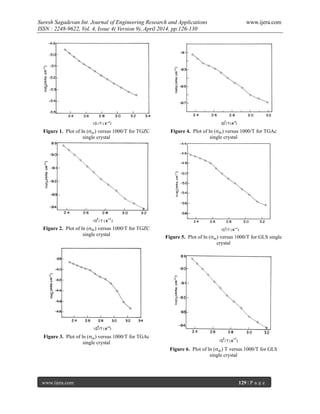
Arrhenius plot of log ζac versus 1000 / T is shown in
Figs.1, 3, and 5. The activation energy for ionic
migration was estimated from the graph. The plot of
lnζac versus 1/T obeys Arrhenius relationship
ζac = ζ0exp (- Ea/ kT) where ζ0 is the pre-exponent
factor, Ea activation energy for the conduction process
and k is the Boltzmann constant. Therefore, the crystal
exhibits Arrhenius type conductivity behaviour in the
temperature range of investigation. The activation
energy of TGZC, TGAc and GLS for the conduction
process calculated from plots is found to be 0.035 eV,
0.075 eV and 0.10 eV. The electrical conduction is
mainly a defect controlled process in low temperature
region. It is observed that the electrical conduction of
glycine family of crystals is low at low temperature
owing to trapping of some carriers at defect sites. As
temperature rises, more and more defects are created,
and as a result, the conductivity increases, which is
predominantly due to motion of defects produced by
thermal activation.
3.2. DC Conductivity Studies
Electrical conductivity depends on thermal
treatment of a crystal. Thus, the conductivity at low
temperatures depends on the cooling rate from melting
point to room temperature. Thus, for slow cooling, the
remaking of the lattice can occur by the migration of
interstitials to vacancies recombination of Schottky
defects or migration of vacancies to the surface along
dislocation channels. On quenching or rapid cooling, a
fraction of the vacancies freeze and the pre exponential
term includes a contribution from those frozen
vacancies. The value of DC conductivity is found to
increase with temperature. The activation energy (Ea)
for temperatures range of 313 to 423 K has been
calculated from the slope of the graph between
lnζdc and 1/T (Figs. 2, 4 and 6). It is found to be
0.050 eV, 0.060 eV and 0.055 eV for the crystals
TGZC, TGAc and GLS respectively. Evaluation of DC
electrical conductivity reveals useful information about
materials to exploit them for various applications. The
study of DC electrical conductivity sheds light on the
behaviour of charge carriers under a DC field, their
mobility and mechanism of conduction. At any
particular temperature, the Gibb’s free energy of a
crystal is minimum when a certain fraction of ions
leave the normal lattice.
Suresh Sagadevan Int. Journal of Engineering Research and Applications www.ijera.com
ISSN : 2248-9622, Vol. 4, Issue 4( Version 9), April 2014, pp.126-130
www.ijera.com 129 | P a g e
Figure 1. Plot of ln (ac) versus 1000/T for TGZC
single crystal
Figure 2. Plot of ln (dc) versus 1000/T for TGZC
single crystal
Figure 3. Plot of ln (ac) versus 1000/T for TGAc
single crystal
Figure 4. Plot of ln (dc) versus 1000/T for TGAc
single crystal
Figure 5. Plot of ln (ac) versus 1000/T for GLS single
crystal
Figure 6. Plot of ln (dc) T versus 1000/T for GLS
single crystal
Suresh Sagadevan Int. Journal of Engineering Research and Applications www.ijera.com
ISSN : 2248-9622, Vol. 4, Issue 4( Version 9), April 2014, pp.126-130
www.ijera.com 130 | P a g e
IV. Conclusion
Single crystals of Semi-organic nonlinear
optical materials, such as Trisglycine Zinc Chloride
(TGZC), Triglycine Acetate (TGAc), and Glycine
Lithium Sulphate (GLS) have been grown by slow
evaporation method. The AC/DC electrical conductivity
studies were carried out on the grown single crystals.
The AC electrical conductivity studies were carried out
on the grown single crystals. The activation energy of
TGZC, TGAc and GLS for the conduction process
calculated from plots is found to be 0.035 eV, 0.075 eV
and 0.10 eV. The activation energy for temperatures
range of 313 to 423 K has been calculated from DC
conductivity studies. It is found to be 0.050 eV, 0.060
eV and 0.055 eV for the crystals TGZC, TGAc and
GLS respectively. The lower activation energies
estimated from electrical conductivity studies suggests
that the material contains less number of charge carriers
for conduction process and the dielectric behaviour is
very well understood.
REFERENCES
[1] Prasad PN and Williams DJ, Introduction to
nonlinear optical effects in organic molecules
and polymers. Wiley, NY, (1991)
[2] Jordon G, Kobayashi T, Blau WJ, Pfeiffer S,
Horhold H-H, Advanced Functional Material.
13, (2003), 751–4.
[3] Yang Z, Aravazhi S, Schneider A, Seiler P,
Jazbisnek M, Gunter P. Advanced Functional
Materials. 15, (2005), 1072–6
[4] Boyd GT, J. Opt. Soc. Am. B 6, (1989), 685
[5] Hatton BT, Landskron K, Hunks WJ, Benett
MR, Shukaris D, Perovic DD, and Ozinn GA,
Mater. Today. 9, (2006), 22
[6] Freeda T H and Mahadevan C, Bull. Mater.
Sci., 23, (2000), 335
[7] Bunget I and Popescu M, Physics of dielectrics
(New York: Elsevier) (1984)
[8] Deepa G, Freeda T H and Mahadevan C,
Indian J. Phys., A76, (2002 ), 369
[9] Priya M, Padma C M, Freeda T H, Mahadevan
C and Balasingh C, Bull. Mater. Sci., 24,
(2001), 511
[10] Sancta J A, Sutha A G, Freeda T H, Mahadevan
C and Balasingh C, Indian J. Phys. A75,
(2001), 245
[11] Suresh S and Arivuoli D, Journal of Minerals
& Materials Characterization &
Engineering,6,(2011), 517-526
[12] Suresh S, Ramanand A, Jayaraman D, Mani P
Journal of Optoelectronics and Advanced
materials – rapid communications, 11, (2010)
176
[13] Suresh S, Ramanand A, Jayaraman D, Navis
Priya SM, Journal of Minerals & Materials
Characterization & Engineering, 12, (2010),
1071

W4409126130

  • 1.
    Suresh Sagadevan Int.Journal of Engineering Research and Applications www.ijera.com ISSN : 2248-9622, Vol. 4, Issue 4( Version 9), April 2014, pp.126-130 www.ijera.com 126 | P a g e AC and DC Electrical Conductivity Measurements on Glycine Family of Nonlinear Optical (NLO) Single Crystals Suresh Sagadevan* *Department of Physics, Sree Sastha Institute of Engineering and Technology, Chembarambakkam, Chennai, 600123 Abstract In the present work, the AC/DC conductivity studies were carried out on Glycine family of NLO single crystals such as Trisglycine Zinc Chloride (TGZC), Triglycine Acetate (TGAc) and Glycine Lithium Sulphate (GLS). The AC conductivity measurements were carried out using HIOKI 3532-50 LCR HITESTER in the frequency range of 50 Hz to 5 MHz for the grown NLO single crystals. The DC electrical conductivity measurements were also carried out for the crystals using the conventional two – probe technique in the temperature range of 313 – 423 K. The present study indicates that both the AC and DC conductivity of the samples increase with the increase in temperature. The activation energies were also calculated from AC/DC conductivity studies. Keywords AC conductivity, DC conductivity, Glycine family of NLO Single Crystal I. Introduction Extensive studies have been made on the synthesis and crystal growth of nonlinear optical (NLO) materials over the past decade because of their potential applications in the field of telecommunications, optical signal processing and optical switching [1]. Organic nonlinear optical materials are attracting a great deal of attention due to their potentially high nonlinearities and rapid response in the electro-optic effect compared to inorganic NLO materials. The development of optical devices such as photonic integrated circuitry depends strongly on the design of highly efficient NLO materials. Among such NLO materials, organic materials are known to be superior to their inorganic counterparts in terms of synthesis, crystal fabrication, potential to create large devices and much faster optical nonlinearities [2, 3]. Operation of electro-optic devices is based on the Pockel’s effect, in which the change in the dielectric constant is a linear function of the applied field [4]. Microelectronics industry needs replacement of dielectric materials in multilevel interconnect structures with new low dielectric constant(εr) materials, as an interlayer dielectric (ILD) which surrounds and insulates interconnect wiring. Lowering the dielectric constant values of the ILD decreases the RC delay, lowers power consumptions, and reduces ‘cross-talk’ between nearby interconnects [5]. The electrical conduction in dielectrics is mainly a defect controlled process in the low temperature region. The presence of impurities and vacancies mainly determine the behaviour in this region. The energy needs to form the defect is much larger than the energy needed for its drift. The conductivity of the crystal in the higher temperature region is determined by the intrinsic defects caused due to the thermal fluctuations in the crystal [6]. The low temperature conduction region seems to be connected to the mobility of vacancies. If the probability of occupation of an interstitial is f, then the probability of finding a vacant neighbour site is (1–f). Even for very high concentrations, of the order of 1020 cm–3 , f does not exceed 10–2 so that in real cases with concentration of interstitials of the order of 1015 –1020 cm–3 , (1–f ) » 1[7]. Electrical conductivity may be influenced by the proton transport within the framework of hydrogen bonds. The conductivity is associated with the incorporation of impurity into the crystal lattice (of impurities) and the formation of corresponding defects in ionic crystals [8-10]. The proton conduction may be accounted for the motion of protons accompanied by a D defect (excess of positive charge). Migration of these defects may only modify electric polarization and may not change the charge at an electrode. In the present investigation, the AC/DC conductivity studies were carried out on Glycine family of NLO single crystals such as Trisglycine Zinc Chloride (TGZC), Triglycine Acetate (TGAc), and Glycine Lithium Sulphate (GLS). The activation energies were also calculated from AC/DC conductivity studies. II. Materials and Methods The NLO single crystals were grown by slow evaporation technique. Growth, Single crystal X-ray diffraction, UV analysis, FTIR, SHG, Thermal and Mechanical analysis, and Photoconductivity studies have been reported earlier by Suresh et al [11-13]. The RESEARCH ARTICLE OPEN ACCESS
  • 2.
    Suresh Sagadevan Int.Journal of Engineering Research and Applications www.ijera.com ISSN : 2248-9622, Vol. 4, Issue 4( Version 9), April 2014, pp.126-130 www.ijera.com 127 | P a g e conductivity of the material depends on its overall characteristics such as chemical composition, purity and crystal structure. Measurements taken with continuous currents provide only total conductivity. However, simultaneous information on conductivity and on the material’s electrode interface effects can be partially offset by impedance measurements. Impedance measurement is a flexible tool for electrical characterization of materials. The compacted pellet (diameter 8 mm) of the sample is dried at 100ºC for few hours. In the present study, electric ohmic contacts were made using air drying silver paint on the opposite faces. Electrical measurements were taken in the frequency range from 50 Hz to 5 MHz using HIOKI 3532 LCR HITESTER. The AC impedance measurements were taken in the thermal range of 313 to 423 K. A chromel- Alumel thermocouple was employed to record the sample temperature. A time interval 30 minutes was taken prior to thermal stabilization after each measuring temperature. All the measurements were carried out in atmospheric air. 2.1. AC CONDUCTIVITY STUDY A capacitor when charged under AC voltage will have some loss current due to ohmic resistance or impedance by heat absorption. If Q be the charge in Coulomb due to a potential difference of V volts between two plates of a condenser of area, A, and inter- plate distance d, then AC conductivity (ζac) due to AC voltage is given by the relation EJac / (1) J is the current density and is the electric field strength vector. But the electric field vector, E  = D  /ε, where is the displacement field vector of the dipole charges and ε is the complex permittivity of the material. For a parallel plate capacitor, the electric field intensity ( E  ) is the ratio of potential difference between the plates of the capacitor and the inter-plate distance. i.e. dVE /  (2) The current density, where Q is given by dAVQ / Therefore, dtdVddVdtddtdQAJ /./)/(//)/1(   (3) dtdVdJ /)/( (4) Substituting for and J in (1)  jEJac   / (5) where ε is a complex quantity ''')'''(   jjjac (6) In order that the AC conductivity may be a real quantity, the term containing j has to be neglected. Hence, '' ac (7) In any dielectric material, there will be power loss because of the work done to overcome the frictional damping forces encountered by the dipoles during their rotation. If AC field is considered, then in an ideal case the charging current IC will be 90º out of phase with the voltage. But in most of the capacitors due to the absorption of electrical energy some loss current, IL will also be produced, which will be in phase with the voltage. Charging current, IC, and loss current, IL, will make angles δ and θ, respectively with the total current (I), passing through the capacitor. The loss current is represented by sin δ with respect to the total current (I). Generally, sin δ is called the loss factor, but when δ is small then, sin δ = δ = tan δ. But the two components ε’ and ε’’ of the complex dielectric constant (ε,) will be frequency dependent and is given by 00 /cos)(' ED    00 /sin)('' ED    (8) Since the displacement vector in a time varying field will not be in phase with E  there will be a phase difference δ between them. From (7) and (8), we have )('/)(''tan   (9) Substituting the value of (ω) from (6) and (9) we have )('tan  ac (10) where ω = 2πf and r 0' , where εr is the relative permittivity of the material and ε0 the permittivity of the free space. So rac f  0tan2 (11) This equation is used to calculate the AC conductivity using dielectric constant and tan δ at a given frequency. It is to be noted that both tan δ and εr were available from dielectric measurement. The plots between ln(ζac) and 1000/ T were found to be very linear. Hence, the conductivity values can be fitted to the relation ]/exp[0 kTEac   (12) Where is the activation energy, k, the Boltzmann constant, T, the absolute temperature and ζ0 the parameter depending on the material. Activation energy was estimated using the slopes of the above line plots [ E  = -(slope)k x1000]. 2.2. DC CONDUCTIVITY STUDY The DC conductivity of the grown crystals was measured using the two-probe technique. The samples (rectangular shaped crystals) were cut parallel
  • 3.
    Suresh Sagadevan Int.Journal of Engineering Research and Applications www.ijera.com ISSN : 2248-9622, Vol. 4, Issue 4( Version 9), April 2014, pp.126-130 www.ijera.com 128 | P a g e to the cleavage plane to the desired thickness of 1-2 mm and polished using silicon carbide paper. They were annealed for two hours at 423 K to remove the resistance moisture content. Opposite faces of the crystals were coated with good quality graphite to obtain a good ohmic contact with the electrodes. The samples were again annealed in the holder assembly at 423 K before making observations. The resistance of the crystal was measured using a megohmmeter. The observations were made while cooling the sample and temperature was controlled to an accuracy of ± 1°C. The dimensions of the crystal were measured using a travelling microscope. The DC conductivity (ζdc) of the crystal was calculated using the relation, RAtdc / (13) where R is the measured resistance, t is the thickness of the sample and A is the area of the face in contact with the electrode. The above procedure was used to determine the DC electrical conductivity. The general relation for the temperature variation of conductivity is given by  kTEdc /exp0   (14) where ζ0 is a constant depending on material, E is the activation energy, T the absolute temperature and k is the Boltzmann’s constant. The above equation can be rewritten as kTEdc /lnln 0   (15) A plot of lnζdc versus 1000/T gives - E/k as the slope and lnζdc as the intercept. It is customary to plot lnζdc versus 1000/T, from the slope of which activation energy (E) can be calculated. III. Results and Discussion 3.1. AC conductivity studies Dielectrics exhibit a combined conduction, especially ionic and electronic conduction. Ionic conductivity studies provide valuable information about the state of point imperfections. In the high temperature (intrinsic) region, the effect of impurity on electrical conduction will not change appreciably whereas in the low temperature (extrinsic) region the presence of impurity in the crystal increases its conductivity. The energy needed to form the defect is much larger than the energy needed for its drift. The conductivity of the crystal in the high temperature region is determined by the intrinsic defects caused by thermal fluctuations in the crystal. Conduction in an ionic crystal is, in general, a defect controlled property. The defect concentration increases exponentially with rise of temperature and the electrical conductivity increases correspondingly. The Arrhenius plot of log ζac versus 1000 / T is shown in Figs.1, 3, and 5. The activation energy for ionic migration was estimated from the graph. The plot of lnζac versus 1/T obeys Arrhenius relationship ζac = ζ0exp (- Ea/ kT) where ζ0 is the pre-exponent factor, Ea activation energy for the conduction process and k is the Boltzmann constant. Therefore, the crystal exhibits Arrhenius type conductivity behaviour in the temperature range of investigation. The activation energy of TGZC, TGAc and GLS for the conduction process calculated from plots is found to be 0.035 eV, 0.075 eV and 0.10 eV. The electrical conduction is mainly a defect controlled process in low temperature region. It is observed that the electrical conduction of glycine family of crystals is low at low temperature owing to trapping of some carriers at defect sites. As temperature rises, more and more defects are created, and as a result, the conductivity increases, which is predominantly due to motion of defects produced by thermal activation. 3.2. DC Conductivity Studies Electrical conductivity depends on thermal treatment of a crystal. Thus, the conductivity at low temperatures depends on the cooling rate from melting point to room temperature. Thus, for slow cooling, the remaking of the lattice can occur by the migration of interstitials to vacancies recombination of Schottky defects or migration of vacancies to the surface along dislocation channels. On quenching or rapid cooling, a fraction of the vacancies freeze and the pre exponential term includes a contribution from those frozen vacancies. The value of DC conductivity is found to increase with temperature. The activation energy (Ea) for temperatures range of 313 to 423 K has been calculated from the slope of the graph between lnζdc and 1/T (Figs. 2, 4 and 6). It is found to be 0.050 eV, 0.060 eV and 0.055 eV for the crystals TGZC, TGAc and GLS respectively. Evaluation of DC electrical conductivity reveals useful information about materials to exploit them for various applications. The study of DC electrical conductivity sheds light on the behaviour of charge carriers under a DC field, their mobility and mechanism of conduction. At any particular temperature, the Gibb’s free energy of a crystal is minimum when a certain fraction of ions leave the normal lattice.
  • 4.
    Suresh Sagadevan Int.Journal of Engineering Research and Applications www.ijera.com ISSN : 2248-9622, Vol. 4, Issue 4( Version 9), April 2014, pp.126-130 www.ijera.com 129 | P a g e Figure 1. Plot of ln (ac) versus 1000/T for TGZC single crystal Figure 2. Plot of ln (dc) versus 1000/T for TGZC single crystal Figure 3. Plot of ln (ac) versus 1000/T for TGAc single crystal Figure 4. Plot of ln (dc) versus 1000/T for TGAc single crystal Figure 5. Plot of ln (ac) versus 1000/T for GLS single crystal Figure 6. Plot of ln (dc) T versus 1000/T for GLS single crystal
  • 5.
    Suresh Sagadevan Int.Journal of Engineering Research and Applications www.ijera.com ISSN : 2248-9622, Vol. 4, Issue 4( Version 9), April 2014, pp.126-130 www.ijera.com 130 | P a g e IV. Conclusion Single crystals of Semi-organic nonlinear optical materials, such as Trisglycine Zinc Chloride (TGZC), Triglycine Acetate (TGAc), and Glycine Lithium Sulphate (GLS) have been grown by slow evaporation method. The AC/DC electrical conductivity studies were carried out on the grown single crystals. The AC electrical conductivity studies were carried out on the grown single crystals. The activation energy of TGZC, TGAc and GLS for the conduction process calculated from plots is found to be 0.035 eV, 0.075 eV and 0.10 eV. The activation energy for temperatures range of 313 to 423 K has been calculated from DC conductivity studies. It is found to be 0.050 eV, 0.060 eV and 0.055 eV for the crystals TGZC, TGAc and GLS respectively. The lower activation energies estimated from electrical conductivity studies suggests that the material contains less number of charge carriers for conduction process and the dielectric behaviour is very well understood. REFERENCES [1] Prasad PN and Williams DJ, Introduction to nonlinear optical effects in organic molecules and polymers. Wiley, NY, (1991) [2] Jordon G, Kobayashi T, Blau WJ, Pfeiffer S, Horhold H-H, Advanced Functional Material. 13, (2003), 751–4. [3] Yang Z, Aravazhi S, Schneider A, Seiler P, Jazbisnek M, Gunter P. Advanced Functional Materials. 15, (2005), 1072–6 [4] Boyd GT, J. Opt. Soc. Am. B 6, (1989), 685 [5] Hatton BT, Landskron K, Hunks WJ, Benett MR, Shukaris D, Perovic DD, and Ozinn GA, Mater. Today. 9, (2006), 22 [6] Freeda T H and Mahadevan C, Bull. Mater. Sci., 23, (2000), 335 [7] Bunget I and Popescu M, Physics of dielectrics (New York: Elsevier) (1984) [8] Deepa G, Freeda T H and Mahadevan C, Indian J. Phys., A76, (2002 ), 369 [9] Priya M, Padma C M, Freeda T H, Mahadevan C and Balasingh C, Bull. Mater. Sci., 24, (2001), 511 [10] Sancta J A, Sutha A G, Freeda T H, Mahadevan C and Balasingh C, Indian J. Phys. A75, (2001), 245 [11] Suresh S and Arivuoli D, Journal of Minerals & Materials Characterization & Engineering,6,(2011), 517-526 [12] Suresh S, Ramanand A, Jayaraman D, Mani P Journal of Optoelectronics and Advanced materials – rapid communications, 11, (2010) 176 [13] Suresh S, Ramanand A, Jayaraman D, Navis Priya SM, Journal of Minerals & Materials Characterization & Engineering, 12, (2010), 1071