
Unit 2
Identifying main
      ideas
        &
  Compound
   Sentences
What is a good topic sentence?          Part 1
 A good topic sentence should
  Have ONE clear topic
    Weak: It’s important to have friends, and to
    do well in school.
    Why: 2 topics; having friends, and doing
    well academically
What is a good topic sentence?           Part 2
 A good topic sentence should
  Contain an opinion of the topic
    Weak: I have been studying karate.
    Why: mention the action without expressing
    an idea. What do you think about studying
    karate?
What is a good topic sentence?          Part 3
 A good topic sentence should
  Broad enough to contain the idea
    But not too broad
    Weak: Australia is an interesting country.
    Why: Interesting how? In what way? The
    topic sentence is too general. The paragraph
    lacks the controlling idea.
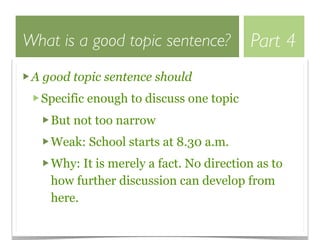
What is a good topic sentence?           Part 4
 A good topic sentence should
  Specific enough to discuss one topic
    But not too narrow
    Weak: School starts at 8.30 a.m.
    Why: It is merely a fact. No direction as to
    how further discussion can develop from
    here.
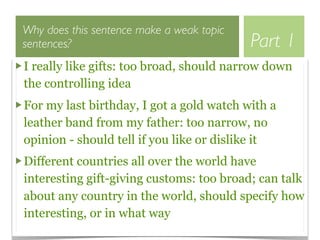
Why does this sentence make a weak topic
sentences?                                 Part 1
I really like gifts: too broad, should narrow down
the controlling idea
For my last birthday, I got a gold watch with a
leather band from my father: too narrow, no
opinion - should tell if you like or dislike it
Different countries all over the world have
interesting gift-giving customs: too broad; can talk
about any country in the world, should specify how
interesting, or in what way
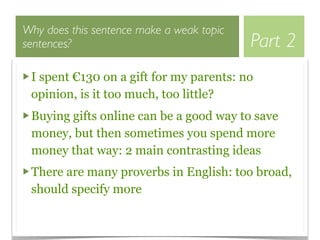
Why does this sentence make a weak topic
sentences?                                 Part 2
 I spent €130 on a gift for my parents: no
 opinion, is it too much, too little?
 Buying gifts online can be a good way to save
 money, but then sometimes you spend more
 money that way: 2 main contrasting ideas
 There are many proverbs in English: too broad,
 should specify more
Compound
sentences
and, or, nor, but, so, for, yet
Compound sentences
 are TWO independent clauses which are joined
       by coordinate conjunctions


      AND/OR/NOR/BUT/SO/FOR/YET
                  [FANBOY]


    They are used together with a comma [,]
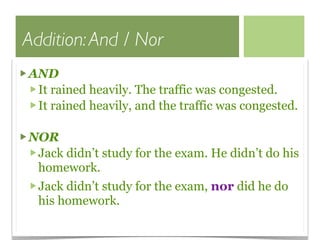
Addition: And / Nor
AND
 It rained heavily. The traffic was congested.
 It rained heavily, and the traffic was congested.

NOR
 Jack didn’t study for the exam. He didn’t do his
 homework.
 Jack didn’t study for the exam, nor did he do
 his homework.
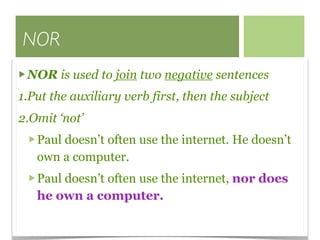
NOR
 NOR is used to join two negative sentences
1.Put the auxiliary verb first, then the subject
2.Omit ‘not’
   Paul doesn’t often use the internet. He doesn’t
   own a computer.
   Paul doesn’t often use the internet, nor does
   he own a computer.
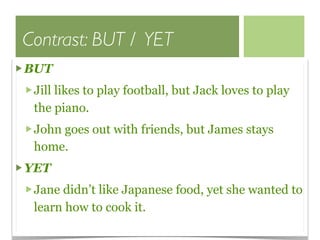
Contrast: BUT / YET
BUT
 Jill likes to play football, but Jack loves to play
 the piano.
 John goes out with friends, but James stays
 home.
YET
 Jane didn’t like Japanese food, yet she wanted to
 learn how to cook it.
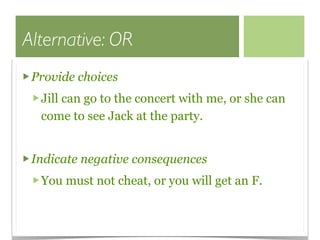
Alternative: OR
 Provide choices
  Jill can go to the concert with me, or she can
  come to see Jack at the party.


 Indicate negative consequences
  You must not cheat, or you will get an F.
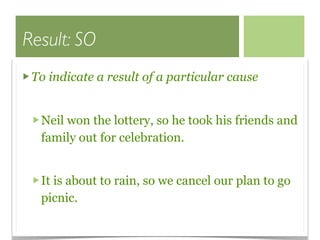
Result: SO
 To indicate a result of a particular cause


  Neil won the lottery, so he took his friends and
  family out for celebration.


  It is about to rain, so we cancel our plan to go
  picnic.
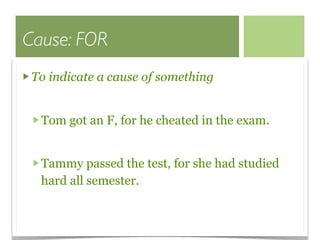
Cause: FOR
 To indicate a cause of something


  Tom got an F, for he cheated in the exam.


  Tammy passed the test, for she had studied
  hard all semester.
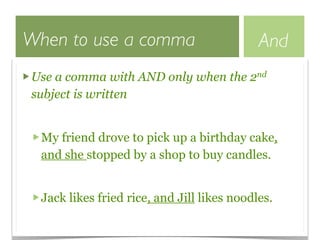
When to use a comma                          And
Use a comma with AND only when the 2nd
subject is written


  My friend drove to pick up a birthday cake,
  and she stopped by a shop to buy candles.


  Jack likes fried rice, and Jill likes noodles.
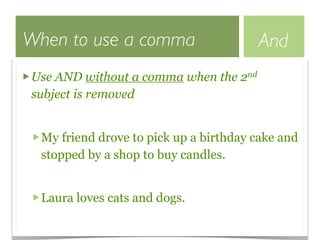
When to use a comma                     And
Use AND without a comma when the 2nd
subject is removed


  My friend drove to pick up a birthday cake and
  stopped by a shop to buy candles.


  Laura loves cats and dogs.

W unit 2

  • 1.
    Unit 2 Identifying main ideas & Compound Sentences
  • 2.
    What is agood topic sentence? Part 1 A good topic sentence should Have ONE clear topic Weak: It’s important to have friends, and to do well in school. Why: 2 topics; having friends, and doing well academically
  • 3.
    What is agood topic sentence? Part 2 A good topic sentence should Contain an opinion of the topic Weak: I have been studying karate. Why: mention the action without expressing an idea. What do you think about studying karate?
  • 4.
    What is agood topic sentence? Part 3 A good topic sentence should Broad enough to contain the idea But not too broad Weak: Australia is an interesting country. Why: Interesting how? In what way? The topic sentence is too general. The paragraph lacks the controlling idea.
  • 5.
    What is agood topic sentence? Part 4 A good topic sentence should Specific enough to discuss one topic But not too narrow Weak: School starts at 8.30 a.m. Why: It is merely a fact. No direction as to how further discussion can develop from here.
  • 6.
    Why does thissentence make a weak topic sentences? Part 1 I really like gifts: too broad, should narrow down the controlling idea For my last birthday, I got a gold watch with a leather band from my father: too narrow, no opinion - should tell if you like or dislike it Different countries all over the world have interesting gift-giving customs: too broad; can talk about any country in the world, should specify how interesting, or in what way
  • 7.
    Why does thissentence make a weak topic sentences? Part 2 I spent €130 on a gift for my parents: no opinion, is it too much, too little? Buying gifts online can be a good way to save money, but then sometimes you spend more money that way: 2 main contrasting ideas There are many proverbs in English: too broad, should specify more
  • 8.
  • 9.
    Compound sentences areTWO independent clauses which are joined by coordinate conjunctions AND/OR/NOR/BUT/SO/FOR/YET [FANBOY] They are used together with a comma [,]
  • 10.
    Addition: And /Nor AND It rained heavily. The traffic was congested. It rained heavily, and the traffic was congested. NOR Jack didn’t study for the exam. He didn’t do his homework. Jack didn’t study for the exam, nor did he do his homework.
  • 11.
    NOR NOR isused to join two negative sentences 1.Put the auxiliary verb first, then the subject 2.Omit ‘not’ Paul doesn’t often use the internet. He doesn’t own a computer. Paul doesn’t often use the internet, nor does he own a computer.
  • 12.
    Contrast: BUT /YET BUT Jill likes to play football, but Jack loves to play the piano. John goes out with friends, but James stays home. YET Jane didn’t like Japanese food, yet she wanted to learn how to cook it.
  • 13.
    Alternative: OR Providechoices Jill can go to the concert with me, or she can come to see Jack at the party. Indicate negative consequences You must not cheat, or you will get an F.
  • 14.
    Result: SO Toindicate a result of a particular cause Neil won the lottery, so he took his friends and family out for celebration. It is about to rain, so we cancel our plan to go picnic.
  • 15.
    Cause: FOR Toindicate a cause of something Tom got an F, for he cheated in the exam. Tammy passed the test, for she had studied hard all semester.
  • 16.
    When to usea comma And Use a comma with AND only when the 2nd subject is written My friend drove to pick up a birthday cake, and she stopped by a shop to buy candles. Jack likes fried rice, and Jill likes noodles.
  • 17.
    When to usea comma And Use AND without a comma when the 2nd subject is removed My friend drove to pick up a birthday cake and stopped by a shop to buy candles. Laura loves cats and dogs.