
OBJECT-ORIENTED DATA
MODEL :
Concept of Inheritance &
Persistent programming languages
Name : Vyanktesh Haribhau Dorlikar
Roll No : 1324
OODM
 Loosely speaking, an object corresponds to an
entity in the E-R model.
 An object represents a real world entity
(Person), a concept (Cricket Match), a logical
thing (Driving Licence), a physical thing (Car)
 An object associated with :
◦ A set of variables that contain the data for the object. The value of
each variable is itself an object.
◦ A set of messages to which the object responds; each message may
have zero, one, or more parameters.
◦ A set of methods, each of which is a body of code to implement a
message; a method returns a value as the response to the message
Class Definition
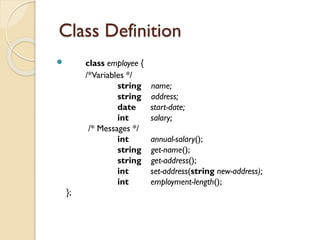
 class employee {
/*Variables */
string name;
string address;
date start-date;
int salary;
/* Messages */
int annual-salary();
string get-name();
string get-address();
int set-address(string new-address);
int employment-length();
};
Inheritance
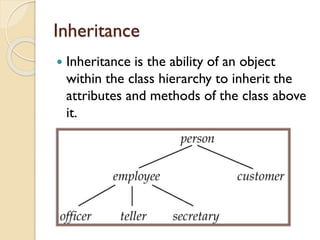
 Inheritance is the ability of an object
within the class hierarchy to inherit the
attributes and methods of the class above
it.
 E.g., Some part of the class of bank
customers is similar to class of bank
employees, although there are differences
◦ both share some variables and messages, e.g., name
and address.
◦ But there are variables and messages specific to each
class e.g., salary for employees and credit-rating for
customers.
 Every employee is a person; thus
employee is a specialization of person
 Similarly, customer is a specialization of
person.
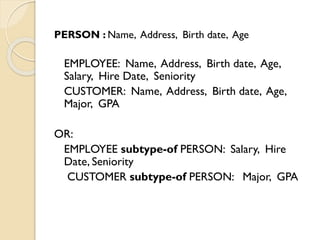
PERSON : Name, Address, Birth date, Age
EMPLOYEE: Name, Address, Birth date, Age,
Salary, Hire Date, Seniority
CUSTOMER: Name, Address, Birth date, Age,
Major, GPA
OR:
EMPLOYEE subtype-of PERSON: Salary, Hire
Date, Seniority
CUSTOMER subtype-of PERSON: Major, GPA
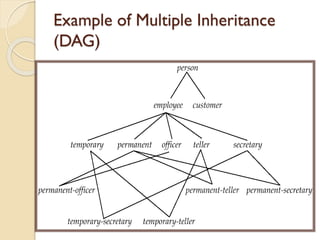
Multiple Inheritance
 With multiple inheritance a class may have more than one super
class.
◦ The class/subclass relationship is represented by a directed acyclic
graph (DAG)
◦ Particularly useful when objects can be classified in more than one
way, which are independent of each other
 E.g. temporary/permanent is independent of
Officer/secretary/teller
◦ Eg . A person can play the roles of student, a teacher or
footballPlayer, or any combination of the three
 E.g., student who is teaching assistant who also play football
 Multiple Inheritance Create a subclass for each combination of
subclasses
 Need not create subclasses for combinations that are not possible
in the database being modeled
 A class inherits variables and methods from all its
superclasses
 There is potential for ambiguity when a
variable/message N with the same name is inherited
from two superclasses A and B
◦ No problem if the variable/message is defined in a shared
superclass
◦ Otherwise, do one of the following
 flag as an error,
 rename variables (A.N and B.N)
 choose one.
Example of Multiple Inheritance
(DAG)
Object-Oriented Languages
 Object-oriented concepts can be used in
different ways
◦ Object-orientation can be used as a design tool, and be encoded into,
for example, a relational database
(analogous to modeling data with E-R diagram and then converting to
a set of relations)
◦ The concepts of object orientation can be incorporated into a
programming language that is used to manipulate the database.
 Persistent programming languages – extend object-oriented
programming language to deal with databases by adding concepts
such as persistence and collections.
Persistent Programming Languages
 Persistent Programming languages allow
objects to be created and stored in a
database, and used directly from a
programming language
◦ allow data to be manipulated directly from the programming language
 No need to go through SQL.
◦ No need for explicit format (type) changes
 format changes are carried out transparently by system
 Without a persistent programming language, format changes becomes a
burden on the programmer
 More code to be written
 More chance of bugs
◦ allow objects to be manipulated in-memory
 no need to explicitly load from or store to the database
 Saved code, and saved overhead of loading/storing large amounts of
data
 Drawbacks of persistent programming
languages
◦ Due to power of most programming languages, it is easy to make
programming errors that damage the database.
◦ Complexity of languages makes automatic high-level optimization more
difficult.
Persistent C++ Systems
 C++ language allows support for persistence to be added
without changing the language
◦ Declare a class called Persistent Object with attributes and methods to
support persistence
◦ Overloading – ability to redefine standard function names and operators
(i.e., +, –, the pointer deference operator –>) when applied to new types
◦ Template classes help to build a type-safe system supporting collections
and persistent types.
 Providing persistence without extending the C++ language is
◦ relatively easy to implement
◦ but more difficult to use
Persistent Java Systems
 (object database management group)ODMG-3.0
defines extensions to Java for persistence
◦ Java does not support templates, so language extensions are required
 Class is made persistence capable by running a
post-processor on object code generated by the
Java compiler
◦ Contrast with pre-processor used in C++
◦ Post-processor adds mark_modified() automatically
 Defines collection types Dset(union, intersection, diff),
Dlist(creates list of objects), etc.
 Uses Java iterators, no need for new iterator class
 Transaction must start accessing database
from one of the root object (looked up
by name)
◦ finds other objects by following pointers from the root objects
 a fetched object are allocated space in
memory, but all objects not necessarily
fetched
◦ An object with space allocated but not yet fetched is called a hollow
object
◦ When a hollow object is accessed, its data is fetched from disk.
THANK YOU

Object oriented data model

  • 1.
    OBJECT-ORIENTED DATA MODEL : Conceptof Inheritance & Persistent programming languages Name : Vyanktesh Haribhau Dorlikar Roll No : 1324
  • 2.
    OODM  Loosely speaking,an object corresponds to an entity in the E-R model.  An object represents a real world entity (Person), a concept (Cricket Match), a logical thing (Driving Licence), a physical thing (Car)  An object associated with : ◦ A set of variables that contain the data for the object. The value of each variable is itself an object. ◦ A set of messages to which the object responds; each message may have zero, one, or more parameters. ◦ A set of methods, each of which is a body of code to implement a message; a method returns a value as the response to the message
  • 3.
    Class Definition  classemployee { /*Variables */ string name; string address; date start-date; int salary; /* Messages */ int annual-salary(); string get-name(); string get-address(); int set-address(string new-address); int employment-length(); };
  • 4.
    Inheritance  Inheritance isthe ability of an object within the class hierarchy to inherit the attributes and methods of the class above it.
  • 5.
     E.g., Somepart of the class of bank customers is similar to class of bank employees, although there are differences ◦ both share some variables and messages, e.g., name and address. ◦ But there are variables and messages specific to each class e.g., salary for employees and credit-rating for customers.  Every employee is a person; thus employee is a specialization of person  Similarly, customer is a specialization of person.
  • 6.
    PERSON : Name,Address, Birth date, Age EMPLOYEE: Name, Address, Birth date, Age, Salary, Hire Date, Seniority CUSTOMER: Name, Address, Birth date, Age, Major, GPA OR: EMPLOYEE subtype-of PERSON: Salary, Hire Date, Seniority CUSTOMER subtype-of PERSON: Major, GPA
  • 7.
    Multiple Inheritance  Withmultiple inheritance a class may have more than one super class. ◦ The class/subclass relationship is represented by a directed acyclic graph (DAG) ◦ Particularly useful when objects can be classified in more than one way, which are independent of each other  E.g. temporary/permanent is independent of Officer/secretary/teller ◦ Eg . A person can play the roles of student, a teacher or footballPlayer, or any combination of the three  E.g., student who is teaching assistant who also play football  Multiple Inheritance Create a subclass for each combination of subclasses  Need not create subclasses for combinations that are not possible in the database being modeled
  • 8.
     A classinherits variables and methods from all its superclasses  There is potential for ambiguity when a variable/message N with the same name is inherited from two superclasses A and B ◦ No problem if the variable/message is defined in a shared superclass ◦ Otherwise, do one of the following  flag as an error,  rename variables (A.N and B.N)  choose one.
  • 9.
    Example of MultipleInheritance (DAG)
  • 10.
    Object-Oriented Languages  Object-orientedconcepts can be used in different ways ◦ Object-orientation can be used as a design tool, and be encoded into, for example, a relational database (analogous to modeling data with E-R diagram and then converting to a set of relations) ◦ The concepts of object orientation can be incorporated into a programming language that is used to manipulate the database.  Persistent programming languages – extend object-oriented programming language to deal with databases by adding concepts such as persistence and collections.
  • 11.
    Persistent Programming Languages Persistent Programming languages allow objects to be created and stored in a database, and used directly from a programming language ◦ allow data to be manipulated directly from the programming language  No need to go through SQL. ◦ No need for explicit format (type) changes  format changes are carried out transparently by system  Without a persistent programming language, format changes becomes a burden on the programmer  More code to be written  More chance of bugs ◦ allow objects to be manipulated in-memory  no need to explicitly load from or store to the database  Saved code, and saved overhead of loading/storing large amounts of data
  • 12.
     Drawbacks ofpersistent programming languages ◦ Due to power of most programming languages, it is easy to make programming errors that damage the database. ◦ Complexity of languages makes automatic high-level optimization more difficult.
  • 13.
    Persistent C++ Systems C++ language allows support for persistence to be added without changing the language ◦ Declare a class called Persistent Object with attributes and methods to support persistence ◦ Overloading – ability to redefine standard function names and operators (i.e., +, –, the pointer deference operator –>) when applied to new types ◦ Template classes help to build a type-safe system supporting collections and persistent types.  Providing persistence without extending the C++ language is ◦ relatively easy to implement ◦ but more difficult to use
  • 14.
    Persistent Java Systems (object database management group)ODMG-3.0 defines extensions to Java for persistence ◦ Java does not support templates, so language extensions are required  Class is made persistence capable by running a post-processor on object code generated by the Java compiler ◦ Contrast with pre-processor used in C++ ◦ Post-processor adds mark_modified() automatically  Defines collection types Dset(union, intersection, diff), Dlist(creates list of objects), etc.  Uses Java iterators, no need for new iterator class
  • 15.
     Transaction muststart accessing database from one of the root object (looked up by name) ◦ finds other objects by following pointers from the root objects  a fetched object are allocated space in memory, but all objects not necessarily fetched ◦ An object with space allocated but not yet fetched is called a hollow object ◦ When a hollow object is accessed, its data is fetched from disk.
  • 16.