DISCOVER . LEARN . EMPOWER
UNIVERSITY INSTITUTE OF
COMPUTING
Master of Computer Applications
Winning Camp – Content
MCA (TPP) - 2021 Batch
Logic Building
*
*
*
3
Why use OOP?
• Object Oriented Programming (OOP) is one of the most widely used programming paradigm
• Why is it extensively used?
• Well suited for building trivial and complex applications
• Allows re-use of code thereby increasing productivity
• New features can be easily built into the existing code
• Reduced production cost and maintenance cost
• Common programming languages used for OOP include C++, Java, and C#
• Object: models a
• Real world object (ex. computer, book, box)
• Concept (ex. meeting, interview)
• Process (ex. sorting a stack of papers or comparing two computers to measure their performance)
May create many objects from a given class
- Each object will have its own attribute, but will have identical behaviour.
• Class:
• prototype or blueprint from which objects are created
• The class construct provides a template (or blueprint) for the creation of objects.
• Classes specify what attributes and behaviour an object may have.
*
*
*
3
1. Objects & Classes
• Class has
• Set of attributes or properties that describes every object
• Set of behavior or actions that every object can perform
• Object has
• Set of data (value for each of its attribute)
• Set of actions that it can perform
• An identity
*
*
*
3
Objects & Classes
• In old style programming, you had:
• data, which was completely passive
• functions, which could manipulate any data
• An object contains both data and methods that manipulate that data
• An object is active, not passive; it does things
• An object is responsible for its own data
• But: it can expose that data to other objects
*
*
*
3
An object has behaviors
*
*
*
3
An object has state
• An object contains both data and methods that manipulate that data
• The data represent the state of the object
• Data can also describe the relationships between this object and other objects
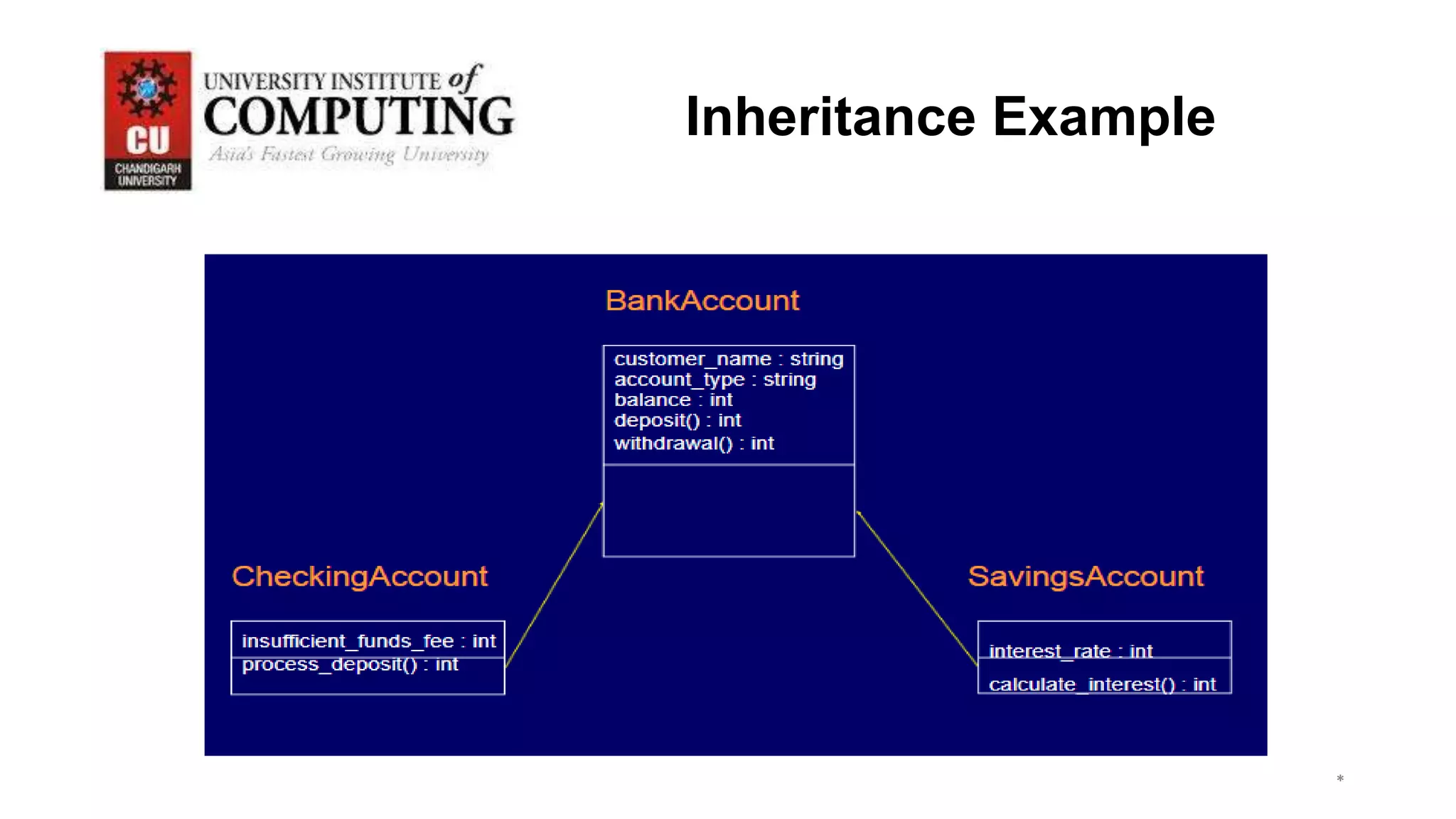
• Example: A CheckingAccount might have
• A balance (the internal state of the account)
• An owner (some object representing a person)
*
*
*
3
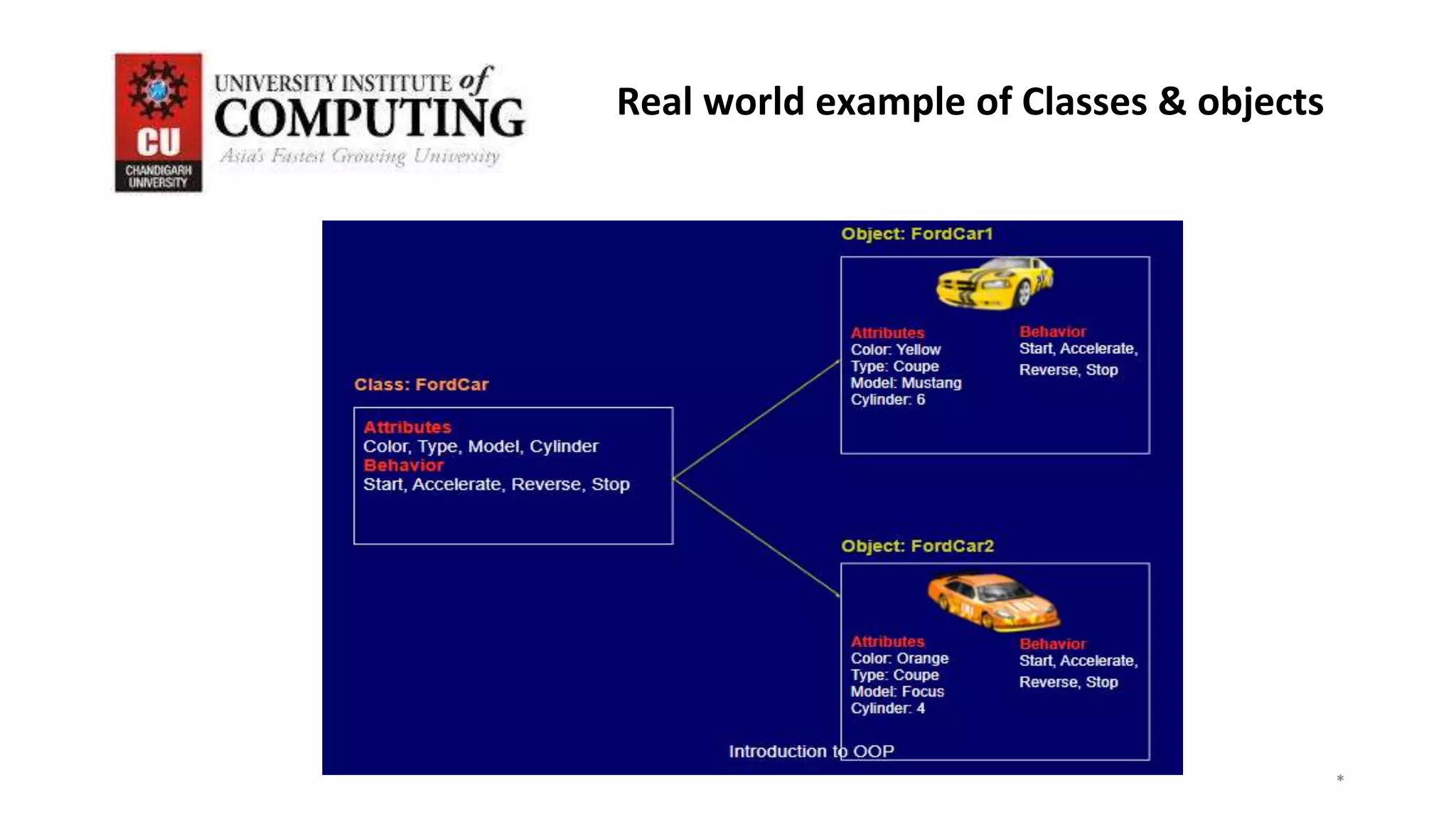
Real world example of Classes & objects
*
*
*
3
Real world example of Classes & objects
• A Class is a set of variables (to represent its attributes) and functions (to describe its behavior)
that act on its variables
• Object is an instance of a class that holds data (values) in its variables. Data can be accessed by its
functions
• Every object belongs to (is an instance of) a class
• An object may have fields, or variables
• The class describes those fields
• An object may have methods
• The class describes those methods
• A class is like a template, or cookie cutter
• You use the class’s constructor to make objects
*
*
*
3
Classes describe objects
• Every class object
- Has its own data members
- Has its own member functions (which are the same as other objects of the
same class have)
- When a member function accesses a data member
By default the function accesses the data member of the object to which it belongs!
- No special notation needed
*
*
*
3
Remember
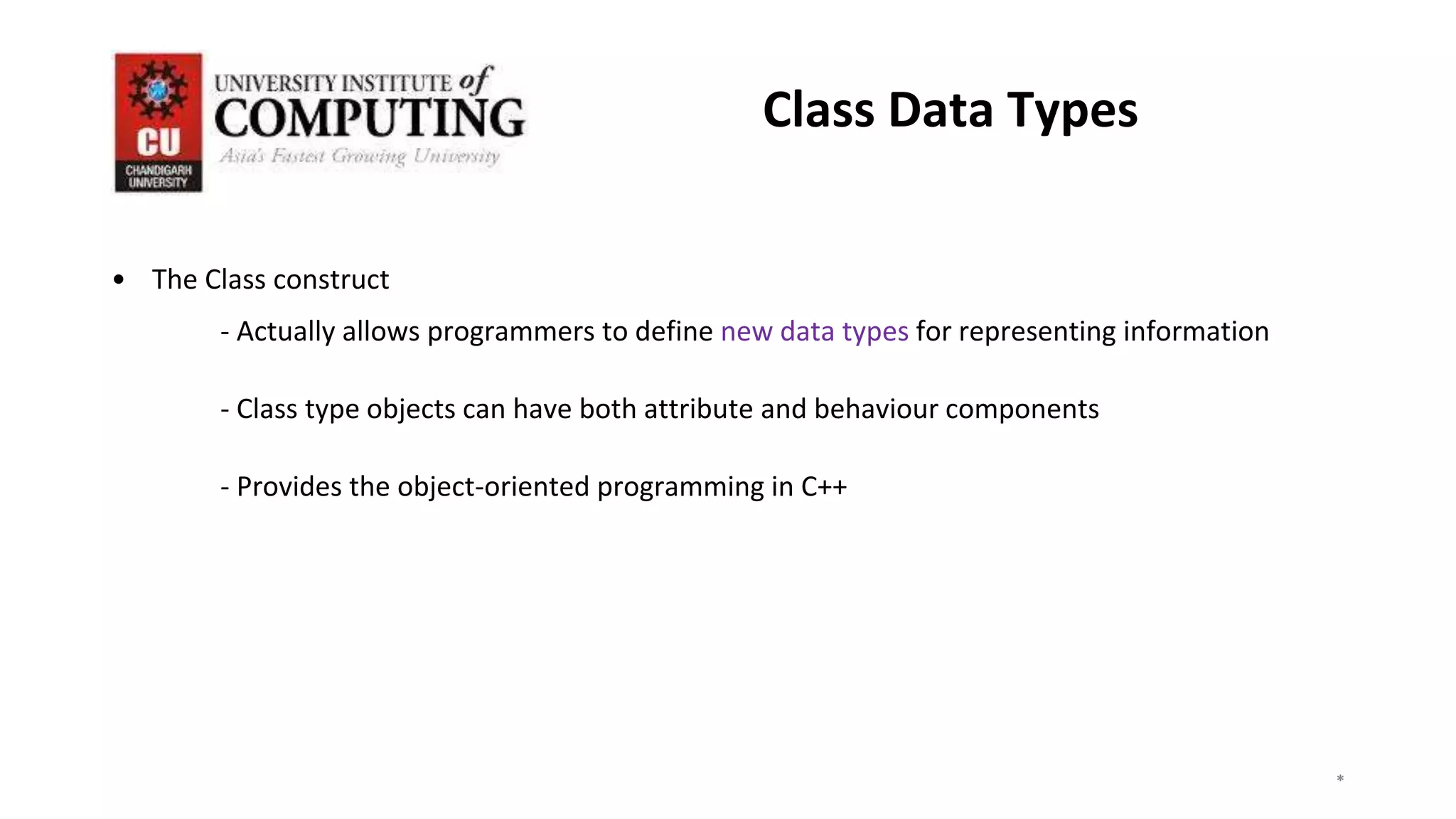
• The Class construct
- Actually allows programmers to define new data types for representing information
- Class type objects can have both attribute and behaviour components
- Provides the object-oriented programming in C++
*
*
*
3
Class Data Types
*
*
*
3
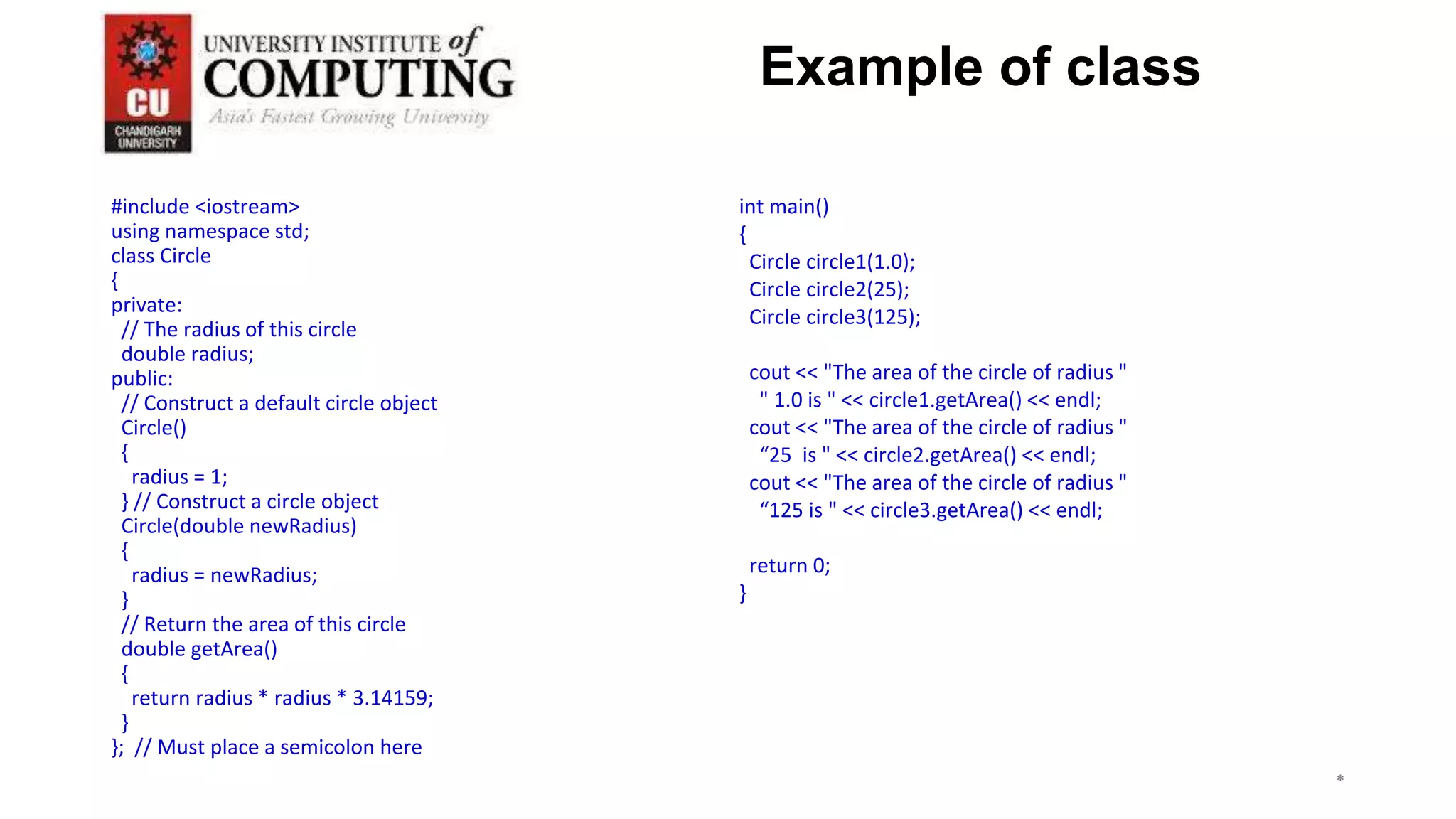
Example of class
#include <iostream>
using namespace std;
class Circle
{
private:
// The radius of this circle
double radius;
public:
// Construct a default circle object
Circle()
{
radius = 1;
} // Construct a circle object
Circle(double newRadius)
{
radius = newRadius;
}
// Return the area of this circle
double getArea()
{
return radius * radius * 3.14159;
}
}; // Must place a semicolon here
int main()
{
Circle circle1(1.0);
Circle circle2(25);
Circle circle3(125);
cout << "The area of the circle of radius "
" 1.0 is " << circle1.getArea() << endl;
cout << "The area of the circle of radius "
“25 is " << circle2.getArea() << endl;
cout << "The area of the circle of radius "
“125 is " << circle3.getArea() << endl;
return 0;
}
*
*
*
3
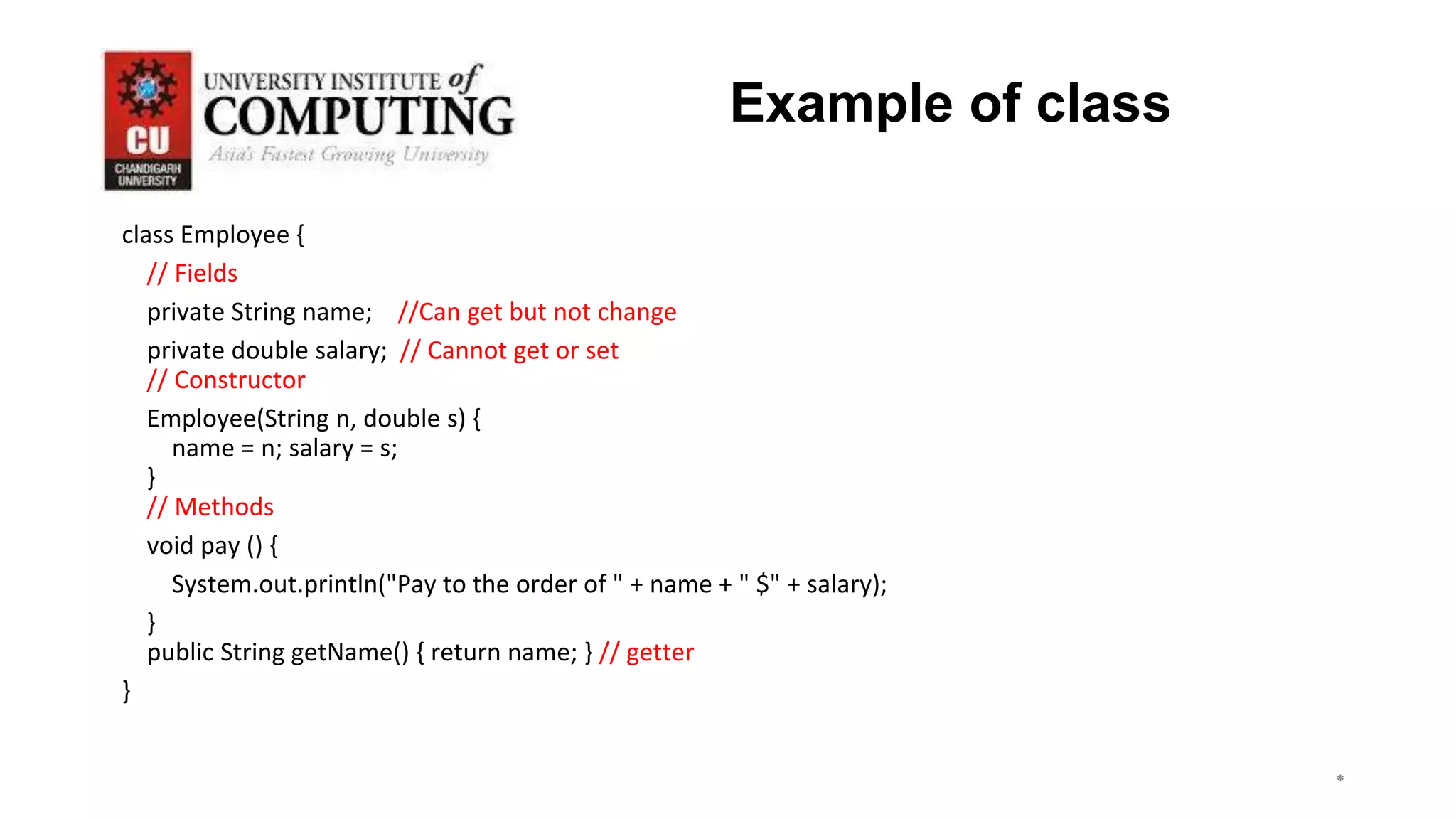
Example of class
class Employee {
// Fields
private String name; //Can get but not change
private double salary; // Cannot get or set
// Constructor
Employee(String n, double s) {
name = n; salary = s;
}
// Methods
void pay () {
System.out.println("Pay to the order of " + name + " $" + salary);
}
public String getName() { return name; } // getter
}
*
*
*
3
Example of class
• instance = object
• field = instance variable
• method = function
• sending a message to an object = calling a function
• These are all approximately true
*
*
*
3
Approximate Terminology
*
*
*
3
C++ & Java
• In C++ there may be more than one root
• but not in Java!
• In C++ an object may have more than one parent (immediate superclass)
• but not in Java!
• Java has a single, strict hierarchy
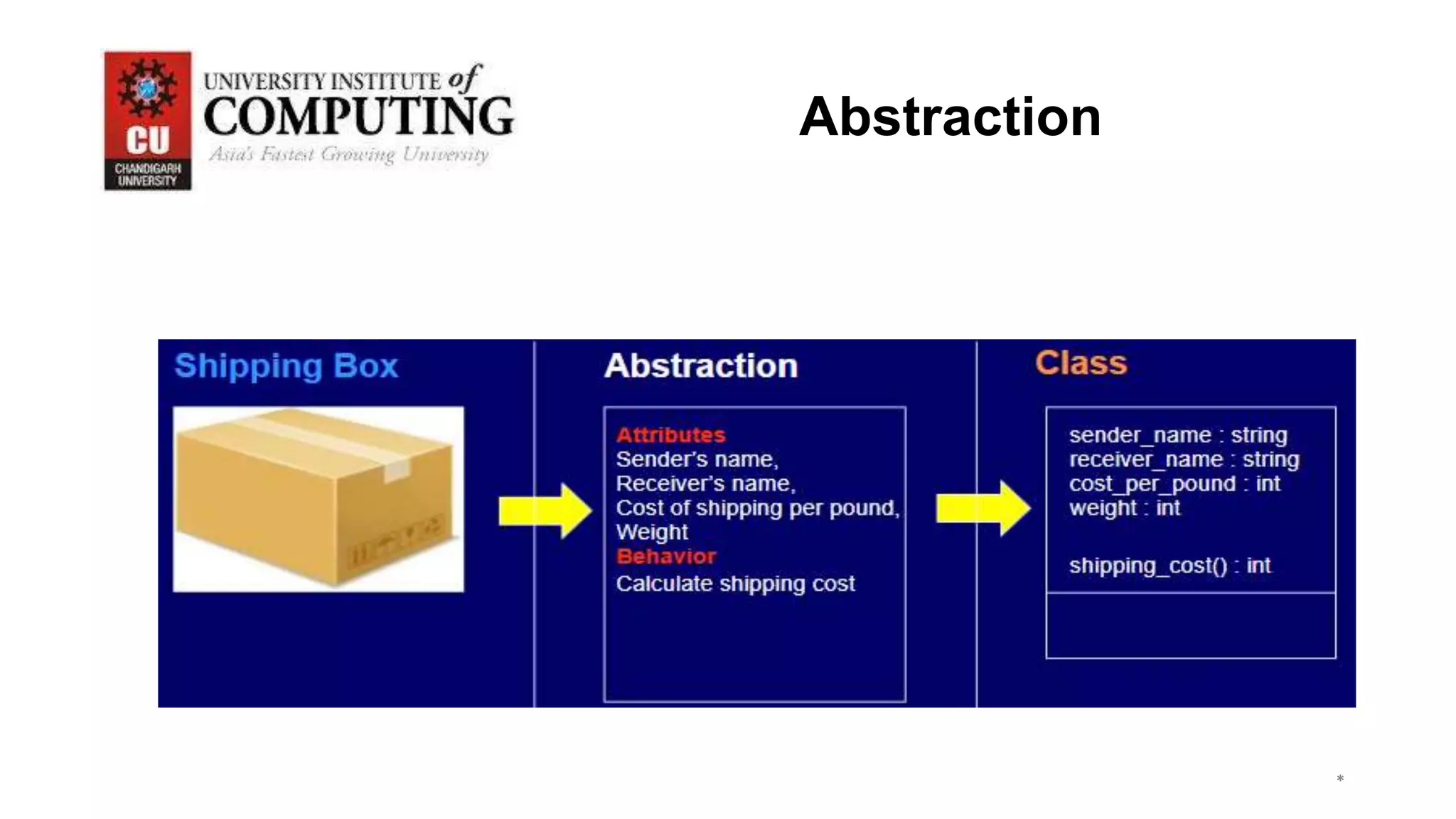
• Extracting essential properties and behavior of an entity
• Class represents such an abstraction and is commonly referred to as an abstract data type
• Extract only the relevant properties of a real-world of or developing a class while ignoring the
inessentials
• For any problem, extract the relevant real-world object properties for software objects, while
ignoring inessentials
• Defines a view of the software object
*
*
*
3
2. Abstraction
*
*
*
3
Abstraction
*
*
*
3
Abstraction
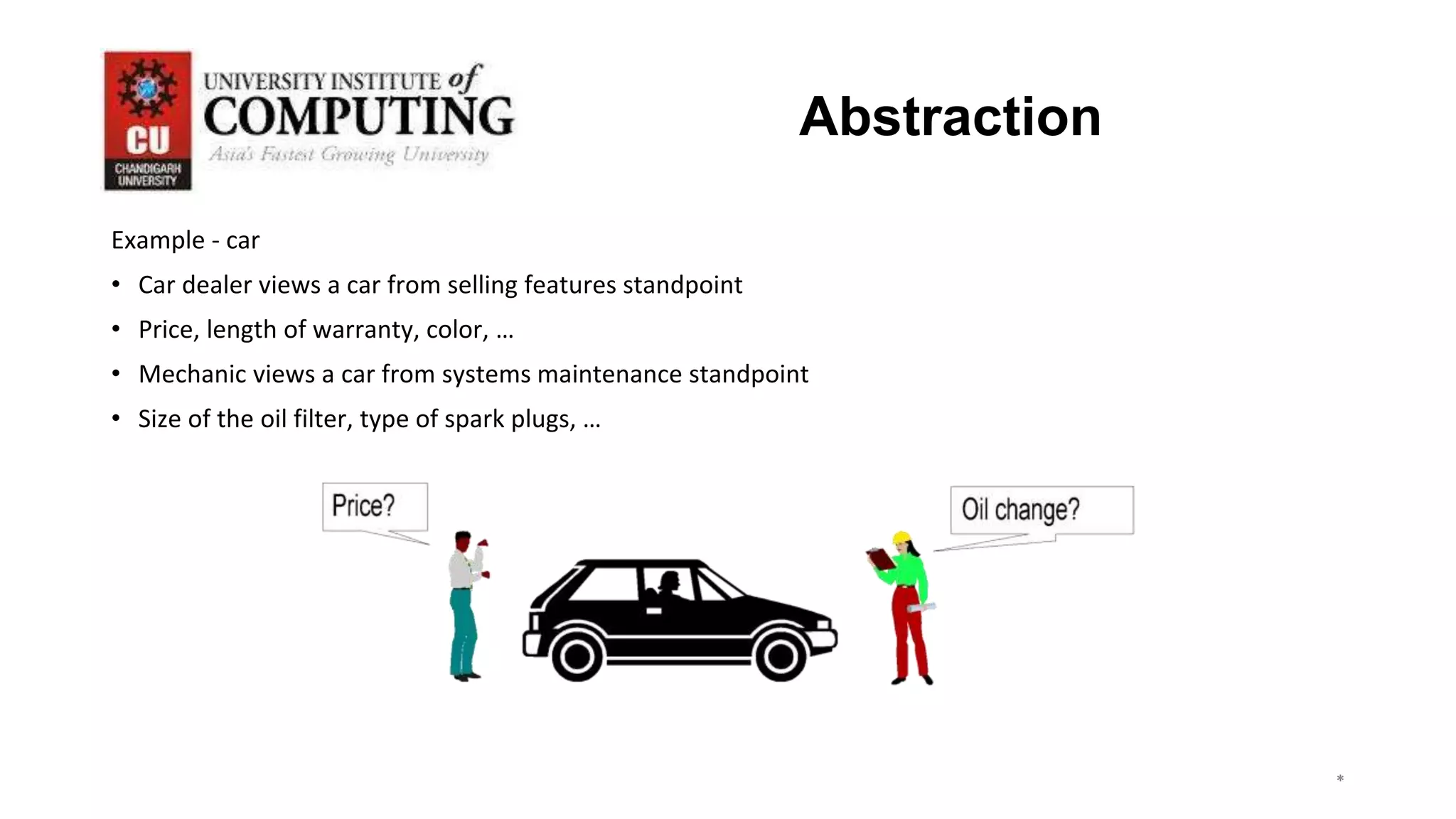
Example - car
• Car dealer views a car from selling features standpoint
• Price, length of warranty, color, …
• Mechanic views a car from systems maintenance standpoint
• Size of the oil filter, type of spark plugs, …
*
*
*
3
3. Encapsulation and
Information Hiding
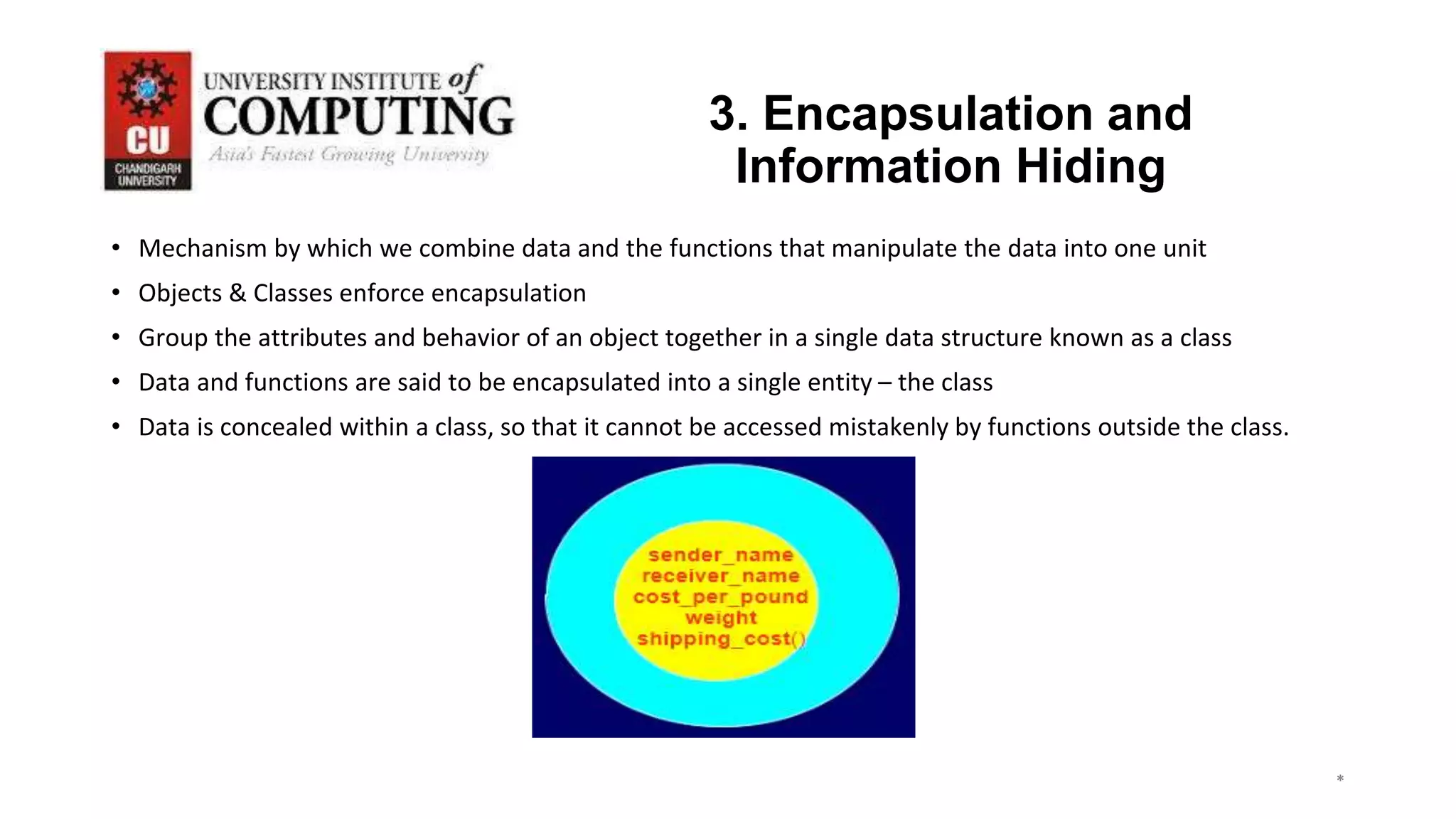
• Mechanism by which we combine data and the functions that manipulate the data into one unit
• Objects & Classes enforce encapsulation
• Group the attributes and behavior of an object together in a single data structure known as a class
• Data and functions are said to be encapsulated into a single entity – the class
• Data is concealed within a class, so that it cannot be accessed mistakenly by functions outside the class.

*
*
*
3
Encapsulation
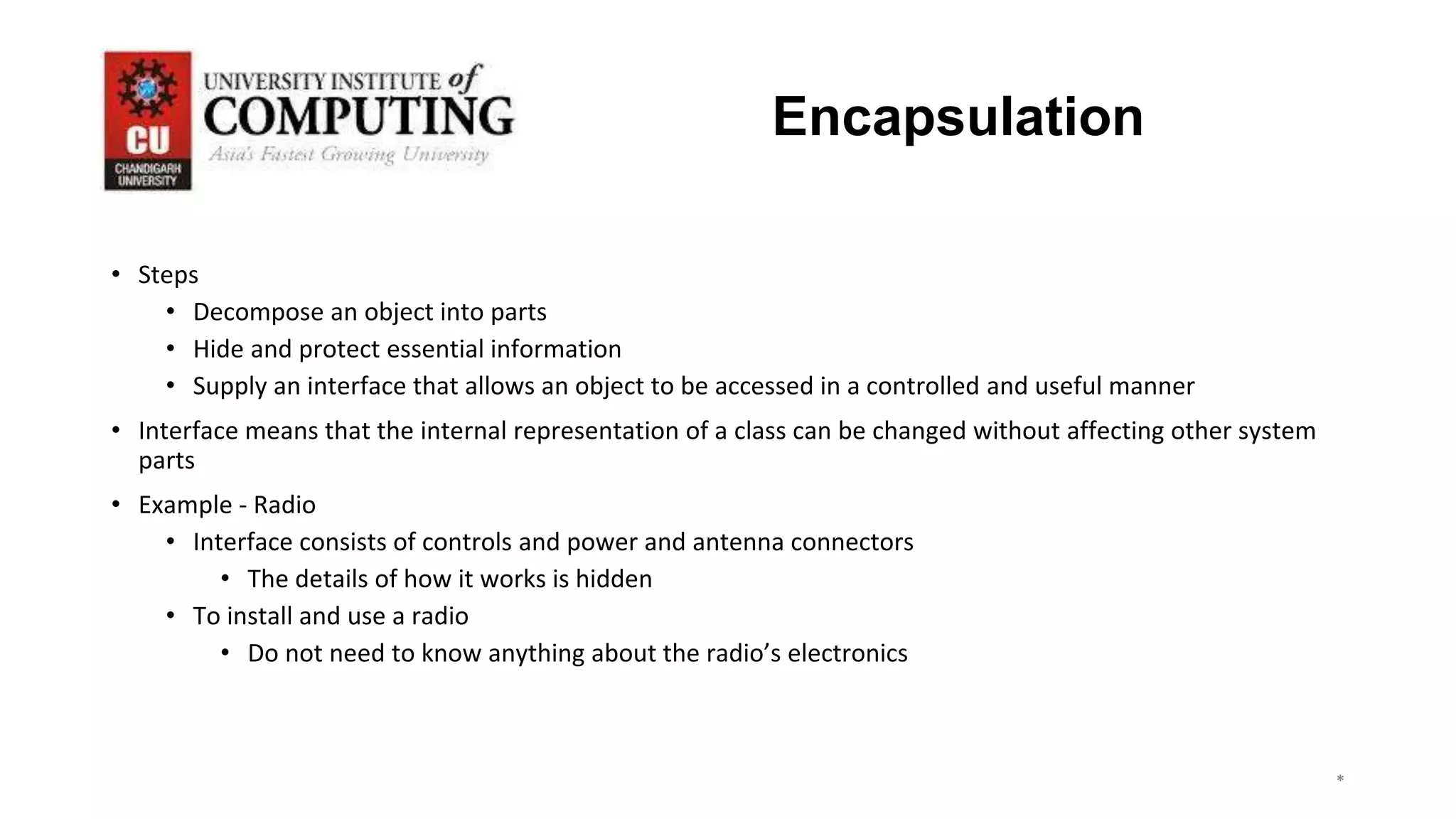
• Steps
• Decompose an object into parts
• Hide and protect essential information
• Supply an interface that allows an object to be accessed in a controlled and useful manner
• Interface means that the internal representation of a class can be changed without affecting other system
parts
• Example - Radio
• Interface consists of controls and power and antenna connectors
• The details of how it works is hidden
• To install and use a radio
• Do not need to know anything about the radio’s electronics
*
*
*
3
Modularity
• Dividing an object into smaller pieces or “modules” so that the object is easier to understand and
• Most complex systems are modular
• Example - Car can be decomposed into subsystems
1. Cooling system
• Radiator Thermostat Water pump
2. Ignition system
• Battery Starter motor Spark plugs
*
*
*
3
Hierarchy
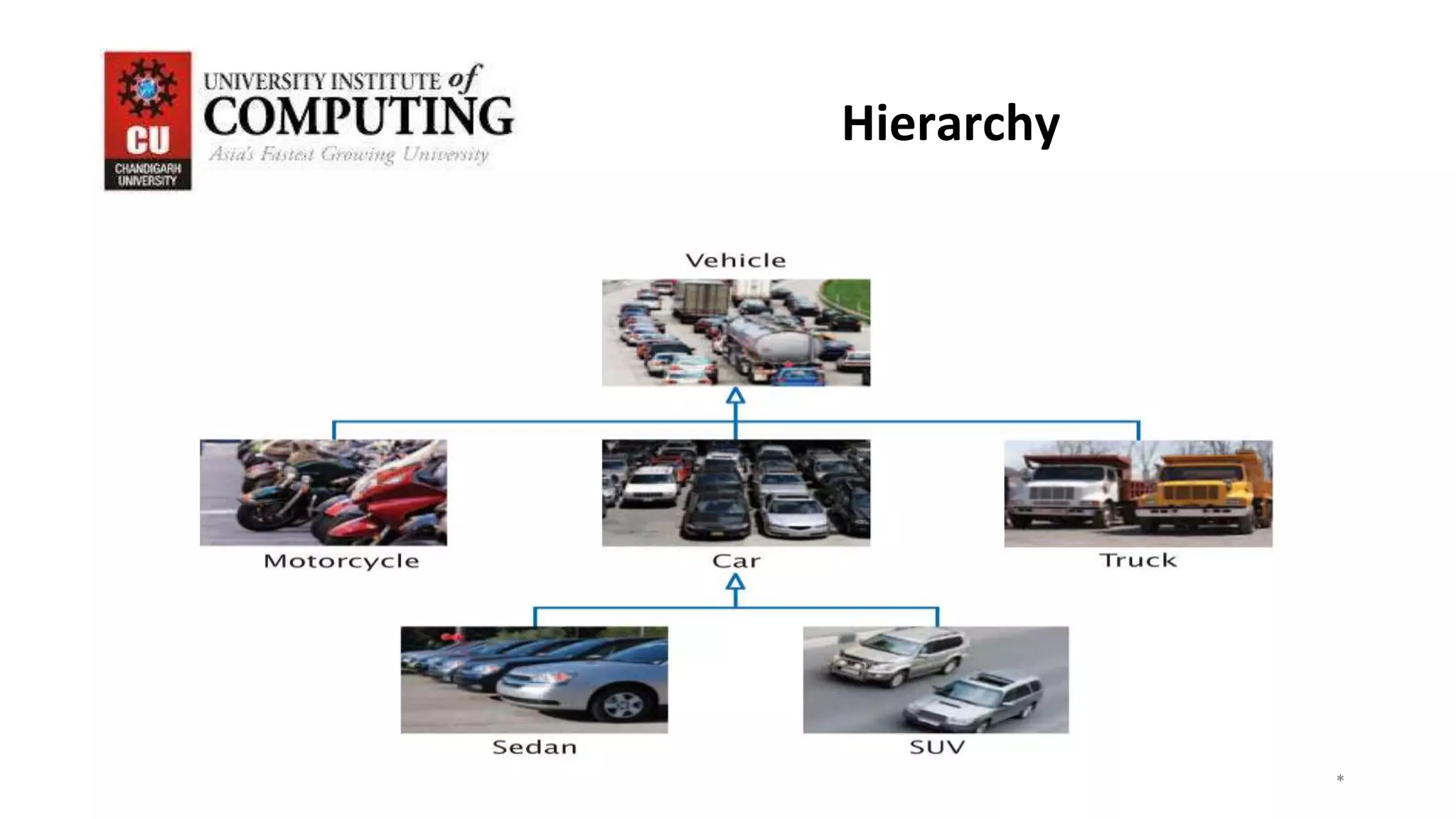
• Hierarchy
• Ranking or ordering of objects based on some relationship between them
• Helps us understand complex systems
• Example - a company hierarchy helps employees understand the company and their positions within it
• For complex systems, a useful way of ordering similar abstractions is a taxonomy
from least general to most general
• Classes are arranged in a tree like structure called a hierarchy
• The class at the root is named Object
• Every class, except Object, has a superclass
• A class may have several ancestors, up to Object
• When you define a class, you specify its superclass
• If you don’t specify a superclass, Object is assumed
• Every class may have one or more subclasses
*
*
*
3
Classes form a hierarchy
*
*
*
3
Hierarchy
*
*
*
3
4. Inheritance
• The process of creating new classes, called derived classes, from existing classes or base
classes creating a hierarchy of parent classes and child classes.
• The child classes inherit the attributes and behaviour of the parent classes.
• The derived class inherits the variables and functions of the base class and adds additional
ones!
• Provides the ability to re-use existing code
*
*
*
3
A variable can hold subclass objects
• Suppose B is a subclass of A
• A objects can be assigned to A variables
• B objects can be assigned to B variables
• B objects can be assigned to A variables, but
• A objects can not be assigned to B variables
• Every B is also an A but not every A is a B
• You can cast: bVariable = (B) aObject;
• In this case, Java does a runtime check
*
*
*
3
Objects inherit from superclasses
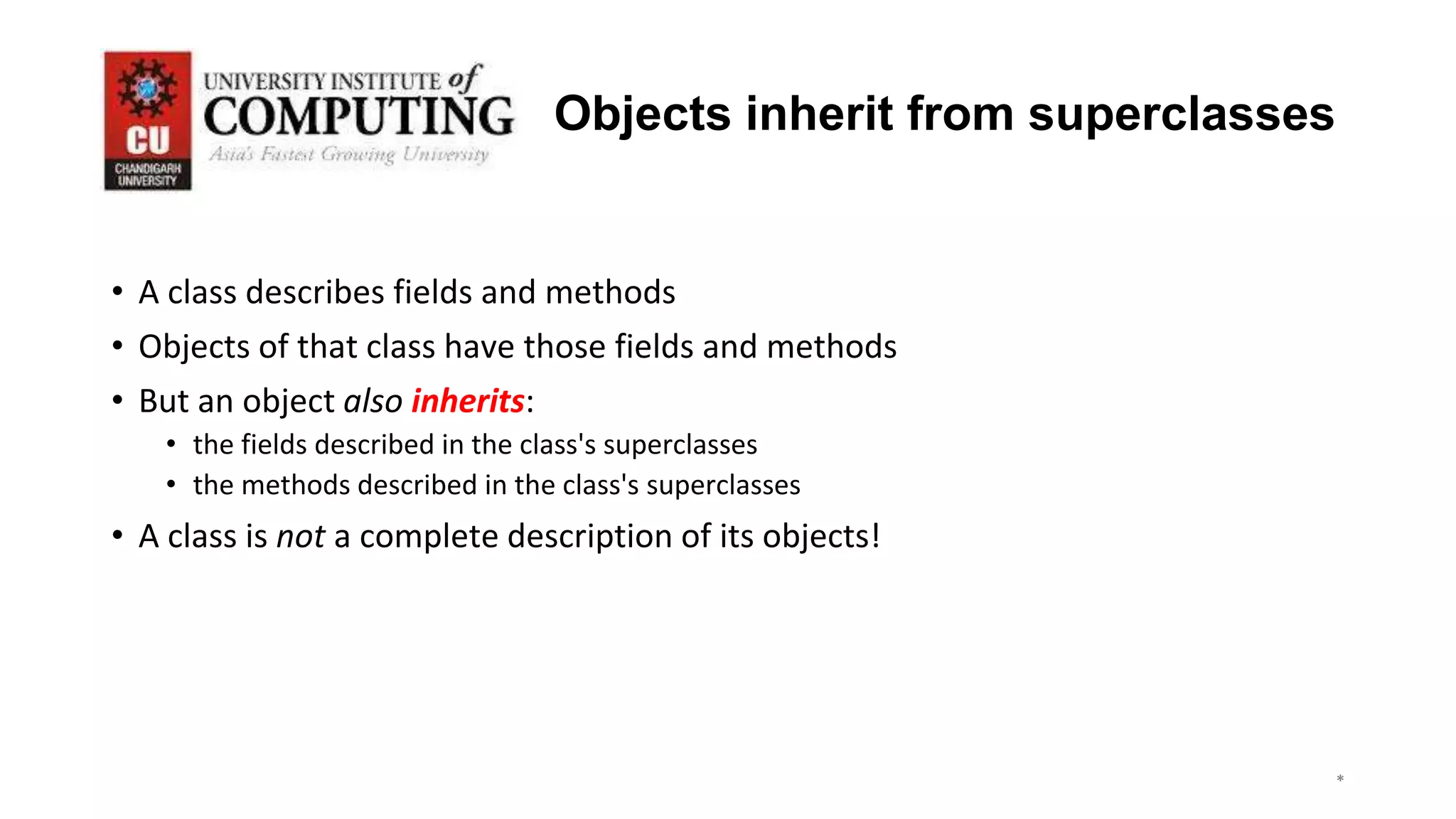
• A class describes fields and methods
• Objects of that class have those fields and methods
• But an object also inherits:
• the fields described in the class's superclasses
• the methods described in the class's superclasses
• A class is not a complete description of its objects!
*
*
*
3
Example of inheritance
class Person {
String name;
int age;
void birthday () {
age = age + 1;
}
}
class Employee
extends Person {
double salary;
void pay () { ...}
}
Every Employee has name and age fields and birthday method as well as a salary field and a pay method.
*
*
*
3
Inheritance Example
*
*
*
3
Inheritance Example
– Generally, the ability to appear in many forms
– More specifically, in OOP, it is the ability to redefine methods for derived classes
– Ability to process objects differently depending on their data type or class
– Giving different meanings to the same thing
*
*
*
3
5. Polymorphism
THANK YOU

4-OOPS.pptx

  • 1.
    DISCOVER . LEARN. EMPOWER UNIVERSITY INSTITUTE OF COMPUTING Master of Computer Applications Winning Camp – Content MCA (TPP) - 2021 Batch Logic Building
  • 2.
    * * * 3 Why use OOP? •Object Oriented Programming (OOP) is one of the most widely used programming paradigm • Why is it extensively used? • Well suited for building trivial and complex applications • Allows re-use of code thereby increasing productivity • New features can be easily built into the existing code • Reduced production cost and maintenance cost • Common programming languages used for OOP include C++, Java, and C#
  • 3.
    • Object: modelsa • Real world object (ex. computer, book, box) • Concept (ex. meeting, interview) • Process (ex. sorting a stack of papers or comparing two computers to measure their performance) May create many objects from a given class - Each object will have its own attribute, but will have identical behaviour. • Class: • prototype or blueprint from which objects are created • The class construct provides a template (or blueprint) for the creation of objects. • Classes specify what attributes and behaviour an object may have. * * * 3 1. Objects & Classes
  • 4.
    • Class has •Set of attributes or properties that describes every object • Set of behavior or actions that every object can perform • Object has • Set of data (value for each of its attribute) • Set of actions that it can perform • An identity * * * 3 Objects & Classes
  • 5.
    • In oldstyle programming, you had: • data, which was completely passive • functions, which could manipulate any data • An object contains both data and methods that manipulate that data • An object is active, not passive; it does things • An object is responsible for its own data • But: it can expose that data to other objects * * * 3 An object has behaviors
  • 6.
    * * * 3 An object hasstate • An object contains both data and methods that manipulate that data • The data represent the state of the object • Data can also describe the relationships between this object and other objects • Example: A CheckingAccount might have • A balance (the internal state of the account) • An owner (some object representing a person)
  • 7.
    * * * 3 Real world exampleof Classes & objects
  • 8.
    * * * 3 Real world exampleof Classes & objects
  • 9.
    • A Classis a set of variables (to represent its attributes) and functions (to describe its behavior) that act on its variables • Object is an instance of a class that holds data (values) in its variables. Data can be accessed by its functions • Every object belongs to (is an instance of) a class • An object may have fields, or variables • The class describes those fields • An object may have methods • The class describes those methods • A class is like a template, or cookie cutter • You use the class’s constructor to make objects * * * 3 Classes describe objects
  • 10.
    • Every classobject - Has its own data members - Has its own member functions (which are the same as other objects of the same class have) - When a member function accesses a data member By default the function accesses the data member of the object to which it belongs! - No special notation needed * * * 3 Remember
  • 11.
    • The Classconstruct - Actually allows programmers to define new data types for representing information - Class type objects can have both attribute and behaviour components - Provides the object-oriented programming in C++ * * * 3 Class Data Types
  • 12.
  • 13.
    #include <iostream> using namespacestd; class Circle { private: // The radius of this circle double radius; public: // Construct a default circle object Circle() { radius = 1; } // Construct a circle object Circle(double newRadius) { radius = newRadius; } // Return the area of this circle double getArea() { return radius * radius * 3.14159; } }; // Must place a semicolon here int main() { Circle circle1(1.0); Circle circle2(25); Circle circle3(125); cout << "The area of the circle of radius " " 1.0 is " << circle1.getArea() << endl; cout << "The area of the circle of radius " “25 is " << circle2.getArea() << endl; cout << "The area of the circle of radius " “125 is " << circle3.getArea() << endl; return 0; } * * * 3 Example of class
  • 14.
    class Employee { //Fields private String name; //Can get but not change private double salary; // Cannot get or set // Constructor Employee(String n, double s) { name = n; salary = s; } // Methods void pay () { System.out.println("Pay to the order of " + name + " $" + salary); } public String getName() { return name; } // getter } * * * 3 Example of class
  • 15.
    • instance =object • field = instance variable • method = function • sending a message to an object = calling a function • These are all approximately true * * * 3 Approximate Terminology
  • 16.
    * * * 3 C++ & Java •In C++ there may be more than one root • but not in Java! • In C++ an object may have more than one parent (immediate superclass) • but not in Java! • Java has a single, strict hierarchy
  • 17.
    • Extracting essentialproperties and behavior of an entity • Class represents such an abstraction and is commonly referred to as an abstract data type • Extract only the relevant properties of a real-world of or developing a class while ignoring the inessentials • For any problem, extract the relevant real-world object properties for software objects, while ignoring inessentials • Defines a view of the software object * * * 3 2. Abstraction
  • 18.
  • 19.
    * * * 3 Abstraction Example - car •Car dealer views a car from selling features standpoint • Price, length of warranty, color, … • Mechanic views a car from systems maintenance standpoint • Size of the oil filter, type of spark plugs, …
  • 20.
    * * * 3 3. Encapsulation and InformationHiding • Mechanism by which we combine data and the functions that manipulate the data into one unit • Objects & Classes enforce encapsulation • Group the attributes and behavior of an object together in a single data structure known as a class • Data and functions are said to be encapsulated into a single entity – the class • Data is concealed within a class, so that it cannot be accessed mistakenly by functions outside the class.
  • 21.
    * * * 3 Encapsulation • Steps • Decomposean object into parts • Hide and protect essential information • Supply an interface that allows an object to be accessed in a controlled and useful manner • Interface means that the internal representation of a class can be changed without affecting other system parts • Example - Radio • Interface consists of controls and power and antenna connectors • The details of how it works is hidden • To install and use a radio • Do not need to know anything about the radio’s electronics
  • 22.
    * * * 3 Modularity • Dividing anobject into smaller pieces or “modules” so that the object is easier to understand and • Most complex systems are modular • Example - Car can be decomposed into subsystems 1. Cooling system • Radiator Thermostat Water pump 2. Ignition system • Battery Starter motor Spark plugs
  • 23.
    * * * 3 Hierarchy • Hierarchy • Rankingor ordering of objects based on some relationship between them • Helps us understand complex systems • Example - a company hierarchy helps employees understand the company and their positions within it • For complex systems, a useful way of ordering similar abstractions is a taxonomy from least general to most general
  • 24.
    • Classes arearranged in a tree like structure called a hierarchy • The class at the root is named Object • Every class, except Object, has a superclass • A class may have several ancestors, up to Object • When you define a class, you specify its superclass • If you don’t specify a superclass, Object is assumed • Every class may have one or more subclasses * * * 3 Classes form a hierarchy
  • 25.
  • 26.
    * * * 3 4. Inheritance • Theprocess of creating new classes, called derived classes, from existing classes or base classes creating a hierarchy of parent classes and child classes. • The child classes inherit the attributes and behaviour of the parent classes. • The derived class inherits the variables and functions of the base class and adds additional ones! • Provides the ability to re-use existing code
  • 27.
    * * * 3 A variable canhold subclass objects • Suppose B is a subclass of A • A objects can be assigned to A variables • B objects can be assigned to B variables • B objects can be assigned to A variables, but • A objects can not be assigned to B variables • Every B is also an A but not every A is a B • You can cast: bVariable = (B) aObject; • In this case, Java does a runtime check
  • 28.
    * * * 3 Objects inherit fromsuperclasses • A class describes fields and methods • Objects of that class have those fields and methods • But an object also inherits: • the fields described in the class's superclasses • the methods described in the class's superclasses • A class is not a complete description of its objects!
  • 29.
    * * * 3 Example of inheritance classPerson { String name; int age; void birthday () { age = age + 1; } } class Employee extends Person { double salary; void pay () { ...} } Every Employee has name and age fields and birthday method as well as a salary field and a pay method.
  • 30.
  • 31.
  • 32.
    – Generally, theability to appear in many forms – More specifically, in OOP, it is the ability to redefine methods for derived classes – Ability to process objects differently depending on their data type or class – Giving different meanings to the same thing * * * 3 5. Polymorphism
  • 33.