Introduction to Object Oriented
         Programming
Evolution of Programming Paradigms
• Structured Programming
  – Large programming project
  – Emphasis on algorithm rather than data
  – Programs are divided into individual procedures
    that perform discrete tasks
  – Procedures are independent of each other as far
    as possible
  – Procedures have their own local data and
    processing logic
Evolution of Programming Paradigms
 – Parameter passing facility between the
   procedures for information communication
 – Introduced the concept of user defined data types
 – Support modular programming
 – Projects can be broken up into modules and
   programmed independently
 – Scope of the data items is controlled across
   modules
 – Maintenance of a large software system is tedious
   and costly
Object oriented programming
                 language
• Object oriented programming is a method of
  implementation in which programs are organized as co-
  operative collection of objects, each of which represents an
  instance of some class and whose classes are all members
  of hierarchy of classes united through the property called
  inheritance.
• Object Based Programming Languages
   – Encapsulation
   – Object Identity
• Example
   – Ada
• Object Oriented Programming Languages
   – Object Based features
Object oriented programming
               language
  – Inheritance
  – Polymorphism
• Example
  – C++, Java, Smalltalk, Eiffel
• Developed by Bjarne Stroustrup at AT&T Bell
  Laboratories in USA
• Incremented version of C
• Superset of C
Evolution of Programming Paradigms
• Object Oriented Programming
  – OOP treats data as a critical element
  – Emphasis on data rather than algorithm
  – Decompose the problem into number of entities
    namely objects
  – Doesn’t allow data to flow freely around the
    system
  – Data is hidden and cannot be accessed by external
    function
Evolution of Programming Paradigms
 – Data and the functions that operate on the data
   are tied together in the data structure
 – Object may communicate with each other through
   functions
 – New data and functions can be added whenever
   necessary
 – Follows bottom up approach
Basic Concepts of Object Oriented
              Programming
•   Object
•   Classes
•   Data abstraction
•   Encapsulation
•   Inheritance
•   Polymorphism
•   Dynamic Binding
•   Message Passing
Basic Concepts of Object Oriented
            Programming
• Object
  – Objects are the basic run time entities in an object
    oriented system
  – Object is a instance of class
  – We can say that objects are variables of the type
    class
  – Objects can be student, employee, car, book, etc
Basic Concepts of Object Oriented
          Programming
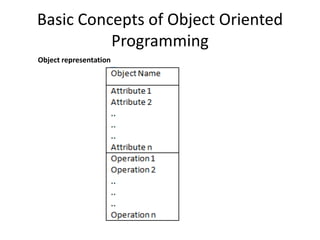
Object representation
Basic Concepts of Object Oriented
             Programming
• Classes
  – A class is a user defined data type.
  – A class is a collection of data member and member
    functions.
  – Variable declared in class are called data member and
    functions declared in class are known as member
    functions.
  – A class is an abstraction of the real world entities with
    similar properties.
  – A class identifies a set of similar properties.
  – A class is an implementation of abstract data type.
Basic Concepts of Object Oriented
            Programming
• Data Abstraction

  – Abstraction refers to the act of representing
    essential features without including the
    background details or explanations.

  – Classes use the concept of abstraction and are
    defined as a list of abstract attributes such as
    size, weight, cost etc.
Basic Concepts of Object Oriented
            Programming
• Encapsulation

  – The wrapping of data and functions into a single
    unit is known as encapsulation.


  – The data is not accessible to the outside
    world, and only those functions which are
    wrapped in the class can access it.
Basic Concepts of Object Oriented
            Programming
• Inheritance
  – Inheritance is the process by which objects of one
    class acquire the properties of objects of another
    class.
  – Create a new class from existing class.
  – The main benefits of the Inheritance is code
    reusability.
     • Add additional features to an existing class without
       modifying it.
Basic Concepts of Object Oriented
            Programming
• Polymorphism
  – Polymorphism is a Greek term.
  – It means the ability to take more than one form.
  – An operation may exhibit different behaviors in
    different instances.
  – The behavior depends upon the type of data used
    in the operation.
     • For adding two number operation will generate sum of
       two number.
     • For adding two string operation will concate two string.
Basic Concepts of Object Oriented
            Programming
• Dynamic Binding(Late Binding)

  – Binding refers to the linking of a procedure call to
    the code to be executed in response to call.

  • Dynamic binding means that the code associated with a
    given function call is not known until the time of the call at
    run time.
Basic Concepts of Object Oriented
            Programming
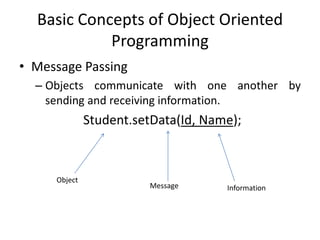
• Message Passing
  – Objects communicate with one another by
    sending and receiving information.
              Student.setData(Id, Name);


     Object
                        Message      Information
Advantages of OOP
• Through inheritance, redundant code is
  eliminated and extend the use of existing classes.
• One can build programs from the standard
  working modules that communicate with one
  another.
  – No need to write from scratch.
  – Save the development time and increase the
    productivity.
• The principal of data hiding helps the
  programmer to build the secure program.
Advantages of OOP
• The data centered design approach enable
  programmer to get details of a model in
  implementable form.
• Possible to map objects in the problem domain to
  those in the program.
• It is easy to partition the work in project based on
  objects.
• Easily upgradable from small system to large
  system.
• Software complexity can be easily managed.
Application of OOP
What are the applications of OOP?
What are the application of C++?

1 unit (oops)

  • 1.
    Introduction to ObjectOriented Programming
  • 2.
    Evolution of ProgrammingParadigms • Structured Programming – Large programming project – Emphasis on algorithm rather than data – Programs are divided into individual procedures that perform discrete tasks – Procedures are independent of each other as far as possible – Procedures have their own local data and processing logic
  • 3.
    Evolution of ProgrammingParadigms – Parameter passing facility between the procedures for information communication – Introduced the concept of user defined data types – Support modular programming – Projects can be broken up into modules and programmed independently – Scope of the data items is controlled across modules – Maintenance of a large software system is tedious and costly
  • 4.
    Object oriented programming language • Object oriented programming is a method of implementation in which programs are organized as co- operative collection of objects, each of which represents an instance of some class and whose classes are all members of hierarchy of classes united through the property called inheritance. • Object Based Programming Languages – Encapsulation – Object Identity • Example – Ada • Object Oriented Programming Languages – Object Based features
  • 5.
    Object oriented programming language – Inheritance – Polymorphism • Example – C++, Java, Smalltalk, Eiffel • Developed by Bjarne Stroustrup at AT&T Bell Laboratories in USA • Incremented version of C • Superset of C
  • 6.
    Evolution of ProgrammingParadigms • Object Oriented Programming – OOP treats data as a critical element – Emphasis on data rather than algorithm – Decompose the problem into number of entities namely objects – Doesn’t allow data to flow freely around the system – Data is hidden and cannot be accessed by external function
  • 7.
    Evolution of ProgrammingParadigms – Data and the functions that operate on the data are tied together in the data structure – Object may communicate with each other through functions – New data and functions can be added whenever necessary – Follows bottom up approach
  • 8.
    Basic Concepts ofObject Oriented Programming • Object • Classes • Data abstraction • Encapsulation • Inheritance • Polymorphism • Dynamic Binding • Message Passing
  • 9.
    Basic Concepts ofObject Oriented Programming • Object – Objects are the basic run time entities in an object oriented system – Object is a instance of class – We can say that objects are variables of the type class – Objects can be student, employee, car, book, etc
  • 10.
    Basic Concepts ofObject Oriented Programming Object representation
  • 11.
    Basic Concepts ofObject Oriented Programming • Classes – A class is a user defined data type. – A class is a collection of data member and member functions. – Variable declared in class are called data member and functions declared in class are known as member functions. – A class is an abstraction of the real world entities with similar properties. – A class identifies a set of similar properties. – A class is an implementation of abstract data type.
  • 12.
    Basic Concepts ofObject Oriented Programming • Data Abstraction – Abstraction refers to the act of representing essential features without including the background details or explanations. – Classes use the concept of abstraction and are defined as a list of abstract attributes such as size, weight, cost etc.
  • 13.
    Basic Concepts ofObject Oriented Programming • Encapsulation – The wrapping of data and functions into a single unit is known as encapsulation. – The data is not accessible to the outside world, and only those functions which are wrapped in the class can access it.
  • 14.
    Basic Concepts ofObject Oriented Programming • Inheritance – Inheritance is the process by which objects of one class acquire the properties of objects of another class. – Create a new class from existing class. – The main benefits of the Inheritance is code reusability. • Add additional features to an existing class without modifying it.
  • 15.
    Basic Concepts ofObject Oriented Programming • Polymorphism – Polymorphism is a Greek term. – It means the ability to take more than one form. – An operation may exhibit different behaviors in different instances. – The behavior depends upon the type of data used in the operation. • For adding two number operation will generate sum of two number. • For adding two string operation will concate two string.
  • 16.
    Basic Concepts ofObject Oriented Programming • Dynamic Binding(Late Binding) – Binding refers to the linking of a procedure call to the code to be executed in response to call. • Dynamic binding means that the code associated with a given function call is not known until the time of the call at run time.
  • 17.
    Basic Concepts ofObject Oriented Programming • Message Passing – Objects communicate with one another by sending and receiving information. Student.setData(Id, Name); Object Message Information
  • 18.
    Advantages of OOP •Through inheritance, redundant code is eliminated and extend the use of existing classes. • One can build programs from the standard working modules that communicate with one another. – No need to write from scratch. – Save the development time and increase the productivity. • The principal of data hiding helps the programmer to build the secure program.
  • 19.
    Advantages of OOP •The data centered design approach enable programmer to get details of a model in implementable form. • Possible to map objects in the problem domain to those in the program. • It is easy to partition the work in project based on objects. • Easily upgradable from small system to large system. • Software complexity can be easily managed.
  • 20.
    Application of OOP Whatare the applications of OOP? What are the application of C++?