VESICOURETERIC REFLUX
VIDHYA.T
MBBS, DNB, Fellowship in Paediatric urology
Apollo Children’s hospital
-A OVERVIEW
Paediatrician
Paediatric surgeons/ Paediatric urologist
Nephrologist
Pediatric Radiologist
Nuclear Medicine Radiologist
VUR
 Retrograde flow of urine from bladder into the kidney or ureter during emptying or
filling phase of bladder
 Dynamic phenomenon
 First described by GALEN 150 A.D- autopsy specimens
 Human VUR-1893 POZZI- noted efflux of urine into ureter during plevic surgery
VUR is physiological in young of many species, considered abnormal in human!!
INTRODUCTION
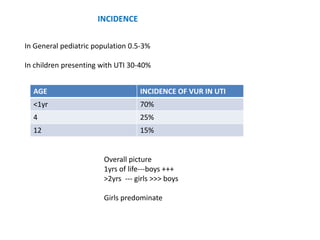
INCIDENCE
In General pediatric population 0.5-3%
In children presenting with UTI 30-40%
AGE INCIDENCE OF VUR IN UTI
<1yr 70%
4 25%
12 15%
Overall picture
1yrs of life---boys +++
>2yrs --- girls >>> boys
Girls predominate
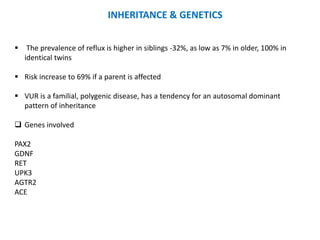
 The prevalence of reflux is higher in siblings -32%, as low as 7% in older, 100% in
identical twins
 Risk increase to 69% if a parent is affected
 VUR is a familial, polygenic disease, has a tendency for an autosomal dominant
pattern of inheritance
 Genes involved
PAX2
GDNF
RET
UPK3
AGTR2
ACE
INHERITANCE & GENETICS
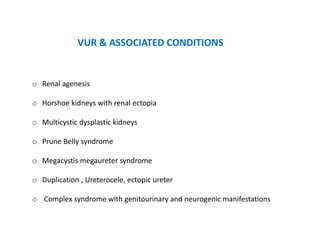
VUR & ASSOCIATED CONDITIONS
o Renal agenesis
o Horshoe kidneys with renal ectopia
o Multicystic dysplastic kidneys
o Prune Belly syndrome
o Megacystis megaureter syndrome
o Duplication , Ureterocele, ectopic ureter
o Complex syndrome with genitourinary and neurogenic manifestations
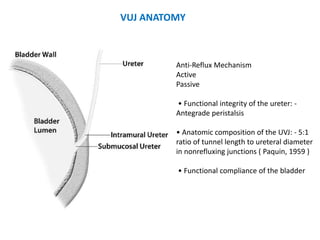
Anti-Reflux Mechanism
Active
Passive
• Functional integrity of the ureter: -
Antegrade peristalsis
• Anatomic composition of the UVJ: - 5:1
ratio of tunnel length to ureteral diameter
in nonrefluxing junctions ( Paquin, 1959 )
• Functional compliance of the bladder
VUJ ANATOMY
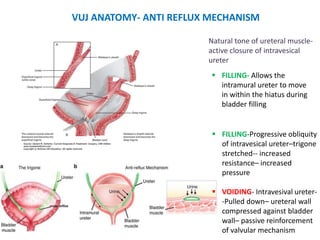
VUJ ANATOMY- ANTI REFLUX MECHANISM
 FILLING- Allows the
intramural ureter to move
in within the hiatus during
bladder filling
 FILLING-Progressive obliquity
of intravesical ureter–trigone
stretched-- increased
resistance– increased
pressure
 VOIDING- Intravesival ureter-
-Pulled down– ureteral wall
compressed against bladder
wall– passive reinforcement
of valvular mechanism
Natural tone of ureteral muscle-
active closure of intravesical
ureter
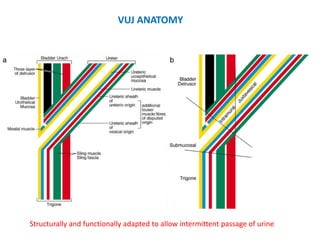
VUJ ANATOMY
Structurally and functionally adapted to allow intermittent passage of urine
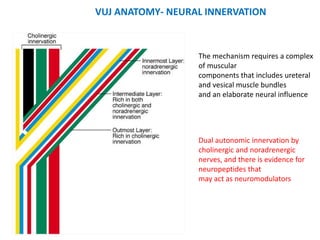
VUJ ANATOMY- NEURAL INNERVATION
The mechanism requires a complex
of muscular
components that includes ureteral
and vesical muscle bundles
and an elaborate neural influence
Dual autonomic innervation by
cholinergic and noradrenergic
nerves, and there is evidence for
neuropeptides that
may act as neuromodulators
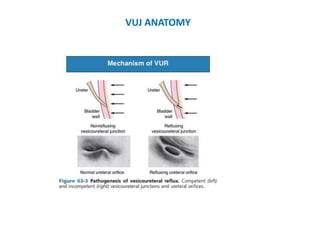
VUJ ANATOMY
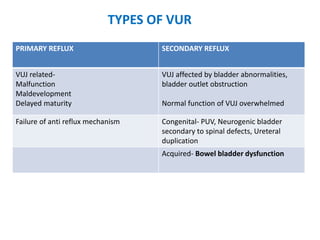
PRIMARY REFLUX SECONDARY REFLUX
VUJ related-
Malfunction
Maldevelopment
Delayed maturity
VUJ affected by bladder abnormalities,
bladder outlet obstruction
Normal function of VUJ overwhelmed
Failure of anti reflux mechanism Congenital- PUV, Neurogenic bladder
secondary to spinal defects, Ureteral
duplication
Acquired- Bowel bladder dysfunction
TYPES OF VUR
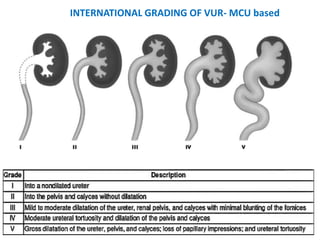
INTERNATIONAL GRADING OF VUR- MCU based
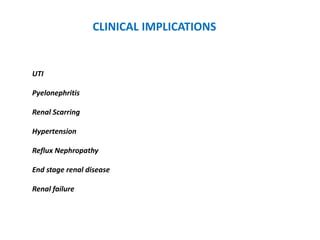
CLINICAL IMPLICATIONS
UTI
Pyelonephritis
Renal Scarring
Hypertension
Reflux Nephropathy
End stage renal disease
Renal failure
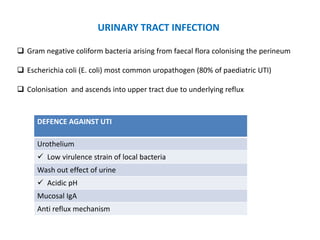
 Gram negative coliform bacteria arising from faecal flora colonising the perineum
 Escherichia coli (E. coli) most common uropathogen (80% of paediatric UTI)
 Colonisation and ascends into upper tract due to underlying reflux
URINARY TRACT INFECTION
DEFENCE AGAINST UTI
Urothelium
 Low virulence strain of local bacteria
Wash out effect of urine
 Acidic pH
Mucosal IgA
Anti reflux mechanism
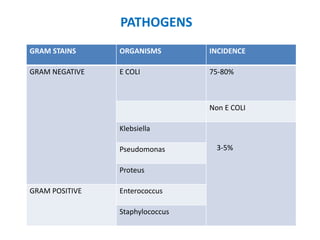
PATHOGENS
GRAM STAINS ORGANISMS INCIDENCE
GRAM NEGATIVE E COLI 75-80%
Non E COLI
Klebsiella
3-5%
Pseudomonas
Proteus
GRAM POSITIVE Enterococcus
Staphylococcus
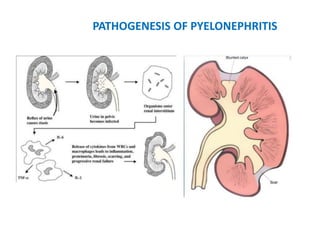
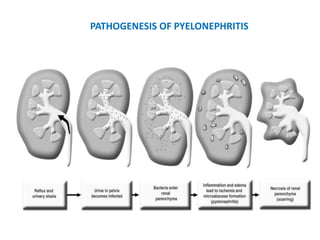
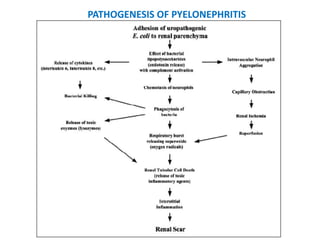
PATHOGENESIS OF PYELONEPHRITIS
SCARS in VUR
Happens where ?!
Why!
Reason?
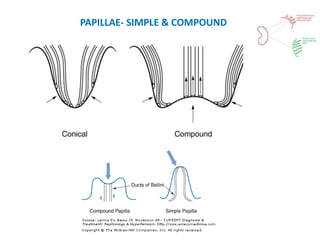
PAPILLAE- SIMPLE & COMPOUND
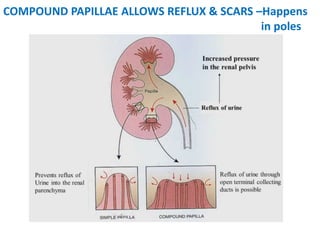
COMPOUND PAPILLAE ALLOWS REFLUX & SCARS –Happens
in poles
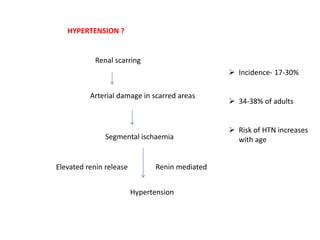
HYPERTENSION ?
Renal scarring
Arterial damage in scarred areas
Segmental ischaemia
Hypertension
Renin mediated
Elevated renin release
 Incidence- 17-30%
 34-38% of adults
 Risk of HTN increases
with age
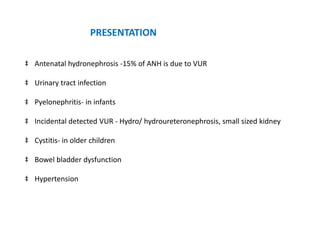
PRESENTATION
‡ Antenatal hydronephrosis -15% of ANH is due to VUR
‡ Urinary tract infection
‡ Pyelonephritis- in infants
‡ Incidental detected VUR - Hydro/ hydroureteronephrosis, small sized kidney
‡ Cystitis- in older children
‡ Bowel bladder dysfunction
‡ Hypertension
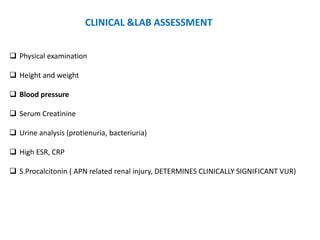
 Physical examination
 Height and weight
 Blood pressure
 Serum Creatinine
 Urine analysis (protienuria, bacteriuria)
 High ESR, CRP
 S.Procalcitonin ( APN related renal injury, DETERMINES CLINICALLY SIGNIFICANT VUR)
CLINICAL &LAB ASSESSMENT
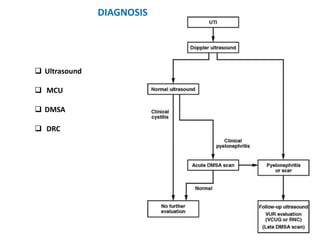
DIAGNOSIS
 Ultrasound
 MCU
 DMSA
 DRC
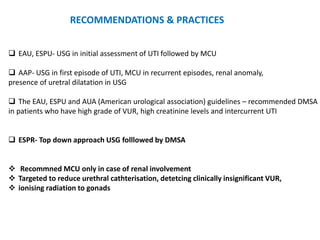
 EAU, ESPU- USG in initial assessment of UTI followed by MCU
 AAP- USG in first episode of UTI, MCU in recurrent episodes, renal anomaly,
presence of uretral dilatation in USG
 The EAU, ESPU and AUA (American urological association) guidelines – recommended DMSA
in patients who have high grade of VUR, high creatinine levels and intercurrent UTI
 ESPR- Top down approach USG folllowed by DMSA
 Recommned MCU only in case of renal involvement
 Targeted to reduce urethral cathterisation, detetcing clinically insignificant VUR,
 ionising radiation to gonads
RECOMMENDATIONS & PRACTICES
USG
Pyelonephritis
Hydroureteronephrosis
Small sized kidney
Scarred kidney
Altered echogenic kidneys
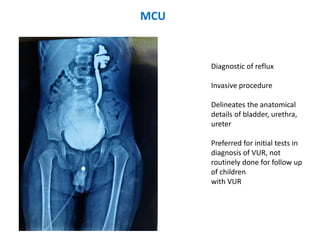
MCU
Diagnostic of reflux
Invasive procedure
Delineates the anatomical
details of bladder, urethra,
ureter
Preferred for initial tests in
diagnosis of VUR, not
routinely done for follow up
of children
with VUR
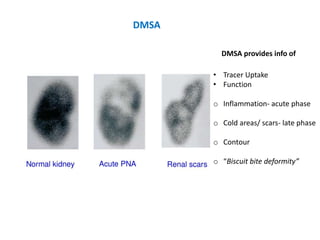
DMSA
• Tracer Uptake
• Function
o Inflammation- acute phase
o Cold areas/ scars- late phase
o Contour
o “Biscuit bite deformity”
DMSA provides info of
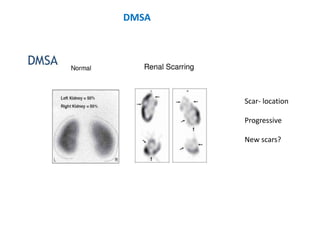
Scar- location
Progressive
New scars?
DMSA
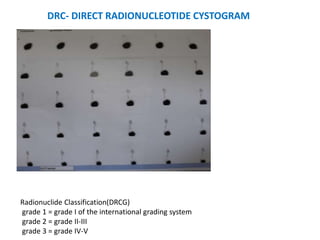
Radionuclide Classification(DRCG)
grade 1 = grade I of the international grading system
grade 2 = grade II-III
grade 3 = grade IV-V
DRC- DIRECT RADIONUCLEOTIDE CYSTOGRAM
AIM OF THE TREATMENT
 To Prevent Recurrent Febrile UTIs
 New Renal Parenchymal Damage
 Minimize The morbidity of therapy and follow-up procedures.
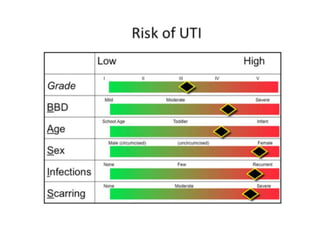
Consider these factors prior to decision making of VUR management
 Age
 Gender,
 Reflux grade,
 History of recurrent UTI
 Renal dysfunction
 Associated BBD
Principles of management:
1. Spontaneous resolution of reflux is very common
2. High-grade reflux is less likely to resolve spontaneously
3. Extended use of prophylactic antibiotics & “ Watchful waiting”
4. The success rate with surgical correction is very high
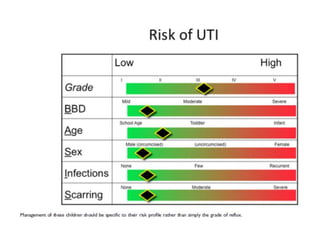
Management of VUR cannot be based simply on VUR grade or broad statements of the
utility of CAP, but must be individualized
It is prudent to consider UTIs not only as acute episodes of illness but also as a first
step to possible renal damage
STRATEGY IN VUR
CAP- CONTINUOUS ANTIBIOTIC PROPHYLAXIS
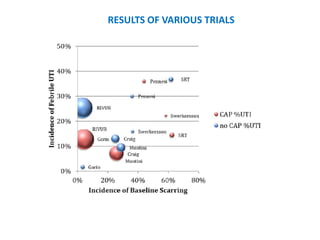
 International reflux trial
 Birmingham reflux trial
 Swedish trial
 RIVUR trial
GROSS RECOMMENDATION
Antibiotic upto 1 yr of age
Until circumcision in boys
CAP is widely accepted as a revolutionary conservative therapy for VUR, because it
prevents recurrent episodes of UTI and consequent new renal scarring
 Antibiotic prophylaxis has been shown to be effective in preventing UTI in some
children with VUR but is not required for all
 Although strict criteria for the identification of those who are best managed with
CAP have yet to be defined, there is evidence to guide us today
 Children with a clear history of recurrent UTI
 The child with documented renal abnormalities on US or DMSA scanning
 The child with abnormal voiding patterns or BBD should be offered CAP while an
attempt is made to correct his or her voiding patterns.
 Parental understanding of the risks of renal injury from infection must be clear
 If CAP is to be used, the obligation of education is equally strong in that failure to
follow the medication program may lead to a false sense of security among both
parents and caregivers
CAP- CONTINUOUS ANTIBIOTIC PROPHYLAXIS
AUA- AMERICAN UROLOGICAL ASSOCIATION
An option of not using CAP in selected children-
 children less than 1 year and with grade I or II VUR, no history of febrile UTI, and no
renal cortical abnormalities.
 For children over 1 year, those without history of febrile UTI, no history of BBD, and no
renal cortical abnormalities
CAP- CONTINUOUS ANTIBIOTIC PROPHYLAXIS
RESULTS OF VARIOUS TRIALS
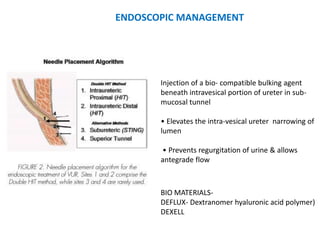
ENDOSCOPIC MANAGEMENT
Injection of a bio- compatible bulking agent
beneath intravesical portion of ureter in sub-
mucosal tunnel
• Elevates the intra-vesical ureter narrowing of
lumen
• Prevents regurgitation of urine & allows
antegrade flow
BIO MATERIALS-
DEFLUX- Dextranomer hyaluronic acid polymer)
DEXELL
ENDOSCOPIC MANAGEMENT
ADVANTAGES
• Daycare
• less morbidity, no mortality
• No surgical scar
• Success rate almost equivalent to open surgery for primary reflux.
DISADVANTAGES
• Cost
• Lower success rate compared to surgery for high grade reflux
Indications
• Primary reflux
• Secondary reflux - Dysfn voiding - Neurogenic bladder - Duplex system • Failed open re-
implant
Surgical outcomes Success rates: • Open - 98% • Endoscopic – 80-89%
SURGICAL
TYPES
INTRAVESICAL- InfraHiatal- Cohen’s, Gil Vernant
Suprahiatal- Lead Better Politano,
EXTRAVESICAL- Lich Gregoir
METHODS
Open
Laparoscopic
Robotic
Higher success rate 98% for Cohen’s in terms of resolution of reflux and symptoms
• SPONTANEOUS RESOLUTION: - At birth, the probability of spontaneous resolution of
primary reflux is inversely proportional to the initial grade - If a patient is encountered
at a later age, resolution from any point in time forward will depend on the initial
grade of reflux
NATURAL HISTORY • Resolution by grade: - Most cases of low-grade reflux (grade I and
II) will resolve : 63-85% - Grade III reflux will resolve in approximately 50% of cases -
Higher-grade reflux (grades IV and V and bilateral grade III) : 9-25%
NATURAL HISTORY • Resolution with age : - Age has greater significance than grade -
Most prevalent in neonates and young children and will demonstrate the greatest
tendency to resolve in this group
VUR & RESOLUTION
BBD &VUR
o Most critical and modifiable variables that affect VUR management and attendant UTIs
High incidence of UTI despite prophylaxis
Poor surgical results
Less VUR resolution rate
o Persistence of the expected early attempts to suppress bladder contractions during
the toilet training months by volitional contraction of the external sphincter
o High voiding pressure leads to relux, UTI
 In older children
 Acquired voiding abnormality
THANK YOU!

VUR in Children-Overview

  • 1.
    VESICOURETERIC REFLUX VIDHYA.T MBBS, DNB,Fellowship in Paediatric urology Apollo Children’s hospital -A OVERVIEW
  • 2.
    Paediatrician Paediatric surgeons/ Paediatricurologist Nephrologist Pediatric Radiologist Nuclear Medicine Radiologist VUR
  • 3.
     Retrograde flowof urine from bladder into the kidney or ureter during emptying or filling phase of bladder  Dynamic phenomenon  First described by GALEN 150 A.D- autopsy specimens  Human VUR-1893 POZZI- noted efflux of urine into ureter during plevic surgery VUR is physiological in young of many species, considered abnormal in human!! INTRODUCTION
  • 4.
    INCIDENCE In General pediatricpopulation 0.5-3% In children presenting with UTI 30-40% AGE INCIDENCE OF VUR IN UTI <1yr 70% 4 25% 12 15% Overall picture 1yrs of life---boys +++ >2yrs --- girls >>> boys Girls predominate
  • 5.
     The prevalenceof reflux is higher in siblings -32%, as low as 7% in older, 100% in identical twins  Risk increase to 69% if a parent is affected  VUR is a familial, polygenic disease, has a tendency for an autosomal dominant pattern of inheritance  Genes involved PAX2 GDNF RET UPK3 AGTR2 ACE INHERITANCE & GENETICS
  • 6.
    VUR & ASSOCIATEDCONDITIONS o Renal agenesis o Horshoe kidneys with renal ectopia o Multicystic dysplastic kidneys o Prune Belly syndrome o Megacystis megaureter syndrome o Duplication , Ureterocele, ectopic ureter o Complex syndrome with genitourinary and neurogenic manifestations
  • 7.
    Anti-Reflux Mechanism Active Passive • Functionalintegrity of the ureter: - Antegrade peristalsis • Anatomic composition of the UVJ: - 5:1 ratio of tunnel length to ureteral diameter in nonrefluxing junctions ( Paquin, 1959 ) • Functional compliance of the bladder VUJ ANATOMY
  • 8.
    VUJ ANATOMY- ANTIREFLUX MECHANISM  FILLING- Allows the intramural ureter to move in within the hiatus during bladder filling  FILLING-Progressive obliquity of intravesical ureter–trigone stretched-- increased resistance– increased pressure  VOIDING- Intravesival ureter- -Pulled down– ureteral wall compressed against bladder wall– passive reinforcement of valvular mechanism Natural tone of ureteral muscle- active closure of intravesical ureter
  • 9.
    VUJ ANATOMY Structurally andfunctionally adapted to allow intermittent passage of urine
  • 10.
    VUJ ANATOMY- NEURALINNERVATION The mechanism requires a complex of muscular components that includes ureteral and vesical muscle bundles and an elaborate neural influence Dual autonomic innervation by cholinergic and noradrenergic nerves, and there is evidence for neuropeptides that may act as neuromodulators
  • 11.
  • 12.
    PRIMARY REFLUX SECONDARYREFLUX VUJ related- Malfunction Maldevelopment Delayed maturity VUJ affected by bladder abnormalities, bladder outlet obstruction Normal function of VUJ overwhelmed Failure of anti reflux mechanism Congenital- PUV, Neurogenic bladder secondary to spinal defects, Ureteral duplication Acquired- Bowel bladder dysfunction TYPES OF VUR
  • 13.
  • 14.
    CLINICAL IMPLICATIONS UTI Pyelonephritis Renal Scarring Hypertension RefluxNephropathy End stage renal disease Renal failure
  • 15.
     Gram negativecoliform bacteria arising from faecal flora colonising the perineum  Escherichia coli (E. coli) most common uropathogen (80% of paediatric UTI)  Colonisation and ascends into upper tract due to underlying reflux URINARY TRACT INFECTION DEFENCE AGAINST UTI Urothelium  Low virulence strain of local bacteria Wash out effect of urine  Acidic pH Mucosal IgA Anti reflux mechanism
  • 16.
    PATHOGENS GRAM STAINS ORGANISMSINCIDENCE GRAM NEGATIVE E COLI 75-80% Non E COLI Klebsiella 3-5% Pseudomonas Proteus GRAM POSITIVE Enterococcus Staphylococcus
  • 17.
  • 18.
  • 19.
  • 20.
    SCARS in VUR Happenswhere ?! Why! Reason?
  • 21.
  • 22.
    COMPOUND PAPILLAE ALLOWSREFLUX & SCARS –Happens in poles
  • 23.
    HYPERTENSION ? Renal scarring Arterialdamage in scarred areas Segmental ischaemia Hypertension Renin mediated Elevated renin release  Incidence- 17-30%  34-38% of adults  Risk of HTN increases with age
  • 24.
    PRESENTATION ‡ Antenatal hydronephrosis-15% of ANH is due to VUR ‡ Urinary tract infection ‡ Pyelonephritis- in infants ‡ Incidental detected VUR - Hydro/ hydroureteronephrosis, small sized kidney ‡ Cystitis- in older children ‡ Bowel bladder dysfunction ‡ Hypertension
  • 25.
     Physical examination Height and weight  Blood pressure  Serum Creatinine  Urine analysis (protienuria, bacteriuria)  High ESR, CRP  S.Procalcitonin ( APN related renal injury, DETERMINES CLINICALLY SIGNIFICANT VUR) CLINICAL &LAB ASSESSMENT
  • 26.
  • 27.
     EAU, ESPU-USG in initial assessment of UTI followed by MCU  AAP- USG in first episode of UTI, MCU in recurrent episodes, renal anomaly, presence of uretral dilatation in USG  The EAU, ESPU and AUA (American urological association) guidelines – recommended DMSA in patients who have high grade of VUR, high creatinine levels and intercurrent UTI  ESPR- Top down approach USG folllowed by DMSA  Recommned MCU only in case of renal involvement  Targeted to reduce urethral cathterisation, detetcing clinically insignificant VUR,  ionising radiation to gonads RECOMMENDATIONS & PRACTICES
  • 28.
  • 29.
    MCU Diagnostic of reflux Invasiveprocedure Delineates the anatomical details of bladder, urethra, ureter Preferred for initial tests in diagnosis of VUR, not routinely done for follow up of children with VUR
  • 30.
    DMSA • Tracer Uptake •Function o Inflammation- acute phase o Cold areas/ scars- late phase o Contour o “Biscuit bite deformity” DMSA provides info of
  • 31.
  • 32.
    Radionuclide Classification(DRCG) grade 1= grade I of the international grading system grade 2 = grade II-III grade 3 = grade IV-V DRC- DIRECT RADIONUCLEOTIDE CYSTOGRAM
  • 33.
    AIM OF THETREATMENT  To Prevent Recurrent Febrile UTIs  New Renal Parenchymal Damage  Minimize The morbidity of therapy and follow-up procedures. Consider these factors prior to decision making of VUR management  Age  Gender,  Reflux grade,  History of recurrent UTI  Renal dysfunction  Associated BBD
  • 34.
    Principles of management: 1.Spontaneous resolution of reflux is very common 2. High-grade reflux is less likely to resolve spontaneously 3. Extended use of prophylactic antibiotics & “ Watchful waiting” 4. The success rate with surgical correction is very high Management of VUR cannot be based simply on VUR grade or broad statements of the utility of CAP, but must be individualized It is prudent to consider UTIs not only as acute episodes of illness but also as a first step to possible renal damage STRATEGY IN VUR
  • 35.
    CAP- CONTINUOUS ANTIBIOTICPROPHYLAXIS  International reflux trial  Birmingham reflux trial  Swedish trial  RIVUR trial GROSS RECOMMENDATION Antibiotic upto 1 yr of age Until circumcision in boys CAP is widely accepted as a revolutionary conservative therapy for VUR, because it prevents recurrent episodes of UTI and consequent new renal scarring
  • 36.
     Antibiotic prophylaxishas been shown to be effective in preventing UTI in some children with VUR but is not required for all  Although strict criteria for the identification of those who are best managed with CAP have yet to be defined, there is evidence to guide us today  Children with a clear history of recurrent UTI  The child with documented renal abnormalities on US or DMSA scanning  The child with abnormal voiding patterns or BBD should be offered CAP while an attempt is made to correct his or her voiding patterns.  Parental understanding of the risks of renal injury from infection must be clear  If CAP is to be used, the obligation of education is equally strong in that failure to follow the medication program may lead to a false sense of security among both parents and caregivers CAP- CONTINUOUS ANTIBIOTIC PROPHYLAXIS
  • 37.
    AUA- AMERICAN UROLOGICALASSOCIATION An option of not using CAP in selected children-  children less than 1 year and with grade I or II VUR, no history of febrile UTI, and no renal cortical abnormalities.  For children over 1 year, those without history of febrile UTI, no history of BBD, and no renal cortical abnormalities CAP- CONTINUOUS ANTIBIOTIC PROPHYLAXIS
  • 40.
  • 41.
    ENDOSCOPIC MANAGEMENT Injection ofa bio- compatible bulking agent beneath intravesical portion of ureter in sub- mucosal tunnel • Elevates the intra-vesical ureter narrowing of lumen • Prevents regurgitation of urine & allows antegrade flow BIO MATERIALS- DEFLUX- Dextranomer hyaluronic acid polymer) DEXELL
  • 42.
    ENDOSCOPIC MANAGEMENT ADVANTAGES • Daycare •less morbidity, no mortality • No surgical scar • Success rate almost equivalent to open surgery for primary reflux. DISADVANTAGES • Cost • Lower success rate compared to surgery for high grade reflux Indications • Primary reflux • Secondary reflux - Dysfn voiding - Neurogenic bladder - Duplex system • Failed open re- implant Surgical outcomes Success rates: • Open - 98% • Endoscopic – 80-89%
  • 43.
    SURGICAL TYPES INTRAVESICAL- InfraHiatal- Cohen’s,Gil Vernant Suprahiatal- Lead Better Politano, EXTRAVESICAL- Lich Gregoir METHODS Open Laparoscopic Robotic Higher success rate 98% for Cohen’s in terms of resolution of reflux and symptoms
  • 44.
    • SPONTANEOUS RESOLUTION:- At birth, the probability of spontaneous resolution of primary reflux is inversely proportional to the initial grade - If a patient is encountered at a later age, resolution from any point in time forward will depend on the initial grade of reflux NATURAL HISTORY • Resolution by grade: - Most cases of low-grade reflux (grade I and II) will resolve : 63-85% - Grade III reflux will resolve in approximately 50% of cases - Higher-grade reflux (grades IV and V and bilateral grade III) : 9-25% NATURAL HISTORY • Resolution with age : - Age has greater significance than grade - Most prevalent in neonates and young children and will demonstrate the greatest tendency to resolve in this group VUR & RESOLUTION
  • 45.
    BBD &VUR o Mostcritical and modifiable variables that affect VUR management and attendant UTIs High incidence of UTI despite prophylaxis Poor surgical results Less VUR resolution rate o Persistence of the expected early attempts to suppress bladder contractions during the toilet training months by volitional contraction of the external sphincter o High voiding pressure leads to relux, UTI  In older children  Acquired voiding abnormality
  • 46.