Ureteral Stents
For the Diagnostic Radiologist
Jud Gash, MD
University of Tennessee, Knoxville



The Typical Stent






Indications
Placement
Stent
Normal Position
Common Symptoms
Indications



Benign or Malignant obstruction relief
Adjunct to stone therapy





Perioperative




Obstruction
ESWL
Identification of the ureter

Management of Urine leaks


After trauma, surgery or fistula
Placement








Typically in OR
Cystoscopy (identify ureteral orifice)
+/- Retrograde pyelogram to outline upper tract
Placement of soft guidewire into upper tract
(kidney)
Place stent over guidewire (using pusher)
Remove guidwire
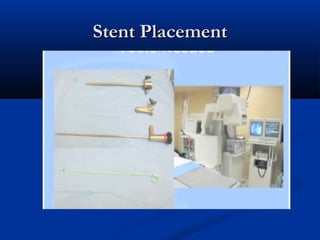
Stent Placement
Typical Stent





Double J/Pigtail configuration
5-9 Fr
20-32 cm
Polyurethane
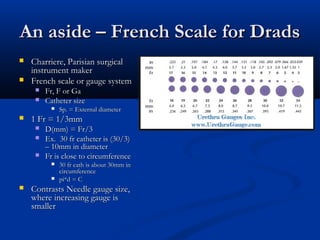
An aside – French Scale for Drads



Charriere, Parisian surgical
instrument maker
French scale or gauge system



Fr, F or Ga
Catheter size




1 Fr = 1/3mm




D(mm) = Fr/3
Ex. 30 fr catheter is (30/3)
– 10mm in diameter
Fr is close to circumference





Sp. = External diameter

30 fr cath is about 30mm in
circumference
pi*d = C

Contrasts Needle gauge size,
where increasing gauge is
smaller
Normal Position



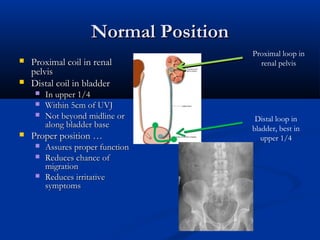
Proximal coil in renal
pelvis
Distal coil in bladder






In upper 1/4
Within 5cm of UVJ
Not beyond midline or
along bladder base

Proper position …




Assures proper function
Reduces chance of
migration
Reduces irritative
symptoms

Proximal loop in
renal pelvis

Distal loop in
bladder, best in
upper 1/4
Common Symptoms


Stent Irritation
Flank discomfort
 Bladder discomfort


Pain
 Desire to void
 Incontinence





Hematuria/Pyuria
Vesicoureteral Reflux
Complications/Issues









Malposition (Too short or long/outside ureter)
Migration
UTI
Inadequate Relief of Obstruction
Encrustation
Fracture
Ureteral erosion/fistula
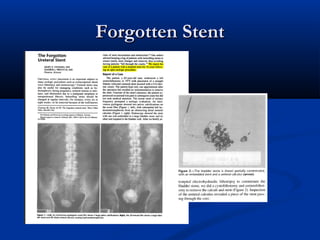
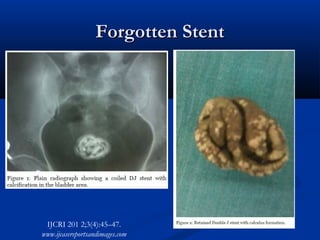
Forgotten Stent
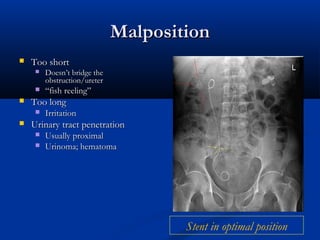
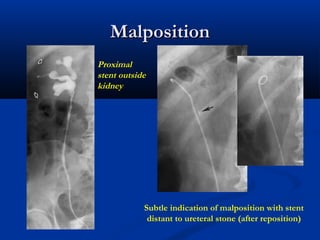
Malposition


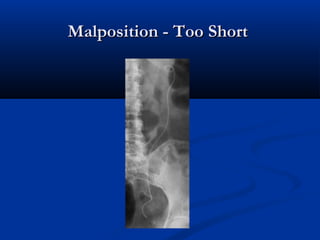
Too short






Doesn’t bridge the
obstruction/ureter

“fish reeling”

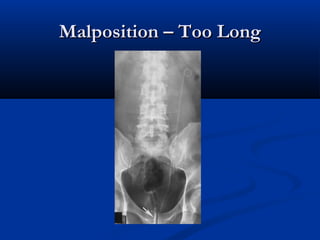
Too long




Irritation

Urinary tract penetration



Usually proximal
Urinoma; hematoma

Stent in optimal position
Malposition - Too Short
Malposition – Too Long
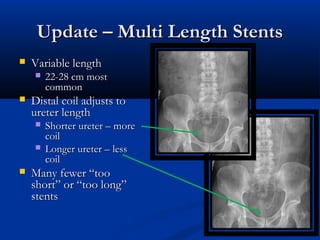
Update – Multi Length Stents


Variable length




Distal coil adjusts to
ureter length





22-28 cm most
common
Shorter ureter – more
coil
Longer ureter – less
coil

Many fewer “too
short” or “too long”
stents
Malposition
Proximal
stent outside
kidney

Subtle indication of malposition with stent
distant to ureteral stone (after reposition)
Migration



Prevented by proximal and distal “J” or loop
May occur due to peristalsis or short stent
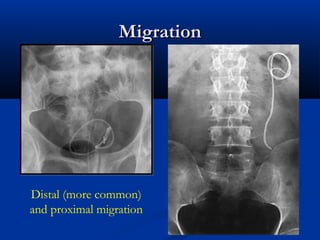
Migration

Distal (more common)
and proximal migration
Urinary Tract Infection



Not uncommon with stent
Causes
Stent placement (Abx before placement)
 Colonization

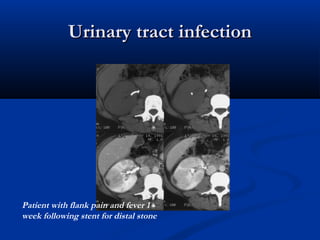
Urinary tract infection

Patient with flank pain and fever 1
week following stent for distal stone
Inadequate Relief of Obstruction
or Stent Malfunction


Relief of obstruction with ureteral stent is
complex
Intrinsic obstruction (ie stones - stent good)
 Extrinsic obstruction (ie malignant – less effective)







Complex issues

Stent May become clogged/obstructed
Clinical Suggestion




Flank pain (but often present anyway)
Renal insufficiency (insenstive)
Hydronephrosis (may persist from previous)
Inadequate Relief of Obstruction
or Stent Malfunction


Imaging Diagnosis



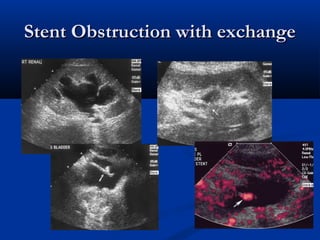
Doppler US – no ureteral jet and increasing hydro
No reflux at VCUG (or loopagram)
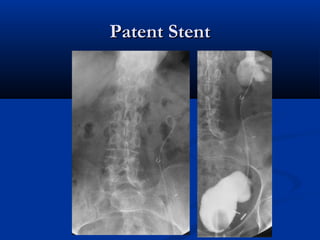
Patent Stent
Stent Obstruction with exchange
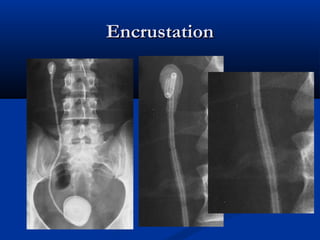
Encrustation


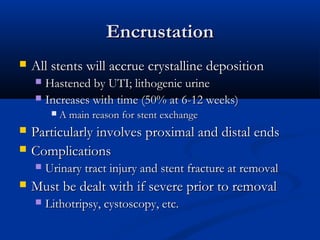
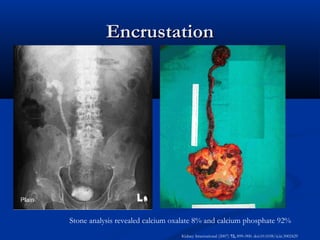
All stents will accrue crystalline deposition
Hastened by UTI; lithogenic urine
 Increases with time (50% at 6-12 weeks)







Particularly involves proximal and distal ends
Complications




A main reason for stent exchange

Urinary tract injury and stent fracture at removal

Must be dealt with if severe prior to removal


Lithotripsy, cystoscopy, etc.
Encrustation
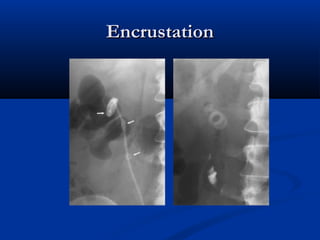
Encrustation
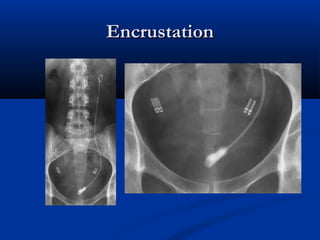
Encrustation
Encrustation

Stone analysis revealed calcium oxalate 8% and calcium phosphate 92%
Kidney International (2007) 72, 899–900. doi:10.1038/sj.ki.5002429
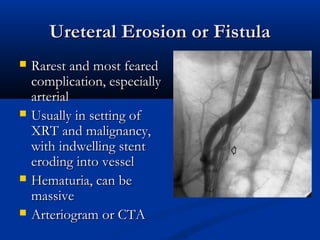
Ureteral Erosion or Fistula







Rarest and most feared
complication, especially
arterial
Usually in setting of
XRT and malignancy,
with indwelling stent
eroding into vessel
Hematuria, can be
massive
Arteriogram or CTA
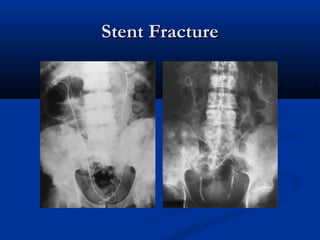
Stent Fracture



Urine is a hostile enviroment
Rare today
Increases with indwelling time
 Increases with encrustation

Stent Fracture
Forgotten Stent
Forgotten Stent

IJCRI 201 2;3(4):45–47.
www.ijcasereportsandimages.com
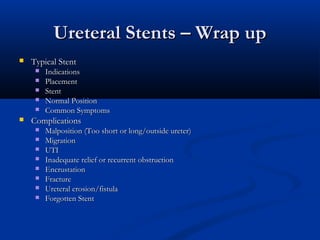
Ureteral Stents – Wrap up


Typical Stent








Indications
Placement
Stent
Normal Position
Common Symptoms

Complications









Malposition (Too short or long/outside ureter)
Migration
UTI
Inadequate relief or recurrent obstruction
Encrustation
Fracture
Ureteral erosion/fistula
Forgotten Stent

Ureteral stents for the Dx Radiologist

Editor's Notes

  • #5 First inserted in 1967 as “indwelling ureteral splint” for obstruction and fistula
  • #7 From UNC
  • #14 Too short stent at placement, which with reconstitution of the proximal coil pulls distal stent into ureter (fish reeling)
  • #15 Too long
  • #24 Contrast in and around stent at VCUG
  • #25 Left: increaed hydro with no doppler flow Right: decrease hydro with flow after stent exchange
  • #27 a) Conventional radiograph demonstrates minimal encrustation around the proximal portion of a ureteral stent (arrows), which was initially placed to assist with treatment of urinary tract stone disease. (b) Conventional radiograph obtained after stent removal shows the encrusting shell that was left behind. The patient was successfully treated with ESWL.
  • #33 Stent fracture in a patient with disseminated prostatic carcinoma. (a) Abdominal radiograph shows bilateral ureteral stents that were placed for relief of ureteral obstruction. No arrangements were made for follow-up given the patient’s condition. (b) On a conventional radiograph obtained 18 months later when the patient presented with a complaint of recurrent urinary tract infections, the stents are fractured into multiple pieces. This necessitated percutaneous entry with cystoscopic and ureteroscopic manipulations for complete removal.