Vulners – Google for hacker.
How the best vulnerability search engine
works and how to use it
Original article was published in Xakep Magazine #06/2016 (in Russian)
The common task. Уou need to find all information about some vulnerability: how critical the bug
is, whether there is a public exploit, which vendors already released patches, which vulnerability
scanner can detect this bug in the system. Previously, you had to search it all manually in dozens of
sources (CVEDetails, SecurityFocus, Rapid7 DB, Exploit-DB, CVEs from MITRE / NIST, vendor
newsletters, etc.) and analyze the collected data. Today, this routine can be (and should be!)
automated with specialized services. One of these services – Vulners.com, the coolest search engine
for bugs. And what is the most important – it’s free and has an open API. Let’s see how it can be
useful for us.
1
What is it?
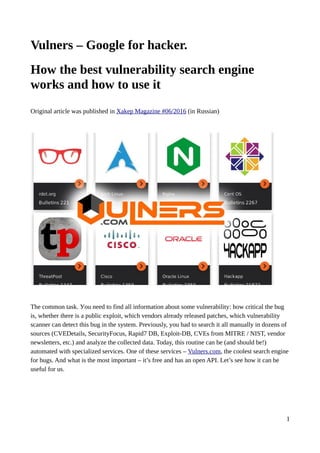
Vulners is a very large constantly updating database of Information Security content. This site lets
you search for vulnerabilities, exploits, patches, bug bounty programs the same way a web search
engine lets you search for websites. Vulners aggregates and presents in convenient form seven
major types of data:
• Popular vulnerability databases, containing general descriptions of vulnerabilities and links.
For example, well-known NVD CVEs of MITRE US agency and NIST Institute. In addition
to this, Vulners supports vulnerability descriptions from various research centers and
response teams: Vulnerability Lab, XSSed, CERT, ICS, Zero Day Initiative, Positive
Technologies, ERPScan.
• Vendor’s security bulletins. This bug-reports are published by software vendors and contain
information about vulnerabilities in their own products. At current moment Vulners supports
various Linux distributions (Red Hat, CentOS, Oracle Linux, Arch Linux, Debian, Ubuntu,
SUSE), FreeBSD, network devices (F5 Networks, Cisco, Huawei, Palo Alto Networks),
popular and critical software (OpenSSL, Samba, nginx, Mozilla, Opera), including CMS
(WordPress, Drupal).
• Exploits from Exploit-DB, Metasploit and 0day.today. Exploits are parsed and stored in full-
text form and you can read the sources in a convenient text editor.
• Nessus plugins for vulnerability detection. It makes easy to find out whether a particular
vulnerability can be detected using this popular network scanner. Why is it important? Read
in my article “When a free scanning service detects vulnerabilities better“.
• Bug disclousers for bug bounty programs. At current moment Vulners supports HackerOne
and Open Bug Bounty.
• Potential vulnerabilities of mobile applications and CMS. It is possible in cooperation with
the static application security testing (SAST) vendors Hackapp and InfoWatch APPERCUT.
• Posts from hacking resources. Vulners collects Threatpost and rdot.org publications, which
often cover vulnerability related topics.
All this information is handled, cataloged, structured and is always available for the search.
2
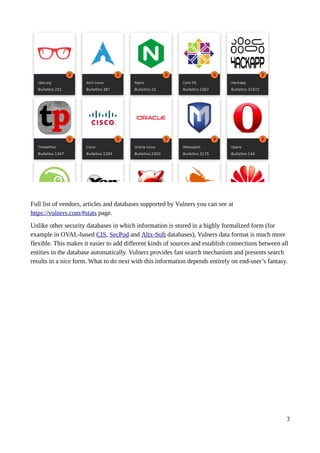
Full list of vendors, articles and databases supported by Vulners you can see at
https://vulners.com/#stats page.
Unlike other security databases in which information is stored in a highly formalized form (for
example in OVAL-based CIS, SecPod and Altx-Soft databases), Vulners data format is much more
flexible. This makes it easier to add different kinds of sources and establish connections between all
entities in the database automatically. Vulners provides fast search mechanism and presents search
results in a nice form. What to do next with this information depends entirely on end-user’s fantasy.
3
Who makes Vulners and what is under the
hood?
Vulners is developing by a small group of security enthusiasts in their spare time:
• Kirill «isox» Ermakov codes kernel and makes system administration tasks;
• Igor «Videns» codes the search engine;
• Vanya «Vankyv3r» codes the front-end;
• Sasha «Plex» codes data collecting robots;
• Alexander Leonov writes articles and makes analytics.
The first version of Vulners was rolled out in a couple of months after beginning of the
development and was presented at Black Hat USA 2015 conference in Las Vegas. In June, the
project celebrated it’s first anniversary.
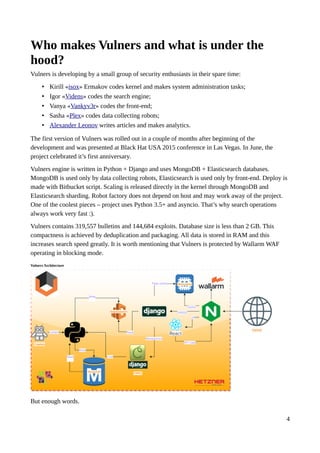
Vulners engine is written in Python + Django and uses MongoDB + Elasticsearch databases.
MongoDB is used only by data collecting robots, Elasticsearch is used only by front-end. Deploy is
made with Bitbucket script. Scaling is released directly in the kernel through MongoDB and
Elasticsearch sharding. Robot factory does not depend on host and may work away of the project.
One of the coolest pieces – project uses Python 3.5+ and asyncio. That’s why search operations
always work very fast :).
Vulners contains 319,557 bulletins and 144,684 exploits. Database size is less than 2 GB. This
compactness is achieved by deduplication and packaging. All data is stored in RAM and this
increases search speed greatly. It is worth mentioning that Vulners is protected by Wallarm WAF
operating in blocking mode.
Vulners Architecture
But enough words.
4
Let’s try to search something
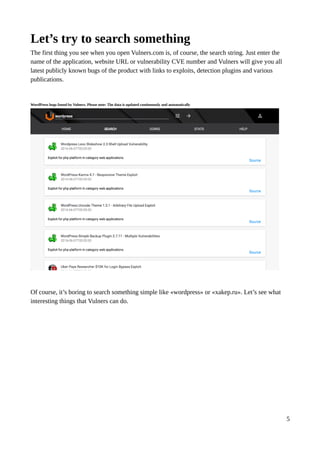
The first thing you see when you open Vulners.com is, of course, the search string. Just enter the
name of the application, website URL or vulnerability CVE number and Vulners will give you all
latest publicly known bugs of the product with links to exploits, detection plugins and various
publications.
WordPress bugs found by Vulners. Please note: The data is updated continuously and automatically
Of course, it’s boring to search something simple like «wordpress» or «xakep.ru». Let’s see what
interesting things that Vulners can do.
5
Task: find critical CentOS bugs with public
exploits
Query: type:centos order:published
Vulners allows you to filter search results and/or sort it by any field in bug description:
• by type of the bulletin;
• by CVSS Score;
• by date;
• by detection plugin number;
• by researcher name;
And so on.
That’s why we can form a complex queries like “type:centos cvss.score:[8 TO 10] order:published“,
which means “find all new critical CentOS bugs, with CVSS Base Score from 8 to 10”. Since
Vulners automatically add links to all collected data, you will see all related CVEs, detecting
plugins, and exploits on every CentOS CESA bulletin page in search results.
Search results for this query can be obtained via Vulners API – it is may be useful for scripting. You
just need to make a GET-request https://vulners.com/api/v3/search/lucene/?query=type:centos
%20cvss.score:[8%20TO%2010]%20order:published. The answer will be in JSON.
Another useful API-request option – references=true, which allows you to get not only security
objects (CentOS bulletins) in the query results, but all of related linked objects (detection plugins,
exploits, etc.). For example,
https://vulners.com/api/v3/search/lucene/?references=True&query=type:centos%20cvss.score:
[8%20TO%2010]%20order:published
GUI master for search requests
6
Getting more than 20 objects from Vulners
By default Vulners returns only first twenty objects in the search results. If you want more, you
need to set the parameter size. So you can get up to 500 objects. And if that’s not enough, you can
request several times by 500 using parameter skip.
7
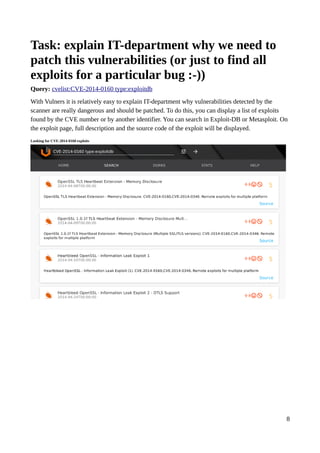
Task: explain IT-department why we need to
patch this vulnerabilities (or just to find all
exploits for a particular bug :-))
Query: cvelist:CVE-2014-0160 type:exploitdb
With Vulners it is relatively easy to explain IT-department why vulnerabilities detected by the
scanner are really dangerous and should be patched. To do this, you can display a list of exploits
found by the CVE number or by another identifier. You can search in Exploit-DB or Metasploit. On
the exploit page, full description and the source code of the exploit will be displayed.
Looking for CVE-2014-0160 exploits
8
You can see full text of the exploit in a convenient web editor.
9
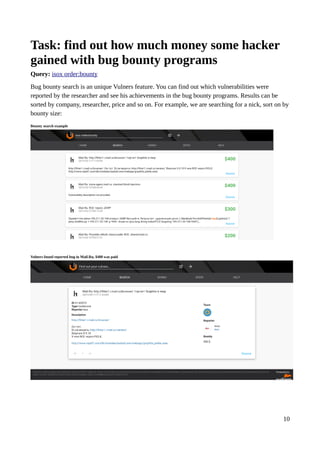
Task: find out how much money some hacker
gained with bug bounty programs
Query: isox order:bounty
Bug bounty search is an unique Vulners feature. You can find out which vulnerabilities were
reported by the researcher and see his achievements in the bug bounty programs. Results can be
sorted by company, researcher, price and so on. For example, we are searching for a nick, sort on by
bounty size:
Bounty search example
Vulners found reported bug in Mail.Ru, $400 was paid
10
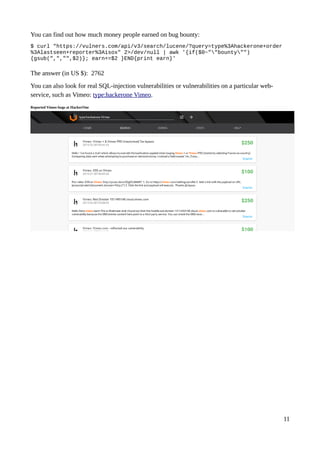
You can find out how much money people earned on bug bounty:
$ curl "https://vulners.com/api/v3/search/lucene/?query=type%3Ahackerone+order
%3Alastseen+reporter%3Aisox" 2>/dev/null | awk '{if($0~""bounty"")
{gsub(",","",$2)}; earn+=$2 }END{print earn}'
The answer (in US $): 2762
You can also look for real SQL-injection vulnerabilities or vulnerabilities on a particular web-
service, such as Vimeo: type:hackerone Vimeo.
Reported Vimeo bugs at HackerOne
11
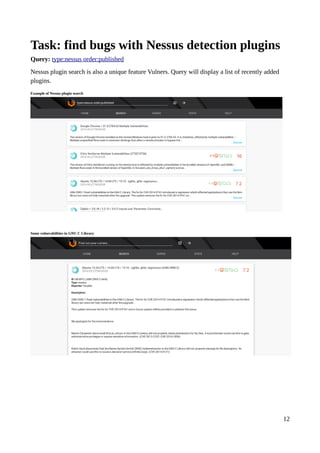
Task: find bugs with Nessus detection plugins
Query: type:nessus order:published
Nessus plugin search is also a unique feature Vulners. Query will display a list of recently added
plugins.
Example of Nessus plugin search
Some vulnerabilities in GNU C Library
12
Task: find potential vulnerabilities in mobile
applications
Query: type:hackapp
Another cool Vulners feature – the ability to search for vulnerabilities in more than 13,000 free
Android apps from US Google Play! Store through HackApp base. HackApp – is shareware toolkit
and service for analyzing mobile applications.
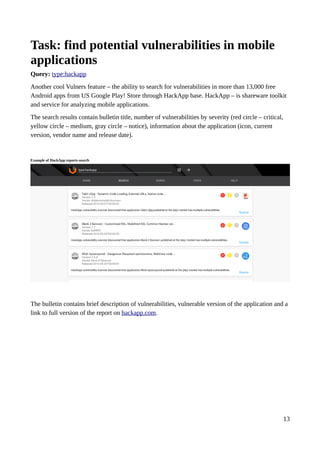
The search results contain bulletin title, number of vulnerabilities by severity (red circle – critical,
yellow circle – medium, gray circle – notice), information about the application (icon, current
version, vendor name and release date).
Example of HackApp reports search
The bulletin contains brief description of vulnerabilities, vulnerable version of the application and a
link to full version of the report on hackapp.com.
13
HACKAPP:COM.TIR.SIMULASYONU.APK vulnerabilities
14
Task: find potential vulnerabilities in popular
CMS
Query: type:appercut
With Vulners.com you can search for potential vulnerabilities in the popular CMS and plugins.
Application source codes are checked by InfoWatch APPERCUT static source code analyzer. It is
generally known that the most exploited vulnerabilities are not in CMS engines, but in thousands of
third-party plugins. Developers rarely fix this vulnerabilities quickly or even don’t fix them at all.
You can find examples of such vulnerabilities and exploits with “wordpress plugin
bulletinFamily:exploit” request.
Appercut is well suited for CMS analysis. Appercut® Custom Code Scanner supports a wide range
of programming languages: 1C 8x, Delphi, Java, JavaScript, LotusScript, PHP, C#, PLSQL, SAP
Abap4, T-SQL. One of the main Appercut features is concentration on developer’s undocumented
features (backdoors) detection. It is very important in the case of open source software.
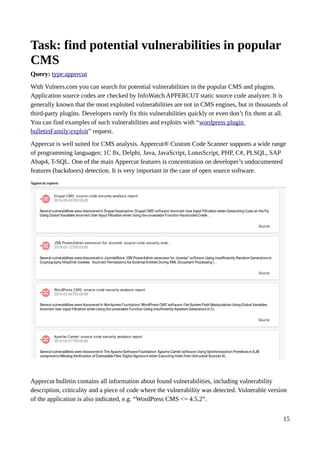
Appercut reports
Appercut bulletin contains all information about found vulnerabilities, including vulnerability
description, criticality and a piece of code where the vulnerability was detected. Vulnerable version
of the application is also indicated, e.g. “WordPress CMS <= 4.5.2”.
15
Appercut bulletin
16
Using the API
Since Vulners uses Elasticsearch, Vulners supports standard Apache Lucene queries. You can find
Field names for the search with API helper (https://vulners.com/api/v3/search/stats/). Any key from
“schemes” may be used as collector “key” in the Lucene query, for example:
• title
• description
• affectedPackage
• sourceData
• cvelist
Example of API search/lucene request for CVE-2014-0160: curl
https://vulners.com/api/v3/search/lucene/?query=type:cve%20id:CVE-2014-0160
Answer in JSON:
{
"data": {
"exactMatch": null,
"search": [
{
"_index": "bulletins",
"_score": 9.942732,
"_source": {
"type": "cve",
"title": "CVE-2014-0160: OpenSSL heartbeat information disclosure",
"published": "2014-04-07T18:55:03",
"objectVersion": "1.0",
"href": "https://web.nvd.nist.gov/view/vuln/detail?vulnId=CVE-2014-
0160",
"reporter": "NVD",
"modified": "2015-10-22T10:19:38",
"references": [
"http://www.securitytracker.com/id/1030081",
"http://public.support.unisys.com/common/public/vulnerability/NVD_Detail_Rpt.asp
x?ID=1",
"http://advisories.mageia.org/MGASA-2014-0165.html",
],
"description": "OpenSSL could allow a remote attacker to obtain
sensitive information, caused by an error in the TLS/DTLS heartbeat
functionality. An attacker could exploit this vulnerability to remotely read
system memory contents without needing to log on to the server. Successful
exploitation could allow an attacker to retrieve private keys, passwords or
other sensitive information.rnrnThis vulnerability is commonly referred to
as "Heartbleed".",
"lastseen": "2016-03-19T07:17:51",
"cvss": {
"vector": "AV:NETWORK/AC:LOW/Au:NONE/C:PARTIAL/I:NONE/A:NONE/",
"score": 5.0
},
"id": "CVE-2014-0160",
"scanner": [],
"bulletinFamily": "NVD"
17
},
"_id": "CVE-2014-0160",
"_type": "bulletin"
}
]
},
"result": "OK"
}
Vulners archive/collection call provides an easy way to export whole collections of security
bulletins.
For example, to download all CVEs you need to
wget “https://vulners.com/api/v3/archive/collection/?type=cve” -O cve.zip
The result will be cve.zip with cve.json inside.
The same file can be downloaded with GUI at Stats tab
Moreover, with this API call you can download security bulletins for a particular OS version:
wget “https://vulners.com/api/v3/archive/distributive/?os=centos&version=6” -O
centos.zip
It makes possible to get the data, which you won’t find anywhere else: the archives of exploits,
hackerone history, all CentOS vulnerabilities, etc. This functionality might be useful if you want to
make your own tools and data synchronization, if you already use some knowledge base.
No problem if you forgot “type” values. Just enter a nonexistent type, and you get a full list of
available values:
https://vulners.com/api/v3/archive/collection/?type=FAKE
“Error”: “There is no type ‘FAKE’Available collection types:. [ ‘Nessus’, ‘cve’, ‘exploitdb’,
‘xssed’, ‘zdt’, ‘hackapp’, ‘threatpost’, ‘redhat’, ‘debian’, ‘ubuntu’, ‘cert’, ‘metasploit’, ‘freebsd’,
‘zdi’, ‘oraclelinux’, ‘suse’, ‘centos’,’cisco ‘,’hackerone ‘,’vulnerlab ‘,’f5 ‘,’mozilla ‘,’ics’,
‘archlinux’, ‘ptsecurity’, ‘rdot’, ‘erpscan’, ‘huawei’, ‘xen’, ‘openssl’, ‘opera’, ‘vmware’,
‘wpvulndb’, ‘samba’, ‘postgresql’, ‘drupal’, ‘lenovo’, ‘msvr’, ‘paloalto’, ‘nginx’] “
18
Telegram Bot with subscriptions to query
results
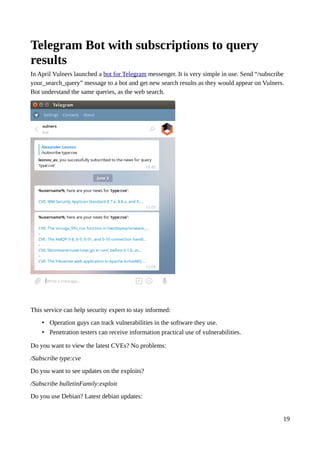
In April Vulners launched a bot for Telegram messenger. It is very simple in use. Send “/subscribe
your_search_query” message to a bot and get new search results as they would appear on Vulners.
Bot understand the same queries, as the web search.
This service can help security expert to stay informed:
• Operation guys can track vulnerabilities in the software they use.
• Penetration testers can receive information practical use of vulnerabilities.
Do you want to view the latest CVEs? No problems:
/Subscribe type:cve
Do you want to see updates on the exploits?
/Subscribe bulletinFamily:exploit
Do you use Debian? Latest debian updates:
19
/Subscribe type:debian
Vulners RSS feeds
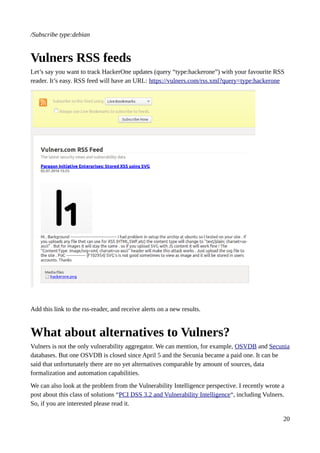
Let’s say you want to track HackerOne updates (query “type:hackerone”) with your favourite RSS
reader. It’s easy. RSS feed will have an URL: https://vulners.com/rss.xml?query=type:hackerone
Add this link to the rss-reader, and receive alerts on a new results.
What about alternatives to Vulners?
Vulners is not the only vulnerability aggregator. We can mention, for example, OSVDB and Secunia
databases. But one OSVDB is closed since April 5 and the Secunia became a paid one. It can be
said that unfortunately there are no yet alternatives comparable by amount of sources, data
formalization and automation capabilities.
We can also look at the problem from the Vulnerability Intelligence perspective. I recently wrote a
post about this class of solutions “PCI DSS 3.2 and Vulnerability Intelligence“, including Vulners.
So, if you are interested please read it.
20
Conclusion
Vulners is a unique and indispensable tool for any hacker and security expert. It is very time-saving
in exploration and exploitation of the complex attack vectors. Of course, the tool is only in
developing stage, but even now it is quite usable. And more importantly, Vulners open and free for
the end user and will always be.
By the way, vulners.com vulnerabilities, can be submitted on https://hackerone.com/vulnerscom.
Since the project is free, there are no rewards, but Vulners developers guarantee public disclosure.
Email for communication support@vulners.com, other contacts here https://vulners.com/#contacts.
Good luck!
21

Vulners: Google for hackers

  • 1.
    Vulners – Googlefor hacker. How the best vulnerability search engine works and how to use it Original article was published in Xakep Magazine #06/2016 (in Russian) The common task. Уou need to find all information about some vulnerability: how critical the bug is, whether there is a public exploit, which vendors already released patches, which vulnerability scanner can detect this bug in the system. Previously, you had to search it all manually in dozens of sources (CVEDetails, SecurityFocus, Rapid7 DB, Exploit-DB, CVEs from MITRE / NIST, vendor newsletters, etc.) and analyze the collected data. Today, this routine can be (and should be!) automated with specialized services. One of these services – Vulners.com, the coolest search engine for bugs. And what is the most important – it’s free and has an open API. Let’s see how it can be useful for us. 1
  • 2.
    What is it? Vulnersis a very large constantly updating database of Information Security content. This site lets you search for vulnerabilities, exploits, patches, bug bounty programs the same way a web search engine lets you search for websites. Vulners aggregates and presents in convenient form seven major types of data: • Popular vulnerability databases, containing general descriptions of vulnerabilities and links. For example, well-known NVD CVEs of MITRE US agency and NIST Institute. In addition to this, Vulners supports vulnerability descriptions from various research centers and response teams: Vulnerability Lab, XSSed, CERT, ICS, Zero Day Initiative, Positive Technologies, ERPScan. • Vendor’s security bulletins. This bug-reports are published by software vendors and contain information about vulnerabilities in their own products. At current moment Vulners supports various Linux distributions (Red Hat, CentOS, Oracle Linux, Arch Linux, Debian, Ubuntu, SUSE), FreeBSD, network devices (F5 Networks, Cisco, Huawei, Palo Alto Networks), popular and critical software (OpenSSL, Samba, nginx, Mozilla, Opera), including CMS (WordPress, Drupal). • Exploits from Exploit-DB, Metasploit and 0day.today. Exploits are parsed and stored in full- text form and you can read the sources in a convenient text editor. • Nessus plugins for vulnerability detection. It makes easy to find out whether a particular vulnerability can be detected using this popular network scanner. Why is it important? Read in my article “When a free scanning service detects vulnerabilities better“. • Bug disclousers for bug bounty programs. At current moment Vulners supports HackerOne and Open Bug Bounty. • Potential vulnerabilities of mobile applications and CMS. It is possible in cooperation with the static application security testing (SAST) vendors Hackapp and InfoWatch APPERCUT. • Posts from hacking resources. Vulners collects Threatpost and rdot.org publications, which often cover vulnerability related topics. All this information is handled, cataloged, structured and is always available for the search. 2
  • 3.
    Full list ofvendors, articles and databases supported by Vulners you can see at https://vulners.com/#stats page. Unlike other security databases in which information is stored in a highly formalized form (for example in OVAL-based CIS, SecPod and Altx-Soft databases), Vulners data format is much more flexible. This makes it easier to add different kinds of sources and establish connections between all entities in the database automatically. Vulners provides fast search mechanism and presents search results in a nice form. What to do next with this information depends entirely on end-user’s fantasy. 3
  • 4.
    Who makes Vulnersand what is under the hood? Vulners is developing by a small group of security enthusiasts in their spare time: • Kirill «isox» Ermakov codes kernel and makes system administration tasks; • Igor «Videns» codes the search engine; • Vanya «Vankyv3r» codes the front-end; • Sasha «Plex» codes data collecting robots; • Alexander Leonov writes articles and makes analytics. The first version of Vulners was rolled out in a couple of months after beginning of the development and was presented at Black Hat USA 2015 conference in Las Vegas. In June, the project celebrated it’s first anniversary. Vulners engine is written in Python + Django and uses MongoDB + Elasticsearch databases. MongoDB is used only by data collecting robots, Elasticsearch is used only by front-end. Deploy is made with Bitbucket script. Scaling is released directly in the kernel through MongoDB and Elasticsearch sharding. Robot factory does not depend on host and may work away of the project. One of the coolest pieces – project uses Python 3.5+ and asyncio. That’s why search operations always work very fast :). Vulners contains 319,557 bulletins and 144,684 exploits. Database size is less than 2 GB. This compactness is achieved by deduplication and packaging. All data is stored in RAM and this increases search speed greatly. It is worth mentioning that Vulners is protected by Wallarm WAF operating in blocking mode. Vulners Architecture But enough words. 4
  • 5.
    Let’s try tosearch something The first thing you see when you open Vulners.com is, of course, the search string. Just enter the name of the application, website URL or vulnerability CVE number and Vulners will give you all latest publicly known bugs of the product with links to exploits, detection plugins and various publications. WordPress bugs found by Vulners. Please note: The data is updated continuously and automatically Of course, it’s boring to search something simple like «wordpress» or «xakep.ru». Let’s see what interesting things that Vulners can do. 5
  • 6.
    Task: find criticalCentOS bugs with public exploits Query: type:centos order:published Vulners allows you to filter search results and/or sort it by any field in bug description: • by type of the bulletin; • by CVSS Score; • by date; • by detection plugin number; • by researcher name; And so on. That’s why we can form a complex queries like “type:centos cvss.score:[8 TO 10] order:published“, which means “find all new critical CentOS bugs, with CVSS Base Score from 8 to 10”. Since Vulners automatically add links to all collected data, you will see all related CVEs, detecting plugins, and exploits on every CentOS CESA bulletin page in search results. Search results for this query can be obtained via Vulners API – it is may be useful for scripting. You just need to make a GET-request https://vulners.com/api/v3/search/lucene/?query=type:centos %20cvss.score:[8%20TO%2010]%20order:published. The answer will be in JSON. Another useful API-request option – references=true, which allows you to get not only security objects (CentOS bulletins) in the query results, but all of related linked objects (detection plugins, exploits, etc.). For example, https://vulners.com/api/v3/search/lucene/?references=True&query=type:centos%20cvss.score: [8%20TO%2010]%20order:published GUI master for search requests 6
  • 7.
    Getting more than20 objects from Vulners By default Vulners returns only first twenty objects in the search results. If you want more, you need to set the parameter size. So you can get up to 500 objects. And if that’s not enough, you can request several times by 500 using parameter skip. 7
  • 8.
    Task: explain IT-departmentwhy we need to patch this vulnerabilities (or just to find all exploits for a particular bug :-)) Query: cvelist:CVE-2014-0160 type:exploitdb With Vulners it is relatively easy to explain IT-department why vulnerabilities detected by the scanner are really dangerous and should be patched. To do this, you can display a list of exploits found by the CVE number or by another identifier. You can search in Exploit-DB or Metasploit. On the exploit page, full description and the source code of the exploit will be displayed. Looking for CVE-2014-0160 exploits 8
  • 9.
    You can seefull text of the exploit in a convenient web editor. 9
  • 10.
    Task: find outhow much money some hacker gained with bug bounty programs Query: isox order:bounty Bug bounty search is an unique Vulners feature. You can find out which vulnerabilities were reported by the researcher and see his achievements in the bug bounty programs. Results can be sorted by company, researcher, price and so on. For example, we are searching for a nick, sort on by bounty size: Bounty search example Vulners found reported bug in Mail.Ru, $400 was paid 10
  • 11.
    You can findout how much money people earned on bug bounty: $ curl "https://vulners.com/api/v3/search/lucene/?query=type%3Ahackerone+order %3Alastseen+reporter%3Aisox" 2>/dev/null | awk '{if($0~""bounty"") {gsub(",","",$2)}; earn+=$2 }END{print earn}' The answer (in US $): 2762 You can also look for real SQL-injection vulnerabilities or vulnerabilities on a particular web- service, such as Vimeo: type:hackerone Vimeo. Reported Vimeo bugs at HackerOne 11
  • 12.
    Task: find bugswith Nessus detection plugins Query: type:nessus order:published Nessus plugin search is also a unique feature Vulners. Query will display a list of recently added plugins. Example of Nessus plugin search Some vulnerabilities in GNU C Library 12
  • 13.
    Task: find potentialvulnerabilities in mobile applications Query: type:hackapp Another cool Vulners feature – the ability to search for vulnerabilities in more than 13,000 free Android apps from US Google Play! Store through HackApp base. HackApp – is shareware toolkit and service for analyzing mobile applications. The search results contain bulletin title, number of vulnerabilities by severity (red circle – critical, yellow circle – medium, gray circle – notice), information about the application (icon, current version, vendor name and release date). Example of HackApp reports search The bulletin contains brief description of vulnerabilities, vulnerable version of the application and a link to full version of the report on hackapp.com. 13
  • 14.
  • 15.
    Task: find potentialvulnerabilities in popular CMS Query: type:appercut With Vulners.com you can search for potential vulnerabilities in the popular CMS and plugins. Application source codes are checked by InfoWatch APPERCUT static source code analyzer. It is generally known that the most exploited vulnerabilities are not in CMS engines, but in thousands of third-party plugins. Developers rarely fix this vulnerabilities quickly or even don’t fix them at all. You can find examples of such vulnerabilities and exploits with “wordpress plugin bulletinFamily:exploit” request. Appercut is well suited for CMS analysis. Appercut® Custom Code Scanner supports a wide range of programming languages: 1C 8x, Delphi, Java, JavaScript, LotusScript, PHP, C#, PLSQL, SAP Abap4, T-SQL. One of the main Appercut features is concentration on developer’s undocumented features (backdoors) detection. It is very important in the case of open source software. Appercut reports Appercut bulletin contains all information about found vulnerabilities, including vulnerability description, criticality and a piece of code where the vulnerability was detected. Vulnerable version of the application is also indicated, e.g. “WordPress CMS <= 4.5.2”. 15
  • 16.
  • 17.
    Using the API SinceVulners uses Elasticsearch, Vulners supports standard Apache Lucene queries. You can find Field names for the search with API helper (https://vulners.com/api/v3/search/stats/). Any key from “schemes” may be used as collector “key” in the Lucene query, for example: • title • description • affectedPackage • sourceData • cvelist Example of API search/lucene request for CVE-2014-0160: curl https://vulners.com/api/v3/search/lucene/?query=type:cve%20id:CVE-2014-0160 Answer in JSON: { "data": { "exactMatch": null, "search": [ { "_index": "bulletins", "_score": 9.942732, "_source": { "type": "cve", "title": "CVE-2014-0160: OpenSSL heartbeat information disclosure", "published": "2014-04-07T18:55:03", "objectVersion": "1.0", "href": "https://web.nvd.nist.gov/view/vuln/detail?vulnId=CVE-2014- 0160", "reporter": "NVD", "modified": "2015-10-22T10:19:38", "references": [ "http://www.securitytracker.com/id/1030081", "http://public.support.unisys.com/common/public/vulnerability/NVD_Detail_Rpt.asp x?ID=1", "http://advisories.mageia.org/MGASA-2014-0165.html", ], "description": "OpenSSL could allow a remote attacker to obtain sensitive information, caused by an error in the TLS/DTLS heartbeat functionality. An attacker could exploit this vulnerability to remotely read system memory contents without needing to log on to the server. Successful exploitation could allow an attacker to retrieve private keys, passwords or other sensitive information.rnrnThis vulnerability is commonly referred to as "Heartbleed".", "lastseen": "2016-03-19T07:17:51", "cvss": { "vector": "AV:NETWORK/AC:LOW/Au:NONE/C:PARTIAL/I:NONE/A:NONE/", "score": 5.0 }, "id": "CVE-2014-0160", "scanner": [], "bulletinFamily": "NVD" 17
  • 18.
    }, "_id": "CVE-2014-0160", "_type": "bulletin" } ] }, "result":"OK" } Vulners archive/collection call provides an easy way to export whole collections of security bulletins. For example, to download all CVEs you need to wget “https://vulners.com/api/v3/archive/collection/?type=cve” -O cve.zip The result will be cve.zip with cve.json inside. The same file can be downloaded with GUI at Stats tab Moreover, with this API call you can download security bulletins for a particular OS version: wget “https://vulners.com/api/v3/archive/distributive/?os=centos&version=6” -O centos.zip It makes possible to get the data, which you won’t find anywhere else: the archives of exploits, hackerone history, all CentOS vulnerabilities, etc. This functionality might be useful if you want to make your own tools and data synchronization, if you already use some knowledge base. No problem if you forgot “type” values. Just enter a nonexistent type, and you get a full list of available values: https://vulners.com/api/v3/archive/collection/?type=FAKE “Error”: “There is no type ‘FAKE’Available collection types:. [ ‘Nessus’, ‘cve’, ‘exploitdb’, ‘xssed’, ‘zdt’, ‘hackapp’, ‘threatpost’, ‘redhat’, ‘debian’, ‘ubuntu’, ‘cert’, ‘metasploit’, ‘freebsd’, ‘zdi’, ‘oraclelinux’, ‘suse’, ‘centos’,’cisco ‘,’hackerone ‘,’vulnerlab ‘,’f5 ‘,’mozilla ‘,’ics’, ‘archlinux’, ‘ptsecurity’, ‘rdot’, ‘erpscan’, ‘huawei’, ‘xen’, ‘openssl’, ‘opera’, ‘vmware’, ‘wpvulndb’, ‘samba’, ‘postgresql’, ‘drupal’, ‘lenovo’, ‘msvr’, ‘paloalto’, ‘nginx’] “ 18
  • 19.
    Telegram Bot withsubscriptions to query results In April Vulners launched a bot for Telegram messenger. It is very simple in use. Send “/subscribe your_search_query” message to a bot and get new search results as they would appear on Vulners. Bot understand the same queries, as the web search. This service can help security expert to stay informed: • Operation guys can track vulnerabilities in the software they use. • Penetration testers can receive information practical use of vulnerabilities. Do you want to view the latest CVEs? No problems: /Subscribe type:cve Do you want to see updates on the exploits? /Subscribe bulletinFamily:exploit Do you use Debian? Latest debian updates: 19
  • 20.
    /Subscribe type:debian Vulners RSSfeeds Let’s say you want to track HackerOne updates (query “type:hackerone”) with your favourite RSS reader. It’s easy. RSS feed will have an URL: https://vulners.com/rss.xml?query=type:hackerone Add this link to the rss-reader, and receive alerts on a new results. What about alternatives to Vulners? Vulners is not the only vulnerability aggregator. We can mention, for example, OSVDB and Secunia databases. But one OSVDB is closed since April 5 and the Secunia became a paid one. It can be said that unfortunately there are no yet alternatives comparable by amount of sources, data formalization and automation capabilities. We can also look at the problem from the Vulnerability Intelligence perspective. I recently wrote a post about this class of solutions “PCI DSS 3.2 and Vulnerability Intelligence“, including Vulners. So, if you are interested please read it. 20
  • 21.
    Conclusion Vulners is aunique and indispensable tool for any hacker and security expert. It is very time-saving in exploration and exploitation of the complex attack vectors. Of course, the tool is only in developing stage, but even now it is quite usable. And more importantly, Vulners open and free for the end user and will always be. By the way, vulners.com vulnerabilities, can be submitted on https://hackerone.com/vulnerscom. Since the project is free, there are no rewards, but Vulners developers guarantee public disclosure. Email for communication support@vulners.com, other contacts here https://vulners.com/#contacts. Good luck! 21