Surgical
Management of
VSD
Presenter – Dr. Prateek Vaswani
Moderator – Dr. Milind P Hote
Discussant – Dr. Sachin Talwar
Outline
• Natural History
• Evaluation
• Indications for surgical intervention
• Various surgical approaches and techniques
• Complications
• Results
• Outcomes
Natural History of VSD (Recap)
1. Spontaneous closure
2. Premature death
3. Pulmonary vascular disease
4. Development of aortic incompetence
5. Bacterial endocarditis
6. Development of Infundibular PS
5
EVALUATION
CXR
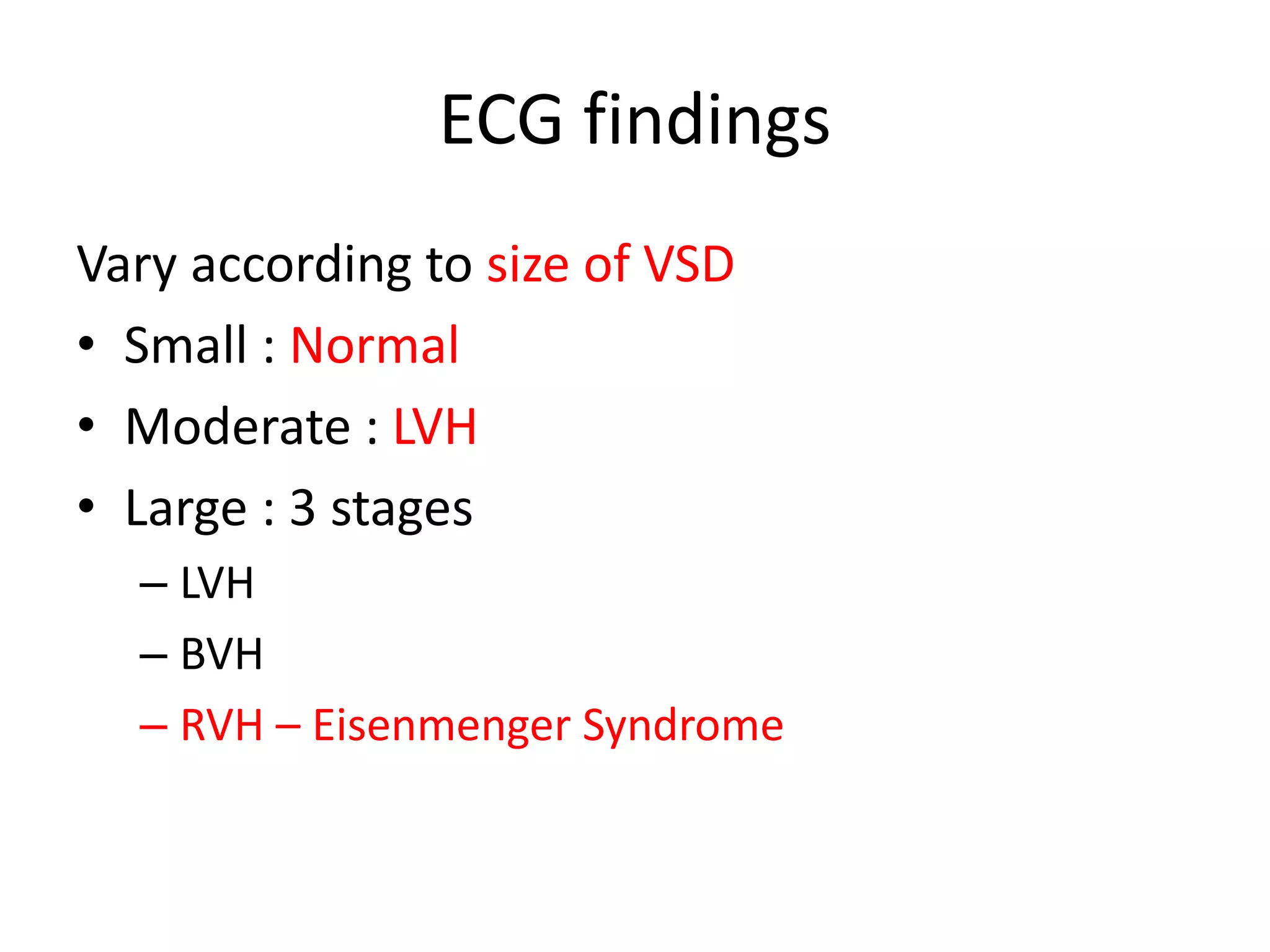
ECG findings
Vary according to size of VSD
• Small : Normal
• Moderate : LVH
• Large : 3 stages
– LVH
– BVH
– RVH – Eisenmenger Syndrome
Echocardiography
A. General
B. VSD
C. Valves
D. Chambers
E. Associated anomalies
Echocardiography
A. General
1. Situs
2. AV connection
3. VA connection
4. Systemic venous drainage
5. Pulmonary venous drainage
Echocardiography
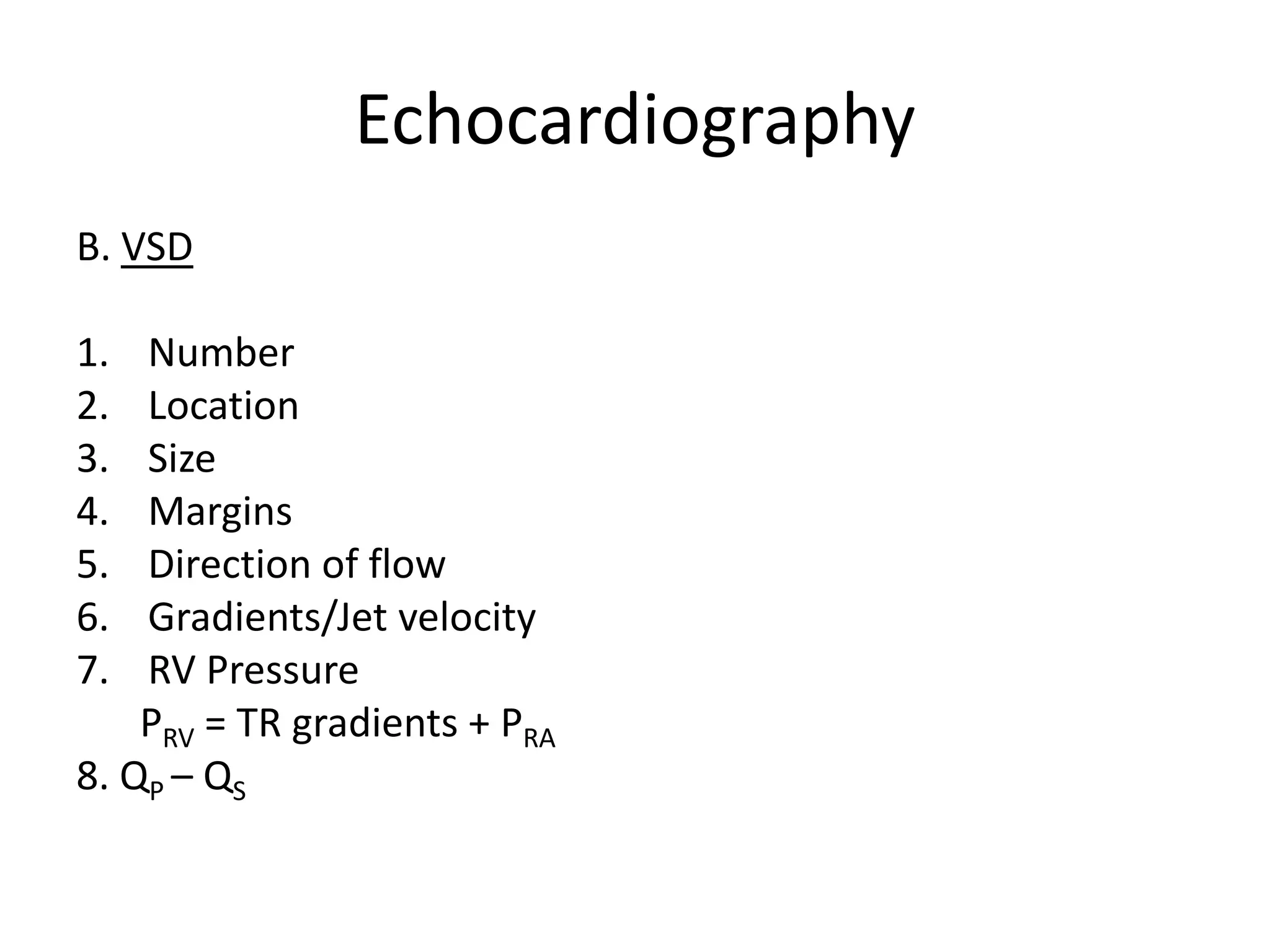
B. VSD
1. Number
2. Location
3. Size
4. Margins
5. Direction of flow
6. Gradients/Jet velocity
7. RV Pressure
PRV = TR gradients + PRA
8. QP – QS
Echocardiography
C. Valves
1.TV : Morphology, Size, Straddling, Override, TR
2. MV : Morphology ( Cleft, parachute), Size, MS,
MR, Supra-mitral membrane
Aorto-mitral continuity
3. AoV: BAV (AS), AR due to cusp prolapse
4. PV : Morphology, PS, RVOTO
Echocardiography
D. Chambers
LA/RA/RV/LV : Size (Dilatation / Hypertrophy)
Function
Echocardiography
E. Associated anomalies
1. MV associated
2. AS, AR
3. PS
4. Arch Hypoplasia, Coarctation
5. PDA
Cardiac catheterization
• Indication : Doubtful operability(Pulmonary
vascular disease)
• For Assessment of PVRI
PVR :(Mean PA pressure-Mean LA pressure)/Qp
PVRI: PVR x BSA
Unit of PVRI: unit . m2
PVRI > 8 – Doubtful Closure
PVRI < 7 after administering O2 – Indicates
Operability
INDICATIONS FOR
SURGICAL INTERVENTION
Saxena A, Relan J, Agarwal R, Awasthy N, Azad S, Chakrabarty M, et
al. Indian guidelines for indications and timing of intervention for
common congenital heart diseases: Revised and updated consensus
statement of the Working group on management of congenital heart
diseases.
Ann Pediatr Card 2019;12:254‐86.
Classification of VSD : Size
Large Moderate Small
Size in relation to
aortic annulus
75% or more 33%-75% < 33%
Flow Velocity < 1m/s 1-4 m/s >4m/s
VSD Resistance Index < 20 units . m2 >20 units . m2 >> 20 units . m2
RV/ LV Systolic
Pressure
2/3 - 1 1/3 - 2/3 < 1/3
Op / Qs Very high. Depends
upon PVRI
> 2 < 1.7
22
Size of VSD Recommendation
Small VSD –
1. Asymptomatic
2. Normal PA pressure
3. Normal left heart chambers
4. No cusp prolapse
However, if –
• Endocarditis episode
• Development of AR
• Development of RVOTO
Annual Follow up till 10 years and
then every 2-3 years
Prompt Closure
Moderate VSD:
Asymptomatic
Symptomatic (Controlled with medications)
Closure of VSD by 2–5 years of age
Closure by 1–2 years of age
Large VSD:
a. Poor growth/congestive heart failure (NOT
controlled with medications (Diuretics and Digoxin)
b. Controlled heart failure
Closure as soon as possible
Closure by 6 months of age
APPROACHES AND
SURGICAL TECHNIQUES
History
Lillehei, Varco(1954):
Repaired using controlled cross circulation
DuShane et al in Mayo Clinic(1955-1956):
Intracardiac repair with pump oxygenator
Lillehei(1957):
Atrial approach to VSD closure
Eisenmenger : Autopsy finding in 1897
25
APPROACH ADVANTAGES DISADVANTAGES SUITABLE FOR TYPE OF VSD
TRANS RA
MOST
COMMON
1. AVOIDANCE OF
VENTRICULOTOMY SCAR-
• DECREASED RISK OF POST OP
RV DYSFUNCTION
• DECREASED RISK OF LATE
POSTOP VENTRICULAR
ARRYTHMIAS
2. DECREASED RISK OF INJURY
TO BUNDLE -> RBBB
1. DIFFICULT TO CLOSE -
• OUTLET EXTENSION /
OUTLET VSD
• APICAL VSD
2. DAMAGE TO TRICUSPID
VALVE(CHORDAE/LEAFLETS)-
>TR
• PM VSD
• INLET VSD
• UPPER MUSCULAR
(TRABECULAR) VSD
TRANS RV 1. ACCURATE
VISUALISATION OF AREA OF
BUNDLE AND RIGHT
TRIGONE
2.EASE OF CLOSURE
RV SCAR -> DYSFUNCTION
RBBB
VENTRICULAR ARRHYTHMIAS
HIGH TRANS RV
• OUTLET VSD
LOW TRANS RV
• APICAL VSD
APPROACH ADVANTAGES DISADVANTAGES SUITABLE FOR
TYPE OF VSD
TRANS PA SUBPULMONARY
VSD
TRANS AORTIC S/A VSD OR PM
VSD WITH AR
TRANS LV 1.VENTRICULAR
DYSFUNCTION
2.LATE VENTRICULAR
ARRYTHMIAS
1.SWISS CHEESE
SEPTUM
2.POST MI VSD
(ADULTS)
COMBINED TRANS RA-
RV/PA
PM VSD WITH OUTLET
EXTENSION
26
Patch material
Choice between three materials
Knitted Dacron
Used for the majority of VSDs
Reasonably flexible
Fibrous reaction
Autologous pericardium ±
treated with glutaraldehyde
Where fibrosis is not desirable
PTFE
AVOIDANCE OF CONDUCTION
BUNDLE
28
PM VSD
PM VSD WITH INLET EXTENSION
MUSCULAR INLET VSD
PM VSD AND INLET VSD
Right Ventricular
approach
INDICATIONS:
• Inaccessibility from the
right atrium or pulmonary
trunk
• Defect opening directly
into the infundibular area
• Obstructive infundibular
muscle bundles
• Difficulty exposing the
inferior margin of an outlet
defect
Trans Aortic
Approach
Trans pulmonary
arterial approach
Left ventricular
approach
48
IDENTIFYING ADDL VSD -
• Using blunt right angled forceps through the VSD explore on the LV side of
septum(smooth LV septum, single opening) -> tip engages the VSD easily.
• Switch off vent
• Light test - via IAS place a paediatric bronchoscope into LV-> Illuminate LV->
see the site on IVS from where light is coming.
• RV Incision- > Few trabeculations at apex are cut
MANAGEMENT OF MULTIPLE VSDS
• Fibrin glue
Leca F, Karam J, Vouhe PR et al. Surgical treatment of
multiple ventricular septal defects using a biologic glue.
J Thorac Cardiovasc Surg 1994; 107:96–102
• Intraoperative use of double umbrella devices
Murzi B, Bonanomi GL, Giusti S et al. Surgical closure of
muscular ventricular septal defects using double
umbrella devices (intraoperative VSD device closure).
Eur J Cardiothorac Surg 1997; 12:450–454.
Closure of Trabecular VSD
Sandwich Technique
Complications
Intra-operatively
1. Damage to Structures
a) Bundle : CHB, RBB
b) Aortic valve
c) Tricuspid valve
2. Residual VSD
3. Imperfect myocardial preservation
4. Air embolism
Immediate Post-op Complications
Related to VSD:
1. Continuation of Intra-op problems: CHB, AR, TR,
RBBB
2. Acute myocardial dysfunction
3. Pulmonary hypertensive crisis
4. Ventricular arrhythmias
5. Patch dehiscence
Related to open heart : Bleeding
Late complications after VSD closure
1. Progression of PAH
2. Patch endocarditis
3. Sudden cardiac death (in patients with
transient CHB in post op period)
Surgical Cure
• Surviving the early postoperative period and
being alive late postoperatively with
essentially normal PPA
• Survival with mean PA pressure less than 25
mm Hg after 5 years
• Depends upon age and PVRI at surgery
Dushane and Kirklin 1973
58
VSD WITH AR
• Lack of support to aortic annulus : Diastolic prolapse of
unsupported cusp.
• Venturi effect : Cusp is sucked during systole
TRUSLER’S REPAIR
YACOUB’S REPAIR
62
• Palliative
• Consider in -
a. Multiple VSDs (Swiss cheese VSDs), inaccessible VSDs
(Class I)
b. Rarely in patients with contraindications for
cardiopulmonary bypass, e.g., sepsis, severe
malnutrition where used as inter-rim measure (Class
IIa).
PA Banding
Pulmonary Artery Banding
• Fixed PA Band (CPAB)
– Problems of band tightening in sedated, ventilated patient
– Sudden increase in afterload
– Acute adverse events
– Multiple re-operations
– High morbidity & mortality
• Adjustable PA Band (APAB)
– Adjustments in extubated, breathing patient on room air
– Gradual tightening
– Better tolerated by sicker patients
APAB: Band tightening
• Pule oxymetry, Echo guidance
• By placing additional clips
• Room Air
• Add no more than 20 mm gradient at one sitting
• 2 Ventricle: Gradient 50% of systemic pressure
(max 50), Sat > 85%
• 1 Ventricle: As much tight as possible, Sat > 75%
Trusler’s formula for Band
• Two ventricle: 20 +Weight in Kg mm
• Complex Cyanotic: 24 +Weight in Kg mm
Special Situation & Controversies
1. VSD and PDA
– Large PDA, 6-8 weeks of life with moderate or less VSD – PDA closure is done
– VSD + PDA in case of Large VSD
2. VSD and CoA
– Severe CoA with Large VSD ->CoA + VSD closure
– Severe CoA with Swiss Cheese septum -> CoA + PA Banding
– Severe CoA with moderate or less VSD -> CoA only
3. Surgical options for patients with borderline operability
– Fenestrated VSD patch closure
– fenestrated flap valve VSD patch closure
– Leaving (or creating) a 5 mm ASD(PFO)
*In addition to Pulmonary vasodilators
AIIMS Technique of Flap valve VSD
68
Eligibility criteria:
• a. Weight >8 kg (5 kg for muscular
VSD)
• b. Left‐to‐right shunt > 1.5:1.
Indications:
• Midmuscular VSD,
• Anterior muscular VSD
• Postoperative residual VSD
69
Device Closure
Contraindications -
a. Irreversible PVD
b. Preexisting LBBB or
conduction abnormalities
c. Associated AR
d. Associated lesions requiring
surgery
e. Inlet and Sub-pulmonic VSD
Device should not be deployed if any of the following findings
develop at the time of procedure -
a. Any degree of AR
b. Conduction defect: CHB / LBBB
c. MR or TR
Follow up For Device Closure
• Antiplatelet agents: Aspirin (3–5 mg/kg/day) is
given a day before or immediately after
procedure and continued for total duration of
6 months.
• Follow‐up visits: At 1 month, 6 months, 1 year,
then annually till 5 years, and then every 3–5
years.
– Echocardiogram
– ECG
• IE prophylaxis is recommended for 6 months
72
THANK YOU
73

Vsd surgery, Dr Prateek Vaswani

  • 1.
    Surgical Management of VSD Presenter –Dr. Prateek Vaswani Moderator – Dr. Milind P Hote Discussant – Dr. Sachin Talwar
  • 2.
    Outline • Natural History •Evaluation • Indications for surgical intervention • Various surgical approaches and techniques • Complications • Results • Outcomes
  • 3.
    Natural History ofVSD (Recap) 1. Spontaneous closure 2. Premature death 3. Pulmonary vascular disease 4. Development of aortic incompetence 5. Bacterial endocarditis 6. Development of Infundibular PS
  • 5.
  • 6.
  • 8.
    ECG findings Vary accordingto size of VSD • Small : Normal • Moderate : LVH • Large : 3 stages – LVH – BVH – RVH – Eisenmenger Syndrome
  • 11.
    Echocardiography A. General B. VSD C.Valves D. Chambers E. Associated anomalies
  • 12.
    Echocardiography A. General 1. Situs 2.AV connection 3. VA connection 4. Systemic venous drainage 5. Pulmonary venous drainage
  • 13.
    Echocardiography B. VSD 1. Number 2.Location 3. Size 4. Margins 5. Direction of flow 6. Gradients/Jet velocity 7. RV Pressure PRV = TR gradients + PRA 8. QP – QS
  • 14.
    Echocardiography C. Valves 1.TV :Morphology, Size, Straddling, Override, TR 2. MV : Morphology ( Cleft, parachute), Size, MS, MR, Supra-mitral membrane Aorto-mitral continuity 3. AoV: BAV (AS), AR due to cusp prolapse 4. PV : Morphology, PS, RVOTO
  • 15.
    Echocardiography D. Chambers LA/RA/RV/LV :Size (Dilatation / Hypertrophy) Function
  • 16.
    Echocardiography E. Associated anomalies 1.MV associated 2. AS, AR 3. PS 4. Arch Hypoplasia, Coarctation 5. PDA
  • 17.
    Cardiac catheterization • Indication: Doubtful operability(Pulmonary vascular disease) • For Assessment of PVRI PVR :(Mean PA pressure-Mean LA pressure)/Qp PVRI: PVR x BSA Unit of PVRI: unit . m2 PVRI > 8 – Doubtful Closure PVRI < 7 after administering O2 – Indicates Operability
  • 18.
  • 19.
    Saxena A, RelanJ, Agarwal R, Awasthy N, Azad S, Chakrabarty M, et al. Indian guidelines for indications and timing of intervention for common congenital heart diseases: Revised and updated consensus statement of the Working group on management of congenital heart diseases. Ann Pediatr Card 2019;12:254‐86.
  • 20.
    Classification of VSD: Size Large Moderate Small Size in relation to aortic annulus 75% or more 33%-75% < 33% Flow Velocity < 1m/s 1-4 m/s >4m/s VSD Resistance Index < 20 units . m2 >20 units . m2 >> 20 units . m2 RV/ LV Systolic Pressure 2/3 - 1 1/3 - 2/3 < 1/3 Op / Qs Very high. Depends upon PVRI > 2 < 1.7
  • 21.
    22 Size of VSDRecommendation Small VSD – 1. Asymptomatic 2. Normal PA pressure 3. Normal left heart chambers 4. No cusp prolapse However, if – • Endocarditis episode • Development of AR • Development of RVOTO Annual Follow up till 10 years and then every 2-3 years Prompt Closure Moderate VSD: Asymptomatic Symptomatic (Controlled with medications) Closure of VSD by 2–5 years of age Closure by 1–2 years of age Large VSD: a. Poor growth/congestive heart failure (NOT controlled with medications (Diuretics and Digoxin) b. Controlled heart failure Closure as soon as possible Closure by 6 months of age
  • 22.
  • 23.
    History Lillehei, Varco(1954): Repaired usingcontrolled cross circulation DuShane et al in Mayo Clinic(1955-1956): Intracardiac repair with pump oxygenator Lillehei(1957): Atrial approach to VSD closure Eisenmenger : Autopsy finding in 1897
  • 24.
    25 APPROACH ADVANTAGES DISADVANTAGESSUITABLE FOR TYPE OF VSD TRANS RA MOST COMMON 1. AVOIDANCE OF VENTRICULOTOMY SCAR- • DECREASED RISK OF POST OP RV DYSFUNCTION • DECREASED RISK OF LATE POSTOP VENTRICULAR ARRYTHMIAS 2. DECREASED RISK OF INJURY TO BUNDLE -> RBBB 1. DIFFICULT TO CLOSE - • OUTLET EXTENSION / OUTLET VSD • APICAL VSD 2. DAMAGE TO TRICUSPID VALVE(CHORDAE/LEAFLETS)- >TR • PM VSD • INLET VSD • UPPER MUSCULAR (TRABECULAR) VSD TRANS RV 1. ACCURATE VISUALISATION OF AREA OF BUNDLE AND RIGHT TRIGONE 2.EASE OF CLOSURE RV SCAR -> DYSFUNCTION RBBB VENTRICULAR ARRHYTHMIAS HIGH TRANS RV • OUTLET VSD LOW TRANS RV • APICAL VSD
  • 25.
    APPROACH ADVANTAGES DISADVANTAGESSUITABLE FOR TYPE OF VSD TRANS PA SUBPULMONARY VSD TRANS AORTIC S/A VSD OR PM VSD WITH AR TRANS LV 1.VENTRICULAR DYSFUNCTION 2.LATE VENTRICULAR ARRYTHMIAS 1.SWISS CHEESE SEPTUM 2.POST MI VSD (ADULTS) COMBINED TRANS RA- RV/PA PM VSD WITH OUTLET EXTENSION 26
  • 26.
    Patch material Choice betweenthree materials Knitted Dacron Used for the majority of VSDs Reasonably flexible Fibrous reaction Autologous pericardium ± treated with glutaraldehyde Where fibrosis is not desirable PTFE
  • 27.
  • 29.
  • 30.
    PM VSD WITHINLET EXTENSION
  • 31.
  • 32.
    PM VSD ANDINLET VSD
  • 43.
    Right Ventricular approach INDICATIONS: • Inaccessibilityfrom the right atrium or pulmonary trunk • Defect opening directly into the infundibular area • Obstructive infundibular muscle bundles • Difficulty exposing the inferior margin of an outlet defect
  • 44.
  • 45.
  • 46.
  • 47.
    48 IDENTIFYING ADDL VSD- • Using blunt right angled forceps through the VSD explore on the LV side of septum(smooth LV septum, single opening) -> tip engages the VSD easily. • Switch off vent • Light test - via IAS place a paediatric bronchoscope into LV-> Illuminate LV-> see the site on IVS from where light is coming. • RV Incision- > Few trabeculations at apex are cut
  • 48.
    MANAGEMENT OF MULTIPLEVSDS • Fibrin glue Leca F, Karam J, Vouhe PR et al. Surgical treatment of multiple ventricular septal defects using a biologic glue. J Thorac Cardiovasc Surg 1994; 107:96–102 • Intraoperative use of double umbrella devices Murzi B, Bonanomi GL, Giusti S et al. Surgical closure of muscular ventricular septal defects using double umbrella devices (intraoperative VSD device closure). Eur J Cardiothorac Surg 1997; 12:450–454.
  • 49.
    Closure of TrabecularVSD Sandwich Technique
  • 50.
    Complications Intra-operatively 1. Damage toStructures a) Bundle : CHB, RBB b) Aortic valve c) Tricuspid valve 2. Residual VSD 3. Imperfect myocardial preservation 4. Air embolism
  • 51.
    Immediate Post-op Complications Relatedto VSD: 1. Continuation of Intra-op problems: CHB, AR, TR, RBBB 2. Acute myocardial dysfunction 3. Pulmonary hypertensive crisis 4. Ventricular arrhythmias 5. Patch dehiscence Related to open heart : Bleeding
  • 52.
    Late complications afterVSD closure 1. Progression of PAH 2. Patch endocarditis 3. Sudden cardiac death (in patients with transient CHB in post op period)
  • 53.
    Surgical Cure • Survivingthe early postoperative period and being alive late postoperatively with essentially normal PPA • Survival with mean PA pressure less than 25 mm Hg after 5 years • Depends upon age and PVRI at surgery
  • 54.
  • 55.
  • 56.
  • 57.
    58 VSD WITH AR •Lack of support to aortic annulus : Diastolic prolapse of unsupported cusp. • Venturi effect : Cusp is sucked during systole
  • 58.
  • 59.
  • 61.
    62 • Palliative • Considerin - a. Multiple VSDs (Swiss cheese VSDs), inaccessible VSDs (Class I) b. Rarely in patients with contraindications for cardiopulmonary bypass, e.g., sepsis, severe malnutrition where used as inter-rim measure (Class IIa). PA Banding
  • 62.
    Pulmonary Artery Banding •Fixed PA Band (CPAB) – Problems of band tightening in sedated, ventilated patient – Sudden increase in afterload – Acute adverse events – Multiple re-operations – High morbidity & mortality • Adjustable PA Band (APAB) – Adjustments in extubated, breathing patient on room air – Gradual tightening – Better tolerated by sicker patients
  • 64.
    APAB: Band tightening •Pule oxymetry, Echo guidance • By placing additional clips • Room Air • Add no more than 20 mm gradient at one sitting • 2 Ventricle: Gradient 50% of systemic pressure (max 50), Sat > 85% • 1 Ventricle: As much tight as possible, Sat > 75%
  • 65.
    Trusler’s formula forBand • Two ventricle: 20 +Weight in Kg mm • Complex Cyanotic: 24 +Weight in Kg mm
  • 66.
    Special Situation &Controversies 1. VSD and PDA – Large PDA, 6-8 weeks of life with moderate or less VSD – PDA closure is done – VSD + PDA in case of Large VSD 2. VSD and CoA – Severe CoA with Large VSD ->CoA + VSD closure – Severe CoA with Swiss Cheese septum -> CoA + PA Banding – Severe CoA with moderate or less VSD -> CoA only 3. Surgical options for patients with borderline operability – Fenestrated VSD patch closure – fenestrated flap valve VSD patch closure – Leaving (or creating) a 5 mm ASD(PFO) *In addition to Pulmonary vasodilators
  • 67.
    AIIMS Technique ofFlap valve VSD 68
  • 68.
    Eligibility criteria: • a.Weight >8 kg (5 kg for muscular VSD) • b. Left‐to‐right shunt > 1.5:1. Indications: • Midmuscular VSD, • Anterior muscular VSD • Postoperative residual VSD 69 Device Closure Contraindications - a. Irreversible PVD b. Preexisting LBBB or conduction abnormalities c. Associated AR d. Associated lesions requiring surgery e. Inlet and Sub-pulmonic VSD Device should not be deployed if any of the following findings develop at the time of procedure - a. Any degree of AR b. Conduction defect: CHB / LBBB c. MR or TR
  • 71.
    Follow up ForDevice Closure • Antiplatelet agents: Aspirin (3–5 mg/kg/day) is given a day before or immediately after procedure and continued for total duration of 6 months. • Follow‐up visits: At 1 month, 6 months, 1 year, then annually till 5 years, and then every 3–5 years. – Echocardiogram – ECG • IE prophylaxis is recommended for 6 months 72
  • 72.