VREs and Research Tools
Supporting collaborative research
Christopher Brown
Programme Manager

21/11/2013

Venue Name: Go to 'View' menu > 'Header and Footer' to change

slide 1
VRE Definition and Concept

 A VRE comprises a set of online tools and other network
resources and technologies interoperating with each other to
facilitate or enhance the processes of research practitioners
within and across institutional boundaries.

 A key characteristic of a VRE is that it facilitates collaboration
amongst researchers and research teams providing them with
more effective means of collaboratively collecting,
manipulating and managing data, as well as collaborative
knowledge creation.

20/11/2013

slide 2
VRE Programme Timeline
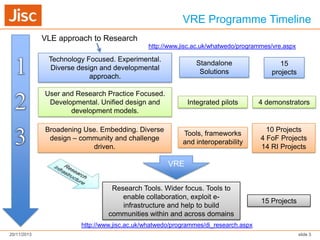
VLE approach to Research
http://www.jisc.ac.uk/whatwedo/programmes/vre.aspx

Technology Focused. Experimental.
Diverse design and developmental
approach.

Standalone
Solutions

15
projects

User and Research Practice Focused.
Developmental. Unified design and
development models.

Integrated pilots

4 demonstrators

Broadening Use. Embedding. Diverse
design – community and challenge
driven.

Tools, frameworks
and interoperability

10 Projects
4 FoF Projects
14 RI Projects

VRE
Research Tools. Wider focus. Tools to
enable collaboration, exploit einfrastructure and help to build
communities within and across domains

15 Projects

http://www.jisc.ac.uk/whatwedo/programmes/di_research.aspx
20/11/2013

slide 3
VRE2 Demonstrators
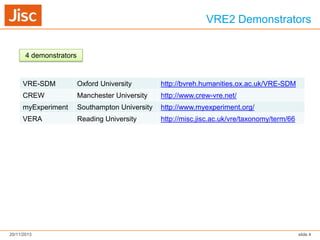
4 demonstrators

VRE-SDM

Oxford University

http://bvreh.humanities.ox.ac.uk/VRE-SDM

CREW

Manchester University

http://www.crew-vre.net/

myExperiment

Southampton University

http://www.myexperiment.org/

VERA

Reading University

http://misc.jisc.ac.uk/vre/taxonomy/term/66

20/11/2013

slide 4
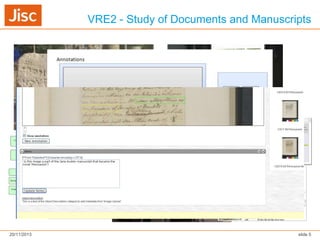
VRE2 - Study of Documents and Manuscripts

20/11/2013

slide 5
VRE2 - myExperiment

myExperiment makes it easy to find, use and share scientific workflows
and other Research Objects, and to build communities.

 “Facebook for Scientists” ...but
different to Facebook!

 A repository of research methods
 A community social network
 A Virtual Research Environment

 Open source (BSD) Ruby on Rails
application with HTML, REST and
SPARQL interfaces

 Project started March 2007
 Closed beta since July 2007
 Open beta November 2007

myExperiment has over 7500 members, 300 groups, 2500 workflows, 600 files and 300
packs*
www.myexperiment.org

20/11/2013

* As of 15/11/2013

slide 6
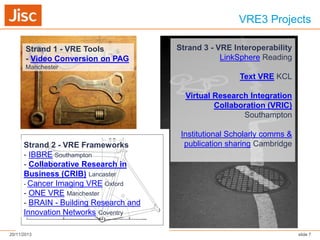
VRE3 Projects
Strand 1 - VRE Tools
- Video Conversion on PAG

Strand 3 - VRE Interoperability
LinkSphere Reading

Manchester

Text VRE KCL
Virtual Research Integration
Collaboration (VRIC)
Southampton

Strand 2 - VRE Frameworks
- IBBRE Southampton
- Collaborative Research in
Business (CRIB) Lancaster
- Cancer Imaging VRE Oxford
- ONE VRE Manchester
- BRAIN - Building Research and
Innovation Networks Coventry
20/11/2013

Institutional Scholarly comms &
publication sharing Cambridge

 16/05/2011 | Slide 7
slide 7
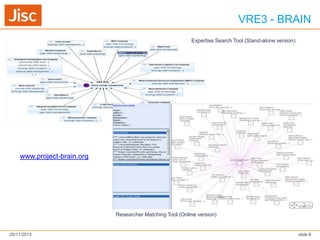
VRE3 - BRAIN
Expertise Search Tool (Stand-alone version)

www.project-brain.org

Researcher Matching Tool (Online version)

20/11/2013

slide 8
VRE3 - IBBRE
 A VRE to support cross-disciplinary and cross-institutional collaboration in internetbased behavioural research

 Enable behavioural scientists working within a variety of disciplines across the
university to collaborate in sharing and reviewing components of internet-delivered
interventions

 Analyse and describe how the VRE can be flexibly used to support collaborations
within and outside the university

 LifeGuide enables researchers to design interventions that:
– give tailored advice based on the user's answers to questions;
– allow users to plan, chart and check their progress;
– send follow-up messages to users in the form of personalised emails or texts;
– automatically randomise users to different interventions arms;
– store all data on user responses and website usage for output to Excel and CSV
http://www.lifeguideonline.org/

20/11/2013

slide 9
VRE3 - VRE-CI

VRE Toolkit
for SP2010

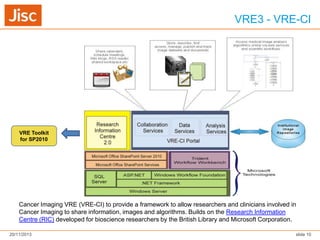
Cancer Imaging VRE (VRE-CI) to provide a framework to allow researchers and clinicians involved in
Cancer Imaging to share information, images and algorithms. Builds on the Research Information
Centre (RIC) developed for bioscience researchers by the British Library and Microsoft Corporation.
20/11/2013

slide 10
VRERI – Rapid Innovation

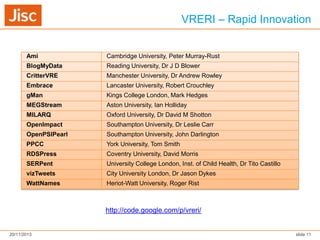
Ami

Cambridge University, Peter Murray-Rust

BlogMyData

Reading University, Dr J D Blower

CritterVRE

Manchester University, Dr Andrew Rowley

Embrace

Lancaster University, Robert Crouchley

gMan

Kings College London, Mark Hedges

MEGStream

Aston University, Ian Holliday

MILARQ

Oxford University, Dr David M Shotton

OpenImpact

Southampton University, Dr Leslie Carr

OpenPSIPearl

Southampton University, John Darlington

PPCC

York University, Tom Smith

RDSPress

Coventry University, David Morris

SERPent

University College London, Inst. of Child Health, Dr Tito Castillo

vizTweets

City University London, Dr Jason Dykes

WattNames

Heriot-Watt University, Roger Rist

http://code.google.com/p/vreri/

20/11/2013

slide 11
VRERI - AMI
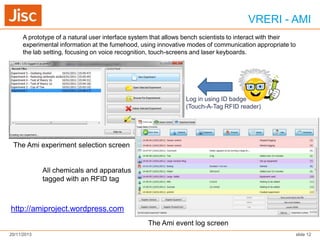
A prototype of a natural user interface system that allows bench scientists to interact with their
experimental information at the fumehood, using innovative modes of communication appropriate to
the lab setting, focusing on voice recognition, touch-screens and laser keyboards.

Log in using ID badge
(Touch-A-Tag RFID reader)

The Ami experiment selection screen

All chemicals and apparatus
tagged with an RFID tag

http://amiproject.wordpress.com
The Ami event log screen
20/11/2013

slide 12
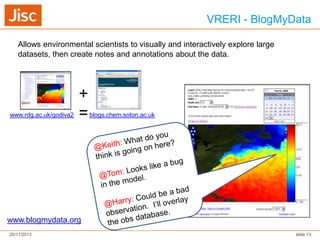
VRERI - BlogMyData
Allows environmental scientists to visually and interactively explore large
datasets, then create notes and annotations about the data.

www.rdg.ac.uk/godiva2

+
=

blogs.chem.soton.ac.uk

www.blogmydata.org
20/11/2013

slide 13
Research Tools
 Challenges
– Embedding
• Tools have been developed but need to be embedded within institutions. Many
used by small groups but their use has not spread across domains, or within
institutions. This is particularly relevant to researchers.

– Usability
• Users often have different levels of expertise so it's important that these tools
are designed so that they are easy enough to use for most users, but also
powerful enough for more advanced users.

 Solutions
– Improved support of available tools. Better awareness of tools available. Ensure
tools are easy to use. Encourage embedding of these tools within institutions.

20/11/2013

slide 14
Research Tools – first call


CamELS

– Improve the adoption of ELNs within Chemistry Dept of Cambridge and Southampton.



Increasing interoperability between Corpus Tools

– Explore ways of linking different corpus query tools so that users can investigate aspects of the same
data in a variety of ways.



e-Health GATEway to the Clouds

– Establish a cloud-based VRE on the White Rose Grid to support e-health records research



HISTORE

– Developing training modules to encourage and support the use of online historical research tools within
VREs



INSPIRES

– Using visualisation environments and tools to find cross-disciplinary connections between researchers
and projects.



SLRGuide

– Establish the requirements for, and develop a cloud based collaborative tool to support, the systematic
literature review process



TEXTUS

– Developing an open source platform that helps researchers and students to collaborate around and work
with collections of digitised public domain texts
20/11/2013

slide 15
Research Tools – second call
 Emerging tools
– BatMobile
• Developing an App to take transformed ultrasound signals from an external mic
to help identify and map the UK’s bat population

– Kinecting up the past
• Exploring the research benefits, use, and disruptive nature of Microsoft’s
Kinect controller to capture environments and artefacts in 3-dimensions

– COSMOS
• Developing a VRE around an information collection, archival and analysis
engine, which harvests freely available socially significant open data (from
social network sites, blogs, micro-blogs, RSS feeds and Open Data (e.g. crime
rates)), and analyses the harvested dataset to detect community tension and
cohesion indicators.

– Twitter analysis workbench development
• Developing existing workbench (social media analysis of large datasets),
integrating a range of new tools and migrating it to a fully cloud-based
infrastructure
20/11/2013

slide 16
Research Tools – second call
 Facilitating research communications
– COMTAX
• Develop and establish a community-driven curation process among practising
taxonomists. The project will combine recommending new texts to users with
an online verification process in order to engage the biodiversity community in
collaborative taxonomic database curation.

20/11/2013

slide 17
Research Tools – second call
 Develop sustainable and open vocabularies for research and information
management

– SOVARR
• The Shared Open Vocabulary for Audio Research and Retrieval (SOVARR)
project aims to investigate the benefits of using sustainable and shared
vocabularies in audio research communities, what are the primary needs of
researchers, and what are the main barriers to the uptake of shared
vocabularies.

– EnviLOD
• Developing semantic annotation tools that tackle the problem of Linked Open
Data vocabulary enrichment, interlinking, and adoption in the domain of
environmental science. Developing an easy to use a semantic search service.

– SKOS-HASSET
• Extending the use of social science thesauri by improving its online presence
and testing its automated indexing capacity.

20/11/2013

slide 18
Resources
 Programme Websites
– http://www.jisc.ac.uk/whatwedo/programmes/di_research.aspx
– http://www.jisc.ac.uk/whatwedo/programmes/vre
– http://code.google.com/p/vreri/

 VRE Synthesis
– http://www.jisc.ac.uk/whatwedo/programmes/di_research/researchtools/VRESynthesis.aspx

 VRE Infokit
– http://www.jiscinfonet.ac.uk/infokits/vre/

 VRE Knowledgebase
– http://misc.jisc.ac.uk/vre/
20/11/2013

slide 19
© Jisc 2013
Jisc permits reuse of this presentation and its contents under the terms of the
Creative Commons Attribution-Non-Commercial-No Derivative Works 2.0 UK
England & Wales Licence.

http://creativecommons.org/licenses/by-nc-nd/2.0/uk

VREs and Research Tools - supporting collaborative research

  • 1.
    VREs and ResearchTools Supporting collaborative research Christopher Brown Programme Manager 21/11/2013 Venue Name: Go to 'View' menu > 'Header and Footer' to change slide 1
  • 2.
    VRE Definition andConcept  A VRE comprises a set of online tools and other network resources and technologies interoperating with each other to facilitate or enhance the processes of research practitioners within and across institutional boundaries.  A key characteristic of a VRE is that it facilitates collaboration amongst researchers and research teams providing them with more effective means of collaboratively collecting, manipulating and managing data, as well as collaborative knowledge creation. 20/11/2013 slide 2
  • 3.
    VRE Programme Timeline VLEapproach to Research http://www.jisc.ac.uk/whatwedo/programmes/vre.aspx Technology Focused. Experimental. Diverse design and developmental approach. Standalone Solutions 15 projects User and Research Practice Focused. Developmental. Unified design and development models. Integrated pilots 4 demonstrators Broadening Use. Embedding. Diverse design – community and challenge driven. Tools, frameworks and interoperability 10 Projects 4 FoF Projects 14 RI Projects VRE Research Tools. Wider focus. Tools to enable collaboration, exploit einfrastructure and help to build communities within and across domains 15 Projects http://www.jisc.ac.uk/whatwedo/programmes/di_research.aspx 20/11/2013 slide 3
  • 4.
    VRE2 Demonstrators 4 demonstrators VRE-SDM OxfordUniversity http://bvreh.humanities.ox.ac.uk/VRE-SDM CREW Manchester University http://www.crew-vre.net/ myExperiment Southampton University http://www.myexperiment.org/ VERA Reading University http://misc.jisc.ac.uk/vre/taxonomy/term/66 20/11/2013 slide 4
  • 5.
    VRE2 - Studyof Documents and Manuscripts 20/11/2013 slide 5
  • 6.
    VRE2 - myExperiment myExperimentmakes it easy to find, use and share scientific workflows and other Research Objects, and to build communities.  “Facebook for Scientists” ...but different to Facebook!  A repository of research methods  A community social network  A Virtual Research Environment  Open source (BSD) Ruby on Rails application with HTML, REST and SPARQL interfaces  Project started March 2007  Closed beta since July 2007  Open beta November 2007 myExperiment has over 7500 members, 300 groups, 2500 workflows, 600 files and 300 packs* www.myexperiment.org 20/11/2013 * As of 15/11/2013 slide 6
  • 7.
    VRE3 Projects Strand 1- VRE Tools - Video Conversion on PAG Strand 3 - VRE Interoperability LinkSphere Reading Manchester Text VRE KCL Virtual Research Integration Collaboration (VRIC) Southampton Strand 2 - VRE Frameworks - IBBRE Southampton - Collaborative Research in Business (CRIB) Lancaster - Cancer Imaging VRE Oxford - ONE VRE Manchester - BRAIN - Building Research and Innovation Networks Coventry 20/11/2013 Institutional Scholarly comms & publication sharing Cambridge  16/05/2011 | Slide 7 slide 7
  • 8.
    VRE3 - BRAIN ExpertiseSearch Tool (Stand-alone version) www.project-brain.org Researcher Matching Tool (Online version) 20/11/2013 slide 8
  • 9.
    VRE3 - IBBRE A VRE to support cross-disciplinary and cross-institutional collaboration in internetbased behavioural research  Enable behavioural scientists working within a variety of disciplines across the university to collaborate in sharing and reviewing components of internet-delivered interventions  Analyse and describe how the VRE can be flexibly used to support collaborations within and outside the university  LifeGuide enables researchers to design interventions that: – give tailored advice based on the user's answers to questions; – allow users to plan, chart and check their progress; – send follow-up messages to users in the form of personalised emails or texts; – automatically randomise users to different interventions arms; – store all data on user responses and website usage for output to Excel and CSV http://www.lifeguideonline.org/ 20/11/2013 slide 9
  • 10.
    VRE3 - VRE-CI VREToolkit for SP2010 Cancer Imaging VRE (VRE-CI) to provide a framework to allow researchers and clinicians involved in Cancer Imaging to share information, images and algorithms. Builds on the Research Information Centre (RIC) developed for bioscience researchers by the British Library and Microsoft Corporation. 20/11/2013 slide 10
  • 11.
    VRERI – RapidInnovation Ami Cambridge University, Peter Murray-Rust BlogMyData Reading University, Dr J D Blower CritterVRE Manchester University, Dr Andrew Rowley Embrace Lancaster University, Robert Crouchley gMan Kings College London, Mark Hedges MEGStream Aston University, Ian Holliday MILARQ Oxford University, Dr David M Shotton OpenImpact Southampton University, Dr Leslie Carr OpenPSIPearl Southampton University, John Darlington PPCC York University, Tom Smith RDSPress Coventry University, David Morris SERPent University College London, Inst. of Child Health, Dr Tito Castillo vizTweets City University London, Dr Jason Dykes WattNames Heriot-Watt University, Roger Rist http://code.google.com/p/vreri/ 20/11/2013 slide 11
  • 12.
    VRERI - AMI Aprototype of a natural user interface system that allows bench scientists to interact with their experimental information at the fumehood, using innovative modes of communication appropriate to the lab setting, focusing on voice recognition, touch-screens and laser keyboards. Log in using ID badge (Touch-A-Tag RFID reader) The Ami experiment selection screen All chemicals and apparatus tagged with an RFID tag http://amiproject.wordpress.com The Ami event log screen 20/11/2013 slide 12
  • 13.
    VRERI - BlogMyData Allowsenvironmental scientists to visually and interactively explore large datasets, then create notes and annotations about the data. www.rdg.ac.uk/godiva2 + = blogs.chem.soton.ac.uk www.blogmydata.org 20/11/2013 slide 13
  • 14.
    Research Tools  Challenges –Embedding • Tools have been developed but need to be embedded within institutions. Many used by small groups but their use has not spread across domains, or within institutions. This is particularly relevant to researchers. – Usability • Users often have different levels of expertise so it's important that these tools are designed so that they are easy enough to use for most users, but also powerful enough for more advanced users.  Solutions – Improved support of available tools. Better awareness of tools available. Ensure tools are easy to use. Encourage embedding of these tools within institutions. 20/11/2013 slide 14
  • 15.
    Research Tools –first call  CamELS – Improve the adoption of ELNs within Chemistry Dept of Cambridge and Southampton.  Increasing interoperability between Corpus Tools – Explore ways of linking different corpus query tools so that users can investigate aspects of the same data in a variety of ways.  e-Health GATEway to the Clouds – Establish a cloud-based VRE on the White Rose Grid to support e-health records research  HISTORE – Developing training modules to encourage and support the use of online historical research tools within VREs  INSPIRES – Using visualisation environments and tools to find cross-disciplinary connections between researchers and projects.  SLRGuide – Establish the requirements for, and develop a cloud based collaborative tool to support, the systematic literature review process  TEXTUS – Developing an open source platform that helps researchers and students to collaborate around and work with collections of digitised public domain texts 20/11/2013 slide 15
  • 16.
    Research Tools –second call  Emerging tools – BatMobile • Developing an App to take transformed ultrasound signals from an external mic to help identify and map the UK’s bat population – Kinecting up the past • Exploring the research benefits, use, and disruptive nature of Microsoft’s Kinect controller to capture environments and artefacts in 3-dimensions – COSMOS • Developing a VRE around an information collection, archival and analysis engine, which harvests freely available socially significant open data (from social network sites, blogs, micro-blogs, RSS feeds and Open Data (e.g. crime rates)), and analyses the harvested dataset to detect community tension and cohesion indicators. – Twitter analysis workbench development • Developing existing workbench (social media analysis of large datasets), integrating a range of new tools and migrating it to a fully cloud-based infrastructure 20/11/2013 slide 16
  • 17.
    Research Tools –second call  Facilitating research communications – COMTAX • Develop and establish a community-driven curation process among practising taxonomists. The project will combine recommending new texts to users with an online verification process in order to engage the biodiversity community in collaborative taxonomic database curation. 20/11/2013 slide 17
  • 18.
    Research Tools –second call  Develop sustainable and open vocabularies for research and information management – SOVARR • The Shared Open Vocabulary for Audio Research and Retrieval (SOVARR) project aims to investigate the benefits of using sustainable and shared vocabularies in audio research communities, what are the primary needs of researchers, and what are the main barriers to the uptake of shared vocabularies. – EnviLOD • Developing semantic annotation tools that tackle the problem of Linked Open Data vocabulary enrichment, interlinking, and adoption in the domain of environmental science. Developing an easy to use a semantic search service. – SKOS-HASSET • Extending the use of social science thesauri by improving its online presence and testing its automated indexing capacity. 20/11/2013 slide 18
  • 19.
    Resources  Programme Websites –http://www.jisc.ac.uk/whatwedo/programmes/di_research.aspx – http://www.jisc.ac.uk/whatwedo/programmes/vre – http://code.google.com/p/vreri/  VRE Synthesis – http://www.jisc.ac.uk/whatwedo/programmes/di_research/researchtools/VRESynthesis.aspx  VRE Infokit – http://www.jiscinfonet.ac.uk/infokits/vre/  VRE Knowledgebase – http://misc.jisc.ac.uk/vre/ 20/11/2013 slide 19
  • 20.
    © Jisc 2013 Jiscpermits reuse of this presentation and its contents under the terms of the Creative Commons Attribution-Non-Commercial-No Derivative Works 2.0 UK England & Wales Licence. http://creativecommons.org/licenses/by-nc-nd/2.0/uk