Inspires Project Event -
Immersive Visualisation and
   Collective Intelligence


              Jim Hensman
Coventry University/Serious Games Institute
                  July 2012
Aims and Agenda
 Not to talk about the work of the project and demonstrate immersive
  visualisation
    Well, yes but … the main aim is to get your feedback, interaction and
     possible future collaboration (We’ve only just begun!)
    Take you through our journey and key research questions and issues
    Look at the context of immersive visualisation - see how you connect
       If the question is “Can you…? – the answer is “Yes”

 Agenda
    What we’ve done and how visualisation fits in
    Interactive Demonstration/Discussion
    Lunch
    Demonstration of other immersive space applications
    Discussion and future possibilities
Background
 Various small projects leading to JISC Brain Project (2009-11)
    Aim: To facilitate building research communities
        User requirements, tools and systems, processes, organisational and
         cultural issues
    Focus on Coventry University (Leeds University partners)
 JISC Inspires Project (2012)
    Aim: To integrate and develop techniques from Brain and other
     related projects (from Oxford, Warwick, Cambridge)
    Focus on SPIRES Community and connections from this
        EPSRC network on research spaces and environments (physical, virtual
         and social aspects) – research about research
    Links with related work (Serena – Serendipity, OpEx – Innovation etc)
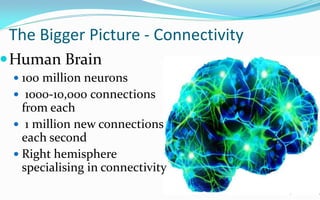
The Bigger Picture - Connectivity
 Human Brain
  100 million neurons
  1000-10,000 connections
   from each
  1 million new connections
   each second
  Right hemisphere
   specialising in connectivity
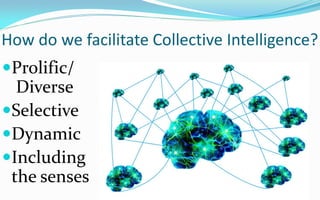
How do we facilitate Collective Intelligence?
Prolific/
  Diverse
Selective
Dynamic
Including
 the senses
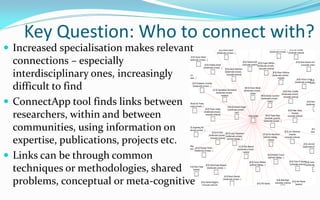
Key Question: Who to connect with?
 Increased specialisation makes relevant
  connections – especially
  interdisciplinary ones, increasingly
  difficult to find
 ConnectApp tool finds links between
  researchers, within and between
  communities, using information on
  expertise, publications, projects etc.
 Links can be through common
  techniques or methodologies, shared
  problems, conceptual or meta-cognitive
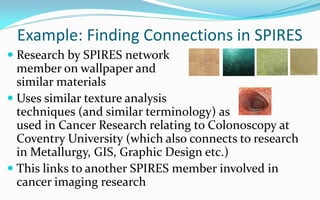
Example: Finding Connections in SPIRES
 Research by SPIRES network
  member on wallpaper and
  similar materials
 Uses similar texture analysis
  techniques (and similar terminology) as
  used in Cancer Research relating to Colonoscopy at
  Coventry University (which also connects to research
  in Metallurgy, GIS, Graphic Design etc.)
 This links to another SPIRES member involved in
  cancer imaging research
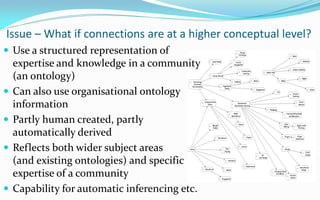
Issue – What if connections are at a higher conceptual level?
 Use a structured representation of
    expertise and knowledge in a community
    (an ontology)
   Can also use organisational ontology
    information
   Partly human created, partly
    automatically derived
   Reflects both wider subject areas
    (and existing ontologies) and specific
    expertise of a community
   Capability for automatic inferencing etc.
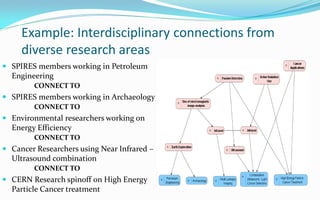
Example: Interdisciplinary connections from
     diverse research areas
 SPIRES members working in Petroleum
  Engineering
        CONNECT TO
 SPIRES members working in Archaeology
        CONNECT TO
 Environmental researchers working on
  Energy Efficiency
        CONNECT TO
 Cancer Researchers using Near Infrared –
  Ultrasound combination
        CONNECT TO
 CERN Research spinoff on High Energy
  Particle Cancer treatment
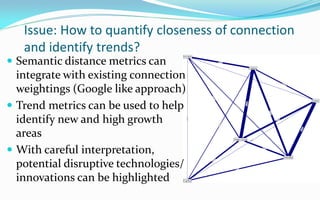
Issue: How to quantify closeness of connection
   and identify trends?
 Semantic distance metrics can
  integrate with existing connection
  weightings (Google like approach)
 Trend metrics can be used to help
  identify new and high growth
  areas
 With careful interpretation,
  potential disruptive technologies/
  innovations can be highlighted
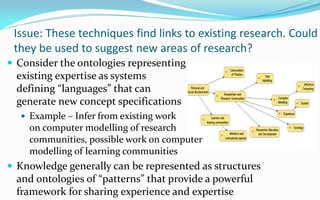
Issue: These techniques find links to existing research. Could
 they be used to suggest new areas of research?
 Consider the ontologies representing
  existing expertise as systems
  defining “languages” that can
  generate new concept specifications
   Example – Infer from existing work
    on computer modelling of research
    communities, possible work on computer
    modelling of learning communities
 Knowledge generally can be represented as structures
  and ontologies of “patterns” that provide a powerful
  framework for sharing experience and expertise
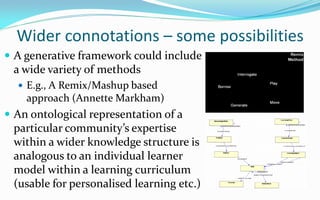
Wider connotations – some possibilities
 A generative framework could include
 a wide variety of methods
   E.g., A Remix/Mashup based
    approach (Annette Markham)
 An ontological representation of a
 particular community’s expertise
 within a wider knowledge structure is
 analogous to an individual learner
 model within a learning curriculum
 (usable for personalised learning etc.)
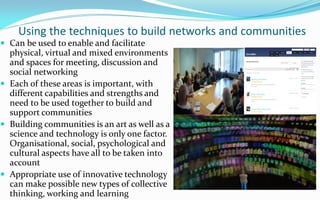
Using the techniques to build networks and communities
 Can be used to enable and facilitate
  physical, virtual and mixed environments
  and spaces for meeting, discussion and
  social networking
 Each of these areas is important, with
  different capabilities and strengths and
  need to be used together to build and
  support communities
 Building communities is an art as well as a
  science and technology is only one factor.
  Organisational, social, psychological and
  cultural aspects have all to be taken into
  account
 Appropriate use of innovative technology
  can make possible new types of collective
  thinking, working and learning
Immersive Environments and Spaces – What’s so special?
 Combines physical and virtual, real time and asynchronous modes
    Can include local and online groups and individuals
 Provides unique capabilities for individual and particularly
 collective engagement, presence and interaction
   Can replicate to a considerable degree our “normal” experience and provide
    “authenticity” – providing a key component of the “experiential web”
   Can include and integrate stimuli to all our senses – and response from them
       Both conventional ( vision, sound etc.) and others (e.g., kinaesthetic)
   Can “externalise” some of our internal sensations, facilitating and
    stimulating collective interaction (SurroundMind concept)
   Can potentially transcend conventional divisions between “intellectual” and
    “aesthetic” modes of thinking (with implications for creativity etc.)
Today’s Demonstrations
 Immersive polarised 3-D systems
 Different aspects and applications of immersion
 Main demo – facilitating collective thinking and
 discussion
   Uses several techniques described earlier through web
    services (e.g., Semantic grouping of ideas, Generation of
    new concepts based on collective knowledge) and core
    facilities (e.g., Collective visualisation and filtering)
 Other demos – related to learning, crowd sourcing,
 citizen science, performance etc.
Questions and Comments
 Thanks to the JISC for funding and support, Project Team and
  Partners, Coventry School of Art and Design for event facilities
 Further Information
    The Project
    – project-brain.org (+ project-inspires.org)
    SPIRES
    - www.spiresnetwork.org
    Immersive Systems
    - Ian Upton (ian@ian-upton.com), Joff Chafer‎(j.chafer@coventry.ac.uk)

                             Thank You!
                         j.hensman@coventry.ac.uk

Inspires Project Immersive Visualisation Event

  • 1.
    Inspires Project Event- Immersive Visualisation and Collective Intelligence Jim Hensman Coventry University/Serious Games Institute July 2012
  • 2.
    Aims and Agenda Not to talk about the work of the project and demonstrate immersive visualisation  Well, yes but … the main aim is to get your feedback, interaction and possible future collaboration (We’ve only just begun!)  Take you through our journey and key research questions and issues  Look at the context of immersive visualisation - see how you connect  If the question is “Can you…? – the answer is “Yes”  Agenda  What we’ve done and how visualisation fits in  Interactive Demonstration/Discussion  Lunch  Demonstration of other immersive space applications  Discussion and future possibilities
  • 3.
    Background  Various smallprojects leading to JISC Brain Project (2009-11)  Aim: To facilitate building research communities  User requirements, tools and systems, processes, organisational and cultural issues  Focus on Coventry University (Leeds University partners)  JISC Inspires Project (2012)  Aim: To integrate and develop techniques from Brain and other related projects (from Oxford, Warwick, Cambridge)  Focus on SPIRES Community and connections from this  EPSRC network on research spaces and environments (physical, virtual and social aspects) – research about research  Links with related work (Serena – Serendipity, OpEx – Innovation etc)
  • 4.
    The Bigger Picture- Connectivity  Human Brain  100 million neurons  1000-10,000 connections from each  1 million new connections each second  Right hemisphere specialising in connectivity
  • 5.
    How do wefacilitate Collective Intelligence? Prolific/ Diverse Selective Dynamic Including the senses
  • 6.
    Key Question: Whoto connect with?  Increased specialisation makes relevant connections – especially interdisciplinary ones, increasingly difficult to find  ConnectApp tool finds links between researchers, within and between communities, using information on expertise, publications, projects etc.  Links can be through common techniques or methodologies, shared problems, conceptual or meta-cognitive
  • 7.
    Example: Finding Connectionsin SPIRES  Research by SPIRES network member on wallpaper and similar materials  Uses similar texture analysis techniques (and similar terminology) as used in Cancer Research relating to Colonoscopy at Coventry University (which also connects to research in Metallurgy, GIS, Graphic Design etc.)  This links to another SPIRES member involved in cancer imaging research
  • 8.
    Issue – Whatif connections are at a higher conceptual level?  Use a structured representation of expertise and knowledge in a community (an ontology)  Can also use organisational ontology information  Partly human created, partly automatically derived  Reflects both wider subject areas (and existing ontologies) and specific expertise of a community  Capability for automatic inferencing etc.
  • 9.
    Example: Interdisciplinary connectionsfrom diverse research areas  SPIRES members working in Petroleum Engineering CONNECT TO  SPIRES members working in Archaeology CONNECT TO  Environmental researchers working on Energy Efficiency CONNECT TO  Cancer Researchers using Near Infrared – Ultrasound combination CONNECT TO  CERN Research spinoff on High Energy Particle Cancer treatment
  • 10.
    Issue: How toquantify closeness of connection and identify trends?  Semantic distance metrics can integrate with existing connection weightings (Google like approach)  Trend metrics can be used to help identify new and high growth areas  With careful interpretation, potential disruptive technologies/ innovations can be highlighted
  • 11.
    Issue: These techniquesfind links to existing research. Could they be used to suggest new areas of research?  Consider the ontologies representing existing expertise as systems defining “languages” that can generate new concept specifications  Example – Infer from existing work on computer modelling of research communities, possible work on computer modelling of learning communities  Knowledge generally can be represented as structures and ontologies of “patterns” that provide a powerful framework for sharing experience and expertise
  • 12.
    Wider connotations –some possibilities  A generative framework could include a wide variety of methods  E.g., A Remix/Mashup based approach (Annette Markham)  An ontological representation of a particular community’s expertise within a wider knowledge structure is analogous to an individual learner model within a learning curriculum (usable for personalised learning etc.)
  • 13.
    Using the techniquesto build networks and communities  Can be used to enable and facilitate physical, virtual and mixed environments and spaces for meeting, discussion and social networking  Each of these areas is important, with different capabilities and strengths and need to be used together to build and support communities  Building communities is an art as well as a science and technology is only one factor. Organisational, social, psychological and cultural aspects have all to be taken into account  Appropriate use of innovative technology can make possible new types of collective thinking, working and learning
  • 14.
    Immersive Environments andSpaces – What’s so special?  Combines physical and virtual, real time and asynchronous modes  Can include local and online groups and individuals  Provides unique capabilities for individual and particularly collective engagement, presence and interaction  Can replicate to a considerable degree our “normal” experience and provide “authenticity” – providing a key component of the “experiential web”  Can include and integrate stimuli to all our senses – and response from them  Both conventional ( vision, sound etc.) and others (e.g., kinaesthetic)  Can “externalise” some of our internal sensations, facilitating and stimulating collective interaction (SurroundMind concept)  Can potentially transcend conventional divisions between “intellectual” and “aesthetic” modes of thinking (with implications for creativity etc.)
  • 15.
    Today’s Demonstrations  Immersivepolarised 3-D systems  Different aspects and applications of immersion  Main demo – facilitating collective thinking and discussion  Uses several techniques described earlier through web services (e.g., Semantic grouping of ideas, Generation of new concepts based on collective knowledge) and core facilities (e.g., Collective visualisation and filtering)  Other demos – related to learning, crowd sourcing, citizen science, performance etc.
  • 16.
    Questions and Comments Thanks to the JISC for funding and support, Project Team and Partners, Coventry School of Art and Design for event facilities  Further Information  The Project – project-brain.org (+ project-inspires.org)  SPIRES - www.spiresnetwork.org  Immersive Systems - Ian Upton (ian@ian-upton.com), Joff Chafer‎(j.chafer@coventry.ac.uk) Thank You! j.hensman@coventry.ac.uk