OrgIDs for UK research
Christopher Brown
9 Nov 2016
PIDapalooza
Jisc?
09/11/2016 OrgIDs for UK Research 2
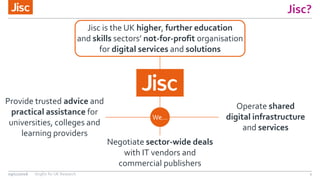
Jisc is the UK higher, further education
and skills sectors’ not-for-profit organisation
for digital services and solutions
Operate shared
digital infrastructure
and services
Provide trusted advice and
practical assistance for
universities, colleges and
learning providers
We…
Negotiate sector-wide deals
with IT vendors and
commercial publishers
Jisc is…
3
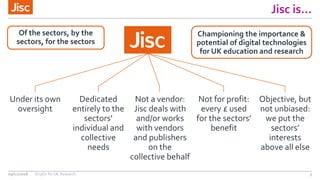
Under its own
oversight
Dedicated
entirely to the
sectors’
individual and
collective
needs
Not a vendor:
Jisc deals with
and/or works
with vendors
and publishers
on the
collective behalf
Not for profit:
every £ used
for the sectors’
benefit
Objective, but
not unbiased:
we put the
sectors’
interests
above all else
Of the sectors, by the
sectors, for the sectors
Championing the importance &
potential of digital technologies
for UK education and research
09/11/2016 OrgIDs for UK Research
Jisc does 3 main things
4
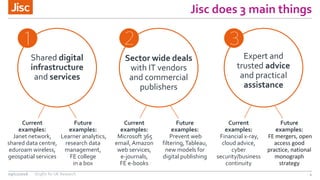
Shared digital
infrastructure
and services
Expert and
trusted advice
and practical
assistance
Sector wide deals
with IT vendors
and commercial
publishers
Current
examples:
Janet network,
shared data centre,
eduroam wireless,
geospatial services
Future
examples:
Learner analytics,
research data
management,
FE college
in a box
Current
examples:
Microsoft 365
email, Amazon
web services,
e-journals,
FE e-books
Future
examples:
Prevent web
filtering,Tableau,
new models for
digital publishing
Current
examples:
Financial x-ray,
cloud advice,
cyber
security/business
continuity
Future
examples:
FE mergers, open
access good
practice, national
monograph
strategy
09/11/2016 OrgIDs for UK Research
The UK research landscape
5
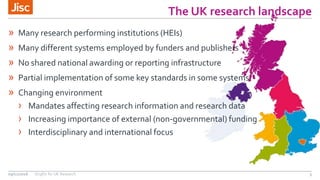
» Many research performing institutions (HEIs)
» Many different systems employed by funders and publishers
» No shared national awarding or reporting infrastructure
» Partial implementation of some key standards in some systems
» Changing environment
› Mandates affecting research information and research data
› Increasing importance of external (non-governmental) funding
› Interdisciplinary and international focus
09/11/2016 OrgIDs for UK Research
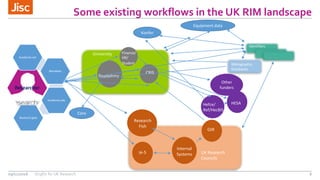
Some existing workflows in the UK RIM landscape
609/11/2016 OrgIDs for UK Research
UK Research
Councils
Je-S
Internal
Systems
GtR
Research
Fish
CRIS
Finance/
HR/
Student
Third Parties
Bibliographic
Databases
Identifiers
University
Repository
Hefce/
Ref/HecBIS
Core
Other
funders
Konfer
Equipment.data
HESA
Researcher
Academia.net
Mendeley
Academia.edu
Research gate
Relevant Areas to Research
7
» Standards and Identifiers in Research
• ORCID
• OrgID
» Reporting Research
• OSIP (Overview of Systems Interoperability Project) – RCUK/Jisc
• RIOXX application profile and guidelines (Supporting RCUK and REF OA reporting)
» Open Access to Research Outputs
• Sherpa Services - Standardisation around publisherOA policies
• Publications Router
• Jisc Monitor - developing metadata profile for various use cases
• Discovering and accessing articles
• Research data discovery
» ‘Measuring’ Research and its Impact
• Usage and citation statistics of research articles and data
09/11/2016 OrgIDs for UK Research
Jisc – How are we helping
8
» Support universities core business and help make research process more productive
› Developing shared services/infrastructure where appropriate
› Supporting implementation of key standards
› Providing a channel for universities requirements with funders, vendors etc.
› Getting everyone together
» Resolving issues:
› Lack of coordination and few shared structures
› Multiple Funder systems: Joint e-submission systems (JeS); Research Fish (a
research outcomes system), Research Outcomes System; Grants on the Web; REF;
HESA.
› Hard to get any meaningful statistics or analytics out of the systems and people are
still left keying in information multiple times in each institution.
09/11/2016 OrgIDs for UK Research
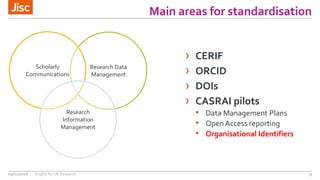
Main areas for standardisation
909/11/2016 OrgIDs for UK Research
Research Data
Management
Scholarly
Communications
Research
Information
Management
› CERIF
› ORCID
› DOIs
› CASRAI pilots
• Data Management Plans
• OpenAccess reporting
• Organisational Identifiers
Teaching &
Business Engaged
Libraries
Document
Delivery
Managing Print
Collections
Digitisation and
Preservation
Resource
Discovery
Benchmarking
Collections
Legal Deposit
Libraries
Academic
Research
Libraries
Specialist
Libraries
Availability Data
Usage Data
Copy
Cataloguing
OpenAccess
Book Directories
Identifiers
Standards
The National Bibliographic Knowledgebase
09/11/2016 OrgIDs for UK Research
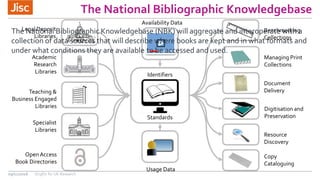
The National Bibliographic Knowledgebase (NBK) will aggregate and interoperate with a
collection of data sources that will describe where books are kept and in what formats and
under what conditions they are available to be accessed and used.
Open Access World
11
» For Gold OA, the payment of APCs and monitoring of these payments - all kinds
of points in those workflows where the easy use of agreed, common
institutional and funder IDs would make life so much more efficient. For
example:
› Researcher acknowledging research funding in a paper submitted to a journal
› Researcher noting their institutional affiliation when submitting a paper to a
journal
› Publisher invoicing the right institution
› Institution trackingAPC payments relevant to different funders with different
T&Cs for their APC funds
› Funder trackingAPC payments from different institutions
› Publisher providing funder / institutional affiliation metadata associated with
a research paper
09/11/2016 OrgIDs for UK Research
Jisc Library Support Services
12
» Summer 2015 review of Jisc Library Support Services
» Looked at the 14 Jisc services offered in the LSS area
» Duplication across systems – orgs stored in 13 different
systems
» Report viewed positively by Jisc & the user community
(incl SCONUL & RLUK) and its findings /
recommendations are being taken forward over the next
year or two in a number of parallel streams (UI, UX, data
orchestration, technical optimisation, governance, etc).
»09/11/2016 OrgIDs for UK Research
“The library systems landscape remains diffuse, despite vendor developments such as unified
search and new generation LMS products. Open Access, research output tracking and further
challenges are adding complexity. Libraries are using combinations of local systems and
supply chain services along with shared services to cover the range of their work.”
Jisc CASRAI-UK pilot
13
» Jisc and CASRAI* set up 3 working groups on priority topics:
› Data Management Plans
› Organisational Identifiers
› Open Access Reporting
» Each group involved wide group of participants from universities,
funders, vendors
09/11/2016 OrgIDs for UK Research
*Consortia Advancing Standards in Research Administration Information (CASRAI) - http://casrai.org/
Research/
requirements
Identify Use
case/issue
Consultation
Consensus
building
Develop
approach
Document Implement
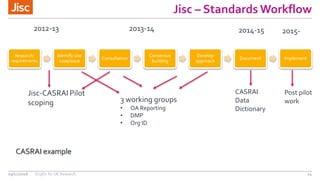
Jisc – Standards Workflow
14
CASRAI example
CASRAI
Data
Dictionary
3 working groups
• OA Reporting
• DMP
• Org ID
Jisc-CASRAI Pilot
scoping
Post pilot
work
2012-13 2013-14 2014-15 2015-
09/11/2016 OrgIDs for UK Research
OrgId Working Group - Objectives
15
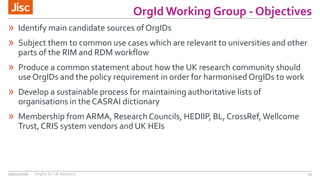
» Identify main candidate sources of OrgIDs
» Subject them to common use cases which are relevant to universities and other
parts of the RIM and RDM workflow
» Produce a common statement about how the UK research community should
use OrgIDs and the policy requirement in order for harmonised OrgIDs to work
» Develop a sustainable process for maintaining authoritative lists of
organisations in the CASRAI dictionary
» Membership from ARMA, Research Councils, HEDIIP, BL, CrossRef,Wellcome
Trust, CRIS system vendors and UK HEIs
09/11/2016 OrgIDs for UK Research
OrgId Working Group - Outputs
16
» Organisational Id Landscape Study – a report to inform theWorking Group on the
current use of organisational identifiers was commissioned and delivered (Sept 2013)
› http://repository.jisc.ac.uk/5381/
» Organisational Id Review – commissioned by theWorking Group to review a core set of
organisational identifiers (ISNI, Ringgold, Digital Science and UKPRN) (Dec 2014)
› http://repository.jisc.ac.uk/5853/
» Use cases – based on key use cases from the Research Lifecycle, these have been
identified by the Working Group and further developed under the OrgId Review (Dec
2014)
09/11/2016 OrgIDs for UK Research
Landscape Study –Terms of Reference
17
» Interview representatives within the working group to establish what
authoritative lists of organisations involved in UK research are being, or could
be, used; determine use cases based on organisational identifiers used, the
problems encountered and the approach they are currently undertaking
» Produce a landscape review of organisational identifiers currently used, and
for what purpose, in the UK
» Look at “organisational” identifiers in its broadest sense.This would,
therefore, include “institutions”, as well as “funders” and other types of
organisation
09/11/2016 OrgIDs for UK Research
Landscape Study- Summary
18
» Examined the landscape of organisational identifiers in the UK and identified
23 different IDs
» Based on interviews with key individuals
» Lots of detail on use cases for publishing, funders and institutions
» Stakeholders interviewed for this study typically described identifying
organisations as “a nightmare”, specifically disambiguation and deduplication
» Benefits from effective unique identifiers are truly realised when data is
shared
» Key aspects of identifiers that support the widest range of uses:
› Governance,Trust,Transparency,Temporal, Appropriate Metadata
› Of these, the “temporal” information is perhaps the most challenging to address
09/11/2016 OrgIDs for UK Research
Landscape Study – Key Recommendations
19
» None of the identifiers investigated fulfils the role of being an “authoritative list” of
organisations involved in research.They are all constrained in scope
» ISNI and UKPRN both have traction, and warrant particularly careful consideration by
the working group.,
» The role of the registration agency in ISNI is crucial, and whether the existing agencies
offer appropriate services for this domain will need to be considered
» The Research Councils, as major funders of research in the UK, should be closely
involved in the development of any new identifier system.At present, ROS,
ResearchFish and Gateway to Research all use their own identifiers
» Given the range of existing identifiers, any new identifier system should only be
developed and introduced if there is clear evidence of demand, and sufficient buy in to
ensure that it is universally adopted
» The authority can remain separate from the identifier (for example, it would be
feasible to establish an authority list with appropriate metadata but using the ISNI as
the identifier)
09/11/2016 OrgIDs for UK Research
OrgID Review –Terms of Reference
20
» Clarify a representative but not comprehensive set of use cases for the UK research
community to use organisational identifiers
» Survey and interview a small number of well-informed people in the field in order to
create and prioritise a list of desirable features for the provision of OrgIDs and potential
services built around them
» Check the use cases and these required features against four* possible candidate OrgIDs
and their providers
» Inform theWorking Group of the review’s conclusions and, if appropriate, make
recommendations for adoption by the UK research community
*Four candidates = ISNI, Ringgold, UKPRN, Digital Science
09/11/2016 OrgIDs for UK Research
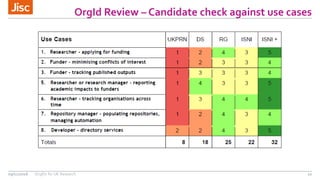
OrgId Review – Use Cases
21
» UC1 - Researcher applying for funding As a Researcher applying for funding, I need to list multiple organisations related
to my proposal in order to enable the target funder to uniquely identify previous employers and other funders, collaborators or
industry partners and beneficiaries.
» UC2 - Funder: minimising conflicts of interest As a funder preparing to find referees or reviewers, I need to be able to
identify suitable people in order to minimize conflicts of interest (through potential co-location at host institution).
» UC3 - Funder - tracking published outputs As a Funder, collating outputs in end-of-research reports, I need to be able
to track published outputs in order to understand our contribution & successful collaborations.
» UC5 - Researcher or research manager - reporting academic impacts to funders As a research producer,
I need to report academic impacts to different funders with different requirements.
» UC6 - Researcher - tracking organisations across time As a researcher I need to preserve the historical integrity of
organisational names at the time of data creation, collection or deposit (and other, specified times); it is similarly important, however,
to record and retain the links between these differing names, so that any user can see which data came from which organisation, even
if the organisation name has changed.
» UC7 - Repository manager - populating repositories, managing automation As a repository manager I
need to be able to uniquely identify my repository, whether or not its location or URL changes; this will enable me to control semi-
automated population of repository records.
» UC8 - Developer - directory services As a developer for research funders, I need to link an OrgID within my application to
a directory service.This will allow an end user or a machine to verify identity and contact details.
N.B. UC4 was deleted early in the review
09/11/2016 OrgIDs for UK Research
OrgId Review – Candidate check against use cases
2209/11/2016 OrgIDs for UK Research
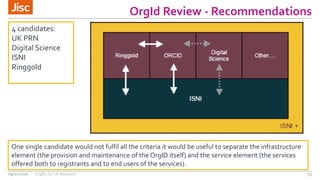
OrgId Review - Recommendations
2309/11/2016 OrgIDs for UK Research
4 candidates:
UK PRN
Digital Science
ISNI
Ringgold
One single candidate would not fulfil all the criteria it would be useful to separate the infrastructure
element (the provision and maintenance of the OrgID itself) and the service element (the services
offered both to registrants and to end users of the services).
OrgId Review - Recommendations
24
» A hybrid approach with ISNI as the backbone. Institutions and others needing to register and use
OrgIDs should use a solution which relies on and feeds the minimum data set curated by ISNI
» In considering registration solutions and value-added services, organisations should bear in mind
that, in the short term, Ringgold is the most developed agency conforming to the above
» Other service providers should be encouraged to deliver value added services on top of ISNI, for
example, Digital Science could be a registration agency for ISNIs in a similar way to Ringgold
» Jisc should investigate the possibilities and costs of a bulk deal for UK academic institutions for
value added services with Ringgold and (in time) with other service providers
» CrossRef should consider creating and maintaining a crosswalk or table of equivalence between
FundRef IDs and ISNI
» UK stakeholders (BL, HEFCE and others) to consider the need for a UK-based registration agency
(like Bibliothèque nationale de France) and how bulk creation/checking of ISNIs (and bulk
registration and/or the creation of a table of equivalence for UKPRNs) might take place for UK
academic institutions and other organisations involved in research
09/11/2016 OrgIDs for UK Research
Input into…….
PT-CRIS
25
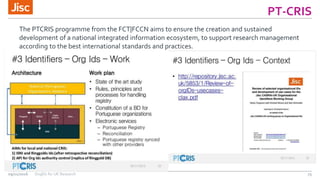
The PTCRIS programme from the FCT|FCCN aims to ensure the creation and sustained
development of a national integrated information ecosystem, to support research management
according to the best international standards and practices.
09/11/2016 OrgIDs for UK Research
OSIP
26
Overview of Systems Interoperability Project (OSIP)
› Joint RCUK-Jisc project with input and support from the Association of Research
Managers and Administrators (ARMA)
› Explore ways to maximise the value of information researchers provide, and reduce
administrative effort
› Provide RCUK with advice on how to take advantage of advancements in research
information standards, and the potential for automatic movement of information
between systems (i.e. interoperability).
› Recognising that this is a complex landscape which needs greater co-ordination
› Project led to the commitment of RCUK to the introduction of both ORCID and
OrgIDs throughout their systems
› RCUK joined the ORCID consortium in December 2015
09/11/2016 OrgIDs for UK Research
http://www.rcuk.ac.uk/publications/policy/osipreport/
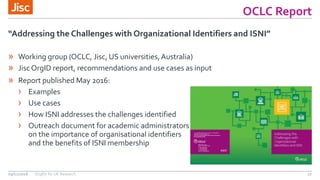
OCLC Report
27
» Report published May 2016:
› Examples
› Use cases
› How ISNI addresses the challenges identified
› Outreach document for academic administrators
on the importance of organisational identifiers
and the benefits of ISNI membership
09/11/2016 OrgIDs for UK Research
“Addressing the Challenges with Organizational Identifiers and ISNI”
» Working group (OCLC, Jisc, US universities,Australia)
» Jisc OrgID report, recommendations and use cases as input
ORCID, CrossRef, DataCite
2809/11/2016 OrgIDs for UK Research
Review the current work on organization identifiers and define use cases as
consumers of these identifiers
» Jisc OrgID work fed into report and discussion, which has resulted in 3 papers:
› Organization Identifier Provider Landscape
› Technical Considerations for an Organization Identifier Registry
› Organization Identifier Project: AWay Forward
2016 update
29
» Revisited report and recommendations
» Met with stakeholders involved in original working group
» What’s changed/new:
› British Library an ISNI registration authority
› British Library and RCUK working on test project
› Digital Science GRID launched (beta test during review)
› ORCID, DataCite,CrossRef work
» Not just a UK solution
09/11/2016 OrgIDs for UK Research
2016 update
30
» Recommended ISNI+ as a solution only if the following concerns are addressed:
› Sustainability
› Efficiency
› Support
› Governance
› Openness
» The world has moved on and it seems possible that another solution will emerge and
we are keeping a watching brief
» The issues are important for any new proposed service so they can be presented as
universally, generically applicable
» A solution will only be adopted when key stakeholders have been persuaded to adopt
it and integrate it with their existing systems
» Establishing the benefits are key to selling any solution, but to achieve a consensus
requires community engagement
09/11/2016 OrgIDs for UK Research
Find out more…
31
Christopher Brown
Senior Co-design Manager,
Jisc
christopher.brown@jisc.ac.uk
@chriscb
Except where otherwise noted, this
work is licensed under CC-BY-NC-ND

Pidapalooza - OrgIDs for UK Research

  • 1.
    OrgIDs for UKresearch Christopher Brown 9 Nov 2016 PIDapalooza
  • 2.
    Jisc? 09/11/2016 OrgIDs forUK Research 2 Jisc is the UK higher, further education and skills sectors’ not-for-profit organisation for digital services and solutions Operate shared digital infrastructure and services Provide trusted advice and practical assistance for universities, colleges and learning providers We… Negotiate sector-wide deals with IT vendors and commercial publishers
  • 3.
    Jisc is… 3 Under itsown oversight Dedicated entirely to the sectors’ individual and collective needs Not a vendor: Jisc deals with and/or works with vendors and publishers on the collective behalf Not for profit: every £ used for the sectors’ benefit Objective, but not unbiased: we put the sectors’ interests above all else Of the sectors, by the sectors, for the sectors Championing the importance & potential of digital technologies for UK education and research 09/11/2016 OrgIDs for UK Research
  • 4.
    Jisc does 3main things 4 Shared digital infrastructure and services Expert and trusted advice and practical assistance Sector wide deals with IT vendors and commercial publishers Current examples: Janet network, shared data centre, eduroam wireless, geospatial services Future examples: Learner analytics, research data management, FE college in a box Current examples: Microsoft 365 email, Amazon web services, e-journals, FE e-books Future examples: Prevent web filtering,Tableau, new models for digital publishing Current examples: Financial x-ray, cloud advice, cyber security/business continuity Future examples: FE mergers, open access good practice, national monograph strategy 09/11/2016 OrgIDs for UK Research
  • 5.
    The UK researchlandscape 5 » Many research performing institutions (HEIs) » Many different systems employed by funders and publishers » No shared national awarding or reporting infrastructure » Partial implementation of some key standards in some systems » Changing environment › Mandates affecting research information and research data › Increasing importance of external (non-governmental) funding › Interdisciplinary and international focus 09/11/2016 OrgIDs for UK Research
  • 6.
    Some existing workflowsin the UK RIM landscape 609/11/2016 OrgIDs for UK Research UK Research Councils Je-S Internal Systems GtR Research Fish CRIS Finance/ HR/ Student Third Parties Bibliographic Databases Identifiers University Repository Hefce/ Ref/HecBIS Core Other funders Konfer Equipment.data HESA Researcher Academia.net Mendeley Academia.edu Research gate
  • 7.
    Relevant Areas toResearch 7 » Standards and Identifiers in Research • ORCID • OrgID » Reporting Research • OSIP (Overview of Systems Interoperability Project) – RCUK/Jisc • RIOXX application profile and guidelines (Supporting RCUK and REF OA reporting) » Open Access to Research Outputs • Sherpa Services - Standardisation around publisherOA policies • Publications Router • Jisc Monitor - developing metadata profile for various use cases • Discovering and accessing articles • Research data discovery » ‘Measuring’ Research and its Impact • Usage and citation statistics of research articles and data 09/11/2016 OrgIDs for UK Research
  • 8.
    Jisc – Howare we helping 8 » Support universities core business and help make research process more productive › Developing shared services/infrastructure where appropriate › Supporting implementation of key standards › Providing a channel for universities requirements with funders, vendors etc. › Getting everyone together » Resolving issues: › Lack of coordination and few shared structures › Multiple Funder systems: Joint e-submission systems (JeS); Research Fish (a research outcomes system), Research Outcomes System; Grants on the Web; REF; HESA. › Hard to get any meaningful statistics or analytics out of the systems and people are still left keying in information multiple times in each institution. 09/11/2016 OrgIDs for UK Research
  • 9.
    Main areas forstandardisation 909/11/2016 OrgIDs for UK Research Research Data Management Scholarly Communications Research Information Management › CERIF › ORCID › DOIs › CASRAI pilots • Data Management Plans • OpenAccess reporting • Organisational Identifiers
  • 10.
    Teaching & Business Engaged Libraries Document Delivery ManagingPrint Collections Digitisation and Preservation Resource Discovery Benchmarking Collections Legal Deposit Libraries Academic Research Libraries Specialist Libraries Availability Data Usage Data Copy Cataloguing OpenAccess Book Directories Identifiers Standards The National Bibliographic Knowledgebase 09/11/2016 OrgIDs for UK Research The National Bibliographic Knowledgebase (NBK) will aggregate and interoperate with a collection of data sources that will describe where books are kept and in what formats and under what conditions they are available to be accessed and used.
  • 11.
    Open Access World 11 »For Gold OA, the payment of APCs and monitoring of these payments - all kinds of points in those workflows where the easy use of agreed, common institutional and funder IDs would make life so much more efficient. For example: › Researcher acknowledging research funding in a paper submitted to a journal › Researcher noting their institutional affiliation when submitting a paper to a journal › Publisher invoicing the right institution › Institution trackingAPC payments relevant to different funders with different T&Cs for their APC funds › Funder trackingAPC payments from different institutions › Publisher providing funder / institutional affiliation metadata associated with a research paper 09/11/2016 OrgIDs for UK Research
  • 12.
    Jisc Library SupportServices 12 » Summer 2015 review of Jisc Library Support Services » Looked at the 14 Jisc services offered in the LSS area » Duplication across systems – orgs stored in 13 different systems » Report viewed positively by Jisc & the user community (incl SCONUL & RLUK) and its findings / recommendations are being taken forward over the next year or two in a number of parallel streams (UI, UX, data orchestration, technical optimisation, governance, etc). »09/11/2016 OrgIDs for UK Research “The library systems landscape remains diffuse, despite vendor developments such as unified search and new generation LMS products. Open Access, research output tracking and further challenges are adding complexity. Libraries are using combinations of local systems and supply chain services along with shared services to cover the range of their work.”
  • 13.
    Jisc CASRAI-UK pilot 13 »Jisc and CASRAI* set up 3 working groups on priority topics: › Data Management Plans › Organisational Identifiers › Open Access Reporting » Each group involved wide group of participants from universities, funders, vendors 09/11/2016 OrgIDs for UK Research *Consortia Advancing Standards in Research Administration Information (CASRAI) - http://casrai.org/
  • 14.
    Research/ requirements Identify Use case/issue Consultation Consensus building Develop approach Document Implement Jisc– Standards Workflow 14 CASRAI example CASRAI Data Dictionary 3 working groups • OA Reporting • DMP • Org ID Jisc-CASRAI Pilot scoping Post pilot work 2012-13 2013-14 2014-15 2015- 09/11/2016 OrgIDs for UK Research
  • 15.
    OrgId Working Group- Objectives 15 » Identify main candidate sources of OrgIDs » Subject them to common use cases which are relevant to universities and other parts of the RIM and RDM workflow » Produce a common statement about how the UK research community should use OrgIDs and the policy requirement in order for harmonised OrgIDs to work » Develop a sustainable process for maintaining authoritative lists of organisations in the CASRAI dictionary » Membership from ARMA, Research Councils, HEDIIP, BL, CrossRef,Wellcome Trust, CRIS system vendors and UK HEIs 09/11/2016 OrgIDs for UK Research
  • 16.
    OrgId Working Group- Outputs 16 » Organisational Id Landscape Study – a report to inform theWorking Group on the current use of organisational identifiers was commissioned and delivered (Sept 2013) › http://repository.jisc.ac.uk/5381/ » Organisational Id Review – commissioned by theWorking Group to review a core set of organisational identifiers (ISNI, Ringgold, Digital Science and UKPRN) (Dec 2014) › http://repository.jisc.ac.uk/5853/ » Use cases – based on key use cases from the Research Lifecycle, these have been identified by the Working Group and further developed under the OrgId Review (Dec 2014) 09/11/2016 OrgIDs for UK Research
  • 17.
    Landscape Study –Termsof Reference 17 » Interview representatives within the working group to establish what authoritative lists of organisations involved in UK research are being, or could be, used; determine use cases based on organisational identifiers used, the problems encountered and the approach they are currently undertaking » Produce a landscape review of organisational identifiers currently used, and for what purpose, in the UK » Look at “organisational” identifiers in its broadest sense.This would, therefore, include “institutions”, as well as “funders” and other types of organisation 09/11/2016 OrgIDs for UK Research
  • 18.
    Landscape Study- Summary 18 »Examined the landscape of organisational identifiers in the UK and identified 23 different IDs » Based on interviews with key individuals » Lots of detail on use cases for publishing, funders and institutions » Stakeholders interviewed for this study typically described identifying organisations as “a nightmare”, specifically disambiguation and deduplication » Benefits from effective unique identifiers are truly realised when data is shared » Key aspects of identifiers that support the widest range of uses: › Governance,Trust,Transparency,Temporal, Appropriate Metadata › Of these, the “temporal” information is perhaps the most challenging to address 09/11/2016 OrgIDs for UK Research
  • 19.
    Landscape Study –Key Recommendations 19 » None of the identifiers investigated fulfils the role of being an “authoritative list” of organisations involved in research.They are all constrained in scope » ISNI and UKPRN both have traction, and warrant particularly careful consideration by the working group., » The role of the registration agency in ISNI is crucial, and whether the existing agencies offer appropriate services for this domain will need to be considered » The Research Councils, as major funders of research in the UK, should be closely involved in the development of any new identifier system.At present, ROS, ResearchFish and Gateway to Research all use their own identifiers » Given the range of existing identifiers, any new identifier system should only be developed and introduced if there is clear evidence of demand, and sufficient buy in to ensure that it is universally adopted » The authority can remain separate from the identifier (for example, it would be feasible to establish an authority list with appropriate metadata but using the ISNI as the identifier) 09/11/2016 OrgIDs for UK Research
  • 20.
    OrgID Review –Termsof Reference 20 » Clarify a representative but not comprehensive set of use cases for the UK research community to use organisational identifiers » Survey and interview a small number of well-informed people in the field in order to create and prioritise a list of desirable features for the provision of OrgIDs and potential services built around them » Check the use cases and these required features against four* possible candidate OrgIDs and their providers » Inform theWorking Group of the review’s conclusions and, if appropriate, make recommendations for adoption by the UK research community *Four candidates = ISNI, Ringgold, UKPRN, Digital Science 09/11/2016 OrgIDs for UK Research
  • 21.
    OrgId Review –Use Cases 21 » UC1 - Researcher applying for funding As a Researcher applying for funding, I need to list multiple organisations related to my proposal in order to enable the target funder to uniquely identify previous employers and other funders, collaborators or industry partners and beneficiaries. » UC2 - Funder: minimising conflicts of interest As a funder preparing to find referees or reviewers, I need to be able to identify suitable people in order to minimize conflicts of interest (through potential co-location at host institution). » UC3 - Funder - tracking published outputs As a Funder, collating outputs in end-of-research reports, I need to be able to track published outputs in order to understand our contribution & successful collaborations. » UC5 - Researcher or research manager - reporting academic impacts to funders As a research producer, I need to report academic impacts to different funders with different requirements. » UC6 - Researcher - tracking organisations across time As a researcher I need to preserve the historical integrity of organisational names at the time of data creation, collection or deposit (and other, specified times); it is similarly important, however, to record and retain the links between these differing names, so that any user can see which data came from which organisation, even if the organisation name has changed. » UC7 - Repository manager - populating repositories, managing automation As a repository manager I need to be able to uniquely identify my repository, whether or not its location or URL changes; this will enable me to control semi- automated population of repository records. » UC8 - Developer - directory services As a developer for research funders, I need to link an OrgID within my application to a directory service.This will allow an end user or a machine to verify identity and contact details. N.B. UC4 was deleted early in the review 09/11/2016 OrgIDs for UK Research
  • 22.
    OrgId Review –Candidate check against use cases 2209/11/2016 OrgIDs for UK Research
  • 23.
    OrgId Review -Recommendations 2309/11/2016 OrgIDs for UK Research 4 candidates: UK PRN Digital Science ISNI Ringgold One single candidate would not fulfil all the criteria it would be useful to separate the infrastructure element (the provision and maintenance of the OrgID itself) and the service element (the services offered both to registrants and to end users of the services).
  • 24.
    OrgId Review -Recommendations 24 » A hybrid approach with ISNI as the backbone. Institutions and others needing to register and use OrgIDs should use a solution which relies on and feeds the minimum data set curated by ISNI » In considering registration solutions and value-added services, organisations should bear in mind that, in the short term, Ringgold is the most developed agency conforming to the above » Other service providers should be encouraged to deliver value added services on top of ISNI, for example, Digital Science could be a registration agency for ISNIs in a similar way to Ringgold » Jisc should investigate the possibilities and costs of a bulk deal for UK academic institutions for value added services with Ringgold and (in time) with other service providers » CrossRef should consider creating and maintaining a crosswalk or table of equivalence between FundRef IDs and ISNI » UK stakeholders (BL, HEFCE and others) to consider the need for a UK-based registration agency (like Bibliothèque nationale de France) and how bulk creation/checking of ISNIs (and bulk registration and/or the creation of a table of equivalence for UKPRNs) might take place for UK academic institutions and other organisations involved in research 09/11/2016 OrgIDs for UK Research Input into…….
  • 25.
    PT-CRIS 25 The PTCRIS programmefrom the FCT|FCCN aims to ensure the creation and sustained development of a national integrated information ecosystem, to support research management according to the best international standards and practices. 09/11/2016 OrgIDs for UK Research
  • 26.
    OSIP 26 Overview of SystemsInteroperability Project (OSIP) › Joint RCUK-Jisc project with input and support from the Association of Research Managers and Administrators (ARMA) › Explore ways to maximise the value of information researchers provide, and reduce administrative effort › Provide RCUK with advice on how to take advantage of advancements in research information standards, and the potential for automatic movement of information between systems (i.e. interoperability). › Recognising that this is a complex landscape which needs greater co-ordination › Project led to the commitment of RCUK to the introduction of both ORCID and OrgIDs throughout their systems › RCUK joined the ORCID consortium in December 2015 09/11/2016 OrgIDs for UK Research http://www.rcuk.ac.uk/publications/policy/osipreport/
  • 27.
    OCLC Report 27 » Reportpublished May 2016: › Examples › Use cases › How ISNI addresses the challenges identified › Outreach document for academic administrators on the importance of organisational identifiers and the benefits of ISNI membership 09/11/2016 OrgIDs for UK Research “Addressing the Challenges with Organizational Identifiers and ISNI” » Working group (OCLC, Jisc, US universities,Australia) » Jisc OrgID report, recommendations and use cases as input
  • 28.
    ORCID, CrossRef, DataCite 2809/11/2016OrgIDs for UK Research Review the current work on organization identifiers and define use cases as consumers of these identifiers » Jisc OrgID work fed into report and discussion, which has resulted in 3 papers: › Organization Identifier Provider Landscape › Technical Considerations for an Organization Identifier Registry › Organization Identifier Project: AWay Forward
  • 29.
    2016 update 29 » Revisitedreport and recommendations » Met with stakeholders involved in original working group » What’s changed/new: › British Library an ISNI registration authority › British Library and RCUK working on test project › Digital Science GRID launched (beta test during review) › ORCID, DataCite,CrossRef work » Not just a UK solution 09/11/2016 OrgIDs for UK Research
  • 30.
    2016 update 30 » RecommendedISNI+ as a solution only if the following concerns are addressed: › Sustainability › Efficiency › Support › Governance › Openness » The world has moved on and it seems possible that another solution will emerge and we are keeping a watching brief » The issues are important for any new proposed service so they can be presented as universally, generically applicable » A solution will only be adopted when key stakeholders have been persuaded to adopt it and integrate it with their existing systems » Establishing the benefits are key to selling any solution, but to achieve a consensus requires community engagement 09/11/2016 OrgIDs for UK Research
  • 31.
    Find out more… 31 ChristopherBrown Senior Co-design Manager, Jisc christopher.brown@jisc.ac.uk @chriscb Except where otherwise noted, this work is licensed under CC-BY-NC-ND

Editor's Notes

  • #6 In 2014–15 there were 159 higher education providers (excluding further education colleges) in the UK in receipt of public funding via one of the UK funding councils. 135 of these are Universities UK members.
  • #9 Also characterised by a lack of coordination, few shared structures, and with no regulated qualification framework. Funder systems: Joint e-submission systems (JeS); Research Fish (a research outcomes system), Research Outcomes System; Grants on the Web; REF; HESA. Despite all this data it is still incredibly hard to get any meaningful statistics or analytics out of the systems, and people are still left keying in information multiple times in each institution.
  • #11 More reliance on Ids for book type objects. Open licence for book metadata – not really feasible any time soon. Should standardise form of data.
  • #13 Jisc
  • #15 Scoping worked with RCUK, HEFCE, ARMA and HEI’s to decide on the priority areas.
  • #19 – Governance. An identifier and agreed metadata must be governed and maintained. Regardless of how this is done, it must be done effectively. – Trust. Parties that rely on an identifier must trust that identifier. There are several key areas of trust: firstly, the assertion that the identifier refers to an organisation of interest (which may be supported by making the identifier human-readable), secondly, the assertion that data associated with an identifier is correct and thirdly that the identifier will continue to be maintained to reflect changes in organisational structure and status, etc. – Transparency. It must be clear how identifiers are issued, and to which organisations. Processes for the management and governance of identifiers must be defined and must be conducted transparently. – Temporal. Many use cases require information not just about the current list of organisations, but also about their histories. Institutions are created, merge, split, acquire each other, change status and are renamed. None of the identifiers discovered during this study adequately meet this requirement, although some do store some historical information. – Appropriate metadata. A Names Authority can issue organisational identifiers associated with a short list of metadata (eg name, deprecated-name, deprecated-nameID, City, County, PostalCode, URI), or an extended metadata list (eg including classifiers and organisational hierarchies). It would probably be easier and more beneficial for an organisational identifier names Authority to be limited to a small metadata set – the minimum required for effective identification.
  • #20 Examined the landscape of organisational identifiers in the UK and identified 23 different IDs Based on interviews with key individuals Lots of detail on use cases for publishing, funders and institutions
  • #22 Start simple. Don’t try to solve all use cases at once. UC4 was deleted but kept with numbering. UK focus but became clear that this is international.
  • #27 Action endorsed by RFP Board: RCUK should adopt ISNI as its organisational ID of choice. RCUK and Jisc should issue a joint commitment to taking forward the results of the Casrai-UK working group, with ISNI as the backbone of the UK research community’s approach to identifying organisations. RCUK should then take forward the planning and implementation of ISNIs within its systems.