Digital Notebooks
Christopher Brown
16 Mar 2018
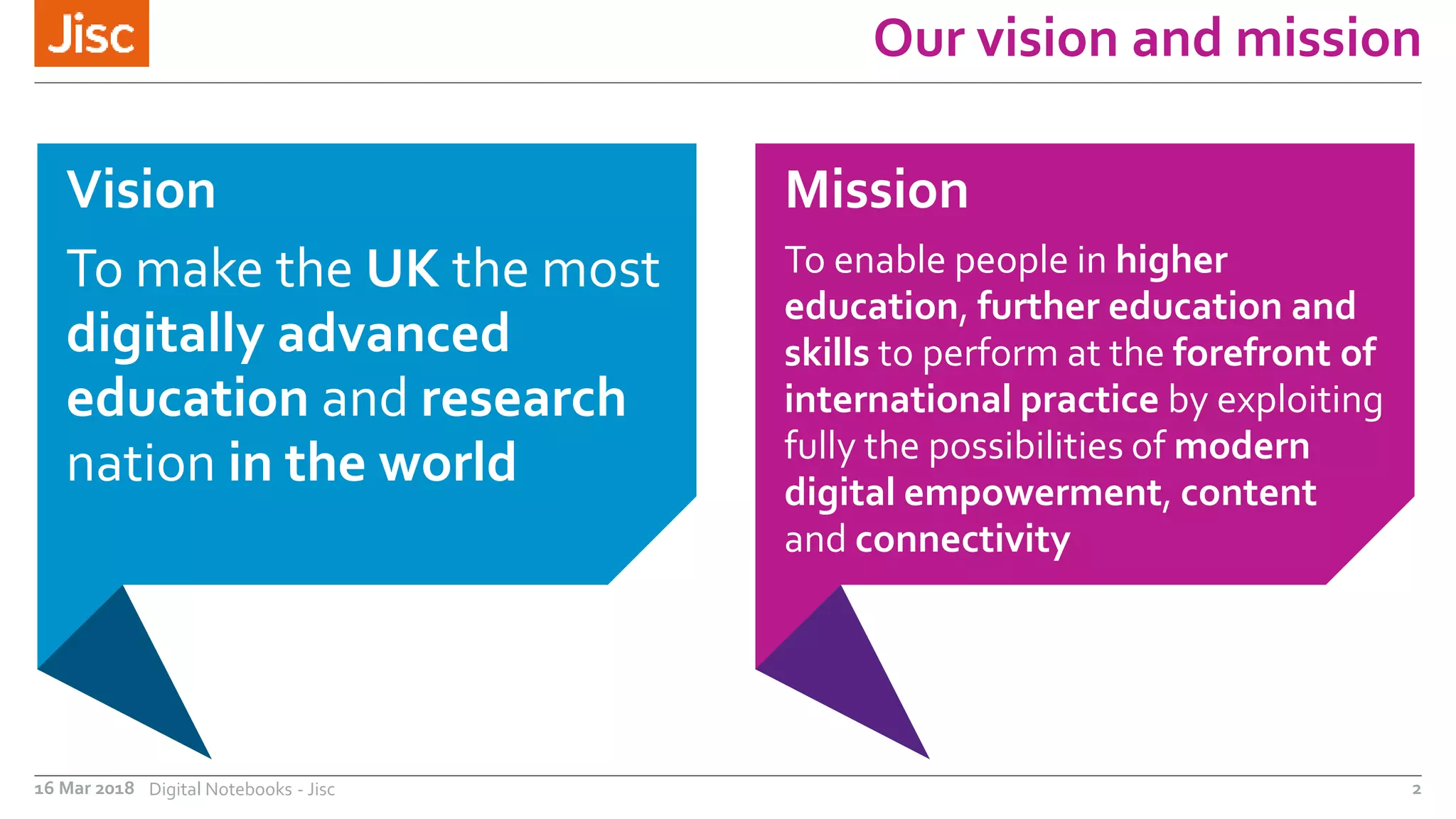
Our vision and mission
16 Mar 2018 Digital Notebooks - Jisc 2
Mission
To enable people in higher
education, further education and
skills to perform at the forefront of
international practice by exploiting
fully the possibilities of modern
digital empowerment, content
and connectivity
Vision
To make the UK the most
digitally advanced
education and research
nation in the world
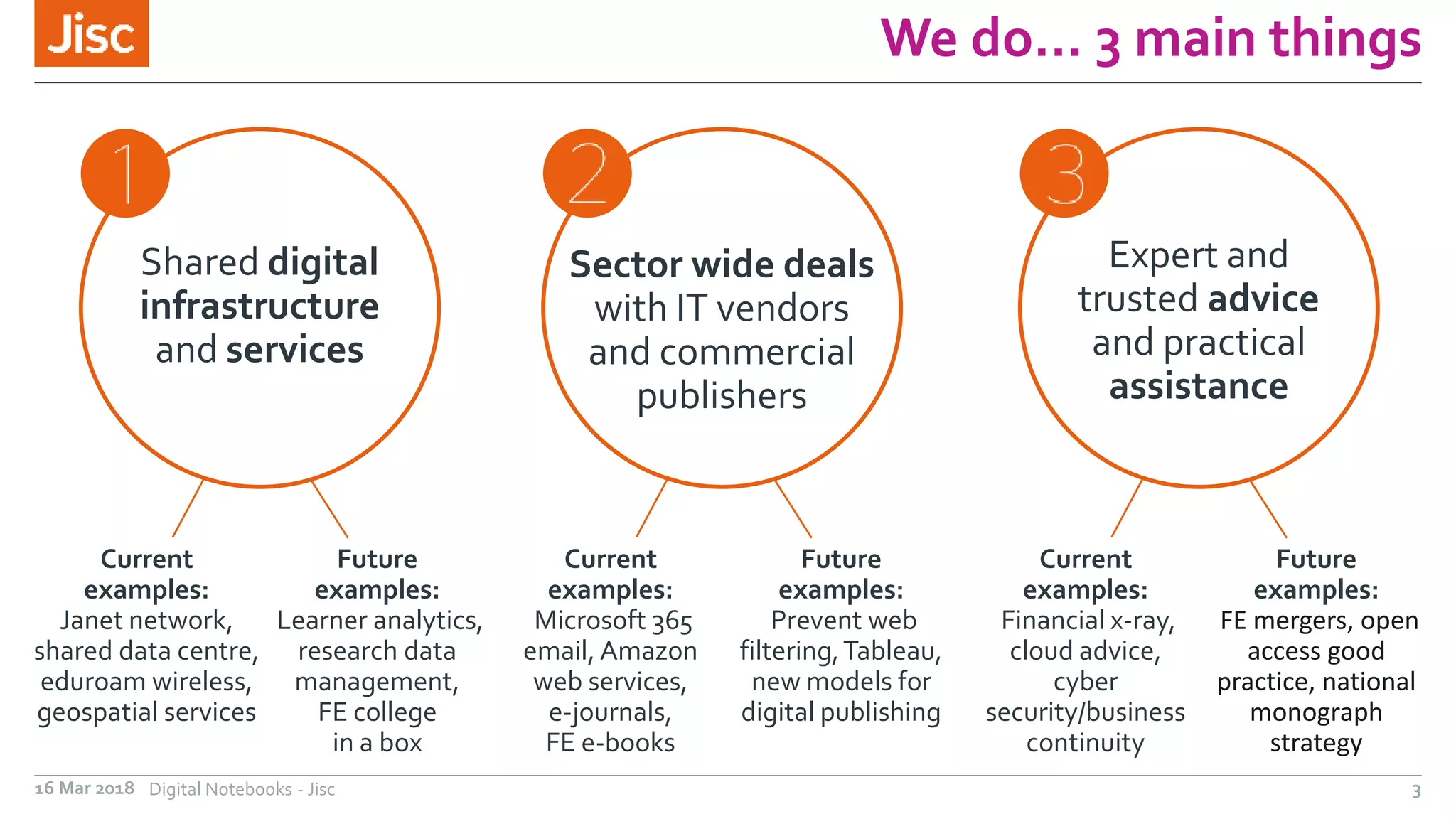
We do… 3 main things
16 Mar 2018 Digital Notebooks - Jisc 3
Shared digital
infrastructure
and services
Expert and
trusted advice
and practical
assistance
Sector wide deals
with IT vendors
and commercial
publishers
Current
examples:
Janet network,
shared data centre,
eduroam wireless,
geospatial services
Future
examples:
Learner analytics,
research data
management,
FE college
in a box
Current
examples:
Microsoft 365
email, Amazon
web services,
e-journals,
FE e-books
Future
examples:
Prevent web
filtering,Tableau,
new models for
digital publishing
Current
examples:
Financial x-ray,
cloud advice,
cyber
security/business
continuity
Future
examples:
FE mergers, open
access good
practice, national
monograph
strategy
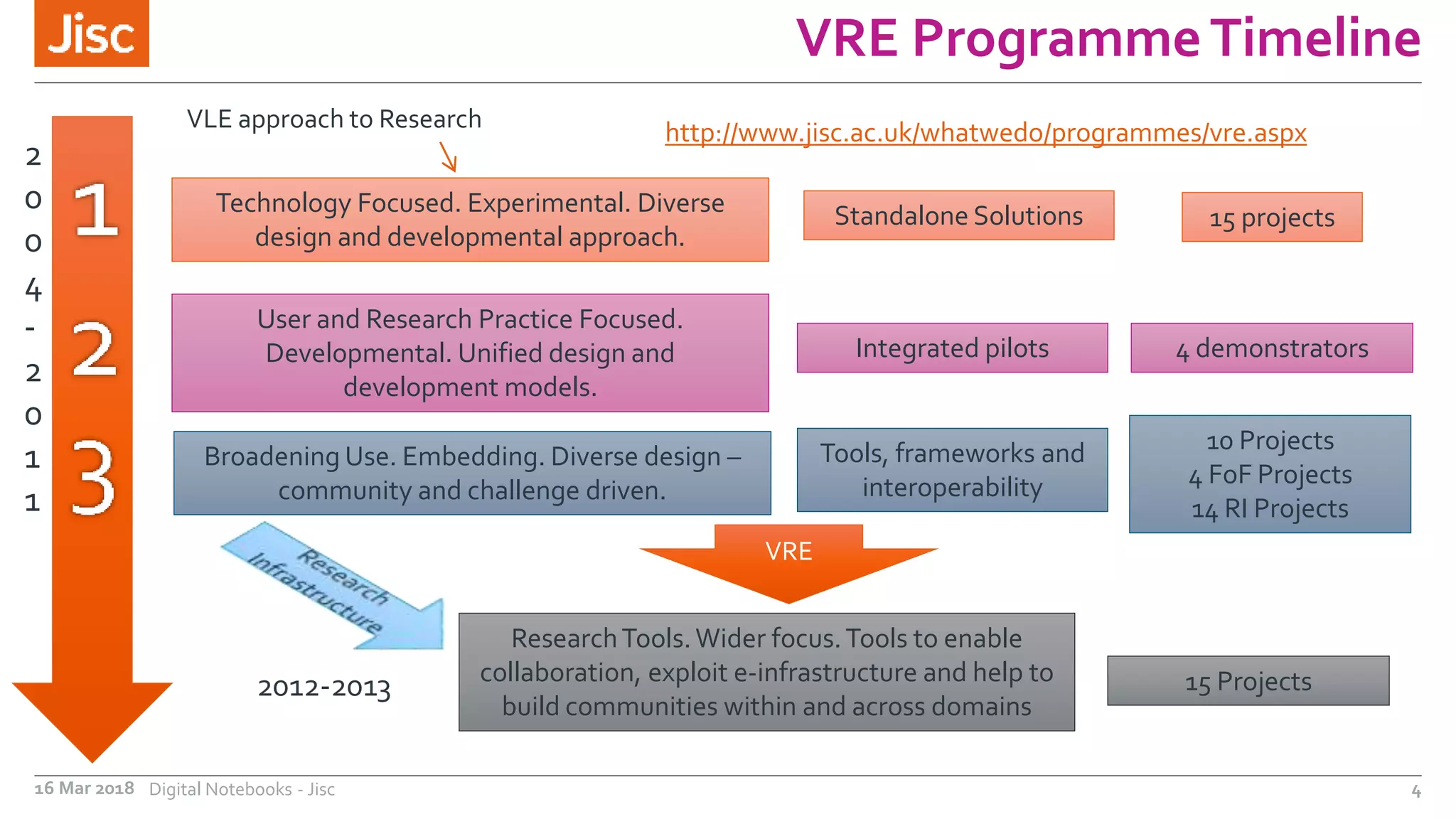
VRE ProgrammeTimeline
16 Mar 2018 Digital Notebooks - Jisc 4
Technology Focused. Experimental. Diverse
design and developmental approach.
Standalone Solutions 15 projects
User and Research Practice Focused.
Developmental. Unified design and
development models.
Integrated pilots 4 demonstrators
Broadening Use. Embedding. Diverse design –
community and challenge driven.
Tools, frameworks and
interoperability
10 Projects
4 FoF Projects
14 RI Projects
15 Projects
VRE
VLE approach to Research
http://www.jisc.ac.uk/whatwedo/programmes/vre.aspx
ResearchTools.Wider focus.Tools to enable
collaboration, exploit e-infrastructure and help to
build communities within and across domains
2
0
0
4
-
2
0
1
1
2012-2013
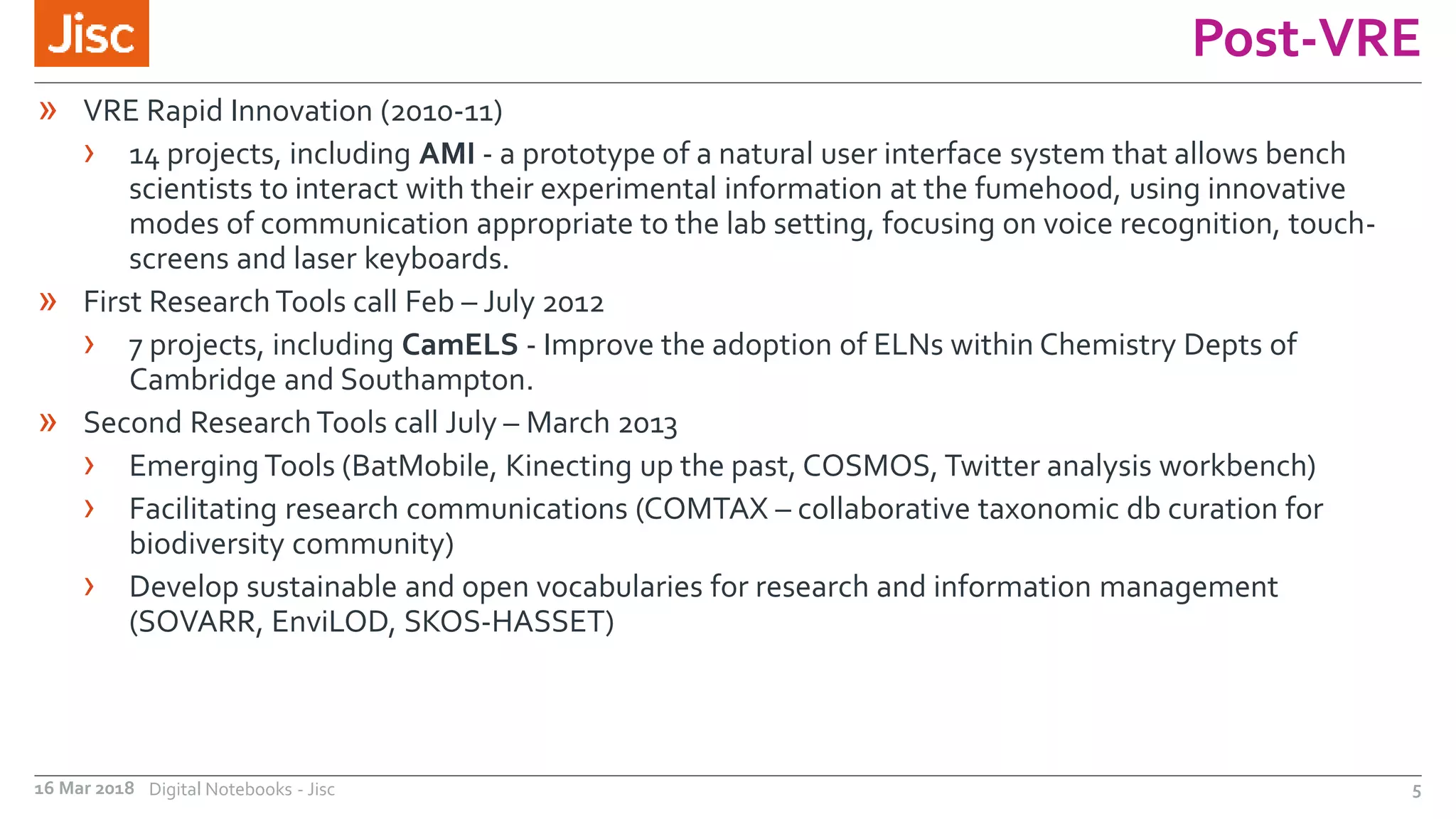
Post-VRE
16 Mar 2018 Digital Notebooks - Jisc 5
Âť VRE Rapid Innovation (2010-11)
› 14 projects, including AMI - a prototype of a natural user interface system that allows bench
scientists to interact with their experimental information at the fumehood, using innovative
modes of communication appropriate to the lab setting, focusing on voice recognition, touch-
screens and laser keyboards.
» First Research Tools call Feb – July 2012
› 7 projects, including CamELS - Improve the adoption of ELNs within Chemistry Depts of
Cambridge and Southampton.
» Second Research Tools call July – March 2013
› Emerging Tools (BatMobile, Kinecting up the past, COSMOS, Twitter analysis workbench)
› Facilitating research communications (COMTAX – collaborative taxonomic db curation for
biodiversity community)
› Develop sustainable and open vocabularies for research and information management
(SOVARR, EnviLOD, SKOS-HASSET)
Post-VRE
16 Mar 2018 Digital Notebooks - Jisc 6
Âť Knowledge Exchange
› VRE working group
› Workshop and report
Âť Help and guidance
› VRE Infokit
› VRE Knowledgebase
Âť SURF
› SURFconext
Âť Project Bamboo/Mellon Foundation
› ELN pilots
Next Generation Research Environment
16 Mar 2018 Digital Notebooks - Jisc 7
Co-design Challenge (2016-17) #codesign16
The time has come to define what a next generation research environment should look like
and develop a modular solution that can satisfy the increasing demands of researchers.
Âť How would you define such a research environment?
Âť What functionality should it have to support researchers performing innovative research?
Âť Steps
› Gather comments and feedback
› Engage consultant to undertake interviews, collate information and write report
› Interview all voters and relevant experts to understand the requirements for a next
generation research environment
› Publish recommendations
Comments and Feedback (1)
16 Mar 2018 Digital Notebooks - Jisc 8
» Modular solutions – integrated and interoperable
› Develop tools to aid the integration and interoperability within research environments
› BYOT (Security issues. Often working against the system)
› Providing a seamless experience is interoperability between products based on open standards
Âť One NGRE to rule them all (not)
› Don’t attempt to address the needs of all disciplines
› Domain specific – promote good practice across disciplines
Âť Transparency, openness and structure
› E.g. E-Lab Notebooks (chemistry) – develop structure, standards and guidelines rather than
build. How can data be re-purposed?
› Structured workflow and capture of inputs/outputs across the whole research lifecycle
› Capture research in a more coherent and transparent manner
› Metadata driven approach to enable research to be reused, better described and produce higher
quality outputs
Âť Ramp-up
› Easy to use for new users. Powerful enough for advanced users.
Comments and Feedback (2)
16 Mar 2018 Digital Notebooks - Jisc 9
Âť Collaborative
› Collaborating outside the organisation is challenging
› Research is cross-discipline/institution/border
› Make it seamless
» Expertise – trained staff to support and researchers with relevant skills
» Policies – top-down versus bottom-up approach
Âť Sharing
› Discoverability
› Text mining
› Research processes and workflows
Âť Not a standalone solution
› The concept of aVRE in the sense of a stand-alone system is obsolete. The task is one of
ubiquitous interoperability and integration, not just at a system level, but also at a deeper
conceptual and knowledge level.
› A standalone system won’t meet researcher needs and that making systems work together as
seamlessly as possible is the ideal state.
Recommendations (1)
16 Mar 2018 Digital Notebooks - Jisc 10
Âť https://researchdata.jiscinvolve.org/wp/2017/07/19/ngre-recommendations/
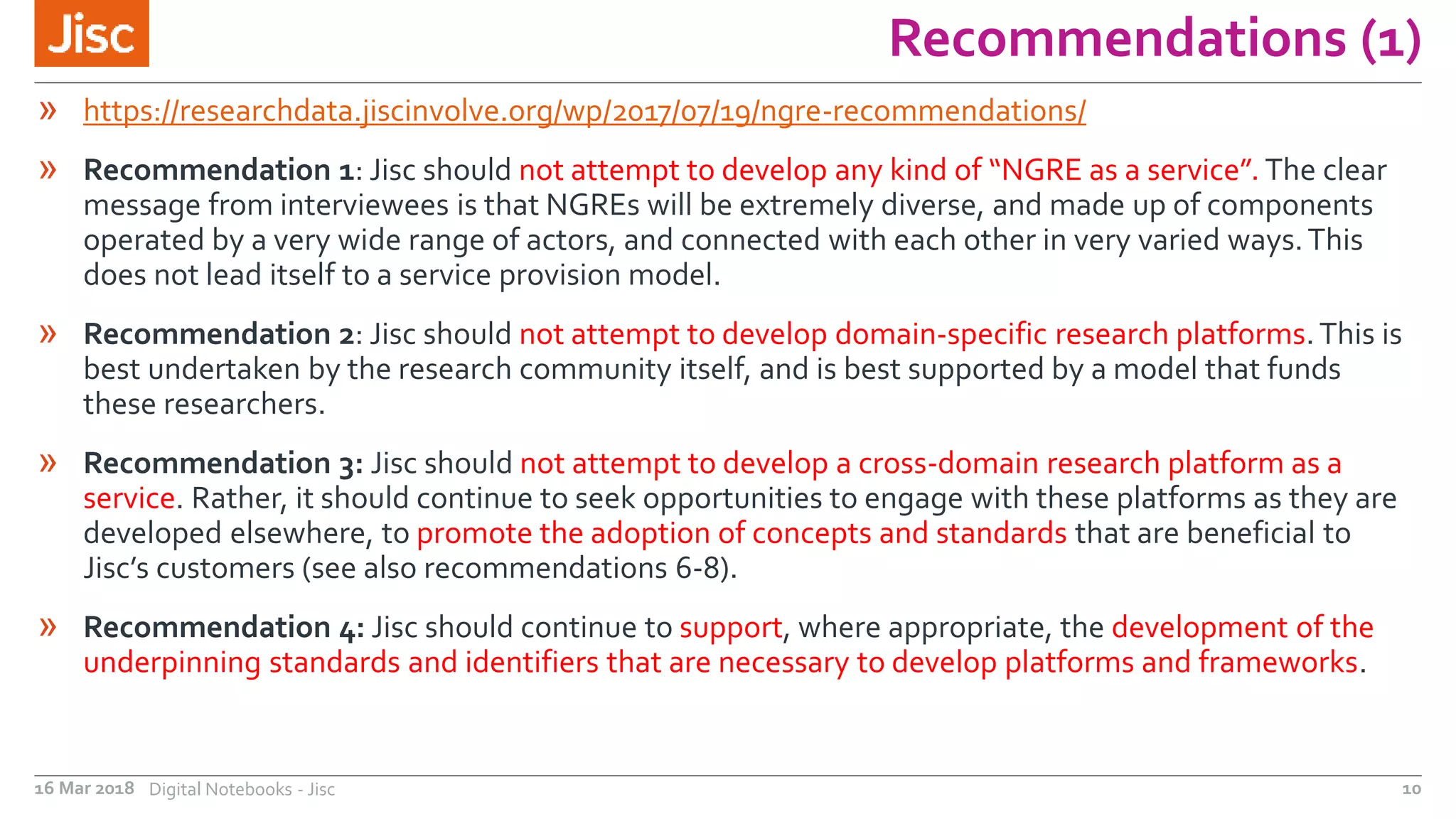
» Recommendation 1: Jisc should not attempt to develop any kind of “NGRE as a service”. The clear
message from interviewees is that NGREs will be extremely diverse, and made up of components
operated by a very wide range of actors, and connected with each other in very varied ways.This
does not lead itself to a service provision model.
Âť Recommendation 2: Jisc should not attempt to develop domain-specific research platforms.This is
best undertaken by the research community itself, and is best supported by a model that funds
these researchers.
Âť Recommendation 3: Jisc should not attempt to develop a cross-domain research platform as a
service. Rather, it should continue to seek opportunities to engage with these platforms as they are
developed elsewhere, to promote the adoption of concepts and standards that are beneficial to
Jisc’s customers (see also recommendations 6-8).
Âť Recommendation 4: Jisc should continue to support, where appropriate, the development of the
underpinning standards and identifiers that are necessary to develop platforms and frameworks.
Recommendations (2)
16 Mar 2018 Digital Notebooks - Jisc 11
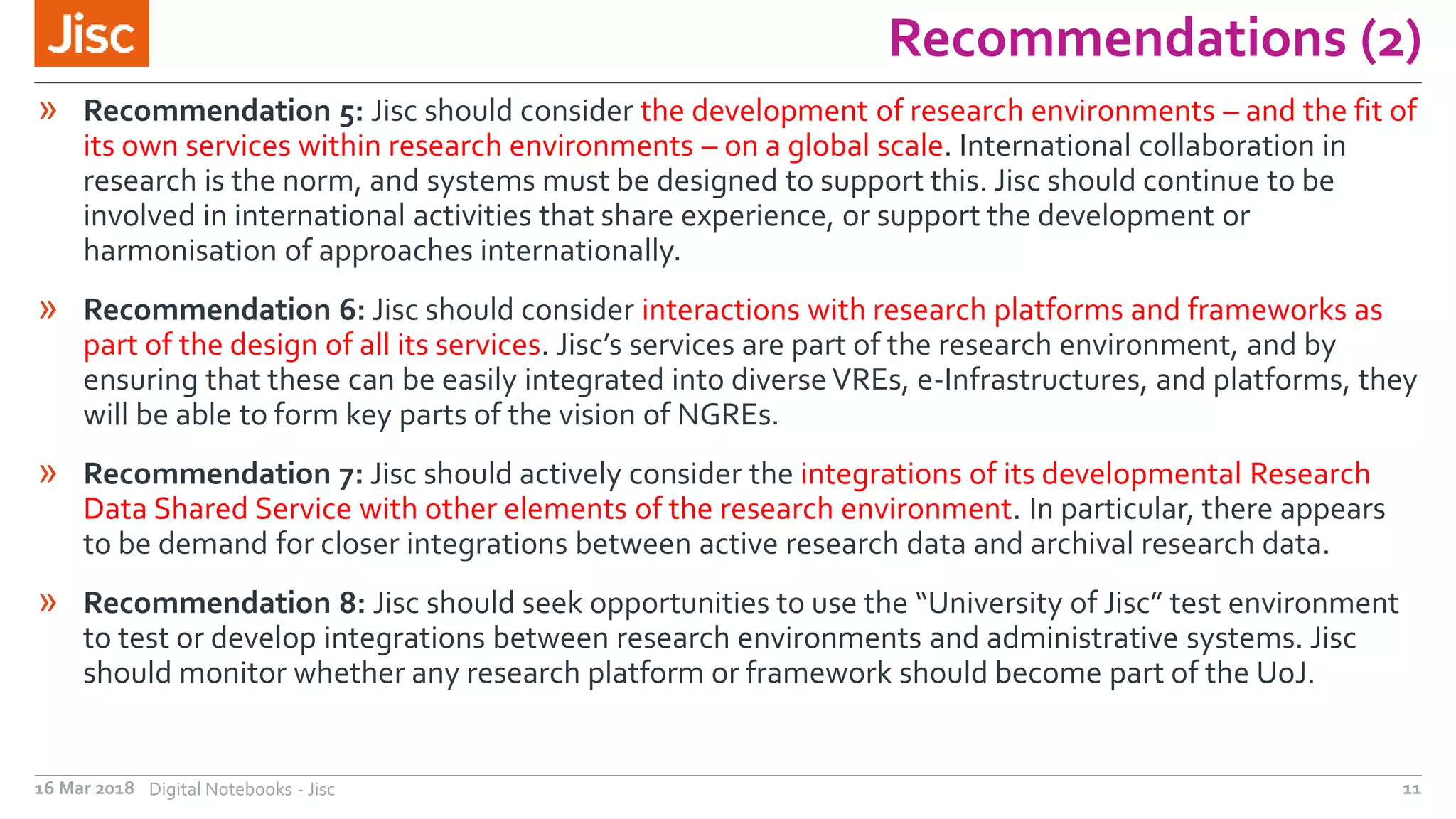
» Recommendation 5: Jisc should consider the development of research environments – and the fit of
its own services within research environments – on a global scale. International collaboration in
research is the norm, and systems must be designed to support this. Jisc should continue to be
involved in international activities that share experience, or support the development or
harmonisation of approaches internationally.
Âť Recommendation 6: Jisc should consider interactions with research platforms and frameworks as
part of the design of all its services. Jisc’s services are part of the research environment, and by
ensuring that these can be easily integrated into diverse VREs, e-Infrastructures, and platforms, they
will be able to form key parts of the vision of NGREs.
Âť Recommendation 7: Jisc should actively consider the integrations of its developmental Research
Data Shared Service with other elements of the research environment. In particular, there appears
to be demand for closer integrations between active research data and archival research data.
» Recommendation 8: Jisc should seek opportunities to use the “University of Jisc” test environment
to test or develop integrations between research environments and administrative systems. Jisc
should monitor whether any research platform or framework should become part of the UoJ.
Actions
16 Mar 2018 Digital Notebooks - Jisc 12
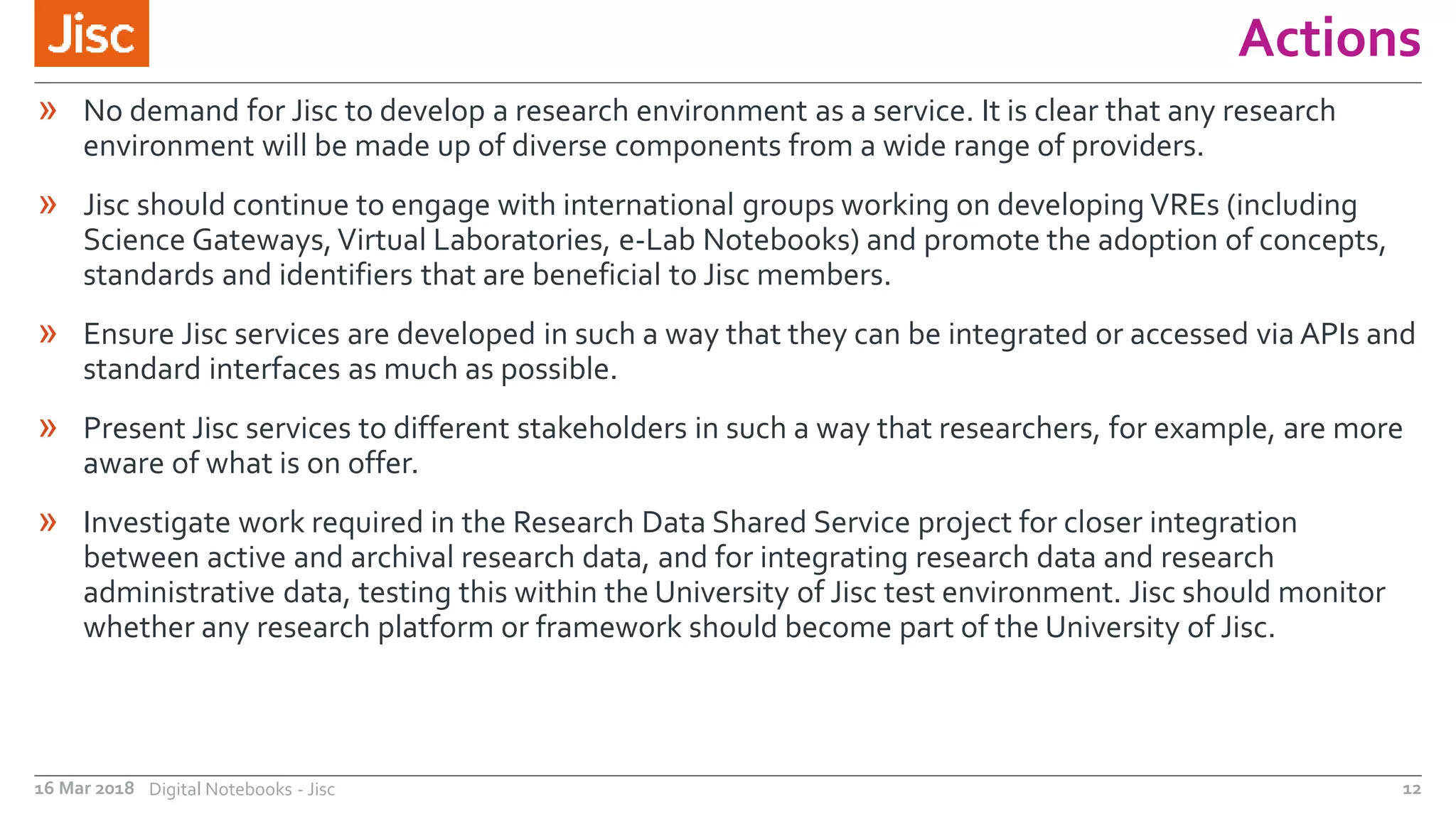
Âť No demand for Jisc to develop a research environment as a service. It is clear that any research
environment will be made up of diverse components from a wide range of providers.
Âť Jisc should continue to engage with international groups working on developing VREs (including
Science Gateways,Virtual Laboratories, e-Lab Notebooks) and promote the adoption of concepts,
standards and identifiers that are beneficial to Jisc members.
Âť Ensure Jisc services are developed in such a way that they can be integrated or accessed via APIs and
standard interfaces as much as possible.
Âť Present Jisc services to different stakeholders in such a way that researchers, for example, are more
aware of what is on offer.
Âť Investigate work required in the Research Data Shared Service project for closer integration
between active and archival research data, and for integrating research data and research
administrative data, testing this within the University of Jisc test environment. Jisc should monitor
whether any research platform or framework should become part of the University of Jisc.
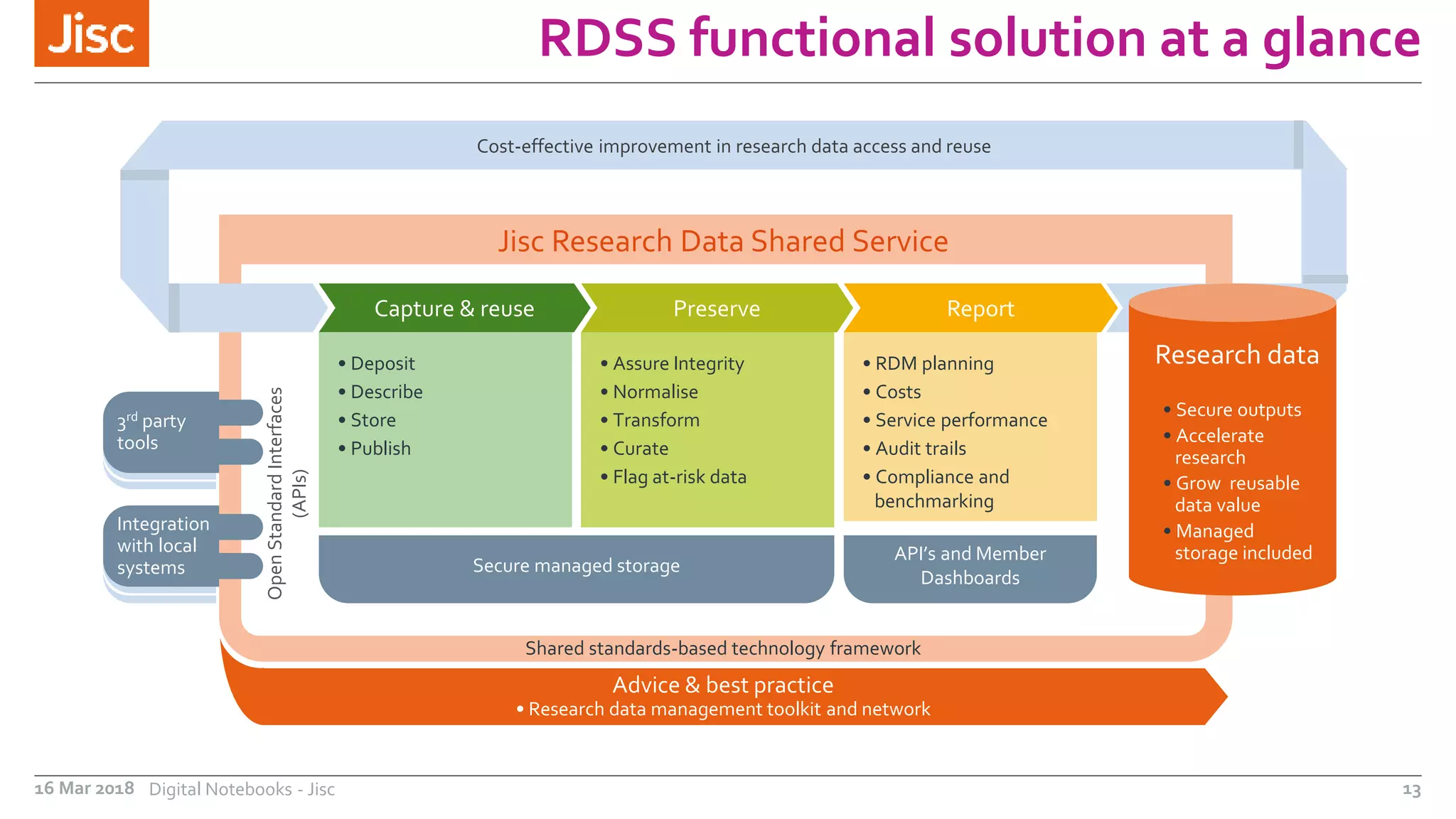
RDSS functional solution at a glance
16 Mar 2018 Digital Notebooks - Jisc 13
Jisc Research Data Shared Service
Capture & reuse Preserve Report
Cost-effective improvement in research data access and reuse
• Deposit
• Describe
• Store
• Publish
• Assure Integrity
• Normalise
• Transform
• Curate
• Flag at-risk data
• RDM planning
• Costs
• Service performance
• Audit trails
• Compliance and
benchmarking
API’s and Member
Dashboards
Secure managed storage
Shared standards-based technology framework
3rd party
tools
Integration
with local
systems
OpenStandardInterfaces
(APIs)
Advice & best practice
• Research data management toolkit and network
Research data
• Secure outputs
• Accelerate
research
• Grow reusable
data value
• Managed
storage included
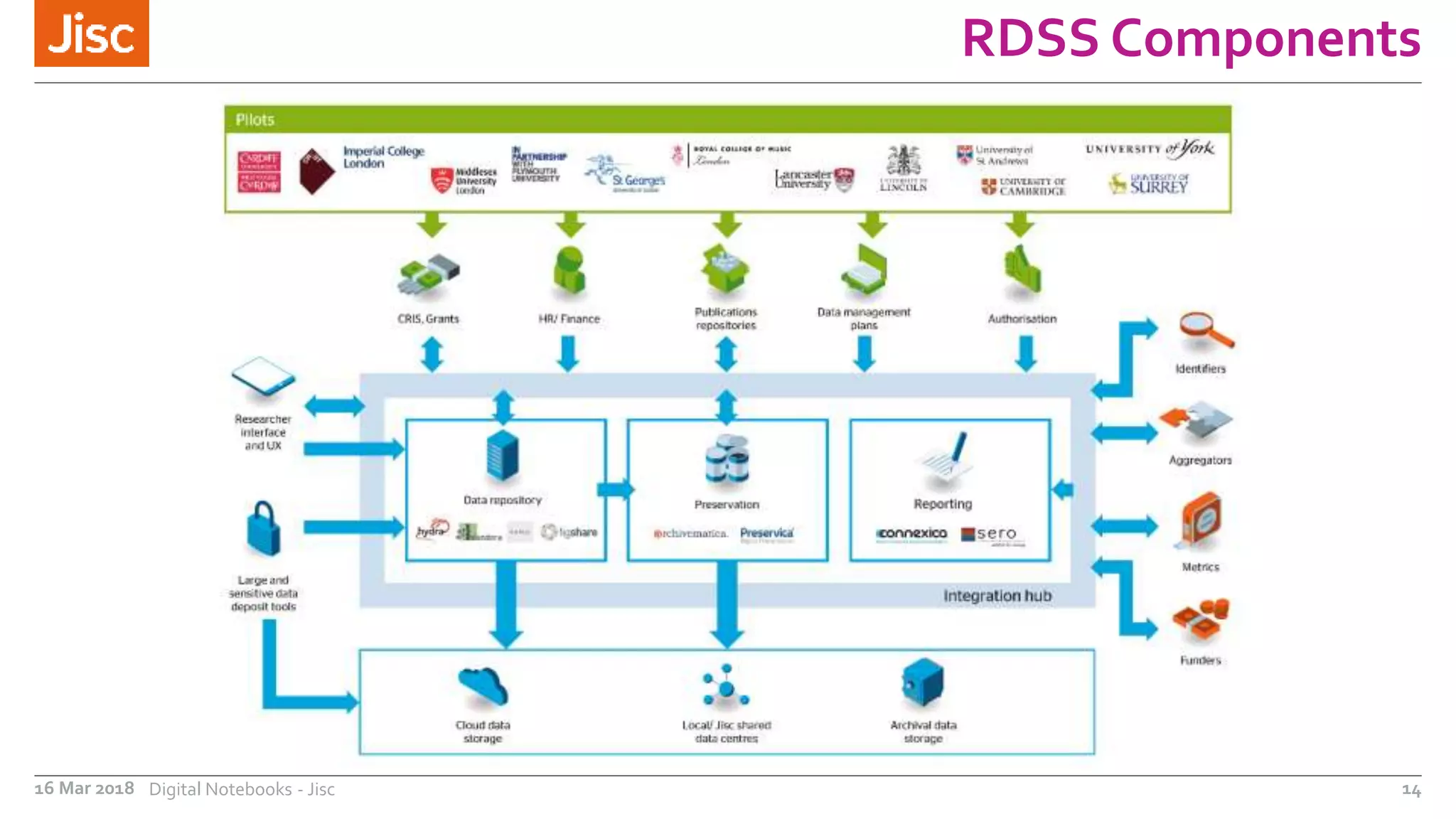
RDSS Components
16 Mar 2018 Digital Notebooks - Jisc 14
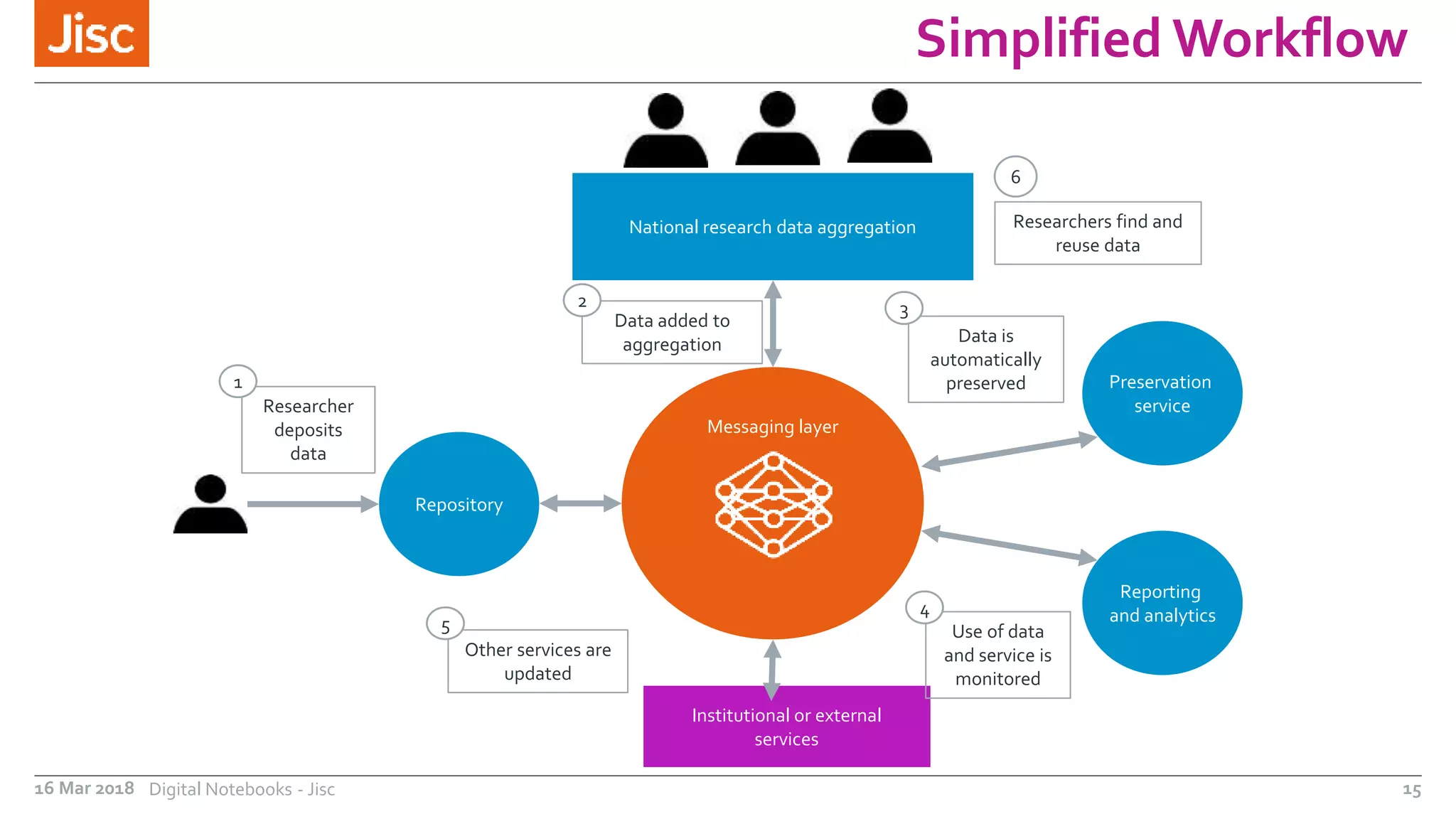
Institutional or external
services
Repository
Messaging layer
National research data aggregation
Preservation
service
Reporting
and analytics
Researcher
deposits
data
Researchers find and
reuse data
Data is
automatically
preserved
Use of data
and service is
monitored
Data added to
aggregation
1
2 3
4
Other services are
updated
5
6
Simplified Workflow
16 Mar 2018 Digital Notebooks - Jisc 15
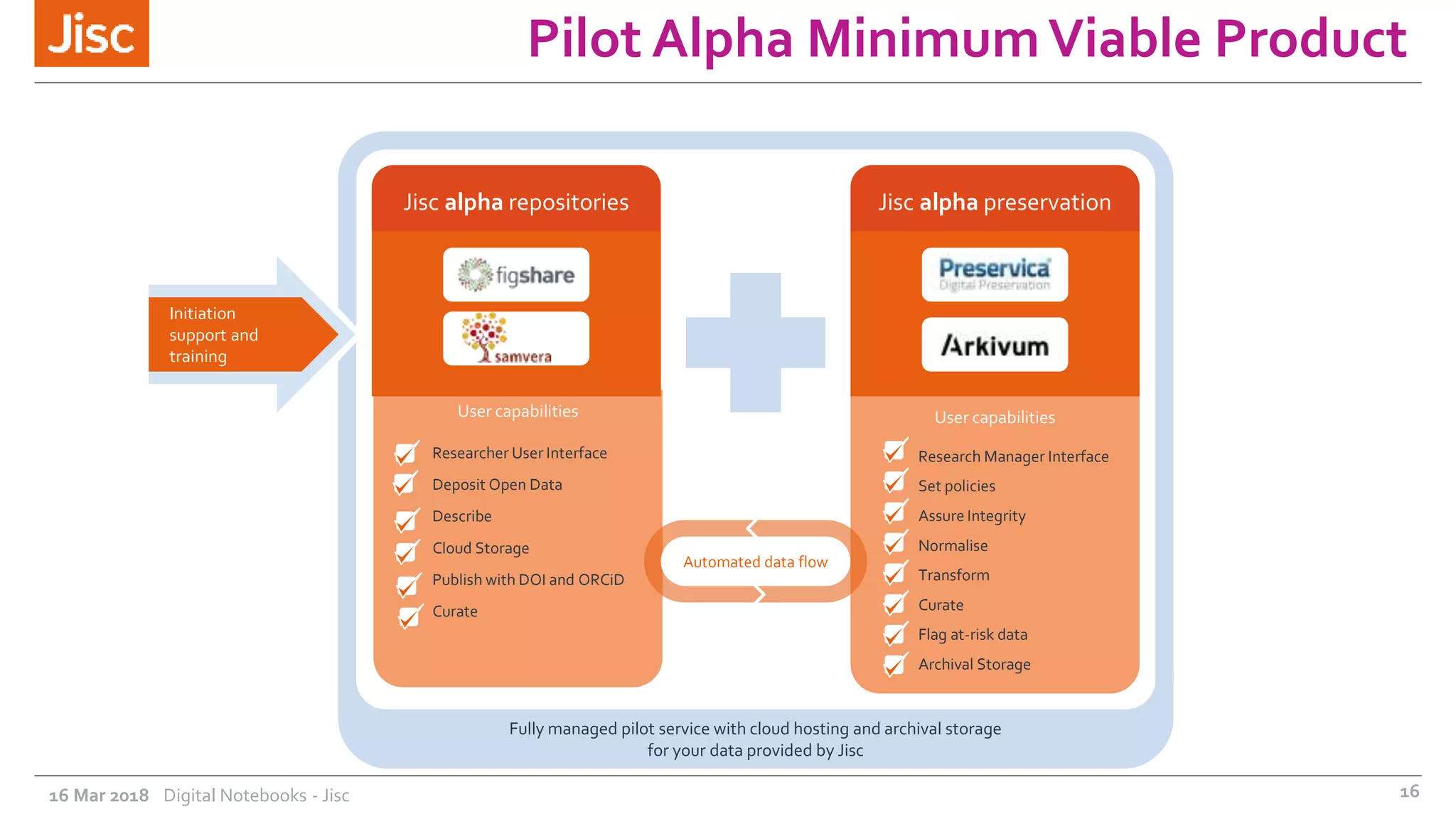
User capabilities
Jisc alpha repositories
Researcher User Interface
Deposit Open Data
Describe
Cloud Storage
Publish with DOI and ORCiD
Curate
User capabilities
Jisc alpha preservation
Research Manager Interface
Set policies
Assure Integrity
Normalise
Transform
Curate
Flag at-risk data
Archival Storage
Initiation
support and
training
Automated data flow
Fully managed pilot service with cloud hosting and archival storage
for your data provided by Jisc
Pilot Alpha MinimumViable Product
1616 Mar 2018 Digital Notebooks - Jisc
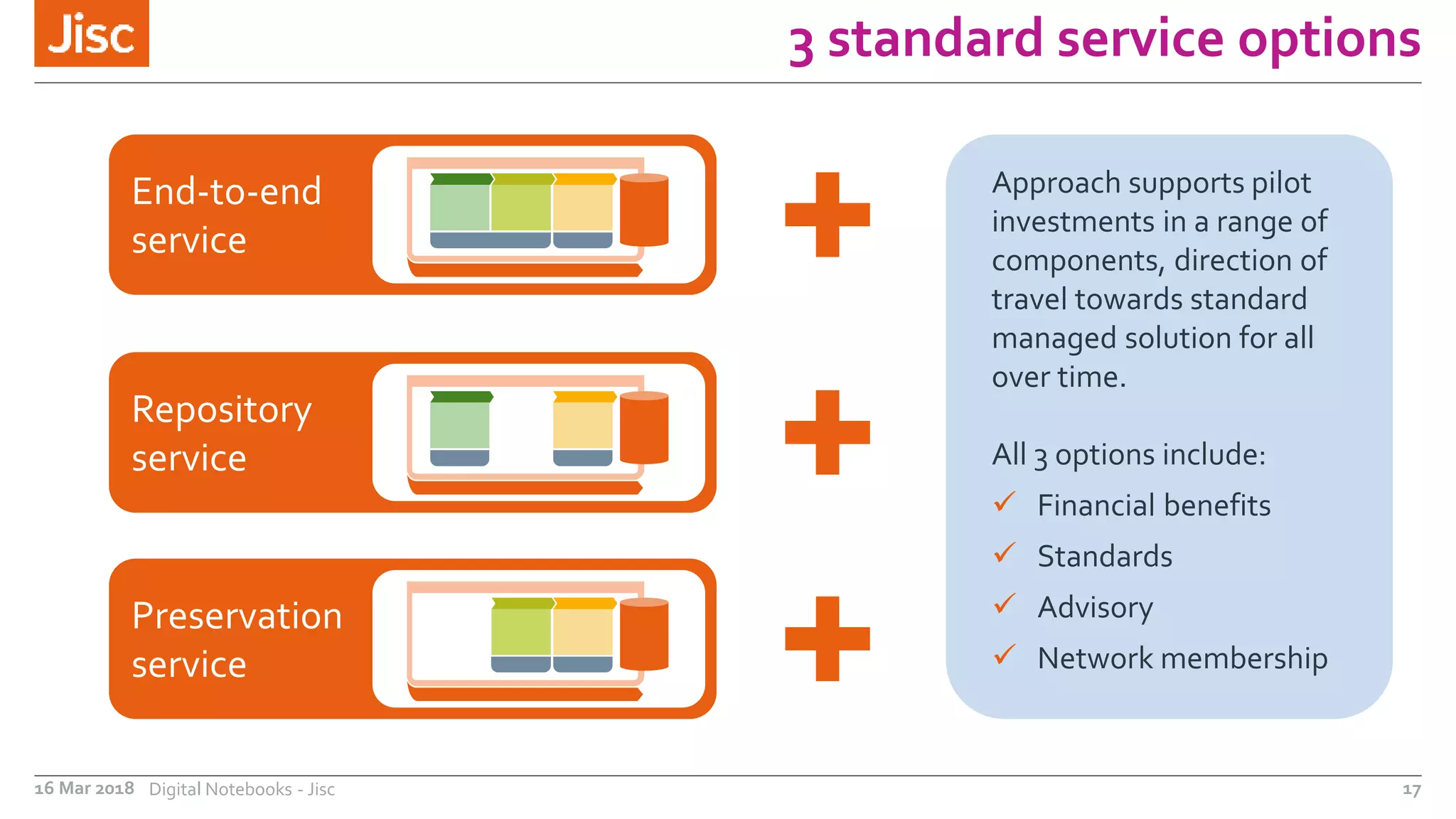
End-to-end
service
Repository
service
Preservation
service
3 standard service options
16 Mar 2018 Digital Notebooks - Jisc 17
Approach supports pilot
investments in a range of
components, direction of
travel towards standard
managed solution for all
over time.
All 3 options include:
 Financial benefits
 Standards
 Advisory
 Network membership
Future Developments
ÂťRealising the potential benefits of widespread use of connected
ELNs in conjunction with data repositories:
› Greater recognition in the repository and research data community of these
potential benefits (NGRE, RDSS’ closer integration between active and archival
research data and for integrating research data and research administrative
data)
› Continue to work together on standards and interoperability to contain costs
and lower barriers
› Enhancements to the APIs provided by repositories to support structured
import of data from ELNs
ÂťEnabling the open science agenda for better and more transparent
research
16 Mar 2018 Digital Notebooks - Jisc 18
jisc.ac.uk
Further information
Christopher Brown
Senior Co-design Manager
christopher.brown@jisc.ac.uk
@chriscb
16 Mar 2018 Digital Notebooks - Jisc 19

Digital notebooks - a Jisc perspective

  • 1.
  • 2.
    Our vision andmission 16 Mar 2018 Digital Notebooks - Jisc 2 Mission To enable people in higher education, further education and skills to perform at the forefront of international practice by exploiting fully the possibilities of modern digital empowerment, content and connectivity Vision To make the UK the most digitally advanced education and research nation in the world
  • 3.
    We do… 3main things 16 Mar 2018 Digital Notebooks - Jisc 3 Shared digital infrastructure and services Expert and trusted advice and practical assistance Sector wide deals with IT vendors and commercial publishers Current examples: Janet network, shared data centre, eduroam wireless, geospatial services Future examples: Learner analytics, research data management, FE college in a box Current examples: Microsoft 365 email, Amazon web services, e-journals, FE e-books Future examples: Prevent web filtering,Tableau, new models for digital publishing Current examples: Financial x-ray, cloud advice, cyber security/business continuity Future examples: FE mergers, open access good practice, national monograph strategy
  • 4.
    VRE ProgrammeTimeline 16 Mar2018 Digital Notebooks - Jisc 4 Technology Focused. Experimental. Diverse design and developmental approach. Standalone Solutions 15 projects User and Research Practice Focused. Developmental. Unified design and development models. Integrated pilots 4 demonstrators Broadening Use. Embedding. Diverse design – community and challenge driven. Tools, frameworks and interoperability 10 Projects 4 FoF Projects 14 RI Projects 15 Projects VRE VLE approach to Research http://www.jisc.ac.uk/whatwedo/programmes/vre.aspx ResearchTools.Wider focus.Tools to enable collaboration, exploit e-infrastructure and help to build communities within and across domains 2 0 0 4 - 2 0 1 1 2012-2013
  • 5.
    Post-VRE 16 Mar 2018Digital Notebooks - Jisc 5 » VRE Rapid Innovation (2010-11) › 14 projects, including AMI - a prototype of a natural user interface system that allows bench scientists to interact with their experimental information at the fumehood, using innovative modes of communication appropriate to the lab setting, focusing on voice recognition, touch- screens and laser keyboards. » First Research Tools call Feb – July 2012 › 7 projects, including CamELS - Improve the adoption of ELNs within Chemistry Depts of Cambridge and Southampton. » Second Research Tools call July – March 2013 › Emerging Tools (BatMobile, Kinecting up the past, COSMOS, Twitter analysis workbench) › Facilitating research communications (COMTAX – collaborative taxonomic db curation for biodiversity community) › Develop sustainable and open vocabularies for research and information management (SOVARR, EnviLOD, SKOS-HASSET)
  • 6.
    Post-VRE 16 Mar 2018Digital Notebooks - Jisc 6 » Knowledge Exchange › VRE working group › Workshop and report » Help and guidance › VRE Infokit › VRE Knowledgebase » SURF › SURFconext » Project Bamboo/Mellon Foundation › ELN pilots
  • 7.
    Next Generation ResearchEnvironment 16 Mar 2018 Digital Notebooks - Jisc 7 Co-design Challenge (2016-17) #codesign16 The time has come to define what a next generation research environment should look like and develop a modular solution that can satisfy the increasing demands of researchers. » How would you define such a research environment? » What functionality should it have to support researchers performing innovative research? » Steps › Gather comments and feedback › Engage consultant to undertake interviews, collate information and write report › Interview all voters and relevant experts to understand the requirements for a next generation research environment › Publish recommendations
  • 8.
    Comments and Feedback(1) 16 Mar 2018 Digital Notebooks - Jisc 8 » Modular solutions – integrated and interoperable › Develop tools to aid the integration and interoperability within research environments › BYOT (Security issues. Often working against the system) › Providing a seamless experience is interoperability between products based on open standards » One NGRE to rule them all (not) › Don’t attempt to address the needs of all disciplines › Domain specific – promote good practice across disciplines » Transparency, openness and structure › E.g. E-Lab Notebooks (chemistry) – develop structure, standards and guidelines rather than build. How can data be re-purposed? › Structured workflow and capture of inputs/outputs across the whole research lifecycle › Capture research in a more coherent and transparent manner › Metadata driven approach to enable research to be reused, better described and produce higher quality outputs » Ramp-up › Easy to use for new users. Powerful enough for advanced users.
  • 9.
    Comments and Feedback(2) 16 Mar 2018 Digital Notebooks - Jisc 9 » Collaborative › Collaborating outside the organisation is challenging › Research is cross-discipline/institution/border › Make it seamless » Expertise – trained staff to support and researchers with relevant skills » Policies – top-down versus bottom-up approach » Sharing › Discoverability › Text mining › Research processes and workflows » Not a standalone solution › The concept of aVRE in the sense of a stand-alone system is obsolete. The task is one of ubiquitous interoperability and integration, not just at a system level, but also at a deeper conceptual and knowledge level. › A standalone system won’t meet researcher needs and that making systems work together as seamlessly as possible is the ideal state.
  • 10.
    Recommendations (1) 16 Mar2018 Digital Notebooks - Jisc 10 » https://researchdata.jiscinvolve.org/wp/2017/07/19/ngre-recommendations/ » Recommendation 1: Jisc should not attempt to develop any kind of “NGRE as a service”. The clear message from interviewees is that NGREs will be extremely diverse, and made up of components operated by a very wide range of actors, and connected with each other in very varied ways.This does not lead itself to a service provision model. » Recommendation 2: Jisc should not attempt to develop domain-specific research platforms.This is best undertaken by the research community itself, and is best supported by a model that funds these researchers. » Recommendation 3: Jisc should not attempt to develop a cross-domain research platform as a service. Rather, it should continue to seek opportunities to engage with these platforms as they are developed elsewhere, to promote the adoption of concepts and standards that are beneficial to Jisc’s customers (see also recommendations 6-8). » Recommendation 4: Jisc should continue to support, where appropriate, the development of the underpinning standards and identifiers that are necessary to develop platforms and frameworks.
  • 11.
    Recommendations (2) 16 Mar2018 Digital Notebooks - Jisc 11 » Recommendation 5: Jisc should consider the development of research environments – and the fit of its own services within research environments – on a global scale. International collaboration in research is the norm, and systems must be designed to support this. Jisc should continue to be involved in international activities that share experience, or support the development or harmonisation of approaches internationally. » Recommendation 6: Jisc should consider interactions with research platforms and frameworks as part of the design of all its services. Jisc’s services are part of the research environment, and by ensuring that these can be easily integrated into diverse VREs, e-Infrastructures, and platforms, they will be able to form key parts of the vision of NGREs. » Recommendation 7: Jisc should actively consider the integrations of its developmental Research Data Shared Service with other elements of the research environment. In particular, there appears to be demand for closer integrations between active research data and archival research data. » Recommendation 8: Jisc should seek opportunities to use the “University of Jisc” test environment to test or develop integrations between research environments and administrative systems. Jisc should monitor whether any research platform or framework should become part of the UoJ.
  • 12.
    Actions 16 Mar 2018Digital Notebooks - Jisc 12 Âť No demand for Jisc to develop a research environment as a service. It is clear that any research environment will be made up of diverse components from a wide range of providers. Âť Jisc should continue to engage with international groups working on developing VREs (including Science Gateways,Virtual Laboratories, e-Lab Notebooks) and promote the adoption of concepts, standards and identifiers that are beneficial to Jisc members. Âť Ensure Jisc services are developed in such a way that they can be integrated or accessed via APIs and standard interfaces as much as possible. Âť Present Jisc services to different stakeholders in such a way that researchers, for example, are more aware of what is on offer. Âť Investigate work required in the Research Data Shared Service project for closer integration between active and archival research data, and for integrating research data and research administrative data, testing this within the University of Jisc test environment. Jisc should monitor whether any research platform or framework should become part of the University of Jisc.
  • 13.
    RDSS functional solutionat a glance 16 Mar 2018 Digital Notebooks - Jisc 13 Jisc Research Data Shared Service Capture & reuse Preserve Report Cost-effective improvement in research data access and reuse • Deposit • Describe • Store • Publish • Assure Integrity • Normalise • Transform • Curate • Flag at-risk data • RDM planning • Costs • Service performance • Audit trails • Compliance and benchmarking API’s and Member Dashboards Secure managed storage Shared standards-based technology framework 3rd party tools Integration with local systems OpenStandardInterfaces (APIs) Advice & best practice • Research data management toolkit and network Research data • Secure outputs • Accelerate research • Grow reusable data value • Managed storage included
  • 14.
    RDSS Components 16 Mar2018 Digital Notebooks - Jisc 14
  • 15.
    Institutional or external services Repository Messaginglayer National research data aggregation Preservation service Reporting and analytics Researcher deposits data Researchers find and reuse data Data is automatically preserved Use of data and service is monitored Data added to aggregation 1 2 3 4 Other services are updated 5 6 Simplified Workflow 16 Mar 2018 Digital Notebooks - Jisc 15
  • 16.
    User capabilities Jisc alpharepositories Researcher User Interface Deposit Open Data Describe Cloud Storage Publish with DOI and ORCiD Curate User capabilities Jisc alpha preservation Research Manager Interface Set policies Assure Integrity Normalise Transform Curate Flag at-risk data Archival Storage Initiation support and training Automated data flow Fully managed pilot service with cloud hosting and archival storage for your data provided by Jisc Pilot Alpha MinimumViable Product 1616 Mar 2018 Digital Notebooks - Jisc
  • 17.
    End-to-end service Repository service Preservation service 3 standard serviceoptions 16 Mar 2018 Digital Notebooks - Jisc 17 Approach supports pilot investments in a range of components, direction of travel towards standard managed solution for all over time. All 3 options include:  Financial benefits  Standards  Advisory  Network membership
  • 18.
    Future Developments »Realising thepotential benefits of widespread use of connected ELNs in conjunction with data repositories: › Greater recognition in the repository and research data community of these potential benefits (NGRE, RDSS’ closer integration between active and archival research data and for integrating research data and research administrative data) › Continue to work together on standards and interoperability to contain costs and lower barriers › Enhancements to the APIs provided by repositories to support structured import of data from ELNs »Enabling the open science agenda for better and more transparent research 16 Mar 2018 Digital Notebooks - Jisc 18
  • 19.
    jisc.ac.uk Further information Christopher Brown SeniorCo-design Manager christopher.brown@jisc.ac.uk @chriscb 16 Mar 2018 Digital Notebooks - Jisc 19

Editor's Notes

  • #6 First Research Tools call (16/11) Feb – July 2012 CamELS Improve the adoption of ELNs within Chemistry Dept of Cambridge and Southampton. Increasing interoperability between Corpus Tools Explore ways of linking different corpus query tools so that users can investigate aspects of the same data in a variety of ways. e-Health GATEway to the Clouds Establish a cloud-based VRE on the White Rose Grid to support e-health records research HISTORE Developing training modules to encourage and support the use of online historical research tools within VREs INSPIRES Using visualisation environments and tools to find cross-disciplinary connections between researchers and projects. SLRGuide Establish the requirements for, and develop a cloud based collaborative tool to support, the systematic literature review process TEXTUS Developing an open source platform that helps researchers and students to collaborate around and work with collections of digitised public domain texts Emerging tools BatMobile Developing an App to take transformed ultrasound signals from an external mic to help identify and map the UK’s bat population Kinecting up the past Exploring the research benefits, use, and disruptive nature of Microsoft’s Kinect controller to capture environments and artefacts in 3-dimensions COSMOS Developing a VRE around an information collection, archival and analysis engine, which harvests freely available socially significant open data (from social network sites, blogs, micro-blogs, RSS feeds and Open Data (e.g. crime rates)), and analyses the harvested dataset to detect community tension and cohesion indicators. Twitter analysis workbench development Developing existing workbench (social media analysis of large datasets), integrating a range of new tools and migrating it to a fully cloud-based infrastructure.  Facilitating research communications COMTAX Develop and establish a community-driven curation process among practising taxonomists. The project will combine recommending new texts to users with an online verification process in order to engage the biodiversity community in collaborative taxonomic database curation. Develop sustainable and open vocabularies for research and information management SOVARR The Shared Open Vocabulary for Audio Research and Retrieval (SOVARR) project aims to investigate the benefits of using sustainable and shared vocabularies in audio research communities, what are the primary needs of researchers, and what are the main barriers to the uptake of shared vocabularies. EnviLOD Developing semantic annotation tools that tackle the problem of Linked Open Data vocabulary enrichment, interlinking, and adoption in the domain of environmental science. Developing an easy to use a semantic search service. SKOS-HASSET Extending the use of social science thesauri by improving its online presence and testing its automated indexing capacity.
  • #18 Commercial benefits attach to bulk buying on behalf of the sector – i.e. efficient procurement on a not-for-profit basis