Moch. Zulfikhar Luthfillah 111040134 Design Prototype Billing System for Voice Over Internet Protocol Services Based on Session Initiation Protocol Advisors : Agus Ganda Permana, Ir. MT. Asep Mulyana, ST. MT.
Background Experts predicted that almost 75% of telecommunications traffic in the world move towards VoIP in a period of five years. The growth of Internet  Telephony Services Provider (ITSP). ITSP need reliable Voice over Internet Protocol Billing System.
Objective of Research Design of prototype of VoIP Billing System in order to Internet Telephony Services Provider in the future. Implement  and analyze rate scheme at TELKOM in VoIP Billing System has been designed by writer. Known and analyze the time process  of  Call Detail Record  (CDR) in one call in VoIP Billing System Server.
Problem Formulation How to make VoIP Billing System at Local Area Network, so that later can be implemented in the Internet Telephony Services Provider. How to implement rate scheme at TELKOM in VoIP Billing System has been designed. How to analyze the time process of  Call Detail Record  in one call in VoIP Billing System Server.
Scope Parameters which analyzed are the rate scheme and the time process of  Call Detail Record  (CDR). Record the duration of call, not recording the volume data. This research using Session Initiation Protocol for relationship between client and server, and using Inter Asterisk Exchange for relationship between one to another server. Test ing is done on the softswitch network has been built and configure by the author with using two different server. Not discuss the issue of rate regulation from VoIP billing system.
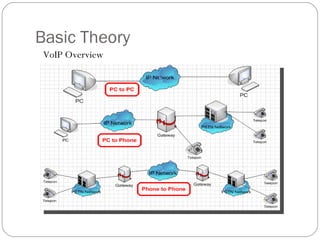
Basic Theory VoIP Overview
Call Detail Record A  Call Detail Record  (CDR) is the computer record produced by a telephone exchange containing details of a call that passed through it.  CDR parameters : Time of Call Talk Time Destination Number Caller number Location Rate
VoIP Billing System VoIP Billing is a  Call Detail record  recording system that done by ITSP, whether a call between the same computer and calls to the  circuit-switch network such as PSTN.
The Important of VoIP Billing Parameters Recording capacity and the quality of a VoIP billing can be directly influenced by several key factors, namely: Time process recording The accuration of billing system The capacity of billing system
Rate Scheme of Telecommunication Flat Pricing Pricing based on call time Pricing based on the distance Pricing based on call duration
Design and Implementation
Scenario 1 (Local Call) Scheme Rate for Local Call Jarak (Km) 00.00-09.00 09.00-15.00 15.00-24.00 Rupiah per Durasi 0 s/d 20 250 / 3 menit 250 / 2 menit 250 / 3 menit > 20 250 / 2 menit 250 / 1,5 menit 250 / 2 menit
Scenario 2 (Interlocal Call) Scheme Rate Interlocal (Monday to Saturday) Scheme Rate Interlocal (Sunday or Holiday) Zone Jarak (Km) 06.00-07.00 07.00-20.00 20.00-23.00 23.00-06.00 Rupiah Per Menit I > 30 s/d 200 645 1290 645 325 II >200 s/d 500 915 1815 915 460 III > 500 1135 2270 1135 570 Zone Jarak (Km) 06.00-23.00 23.00-06.00 Rupiah Per Menit I > 30 s/d 200 645 325 II >200 s/d 500 915 460 III > 500 1135 570
Scenario 3 (Multioperator Call)
The Process of VoIP Billing System
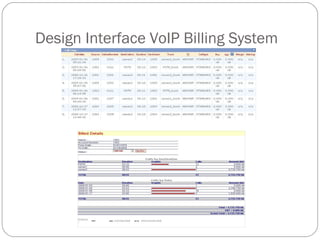
Design Interface VoIP Billing System
Analysis of Implementation Result Call Setup and Call Teardown Sistem Billing
Scheme Rate Analysis Scheme Rate for Local Call (00.00-09.00 distance 0-20km) Scheme Rate for Local Call (09.00-15.00 distance 0-20km)
Scheme Rate Analysis Scheme Rate for Local Call (15.00-24.00 distance 0-20km) Scheme Rate for Local Call (00.00-09.00 distance >20km)
Scheme Rate Analysis Scheme Rate for Local Call (09.00-15.00 distance >20km) Scheme Rate for Local Call (15.00-24.00 distance >20km)
Scheme Rate for Interlocal Call Monday to Saturday (00.00-23.00 Zone I)
Scheme Rate for Interlocal Call Sunday or Holiday (00.00-23.00 Zone I)
Scheme Rate for MultioperatorCall This Scheme rate, not have standard scheme for the connection to the PSTN Network
Time Process Recording Billing Time Process for server billing System : T proses  = T 1  + T 2  + T 3 description:   T 1  = t 2  – t 1   T 2  = t 4  – t 3 T 3  = t 5  – t 6   Call Duration : T lamabicara  = T bye  - T answer
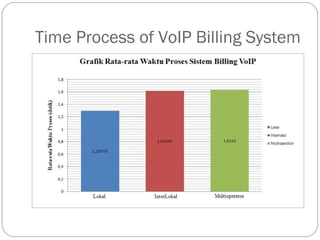
Time Process of VoIP Billing System
The influence of Background Traffic on VoIP Billing System
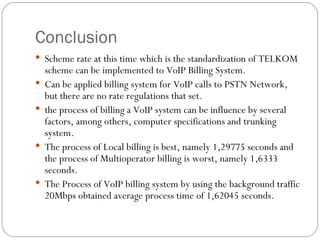
Conclusion Scheme rate at this time which is the standardization of TELKOM scheme can be implemented to VoIP Billing System. Can be applied billing system for VoIP calls to PSTN Network, but there are no rate regulations that set. the process of billing a VoIP system can be influence by several factors, among others, computer specifications and trunking system. The process of Local billing is best, namely 1,29775 seconds and the process of Multioperator billing is worst, namely 1,6333 seconds. The Process of VoIP billing system by using the background traffic 20Mbps obtained average process time of 1,62045 seconds.
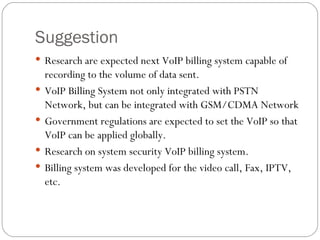
Suggestion Research are expected next VoIP billing system capable of recording to the volume of data sent. VoIP Billing System not only integrated with PSTN Network, but can be integrated with GSM/CDMA Network Government regulations are expected to set the VoIP so that VoIP can be applied globally. Research on system security VoIP billing system. Billing system was developed for the video call, Fax, IPTV, etc.

VoIP Billing System

  • 1.
    Moch. Zulfikhar Luthfillah111040134 Design Prototype Billing System for Voice Over Internet Protocol Services Based on Session Initiation Protocol Advisors : Agus Ganda Permana, Ir. MT. Asep Mulyana, ST. MT.
  • 2.
    Background Experts predictedthat almost 75% of telecommunications traffic in the world move towards VoIP in a period of five years. The growth of Internet Telephony Services Provider (ITSP). ITSP need reliable Voice over Internet Protocol Billing System.
  • 3.
    Objective of ResearchDesign of prototype of VoIP Billing System in order to Internet Telephony Services Provider in the future. Implement and analyze rate scheme at TELKOM in VoIP Billing System has been designed by writer. Known and analyze the time process of Call Detail Record (CDR) in one call in VoIP Billing System Server.
  • 4.
    Problem Formulation Howto make VoIP Billing System at Local Area Network, so that later can be implemented in the Internet Telephony Services Provider. How to implement rate scheme at TELKOM in VoIP Billing System has been designed. How to analyze the time process of Call Detail Record in one call in VoIP Billing System Server.
  • 5.
    Scope Parameters whichanalyzed are the rate scheme and the time process of Call Detail Record (CDR). Record the duration of call, not recording the volume data. This research using Session Initiation Protocol for relationship between client and server, and using Inter Asterisk Exchange for relationship between one to another server. Test ing is done on the softswitch network has been built and configure by the author with using two different server. Not discuss the issue of rate regulation from VoIP billing system.
  • 6.
  • 7.
    Call Detail RecordA Call Detail Record (CDR) is the computer record produced by a telephone exchange containing details of a call that passed through it. CDR parameters : Time of Call Talk Time Destination Number Caller number Location Rate
  • 8.
    VoIP Billing SystemVoIP Billing is a Call Detail record recording system that done by ITSP, whether a call between the same computer and calls to the circuit-switch network such as PSTN.
  • 9.
    The Important ofVoIP Billing Parameters Recording capacity and the quality of a VoIP billing can be directly influenced by several key factors, namely: Time process recording The accuration of billing system The capacity of billing system
  • 10.
    Rate Scheme ofTelecommunication Flat Pricing Pricing based on call time Pricing based on the distance Pricing based on call duration
  • 11.
  • 12.
    Scenario 1 (LocalCall) Scheme Rate for Local Call Jarak (Km) 00.00-09.00 09.00-15.00 15.00-24.00 Rupiah per Durasi 0 s/d 20 250 / 3 menit 250 / 2 menit 250 / 3 menit > 20 250 / 2 menit 250 / 1,5 menit 250 / 2 menit
  • 13.
    Scenario 2 (InterlocalCall) Scheme Rate Interlocal (Monday to Saturday) Scheme Rate Interlocal (Sunday or Holiday) Zone Jarak (Km) 06.00-07.00 07.00-20.00 20.00-23.00 23.00-06.00 Rupiah Per Menit I > 30 s/d 200 645 1290 645 325 II >200 s/d 500 915 1815 915 460 III > 500 1135 2270 1135 570 Zone Jarak (Km) 06.00-23.00 23.00-06.00 Rupiah Per Menit I > 30 s/d 200 645 325 II >200 s/d 500 915 460 III > 500 1135 570
  • 14.
  • 15.
    The Process ofVoIP Billing System
  • 16.
    Design Interface VoIPBilling System
  • 17.
    Analysis of ImplementationResult Call Setup and Call Teardown Sistem Billing
  • 18.
    Scheme Rate AnalysisScheme Rate for Local Call (00.00-09.00 distance 0-20km) Scheme Rate for Local Call (09.00-15.00 distance 0-20km)
  • 19.
    Scheme Rate AnalysisScheme Rate for Local Call (15.00-24.00 distance 0-20km) Scheme Rate for Local Call (00.00-09.00 distance >20km)
  • 20.
    Scheme Rate AnalysisScheme Rate for Local Call (09.00-15.00 distance >20km) Scheme Rate for Local Call (15.00-24.00 distance >20km)
  • 21.
    Scheme Rate forInterlocal Call Monday to Saturday (00.00-23.00 Zone I)
  • 22.
    Scheme Rate forInterlocal Call Sunday or Holiday (00.00-23.00 Zone I)
  • 23.
    Scheme Rate forMultioperatorCall This Scheme rate, not have standard scheme for the connection to the PSTN Network
  • 24.
    Time Process RecordingBilling Time Process for server billing System : T proses = T 1 + T 2 + T 3 description: T 1 = t 2 – t 1 T 2 = t 4 – t 3 T 3 = t 5 – t 6 Call Duration : T lamabicara = T bye - T answer
  • 25.
    Time Process ofVoIP Billing System
  • 26.
    The influence ofBackground Traffic on VoIP Billing System
  • 27.
    Conclusion Scheme rateat this time which is the standardization of TELKOM scheme can be implemented to VoIP Billing System. Can be applied billing system for VoIP calls to PSTN Network, but there are no rate regulations that set. the process of billing a VoIP system can be influence by several factors, among others, computer specifications and trunking system. The process of Local billing is best, namely 1,29775 seconds and the process of Multioperator billing is worst, namely 1,6333 seconds. The Process of VoIP billing system by using the background traffic 20Mbps obtained average process time of 1,62045 seconds.
  • 28.
    Suggestion Research areexpected next VoIP billing system capable of recording to the volume of data sent. VoIP Billing System not only integrated with PSTN Network, but can be integrated with GSM/CDMA Network Government regulations are expected to set the VoIP so that VoIP can be applied globally. Research on system security VoIP billing system. Billing system was developed for the video call, Fax, IPTV, etc.