ARTIFICIAL INTELLIGENCE BASED
VOICE ASSISTANT
1
Guide Name:- Payel Thakur
Submitted By:
 SHIVRAJ YELAVE
 RUTIKA SALUNKHE
 AISHWARYA RETAWADE
 ANUTEJ WARE
Contents
 1.Introduction
 2. Literature Survey
2.1 Existing system architecture
2.2 Summary of Literature Survey
2.3 Problem Statement, Scope and Objectives
 3. Implementation
3.1 Proposed Block Diagram
3.2 Mathematical Model
3.3 Hardware and Software Details
3.4 Input and Output Specification
3.5 Performance Evaluation Parameters
3.6 Conclusion
 4. Application
 5. References
 6. Acknowledgement
2
Introduction
 A voice assistant is a technology based on artificial intelligence. The
software uses a device’s microphone to receive voice requests while the
voice output takes place at the speaker. But the most exciting thing
happens between these two actions.
 It is a combination of several different technologies: voice recognition,
voice analysis and language processing.
 It is completely developed using one of the most powerful language
python.
3
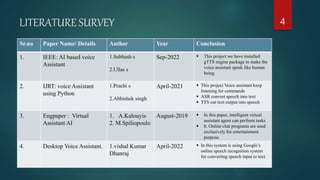
LITERATURE SURVEY
Sr.no Paper Name/ Details Author Year Conclusion
1. IEEE: AI based voice
Assistant
1.Subhash s
2.Ullas s
Sep-2022  This project we have installed
gTTS engine package to make the
voice assistant speak like human
being
2. IJRT: voice Assistant
using Python
1.Prachi s
2.Abhishek singh
April-2021  This project Voice assistant keep
listening for commands
 ASR convert speech into text
 TTS out text output into speech
3. Engpaper : Virtual
Assistant AI
1. A.Kalouyis
2. M.Spiliopoulo
August-2019  In this paper, intelligent virtual
assistant agent can perform tasks
 b. Online chat programs are used
exclusively for entertainment
purpose.
4. Desktop Voice Assistant. 1.vishal Kumar
Dhanraj
April-2022  In this system is using Google’s
online speech recognition system
for converting speech input to text.
4
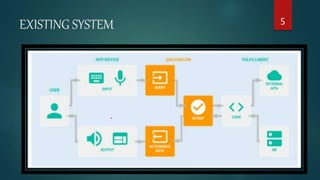
EXISTING SYSTEM 5
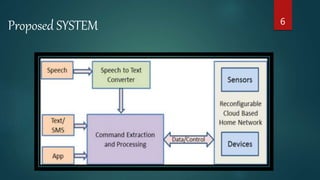
Proposed SYSTEM 6
7
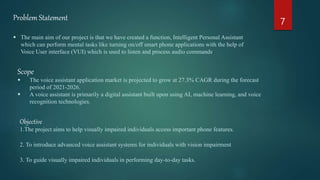
Problem Statement
 The main aim of our project is that we have created a function, Intelligent Personal Assistant
which can perform mental tasks like turning on/off smart phone applications with the help of
Voice User interface (VUI) which is used to listen and process audio commands.
Scope
 The voice assistant application market is projected to grow at 27.3% CAGR during the forecast
period of 2021-2026.
 A voice assistant is primarily a digital assistant built upon using AI, machine learning, and voice
recognition technologies.
Objective
1.The project aims to help visually impaired individuals access important phone features.
2. To introduce advanced voice assistant systems for individuals with vision impairment
3. To guide visually impaired individuals in performing day-to-day tasks.
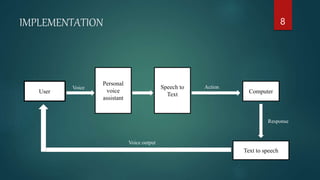
IMPLEMENTATION 8
User
Personal
voice
assistant
Computer
Text to speech
Speech to
Text
Voice Action
Response
Voice output
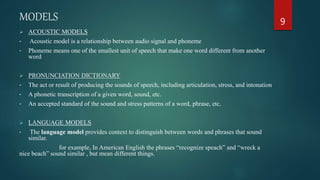
MODELS
 ACOUSTIC MODELS
• Acoustic model is a relationship between audio signal and phoneme
• Phoneme means one of the smallest unit of speech that make one word different from another
word
 PRONUNCIATION DICTIONARY
• The act or result of producing the sounds of speech, including articulation, stress, and intonation
• A phonetic transcription of a given word, sound, etc.
• An accepted standard of the sound and stress patterns of a word, phrase, etc.
 LANGUAGE MODELS
• The language model provides context to distinguish between words and phrases that sound
similar.
for example, In American English the phrases “recognize speach” and “wreck a
nice beach” sound similar , but mean different things.
9
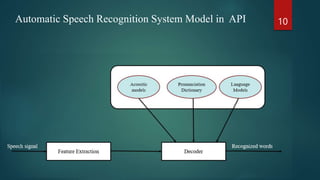
10
Automatic Speech Recognition System Model in API
11
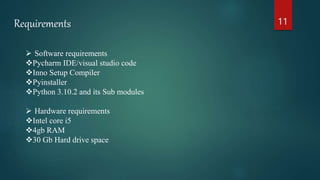
Requirements
 Software requirements
Pycharm IDE/visual studio code
Inno Setup Compiler
Pyinstaller
Python 3.10.2 and its Sub modules
 Hardware requirements
Intel core i5
4gb RAM
30 Gb Hard drive space
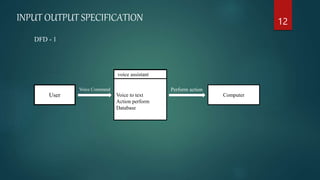
User Voice to text
Action perform
Database
voice assistant
Computer
Voice Command Perform action
DFD - 1
12
INPUT OUTPUT SPECIFICATION
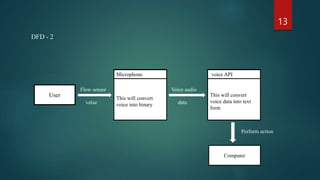
User This will convert
voice into binary
Microphone
Computer
This will convert
voice data into text
form
voice API
Flow sensor
value
Voice audio
data
Perform action
DFD - 2
13
14
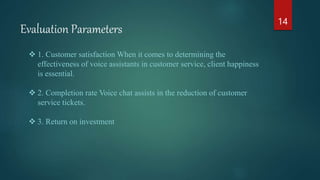
Evaluation Parameters
 1. Customer satisfaction When it comes to determining the
effectiveness of voice assistants in customer service, client happiness
is essential.
 2. Completion rate Voice chat assists in the reduction of customer
service tickets.
 3. Return on investment
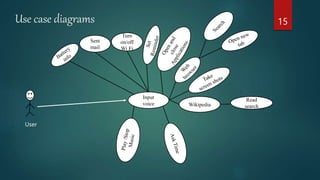
Use case diagrams 15
Input
voice
Sent
mail
Turn
on/off
Wi Fi
Wikipedia
Read
search
User
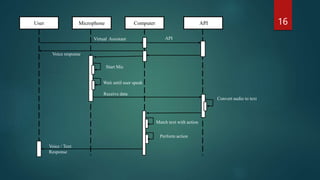
User Microphone API
Computer
Virtual Assistant API
Voice response
Start Mic
Wait until user speak
Receive data
Convert audio to text
Match text with action
Perform action
Voice / Text
Response
16
MODULES
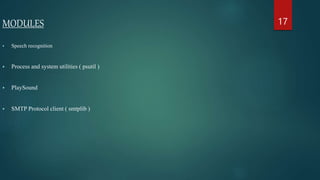
 Speech recognition
 Process and system utilities ( psutil )
 PlaySound
 SMTP Protocol client ( smtplib )
17
Conclusion
Voice Controlled Assistant System will use the Natural language
processing and can be integrated with artificial intelligence techniques
to achieve a smart assistant that can control the computer and
applications and even solve user queries using web searches.. It can be
designed to minimize the human efforts to interact with many other
subsystems, which would otherwise have to be performed manually. By
achieving this, the system will make human life comfortable
18
19
APPLICATION
 Voice assistant applications have been making lives easier by providing custom services
based on voice commands. We help businesses to utilize this technology to expand their
functionality and streamline their business operations with efficiency.
 We utilize voice assistant applications to deliver intuitive, automated experiences and
automated experiences and build customer engagement.
 DASHBOARD REPORTS
We enable you to track your business performance and better understand your data on your
understand your data on your dashboard assistant to discover valuable insights in real-time.
valuable insights in real-time.
 USER-CENTERED SUPPORT
Allow your users to navigate and ask questions with ease. Our in-app voice assistant
voice assistant supports users by responding to their inquiries in real-time.
20
REFERENCES
 S Subhash; Prajwal N Srivatsa; S Siddesh; A Ullas; B Santhosh, “ Artificial
intelligence based voice assistant” ,IEEE,2020
 G Baskaran, Harrish Raj ,S Arun Kumar, R Anand, “To Build A Virtual Assistant
By Using Artificial Intelligence” ,Researchgate,2021...
 Shakti Arora, Vijay Anant Athavale, Himanshu Maggu, , “Artificial Intelligence
and Virtual Assistant-Working Model” , Springer,2020
 Deepak Shende, Ria Umahiya ,Monika Raghorte ,Aishwarya Bhisikar "AI Based
Voice Assistant Using Python", February-2019
21
ACKNOWLEDGEMENT
We would like to Express my special thanks of gratitude to our Prof.
Payel Thakur Who gave us the golden opportunity to do this wonderful
project on the topic AI Based Voice Assistant, which also help us to lot of
research and we came to know About so many new things we are
thankful to you.
THANK YOU
22

VOICE-ASSISTANT-IN-PYTHON-pptx.pptx

  • 1.
    ARTIFICIAL INTELLIGENCE BASED VOICEASSISTANT 1 Guide Name:- Payel Thakur Submitted By:  SHIVRAJ YELAVE  RUTIKA SALUNKHE  AISHWARYA RETAWADE  ANUTEJ WARE
  • 2.
    Contents  1.Introduction  2.Literature Survey 2.1 Existing system architecture 2.2 Summary of Literature Survey 2.3 Problem Statement, Scope and Objectives  3. Implementation 3.1 Proposed Block Diagram 3.2 Mathematical Model 3.3 Hardware and Software Details 3.4 Input and Output Specification 3.5 Performance Evaluation Parameters 3.6 Conclusion  4. Application  5. References  6. Acknowledgement 2
  • 3.
    Introduction  A voiceassistant is a technology based on artificial intelligence. The software uses a device’s microphone to receive voice requests while the voice output takes place at the speaker. But the most exciting thing happens between these two actions.  It is a combination of several different technologies: voice recognition, voice analysis and language processing.  It is completely developed using one of the most powerful language python. 3
  • 4.
    LITERATURE SURVEY Sr.no PaperName/ Details Author Year Conclusion 1. IEEE: AI based voice Assistant 1.Subhash s 2.Ullas s Sep-2022  This project we have installed gTTS engine package to make the voice assistant speak like human being 2. IJRT: voice Assistant using Python 1.Prachi s 2.Abhishek singh April-2021  This project Voice assistant keep listening for commands  ASR convert speech into text  TTS out text output into speech 3. Engpaper : Virtual Assistant AI 1. A.Kalouyis 2. M.Spiliopoulo August-2019  In this paper, intelligent virtual assistant agent can perform tasks  b. Online chat programs are used exclusively for entertainment purpose. 4. Desktop Voice Assistant. 1.vishal Kumar Dhanraj April-2022  In this system is using Google’s online speech recognition system for converting speech input to text. 4
  • 5.
  • 6.
  • 7.
    7 Problem Statement  Themain aim of our project is that we have created a function, Intelligent Personal Assistant which can perform mental tasks like turning on/off smart phone applications with the help of Voice User interface (VUI) which is used to listen and process audio commands. Scope  The voice assistant application market is projected to grow at 27.3% CAGR during the forecast period of 2021-2026.  A voice assistant is primarily a digital assistant built upon using AI, machine learning, and voice recognition technologies. Objective 1.The project aims to help visually impaired individuals access important phone features. 2. To introduce advanced voice assistant systems for individuals with vision impairment 3. To guide visually impaired individuals in performing day-to-day tasks.
  • 8.
    IMPLEMENTATION 8 User Personal voice assistant Computer Text tospeech Speech to Text Voice Action Response Voice output
  • 9.
    MODELS  ACOUSTIC MODELS •Acoustic model is a relationship between audio signal and phoneme • Phoneme means one of the smallest unit of speech that make one word different from another word  PRONUNCIATION DICTIONARY • The act or result of producing the sounds of speech, including articulation, stress, and intonation • A phonetic transcription of a given word, sound, etc. • An accepted standard of the sound and stress patterns of a word, phrase, etc.  LANGUAGE MODELS • The language model provides context to distinguish between words and phrases that sound similar. for example, In American English the phrases “recognize speach” and “wreck a nice beach” sound similar , but mean different things. 9
  • 10.
  • 11.
    11 Requirements  Software requirements PycharmIDE/visual studio code Inno Setup Compiler Pyinstaller Python 3.10.2 and its Sub modules  Hardware requirements Intel core i5 4gb RAM 30 Gb Hard drive space
  • 12.
    User Voice totext Action perform Database voice assistant Computer Voice Command Perform action DFD - 1 12 INPUT OUTPUT SPECIFICATION
  • 13.
    User This willconvert voice into binary Microphone Computer This will convert voice data into text form voice API Flow sensor value Voice audio data Perform action DFD - 2 13
  • 14.
    14 Evaluation Parameters  1.Customer satisfaction When it comes to determining the effectiveness of voice assistants in customer service, client happiness is essential.  2. Completion rate Voice chat assists in the reduction of customer service tickets.  3. Return on investment
  • 15.
    Use case diagrams15 Input voice Sent mail Turn on/off Wi Fi Wikipedia Read search User
  • 16.
    User Microphone API Computer VirtualAssistant API Voice response Start Mic Wait until user speak Receive data Convert audio to text Match text with action Perform action Voice / Text Response 16
  • 17.
    MODULES  Speech recognition Process and system utilities ( psutil )  PlaySound  SMTP Protocol client ( smtplib ) 17
  • 18.
    Conclusion Voice Controlled AssistantSystem will use the Natural language processing and can be integrated with artificial intelligence techniques to achieve a smart assistant that can control the computer and applications and even solve user queries using web searches.. It can be designed to minimize the human efforts to interact with many other subsystems, which would otherwise have to be performed manually. By achieving this, the system will make human life comfortable 18
  • 19.
    19 APPLICATION  Voice assistantapplications have been making lives easier by providing custom services based on voice commands. We help businesses to utilize this technology to expand their functionality and streamline their business operations with efficiency.  We utilize voice assistant applications to deliver intuitive, automated experiences and automated experiences and build customer engagement.  DASHBOARD REPORTS We enable you to track your business performance and better understand your data on your understand your data on your dashboard assistant to discover valuable insights in real-time. valuable insights in real-time.  USER-CENTERED SUPPORT Allow your users to navigate and ask questions with ease. Our in-app voice assistant voice assistant supports users by responding to their inquiries in real-time.
  • 20.
    20 REFERENCES  S Subhash;Prajwal N Srivatsa; S Siddesh; A Ullas; B Santhosh, “ Artificial intelligence based voice assistant” ,IEEE,2020  G Baskaran, Harrish Raj ,S Arun Kumar, R Anand, “To Build A Virtual Assistant By Using Artificial Intelligence” ,Researchgate,2021...  Shakti Arora, Vijay Anant Athavale, Himanshu Maggu, , “Artificial Intelligence and Virtual Assistant-Working Model” , Springer,2020  Deepak Shende, Ria Umahiya ,Monika Raghorte ,Aishwarya Bhisikar "AI Based Voice Assistant Using Python", February-2019
  • 21.
    21 ACKNOWLEDGEMENT We would liketo Express my special thanks of gratitude to our Prof. Payel Thakur Who gave us the golden opportunity to do this wonderful project on the topic AI Based Voice Assistant, which also help us to lot of research and we came to know About so many new things we are thankful to you.
  • 22.