Voice - ActivatedVirtual Assistant
• KRISHNARAJAN V - 8208E22CSR046
• MAHESHWARAN S - 8208E22CSR054
• MANIKANDAN R – 8208E22CSR058
DEPARTMENT OF COMPUTER SCIENCE
AND ENGINEERING
E.G.S. PILLAY ENGINEERING COLLEGE
Nagapattinam,Tamilnadu
Under the guidance of
Dr.M.Priya, Prof/CSE
Mrs.G.Pushpa, AP/CSE
2.
Problem Statement
•Problem:
In aworld filled with distractions, managing tasks and accessing information
efficiently has become challenging. Voice assistants like IRIS can simplify
tasks, provide instant information, and improve productivity.
•Challenges:
•Difficulty in managing routine tasks without distractions.
•Limited accessibility to technology for people with disabilities.
•Lack of an intelligent, context-aware assistant for personalized assistance.
3.
Objective Statement
• Objective:
Todevelop an AI-based voice assistant that can respond
to voice commands, perform tasks like opening apps,
providing weather updates, setting reminders, and
sending emails.
• Goals:
• Implement natural language processing (NLP) for better
command recognition.
• Integrate with third-party services like weather, email, and
music.
• Ensure accessibility for users of all abilities.
4.
Scope of Work
•Key Features:
• Voice command recognition.
• Task management (set reminders, alarms).
• System utility control (open apps, calculator).
• Online information access (weather, news).
• Personal assistant functionalities (emails,
WhatsApp messages).
5.
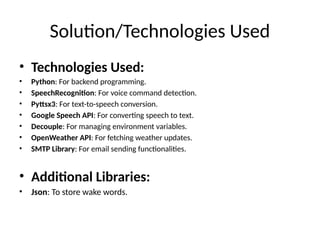
Solution/Technologies Used
• TechnologiesUsed:
• Python: For backend programming.
• SpeechRecognition: For voice command detection.
• Pyttsx3: For text-to-speech conversion.
• Google Speech API: For converting speech to text.
• Decouple: For managing environment variables.
• OpenWeather API: For fetching weather updates.
• SMTP Library: For email sending functionalities.
• Additional Libraries:
• Json: To store wake words.
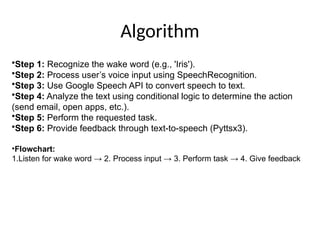
Algorithm
•Step 1: Recognizethe wake word (e.g., 'Iris').
•Step 2: Process user’s voice input using SpeechRecognition.
•Step 3: Use Google Speech API to convert speech to text.
•Step 4: Analyze the text using conditional logic to determine the action
(send email, open apps, etc.).
•Step 5: Perform the requested task.
•Step 6: Provide feedback through text-to-speech (Pyttsx3).
•Flowchart:
1.Listen for wake word → 2. Process input → 3. Perform task → 4. Give feedback
8.
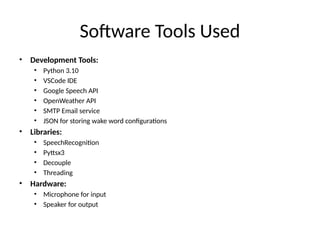
Software Tools Used
•Development Tools:
• Python 3.10
• VSCode IDE
• Google Speech API
• OpenWeather API
• SMTP Email service
• JSON for storing wake word configurations
• Libraries:
• SpeechRecognition
• Pyttsx3
• Decouple
• Threading
• Hardware:
• Microphone for input
• Speaker for output
9.
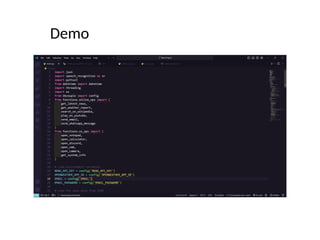
Demo / Progress
•Current Progress:Basic voice command functionality
operational.
• System utilities can be accessed via voice (open apps,
calculator, etc.).
• Online services like weather, emails, and WhatsApp
messaging integrated
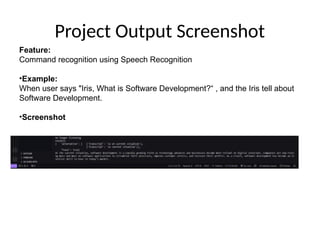
Project Output Screenshot
Feature:
Commandrecognition using Speech Recognition
•Example:
When user says "Iris, What is Software Development?“ , and the Iris tell about
Software Development.
•Screenshot
12.
Merits
• Advantages:Accessibility: Helpfulfor users
with disabilities.
• Productivity: Speeds up routine tasks like
emails and scheduling.
• User-friendly Interface: Voice-driven
interaction with minimal learning curve.
• Customizability: New commands can be
added easily using Python’s modularity.
13.
Demerits
• Challenges:Accuracy Limitations:Dependent on
Google’s Speech API accuracy.
• Noise Sensitivity: May not work well in noisy
environments.
• Hardware Dependency: Requires a good
microphone for optimal performance.
• Dependency on APIs: External services like
OpenWeather and Google APIs can fail due to
network issues.
14.
References
•APIs & Tools:
•GoogleSpeech Recognition API.
•OpenWeather API.
•Pyttsx3 (text-to-speech).
•Libraries:
•Python's speech_recognition and pyttsx3 modules.
•Sources:
•Official Python documentation.
•Google Speech API documentation.
•OpenWeather API documentation.
15.
Future Work
• 1.Expand features like reminders.
• 2. Add multilingual support.
• 3. Implement machine learning for
personalization.
16.
Conclusion
• Summary:
IRIS isa highly versatile AI voice assistant designed to
improve efficiency and accessibility through natural language
interaction. With further refinement, it can be expanded to
serve a broader range of tasks and improve upon accuracy
and contextual understanding.
• Future Work:
• Implement advanced AI functionalities such as machine learning
for better user personalization.
• Improve noise cancellation for better performance in challenging
environments.
• Expand third-party integrations (Spotify, Google Calendar, etc.).


![final_ppt[1].pptxCCCCCCCCCCCCCCCCCCCCCCCC](https://cdn.slidesharecdn.com/ss_thumbnails/finalppt1-240530120839-258d1296-thumbnail.jpg?width=640&height=640&fit=bounds)


![project_ppt[1] Final-2.pptx on AI voice](https://cdn.slidesharecdn.com/ss_thumbnails/projectppt1final-2-240829095552-ae5a2a43-thumbnail.jpg?width=640&height=640&fit=bounds)


