VOCABULARY
UNIT 4. CLIMATE
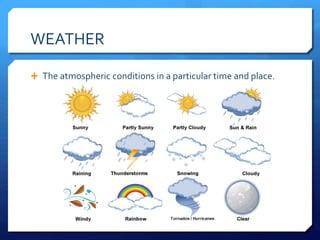
WEATHER
 The atmospheric conditions in a particular time and place.
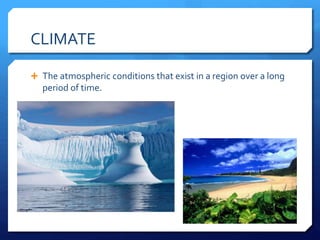
CLIMATE
 The atmospheric conditions that exist in a region over a long
period of time.
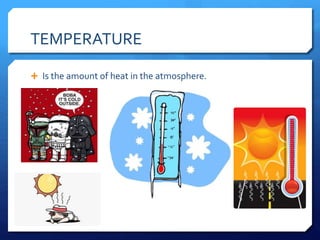
TEMPERATURE
 Is the amount of heat in the atmosphere.
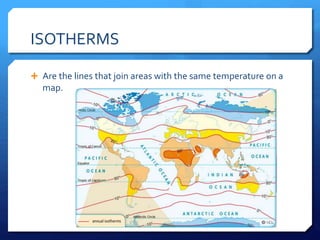
ISOTHERMS
 Are the lines that join areas with the same temperature on a
map.
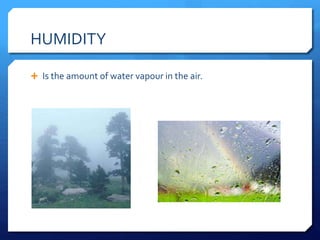
HUMIDITY
 Is the amount of water vapour in the air.
ISOHYETS
 Are the lines on a map that join areas with the same amount of
precipitation.
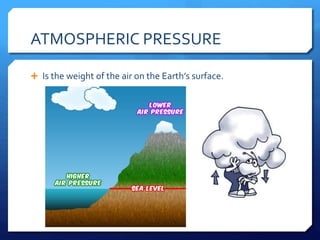
ATMOSPHERIC PRESSURE
 Is the weight of the air on the Earth’s surface.
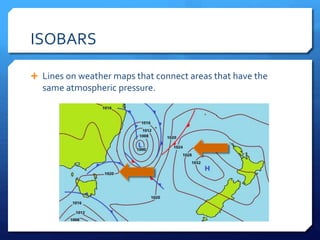
ISOBARS
 Lines on weather maps that connect areas that have the
same atmospheric pressure.
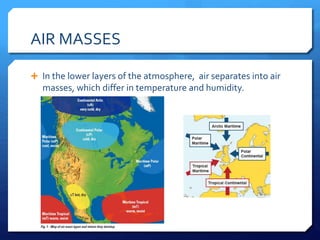
AIR MASSES
 In the lower layers of the atmosphere, air separates into air
masses, which differ in temperature and humidity.
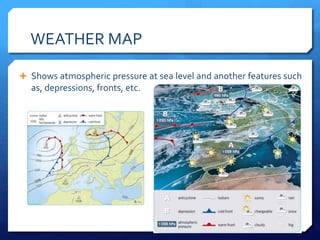
WEATHER MAP
 Shows atmospheric pressure at sea level and another features such
as, depressions, fronts, etc.
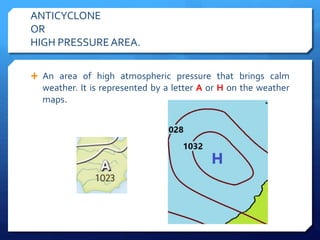
ANTICYCLONE
OR
HIGH PRESSUREAREA.
 An area of high atmospheric pressure that brings calm
weather. It is represented by a letter A or H on the weather
maps.
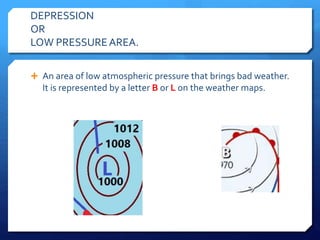
DEPRESSION
OR
LOW PRESSUREAREA.
 An area of low atmospheric pressure that brings bad weather.
It is represented by a letter B or L on the weather maps.
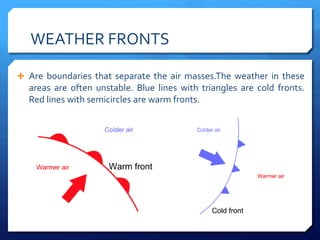
WEATHER FRONTS
 Are boundaries that separate the air masses.The weather in these
areas are often unstable. Blue lines with triangles are cold fronts.
Red lines with semicircles are warm fronts.
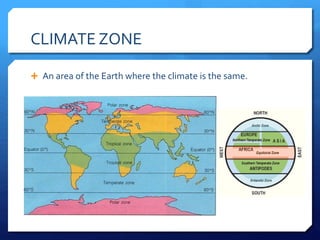
CLIMATE ZONE
 An area of the Earth where the climate is the same.
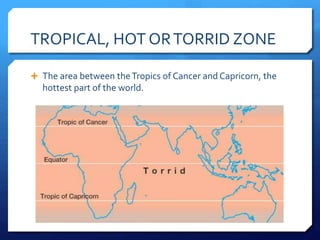
TROPICAL, HOT ORTORRID ZONE
 The area between theTropics of Cancer and Capricorn, the
hottest part of the world.
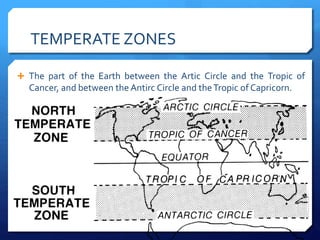
TEMPERATE ZONES
 The part of the Earth between the Artic Circle and the Tropic of
Cancer, and between the Antirc Circle and theTropic of Capricorn.
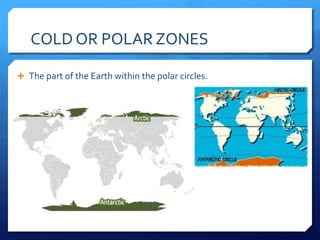
COLD OR POLAR ZONES
 The part of the Earth within the polar circles.
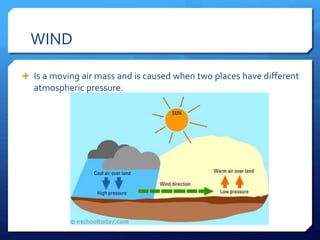
WIND
 Is a moving air mass and is caused when two places have different
atmospheric pressure.
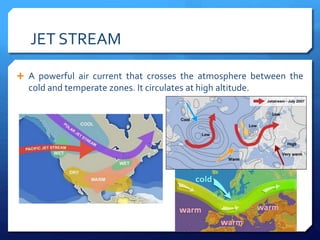
JET STREAM
 A powerful air current that crosses the atmosphere between the
cold and temperate zones. It circulates at high altitude.

Vocabulary Unit4