VirtualBox Bug Hunting
CASE
VM ESCAPE
& Exploitation
STUDY
鄭炳忠 (Billy)
Security Research
@st424204
Muhd. Ramdhan
Security Research
@n0psledbyte
HOW TO ESCAPE THE VMs.
Outline
● What is VM Escape?
● Oracle Virtualbox Overview
● Attack Surface
● CVE-2021-2321: OOB Read Information Disclosure Vulnerability
● CVE-2021-2250: VirtualBox SLIRP Heap-based Overflow
● Demo
IDSECCONF
4 - 5 December 2021
What is VM?
IDSECCONF
4 - 5 December 2021
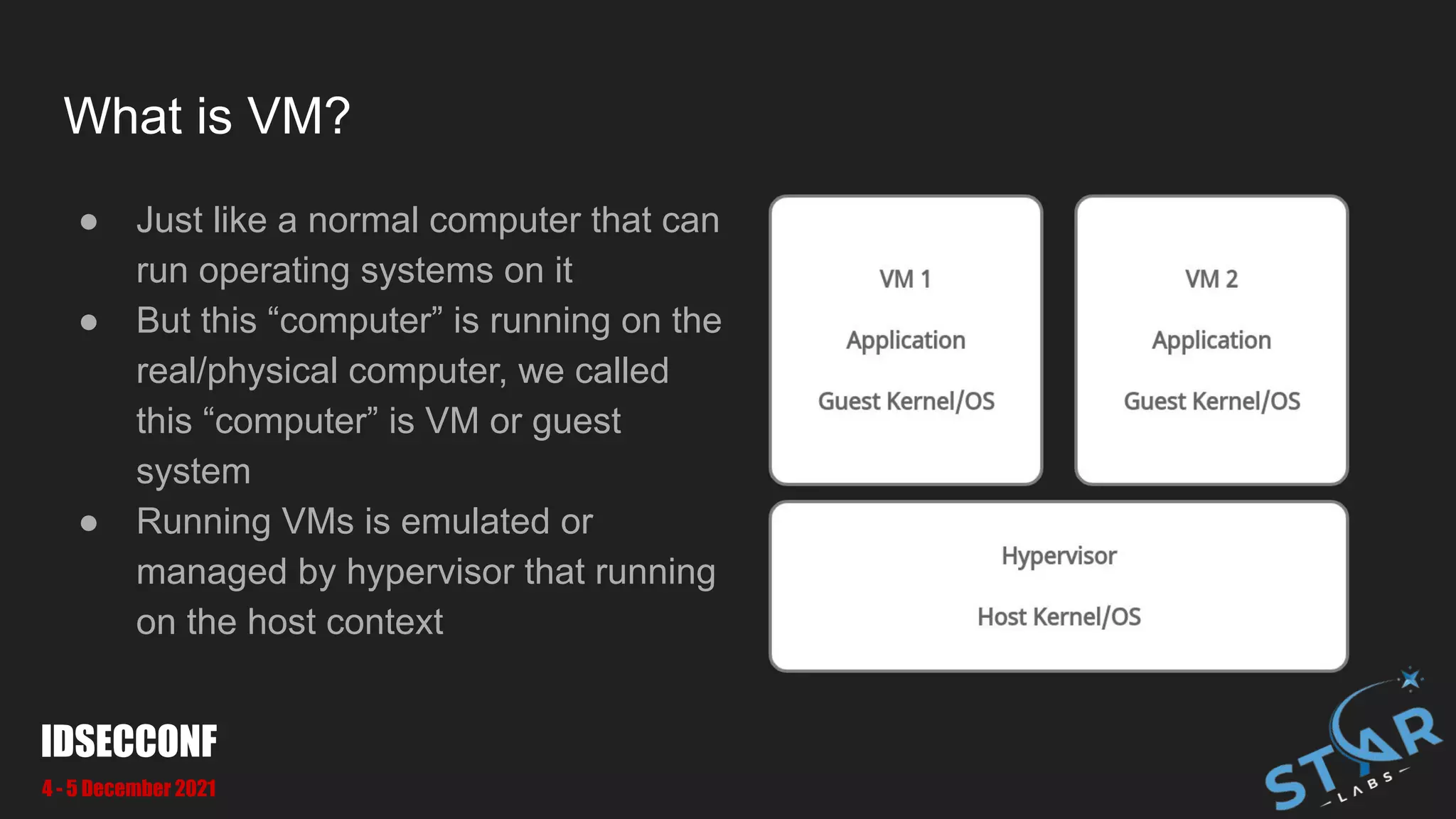
● Just like a normal computer that can
run operating systems on it
● But this “computer” is running on the
real/physical computer, we called
this “computer” is VM or guest
system
● Running VMs is emulated or
managed by hypervisor that running
on the host context
What is VM Escape?
IDSECCONF
4 - 5 December 2021
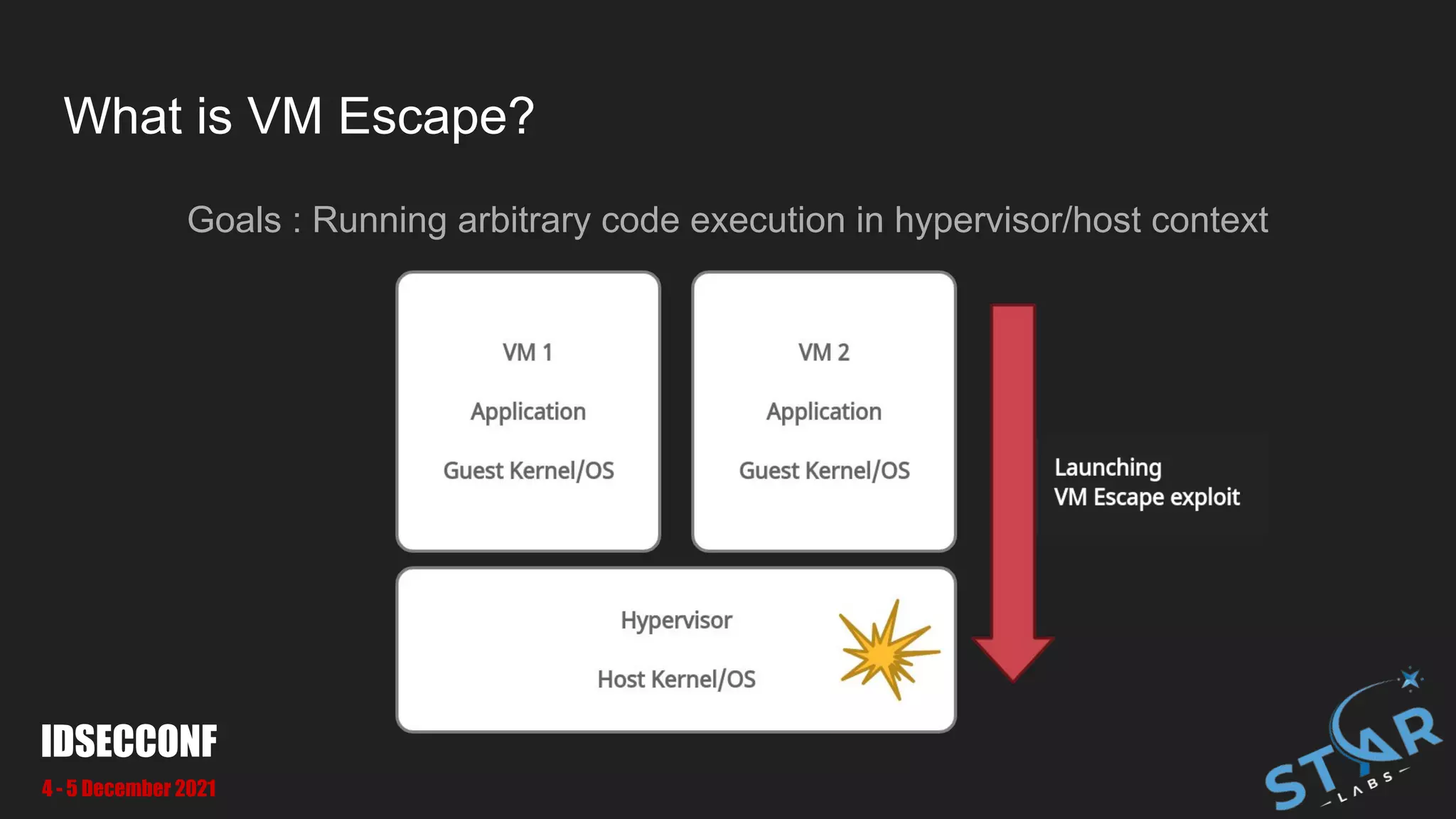
Goals : Running arbitrary code execution in hypervisor/host context
VM Escape Bug & Exploit In The Past
● CVE-2015-3456 : VENOM: buffer-overflow in QEMU virtual floppy disk
controller
● CVE-2018-6981 : Uninitialized stack memory in VMware vmxnet3 virtual
network adapter
● CVE-2019-2722 : Integer underflow in Oracle VirtualBox e1000 virtual
network device
● CVE-2019-14378 : Heap pointer miscalculation in SLiRP (default user
network backend used by QEMU)
● CVE-2021-29657 : Double fetch/TOCTOU in KVM’s AMD implementation
IDSECCONF
4 - 5 December 2021
Oracle Virtualbox Overview
● One of the popular virtualization software for desktop
● C/C++, Free, Open source ( It’s good for code auditing
and find some memory corruption bugs ;) )
● VirtualBox Extensions shipped as binaries, to support
USB 2.0 and 3.0 devices, VirtualBox RDP, etc.
● Virtualbox is using Hardware-assisted Virtualization
based on Intel VT-X and AMD-V
IDSECCONF
4 - 5 December 2021
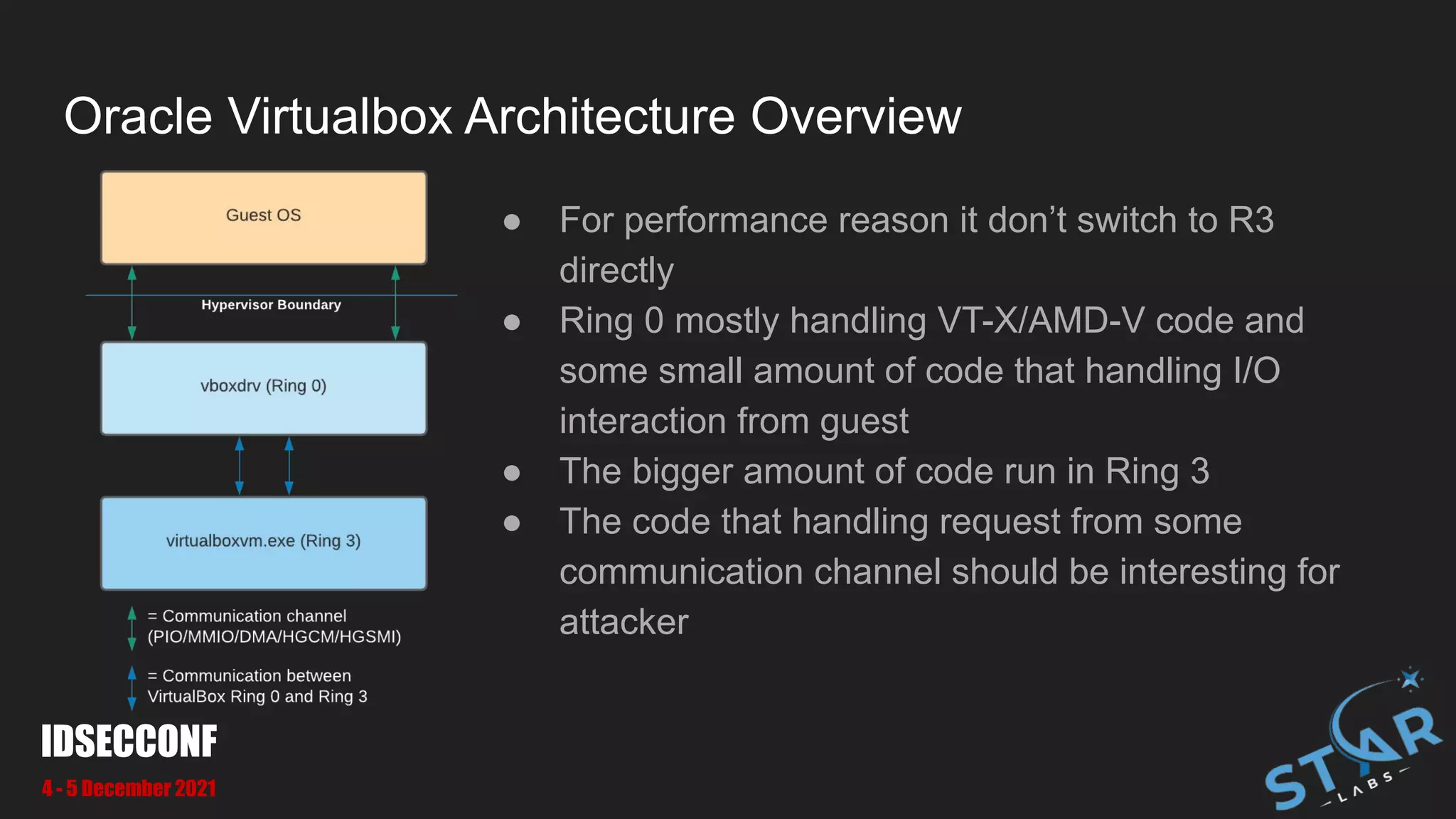
● For performance reason it don’t switch to R3
directly
● Ring 0 mostly handling VT-X/AMD-V code and
some small amount of code that handling I/O
interaction from guest
● The bigger amount of code run in Ring 3
● The code that handling request from some
communication channel should be interesting for
attacker
Oracle Virtualbox Architecture Overview
IDSECCONF
4 - 5 December 2021
Attack Surface
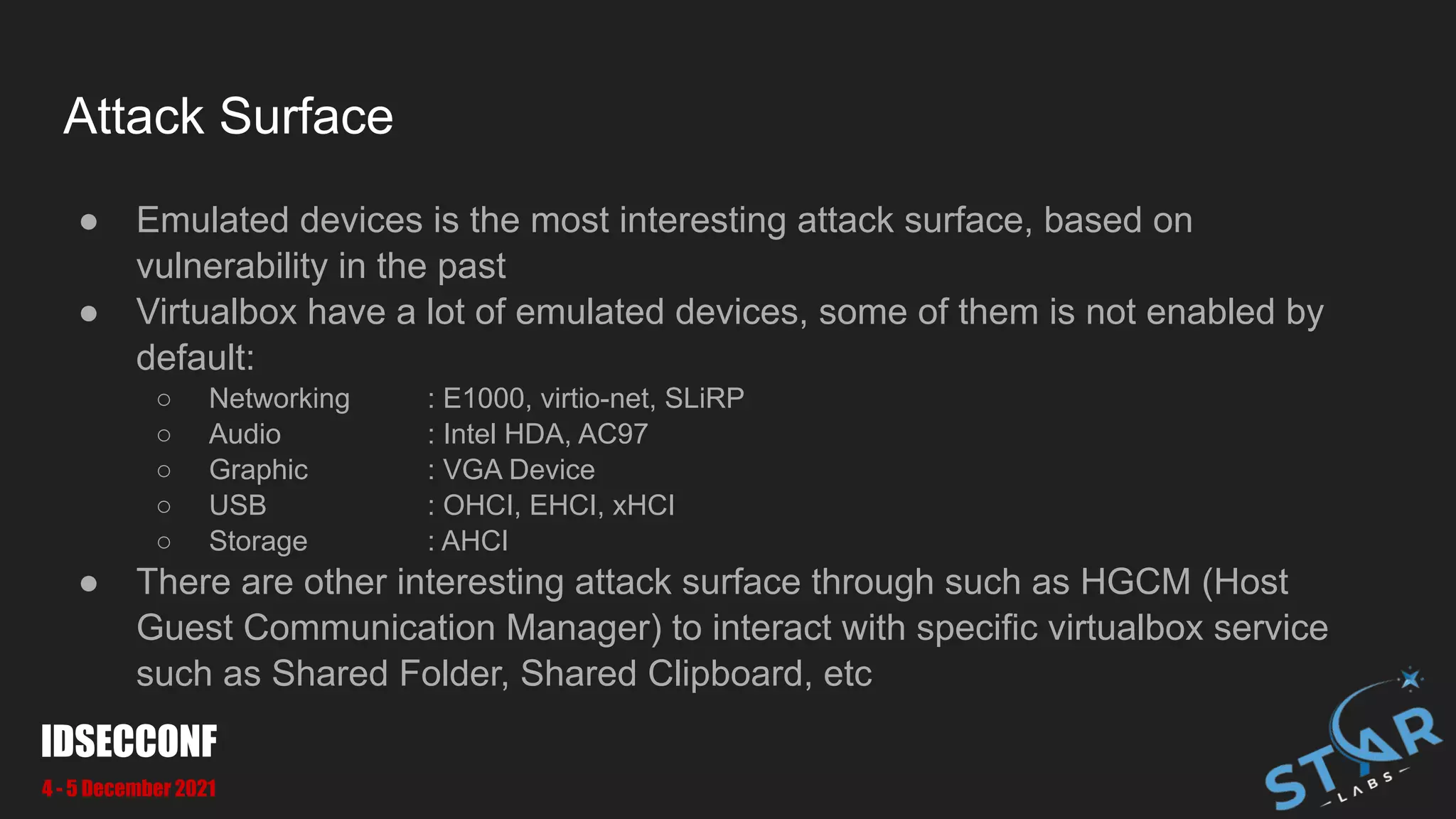
● Emulated devices is the most interesting attack surface, based on
vulnerability in the past
● Virtualbox have a lot of emulated devices, some of them is not enabled by
default:
○ Networking : E1000, virtio-net, SLiRP
○ Audio : Intel HDA, AC97
○ Graphic : VGA Device
○ USB : OHCI, EHCI, xHCI
○ Storage : AHCI
● There are other interesting attack surface through such as HGCM (Host
Guest Communication Manager) to interact with specific virtualbox service
such as Shared Folder, Shared Clipboard, etc
IDSECCONF
4 - 5 December 2021
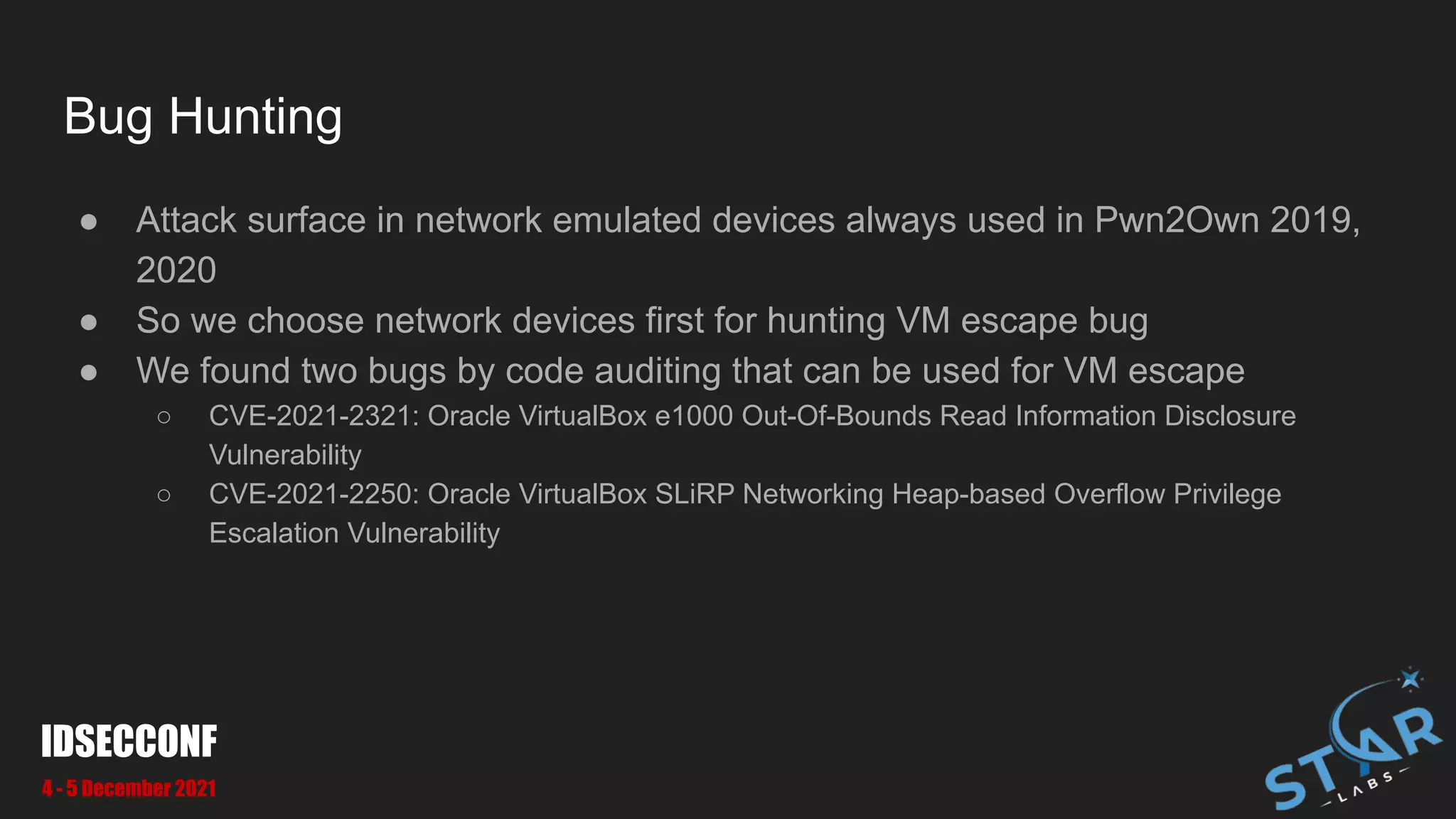
Bug Hunting
● Attack surface in network emulated devices always used in Pwn2Own 2019,
2020
● So we choose network devices first for hunting VM escape bug
● We found two bugs by code auditing that can be used for VM escape
○ CVE-2021-2321: Oracle VirtualBox e1000 Out-Of-Bounds Read Information Disclosure
Vulnerability
○ CVE-2021-2250: Oracle VirtualBox SLiRP Networking Heap-based Overflow Privilege
Escalation Vulnerability
IDSECCONF
4 - 5 December 2021
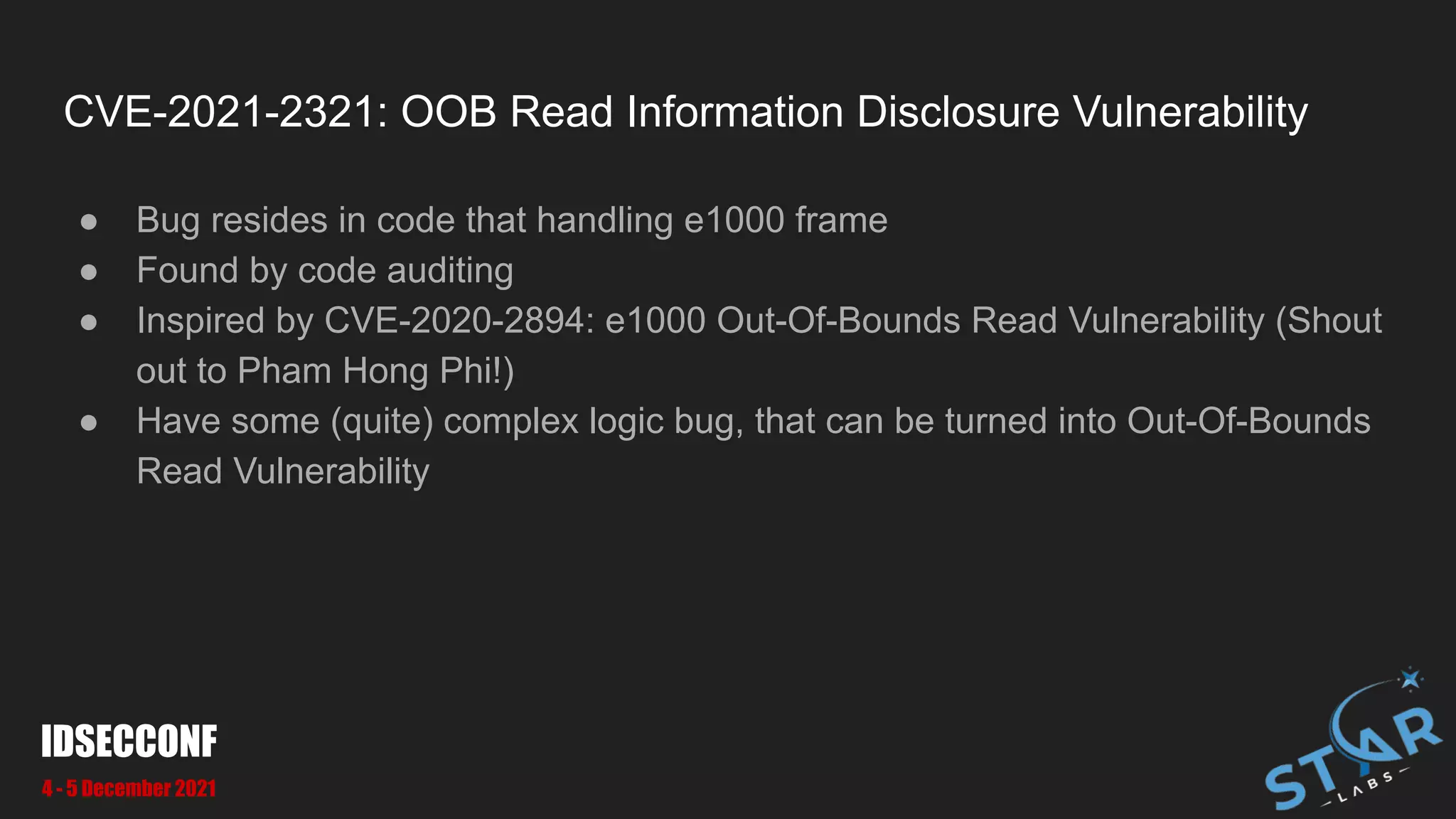
CVE-2021-2321: OOB Read Information Disclosure Vulnerability
● Bug resides in code that handling e1000 frame
● Found by code auditing
● Inspired by CVE-2020-2894: e1000 Out-Of-Bounds Read Vulnerability (Shout
out to Pham Hong Phi!)
● Have some (quite) complex logic bug, that can be turned into Out-Of-Bounds
Read Vulnerability
IDSECCONF
4 - 5 December 2021
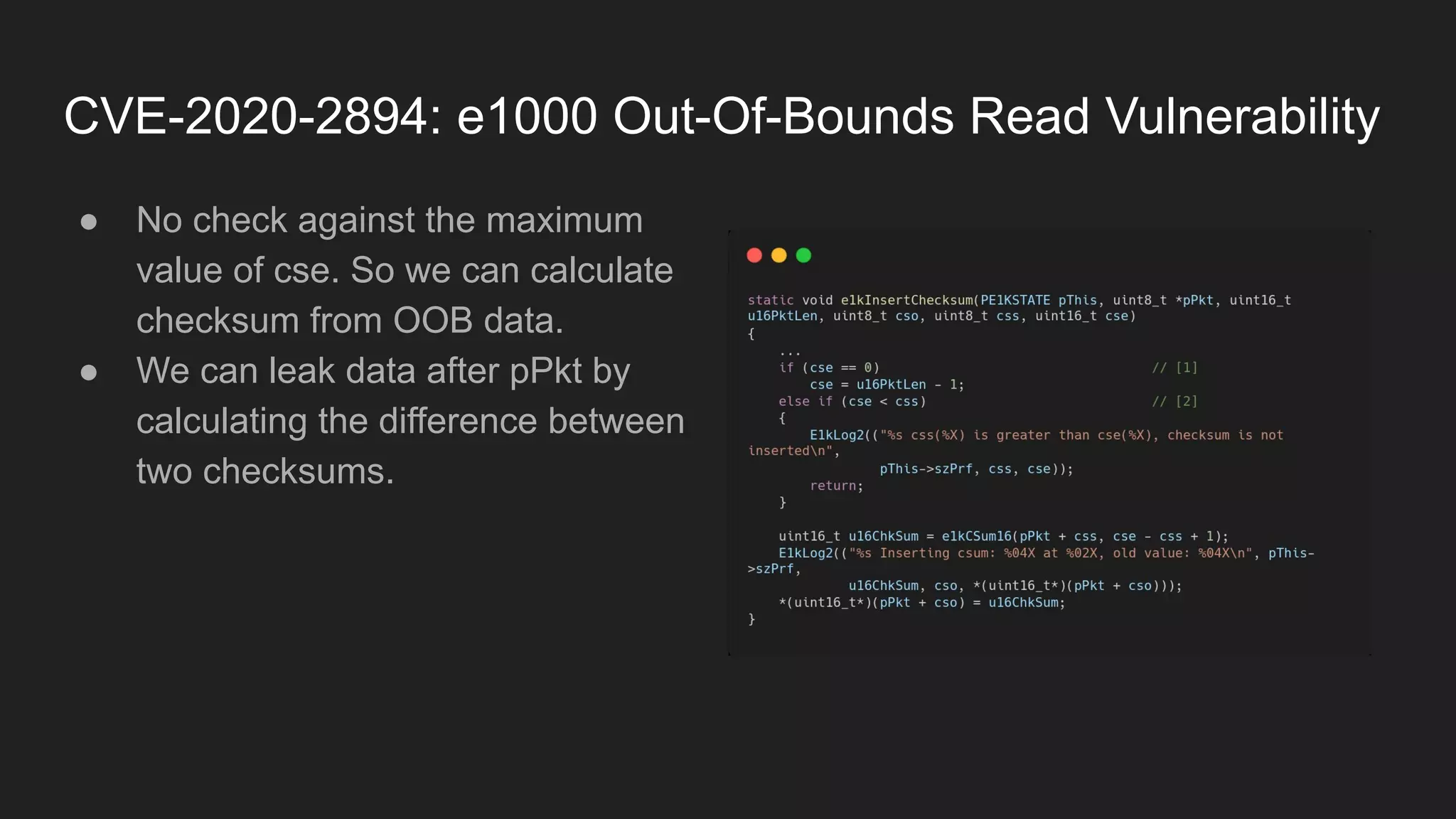
CVE-2020-2894: e1000 Out-Of-Bounds Read Vulnerability
● No check against the maximum
value of cse. So we can calculate
checksum from OOB data.
● We can leak data after pPkt by
calculating the difference between
two checksums.
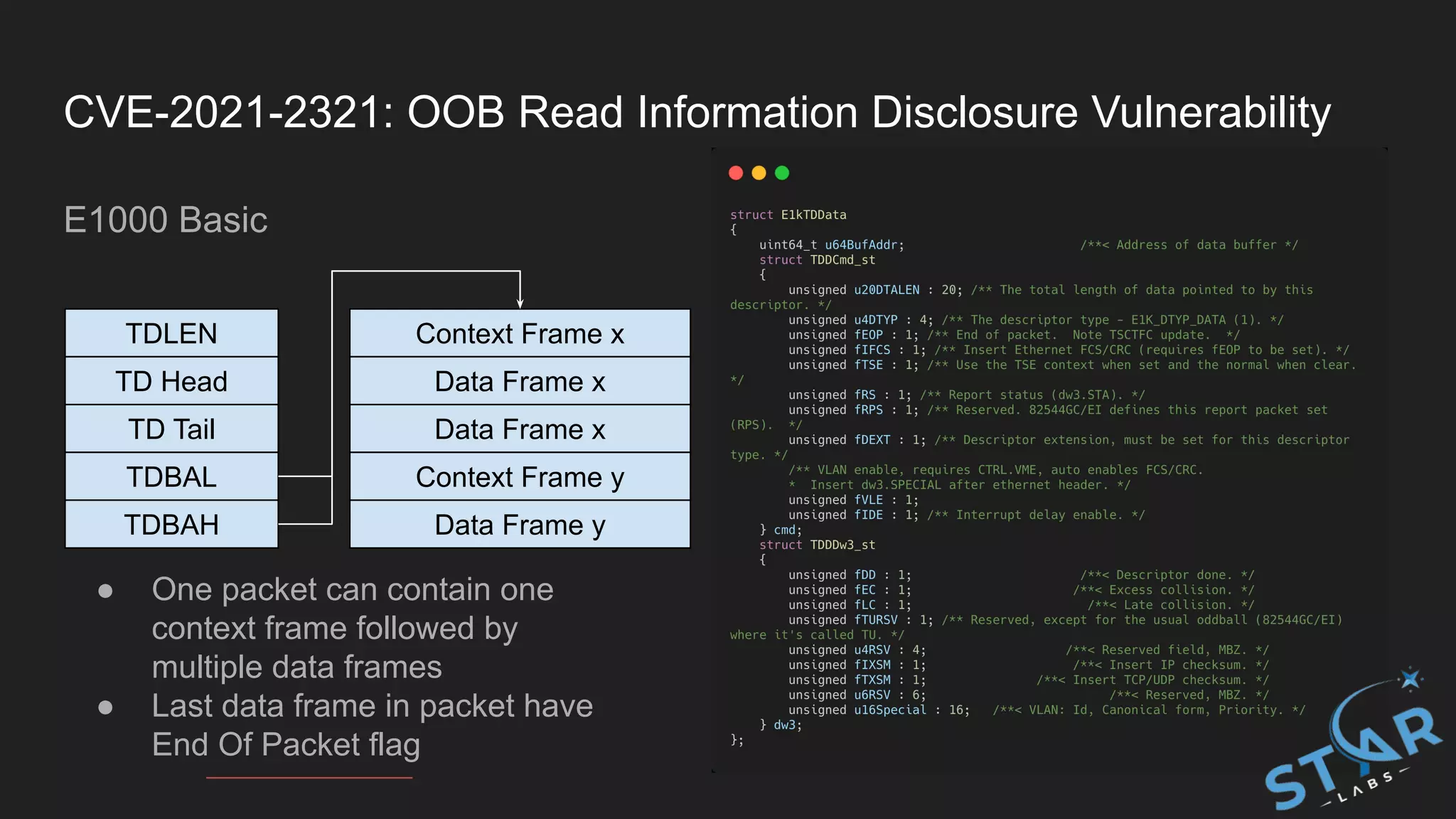
CVE-2021-2321: OOB Read Information Disclosure Vulnerability
E1000 Basic
TDLEN
TD Head
TD Tail
TDBAL
TDBAH
Context Frame x
Data Frame x
Data Frame x
Context Frame y
Data Frame y
● One packet can contain one
context frame followed by
multiple data frames
● Last data frame in packet have
End Of Packet flag
CVE-2021-2321: OOB Read Information Disclosure Vulnerability
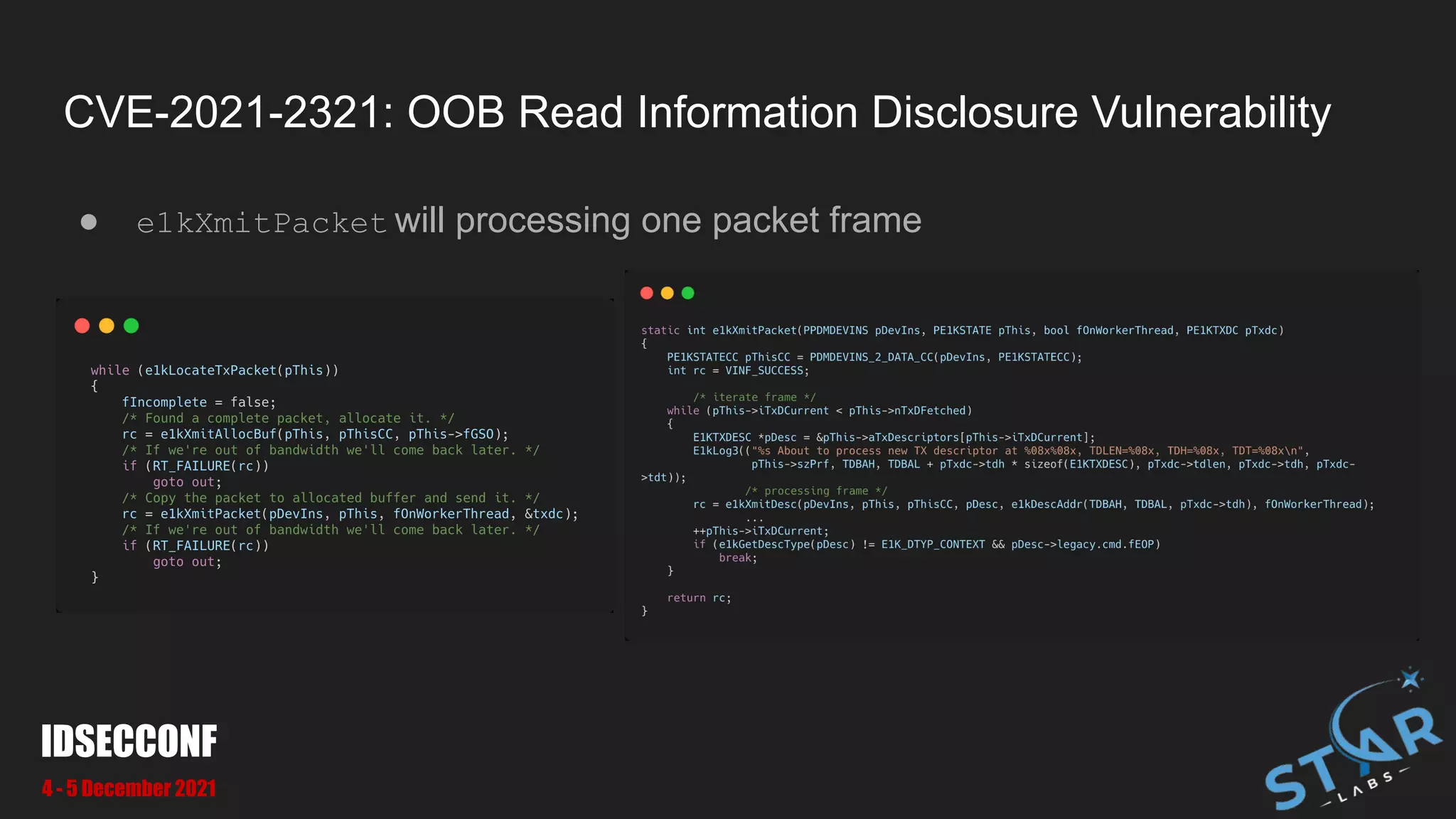
● e1kXmitPacket will processing one packet frame
IDSECCONF
4 - 5 December 2021
CVE-2021-2321: OOB Read Information Disclosure Vulnerability
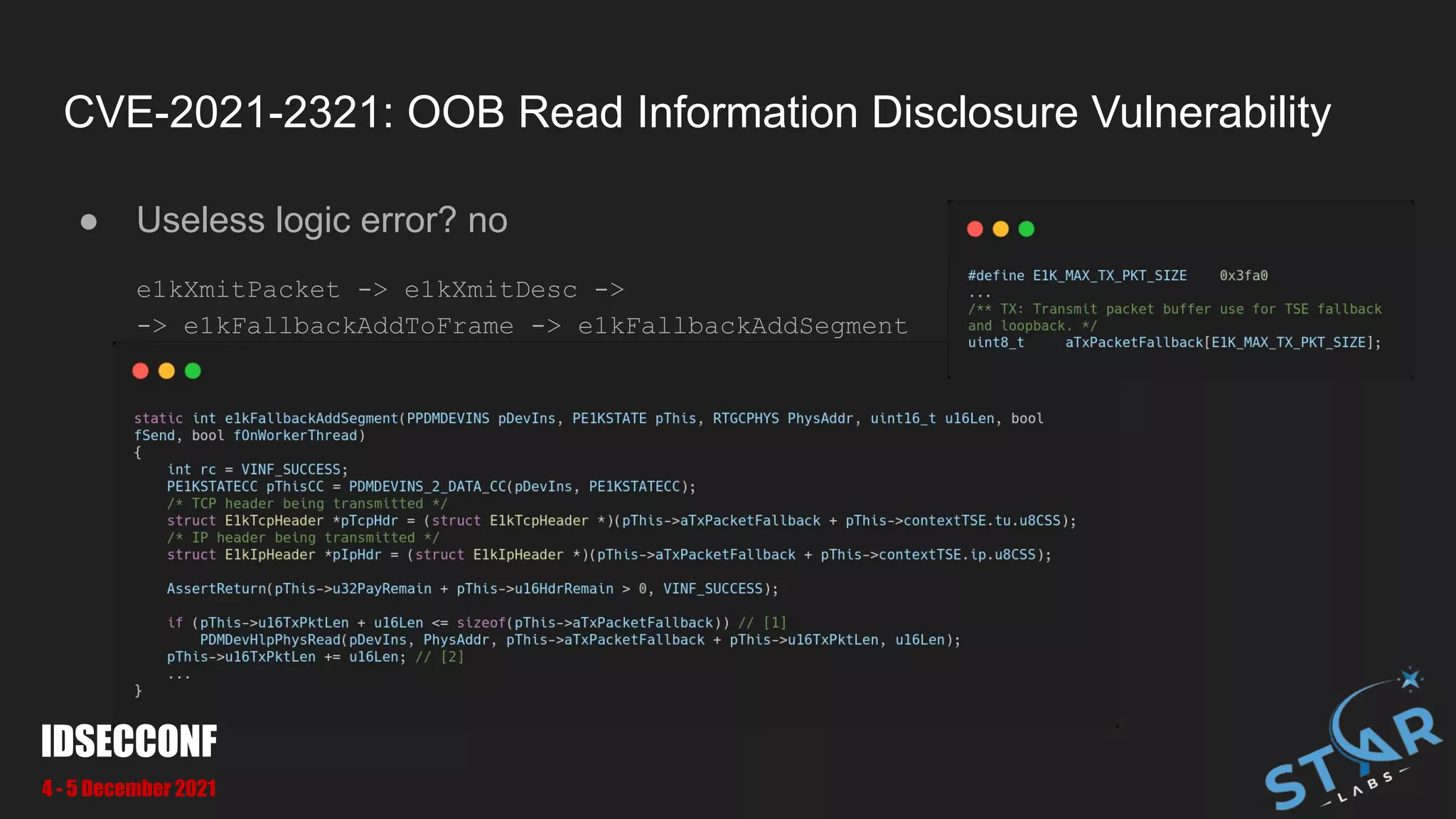
● Useless logic error? no
e1kXmitPacket -> e1kXmitDesc ->
-> e1kFallbackAddToFrame -> e1kFallbackAddSegment
IDSECCONF
4 - 5 December 2021
CVE-2021-2321: OOB Read Information Disclosure Vulnerability
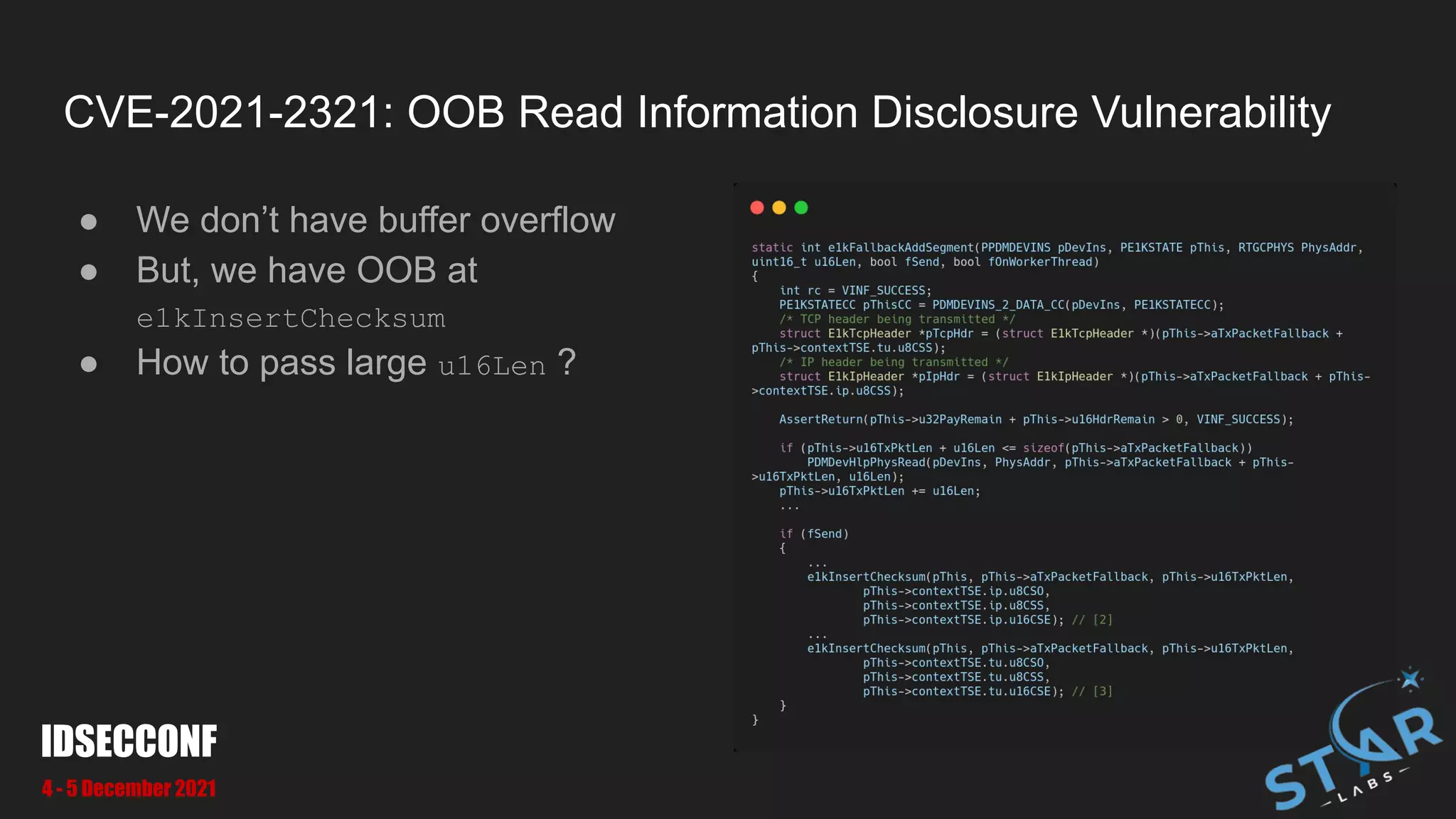
● We don’t have buffer overflow
● But, we have OOB at
e1kInsertChecksum
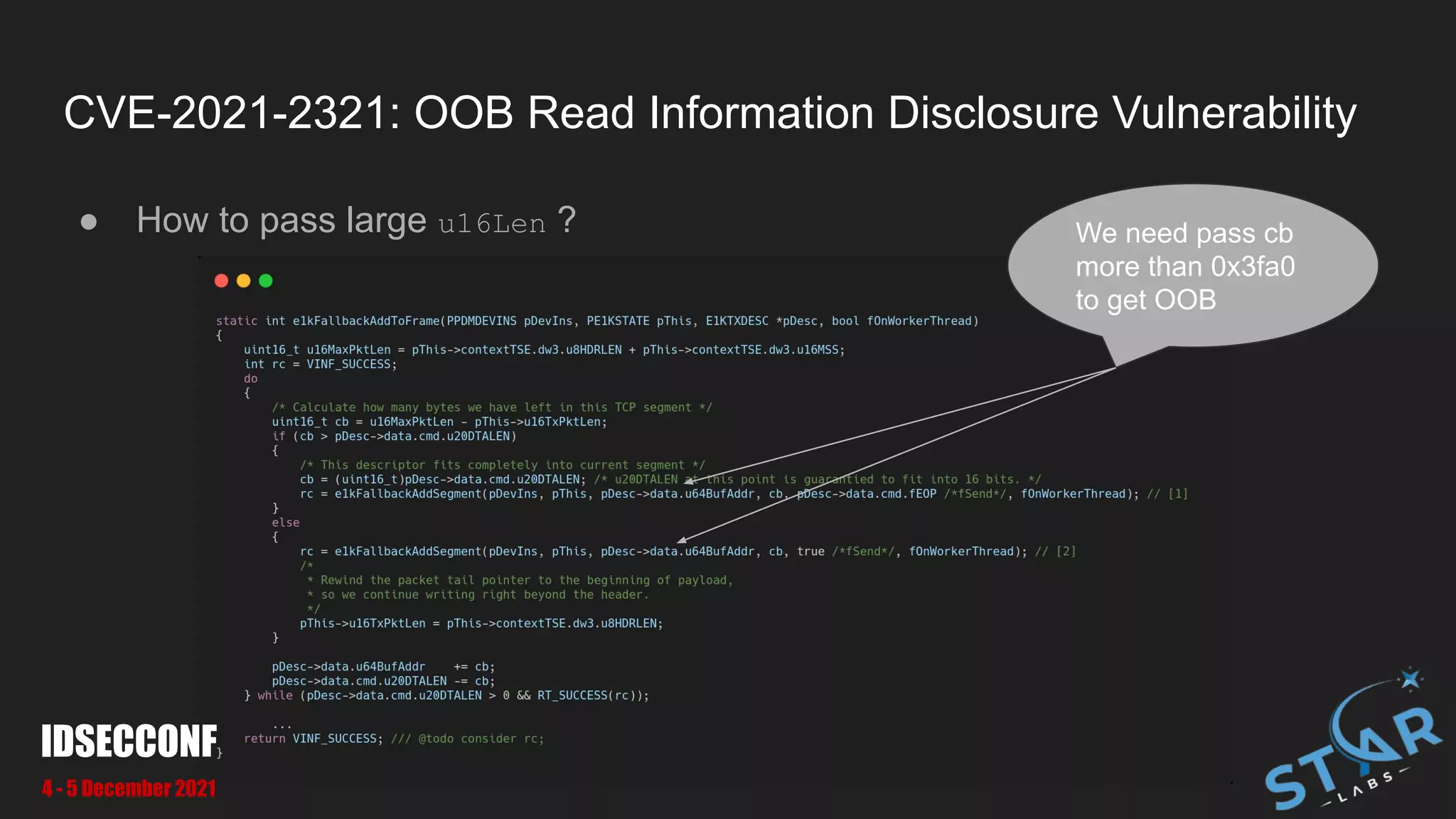
● How to pass large u16Len ?
IDSECCONF
4 - 5 December 2021
CVE-2021-2321: OOB Read Information Disclosure Vulnerability
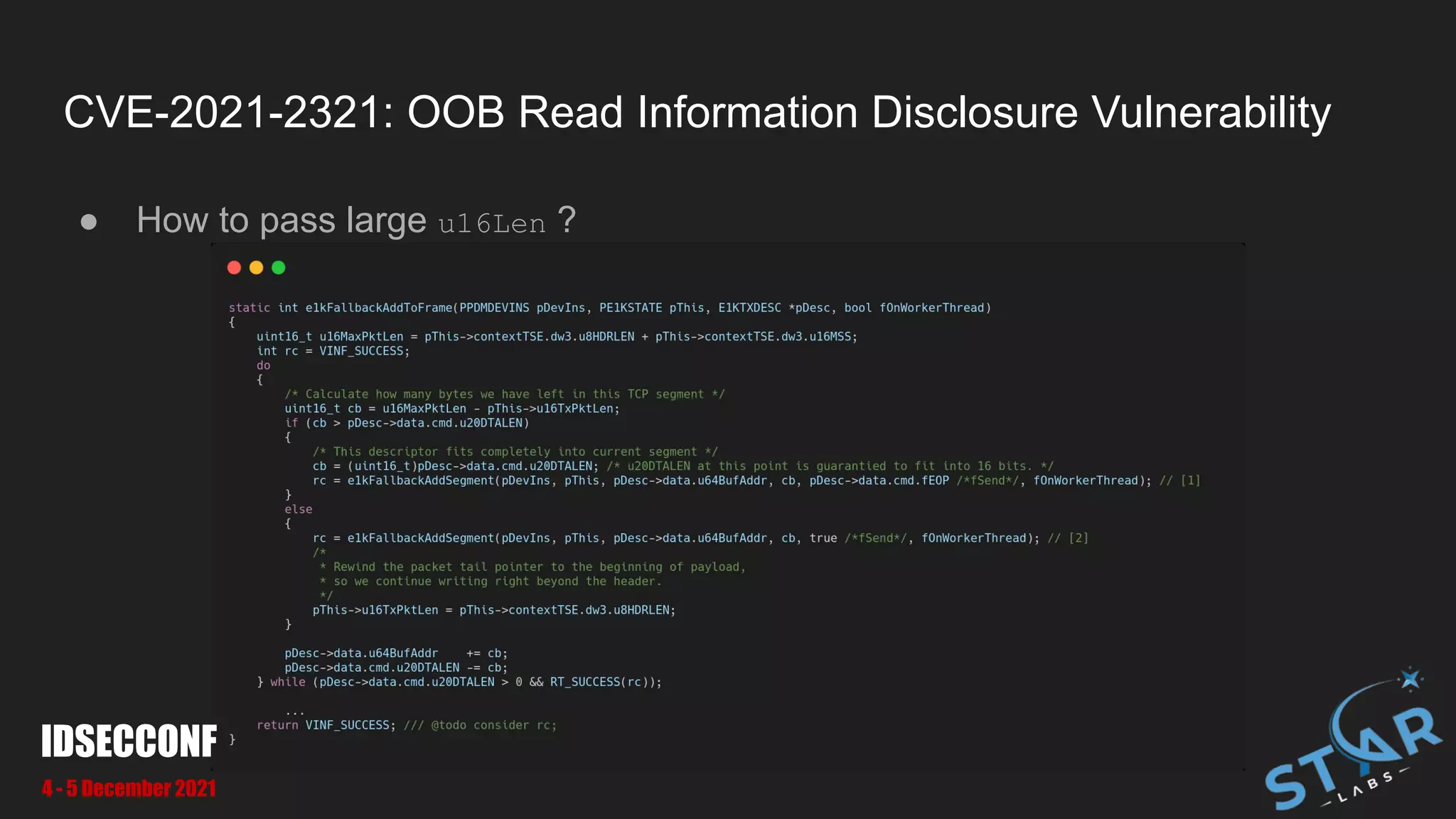
● How to pass large u16Len ?
IDSECCONF
4 - 5 December 2021
CVE-2021-2321: OOB Read Information Disclosure Vulnerability
● How to pass large u16Len ? We need pass cb
more than 0x3fa0
to get OOB
IDSECCONF
4 - 5 December 2021
CVE-2021-2321: OOB Read Information Disclosure Vulnerability
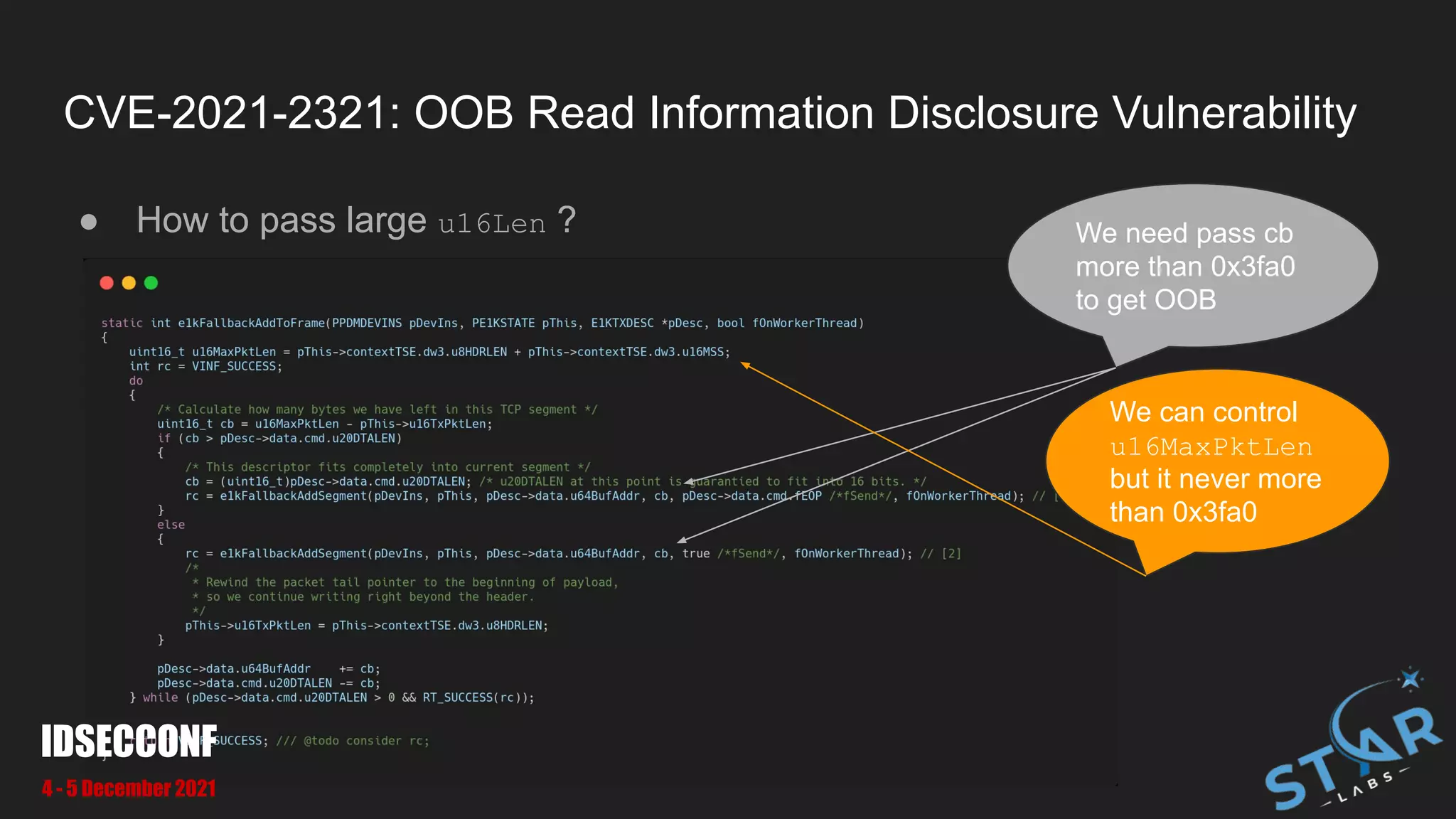
● How to pass large u16Len ? We need pass cb
more than 0x3fa0
to get OOB
● How to pass large u16Len ?
We can control
u16MaxPktLen
but it never more
than 0x3fa0
IDSECCONF
4 - 5 December 2021
CVE-2021-2321: OOB Read Information Disclosure Vulnerability
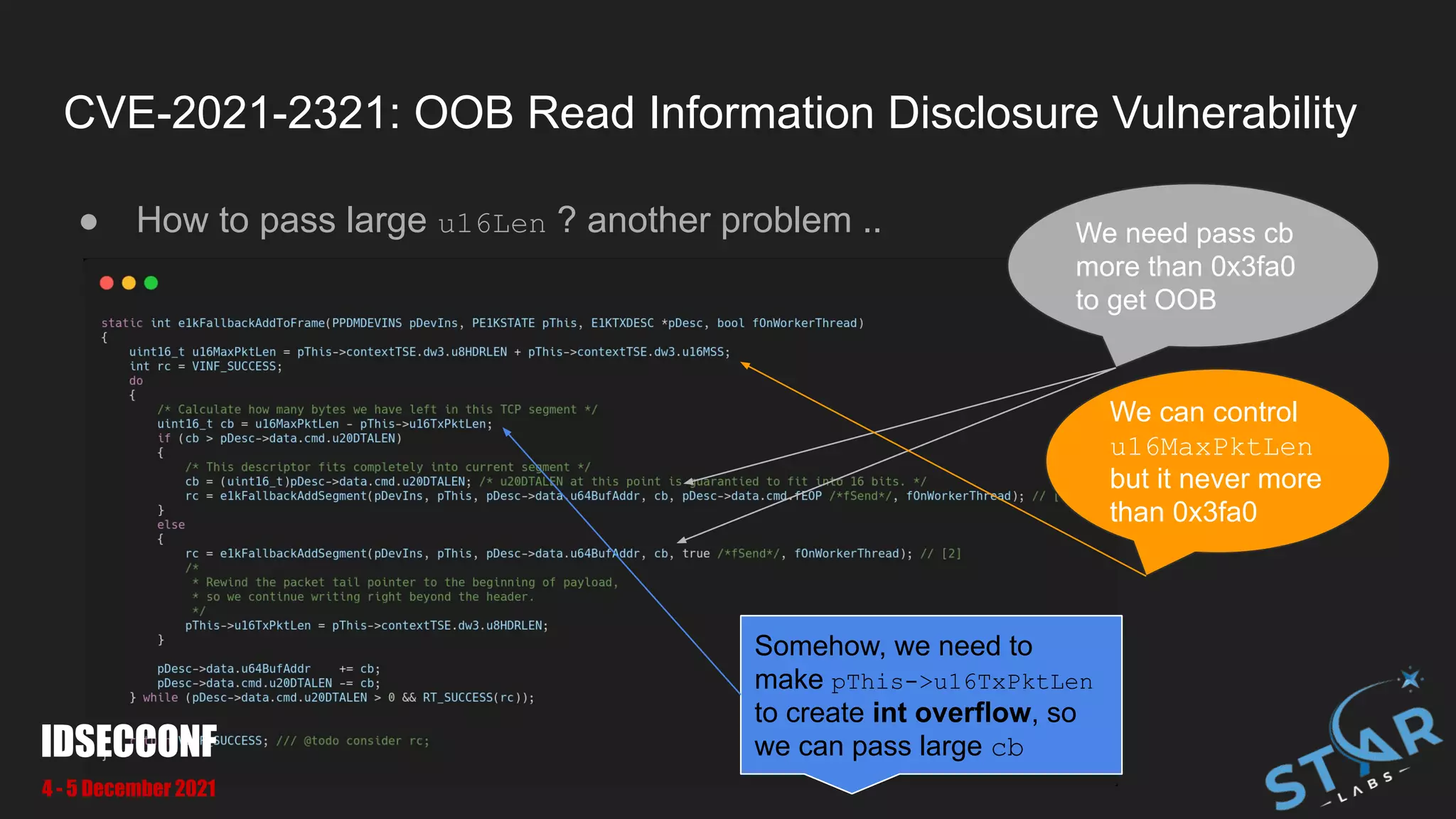
● How to pass large u16Len ? another problem .. We need pass cb
more than 0x3fa0
to get OOB
We can control
u16MaxPktLen
but it never more
than 0x3fa0
Somehow, we need to
make pThis->u16TxPktLen
to create int overflow, so
we can pass large cb
IDSECCONF
4 - 5 December 2021
CVE-2021-2321: OOB Read Information Disclosure Vulnerability
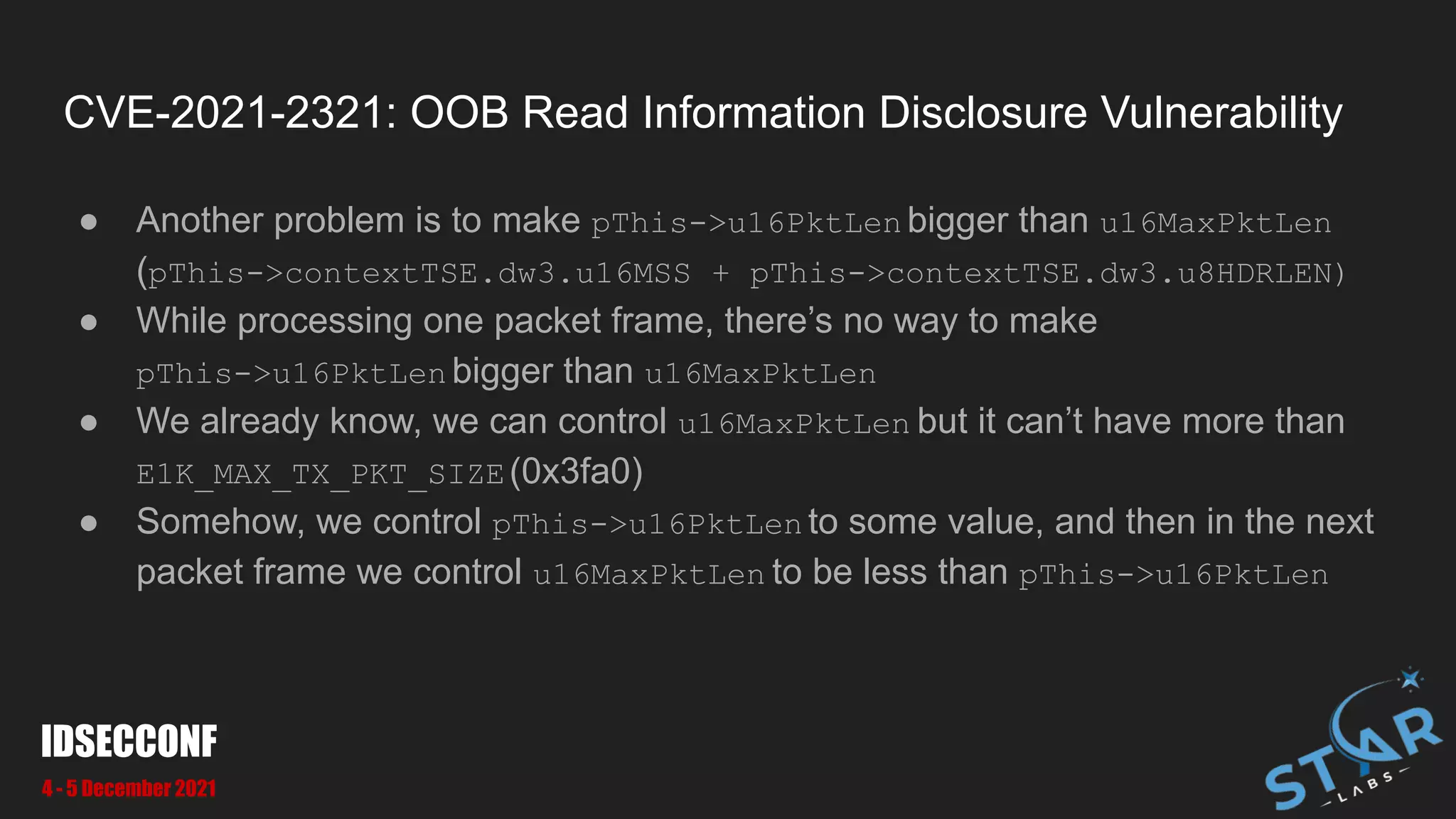
● Another problem is to make pThis->u16PktLen bigger than u16MaxPktLen
(pThis->contextTSE.dw3.u16MSS + pThis->contextTSE.dw3.u8HDRLEN)
● While processing one packet frame, there’s no way to make
pThis->u16PktLen bigger than u16MaxPktLen
● We already know, we can control u16MaxPktLen but it can’t have more than
E1K_MAX_TX_PKT_SIZE(0x3fa0)
● Somehow, we control pThis->u16PktLen to some value, and then in the next
packet frame we control u16MaxPktLen to be less than pThis->u16PktLen
IDSECCONF
4 - 5 December 2021
CVE-2021-2321: OOB Read Information Disclosure Vulnerability
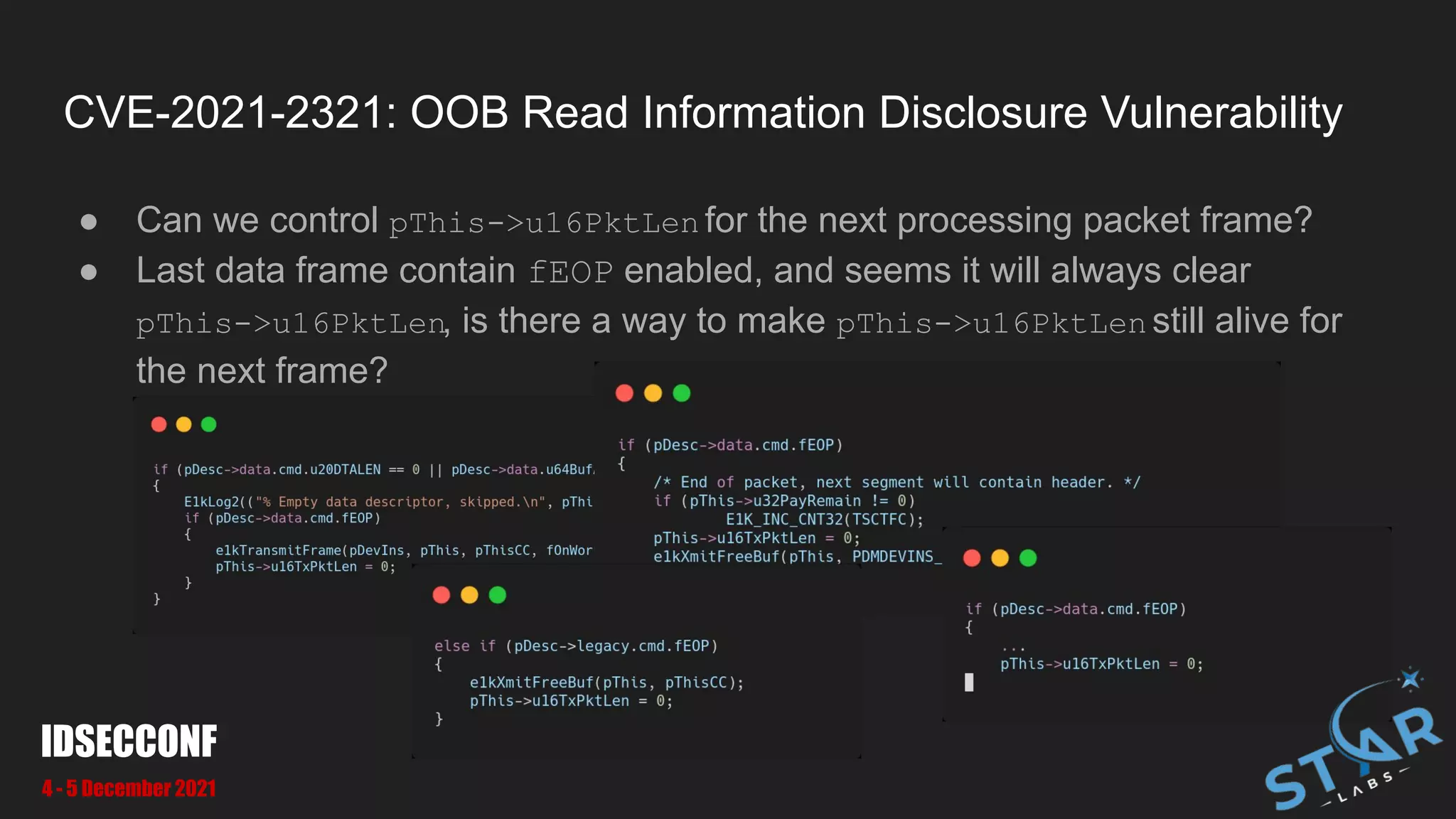
● Can we control pThis->u16PktLen for the next processing packet frame?
● Last data frame contain fEOP enabled, and seems it will always clear
pThis->u16PktLen, is there a way to make pThis->u16PktLen still alive for
the next frame?
IDSECCONF
4 - 5 December 2021
CVE-2021-2321: OOB Read Information Disclosure Vulnerability
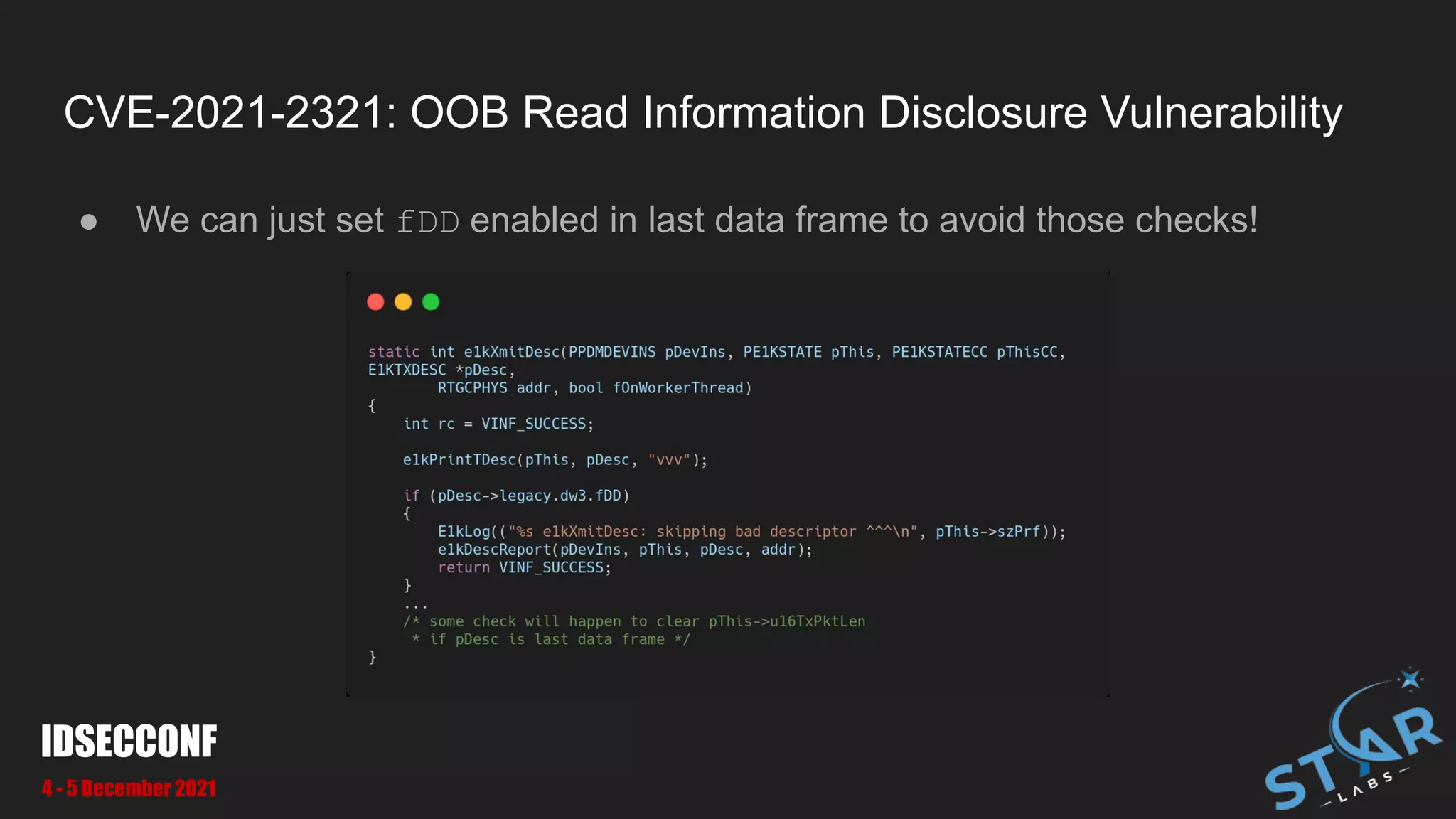
● We can just set fDD enabled in last data frame to avoid those checks!
IDSECCONF
4 - 5 December 2021
CVE-2021-2321: OOB Read Information Disclosure Vulnerability
Recap
● Logic error in mishandling fDD flag that allowed us to make int overflow at
e1kFallbackAddToFrame
● Using int overflow, we can pass large value to e1kFallbackAddSegment
● Because of some missing check handling in e1kFallbackAddSegment, we
can make pThis->u16PktLen large than its buffer, and it allowed us to
create OOB Read in e1kInsertCheckSum
IDSECCONF
4 - 5 December 2021
CVE-2021-2321: OOB Read Information Disclosure Vulnerability
● We can pass pass large u16Len to make OOB at [1] and [2]
IDSECCONF
4 - 5 December 2021
CVE-2021-2321: OOB Read Information Disclosure Vulnerability
Recap (next)
● e1kInsertCheckSum can calculate checksum from data out of the bound
from its buffer
● Using checksum value information we can leak two bytes behind the buffer at
a time by calculating the difference between two checksums
● We can retrieve VBoxDD base address to bypass ASLR and building payload
for our ROP Gadgets
IDSECCONF
4 - 5 December 2021
CVE-2021-2250: VirtualBox SLIRP Heap-based Overflow
● SLIRP is one of the attack surface enabled by default in virtualbox
● Used for user-mode networking by emulating TCP/IP protocol
● This bug resides in emulating of ICMP protocol when the guest try to send
ICMP request
● This bug only affected windows host only
IDSECCONF
4 - 5 December 2021
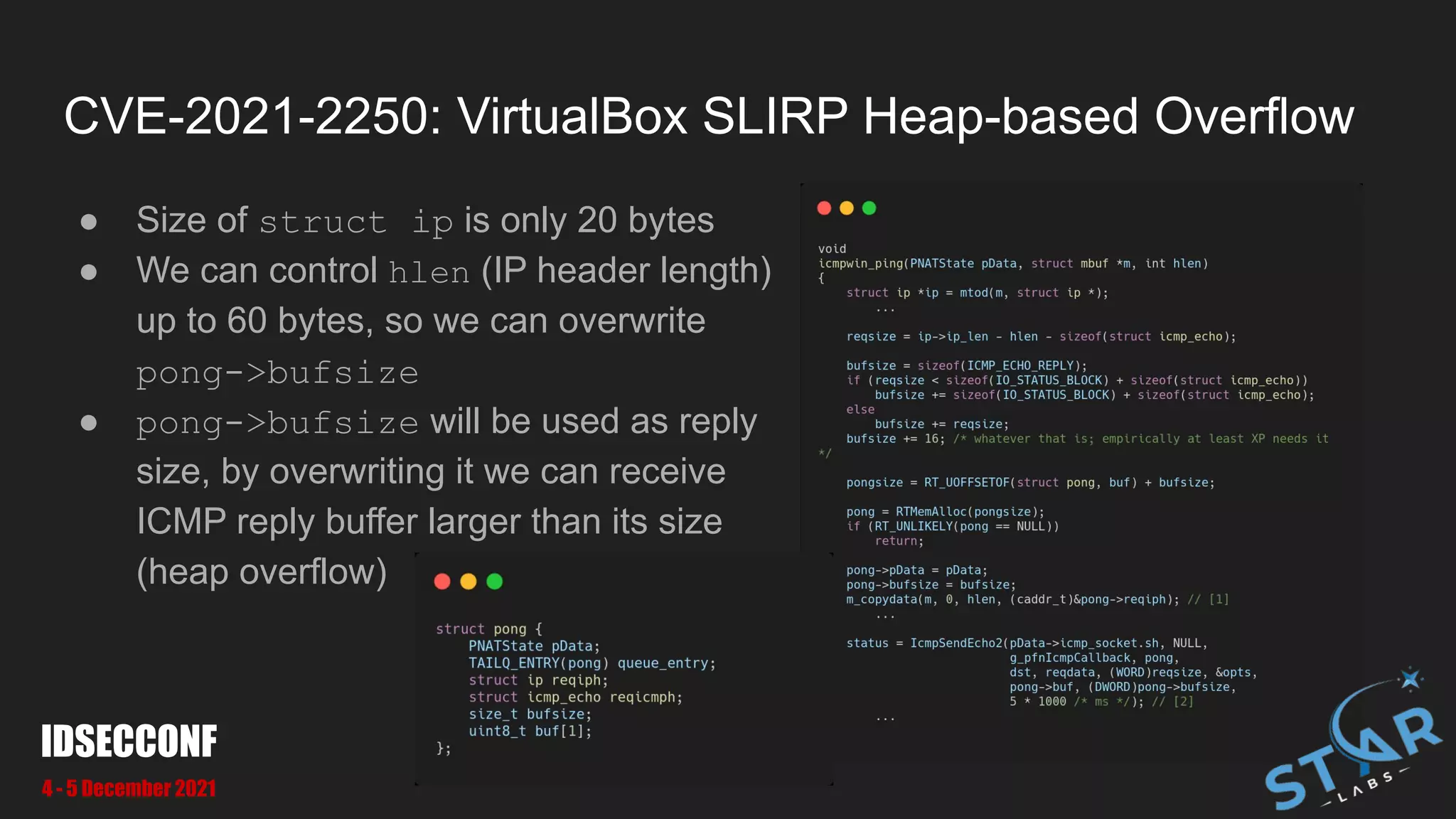
CVE-2021-2250: VirtualBox SLIRP Heap-based Overflow
● Size of struct ip is only 20 bytes
● We can control hlen (IP header length)
up to 60 bytes, so we can overwrite
pong->bufsize
● pong->bufsize will be used as reply
size, by overwriting it we can receive
ICMP reply buffer larger than its size
(heap overflow)
IDSECCONF
4 - 5 December 2021
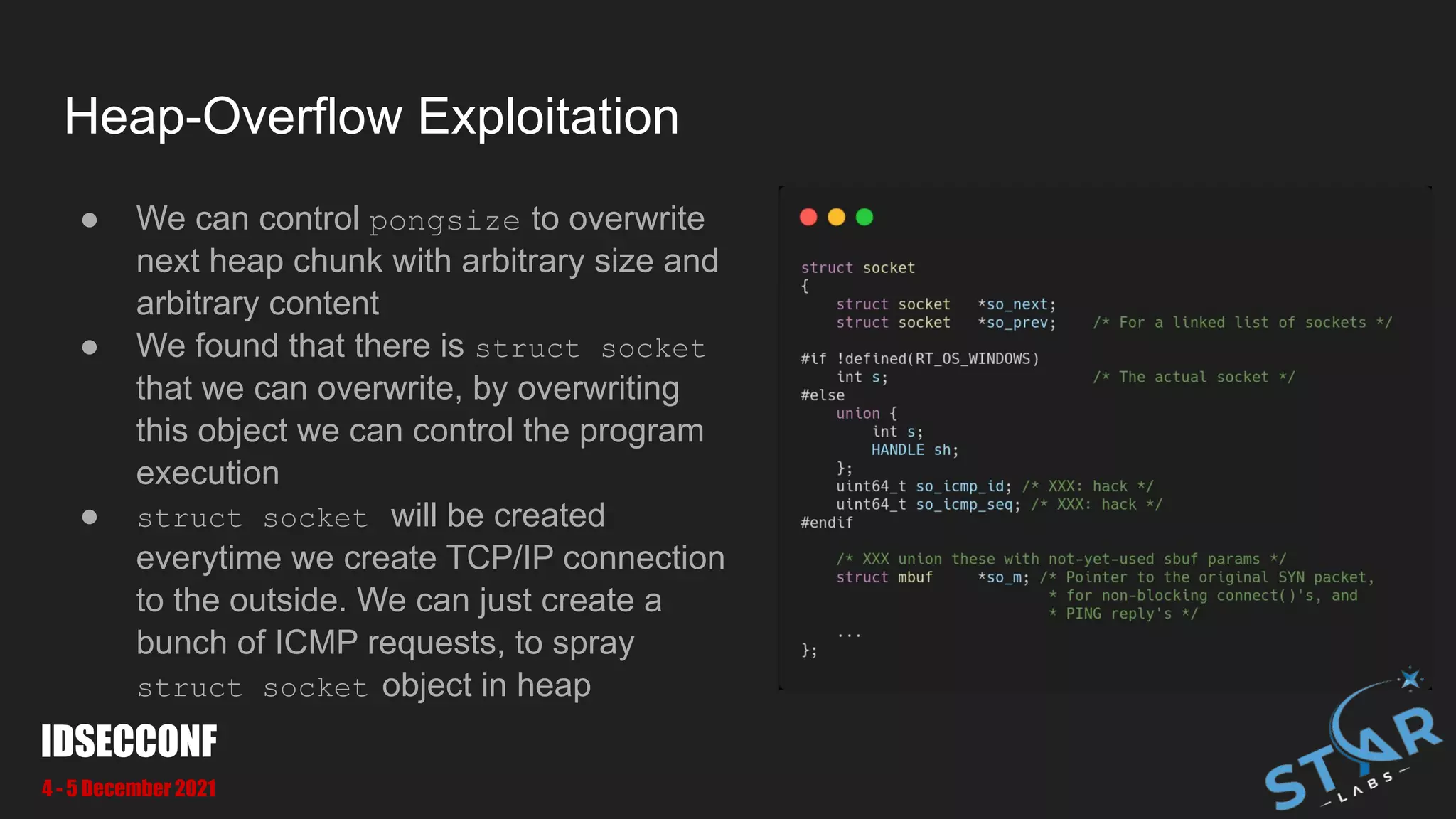
Heap-Overflow Exploitation
● We can control pongsize to overwrite
next heap chunk with arbitrary size and
arbitrary content
● We found that there is struct socket
that we can overwrite, by overwriting
this object we can control the program
execution
● struct socket will be created
everytime we create TCP/IP connection
to the outside. We can just create a
bunch of ICMP requests, to spray
struct socket object in heap
IDSECCONF
4 - 5 December 2021
Heap-Overflow Exploitation
● There is a function which collect
struct socket object for handling
events e.g: there is ICMP reply coming
back
● In [1] it will process ICMP reply and
heap overflow will happened on some
struct object
● In [2] will collecting struct socket
object including the one we overwritten
● An overwritten struct socket will be
processed in [3]
IDSECCONF
4 - 5 December 2021
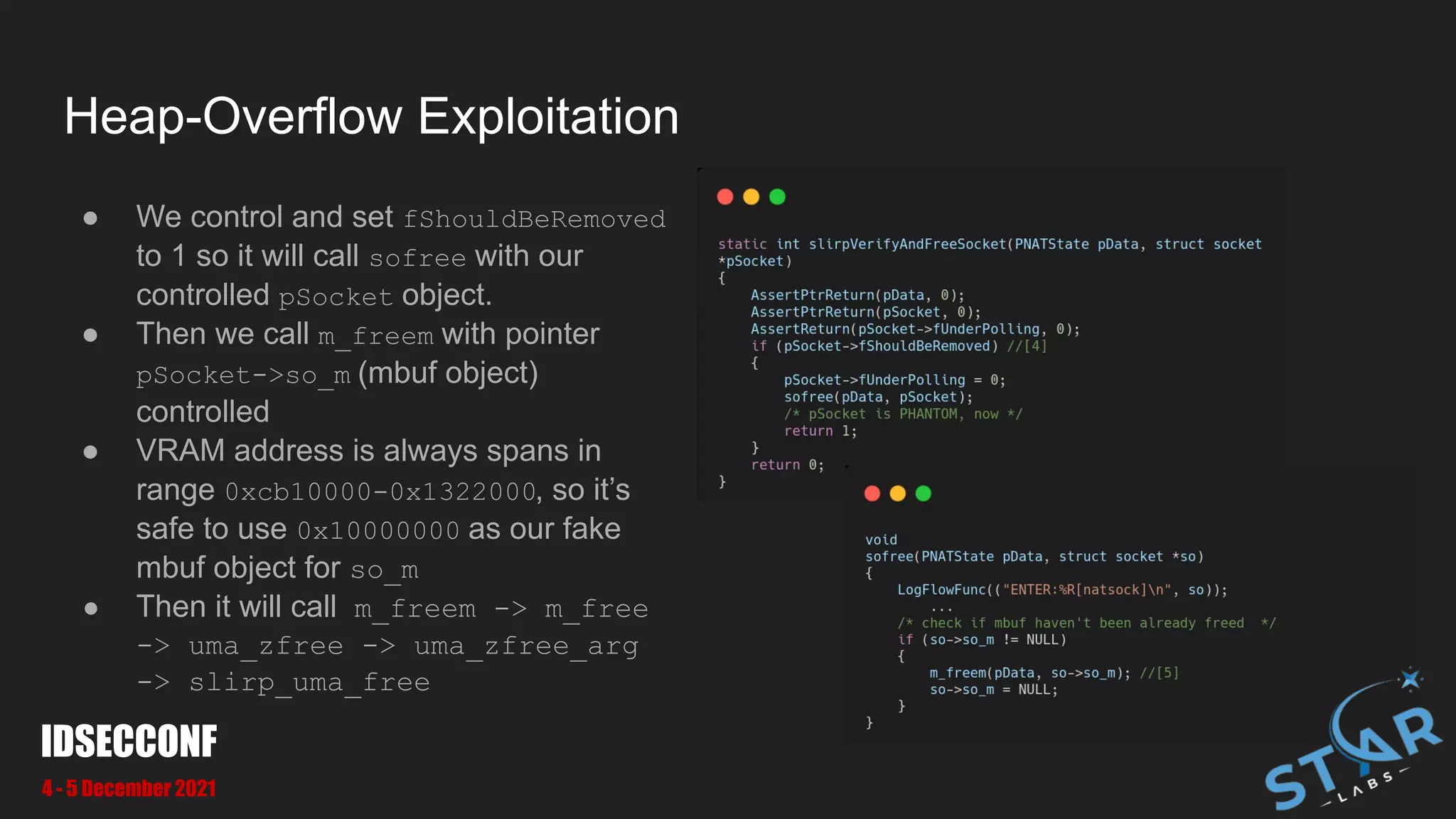
Heap-Overflow Exploitation
● We control and set fShouldBeRemoved
to 1 so it will call sofree with our
controlled pSocket object.
● Then we call m_freem with pointer
pSocket->so_m (mbuf object)
controlled
● VRAM address is always spans in
range 0xcb10000-0x1322000, so it’s
safe to use 0x10000000 as our fake
mbuf object for so_m
● Then it will call m_freem -> m_free
-> uma_zfree -> uma_zfree_arg
-> slirp_uma_free
IDSECCONF
4 - 5 December 2021
Heap-Overflow Exploitation
● We can control item, and redirect
program execution in [6]
● From the VBoxDD address we
retrieve with CVE-2021-2321. We
redirect address to stack pivot
gadget, and execute our
RopChain we already put at
VRAM address
● Then the RopChain will prepare
the shellcode and will execute
calc.exe!
IDSECCONF
4 - 5 December 2021
DEMO
Conclusions
● Most hypervisors still written in C/C++ which very vulnerable to memory
corruption bugs
● Even system nowadays uses many exploit mitigation such as NX, ASLR, but
still can be bypassed with good bug and good exploitation primitive
● Sometimes bug that found by manual code auditing have good quality in
exploitation point of view (and not hanging fruit ones that found by fuzzing)
● With our exploitation, reliability of exploit can reach 85%+, which is good
● Don’t be scared with complex piece of software, sometimes you just need
understand one piece of code/component to fully hacked it
References
● https://phoenhex.re/2018-07-27/better-slow-than-sorry
● https://github.com/0xKira/qemu-vm-escape
● https://starlabs.sg/blog/2020/04/adventures-in-hypervisor-oracle-virtualbox-re
search/
● https://starlabs.sg/blog/2020/06/oracle-virtualbox-vhwa-use-after-free-privileg
e-escalation-vulnerability/
● https://github.com/MorteNoir1/virtualbox_e1000_0day
● https://github.com/hongphipham95/Vulnerabilities/blob/master/VirtualBox/Pwn
2Own%202020/Pwn2Own%202020%20-%20Oracle%20VirtualBox%20Escap
e.md
● https://en.wikipedia.org/wiki/Virtual_machine_escape

Vm escape: case study virtualbox bug hunting and exploitation - Muhammad Alifa Ramdhan

  • 1.
    VirtualBox Bug Hunting CASE VMESCAPE & Exploitation STUDY 鄭炳忠 (Billy) Security Research @st424204 Muhd. Ramdhan Security Research @n0psledbyte HOW TO ESCAPE THE VMs.
  • 2.
    Outline ● What isVM Escape? ● Oracle Virtualbox Overview ● Attack Surface ● CVE-2021-2321: OOB Read Information Disclosure Vulnerability ● CVE-2021-2250: VirtualBox SLIRP Heap-based Overflow ● Demo IDSECCONF 4 - 5 December 2021
  • 3.
    What is VM? IDSECCONF 4- 5 December 2021 ● Just like a normal computer that can run operating systems on it ● But this “computer” is running on the real/physical computer, we called this “computer” is VM or guest system ● Running VMs is emulated or managed by hypervisor that running on the host context
  • 4.
    What is VMEscape? IDSECCONF 4 - 5 December 2021 Goals : Running arbitrary code execution in hypervisor/host context
  • 5.
    VM Escape Bug& Exploit In The Past ● CVE-2015-3456 : VENOM: buffer-overflow in QEMU virtual floppy disk controller ● CVE-2018-6981 : Uninitialized stack memory in VMware vmxnet3 virtual network adapter ● CVE-2019-2722 : Integer underflow in Oracle VirtualBox e1000 virtual network device ● CVE-2019-14378 : Heap pointer miscalculation in SLiRP (default user network backend used by QEMU) ● CVE-2021-29657 : Double fetch/TOCTOU in KVM’s AMD implementation IDSECCONF 4 - 5 December 2021
  • 6.
    Oracle Virtualbox Overview ●One of the popular virtualization software for desktop ● C/C++, Free, Open source ( It’s good for code auditing and find some memory corruption bugs ;) ) ● VirtualBox Extensions shipped as binaries, to support USB 2.0 and 3.0 devices, VirtualBox RDP, etc. ● Virtualbox is using Hardware-assisted Virtualization based on Intel VT-X and AMD-V IDSECCONF 4 - 5 December 2021
  • 7.
    ● For performancereason it don’t switch to R3 directly ● Ring 0 mostly handling VT-X/AMD-V code and some small amount of code that handling I/O interaction from guest ● The bigger amount of code run in Ring 3 ● The code that handling request from some communication channel should be interesting for attacker Oracle Virtualbox Architecture Overview IDSECCONF 4 - 5 December 2021
  • 8.
    Attack Surface ● Emulateddevices is the most interesting attack surface, based on vulnerability in the past ● Virtualbox have a lot of emulated devices, some of them is not enabled by default: ○ Networking : E1000, virtio-net, SLiRP ○ Audio : Intel HDA, AC97 ○ Graphic : VGA Device ○ USB : OHCI, EHCI, xHCI ○ Storage : AHCI ● There are other interesting attack surface through such as HGCM (Host Guest Communication Manager) to interact with specific virtualbox service such as Shared Folder, Shared Clipboard, etc IDSECCONF 4 - 5 December 2021
  • 9.
    Bug Hunting ● Attacksurface in network emulated devices always used in Pwn2Own 2019, 2020 ● So we choose network devices first for hunting VM escape bug ● We found two bugs by code auditing that can be used for VM escape ○ CVE-2021-2321: Oracle VirtualBox e1000 Out-Of-Bounds Read Information Disclosure Vulnerability ○ CVE-2021-2250: Oracle VirtualBox SLiRP Networking Heap-based Overflow Privilege Escalation Vulnerability IDSECCONF 4 - 5 December 2021
  • 10.
    CVE-2021-2321: OOB ReadInformation Disclosure Vulnerability ● Bug resides in code that handling e1000 frame ● Found by code auditing ● Inspired by CVE-2020-2894: e1000 Out-Of-Bounds Read Vulnerability (Shout out to Pham Hong Phi!) ● Have some (quite) complex logic bug, that can be turned into Out-Of-Bounds Read Vulnerability IDSECCONF 4 - 5 December 2021
  • 11.
    CVE-2020-2894: e1000 Out-Of-BoundsRead Vulnerability ● No check against the maximum value of cse. So we can calculate checksum from OOB data. ● We can leak data after pPkt by calculating the difference between two checksums.
  • 12.
    CVE-2021-2321: OOB ReadInformation Disclosure Vulnerability E1000 Basic TDLEN TD Head TD Tail TDBAL TDBAH Context Frame x Data Frame x Data Frame x Context Frame y Data Frame y ● One packet can contain one context frame followed by multiple data frames ● Last data frame in packet have End Of Packet flag
  • 13.
    CVE-2021-2321: OOB ReadInformation Disclosure Vulnerability ● e1kXmitPacket will processing one packet frame IDSECCONF 4 - 5 December 2021
  • 14.
    CVE-2021-2321: OOB ReadInformation Disclosure Vulnerability ● Useless logic error? no e1kXmitPacket -> e1kXmitDesc -> -> e1kFallbackAddToFrame -> e1kFallbackAddSegment IDSECCONF 4 - 5 December 2021
  • 15.
    CVE-2021-2321: OOB ReadInformation Disclosure Vulnerability ● We don’t have buffer overflow ● But, we have OOB at e1kInsertChecksum ● How to pass large u16Len ? IDSECCONF 4 - 5 December 2021
  • 16.
    CVE-2021-2321: OOB ReadInformation Disclosure Vulnerability ● How to pass large u16Len ? IDSECCONF 4 - 5 December 2021
  • 17.
    CVE-2021-2321: OOB ReadInformation Disclosure Vulnerability ● How to pass large u16Len ? We need pass cb more than 0x3fa0 to get OOB IDSECCONF 4 - 5 December 2021
  • 18.
    CVE-2021-2321: OOB ReadInformation Disclosure Vulnerability ● How to pass large u16Len ? We need pass cb more than 0x3fa0 to get OOB ● How to pass large u16Len ? We can control u16MaxPktLen but it never more than 0x3fa0 IDSECCONF 4 - 5 December 2021
  • 19.
    CVE-2021-2321: OOB ReadInformation Disclosure Vulnerability ● How to pass large u16Len ? another problem .. We need pass cb more than 0x3fa0 to get OOB We can control u16MaxPktLen but it never more than 0x3fa0 Somehow, we need to make pThis->u16TxPktLen to create int overflow, so we can pass large cb IDSECCONF 4 - 5 December 2021
  • 20.
    CVE-2021-2321: OOB ReadInformation Disclosure Vulnerability ● Another problem is to make pThis->u16PktLen bigger than u16MaxPktLen (pThis->contextTSE.dw3.u16MSS + pThis->contextTSE.dw3.u8HDRLEN) ● While processing one packet frame, there’s no way to make pThis->u16PktLen bigger than u16MaxPktLen ● We already know, we can control u16MaxPktLen but it can’t have more than E1K_MAX_TX_PKT_SIZE(0x3fa0) ● Somehow, we control pThis->u16PktLen to some value, and then in the next packet frame we control u16MaxPktLen to be less than pThis->u16PktLen IDSECCONF 4 - 5 December 2021
  • 21.
    CVE-2021-2321: OOB ReadInformation Disclosure Vulnerability ● Can we control pThis->u16PktLen for the next processing packet frame? ● Last data frame contain fEOP enabled, and seems it will always clear pThis->u16PktLen, is there a way to make pThis->u16PktLen still alive for the next frame? IDSECCONF 4 - 5 December 2021
  • 22.
    CVE-2021-2321: OOB ReadInformation Disclosure Vulnerability ● We can just set fDD enabled in last data frame to avoid those checks! IDSECCONF 4 - 5 December 2021
  • 23.
    CVE-2021-2321: OOB ReadInformation Disclosure Vulnerability Recap ● Logic error in mishandling fDD flag that allowed us to make int overflow at e1kFallbackAddToFrame ● Using int overflow, we can pass large value to e1kFallbackAddSegment ● Because of some missing check handling in e1kFallbackAddSegment, we can make pThis->u16PktLen large than its buffer, and it allowed us to create OOB Read in e1kInsertCheckSum IDSECCONF 4 - 5 December 2021
  • 24.
    CVE-2021-2321: OOB ReadInformation Disclosure Vulnerability ● We can pass pass large u16Len to make OOB at [1] and [2] IDSECCONF 4 - 5 December 2021
  • 25.
    CVE-2021-2321: OOB ReadInformation Disclosure Vulnerability Recap (next) ● e1kInsertCheckSum can calculate checksum from data out of the bound from its buffer ● Using checksum value information we can leak two bytes behind the buffer at a time by calculating the difference between two checksums ● We can retrieve VBoxDD base address to bypass ASLR and building payload for our ROP Gadgets IDSECCONF 4 - 5 December 2021
  • 26.
    CVE-2021-2250: VirtualBox SLIRPHeap-based Overflow ● SLIRP is one of the attack surface enabled by default in virtualbox ● Used for user-mode networking by emulating TCP/IP protocol ● This bug resides in emulating of ICMP protocol when the guest try to send ICMP request ● This bug only affected windows host only IDSECCONF 4 - 5 December 2021
  • 27.
    CVE-2021-2250: VirtualBox SLIRPHeap-based Overflow ● Size of struct ip is only 20 bytes ● We can control hlen (IP header length) up to 60 bytes, so we can overwrite pong->bufsize ● pong->bufsize will be used as reply size, by overwriting it we can receive ICMP reply buffer larger than its size (heap overflow) IDSECCONF 4 - 5 December 2021
  • 28.
    Heap-Overflow Exploitation ● Wecan control pongsize to overwrite next heap chunk with arbitrary size and arbitrary content ● We found that there is struct socket that we can overwrite, by overwriting this object we can control the program execution ● struct socket will be created everytime we create TCP/IP connection to the outside. We can just create a bunch of ICMP requests, to spray struct socket object in heap IDSECCONF 4 - 5 December 2021
  • 29.
    Heap-Overflow Exploitation ● Thereis a function which collect struct socket object for handling events e.g: there is ICMP reply coming back ● In [1] it will process ICMP reply and heap overflow will happened on some struct object ● In [2] will collecting struct socket object including the one we overwritten ● An overwritten struct socket will be processed in [3] IDSECCONF 4 - 5 December 2021
  • 30.
    Heap-Overflow Exploitation ● Wecontrol and set fShouldBeRemoved to 1 so it will call sofree with our controlled pSocket object. ● Then we call m_freem with pointer pSocket->so_m (mbuf object) controlled ● VRAM address is always spans in range 0xcb10000-0x1322000, so it’s safe to use 0x10000000 as our fake mbuf object for so_m ● Then it will call m_freem -> m_free -> uma_zfree -> uma_zfree_arg -> slirp_uma_free IDSECCONF 4 - 5 December 2021
  • 31.
    Heap-Overflow Exploitation ● Wecan control item, and redirect program execution in [6] ● From the VBoxDD address we retrieve with CVE-2021-2321. We redirect address to stack pivot gadget, and execute our RopChain we already put at VRAM address ● Then the RopChain will prepare the shellcode and will execute calc.exe! IDSECCONF 4 - 5 December 2021
  • 32.
  • 33.
    Conclusions ● Most hypervisorsstill written in C/C++ which very vulnerable to memory corruption bugs ● Even system nowadays uses many exploit mitigation such as NX, ASLR, but still can be bypassed with good bug and good exploitation primitive ● Sometimes bug that found by manual code auditing have good quality in exploitation point of view (and not hanging fruit ones that found by fuzzing) ● With our exploitation, reliability of exploit can reach 85%+, which is good ● Don’t be scared with complex piece of software, sometimes you just need understand one piece of code/component to fully hacked it
  • 34.
    References ● https://phoenhex.re/2018-07-27/better-slow-than-sorry ● https://github.com/0xKira/qemu-vm-escape ●https://starlabs.sg/blog/2020/04/adventures-in-hypervisor-oracle-virtualbox-re search/ ● https://starlabs.sg/blog/2020/06/oracle-virtualbox-vhwa-use-after-free-privileg e-escalation-vulnerability/ ● https://github.com/MorteNoir1/virtualbox_e1000_0day ● https://github.com/hongphipham95/Vulnerabilities/blob/master/VirtualBox/Pwn 2Own%202020/Pwn2Own%202020%20-%20Oracle%20VirtualBox%20Escap e.md ● https://en.wikipedia.org/wiki/Virtual_machine_escape