FIN FIELD-EFFECT TRANSISTOR
Student name : Gauri Jadhav
Class: BE I
Batch: B1
Roll No.: 2101
INTRODUCTION
What is a FinFET?
• A FinFET is a type of field-effect transistor (FET) with a three-dimensional
channel. The channel is shaped like a fin, which gives the transistor its name.
• FinFETs can deliver higher performance while consuming less power compared
to planar transistors. This results in faster and more energy-efficient electronic
devices.
• FinFETs are smaller and faster than traditional planar FETs, and they are also
more energy-efficient.
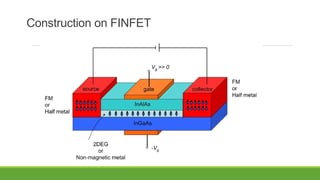
Construction on FINFET
Working of Spin FETs
• FinFETs work by controlling the flow of current through the channel
using a gate electrode.
• The gate electrode is wrapped around the fin, which allows it to
control the current flow from all sides.
• This gives FinFETs better control over the current flow than planar
FETs, which results in improved performance and efficiency.
Advantages-
FinFETs have several advantages over planar FETs, including:
• Smaller size: FinFETs can be made much smaller than planar FETs,
which makes them ideal for use in high-density integrated circuits.
• Faster performance: FinFETs are faster than planar FETs because they
have better control over the current flow.
• Lower power consumption: FinFETs consume less power than planar
FETs because they are more efficient at converting electrical energy to
heat.
Challenges-
• FinFETs are more difficult to manufacture than planar FETs. This is
because the fin channel must be fabricated with very high precision.
• FinFETs are also more expensive to manufacture than planar FETs.
This is because the manufacturing process is more complex.
Applications -
FinFETs are used in a wide range of applications, including:
• Microprocessors
• Memory chips
• Graphics processors
• Mobile devices
• Wearable devices
• Internet of Things (IoT) devices
Future of
FinFETs
• FinFETs are the dominant transistor technology used in today's
integrated circuits.
• FinFET technology is expected to continue to evolve in the coming
years, with new FinFET technologies such as RibbonFET and GAA
FinFET providing further performance and efficiency improvements.
• FinFETs are expected to play a key role in the development of next-
generation electronic devices such as artificial intelligence (AI)
processors and quantum computers.
Conclusio
n
• FinFETs are a type of field-effect transistor with a three-dimensional
channel.
• FinFETs are smaller, faster, and more energy-efficient than
traditional planar FETs.
• FinFET technology is expected to continue to evolve in the coming
years, with new FinFET technologies providing further performance
and efficiency improvements.

VLSI Topic presentation based on FIN FIELD EFFECT TRANSISTOR

  • 1.
    FIN FIELD-EFFECT TRANSISTOR Studentname : Gauri Jadhav Class: BE I Batch: B1 Roll No.: 2101
  • 2.
    INTRODUCTION What is aFinFET? • A FinFET is a type of field-effect transistor (FET) with a three-dimensional channel. The channel is shaped like a fin, which gives the transistor its name. • FinFETs can deliver higher performance while consuming less power compared to planar transistors. This results in faster and more energy-efficient electronic devices. • FinFETs are smaller and faster than traditional planar FETs, and they are also more energy-efficient.
  • 3.
  • 4.
    Working of SpinFETs • FinFETs work by controlling the flow of current through the channel using a gate electrode. • The gate electrode is wrapped around the fin, which allows it to control the current flow from all sides. • This gives FinFETs better control over the current flow than planar FETs, which results in improved performance and efficiency.
  • 5.
    Advantages- FinFETs have severaladvantages over planar FETs, including: • Smaller size: FinFETs can be made much smaller than planar FETs, which makes them ideal for use in high-density integrated circuits. • Faster performance: FinFETs are faster than planar FETs because they have better control over the current flow. • Lower power consumption: FinFETs consume less power than planar FETs because they are more efficient at converting electrical energy to heat.
  • 6.
    Challenges- • FinFETs aremore difficult to manufacture than planar FETs. This is because the fin channel must be fabricated with very high precision. • FinFETs are also more expensive to manufacture than planar FETs. This is because the manufacturing process is more complex.
  • 7.
    Applications - FinFETs areused in a wide range of applications, including: • Microprocessors • Memory chips • Graphics processors • Mobile devices • Wearable devices • Internet of Things (IoT) devices
  • 8.
    Future of FinFETs • FinFETsare the dominant transistor technology used in today's integrated circuits. • FinFET technology is expected to continue to evolve in the coming years, with new FinFET technologies such as RibbonFET and GAA FinFET providing further performance and efficiency improvements. • FinFETs are expected to play a key role in the development of next- generation electronic devices such as artificial intelligence (AI) processors and quantum computers.
  • 9.
    Conclusio n • FinFETs area type of field-effect transistor with a three-dimensional channel. • FinFETs are smaller, faster, and more energy-efficient than traditional planar FETs. • FinFET technology is expected to continue to evolve in the coming years, with new FinFET technologies providing further performance and efficiency improvements.