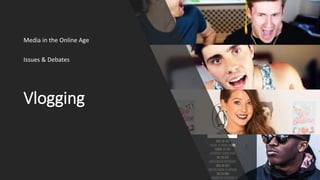
Vlogging
Media in the Online Age
Issues & Debates
Bring in some
theory
• David Gauntlett argued the idea
that the media landscape has
drastically changed to the point
where media is now created by
audiences as well as institutions as so
is more diverse to the audience. Not
only this but audiences can now
communicate in a virtual community.
Relate to vlogging
• This can be seen in vlogging as
now consumers who originally did
not and could not contribute to the
media, have the ability to not only be
involved in the media community
which influences content, but they
can also produce their own media
content to a high professional level.
Examples
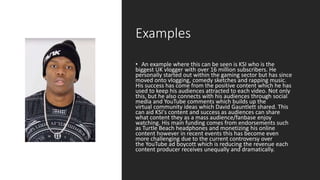
• An example where this can be seen is KSI who is the
biggest UK vlogger with over 16 million subscribers. He
personally started out within the gaming sector but has since
moved onto vlogging, comedy sketches and rapping music.
His success has come from the positive content which he has
used to keep his audiences attracted to each video. Not only
this, but he also connects with his audiences through social
media and YouTube comments which builds up the
virtual community ideas which David Gauntlett shared. This
can aid KSI's content and success as audiences can share
what content they as a mass audience/fanbase enjoy
watching. His main funding comes from endorsements such
as Turtle Beach headphones and monetizing his online
content however in recent events this has become even
more challenging due to the current controversy over
the YouTube ad boycott which is reducing the revenue each
content producer receives unequally and dramatically.
Conclude – how
convincing is the
theory? Does anything
about vlogging
challenge the theory?
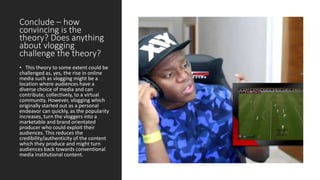
• This theory to some extent could be
challenged as, yes, the rise in online
media such as vlogging might be a
location where audiences have a
diverse choice of media and can
contribute, collectively, to a virtual
community. However, vlogging which
originally started out as a personal
endeavor can quickly, as the popularity
increases, turn the vloggers into a
marketable and brand orientated
producer who could exploit their
audiences. This reduces the
credibility/authenticity of the content
which they produce and might turn
audiences back towards conventional
media institutional content.
Bring in some
theory
• Another theorist is Andrew Keen
who argued that the rise in User
Generated content has had a
negative impact as it creates a
cultural problem where professional
content creators are undermined in
their own media
landscape. Additionally, the internet
is compounding inequality , which
creates a tiny technological elite who
hollows out the middle class.
Relate to vlogging
• Within Vlogging this can be seen
to some extent as anyone can post
their opinions online in a video
form which in most cases are a
dramatically lower quality that
traditional content. Not only this but
the rise in online producers has
attracted current media institutions
who all want a slice of the action.
Examples
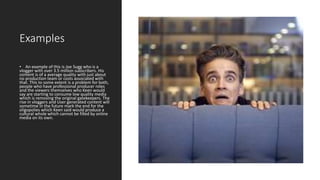
• An example of this is Joe Sugg who is a
vlogger with over 3.5 million subscribers. His
content is of a average quality with just about
no production team or costs associated with
that. This to some extent is a problem for both,
people who have professional producer roles
and the viewers themselves who Keen would
say are starting to consume low quality media
which is removing the original gatekeepers. The
rise in vloggers and User generated content will
sometime in the future mark the end for the
oligopolies which Keen said would produce a
cultural whole which cannot be filled by online
media on its own.
Conclude – how convincing is
the theory? Does anything
about vlogging challenge the
theory?
I would say to some extent it could be
challenged as now media institutions are
taking back control of the individual
prosumers. An example of this is the
discovery network which is currently a large
TV media institution. However with the rise
in vloggers and User generated content they
are increasingly trying to control additional
content produced on these alternate
platforms. They did this by recently have
investing 100 million dollars into Group Nine
Studios. This company have reaches into
social media and YouTube through producers
such as Now This and Dodo who contribute
to a total network reach of 3.5 billion global
monthly video views. In summary I would say
that Web 2.0 has

Vlogging presentation

  • 1.
    Vlogging Media in theOnline Age Issues & Debates
  • 2.
    Bring in some theory •David Gauntlett argued the idea that the media landscape has drastically changed to the point where media is now created by audiences as well as institutions as so is more diverse to the audience. Not only this but audiences can now communicate in a virtual community.
  • 3.
    Relate to vlogging •This can be seen in vlogging as now consumers who originally did not and could not contribute to the media, have the ability to not only be involved in the media community which influences content, but they can also produce their own media content to a high professional level.
  • 4.
    Examples • An examplewhere this can be seen is KSI who is the biggest UK vlogger with over 16 million subscribers. He personally started out within the gaming sector but has since moved onto vlogging, comedy sketches and rapping music. His success has come from the positive content which he has used to keep his audiences attracted to each video. Not only this, but he also connects with his audiences through social media and YouTube comments which builds up the virtual community ideas which David Gauntlett shared. This can aid KSI's content and success as audiences can share what content they as a mass audience/fanbase enjoy watching. His main funding comes from endorsements such as Turtle Beach headphones and monetizing his online content however in recent events this has become even more challenging due to the current controversy over the YouTube ad boycott which is reducing the revenue each content producer receives unequally and dramatically.
  • 5.
    Conclude – how convincingis the theory? Does anything about vlogging challenge the theory? • This theory to some extent could be challenged as, yes, the rise in online media such as vlogging might be a location where audiences have a diverse choice of media and can contribute, collectively, to a virtual community. However, vlogging which originally started out as a personal endeavor can quickly, as the popularity increases, turn the vloggers into a marketable and brand orientated producer who could exploit their audiences. This reduces the credibility/authenticity of the content which they produce and might turn audiences back towards conventional media institutional content.
  • 6.
    Bring in some theory •Another theorist is Andrew Keen who argued that the rise in User Generated content has had a negative impact as it creates a cultural problem where professional content creators are undermined in their own media landscape. Additionally, the internet is compounding inequality , which creates a tiny technological elite who hollows out the middle class.
  • 7.
    Relate to vlogging •Within Vlogging this can be seen to some extent as anyone can post their opinions online in a video form which in most cases are a dramatically lower quality that traditional content. Not only this but the rise in online producers has attracted current media institutions who all want a slice of the action.
  • 8.
    Examples • An exampleof this is Joe Sugg who is a vlogger with over 3.5 million subscribers. His content is of a average quality with just about no production team or costs associated with that. This to some extent is a problem for both, people who have professional producer roles and the viewers themselves who Keen would say are starting to consume low quality media which is removing the original gatekeepers. The rise in vloggers and User generated content will sometime in the future mark the end for the oligopolies which Keen said would produce a cultural whole which cannot be filled by online media on its own.
  • 9.
    Conclude – howconvincing is the theory? Does anything about vlogging challenge the theory? I would say to some extent it could be challenged as now media institutions are taking back control of the individual prosumers. An example of this is the discovery network which is currently a large TV media institution. However with the rise in vloggers and User generated content they are increasingly trying to control additional content produced on these alternate platforms. They did this by recently have investing 100 million dollars into Group Nine Studios. This company have reaches into social media and YouTube through producers such as Now This and Dodo who contribute to a total network reach of 3.5 billion global monthly video views. In summary I would say that Web 2.0 has