HEENA SHARMA
Vitamin Deficiency And
Periodontal Disease – A Tie- in
Relationship
Introduction
 Periodontitis is caused by an increase in the virulence
factors of the infecting organisms and the decreased
resistance of the host.
 Deficiency of vitamins may affect any of the basic
periodontal defence factors such as the integrity of the
dentogingival barrier and the turnover of its constituent
cells.
 Therefore, nutritional imbalance throughout the life
cycle can impair tissue regeneration and healing, and
can increase susceptibility to oral infections.
 Nutrients can be subdivided into two broad categories,
1. Macronutrients (fats, carbohydrates and proteins)
which are required in large quantities from the diet.
2. Micronutrients (minerals, vitamins, trace elements,
and amino-acids) which are only required in small
quantities.
 The majority of opinions and research findings on the
effects of nutrition on oral and periodontal tissues point
to the following:
1. There are nutritional deficiencies that produce
changes in the oral cavity. Which include alterations of
the lips, oral mucosa, and bone, as well as the
periodontal tissues.
2. There are no nutritional deficiencies that by
themselves cause gingivitis or periodontal pockets.
However, nutritional deficiencies can affect the
condition of the periodontium and thereby aggravate
the injurious effects of local factors.
ROLE OF VITAMINS IN DISEASE
FAT-SOLUBLE VITAMIN DEFICIENCY
Vitamin A Deficiency
 Deficiency of vitamin A results in dermatologic,
mucosal, and ocular manifestations.
 In the absence of vitamin A, degenerative changes
occur in epithelial tissues, resulting in keratinizing
metaplasia.
 In experimental animals, vitamin A deficiency results in
hyperkeratosis and hyperplasia of the gingiva with a
tendency for increased periodontal pocket formation and
retardation of gingival wound healing.
Vitamin D deficiency
 Vitamin D, or calciferol, is essential for the absorption of
calcium from the gastrointestinal tract and the
maintenance of the calcium phosphorus balance.
 Deficiency in vitamin D and/or imbalance in calcium-
phosphorus intake results in rickets in the children and
osteomalacia in adults.
 Clinical manifestations of rickets include irritability, growth
retardation, prominence of costochondral junctions ,
bowing of long bones, developmental anomalies of
dentin and enamel, delayed eruption, high caries rate,
abnormally wide predentin zone, interglobular dentin.
 Osteomalacia frequently results in diffuse skeletal pain
and fracture with relatively mild injury.
 Vitamin D3 has been shown to have an important
function as anticancer, immune modulatory and innate
immunity effects through Vitamin D receptor activation.
 mmunomodulatory actions may include Potent
stimulator of innate immune system acting through Toll-
like receptors on monocytes and
macrophages
 Decreased threshold for long-latency diseases such as
cancers, psoriasis, diabetes mellitus, and autoimmune
diseases
Stages of vitamin D deficiency
Stage I
 25-OH-D level decreases, resulting in hypocalcaemia
and euphosphatemia.
Stage II
 25-OH-D level continues to decrease; PTH acts to
maintain calcium through demineralization of bone; the
patient remains eucalcemic and hypophosphatemic and
has a slight increase in the skeletal alkaline
phosphatase level.
Stage III
 Severe 25-OH-D deficiency with hypocalcaemia,
hypophosphatemia, and increased alkaline
phosphatase; bones have overt signs of
demineralization.
Boggess et al.; in 2011 examined the
relationship between maternal vitamin D status and
periodontal disease and concluded that Vitamin D
insufficiency (serum 25[OH] D <75 nmol/l) is associated
with maternal periodontal disease during pregnancy.
Hence, Vitamin D supplementation represents a potential
therapeutic strategy to improve maternal oral health.
Jessica et al.; in 2013 examined the
relationship between vitamin 25(OH) D and chronic
periodontitis in patients with chronic kidney disease and
not on dialysis and found that in patients with chronic
kidney disease and not on dialysis, vitamin D deficiency
was associated with CP.
Assad et al.; in 2014 evaluated the level of
 25-Hydroxy vitamin D3 and osteocalcin in GCF and serum
before and after scaling and root planing in chronic
periodontitis patients. The results showed improvement in
all clinical periodontal parameters (GI, PI, BOP, PD and
CAL) after SRP in chronic periodontitis patients.
 A significant reduction in GCF osteocalcin level in the
study group after SRP was also seen.
 There was a statistically significant increase in the mean
GCF 25-Hydroxy vitamin D3 after performing SRP in the
study group.
 Hence, concluded that SRP was effective in improving
clinical parameters in patients with chronic periodontitis.
25-hydroxy vitamin D3 could be used as adjunctive
therapeutic modality for the prevention and treatment of
different types of periodontitis. Osteocalcin could be used
as a potential diagnostic marker for periodontal disease
activity in both serum and gingival crevicular fluid.
VITAMIN E DEFICIENCY
Vitamin E serves as an antioxidant to limit free-radical
reactions and to protect cells from lipid peroxidation.
• Cell membranes, which are high in polyunsaturated lipids,
are the major site of damage in vitamin E deficiency.
• Deficiency results in increased tendency for haemolysis. It
affects cross linking of collagen .
Neha Singh et al.; in 2014 investigated the
levels of superoxide dismutase (SOD) activity in serum
and saliva of patients with chronic periodontitis (CP). In
addition, the outcome of scaling and root planing (SRP)
with and without vitamin E supplementation is
evaluated in terms of changes in periodontal
parameters and SOD activity in patients with CP and
concluded that systemic and local SOD levels are
lowered in CP. Adjunctive vitamin E supplementation
improves periodontal healing as well as antioxidant
defense.
Vitamin K deficiency
 Vitamin K compounds have been found to be required for
growth of Bacteroides melaninogenicus, an organism
closely associated with periodontal disease.
 It is speculated that a suitable antimetabolite of Vitamin
K might interfere with the growth of this organism, and
consequently, prevent the occurrence of periodontal
disease .
 Deficiency leads to coagulopathy because of inadequate
synthesis of prothrombin and other clotting factors. The
most common oral manifestation is gingival bleeding, with
chances of spontaneous bleeding.
Water soluble vitamins
B-COMPLEX DEFICIENCY
VITAMIN B1 (Thiamine)
 It is also known as “antineurotic factor” due to its
antagonistic pharmacologic action against acetylcholine.
 Deficiency results in a disease called “beri-beri”, a
condition marked by multiple neuritis, edema, and
serous effusion.
Oral manifestations include:
 Hypersensitivity of the teeth and oral mucosa.
 Gingiva may become “dusty-rose” in colour.
 Loss of gingival stippling.
 Aphthous ulcerations
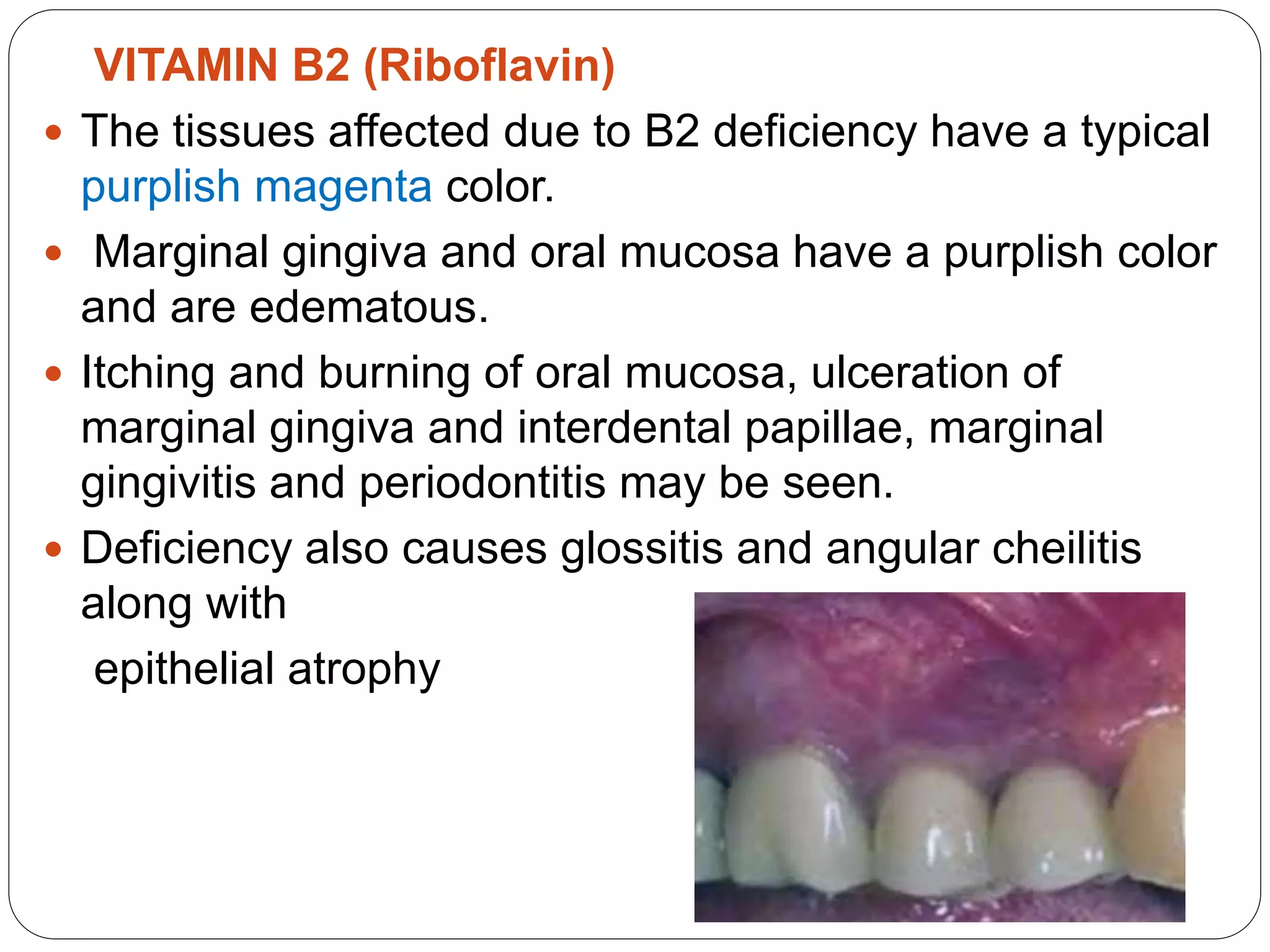
VITAMIN B2 (Riboflavin)
 The tissues affected due to B2 deficiency have a typical
purplish magenta color.
 Marginal gingiva and oral mucosa have a purplish color
and are edematous.
 Itching and burning of oral mucosa, ulceration of
marginal gingiva and interdental papillae, marginal
gingivitis and periodontitis may be seen.
 Deficiency also causes glossitis and angular cheilitis
along with
epithelial atrophy
VITAMIN B3 (Nicotinic Acid)
 Deficiency of niacin or tryptophan results in a condition
known as pellagra.
 Gingivitis, attributable to deficiency of niacin, is
characterized by extremely painful, wedge shaped,
punched out ulcers involving the interdental papillae and
marginal gingiva.
 The lesions in humans are necrotic, exudative, and foul
smelling.
 Epithelial changes particularly in the areas exposed to
sunlight (neck region) result in a characteristic skin rash
called Castle’s necklace.
Castle necklace
VITAMIN B4 (Folic Acid)
 Folic acid deficiency results in macrocytic anemia, with
megalo blastic erythropoiesis, accompanied by oral
changes, gastrointestinal lesions, diarrhea, and intestinal
malabsorption. Marked chronic periodontitis with
loosening of teeth may occur.
 Folic acid deficiency impairs immune responses and
resistance of the oral mucosa to penetration by
pathogenic organisms such as candida.
 Folic acid deficiency in animals demonstrate necrosis of
gingiva, periodontal ligament & Necrosed alveolar bone.
 In a series of human studies, a significant reduction of
gingival inflammation has been reported after systemic
or local use of folic acid, when compared with placebo
Sumona et al.; in 2011 compared the serum folic
acid levels in patients with chronic periodontal disease
in relation to the patient’s smoking habits and concluded
that among patients with periodontal disease the serum
folic acid level is lower in smokers compared with non-
smokers.
VITAMIN B6 (PYRIDOXINE)
 A deficiency of vitamin B6 alone is uncommon because it
usually occurs in association with a deficit in other B
complex vitamins.
 Hypovitaminosis B6 may often occur with riboflavin
deficiency, because riboflavin is needed for the formation
of the coenzyme PLP.
 A decrease in the metabolism of glutamate in the brain,
which is found in vitamin B6 insufficiency, reflects a
nervous system dysfunction.
 vitamin B6 deficiency results in an impairment of the
immune system
VITAMIN B12 (Cobalamin)
 It is the only vitamin that contains a mineral. Vitamin
B12 functions as a coenzyme in conjunction with folate
metabolism in nucleic acid synthesis.
 It also functions in the catabolism of certain amino acids
and fatty acids.
 Vitamin B12 is essential for making red blood cells and
for myelin synthesis.
 An oral examination may reveal stomatitis or a pale or
yellowish mucosa, xerostomia, cheilosis, hemorrhagic
gingiva and bone loss.
 Deficiency symptoms are rapidly corrected with
vitamin B12 injections.
Hasan Hatipoglu et al.; in 2012 showed that severe
periodontal destruction was observed in a patient with
severe iron and B12 deficiency anemia.
VITAMIN C (ASCORBIC ACID) DEFICIENCY
 Severe vitamin C deficiency in humans results in
scurvy, a disease characterized by hemorrhagic
diathesis and retardation of wound healing.
 Clinical manifestations of scurvy include hemorrhagic
lesions into the muscles of the extremities, the joints,
petechial hemorrhages, often around hair follicles;
increased susceptibility to infections; and impaired
wound healing. Bleeding, swollen gingiva and loosened
teeth.
 It results in defective formation and maintenance of
collagen, retardation or cessation of osteoid formation,
and impaired osteoblastic function
 Vitamin C deficiency is also characterized by increased
capillary permeability, susceptibility to traumatic
hemorrhages
POSSIBLE ETIOLOGIC RELATIONSHIPS BETWEEN
ASCORBIC ACID AND PERIODONTAL DISEASE
 It has been suggested that ascorbic acid may play a role
in periodontal disease by one or more of the following
mechanisms:
a) Low levels of ascorbic acid influence the metabolism
of collagen within the periodontium, thereby affecting
the ability of the tissue to regenerate and repair itself.
b) Ascorbic acid deficiency interferes with bone
formation, leading to loss of periodontal bone. as a
result of failure of the osteoblasts to form osteoid , it
occurs in late deficiency stage.
c) Ascorbic acid deficiency increases the permeability of
the oral mucosa to titrated endotoxin and of normal
human crevicular epithelium to titrated dextran.
d) Increasing levels of ascorbic acid enhance both the
chemotactic and migratory action of leukocytes without
influencing their phagocytic activity. Mega doses of
vitamin C seem to impair the bactericidal activity of
leukocytes
e) An optimal level of ascorbic acid is apparently required
to maintain the integrity of the periodontal
microvasculature, as well as the vascular response to
bacterial irritation and wound healing.
f) Depletion of vitamin C may interfere with the ecologic
equilibrium of bacteria in plaque and thus increase its
pathogenicity. However, there is no evidence that
Kuzmanova et al.; in 2012 tested the hypothesis that
vitamin C concentrations in plasma, polymorphonuclear
neutrophilic leucocytes (PMNs) and peripheral blood
mononuclear cells (PBMCs) are lower in periodontitis
patients compared with healthy controls and concluded
that lower plasma vitamin C concentrations are
associated with periodontitis but the disease cannot be
explained by insufficient vitamin C storage capacity of
leucocytes.
Pushparani et al.; in 2013 assessed the serum level
of vitamin C and zinc in type 2 diabetes mellitus with
and without periodontitis, and elucidated whether
increased or decreased serum vitamin C and zinc could
be related to a risk factor for developing oxidative stress
in type 2 diabetes mellitus with periodontitis. It was
concluded that the decreased level of antioxidants,
vitamin C and zinc are associated with an increased risk
for the development of oxidative stress in type 2
diabetes mellitus with periodontitis.
IMPLEMENTING NUTRITION IN PERIODONTAL
PRACTICE
 A practitioner must know how to evaluate the
nutritional status of a patient and perform a
comprehensive nutritional analysis.
 One system, however, does have the distinct
advantage of offering several options or “phases” so
that the clinical nutrition program can be designed to
the needs of the patients. This system is called
triphasic nutritional analysis.
 It consists of three phases:
First phase
 It includes the standard medical/social history, clinical
examination and a qualitative dietary analysis.
 Particularly important in the clinical examination is the
oral bioassay. This assay is the subjective comparison
of the amount of plaque present around the teeth and
the degree of periodontal destruction.
 The oral bioassay should be conducted at three
different stages during periodontal therapy:
a) The primary evaluation should be conducted prior to
any form of therapy , that will provides useful baseline
data in terms of both oral hygiene and the response of
the periodontal tissues to the existing irritants.
 The response of the periodontal tissues should be
evaluated second time after the local irritants have
been removed. Poor tissue reactivity at this stage
suggests that an inadequate healing potential exists
which may compromise the effectiveness of any
anticipated surgical procedures.
 Third assay for tissue response should be done after
the first surgical procedure. As the surgical periodontal
patient has potential nutritional and dietary
requirements the clinician should analyze these
requirements, counsel the patients and modify or
supplement the diet as the needs of the patient.
Second phase of the triphasic nutritional analysis
 Includes a semi quantitative dietary analysis and
routine blood chemistry with differential blood count and
glucose tolerance test. This second level is required
when, based on the first phase, the following conditions
are noted:
(1) The diet appears to be inadequate, but no clinical
signs of malnutrition are present.
(2) The diet appears adequate, but the patient may have
increased needs because of a stress factor.
(3) The clinician desires to correlate specific nutrient
intakes with clinical evidence.
Third phase of analysis
Is reserved for complex metabolic problems is usually
conducted in consultation with a physician.
DIET BEFORE PERIODONTAL
SURGERY
 When prescribing a diet before periodontal surgery, the
goal is to enable the patient to meet the stress of surgery.
 If the periodontal patient is malnourished, a diet high in
protein and enough carbohydrates and fat to provide
about 2,500 K cal should be prescribed for 7-14 days
before surgery.
POSTOPERATIVE DIETARY
MANAGEMENTOFHOSPITALIZED PERIODONTAL
SURGERYPATIENT
 On the first post-operative day, in addition to juice,
sherbets, custards and ice creams may be advised if the
patient is hungry.
 On the second post-operative day, the patient may
supplement the diet with the following :
 Vegetable, fruits : citrus fruits
 Bread cereals
 Milk
 Eggs
 Liquid diet of 2000 calories and proteins 80 gm /day are
recommended
conclusion
 Although periodontal disease is not a nutritional
deficiency disease, malnutrition plays a role in
predisposing the host to the progression of pre existing
periodontal lesions and influences the outcome of
periodontal treatment.
Vitamin deficiency and periodontal disease – a tie

Vitamin deficiency and periodontal disease – a tie

  • 1.
    HEENA SHARMA Vitamin DeficiencyAnd Periodontal Disease – A Tie- in Relationship
  • 2.
    Introduction  Periodontitis iscaused by an increase in the virulence factors of the infecting organisms and the decreased resistance of the host.  Deficiency of vitamins may affect any of the basic periodontal defence factors such as the integrity of the dentogingival barrier and the turnover of its constituent cells.  Therefore, nutritional imbalance throughout the life cycle can impair tissue regeneration and healing, and can increase susceptibility to oral infections.
  • 3.
     Nutrients canbe subdivided into two broad categories, 1. Macronutrients (fats, carbohydrates and proteins) which are required in large quantities from the diet. 2. Micronutrients (minerals, vitamins, trace elements, and amino-acids) which are only required in small quantities.
  • 4.
     The majorityof opinions and research findings on the effects of nutrition on oral and periodontal tissues point to the following: 1. There are nutritional deficiencies that produce changes in the oral cavity. Which include alterations of the lips, oral mucosa, and bone, as well as the periodontal tissues. 2. There are no nutritional deficiencies that by themselves cause gingivitis or periodontal pockets. However, nutritional deficiencies can affect the condition of the periodontium and thereby aggravate the injurious effects of local factors.
  • 5.
    ROLE OF VITAMINSIN DISEASE FAT-SOLUBLE VITAMIN DEFICIENCY Vitamin A Deficiency  Deficiency of vitamin A results in dermatologic, mucosal, and ocular manifestations.  In the absence of vitamin A, degenerative changes occur in epithelial tissues, resulting in keratinizing metaplasia.
  • 6.
     In experimentalanimals, vitamin A deficiency results in hyperkeratosis and hyperplasia of the gingiva with a tendency for increased periodontal pocket formation and retardation of gingival wound healing.
  • 7.
    Vitamin D deficiency Vitamin D, or calciferol, is essential for the absorption of calcium from the gastrointestinal tract and the maintenance of the calcium phosphorus balance.  Deficiency in vitamin D and/or imbalance in calcium- phosphorus intake results in rickets in the children and osteomalacia in adults.
  • 8.
     Clinical manifestationsof rickets include irritability, growth retardation, prominence of costochondral junctions , bowing of long bones, developmental anomalies of dentin and enamel, delayed eruption, high caries rate, abnormally wide predentin zone, interglobular dentin.  Osteomalacia frequently results in diffuse skeletal pain and fracture with relatively mild injury.
  • 9.
     Vitamin D3has been shown to have an important function as anticancer, immune modulatory and innate immunity effects through Vitamin D receptor activation.  mmunomodulatory actions may include Potent stimulator of innate immune system acting through Toll- like receptors on monocytes and macrophages  Decreased threshold for long-latency diseases such as cancers, psoriasis, diabetes mellitus, and autoimmune diseases
  • 10.
    Stages of vitaminD deficiency Stage I  25-OH-D level decreases, resulting in hypocalcaemia and euphosphatemia. Stage II  25-OH-D level continues to decrease; PTH acts to maintain calcium through demineralization of bone; the patient remains eucalcemic and hypophosphatemic and has a slight increase in the skeletal alkaline phosphatase level. Stage III  Severe 25-OH-D deficiency with hypocalcaemia, hypophosphatemia, and increased alkaline phosphatase; bones have overt signs of demineralization.
  • 11.
    Boggess et al.;in 2011 examined the relationship between maternal vitamin D status and periodontal disease and concluded that Vitamin D insufficiency (serum 25[OH] D <75 nmol/l) is associated with maternal periodontal disease during pregnancy. Hence, Vitamin D supplementation represents a potential therapeutic strategy to improve maternal oral health. Jessica et al.; in 2013 examined the relationship between vitamin 25(OH) D and chronic periodontitis in patients with chronic kidney disease and not on dialysis and found that in patients with chronic kidney disease and not on dialysis, vitamin D deficiency was associated with CP.
  • 12.
    Assad et al.;in 2014 evaluated the level of  25-Hydroxy vitamin D3 and osteocalcin in GCF and serum before and after scaling and root planing in chronic periodontitis patients. The results showed improvement in all clinical periodontal parameters (GI, PI, BOP, PD and CAL) after SRP in chronic periodontitis patients.  A significant reduction in GCF osteocalcin level in the study group after SRP was also seen.  There was a statistically significant increase in the mean GCF 25-Hydroxy vitamin D3 after performing SRP in the study group.
  • 13.
     Hence, concludedthat SRP was effective in improving clinical parameters in patients with chronic periodontitis. 25-hydroxy vitamin D3 could be used as adjunctive therapeutic modality for the prevention and treatment of different types of periodontitis. Osteocalcin could be used as a potential diagnostic marker for periodontal disease activity in both serum and gingival crevicular fluid.
  • 14.
    VITAMIN E DEFICIENCY VitaminE serves as an antioxidant to limit free-radical reactions and to protect cells from lipid peroxidation. • Cell membranes, which are high in polyunsaturated lipids, are the major site of damage in vitamin E deficiency. • Deficiency results in increased tendency for haemolysis. It affects cross linking of collagen .
  • 15.
    Neha Singh etal.; in 2014 investigated the levels of superoxide dismutase (SOD) activity in serum and saliva of patients with chronic periodontitis (CP). In addition, the outcome of scaling and root planing (SRP) with and without vitamin E supplementation is evaluated in terms of changes in periodontal parameters and SOD activity in patients with CP and concluded that systemic and local SOD levels are lowered in CP. Adjunctive vitamin E supplementation improves periodontal healing as well as antioxidant defense.
  • 16.
    Vitamin K deficiency Vitamin K compounds have been found to be required for growth of Bacteroides melaninogenicus, an organism closely associated with periodontal disease.  It is speculated that a suitable antimetabolite of Vitamin K might interfere with the growth of this organism, and consequently, prevent the occurrence of periodontal disease .  Deficiency leads to coagulopathy because of inadequate synthesis of prothrombin and other clotting factors. The most common oral manifestation is gingival bleeding, with chances of spontaneous bleeding.
  • 17.
    Water soluble vitamins B-COMPLEXDEFICIENCY VITAMIN B1 (Thiamine)  It is also known as “antineurotic factor” due to its antagonistic pharmacologic action against acetylcholine.  Deficiency results in a disease called “beri-beri”, a condition marked by multiple neuritis, edema, and serous effusion. Oral manifestations include:  Hypersensitivity of the teeth and oral mucosa.  Gingiva may become “dusty-rose” in colour.  Loss of gingival stippling.  Aphthous ulcerations
  • 18.
    VITAMIN B2 (Riboflavin) The tissues affected due to B2 deficiency have a typical purplish magenta color.  Marginal gingiva and oral mucosa have a purplish color and are edematous.  Itching and burning of oral mucosa, ulceration of marginal gingiva and interdental papillae, marginal gingivitis and periodontitis may be seen.  Deficiency also causes glossitis and angular cheilitis along with epithelial atrophy
  • 19.
    VITAMIN B3 (NicotinicAcid)  Deficiency of niacin or tryptophan results in a condition known as pellagra.  Gingivitis, attributable to deficiency of niacin, is characterized by extremely painful, wedge shaped, punched out ulcers involving the interdental papillae and marginal gingiva.  The lesions in humans are necrotic, exudative, and foul smelling.  Epithelial changes particularly in the areas exposed to sunlight (neck region) result in a characteristic skin rash called Castle’s necklace.
  • 20.
  • 21.
    VITAMIN B4 (FolicAcid)  Folic acid deficiency results in macrocytic anemia, with megalo blastic erythropoiesis, accompanied by oral changes, gastrointestinal lesions, diarrhea, and intestinal malabsorption. Marked chronic periodontitis with loosening of teeth may occur.  Folic acid deficiency impairs immune responses and resistance of the oral mucosa to penetration by pathogenic organisms such as candida.  Folic acid deficiency in animals demonstrate necrosis of gingiva, periodontal ligament & Necrosed alveolar bone.
  • 22.
     In aseries of human studies, a significant reduction of gingival inflammation has been reported after systemic or local use of folic acid, when compared with placebo Sumona et al.; in 2011 compared the serum folic acid levels in patients with chronic periodontal disease in relation to the patient’s smoking habits and concluded that among patients with periodontal disease the serum folic acid level is lower in smokers compared with non- smokers.
  • 23.
    VITAMIN B6 (PYRIDOXINE) A deficiency of vitamin B6 alone is uncommon because it usually occurs in association with a deficit in other B complex vitamins.  Hypovitaminosis B6 may often occur with riboflavin deficiency, because riboflavin is needed for the formation of the coenzyme PLP.  A decrease in the metabolism of glutamate in the brain, which is found in vitamin B6 insufficiency, reflects a nervous system dysfunction.  vitamin B6 deficiency results in an impairment of the immune system
  • 24.
    VITAMIN B12 (Cobalamin) It is the only vitamin that contains a mineral. Vitamin B12 functions as a coenzyme in conjunction with folate metabolism in nucleic acid synthesis.  It also functions in the catabolism of certain amino acids and fatty acids.  Vitamin B12 is essential for making red blood cells and for myelin synthesis.
  • 25.
     An oralexamination may reveal stomatitis or a pale or yellowish mucosa, xerostomia, cheilosis, hemorrhagic gingiva and bone loss.  Deficiency symptoms are rapidly corrected with vitamin B12 injections. Hasan Hatipoglu et al.; in 2012 showed that severe periodontal destruction was observed in a patient with severe iron and B12 deficiency anemia.
  • 26.
    VITAMIN C (ASCORBICACID) DEFICIENCY  Severe vitamin C deficiency in humans results in scurvy, a disease characterized by hemorrhagic diathesis and retardation of wound healing.  Clinical manifestations of scurvy include hemorrhagic lesions into the muscles of the extremities, the joints, petechial hemorrhages, often around hair follicles; increased susceptibility to infections; and impaired wound healing. Bleeding, swollen gingiva and loosened teeth.
  • 27.
     It resultsin defective formation and maintenance of collagen, retardation or cessation of osteoid formation, and impaired osteoblastic function  Vitamin C deficiency is also characterized by increased capillary permeability, susceptibility to traumatic hemorrhages
  • 28.
    POSSIBLE ETIOLOGIC RELATIONSHIPSBETWEEN ASCORBIC ACID AND PERIODONTAL DISEASE  It has been suggested that ascorbic acid may play a role in periodontal disease by one or more of the following mechanisms: a) Low levels of ascorbic acid influence the metabolism of collagen within the periodontium, thereby affecting the ability of the tissue to regenerate and repair itself. b) Ascorbic acid deficiency interferes with bone formation, leading to loss of periodontal bone. as a result of failure of the osteoblasts to form osteoid , it occurs in late deficiency stage. c) Ascorbic acid deficiency increases the permeability of the oral mucosa to titrated endotoxin and of normal human crevicular epithelium to titrated dextran.
  • 29.
    d) Increasing levelsof ascorbic acid enhance both the chemotactic and migratory action of leukocytes without influencing their phagocytic activity. Mega doses of vitamin C seem to impair the bactericidal activity of leukocytes e) An optimal level of ascorbic acid is apparently required to maintain the integrity of the periodontal microvasculature, as well as the vascular response to bacterial irritation and wound healing. f) Depletion of vitamin C may interfere with the ecologic equilibrium of bacteria in plaque and thus increase its pathogenicity. However, there is no evidence that
  • 30.
    Kuzmanova et al.;in 2012 tested the hypothesis that vitamin C concentrations in plasma, polymorphonuclear neutrophilic leucocytes (PMNs) and peripheral blood mononuclear cells (PBMCs) are lower in periodontitis patients compared with healthy controls and concluded that lower plasma vitamin C concentrations are associated with periodontitis but the disease cannot be explained by insufficient vitamin C storage capacity of leucocytes.
  • 31.
    Pushparani et al.;in 2013 assessed the serum level of vitamin C and zinc in type 2 diabetes mellitus with and without periodontitis, and elucidated whether increased or decreased serum vitamin C and zinc could be related to a risk factor for developing oxidative stress in type 2 diabetes mellitus with periodontitis. It was concluded that the decreased level of antioxidants, vitamin C and zinc are associated with an increased risk for the development of oxidative stress in type 2 diabetes mellitus with periodontitis.
  • 32.
    IMPLEMENTING NUTRITION INPERIODONTAL PRACTICE  A practitioner must know how to evaluate the nutritional status of a patient and perform a comprehensive nutritional analysis.  One system, however, does have the distinct advantage of offering several options or “phases” so that the clinical nutrition program can be designed to the needs of the patients. This system is called triphasic nutritional analysis.  It consists of three phases:
  • 33.
    First phase  Itincludes the standard medical/social history, clinical examination and a qualitative dietary analysis.  Particularly important in the clinical examination is the oral bioassay. This assay is the subjective comparison of the amount of plaque present around the teeth and the degree of periodontal destruction.  The oral bioassay should be conducted at three different stages during periodontal therapy: a) The primary evaluation should be conducted prior to any form of therapy , that will provides useful baseline data in terms of both oral hygiene and the response of the periodontal tissues to the existing irritants.
  • 34.
     The responseof the periodontal tissues should be evaluated second time after the local irritants have been removed. Poor tissue reactivity at this stage suggests that an inadequate healing potential exists which may compromise the effectiveness of any anticipated surgical procedures.  Third assay for tissue response should be done after the first surgical procedure. As the surgical periodontal patient has potential nutritional and dietary requirements the clinician should analyze these requirements, counsel the patients and modify or supplement the diet as the needs of the patient.
  • 35.
    Second phase ofthe triphasic nutritional analysis  Includes a semi quantitative dietary analysis and routine blood chemistry with differential blood count and glucose tolerance test. This second level is required when, based on the first phase, the following conditions are noted: (1) The diet appears to be inadequate, but no clinical signs of malnutrition are present. (2) The diet appears adequate, but the patient may have increased needs because of a stress factor. (3) The clinician desires to correlate specific nutrient intakes with clinical evidence.
  • 36.
    Third phase ofanalysis Is reserved for complex metabolic problems is usually conducted in consultation with a physician.
  • 37.
    DIET BEFORE PERIODONTAL SURGERY When prescribing a diet before periodontal surgery, the goal is to enable the patient to meet the stress of surgery.  If the periodontal patient is malnourished, a diet high in protein and enough carbohydrates and fat to provide about 2,500 K cal should be prescribed for 7-14 days before surgery.
  • 38.
    POSTOPERATIVE DIETARY MANAGEMENTOFHOSPITALIZED PERIODONTAL SURGERYPATIENT On the first post-operative day, in addition to juice, sherbets, custards and ice creams may be advised if the patient is hungry.  On the second post-operative day, the patient may supplement the diet with the following :  Vegetable, fruits : citrus fruits  Bread cereals  Milk  Eggs  Liquid diet of 2000 calories and proteins 80 gm /day are recommended
  • 39.
    conclusion  Although periodontaldisease is not a nutritional deficiency disease, malnutrition plays a role in predisposing the host to the progression of pre existing periodontal lesions and influences the outcome of periodontal treatment.