INTRODUCTION
You may need to assess vital signs on clients in
your care.
• You need to know how to do this.
• You also need to know if results are abnormal or
should be reported to someone.
• Protocols regarding vital signs should be written
for each client.
VITAL SIGNS – how many are there?
’ B
Blood pressure
’ Temperature
’ Heart rate
’ Respiration rate
’ Oxygen saturation (pulse oximetry)
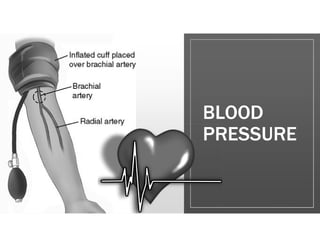
BLOOD
PRESSURE
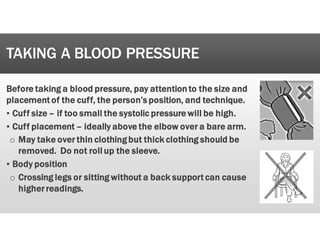
TAKING A BLOOD PRESSURE
B
Before
e taking
g a
a blood
d pressure,
, pay
y attention
n to
o the
e size
e and
d
placement
t of
f the
e cuff,
, the
e person’s
s position,
, and
d technique.
.
’ Cuff
f size
e –
– if
f too
o small
l the
e systolic
c pressure
e will
l be
e high.
.
’ Cuff
f placement
t –
– ideally
y above
e the
e elbow
w over
r a
a bare
e arm.
.
o May
y take
e over
r thin
n clothing
g but
t thick
k clothing
g should
d be
e
removed.
. Do
o not
t roll
l up
p the
e sleeve.
.
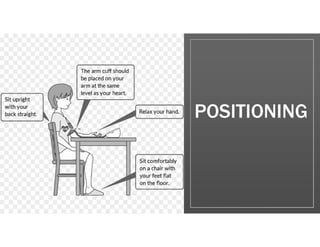
’ Body
y position
o Crossing
g legs
s or
r sitting
g without
t a
a back
k support
t can
n cause
e
higher
r readings.
.
POSITIONING
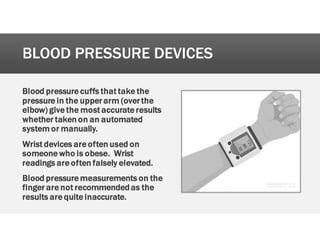
BLOOD PRESSURE DEVICES
B
Blood
d pressure
e cuffs
s that
t take
e the
e
pressure
e in
n the
e upper
r arm
m (over
r the
e
elbow)
) give
e the
e most
t accurate
e results
s
whether
r taken
n on
n an
n automated
d
system
m or
r manually.
.
Wrist
t devices
s are
e often
n used
d on
n
someone
e who
o is
s obese.
. Wrist
t
readings
s are
e often
n falsely
y elevated.
.
Blood
d pressure
e measurements
s on
n the
e
finger
r are
e not
t recommended
das
s the
e
results
s are
e quite
e inaccurate.
.
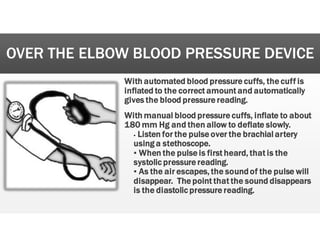
OVER THE ELBOW BLOOD PRESSURE DEVICE
W
With
h automated
d blood
d pressure
e cuffs,
, the
e cuff
f is
s
inflated
d to
o the
e correct
t amount
t and
d automatically
y
gives
s the
e blood
d pressure
e reading.
.
With
h manual
l blood
d pressure
e cuffs,
, inflate
e to
o about
t
180
0 mm
m Hg
g and
d then
n allow
w to
o deflate
e slowly.
.
• Listen
n for
r the
e pulse
e over
r the
e brachial
l artery
y
using
g a
a stethoscope.
.
’ When
n the
e pulse
e is
s first
t heard,
, that
t is
s the
e
systolic
c pressure
e reading.
’ As
s the
e air
r escapes,
, the
e sound
dof
f the
e pulse
e will
l
disappear.
. The
e point
t that
t the
e sound
d disappears
s
is
s the
e diastolic
c pressure
e reading.
.
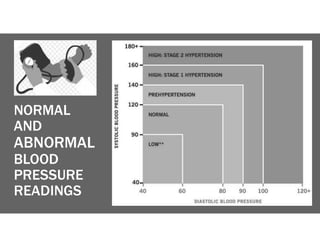
NORMAL
AND
ABNORMAL
BLOOD
PRESSURE
READINGS
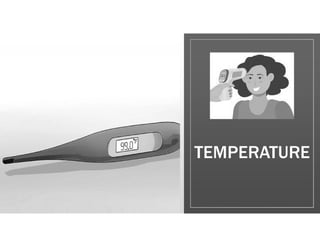
TEMPERATURE
TAKING A TEMPERATURE
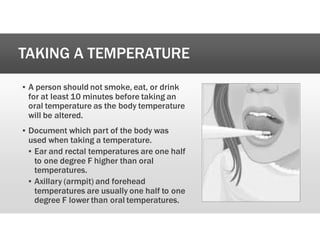
’ A person should not smoke, eat, or drink
for at least 10 minutes before taking an
oral temperature as the body temperature
will be altered.
’ Document which part of the body was
used when taking a temperature.
’ Ear and rectal temperatures are one half
to one degree F higher than oral
temperatures.
’ Axillary (armpit) and forehead
temperatures are usually one half to one
degree F lower than oral temperatures.
NORMAL AND ABNORMAL TEMPERATURES
Normal 97 to 99 degrees Fahrenheit (fF)
Fever Anything over 100.4 fF
• Notify medical provider if temperature is over 103fF
• Notify medical provider if fever more than 3 consecutive days
• Notify medical provider if fever accompanied by severe sore throat
swelling, vomiting, headache, stiff neck, rash, severe cough or
shortness of breath.
o Individualprotocolsmay differ. Follow the protocolsof your agency.
Hypothermia Temperatures below 95fF
HEART
RATE
(pulse)
The pulse is the number
of times the heart beats
per minute
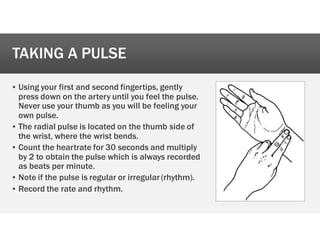
TAKING A PULSE
’ Using your first and second fingertips, gently
press down on the artery until you feel the pulse.
Never use your thumb as you will be feeling your
own pulse.
’ The radial pulse is located on the thumb side of
the wrist, where the wrist bends.
’ Count the heartrate for 30 seconds and multiply
by 2 to obtain the pulse which is always recorded
as beats per minute.
’ Note if the pulse is regular or irregular (rhythm).
’ Record the rate and rhythm.
NORMAL AND ABNORMAL HEART RATES
Normal 60 to 90 beats per minute (BPM)
Tachycardia Over 100 BPM
• Rate normally increases with exercise, sickness, injury, emotions.
• Seek medical attention if rate is over 130 or very irregular.
• Seek medical attention if accompanied by shortness of breath,
lightheadedness, or chest discomfort.
Bradycardia Abnormally low heart rate
• Heart rates are slower when sleeping.
• Concerning symptoms (report):
oFeeling lightheaded, dizzy, faint
oWeakness, fatigue, confusion
• Seek immediate attention if accompanied by chest pain, trouble
breathing, low blood pressure, or fainting.
RESPIRATION
RATE
Respiration rate is the number
of breaths per minute.
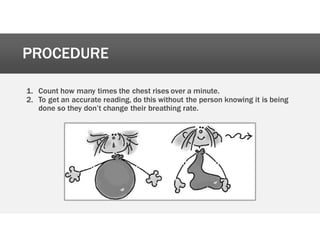
PROCEDURE
1. Count how many times the chest rises over a minute.
2. To get an accurate reading, do this without the person knowing it is being
done so they don’t change their breathing rate.
NORMAL & ABNORMAL BREATHING RATES
Normal 12 TO 20 Breaths per minute
• Rate increases with fever, illness, lung disease
Respiratory
distress
Seek Immediate Medical Attention if:
• Struggling to breath
• Pain with breathing
• Turning blue
• Irregular or very shallow breaths.
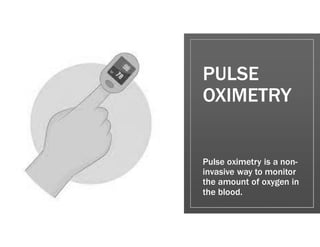
PULSE
OXIMETRY
Pulse oximetry is a non-
invasive way to monitor
the amount of oxygen in
the blood.
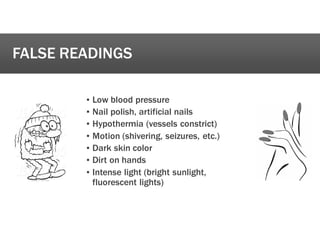
FALSE READINGS
’ Low blood pressure
’ Nail polish, artificial nails
’ Hypothermia (vessels constrict)
’ Motion (shivering, seizures, etc.)
’ Dark skin color
’ Dirt on hands
’ Intense light (bright sunlight,
fluorescent lights)
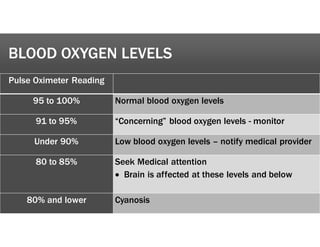
BLOOD OXYGEN LEVELS
Pulse Oximeter Reading
95 to 100% Normal blood oxygen levels
91 to 95% “Concerning” blood oxygen levels - monitor
Under 90% Low blood oxygen levels – notify medical provider
80 to 85% Seek Medical attention
x Brain is affected at these levels and below
80% and lower Cyanosis
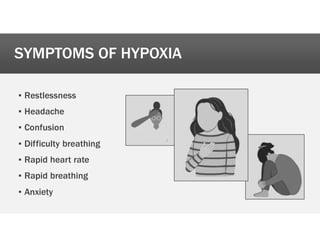
SYMPTOMS OF HYPOXIA
’ Restlessness
’ Headache
’ Confusion
’ Difficulty breathing
’ Rapid heart rate
’ Rapid breathing
’ Anxiety
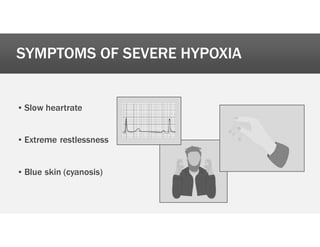
SYMPTOMS OF SEVERE HYPOXIA
’ Slow heartrate
’ Extreme restlessness
’ Blue skin (cyanosis)
THANK YOU
JEAN JUSTAD, MD, MEDICAL DIRECTOR, DDP
CLIPART ON ALL SLIDES FROM CLIPART-LIBRARY.COM EXCEPT:
SLIDE 5 SUNTECHMED.COM AND AINTLUKESKC.ORG/HEALTH-LIBRARY
SLIDE 6 TOPPNG.COM/FREE-IMAGE/BLOOD-PRESSURE
SLIDE 7 CLASSROOMCLIPART.COM
SLIDE 16 CLIPART.EMAIL
SLIDE 22 AND 23 MY.CLEVELANDCLINIC.ORG

VITALSIGNSPPMay2023lowvision (1).pdf my document

  • 2.
    INTRODUCTION You may needto assess vital signs on clients in your care. • You need to know how to do this. • You also need to know if results are abnormal or should be reported to someone. • Protocols regarding vital signs should be written for each client.
  • 3.
    VITAL SIGNS –how many are there? ’ B Blood pressure ’ Temperature ’ Heart rate ’ Respiration rate ’ Oxygen saturation (pulse oximetry)
  • 4.
  • 5.
    TAKING A BLOODPRESSURE B Before e taking g a a blood d pressure, , pay y attention n to o the e size e and d placement t of f the e cuff, , the e person’s s position, , and d technique. . ’ Cuff f size e – – if f too o small l the e systolic c pressure e will l be e high. . ’ Cuff f placement t – – ideally y above e the e elbow w over r a a bare e arm. . o May y take e over r thin n clothing g but t thick k clothing g should d be e removed. . Do o not t roll l up p the e sleeve. . ’ Body y position o Crossing g legs s or r sitting g without t a a back k support t can n cause e higher r readings. .
  • 6.
  • 7.
    BLOOD PRESSURE DEVICES B Blood dpressure e cuffs s that t take e the e pressure e in n the e upper r arm m (over r the e elbow) ) give e the e most t accurate e results s whether r taken n on n an n automated d system m or r manually. . Wrist t devices s are e often n used d on n someone e who o is s obese. . Wrist t readings s are e often n falsely y elevated. . Blood d pressure e measurements s on n the e finger r are e not t recommended das s the e results s are e quite e inaccurate. .
  • 8.
    OVER THE ELBOWBLOOD PRESSURE DEVICE W With h automated d blood d pressure e cuffs, , the e cuff f is s inflated d to o the e correct t amount t and d automatically y gives s the e blood d pressure e reading. . With h manual l blood d pressure e cuffs, , inflate e to o about t 180 0 mm m Hg g and d then n allow w to o deflate e slowly. . • Listen n for r the e pulse e over r the e brachial l artery y using g a a stethoscope. . ’ When n the e pulse e is s first t heard, , that t is s the e systolic c pressure e reading. ’ As s the e air r escapes, , the e sound dof f the e pulse e will l disappear. . The e point t that t the e sound d disappears s is s the e diastolic c pressure e reading. .
  • 9.
  • 10.
  • 11.
    TAKING A TEMPERATURE ’A person should not smoke, eat, or drink for at least 10 minutes before taking an oral temperature as the body temperature will be altered. ’ Document which part of the body was used when taking a temperature. ’ Ear and rectal temperatures are one half to one degree F higher than oral temperatures. ’ Axillary (armpit) and forehead temperatures are usually one half to one degree F lower than oral temperatures.
  • 12.
    NORMAL AND ABNORMALTEMPERATURES Normal 97 to 99 degrees Fahrenheit (fF) Fever Anything over 100.4 fF • Notify medical provider if temperature is over 103fF • Notify medical provider if fever more than 3 consecutive days • Notify medical provider if fever accompanied by severe sore throat swelling, vomiting, headache, stiff neck, rash, severe cough or shortness of breath. o Individualprotocolsmay differ. Follow the protocolsof your agency. Hypothermia Temperatures below 95fF
  • 13.
    HEART RATE (pulse) The pulse isthe number of times the heart beats per minute
  • 14.
    TAKING A PULSE ’Using your first and second fingertips, gently press down on the artery until you feel the pulse. Never use your thumb as you will be feeling your own pulse. ’ The radial pulse is located on the thumb side of the wrist, where the wrist bends. ’ Count the heartrate for 30 seconds and multiply by 2 to obtain the pulse which is always recorded as beats per minute. ’ Note if the pulse is regular or irregular (rhythm). ’ Record the rate and rhythm.
  • 15.
    NORMAL AND ABNORMALHEART RATES Normal 60 to 90 beats per minute (BPM) Tachycardia Over 100 BPM • Rate normally increases with exercise, sickness, injury, emotions. • Seek medical attention if rate is over 130 or very irregular. • Seek medical attention if accompanied by shortness of breath, lightheadedness, or chest discomfort. Bradycardia Abnormally low heart rate • Heart rates are slower when sleeping. • Concerning symptoms (report): oFeeling lightheaded, dizzy, faint oWeakness, fatigue, confusion • Seek immediate attention if accompanied by chest pain, trouble breathing, low blood pressure, or fainting.
  • 16.
    RESPIRATION RATE Respiration rate isthe number of breaths per minute.
  • 17.
    PROCEDURE 1. Count howmany times the chest rises over a minute. 2. To get an accurate reading, do this without the person knowing it is being done so they don’t change their breathing rate.
  • 18.
    NORMAL & ABNORMALBREATHING RATES Normal 12 TO 20 Breaths per minute • Rate increases with fever, illness, lung disease Respiratory distress Seek Immediate Medical Attention if: • Struggling to breath • Pain with breathing • Turning blue • Irregular or very shallow breaths.
  • 19.
    PULSE OXIMETRY Pulse oximetry isa non- invasive way to monitor the amount of oxygen in the blood.
  • 20.
    FALSE READINGS ’ Lowblood pressure ’ Nail polish, artificial nails ’ Hypothermia (vessels constrict) ’ Motion (shivering, seizures, etc.) ’ Dark skin color ’ Dirt on hands ’ Intense light (bright sunlight, fluorescent lights)
  • 21.
    BLOOD OXYGEN LEVELS PulseOximeter Reading 95 to 100% Normal blood oxygen levels 91 to 95% “Concerning” blood oxygen levels - monitor Under 90% Low blood oxygen levels – notify medical provider 80 to 85% Seek Medical attention x Brain is affected at these levels and below 80% and lower Cyanosis
  • 22.
    SYMPTOMS OF HYPOXIA ’Restlessness ’ Headache ’ Confusion ’ Difficulty breathing ’ Rapid heart rate ’ Rapid breathing ’ Anxiety
  • 23.
    SYMPTOMS OF SEVEREHYPOXIA ’ Slow heartrate ’ Extreme restlessness ’ Blue skin (cyanosis)
  • 24.
    THANK YOU JEAN JUSTAD,MD, MEDICAL DIRECTOR, DDP CLIPART ON ALL SLIDES FROM CLIPART-LIBRARY.COM EXCEPT: SLIDE 5 SUNTECHMED.COM AND AINTLUKESKC.ORG/HEALTH-LIBRARY SLIDE 6 TOPPNG.COM/FREE-IMAGE/BLOOD-PRESSURE SLIDE 7 CLASSROOMCLIPART.COM SLIDE 16 CLIPART.EMAIL SLIDE 22 AND 23 MY.CLEVELANDCLINIC.ORG