Vital Signs in
Nursing
Vital Signs
Vital signs are critical indicators of a patient's health status and help monitor and
detect medical conditions. The five primary vital signs are
:
1
.
Temperature
2
.
Pulse
3
.
Respiratory Rate
4
.
Blood Pressure (BP)
5
.
Oxygen Saturation (SpO )
₂
Temperature
What is body temperature
?
The normal body temperature of a person varies depending on gender, recent
activity, food and fluid consumption, time of day, and, in women, the stage
of the menstrual cycle. Normal body temperature can range from 97.8° F
(36.5°C) to 99°F (37.2°C) for a healthy adult. A person's body temperature
can be taken in any of the following ways
:
Orally. Temperature can be taken by mouth using a digital thermometer that
uses an electronic probe to measure body temperature
.
Rectally. Temperatures taken rectally tend to be 0.5°F to 0.7°F higher than
when taken by mouth. This is more common in babies because their body
doesn't regulate temperature the way an older child or adult's body does
.
Armpit (axillary). Temperatures can be taken under the arm using a digital
thermometer. Temperatures taken by this route tend to be 0.3°F to 0.4°F
lower than those temperatures taken by mouth
.
What is body temperature
?
By ear. A special thermometer can quickly measure the temperature of the
eardrum, which reflects the body's core temperature (the temperature of
the internal organs)
.
By skin. A special thermometer can quickly measure the temperature of
the skin on the forehead. Some thermometers don't require contact with
the skin to get a temperature reading
.
Internally. This method is common in people who are critically ill in an
intensive care unit (ICU). The temperature can be measured by probes
that are placed in the esophagus, heart, or bladder
.
Body temperature may be abnormal due to fever (high temperature) or
hypothermia (low temperature). A fever is indicated when body
temperature rises about 1 degree or more over the normal temperature
of 98.6°F, according to the American Academy of Family Physicians.
Hypothermia is defined as a drop in body temperature below 95°F
.
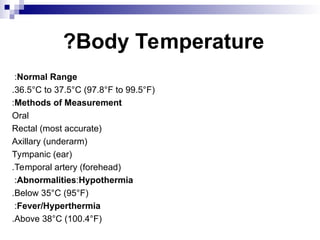
Body Temperature
?
Normal Range
:
36.5°C to 37.5°C (97.8°F to 99.5°F)
.
Methods of Measurement
:
Oral
Rectal (most accurate)
Axillary (underarm)
Tympanic (ear)
Temporal artery (forehead)
.
Abnormalities:Hypothermia
:
Below 35°C (95°F)
.
Fever/Hyperthermia
:
Above 38°C (100.4°F)
.
Pulse Rate
What is the pulse rate
?
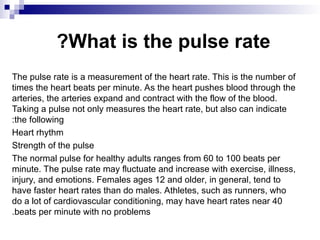
The pulse rate is a measurement of the heart rate. This is the number of
times the heart beats per minute. As the heart pushes blood through the
arteries, the arteries expand and contract with the flow of the blood.
Taking a pulse not only measures the heart rate, but also can indicate
the following
:
Heart rhythm
Strength of the pulse
The normal pulse for healthy adults ranges from 60 to 100 beats per
minute. The pulse rate may fluctuate and increase with exercise, illness,
injury, and emotions. Females ages 12 and older, in general, tend to
have faster heart rates than do males. Athletes, such as runners, who
do a lot of cardiovascular conditioning, may have heart rates near 40
beats per minute with no problems
.
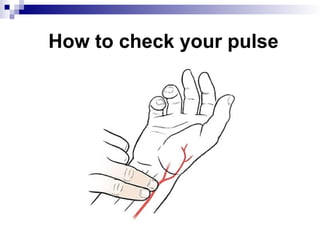
How to check your pulse
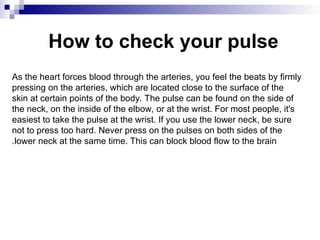
As the heart forces blood through the arteries, you feel the beats by firmly
pressing on the arteries, which are located close to the surface of the
skin at certain points of the body. The pulse can be found on the side of
the neck, on the inside of the elbow, or at the wrist. For most people, it's
easiest to take the pulse at the wrist. If you use the lower neck, be sure
not to press too hard. Never press on the pulses on both sides of the
lower neck at the same time. This can block blood flow to the brain
.
How to check your pulse
When taking your pulse
:
Using the first and second fingertips, press firmly but gently on the arteries
until you feel a pulse
.
Start counting the pulse when the clock's second hand is on the 12
.
Count your pulse for 60 seconds (or for 30 seconds and then multiply by 2
to calculate beats per minute)
.
When counting, don't watch the clock continuously, but concentrate on the
beats of the pulse
.
If unsure about your results, ask another person to count for you
.
If your healthcare provider has asked you to check your own pulse and you
are having trouble finding it, consult your provider or nurse for advice.
Many types of monitoring devices can help check your pulse. These
include fitness tracker devices to help track your pulse rate
.
How to check your pulse
Normal Range
:
60
–
100
beats per minute (bpm) for adults
.
Assessment Sites
:
Radial artery (wrist)
.
Carotid artery (neck)
.
Brachial artery (arm)
.
Characteristics
:
Rate: Fast (tachycardia) or slow (bradycardia)
.
Rhythm: Regular or irregular
.
Strength: Strong, weak, or thready
.
Respiratory Rate
What is the respiration rate
?
The respiration rate is the number of breaths you take each
minute. The rate is usually measured when you are at rest. It
simply involves counting the number of breaths for 1 minute
by counting how many times your chest rises. Respiration
rates may increase with exercise, fever, illness, and with
other medical conditions. When checking respiration, it's
important to also note whether you have any trouble
breathing
.
Normal respiration rates for an adult person at rest range from
12 to 20 breaths per minute
.
What is the respiration rate
?
Normal Range
:
12
–
20
breaths per minute for adults
.
Assessment
:
Observe chest or abdominal movements
.
Count breaths for 30 seconds and multiply by 2
.
Abnormalities
:
Tachypnea
:
Fast breathing (e.g., >20 breaths/min)
.
Bradypnea
:
Slow breathing (<12 breaths/min)
.
Dyspnea
:
Difficulty breathing
.
Blood Pressure
What is blood pressure
?
Blood pressure is the force of the blood pushing against the artery walls
during contraction and relaxation of the heart. Each time the heart
beats, it pumps blood into the arteries. It results in the highest blood
pressure as the heart contracts. When the heart relaxes, the blood
pressure falls
.
Two numbers are recorded when measuring blood pressure. The higher
number is called systolic pressure. It refers to the pressure inside the
artery when the heart contracts and pumps blood through the body. The
lower number is called diastolic pressure. It refers to the pressure inside
the artery when the heart is at rest and is filling with blood. Both
pressures are recorded as "mm Hg" (millimeters of mercury)
.
High blood pressure directly increases the risk of heart attack, heart failure,
and stroke. With high blood pressure, the arteries may have an
increased resistance against the flow of blood. This causes the heart to
work harder to circulate the blood
.
What is blood pressure
?
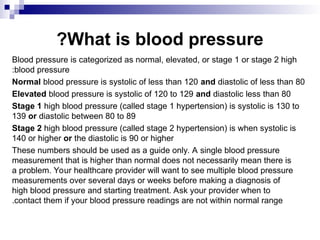
Blood pressure is categorized as normal, elevated, or stage 1 or stage 2 high
blood pressure
:
Normal blood pressure is systolic of less than 120 and diastolic of less than 80
Elevated blood pressure is systolic of 120 to 129 and diastolic less than 80
Stage 1 high blood pressure (called stage 1 hypertension) is systolic is 130 to
139 or diastolic between 80 to 89
Stage 2 high blood pressure (called stage 2 hypertension) is when systolic is
140 or higher or the diastolic is 90 or higher
These numbers should be used as a guide only. A single blood pressure
measurement that is higher than normal does not necessarily mean there is
a problem. Your healthcare provider will want to see multiple blood pressure
measurements over several days or weeks before making a diagnosis of
high blood pressure and starting treatment. Ask your provider when to
contact them if your blood pressure readings are not within normal range
.
Before you measure blood pressure
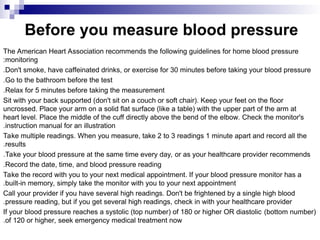
The American Heart Association recommends the following guidelines for home blood pressure
monitoring
:
Don't smoke, have caffeinated drinks, or exercise for 30 minutes before taking your blood pressure
.
Go to the bathroom before the test
.
Relax for 5 minutes before taking the measurement
.
Sit with your back supported (don't sit on a couch or soft chair). Keep your feet on the floor
uncrossed. Place your arm on a solid flat surface (like a table) with the upper part of the arm at
heart level. Place the middle of the cuff directly above the bend of the elbow. Check the monitor's
instruction manual for an illustration
.
Take multiple readings. When you measure, take 2 to 3 readings 1 minute apart and record all the
results
.
Take your blood pressure at the same time every day, or as your healthcare provider recommends
.
Record the date, time, and blood pressure reading
.
Take the record with you to your next medical appointment. If your blood pressure monitor has a
built-in memory, simply take the monitor with you to your next appointment
.
Call your provider if you have several high readings. Don't be frightened by a single high blood
pressure reading, but if you get several high readings, check in with your healthcare provider
.
If your blood pressure reaches a systolic (top number) of 180 or higher OR diastolic (bottom number)
of 120 or higher, seek emergency medical treatment now
.
What is blood pressure
?
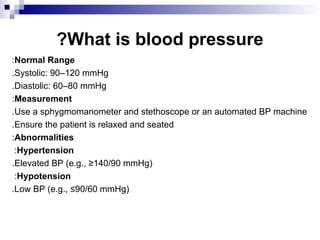
Normal Range
:
Systolic: 90–120 mmHg
.
Diastolic: 60–80 mmHg
.
Measurement
:
Use a sphygmomanometer and stethoscope or an automated BP machine
.
Ensure the patient is relaxed and seated
.
Abnormalities
:
Hypertension
:
Elevated BP (e.g., ≥140/90 mmHg)
.
Hypotension
:
Low BP (e.g., ≤90/60 mmHg)
.
Oxygen Saturation
(SpO )
₂
What does blood oxygen level
mean
?
Your blood oxygen level (blood oxygen saturation) is the
amount of oxygen you have circulating in your blood
.
Oxygen is essential to life, and our bodies need a certain
amount of oxygen to function properly. Oxygen enters
your body through your nose or mouth when you breathe
(inhale) and passes through your lungs into your
bloodstream. Once in your bloodstream, the oxygen then
goes to cells all over your body. All of your cells need
oxygen to create energy efficiently, and your body needs
energy to fulfill all of its processes, such as digestion and
even thinking
.
What does blood oxygen level
mean
?
Once your cells use oxygen, they create carbon dioxide.
Your bloodstream then carries the carbon dioxide back
to your lungs, and you breathe it out (exhale it) through
your mouth or nose
.
Your body tightly regulates the amount of oxygen
saturation in your blood, because low blood oxygen
levels (hypoxemia) can lead to many serious conditions
and damage to individual organ systems, especially your
brain and heart. Low blood oxygen levels indicate that
your lungs and/or circulatory system may not be working
as they should
.
What is a blood oxygen level
test
?
There are two main ways to measure or test blood oxygen levels:
through a blood draw test and through pulse oximetry (using
an oximeter). A blood draw test provides much more information
about your oxygen levels than an oximeter does
.
Pulse oximetry
A pulse oximeter can also measure blood oxygen saturation levels
through a small clip that’s usually placed on your finger or toe. An
oximeter reading only indicates what percentage of your blood is
saturated with oxygen, known as the SpO2 level, as well as
your heart rate. It’s a quick and harmless way to check if someone’s
blood oxygen level is too low
.
Why do I need to have my
blood oxygen level tested
?
Your healthcare provider may have you undergo a blood oxygen level
test if you’re experiencing any of the following acute (sudden and
serious) conditions
:
If you’re having trouble breathing. (A newborn baby may also need a
blood oxygen test if they are having trouble breathing)
.
If you’ve recently injured your head or neck, which can affect your
breathing
.
If you have coronavirus disease (COVID-19)
.
If you have pneumonia
.
If you have carbon monoxide poisoning
.
If you have a smoke inhalation injury
.
If you’ve had multiple episodes of nausea and/or vomiting
.
If you’ve had a drug overdose
.
How can I increase my blood
oxygen level
?
There are some ways to naturally increase the amount of oxygen in
your blood, including
:
Breathing in fresh air: Opening your windows or going outside for a
walk can increase the amount of oxygen that your body brings in,
which increases your overall blood oxygen level
.
Quitting smoking: Only two to three weeks after you quit smoking,
your circulation will likely improve significantly. After one to nine
months, your shortness of breath decreases. Both of these aspects
contribute to your body’s ability to take in more oxygen
.
Practicing breathing exercises: Simple breathing exercises like
pursed-lip breathing and deep belly breathing can open your
airways and increase the amount of oxygen in your blood
.
What does blood oxygen level
mean
?
Normal Range
:
95
–
100%
.
Measurement
:
Use a pulse oximeter
.
Low Oxygen Levels
:
Indicate hypoxemia, which may require supplemental
oxygen
.
CNA Class 06. nursing practice basics fundamental

CNA Class 06. nursing practice basics fundamental

  • 1.
  • 2.
    Vital Signs Vital signsare critical indicators of a patient's health status and help monitor and detect medical conditions. The five primary vital signs are : 1 . Temperature 2 . Pulse 3 . Respiratory Rate 4 . Blood Pressure (BP) 5 . Oxygen Saturation (SpO ) ₂
  • 3.
  • 4.
    What is bodytemperature ? The normal body temperature of a person varies depending on gender, recent activity, food and fluid consumption, time of day, and, in women, the stage of the menstrual cycle. Normal body temperature can range from 97.8° F (36.5°C) to 99°F (37.2°C) for a healthy adult. A person's body temperature can be taken in any of the following ways : Orally. Temperature can be taken by mouth using a digital thermometer that uses an electronic probe to measure body temperature . Rectally. Temperatures taken rectally tend to be 0.5°F to 0.7°F higher than when taken by mouth. This is more common in babies because their body doesn't regulate temperature the way an older child or adult's body does . Armpit (axillary). Temperatures can be taken under the arm using a digital thermometer. Temperatures taken by this route tend to be 0.3°F to 0.4°F lower than those temperatures taken by mouth .
  • 5.
    What is bodytemperature ? By ear. A special thermometer can quickly measure the temperature of the eardrum, which reflects the body's core temperature (the temperature of the internal organs) . By skin. A special thermometer can quickly measure the temperature of the skin on the forehead. Some thermometers don't require contact with the skin to get a temperature reading . Internally. This method is common in people who are critically ill in an intensive care unit (ICU). The temperature can be measured by probes that are placed in the esophagus, heart, or bladder . Body temperature may be abnormal due to fever (high temperature) or hypothermia (low temperature). A fever is indicated when body temperature rises about 1 degree or more over the normal temperature of 98.6°F, according to the American Academy of Family Physicians. Hypothermia is defined as a drop in body temperature below 95°F .
  • 6.
    Body Temperature ? Normal Range : 36.5°Cto 37.5°C (97.8°F to 99.5°F) . Methods of Measurement : Oral Rectal (most accurate) Axillary (underarm) Tympanic (ear) Temporal artery (forehead) . Abnormalities:Hypothermia : Below 35°C (95°F) . Fever/Hyperthermia : Above 38°C (100.4°F) .
  • 7.
  • 8.
    What is thepulse rate ? The pulse rate is a measurement of the heart rate. This is the number of times the heart beats per minute. As the heart pushes blood through the arteries, the arteries expand and contract with the flow of the blood. Taking a pulse not only measures the heart rate, but also can indicate the following : Heart rhythm Strength of the pulse The normal pulse for healthy adults ranges from 60 to 100 beats per minute. The pulse rate may fluctuate and increase with exercise, illness, injury, and emotions. Females ages 12 and older, in general, tend to have faster heart rates than do males. Athletes, such as runners, who do a lot of cardiovascular conditioning, may have heart rates near 40 beats per minute with no problems .
  • 9.
    How to checkyour pulse As the heart forces blood through the arteries, you feel the beats by firmly pressing on the arteries, which are located close to the surface of the skin at certain points of the body. The pulse can be found on the side of the neck, on the inside of the elbow, or at the wrist. For most people, it's easiest to take the pulse at the wrist. If you use the lower neck, be sure not to press too hard. Never press on the pulses on both sides of the lower neck at the same time. This can block blood flow to the brain .
  • 10.
    How to checkyour pulse
  • 11.
    How to checkyour pulse When taking your pulse : Using the first and second fingertips, press firmly but gently on the arteries until you feel a pulse . Start counting the pulse when the clock's second hand is on the 12 . Count your pulse for 60 seconds (or for 30 seconds and then multiply by 2 to calculate beats per minute) . When counting, don't watch the clock continuously, but concentrate on the beats of the pulse . If unsure about your results, ask another person to count for you . If your healthcare provider has asked you to check your own pulse and you are having trouble finding it, consult your provider or nurse for advice. Many types of monitoring devices can help check your pulse. These include fitness tracker devices to help track your pulse rate .
  • 12.
    How to checkyour pulse Normal Range : 60 – 100 beats per minute (bpm) for adults . Assessment Sites : Radial artery (wrist) . Carotid artery (neck) . Brachial artery (arm) . Characteristics : Rate: Fast (tachycardia) or slow (bradycardia) . Rhythm: Regular or irregular . Strength: Strong, weak, or thready .
  • 13.
  • 14.
    What is therespiration rate ? The respiration rate is the number of breaths you take each minute. The rate is usually measured when you are at rest. It simply involves counting the number of breaths for 1 minute by counting how many times your chest rises. Respiration rates may increase with exercise, fever, illness, and with other medical conditions. When checking respiration, it's important to also note whether you have any trouble breathing . Normal respiration rates for an adult person at rest range from 12 to 20 breaths per minute .
  • 15.
    What is therespiration rate ? Normal Range : 12 – 20 breaths per minute for adults . Assessment : Observe chest or abdominal movements . Count breaths for 30 seconds and multiply by 2 . Abnormalities : Tachypnea : Fast breathing (e.g., >20 breaths/min) . Bradypnea : Slow breathing (<12 breaths/min) . Dyspnea : Difficulty breathing .
  • 16.
  • 17.
    What is bloodpressure ? Blood pressure is the force of the blood pushing against the artery walls during contraction and relaxation of the heart. Each time the heart beats, it pumps blood into the arteries. It results in the highest blood pressure as the heart contracts. When the heart relaxes, the blood pressure falls . Two numbers are recorded when measuring blood pressure. The higher number is called systolic pressure. It refers to the pressure inside the artery when the heart contracts and pumps blood through the body. The lower number is called diastolic pressure. It refers to the pressure inside the artery when the heart is at rest and is filling with blood. Both pressures are recorded as "mm Hg" (millimeters of mercury) . High blood pressure directly increases the risk of heart attack, heart failure, and stroke. With high blood pressure, the arteries may have an increased resistance against the flow of blood. This causes the heart to work harder to circulate the blood .
  • 18.
    What is bloodpressure ? Blood pressure is categorized as normal, elevated, or stage 1 or stage 2 high blood pressure : Normal blood pressure is systolic of less than 120 and diastolic of less than 80 Elevated blood pressure is systolic of 120 to 129 and diastolic less than 80 Stage 1 high blood pressure (called stage 1 hypertension) is systolic is 130 to 139 or diastolic between 80 to 89 Stage 2 high blood pressure (called stage 2 hypertension) is when systolic is 140 or higher or the diastolic is 90 or higher These numbers should be used as a guide only. A single blood pressure measurement that is higher than normal does not necessarily mean there is a problem. Your healthcare provider will want to see multiple blood pressure measurements over several days or weeks before making a diagnosis of high blood pressure and starting treatment. Ask your provider when to contact them if your blood pressure readings are not within normal range .
  • 19.
    Before you measureblood pressure The American Heart Association recommends the following guidelines for home blood pressure monitoring : Don't smoke, have caffeinated drinks, or exercise for 30 minutes before taking your blood pressure . Go to the bathroom before the test . Relax for 5 minutes before taking the measurement . Sit with your back supported (don't sit on a couch or soft chair). Keep your feet on the floor uncrossed. Place your arm on a solid flat surface (like a table) with the upper part of the arm at heart level. Place the middle of the cuff directly above the bend of the elbow. Check the monitor's instruction manual for an illustration . Take multiple readings. When you measure, take 2 to 3 readings 1 minute apart and record all the results . Take your blood pressure at the same time every day, or as your healthcare provider recommends . Record the date, time, and blood pressure reading . Take the record with you to your next medical appointment. If your blood pressure monitor has a built-in memory, simply take the monitor with you to your next appointment . Call your provider if you have several high readings. Don't be frightened by a single high blood pressure reading, but if you get several high readings, check in with your healthcare provider . If your blood pressure reaches a systolic (top number) of 180 or higher OR diastolic (bottom number) of 120 or higher, seek emergency medical treatment now .
  • 20.
    What is bloodpressure ? Normal Range : Systolic: 90–120 mmHg . Diastolic: 60–80 mmHg . Measurement : Use a sphygmomanometer and stethoscope or an automated BP machine . Ensure the patient is relaxed and seated . Abnormalities : Hypertension : Elevated BP (e.g., ≥140/90 mmHg) . Hypotension : Low BP (e.g., ≤90/60 mmHg) .
  • 21.
  • 22.
    What does bloodoxygen level mean ? Your blood oxygen level (blood oxygen saturation) is the amount of oxygen you have circulating in your blood . Oxygen is essential to life, and our bodies need a certain amount of oxygen to function properly. Oxygen enters your body through your nose or mouth when you breathe (inhale) and passes through your lungs into your bloodstream. Once in your bloodstream, the oxygen then goes to cells all over your body. All of your cells need oxygen to create energy efficiently, and your body needs energy to fulfill all of its processes, such as digestion and even thinking .
  • 23.
    What does bloodoxygen level mean ? Once your cells use oxygen, they create carbon dioxide. Your bloodstream then carries the carbon dioxide back to your lungs, and you breathe it out (exhale it) through your mouth or nose . Your body tightly regulates the amount of oxygen saturation in your blood, because low blood oxygen levels (hypoxemia) can lead to many serious conditions and damage to individual organ systems, especially your brain and heart. Low blood oxygen levels indicate that your lungs and/or circulatory system may not be working as they should .
  • 24.
    What is ablood oxygen level test ? There are two main ways to measure or test blood oxygen levels: through a blood draw test and through pulse oximetry (using an oximeter). A blood draw test provides much more information about your oxygen levels than an oximeter does .
  • 25.
    Pulse oximetry A pulseoximeter can also measure blood oxygen saturation levels through a small clip that’s usually placed on your finger or toe. An oximeter reading only indicates what percentage of your blood is saturated with oxygen, known as the SpO2 level, as well as your heart rate. It’s a quick and harmless way to check if someone’s blood oxygen level is too low .
  • 26.
    Why do Ineed to have my blood oxygen level tested ? Your healthcare provider may have you undergo a blood oxygen level test if you’re experiencing any of the following acute (sudden and serious) conditions : If you’re having trouble breathing. (A newborn baby may also need a blood oxygen test if they are having trouble breathing) . If you’ve recently injured your head or neck, which can affect your breathing . If you have coronavirus disease (COVID-19) . If you have pneumonia . If you have carbon monoxide poisoning . If you have a smoke inhalation injury . If you’ve had multiple episodes of nausea and/or vomiting . If you’ve had a drug overdose .
  • 27.
    How can Iincrease my blood oxygen level ? There are some ways to naturally increase the amount of oxygen in your blood, including : Breathing in fresh air: Opening your windows or going outside for a walk can increase the amount of oxygen that your body brings in, which increases your overall blood oxygen level . Quitting smoking: Only two to three weeks after you quit smoking, your circulation will likely improve significantly. After one to nine months, your shortness of breath decreases. Both of these aspects contribute to your body’s ability to take in more oxygen . Practicing breathing exercises: Simple breathing exercises like pursed-lip breathing and deep belly breathing can open your airways and increase the amount of oxygen in your blood .
  • 28.
    What does bloodoxygen level mean ? Normal Range : 95 – 100% . Measurement : Use a pulse oximeter . Low Oxygen Levels : Indicate hypoxemia, which may require supplemental oxygen .