Visual Evoked Potentials
Clinical Electrophysiology
• an important adjunct to the bedside
evaluation
• Only means available for objective assessment
of visual function, especially of the retina and
optic nerve
• also provide localizing information in the
visual pathway
• may have use in distinguishing types of
injuries of the optic nerve (e.g., glaucomatous,
inflammatory, or metabolic)
• based on assessments tailored to the
evaluation of particular functional systems
(such as motion or color)
• utility is established firmly in the diagnosis
and monitoring of patients with neurologic
conditions with well-recognized
ophthalmologic manifestations such as MS,
NMO-SD.
ANATOMY OF THE ANTERIOR
VISUAL SYSTEM
• Of our senses, vision has the greatest amount
of cortical surface area dedicated to
processing its output
• up to 40 percent of the brain has been
estimated to be devoted to this effort
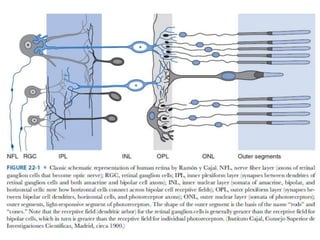
• retina is comprised of 110 million cells divided
into at least ten anatomic layers and three
primary subsets of neurons
• More than 50 different cell types have been
described, and ten different neurotransmitters
play an important role in retinal physiology
• Photoreceptors are the primary sensory
neurons of the retina and the most abundant
of all the retinal cell types
• They are positioned in the deepest layers of
the retina, closest to the retinal pigment
epithelium
• Photoreceptors respond to light by converting
11-cis-retinal to 11-transretinal, resulting in
the hyperpolarization of the neuron and
leading to a reduction in release of glutamate
from its synaptic terminal
• Rods are highly sensitive to light and evidence
peak function in low light conditions
• Cones are color sensitive and provide their
predominant perceptual input under bright-
light (photopic) conditions
• In normal individuals there are three cone
subtypes (short-, medium-, and long-
wavelength)
• each tuned to a different peak spectral
sensitivity within the visible spectrum
• Cones are concentrated in the fovea, making
up nearly all the photoreceptors in the central
1 degree of the retina
• Rods have a peak density around 6 to 8
degrees from the center of the retina
• Photoreceptors synapse with the cells of the
inner nuclear layer (bipolar and horizontal
cells) in the outer plexiform layer of the retina
• The middle layers of the retina consist of
interneurons that perform the initial
processing and organizing of visual
information
• Horizontal cells provide a wide neural network
for inter-retinal feedback and processing of
visual information
• Bipolar cells can be characterized as ON or OFF
based on how they respond to photoreceptor
hyperpolarization and
• their response to the reduction of glutamate
input that results in depolarizing (in the case of
ON-bipolar cells)
• Retinal ganglion cells constitute the primary
output neurons of the retina
• They receive input from the bipolar cells (via
amacrine cells) and synapse primarily in the
thalamus, tectum and hypothalamus
• There are four primary types of retinal ganglion
cells
• Magnocellular (aka alpha or Y-type) cells have a
large receptive field and a large axonal diameter
and hence faster conduction of their action
potential
• They are concentrated outside of the macula and
are tuned primarily for detection of contrast and
motion
• Parvocellular cells have a smaller receptive field,
a smaller axonal diameter, and a relatively slower
conduction time
• concentrated in the macula and are tuned for the
discrimination of color
• Koniocellular cells are the smallest in size and
least well characterized
• Finally, a class of intrinsically photosensitive
retinal ganglion cells containing melanopsin
are distributed evenly throughout the retina
• These melanopsin-containing retinal ganglion
cells likely underlie subjective luminance
sensitivity
• provide some of the afferent input for the
pupillary response and help entrain the
circadian rhythm
• The axons of RGC are myelinated once they exit the eye
posterior to the lamina cribrosa
• These axons travel via the optic tract to synapse in the
1. thalamus (sensory visual information)
2. hypothalamus (circadian rhythm), and
3. midbrain tectum (luminance sensitivity and pupillary
response)
• Only a small number of melanopsin-containing RGC
synapse in the intergeniculate leaflet of the LGN
• the majority of them synapse in the midbrain and
hypothalamus
• The predominant subnucleus of the LGN (the
dorsal LGN) receives retinal input
• Inputs from magnocellular and parvocellular cells
are separated into distinct lamellae
• neurons in the LGN are selectively responsive to
stimuli with a particular orientation or direction
of motion
• LGN enhances the discriminating power of the
retinal input
• Allows for small variations in the visual scene to
be highlighted by the visual cortex
• Dorsal LGN cells send their axons primarily to
the primary visual cortex (Brodmann area 17)
• Outputs primarily terminate in layer 4 of the
striate cortex
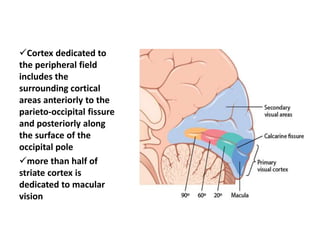
• Striate cortex dedicates 65 percent of its area
to the central 15 degrees of the visual field
• Primary visual cortex maintains the general
retinotopic organization of visual information
Cortex dedicated to
the peripheral field
includes the
surrounding cortical
areas anteriorly to the
parieto-occipital fissure
and posteriorly along
the surface of the
occipital pole
more than half of
striate cortex is
dedicated to macular
vision
• Visual information is deciphered and
processed further in accessory visual cortex
• A wide swath of neighboring cortex in areas
that have been distinguished based on
functional determinants (V2–V6)
• Extra-striate visual processing reflects a loose
hierarchy with ample feedback and feed-
forward loops of interconnection
• In these regions neurons have extremely large
receptive fields tuned for particular features of
the visual scene, such as faces (including
emotional state), animals, or rates of motion
• There are two classic pathways arising from the
visual cortex
• Dorsal stream carrying visual information to the
parietal lobes for spatial identification
(“Where?”)
• Ventral stream carrying information to the
temporal lobes for object identification
(“What?”)
• Primary visual cortex is comprised of layers
(besides layer 4C) that receive inhibitory and
modulating inputs from extra-striate areas
• These help to focus visual processing power
on features deemed salient
VEP
• VEP is the only objective technique available
to assess clinically the functional state of the
visual system beyond the retinal ganglion cells
• Since foveal projection is magnified at cortex,
it is an objective indication of macular
function
• At rapid rates of stimulation the waveform
becomes sinusoidal – STEADY STATE VEP
• Not used routinely due to inferior information
on latency
• At low rates of stimulation – discrete
deflections are formed known as TRANSIENT
VEP
• This is commonly employed
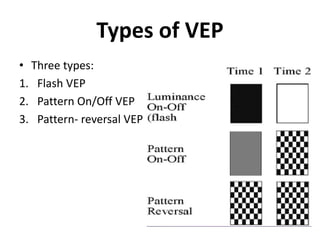
Types of VEP
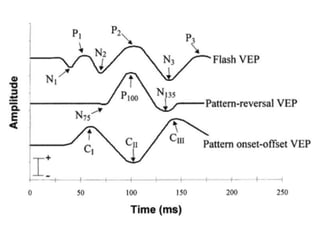
• Three types:
1. Flash VEP
2. Pattern On/Off VEP
3. Pattern- reversal VEP
FLASH VEP
• Response to diffusely flashing light stimulus that
subtends a visual field of 20 degrees
• Cruder response than pattern VEP
• Merely indicates that light has been perceived by
cortex
• Indications –
1. media haze,
2. Infant,
3. poor patient cooperation
PATTERN REVERSAL VEP
• Response to a patterned stimulus - checkerboard
or square and sine wave gratings
• Frequency of gratings is described in cycles per
degree (CPD)
• For check pattern visual angle subtended by a
single check is used
• Preferred technique for most clinical purposes,
gives an estimate of form sense and thus visual
acuity
N145
PATTERN ON/OFF VEP
• A pattern is abruptly exchanged with an
equilluminant diffuse background
• More intersubject variability than pattern
reversal VEP
• Useful in detection of patients with
malingering & patients with nystagmus
PREREQUISITES
• There should be no distracting sound or light
waves
• Pattern and flash must both be done in all
patients as pattern cannot be detected in pts
with media opacities
• Pattern VEP followed by flash VEP-
significantly affected by eccentric fixation,
excessive blinking of eyes and partial closure
of eyes
TECHNIQUE OF RECORDING
• Undilated pupil
• Monocular recording
• Refractive correction
• Relaxed position
• 1m distance from monitor
Electrode placement over scalp
• Clinical VEPs are usually recorded from
occipital scalp overlying the calcarine fissure
• 10-20 International System:-
• mid-occipital electrode location (OZ) is on the
midline
• The distance above the inion calculated as 10
% of the distance between the inion and
nasion, which is 3-4 cm in most adults
• Lateral occipital electrodes are a similar
distance off the midline
• Queen Square system:-
• includes a mid-occipital electrode placed 5 cm
above the inion, referenced to a mid-frontal
electrode placed 12 cm above the nasion (MO–
MF)
• To complete the montage, leads usually are also
placed 5 cm to the left (LO) and right (RO) of the
MO lead
• Queen Square locations, further off the midline,
are better able to lateralize anomalies such as
when using hemi-field stimulation
• Multifocal Visually Evoked Potentials
(Mfveps):
• A common mfVEP montage is to place two
electrodes on the midline one just below the
inion and another 3 cm above the inion
• laterally place electrodes 3-4 cm off the
midline several centimeters above the inion
COMPONENTS OF VEP
N145
• In most individuals, the first response of the
full-field pattern-reversal VEP recorded mid-
occipitally is a negative deflection termed the
N75
• By convention full-field VEPs usually are
assessed by evaluating the first major positive
deflection that occurs at around 100 msec and
is therefore designated the P100 component
• Following the P100, the next negative
deflection is referred to as the N145
• The neural generators of the waves of the VEP
are not clearly defined
• The visual cortex is the source of the early
components of the VEP (N1, N75) prior to P1
(“P100”)
• It has been suggested that the N75 reflects
input from the dorsal LGN to the striate cortex
(via the optic radiations)
• The early phase of the P1 component with a
peak around 95-110 msec, is likely generated
in dorsal extrastriate cortex of the middle
occipital gyrus
• P100 may reflect a secondary inhibitory
response at V1 or excitatory outflow to the
accessory visual cortical areas (V2 to V5)
• The later component N2 (N145) is generated
from several areas including a deep source in
the parietal lobe
• There are two primary features to each
deflection that can be described:
1. the time elapsed since the stimulus (latency)
2. the magnitude of deflection from the
baseline (amplitude)
• Normal ranges used for references are
dependent on the size, luminance, contrast,
and temporal characteristics of the stimulus
• Latency delay of the full-field VEP is often
interpreted as evidence of demyelinating
injury to the visual pathway
• Abnormality of latency is defined routinely as
a value exceeding the mean by more than 2.5
standard deviations
• The optimal cut-off for inter-ocular latency
ranges from 6 to 10 msec
• There is a high degree of interindividual
variability in amplitude on pattern-reversal
VEPs in healthy subjects
• the range of observed values is not subject to
a gaussian distribution, making it difficult to
establish normal values
• There may be interocular differences in
amplitude of up to 200 percent
• Repeated VEPs in the same individual may
show variability in amplitude of a similar
extent as well
NORMAL DATA
• P 100 LATENCY (msec) = 102 +/- 5
• R-L difference (msec) = 1.3 +/- 2.0
• Amplitude (μV) =10 +/- 4.2
• Duration = 63 +/- 8.7
• If acuity of the patient is in question, the
amplitude is more important
• If detection of a lesion in visual pathway is in
question, latency is more important
• Latency is more reliable than amplitude
(Variability – 5% as compared to 25%)
• Presence of reduced amplitude is non specific,
gains importance only on serial testing
• Bilateral symmetry is seen both with flash and
pattern VEP, thus an asymmetrical response is
more indicative of an abnormality
Factors Influencing VEP
• Size of stimulus – Decrease in size of stimulus,
increases amplitude of VEP
• Position of electrodes on scalp
• Age- amplitude decreases with age
• Attention of patient – If subject looks to side
of stimulus, there is rapid fall in size of
response
CLINICAL APPLICATION
• DELAYED LATENCY
1. Ageing
2. De-myelinating optic
neuritis
3. Neurotransmitter
disorders
4. Glaucoma
5. Uncorrected refractive
error
• REDUCED AMPLITUDE
1. Optic atrophy
2. Toxic
3. Compressive
4. Ambylopia
5. Uncorrected refractive
error
• Multiple Sclerosis:-
Increased latency of P100
Even when no defect in visual acuity , colour
vision or field of vision
About 96% of pts with MS have delayed latency
• Compressive Optic Nerve Lesions :-
decreased amplitude without much change in
latency
• During Orbital Or Neurosurgical Procedures:-
continuous record of optic nerve function in form
of VEP to prevent inadvertent damage to the
nerve during surgical manipulation
• Degenerative Diseases that affect the spinal cord,
cerebellar pathways, or both, such as Friedreich's
ataxia, Huntington's disease, neurosyphilis, and
AIDS, also can affect the optic nerves and cause
visual defects, including a delay of the pattern
VEP
• Leber’s Optic Neuropathy:-
The earliest VEP abnormalities appear to be
increases in P100 latency or changes in the
waveform morphology (i.e. the development a
double positive peak)
As the condition progresses, the VEP
amplitude decreases to a point where
responses become immeasurable
• Thyroid Ophthalmopathy:-
may have a prolonged latency of the pattern
VEP before a clinically apparent optic
neuropathy
• Subacute Combined Degeneration:-
vitamin B12 deficiency causes demyelination
and prolongs the pattern VEP latency even
with an unremarkable neuroophthalmologic
examination
• AION:-
Low amplitude but normal latency
• To Assess Misprojection Of Optic Nerve
Fibers In Albinism:-
Nerve fibers that originate in the temporal
retina are misrouted at the optic chiasm
This misrouting results in an anomalous
temporal nerve fiber decussation and an
abnormal projection to the occipital cortex
This leads to a definite VEP asymmetry
• To Assess Visual Potential In Patients With
Opaque Media:-
Flash VEPs may be useful for detecting
maculopathy or optic neuropathy in patients with
dense media opacities
An amplitude reduction of more than 50% or a
latency delay of more than 15 ms is highly
suggestive of dysfunction in the central visual
field
Important in patients with opacities who are at
high risk for neuronal dysfunction, such as
patients with diabetes, ocular hypertension, or
ocular trauma
• To Assess Visual Acuity In Non Verbal
Children ,Mentally Challenged And Aphasic
Patients
Useful in assessing the integrity of macula and
visual pathway
Pattern VEP gives a rough estimate of visual
acuity objectively
• Evaluation Of Optic Nerve Function In Patients With
Head Injury:-
 Pupillary reflexes are often inaccessible because of
periocular edema and/or pupillary involvement, and
patients are often comatose or sedated
 Under these circumstances, the flash VEP can provide
valuable information regarding optic nerve integrity
• AMBYLOPIA:-
 decrease in amplitude with relative sparing of latency
• Glaucoma:-
Decreases in pattern VEP amplitude and
prolonged VEP latencies are found in many
patients
Steady-state VEPs appear to be more sensitive
for detecting glaucomatous damage than
transient VEP responses
• Malingering:-
Helps by confirming the fact that visual
pathway is intact even in patients claiming no
PL
• Hysterical Blindness:-
shows large variations from moment to
moment, ex. first half may produce an absent
VEP and second half may produce normal VEP
• Visual Field Defects:-
Asymmetry of amplitudes of VEP recorded
over each hemisphere implies a hemianopic
visual pattern
Decreased amplitude of VEP recorded over
contralateral hemisphere when each eye is
stimulated separately indicates bitemporal
field defect
MULTIFOCAL VEP
• This technique divides the visual field into a fixed
number of sectors, each of which follows its own
sequence of stimulus changes
• Generated simultaneously from 60 regions of
central 20 to 25 degrees of visual field
• Local defects are easily missed in conventional
VEPS
• Can detect local demyelination - f/u of cases of
optic neuritis
• To confirm unreliable visual fields
• Two different montages have been employed:
• Standard arrangements include four leads:
• one at the inion, another 2 cm above the
inion, and the last two 3 cm to the right and
left of the line bisecting these first two
electrodes
• Bipolar occipital-straddle placement:-
• Electrodes are placed 2 cm above and 2 cm
below the inion
• results in improved SNR in potentials from the
superior visual field
Normal Multifocal Visual Evoked Potential
Right eye represented with black tracings and left eye represented with blue tracings.
Notice the symmetry of the waveforms between the two eyes. Also note the phase
reversal across the horizontal meridian caused by the calcarine fissure
• The waveforms are generally analogous to those
seen in full-field VEP, although there is usually a
phase reversal at the horizontal meridian caused
by the involution of the calcarine fissure
• the multifocal VEP is derived primarily from
primary visual cortex, as compared to the full-
field pattern-reversal VEP which has significant
contributions from extrastriate cortex
• The multifocal VEP can be used to monitor for
progression within an individual patient
Visual evoked potentials

Visual evoked potentials

  • 1.
  • 2.
    Clinical Electrophysiology • animportant adjunct to the bedside evaluation • Only means available for objective assessment of visual function, especially of the retina and optic nerve • also provide localizing information in the visual pathway
  • 3.
    • may haveuse in distinguishing types of injuries of the optic nerve (e.g., glaucomatous, inflammatory, or metabolic) • based on assessments tailored to the evaluation of particular functional systems (such as motion or color) • utility is established firmly in the diagnosis and monitoring of patients with neurologic conditions with well-recognized ophthalmologic manifestations such as MS, NMO-SD.
  • 4.
    ANATOMY OF THEANTERIOR VISUAL SYSTEM
  • 5.
    • Of oursenses, vision has the greatest amount of cortical surface area dedicated to processing its output • up to 40 percent of the brain has been estimated to be devoted to this effort • retina is comprised of 110 million cells divided into at least ten anatomic layers and three primary subsets of neurons
  • 7.
    • More than50 different cell types have been described, and ten different neurotransmitters play an important role in retinal physiology • Photoreceptors are the primary sensory neurons of the retina and the most abundant of all the retinal cell types • They are positioned in the deepest layers of the retina, closest to the retinal pigment epithelium
  • 8.
    • Photoreceptors respondto light by converting 11-cis-retinal to 11-transretinal, resulting in the hyperpolarization of the neuron and leading to a reduction in release of glutamate from its synaptic terminal • Rods are highly sensitive to light and evidence peak function in low light conditions • Cones are color sensitive and provide their predominant perceptual input under bright- light (photopic) conditions
  • 9.
    • In normalindividuals there are three cone subtypes (short-, medium-, and long- wavelength) • each tuned to a different peak spectral sensitivity within the visible spectrum • Cones are concentrated in the fovea, making up nearly all the photoreceptors in the central 1 degree of the retina • Rods have a peak density around 6 to 8 degrees from the center of the retina
  • 10.
    • Photoreceptors synapsewith the cells of the inner nuclear layer (bipolar and horizontal cells) in the outer plexiform layer of the retina • The middle layers of the retina consist of interneurons that perform the initial processing and organizing of visual information • Horizontal cells provide a wide neural network for inter-retinal feedback and processing of visual information
  • 11.
    • Bipolar cellscan be characterized as ON or OFF based on how they respond to photoreceptor hyperpolarization and • their response to the reduction of glutamate input that results in depolarizing (in the case of ON-bipolar cells) • Retinal ganglion cells constitute the primary output neurons of the retina • They receive input from the bipolar cells (via amacrine cells) and synapse primarily in the thalamus, tectum and hypothalamus
  • 12.
    • There arefour primary types of retinal ganglion cells • Magnocellular (aka alpha or Y-type) cells have a large receptive field and a large axonal diameter and hence faster conduction of their action potential • They are concentrated outside of the macula and are tuned primarily for detection of contrast and motion • Parvocellular cells have a smaller receptive field, a smaller axonal diameter, and a relatively slower conduction time • concentrated in the macula and are tuned for the discrimination of color
  • 13.
    • Koniocellular cellsare the smallest in size and least well characterized • Finally, a class of intrinsically photosensitive retinal ganglion cells containing melanopsin are distributed evenly throughout the retina • These melanopsin-containing retinal ganglion cells likely underlie subjective luminance sensitivity • provide some of the afferent input for the pupillary response and help entrain the circadian rhythm
  • 14.
    • The axonsof RGC are myelinated once they exit the eye posterior to the lamina cribrosa • These axons travel via the optic tract to synapse in the 1. thalamus (sensory visual information) 2. hypothalamus (circadian rhythm), and 3. midbrain tectum (luminance sensitivity and pupillary response) • Only a small number of melanopsin-containing RGC synapse in the intergeniculate leaflet of the LGN • the majority of them synapse in the midbrain and hypothalamus
  • 15.
    • The predominantsubnucleus of the LGN (the dorsal LGN) receives retinal input • Inputs from magnocellular and parvocellular cells are separated into distinct lamellae • neurons in the LGN are selectively responsive to stimuli with a particular orientation or direction of motion • LGN enhances the discriminating power of the retinal input • Allows for small variations in the visual scene to be highlighted by the visual cortex
  • 16.
    • Dorsal LGNcells send their axons primarily to the primary visual cortex (Brodmann area 17) • Outputs primarily terminate in layer 4 of the striate cortex • Striate cortex dedicates 65 percent of its area to the central 15 degrees of the visual field • Primary visual cortex maintains the general retinotopic organization of visual information
  • 17.
    Cortex dedicated to theperipheral field includes the surrounding cortical areas anteriorly to the parieto-occipital fissure and posteriorly along the surface of the occipital pole more than half of striate cortex is dedicated to macular vision
  • 18.
    • Visual informationis deciphered and processed further in accessory visual cortex • A wide swath of neighboring cortex in areas that have been distinguished based on functional determinants (V2–V6) • Extra-striate visual processing reflects a loose hierarchy with ample feedback and feed- forward loops of interconnection
  • 20.
    • In theseregions neurons have extremely large receptive fields tuned for particular features of the visual scene, such as faces (including emotional state), animals, or rates of motion • There are two classic pathways arising from the visual cortex • Dorsal stream carrying visual information to the parietal lobes for spatial identification (“Where?”) • Ventral stream carrying information to the temporal lobes for object identification (“What?”)
  • 21.
    • Primary visualcortex is comprised of layers (besides layer 4C) that receive inhibitory and modulating inputs from extra-striate areas • These help to focus visual processing power on features deemed salient
  • 22.
    VEP • VEP isthe only objective technique available to assess clinically the functional state of the visual system beyond the retinal ganglion cells • Since foveal projection is magnified at cortex, it is an objective indication of macular function
  • 23.
    • At rapidrates of stimulation the waveform becomes sinusoidal – STEADY STATE VEP • Not used routinely due to inferior information on latency • At low rates of stimulation – discrete deflections are formed known as TRANSIENT VEP • This is commonly employed
  • 25.
    Types of VEP •Three types: 1. Flash VEP 2. Pattern On/Off VEP 3. Pattern- reversal VEP
  • 26.
    FLASH VEP • Responseto diffusely flashing light stimulus that subtends a visual field of 20 degrees • Cruder response than pattern VEP • Merely indicates that light has been perceived by cortex • Indications – 1. media haze, 2. Infant, 3. poor patient cooperation
  • 28.
    PATTERN REVERSAL VEP •Response to a patterned stimulus - checkerboard or square and sine wave gratings • Frequency of gratings is described in cycles per degree (CPD) • For check pattern visual angle subtended by a single check is used • Preferred technique for most clinical purposes, gives an estimate of form sense and thus visual acuity
  • 29.
  • 30.
    PATTERN ON/OFF VEP •A pattern is abruptly exchanged with an equilluminant diffuse background • More intersubject variability than pattern reversal VEP • Useful in detection of patients with malingering & patients with nystagmus
  • 33.
    PREREQUISITES • There shouldbe no distracting sound or light waves • Pattern and flash must both be done in all patients as pattern cannot be detected in pts with media opacities • Pattern VEP followed by flash VEP- significantly affected by eccentric fixation, excessive blinking of eyes and partial closure of eyes
  • 34.
    TECHNIQUE OF RECORDING •Undilated pupil • Monocular recording • Refractive correction • Relaxed position • 1m distance from monitor
  • 36.
  • 37.
    • Clinical VEPsare usually recorded from occipital scalp overlying the calcarine fissure • 10-20 International System:- • mid-occipital electrode location (OZ) is on the midline • The distance above the inion calculated as 10 % of the distance between the inion and nasion, which is 3-4 cm in most adults • Lateral occipital electrodes are a similar distance off the midline
  • 38.
    • Queen Squaresystem:- • includes a mid-occipital electrode placed 5 cm above the inion, referenced to a mid-frontal electrode placed 12 cm above the nasion (MO– MF) • To complete the montage, leads usually are also placed 5 cm to the left (LO) and right (RO) of the MO lead • Queen Square locations, further off the midline, are better able to lateralize anomalies such as when using hemi-field stimulation
  • 40.
    • Multifocal VisuallyEvoked Potentials (Mfveps): • A common mfVEP montage is to place two electrodes on the midline one just below the inion and another 3 cm above the inion • laterally place electrodes 3-4 cm off the midline several centimeters above the inion
  • 41.
  • 42.
    • In mostindividuals, the first response of the full-field pattern-reversal VEP recorded mid- occipitally is a negative deflection termed the N75 • By convention full-field VEPs usually are assessed by evaluating the first major positive deflection that occurs at around 100 msec and is therefore designated the P100 component • Following the P100, the next negative deflection is referred to as the N145
  • 43.
    • The neuralgenerators of the waves of the VEP are not clearly defined • The visual cortex is the source of the early components of the VEP (N1, N75) prior to P1 (“P100”) • It has been suggested that the N75 reflects input from the dorsal LGN to the striate cortex (via the optic radiations)
  • 44.
    • The earlyphase of the P1 component with a peak around 95-110 msec, is likely generated in dorsal extrastriate cortex of the middle occipital gyrus • P100 may reflect a secondary inhibitory response at V1 or excitatory outflow to the accessory visual cortical areas (V2 to V5) • The later component N2 (N145) is generated from several areas including a deep source in the parietal lobe
  • 45.
    • There aretwo primary features to each deflection that can be described: 1. the time elapsed since the stimulus (latency) 2. the magnitude of deflection from the baseline (amplitude) • Normal ranges used for references are dependent on the size, luminance, contrast, and temporal characteristics of the stimulus
  • 46.
    • Latency delayof the full-field VEP is often interpreted as evidence of demyelinating injury to the visual pathway • Abnormality of latency is defined routinely as a value exceeding the mean by more than 2.5 standard deviations • The optimal cut-off for inter-ocular latency ranges from 6 to 10 msec
  • 47.
    • There isa high degree of interindividual variability in amplitude on pattern-reversal VEPs in healthy subjects • the range of observed values is not subject to a gaussian distribution, making it difficult to establish normal values • There may be interocular differences in amplitude of up to 200 percent • Repeated VEPs in the same individual may show variability in amplitude of a similar extent as well
  • 48.
    NORMAL DATA • P100 LATENCY (msec) = 102 +/- 5 • R-L difference (msec) = 1.3 +/- 2.0 • Amplitude (μV) =10 +/- 4.2 • Duration = 63 +/- 8.7
  • 49.
    • If acuityof the patient is in question, the amplitude is more important • If detection of a lesion in visual pathway is in question, latency is more important • Latency is more reliable than amplitude (Variability – 5% as compared to 25%)
  • 50.
    • Presence ofreduced amplitude is non specific, gains importance only on serial testing • Bilateral symmetry is seen both with flash and pattern VEP, thus an asymmetrical response is more indicative of an abnormality
  • 51.
    Factors Influencing VEP •Size of stimulus – Decrease in size of stimulus, increases amplitude of VEP • Position of electrodes on scalp • Age- amplitude decreases with age • Attention of patient – If subject looks to side of stimulus, there is rapid fall in size of response
  • 52.
    CLINICAL APPLICATION • DELAYEDLATENCY 1. Ageing 2. De-myelinating optic neuritis 3. Neurotransmitter disorders 4. Glaucoma 5. Uncorrected refractive error • REDUCED AMPLITUDE 1. Optic atrophy 2. Toxic 3. Compressive 4. Ambylopia 5. Uncorrected refractive error
  • 53.
    • Multiple Sclerosis:- Increasedlatency of P100 Even when no defect in visual acuity , colour vision or field of vision About 96% of pts with MS have delayed latency • Compressive Optic Nerve Lesions :- decreased amplitude without much change in latency
  • 54.
    • During OrbitalOr Neurosurgical Procedures:- continuous record of optic nerve function in form of VEP to prevent inadvertent damage to the nerve during surgical manipulation • Degenerative Diseases that affect the spinal cord, cerebellar pathways, or both, such as Friedreich's ataxia, Huntington's disease, neurosyphilis, and AIDS, also can affect the optic nerves and cause visual defects, including a delay of the pattern VEP
  • 55.
    • Leber’s OpticNeuropathy:- The earliest VEP abnormalities appear to be increases in P100 latency or changes in the waveform morphology (i.e. the development a double positive peak) As the condition progresses, the VEP amplitude decreases to a point where responses become immeasurable
  • 56.
    • Thyroid Ophthalmopathy:- mayhave a prolonged latency of the pattern VEP before a clinically apparent optic neuropathy • Subacute Combined Degeneration:- vitamin B12 deficiency causes demyelination and prolongs the pattern VEP latency even with an unremarkable neuroophthalmologic examination
  • 57.
    • AION:- Low amplitudebut normal latency • To Assess Misprojection Of Optic Nerve Fibers In Albinism:- Nerve fibers that originate in the temporal retina are misrouted at the optic chiasm This misrouting results in an anomalous temporal nerve fiber decussation and an abnormal projection to the occipital cortex This leads to a definite VEP asymmetry
  • 58.
    • To AssessVisual Potential In Patients With Opaque Media:- Flash VEPs may be useful for detecting maculopathy or optic neuropathy in patients with dense media opacities An amplitude reduction of more than 50% or a latency delay of more than 15 ms is highly suggestive of dysfunction in the central visual field Important in patients with opacities who are at high risk for neuronal dysfunction, such as patients with diabetes, ocular hypertension, or ocular trauma
  • 59.
    • To AssessVisual Acuity In Non Verbal Children ,Mentally Challenged And Aphasic Patients Useful in assessing the integrity of macula and visual pathway Pattern VEP gives a rough estimate of visual acuity objectively
  • 60.
    • Evaluation OfOptic Nerve Function In Patients With Head Injury:-  Pupillary reflexes are often inaccessible because of periocular edema and/or pupillary involvement, and patients are often comatose or sedated  Under these circumstances, the flash VEP can provide valuable information regarding optic nerve integrity • AMBYLOPIA:-  decrease in amplitude with relative sparing of latency
  • 61.
    • Glaucoma:- Decreases inpattern VEP amplitude and prolonged VEP latencies are found in many patients Steady-state VEPs appear to be more sensitive for detecting glaucomatous damage than transient VEP responses
  • 62.
    • Malingering:- Helps byconfirming the fact that visual pathway is intact even in patients claiming no PL • Hysterical Blindness:- shows large variations from moment to moment, ex. first half may produce an absent VEP and second half may produce normal VEP
  • 63.
    • Visual FieldDefects:- Asymmetry of amplitudes of VEP recorded over each hemisphere implies a hemianopic visual pattern Decreased amplitude of VEP recorded over contralateral hemisphere when each eye is stimulated separately indicates bitemporal field defect
  • 64.
    MULTIFOCAL VEP • Thistechnique divides the visual field into a fixed number of sectors, each of which follows its own sequence of stimulus changes • Generated simultaneously from 60 regions of central 20 to 25 degrees of visual field • Local defects are easily missed in conventional VEPS • Can detect local demyelination - f/u of cases of optic neuritis • To confirm unreliable visual fields
  • 66.
    • Two differentmontages have been employed: • Standard arrangements include four leads: • one at the inion, another 2 cm above the inion, and the last two 3 cm to the right and left of the line bisecting these first two electrodes • Bipolar occipital-straddle placement:- • Electrodes are placed 2 cm above and 2 cm below the inion • results in improved SNR in potentials from the superior visual field
  • 67.
    Normal Multifocal VisualEvoked Potential Right eye represented with black tracings and left eye represented with blue tracings. Notice the symmetry of the waveforms between the two eyes. Also note the phase reversal across the horizontal meridian caused by the calcarine fissure
  • 68.
    • The waveformsare generally analogous to those seen in full-field VEP, although there is usually a phase reversal at the horizontal meridian caused by the involution of the calcarine fissure • the multifocal VEP is derived primarily from primary visual cortex, as compared to the full- field pattern-reversal VEP which has significant contributions from extrastriate cortex • The multifocal VEP can be used to monitor for progression within an individual patient