
www.visualcommunicationplanner.com
PLANNING YOUR COMMUNICATION
STRATEGY DOESN’T HAVE TO BE
COMPLICATED.
Plot a path to communication success,
analyse the most effective methods
and eliminate operational issues and
problems along the way.
NOT A
MARKETING
EXPERT?
www.visualcommunicationplanner.com
Perfect for marketing and communication
professionals and non-specialists alike, the
Visual Communication Planner allows
you to outline and visualise your strategy in
a simple and understandable way.
www.visualcommunicationplanner.com
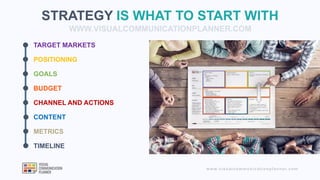
STRATEGY IS WHAT TO START WITH
TARGET MARKETS
POSITIONING
GOALS
BUDGET
CHANNEL AND ACTIONS
CONTENT
METRICS
TIMELINE
WWW.VISUALCOMMUNICATIONPLANNER.COM
www.visualcommunicationplanner.com
HOW TO USE IT
Outlining your communication strategy has never
been easier. Answer the questions and start
creating your visual plan today.
www.visualcommunicationplanner.com
WHEN IT IS USEFUL
EXAMINE
results and calculate the ROI
IDENTIFY
and anticipate possible mistakes
in current strategies
DEFINE
the communication plan for a
brand, project or specific market
FIND
any correctives quickly
OUTLINE
the editorial plan
ANALYZE
the communication scenario
www.visualcommunicationplanner.com
• Can you measure your market segment?
• Is it large enough to make a profit?
• Will it remain stable over time?
• Are you confident you can reach the right potential customers through the
communication channels you’re currently using?
• Do potential customers in the same segment want the same kind of product?
• Is your market segment diverse enough? Can potential groups of customers access
different kinds of products?
• Does the market segment respond to marketing stimulation?
• Can you create marketing stimulation with marketing activities that ensure a cost-
sustainable effect?
SEGMENTATION
www.visualcommunicationplanner.com
• Geographical segmentation – Your communication strategy doesn’t have to be confined to a specific country, you can
also target a particular region, city or defined geographical area. This is known as geo-marketing, and is particularly
useful for B2C communication. In geo-marketing, geographical data is used to communicate directly with specific
demographics.
• Demographic segmentation – This segments target markets by age, gender, employment, education or digitisation. When
used for B2C communication, it also takes into account the company’s size - more specifically its turnover, number of
employees and/or industry.
• Behavioural segmentation – Potential customers are divided into groups based on their skills, attitude, awareness and
brand loyalty.
• Psychographic segmentation – This is evaluated based on the social class, lifestyle, personality, interest and opinions of
potential customers.
• Cultural segmentation – This kind of segmentation is particularly important for foreign markets as it takes into account
cultural origin, religion, behaviour, traditions and colloquial language. Segmenting customers based on culture is
becoming increasingly important because of globalisation and migration, and new targets are beginning to request
products and services based on their cultural needs.
SEGMENTATION
www.visualcommunicationplanner.com
• Who do you want to buy your product or service?
• Who are your competitors communicating with?
• Who is influencing your target audience?
• Who is affected by your target audience?
• Who has the greatest online influence in your industry?
• Which industries are connected to your field of reference?
• What job positions do the superiors and subordinates of your target profiles
traditionally hold in the company?
TARGET MARKETS
www.visualcommunicationplanner.com
• How do you want your brand or product to be perceived by
your target market?
• Could this influence your choice of name?
• How do your competitors position themselves in this particular
market?
• Is your positioning appropriate for your target market?
The goal of positioning research is to define how your target market
perceives your product or service, compared to alternatives offered by
competitors in the same market.
POSITIONING
www.visualcommunicationplanner.com
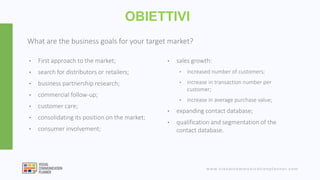
• First approach to the market;
• search for distributors or retailers;
• business partnership research;
• commercial follow-up;
• customer care;
• consolidating its position on the market;
• consumer involvement;
OBIETTIVI
• sales growth:
• increased number of customers;
• increase in transaction number per
customer;
• increase in average purchase value;
• expanding contact database;
• qualification and segmentation of the
contact database.
What are the business goals for your target market?
www.visualcommunicationplanner.com
GOALS VS. METRICS
Don’t confuse metrics with goals
Some metrics often referred to as goals:
 attract more visits to the website / e-commerce / blog, through specific sources;
 increase the number of followers or likes on Social Media;
 generate share of your posts on social media;
 get clicks from advertisements;
 increase openings or clicks on newsletters.
www.visualcommunicationplanner.com
METRICS
• What are the channel metrics to consider?
• What are business metrics?
• What metrics are needed to measure the ultimate communication goals?
• How often do you analyze traffic?
• What tools do you use to analyze the results?
• Who will analyze the results?
• What to do if goals are not met?
www.visualcommunicationplanner.com
METRICS
CHANNEL
METRICS
TOFU: WEBSITE TRAFFIC FROM
SPECIFIC CHANNELS
BUSINESS
METRICS
MOFU: FILLED FORMS
BUSINESS
GOALS
BOFU: READY-TO-BUY LEADS
www.visualcommunicationplanner.com
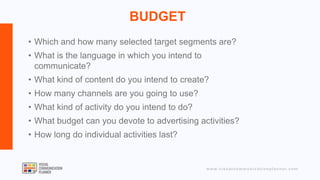
• Which and how many selected target segments are?
• What is the language in which you intend to
communicate?
• What kind of content do you intend to create?
• How many channels are you going to use?
• What kind of activity do you intend to do?
• What budget can you devote to advertising activities?
• How long do individual activities last?
BUDGET
www.visualcommunicationplanner.com
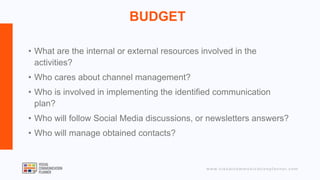
• What are the internal or external resources involved in the
activities?
• Who cares about channel management?
• Who is involved in implementing the identified communication
plan?
• Who will follow Social Media discussions, or newsletters answers?
• Who will manage obtained contacts?
BUDGET
www.visualcommunicationplanner.com
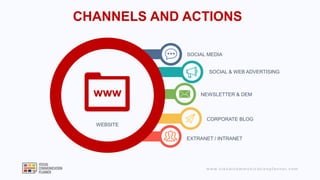
SOCIAL MEDIA
SOCIAL & WEB ADVERTISING
NEWSLETTER & DEM
CORPORATE BLOG
EXTRANET / INTRANET
CHANNELS AND ACTIONS
www
WEBSITE
www.visualcommunicationplanner.com
CHANNELS AND ACTIONS
• What are the most used web channels from the defined target?
• Are there niche channels dedicated to the reference sector?
• What is the actual use of these channels from your target?
• Have multiple target segments been identified, so are channels dedicated to these
segments?
• Which channels can be opened in relation to the defined budget?
• Do these channels help you achieve your goals?
• What are the direct and indirect costs?
• Is there anyone inside the company who can handle them?
• What tools are needed to use and measure these channels?
www.visualcommunicationplanner.com
• What actions do you need to take to achieve your defined objectives?
• Are your preferred channels already available? Do you need to activate any social profiles or
create a newsletter platform?
• What are the characteristics of each channel you want to use?
• What content do you need to properly profile your chosen channels?
• How many campaigns can you start with your current budget? Which ones will you focus on?
• What is your budget for web and social advertising?
• What action do you need to take on each channel?
• How often do you want to communicate on each channel?
• How do you plan to manage your engagement?
CHANNEL AND ACTIONS
www.visualcommunicationplanner.com
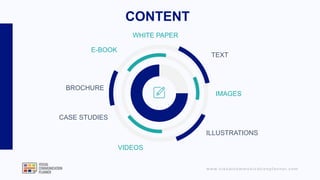
CONTENT
TEXT
IMAGES
ILLUSTRATIONS
VIDEOS
BROCHURE
E-BOOK
WHITE PAPER
CASE STUDIES
www.visualcommunicationplanner.com
• What content do you want to use in your communication?
• What is the context of your communication?
• What tone of voice and style do you want to use in your communication?
• What content do you need, and for which channels?
• What new content do you need to create? What existing content needs to be revised?
• Do you have an editorial calendar?
• Do you have editorial guidelines or standards for your content?
• What magazines, influencers or blogs inspire you?
• Who translates or localises your content?
• What are the main concepts or data you want to underline or emphasise?
• What concepts don’t you want to use?
• How do you plan to present your market supply on the web?
• What graphic line do you want to follow?
CONTENUTI
www.visualcommunicationplanner.com
GABRIELE CARBONI
Gabriele Carboni is co-founder of Weevo S.r.l., an Italian web
agency specializing in the international market approach
through Social Media. He is engaged in Marketing,
Communication and Sales, is a Digital Strategic Planner,
journalist and Communications Designer.
He has worked as a lecturer for 24Ore Business School, Ninja
Academy, Warrantraining and several Italian universities.
He is co-publisher and columist of Il Giornale delle PMI, the
Italian online magazine dedicated to small and medium-sized
businesses. He is also the author of "Strategie web per i mercati
esteri" (Digital Strategies for International Markets), Hoepli
2016.
www.visualcommunicationplanner.com
• Enterprise websites
• Social Media strategies and management
• Web Advertising
• Content production
• Twitter: @gabbariele | @weevo
• Webiste: http://www.weevo.it
• Blog: http://gabbariele.weevo.it
• Magazine: http://www.giornaledellepmi.it
• E-mail: gabriele@weevo.it
The Visual Communication Planner is licensed under the Creative Commons
Attribution-ShareAlike 4.0 International License. To view a copy of this license,
visit http://creativecommons.org/licenses/by-sa/4.0/.

Visual Communication Planner

  • 1.
  • 2.
    Plot a pathto communication success, analyse the most effective methods and eliminate operational issues and problems along the way. NOT A MARKETING EXPERT?
  • 3.
    www.visualcommunicationplanner.com Perfect for marketingand communication professionals and non-specialists alike, the Visual Communication Planner allows you to outline and visualise your strategy in a simple and understandable way.
  • 4.
    www.visualcommunicationplanner.com STRATEGY IS WHATTO START WITH TARGET MARKETS POSITIONING GOALS BUDGET CHANNEL AND ACTIONS CONTENT METRICS TIMELINE WWW.VISUALCOMMUNICATIONPLANNER.COM
  • 5.
    www.visualcommunicationplanner.com HOW TO USEIT Outlining your communication strategy has never been easier. Answer the questions and start creating your visual plan today.
  • 6.
    www.visualcommunicationplanner.com WHEN IT ISUSEFUL EXAMINE results and calculate the ROI IDENTIFY and anticipate possible mistakes in current strategies DEFINE the communication plan for a brand, project or specific market FIND any correctives quickly OUTLINE the editorial plan ANALYZE the communication scenario
  • 7.
    www.visualcommunicationplanner.com • Can youmeasure your market segment? • Is it large enough to make a profit? • Will it remain stable over time? • Are you confident you can reach the right potential customers through the communication channels you’re currently using? • Do potential customers in the same segment want the same kind of product? • Is your market segment diverse enough? Can potential groups of customers access different kinds of products? • Does the market segment respond to marketing stimulation? • Can you create marketing stimulation with marketing activities that ensure a cost- sustainable effect? SEGMENTATION
  • 8.
    www.visualcommunicationplanner.com • Geographical segmentation– Your communication strategy doesn’t have to be confined to a specific country, you can also target a particular region, city or defined geographical area. This is known as geo-marketing, and is particularly useful for B2C communication. In geo-marketing, geographical data is used to communicate directly with specific demographics. • Demographic segmentation – This segments target markets by age, gender, employment, education or digitisation. When used for B2C communication, it also takes into account the company’s size - more specifically its turnover, number of employees and/or industry. • Behavioural segmentation – Potential customers are divided into groups based on their skills, attitude, awareness and brand loyalty. • Psychographic segmentation – This is evaluated based on the social class, lifestyle, personality, interest and opinions of potential customers. • Cultural segmentation – This kind of segmentation is particularly important for foreign markets as it takes into account cultural origin, religion, behaviour, traditions and colloquial language. Segmenting customers based on culture is becoming increasingly important because of globalisation and migration, and new targets are beginning to request products and services based on their cultural needs. SEGMENTATION
  • 9.
    www.visualcommunicationplanner.com • Who doyou want to buy your product or service? • Who are your competitors communicating with? • Who is influencing your target audience? • Who is affected by your target audience? • Who has the greatest online influence in your industry? • Which industries are connected to your field of reference? • What job positions do the superiors and subordinates of your target profiles traditionally hold in the company? TARGET MARKETS
  • 10.
    www.visualcommunicationplanner.com • How doyou want your brand or product to be perceived by your target market? • Could this influence your choice of name? • How do your competitors position themselves in this particular market? • Is your positioning appropriate for your target market? The goal of positioning research is to define how your target market perceives your product or service, compared to alternatives offered by competitors in the same market. POSITIONING
  • 11.
    www.visualcommunicationplanner.com • First approachto the market; • search for distributors or retailers; • business partnership research; • commercial follow-up; • customer care; • consolidating its position on the market; • consumer involvement; OBIETTIVI • sales growth: • increased number of customers; • increase in transaction number per customer; • increase in average purchase value; • expanding contact database; • qualification and segmentation of the contact database. What are the business goals for your target market?
  • 12.
    www.visualcommunicationplanner.com GOALS VS. METRICS Don’tconfuse metrics with goals Some metrics often referred to as goals:  attract more visits to the website / e-commerce / blog, through specific sources;  increase the number of followers or likes on Social Media;  generate share of your posts on social media;  get clicks from advertisements;  increase openings or clicks on newsletters.
  • 13.
    www.visualcommunicationplanner.com METRICS • What arethe channel metrics to consider? • What are business metrics? • What metrics are needed to measure the ultimate communication goals? • How often do you analyze traffic? • What tools do you use to analyze the results? • Who will analyze the results? • What to do if goals are not met?
  • 14.
    www.visualcommunicationplanner.com METRICS CHANNEL METRICS TOFU: WEBSITE TRAFFICFROM SPECIFIC CHANNELS BUSINESS METRICS MOFU: FILLED FORMS BUSINESS GOALS BOFU: READY-TO-BUY LEADS
  • 15.
    www.visualcommunicationplanner.com • Which andhow many selected target segments are? • What is the language in which you intend to communicate? • What kind of content do you intend to create? • How many channels are you going to use? • What kind of activity do you intend to do? • What budget can you devote to advertising activities? • How long do individual activities last? BUDGET
  • 16.
    www.visualcommunicationplanner.com • What arethe internal or external resources involved in the activities? • Who cares about channel management? • Who is involved in implementing the identified communication plan? • Who will follow Social Media discussions, or newsletters answers? • Who will manage obtained contacts? BUDGET
  • 17.
    www.visualcommunicationplanner.com SOCIAL MEDIA SOCIAL &WEB ADVERTISING NEWSLETTER & DEM CORPORATE BLOG EXTRANET / INTRANET CHANNELS AND ACTIONS www WEBSITE
  • 18.
    www.visualcommunicationplanner.com CHANNELS AND ACTIONS •What are the most used web channels from the defined target? • Are there niche channels dedicated to the reference sector? • What is the actual use of these channels from your target? • Have multiple target segments been identified, so are channels dedicated to these segments? • Which channels can be opened in relation to the defined budget? • Do these channels help you achieve your goals? • What are the direct and indirect costs? • Is there anyone inside the company who can handle them? • What tools are needed to use and measure these channels?
  • 19.
    www.visualcommunicationplanner.com • What actionsdo you need to take to achieve your defined objectives? • Are your preferred channels already available? Do you need to activate any social profiles or create a newsletter platform? • What are the characteristics of each channel you want to use? • What content do you need to properly profile your chosen channels? • How many campaigns can you start with your current budget? Which ones will you focus on? • What is your budget for web and social advertising? • What action do you need to take on each channel? • How often do you want to communicate on each channel? • How do you plan to manage your engagement? CHANNEL AND ACTIONS
  • 20.
  • 21.
    www.visualcommunicationplanner.com • What contentdo you want to use in your communication? • What is the context of your communication? • What tone of voice and style do you want to use in your communication? • What content do you need, and for which channels? • What new content do you need to create? What existing content needs to be revised? • Do you have an editorial calendar? • Do you have editorial guidelines or standards for your content? • What magazines, influencers or blogs inspire you? • Who translates or localises your content? • What are the main concepts or data you want to underline or emphasise? • What concepts don’t you want to use? • How do you plan to present your market supply on the web? • What graphic line do you want to follow? CONTENUTI
  • 22.
    www.visualcommunicationplanner.com GABRIELE CARBONI Gabriele Carboniis co-founder of Weevo S.r.l., an Italian web agency specializing in the international market approach through Social Media. He is engaged in Marketing, Communication and Sales, is a Digital Strategic Planner, journalist and Communications Designer. He has worked as a lecturer for 24Ore Business School, Ninja Academy, Warrantraining and several Italian universities. He is co-publisher and columist of Il Giornale delle PMI, the Italian online magazine dedicated to small and medium-sized businesses. He is also the author of "Strategie web per i mercati esteri" (Digital Strategies for International Markets), Hoepli 2016.
  • 23.
    www.visualcommunicationplanner.com • Enterprise websites •Social Media strategies and management • Web Advertising • Content production • Twitter: @gabbariele | @weevo • Webiste: http://www.weevo.it • Blog: http://gabbariele.weevo.it • Magazine: http://www.giornaledellepmi.it • E-mail: gabriele@weevo.it The Visual Communication Planner is licensed under the Creative Commons Attribution-ShareAlike 4.0 International License. To view a copy of this license, visit http://creativecommons.org/licenses/by-sa/4.0/.