THE INDIAN PUBLIC SCHOOL (CBSE), ERODE
VISUAL ART
HAPPY DAY STUDENTS ;
I welcome you all to the world of creativity, colours and excitements.
Here, I like to give you a quick introduction about visual art and its role in your life.
What is Art?
The expression or application of human creative skill and imagination, typically in a visual
form such as painting or sculpture, producing works to be appreciated primarily for the
beauty or emotional power.
10 important skills to learn from art education:
 Creativity
 Observation
 Self-expression
 Focus
 Discipline
 Perseverance
 Collaboration
 Risk-taking
 Open mindedness
 Confidence
Benefits of art:
1. Working in the art helps learners to develop creative problem-solving skills.
2. Teaching through the arts can present difficult concepts visually, making them more
easy to understand.
3. Art instruction helps children with the development of motor skills, language skills,
social skills, decision-making, risk-taking, and inventiveness.
4. Visual arts teach learners about colour, layout, perspective, and balance: all
techniques that are necessary in presentations (visual, digital) of academic work.
5. Integrating art with other disciplines reaches students who might not otherwise be
engaged in classwork.
6. Arts experiences boost critical thinking, teaching students to take the time to be
more careful and thorough in how they observe the world.
7. The arts provide challenges for learners at all levels.
8. Art education connects students with their own culture as well as with the wider
world
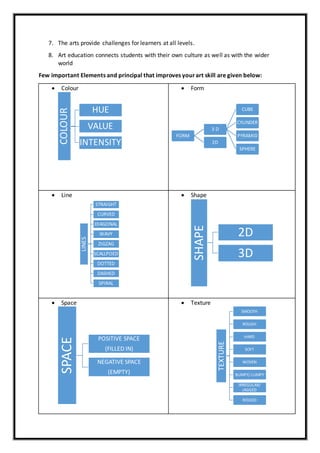
Few important Elements and principal that improves yourart skill are given below:
 Colour  Form
 Line  Shape
 Space  Texture
COLOUR
HUE
VALUE
INTENSITY
FORM
3 D
CUBE
CYLINDER
PYRAMID
SPHERE
2D
LINES
STRAIGHT
CURVED
DIAGONAL
WAVY
ZIGZAG
SCALLPOED
DOTTED
DASHED
SPIRAL
SHAPE
2D
3D
SPACE
POSITIVE SPACE
(FILLED IN)
NEGATIVE SPACE
(EMPTY)
TEXTURE
SMOOTH
ROUGH
HARD
SOFT
WOVEN
BUMPY/ LUMPY
IRREGULAR/
JAGGED
RIDGED
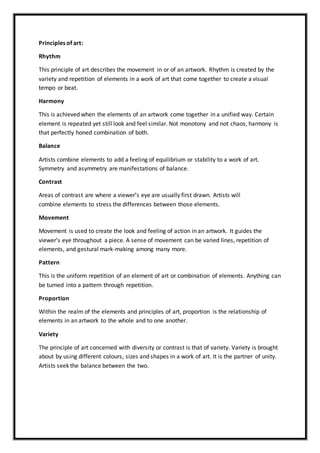
Principles of art:
Rhythm
This principle of art describes the movement in or of an artwork. Rhythm is created by the
variety and repetition of elements in a work of art that come together to create a visual
tempo or beat.
Harmony
This is achieved when the elements of an artwork come together in a unified way. Certain
element is repeated yet still look and feel similar. Not monotony and not chaos, harmony is
that perfectly honed combination of both.
Balance
Artists combine elements to add a feeling of equilibrium or stability to a work of art.
Symmetry and asymmetry are manifestations of balance.
Contrast
Areas of contrast are where a viewer’s eye are usually first drawn. Artists will
combine elements to stress the differences between those elements.
Movement
Movement is used to create the look and feeling of action in an artwork. It guides the
viewer’s eye throughout a piece. A sense of movement can be varied lines, repetition of
elements, and gestural mark-making among many more.
Pattern
This is the uniform repetition of an element of art or combination of elements. Anything can
be turned into a pattern through repetition.
Proportion
Within the realm of the elements and principles of art, proportion is the relationship of
elements in an artwork to the whole and to one another.
Variety
The principle of art concerned with diversity or contrast is that of variety. Variety is brought
about by using different colours, sizes and shapes in a work of art. It is the partner of unity.
Artists seek the balance between the two.
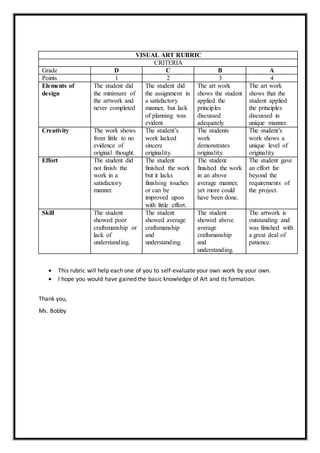
VISUAL ART RUBRIC
CRITERIA
Grade D C B A
Points 1 2 3 4
Elements of
design
The student did
the minimum of
the artwork and
never completed
The student did
the assignment in
a satisfactory
manner, but lack
of planning was
evident
The art work
shows the student
applied the
principles
discussed
adequately.
The art work
shows that the
student applied
the principles
discussed in
unique manner.
Creativity The work shows
from little to no
evidence of
original thought.
The student’s
work lacked
sincere
originality.
The students
work
demonstrates
originality.
The student’s
work shows a
unique level of
originality.
Effort The student did
not finish the
work in a
satisfactory
manner.
The student
finished the work
but it lacks
finishing touches
or can be
improved upon
with little effort.
The student
finished the work
in an above
average manner,
yet more could
have been done.
The student gave
an effort far
beyond the
requirements of
the project.
Skill The student
showed poor
craftsmanship or
lack of
understanding.
The student
showed average
craftsmanship
and
understanding.
The student
showed above
average
craftsmanship
and
understanding.
The artwork is
outstanding and
was finished with
a great deal of
patience.
 This rubric will help each one of you to self-evaluate your own work by your own.
 I hope you would have gained the basic knowledge of Art and its formation.
Thank you,
Ms. Bobby

Visual art basics

  • 1.
    THE INDIAN PUBLICSCHOOL (CBSE), ERODE VISUAL ART HAPPY DAY STUDENTS ; I welcome you all to the world of creativity, colours and excitements. Here, I like to give you a quick introduction about visual art and its role in your life. What is Art? The expression or application of human creative skill and imagination, typically in a visual form such as painting or sculpture, producing works to be appreciated primarily for the beauty or emotional power. 10 important skills to learn from art education:  Creativity  Observation  Self-expression  Focus  Discipline  Perseverance  Collaboration  Risk-taking  Open mindedness  Confidence Benefits of art: 1. Working in the art helps learners to develop creative problem-solving skills. 2. Teaching through the arts can present difficult concepts visually, making them more easy to understand. 3. Art instruction helps children with the development of motor skills, language skills, social skills, decision-making, risk-taking, and inventiveness. 4. Visual arts teach learners about colour, layout, perspective, and balance: all techniques that are necessary in presentations (visual, digital) of academic work. 5. Integrating art with other disciplines reaches students who might not otherwise be engaged in classwork. 6. Arts experiences boost critical thinking, teaching students to take the time to be more careful and thorough in how they observe the world.
  • 2.
    7. The artsprovide challenges for learners at all levels. 8. Art education connects students with their own culture as well as with the wider world Few important Elements and principal that improves yourart skill are given below:  Colour  Form  Line  Shape  Space  Texture COLOUR HUE VALUE INTENSITY FORM 3 D CUBE CYLINDER PYRAMID SPHERE 2D LINES STRAIGHT CURVED DIAGONAL WAVY ZIGZAG SCALLPOED DOTTED DASHED SPIRAL SHAPE 2D 3D SPACE POSITIVE SPACE (FILLED IN) NEGATIVE SPACE (EMPTY) TEXTURE SMOOTH ROUGH HARD SOFT WOVEN BUMPY/ LUMPY IRREGULAR/ JAGGED RIDGED
  • 3.
    Principles of art: Rhythm Thisprinciple of art describes the movement in or of an artwork. Rhythm is created by the variety and repetition of elements in a work of art that come together to create a visual tempo or beat. Harmony This is achieved when the elements of an artwork come together in a unified way. Certain element is repeated yet still look and feel similar. Not monotony and not chaos, harmony is that perfectly honed combination of both. Balance Artists combine elements to add a feeling of equilibrium or stability to a work of art. Symmetry and asymmetry are manifestations of balance. Contrast Areas of contrast are where a viewer’s eye are usually first drawn. Artists will combine elements to stress the differences between those elements. Movement Movement is used to create the look and feeling of action in an artwork. It guides the viewer’s eye throughout a piece. A sense of movement can be varied lines, repetition of elements, and gestural mark-making among many more. Pattern This is the uniform repetition of an element of art or combination of elements. Anything can be turned into a pattern through repetition. Proportion Within the realm of the elements and principles of art, proportion is the relationship of elements in an artwork to the whole and to one another. Variety The principle of art concerned with diversity or contrast is that of variety. Variety is brought about by using different colours, sizes and shapes in a work of art. It is the partner of unity. Artists seek the balance between the two.
  • 4.
    VISUAL ART RUBRIC CRITERIA GradeD C B A Points 1 2 3 4 Elements of design The student did the minimum of the artwork and never completed The student did the assignment in a satisfactory manner, but lack of planning was evident The art work shows the student applied the principles discussed adequately. The art work shows that the student applied the principles discussed in unique manner. Creativity The work shows from little to no evidence of original thought. The student’s work lacked sincere originality. The students work demonstrates originality. The student’s work shows a unique level of originality. Effort The student did not finish the work in a satisfactory manner. The student finished the work but it lacks finishing touches or can be improved upon with little effort. The student finished the work in an above average manner, yet more could have been done. The student gave an effort far beyond the requirements of the project. Skill The student showed poor craftsmanship or lack of understanding. The student showed average craftsmanship and understanding. The student showed above average craftsmanship and understanding. The artwork is outstanding and was finished with a great deal of patience.  This rubric will help each one of you to self-evaluate your own work by your own.  I hope you would have gained the basic knowledge of Art and its formation. Thank you, Ms. Bobby