1
The Future of Transportation on
the Caltrain Corridor
11.30.16
2
3
Today
What is happening
Vision
Recommendations
What is costs
How to pay for it
4
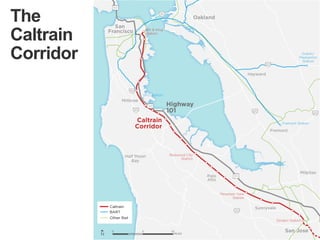
The Caltrain Corridor is home to
the world’s innovation economy –
but its transportation system is
falling short.
5
The
Caltrain
Corridor
6
Caltrain is increasingly crowded
during peak hours
7
Caltrain’s limited off-peak service
makes transit less usable.
8
User of highway 101 face growing
delays due to traffic and
inefficiencies.
9
Single-occupancy vehicles take up
most of the space on highway 101
10
Access to
opportunity
needs to
grow.
11
As the
region
grows,
we’ll need
to move
more
people.
12
Densification
13
Densification
14
Our Vision for the Caltrain Corridor
Convenience
Connectivity
Capacity
Community
Climate Protection
15
Vision: Highway, rail and ferry
system that work together.
16
New Capacity
People moved during
peak hour today
(each direction)
People moved during
peak hour under the
vision plan (each
direction)
Caltrain 3,250 10,000*
Highway 101 1,780 5,680
Ferry 0 1,400
Does not include capacity provided by HSR.
17
Opportunities
18
Electrification and high-speed
rail can dramatically imrpove rail
capacity, comfort and reliability.
19
Electrification
can transform
the economics
of the railroad.
20
With high-
speed rail and
statewide rail
modernization,
this corridor will
become part of
an improved
statewide rail
network.
21
The digital age of transportation
portends safer, more efficient, more
convenient passenger transportation.
22
Challenges
23
The corridor’s transportation
system was built for a different era.
24
The corridor’s transportation
system was built for a different
era.
25
The corridor’s transportation
system was built for a different era.
26
Caltrain is financially unstable,
making it difficult to plan for the
future.
27
Neighborhood impacts make it
harder to grow rail service.
28
Many origins and destinations are
far from rail.
29
Transportation
planning is
done locally,
for one mode
at a time,
instead of
through an
integrated,
corridor-wide
approach.
30
Recommendations
31
A corridor shaped by an
outstanding rail system.
32
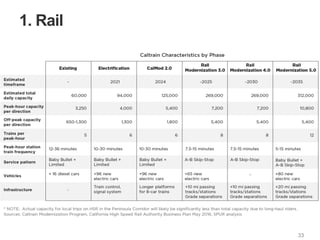
1. Rail
33
1. Rail
34
Additional Rail Recommendations.
•  Improve Caltrain in short-term – before
electrification.
•  Connect Caltrain to downtown SF (the DTX)
•  Develop a business plan for Caltrain.
35
Use a corridor-wide strategy to
address the impact of at-grade
crossings.
36
New Rail Services: Concepts for the
Future
Local Rail Connections (spurs and branches)
Major Connecting Corridors
Second Transbay Rail Crossing
Dumbarton Rail Corridor

BART Silicon Valley
New Alignments within the Caltrain Corridor
37
2. Rail Stations and First/Last Mile-
Connections
38
Stations and First/Last-mile
Recommendations
Create a station modernization program
•  Upgrade Stations to attract and accommodate new
riders.
•  Improve station access – for sustainable and space-
efficient modes of travel.
Create a first/last-mile program.
•  Proactively mange station access and first- and last-
mile connections at each rail station.
39
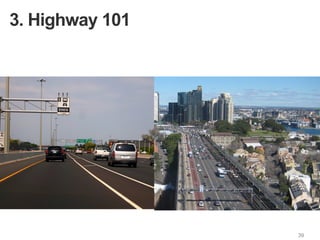
3. Highway 101
40
Highway 101 Recommendations
•  Manage a lane (or more) of highways 101 as an
“optimized” high-occupancy toll (HOT) lane, along the
entire corridor.
•  Adopt equity policies and programs for HOT lanes.
•  Use revenue from pricing Highway 101 to add more
public transit service.
•  Grow regional express bus services.
41
4. Ferries
42
Ferry Recommendations
•  Create a ferry terminal at the Port of Redwood
City.
•  Expand ferry services to include Peninsula
stops.
43
5. A Seamless Transit Experience
44
Seamless Transit
Recommendations
•  Integrate information and payment across mobility
services.
•  Operate BART, Caltrain and high-speed rail as one
system from the rider’s perspective.
•  Use fare subsidies and fare policies to improve transit
affordability and make transit work for more people.
•  Conduct short-range and long-range transportation
planning as a corridor.
45
Governance:
Everyone
has a part to
play.
Caltrans
Samtrans
Caltrain
VTA
SMCTA
SFCTA
SFMTA
Cities
MTC
CAHSR
BART
CalSTA
46
What the Vision Costs:
$16 - $21 billion (20 years)
Fleet	 Capital	
Operations and
Maintenace	
Rail	 $140 million	 $8.2 - $12.3 billion	 $4.95 billion	
Stations and
First/Last-Mile
Connections	
n/a	 $1.6 - 1.7 billion	 $660 million	
Highway 101	 $40 million	 $20 -$150 million	 $210 - $735 million	
Ferry	 $80 million	 $40 million	 $260 million	
Coordinated
Transit	 n/a	 $15 million	 $140-150 million	
Total	 $260 million	 $9.8 - $14.1 billion	 $6.2 - $6.8 billion
47
How Do We Fund the Vision?
Strategy Anticipated Revenue
1. Anticipated Regional/State/Federal
revenue
$3.0 Billion
2. Transit fares and highway toll $5.0 Billion
3. Countywide sales taxes $2.0 Billion
4. Corridor parcel tax $2.4 Billion
5. Local property-based and business-
based funding
$3.0 Billion
6. New regional and state funding $3.0 Billion
7. Public-Private Partnership
Total $18.5 Billion
48
Next Steps: What we need to do
now.
Policy Agreement:
1. Caltrain/high-speed rail operating plan.
2. Highway 101 lane management across three counties.
3. Alignment for the Downtown Extension.
Funding:
4. Advocate for Vision Plan projects in the Regional Transportation
Plan.
5. Organize 2018 funding measures to fund rail infrastructure, fleet
and operations, highway 101 management.
Rail Service:
6. Improve today’s rail schedule, add trains.
49
The Future of Transportation on
the Caltrain Corridor

Vision plan spur 11.30 presentation - hires