Transportation
Sustainability
CE 256
Prof. Susan
Shaheen
MEGAPROJECTS AND THE
CALIFORNIA HIGH-SPEED
RAIL PROJECT
UNIVERSITY OF CALIFORNIA
BERKELEY
PRESENTED BY ARTHUR BAUER
MARCH 10, 2016
USDOT: A project costing $1B or more
Mega implies the size of the task involved in
developing, planning, and managing projects are
challenging
Socio-economic impacts
Engineering or construction innovation
The risks are substantial
WHAT IS A MEGAPROJECT?
 Today the focus will be on public projects, especially
the California high-Speed Rail Project
 Because of the scale of megaprojects, the general
public and public officials become enamored or
disenchanted
 A sense of mastering the universe
 There is an awe quality surrounding megaprojects
 Important Benefits may flow from Megaprojet
WHAT IS A MEGAPROJECT?
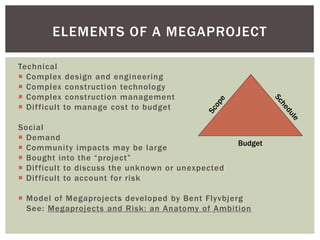
Technical
 Complex design and engineering
 Complex construction technology
 Complex construction management
 Difficult to manage cost to budget
Social
 Demand
 Community impacts may be large
 Bought into the “project”
 Difficult to discuss the unknown or unexpected
 Difficult to account for risk
 Model of Megaprojects developed by Bent Flyvbjerg
See: Megaprojects and Risk: an Anatomy of Ambition
ELEMENTS OF A MEGAPROJECT
Budget
Big dreams
Big dollars
Big risks
CORE ELEMENTS OF A MEGAPROJECT
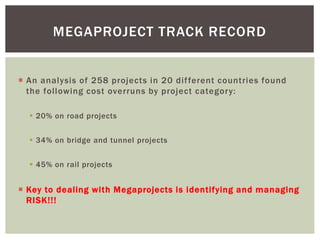
 An analysis of 258 projects in 20 different countries found
the following cost overruns by project category:
ď‚§ 20% on road projects
ď‚§ 34% on bridge and tunnel projects
ď‚§ 45% on rail projects
 Key to dealing with Megaprojects is identifying and managing
RISK!!!
MEGAPROJECT TRACK RECORD
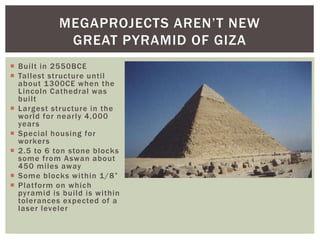
 Built in 2550BCE
 Tallest structure until
about 1300CE when the
Lincoln Cathedral was
built
 Largest structure in the
world for nearly 4,000
years
 Special housing for
workers
 2.5 to 6 ton stone blocks
some from Aswan about
450 miles away
 Some blocks within 1/8”
 Platform on which
pyramid is build is within
tolerances expected of a
laser leveler
MEGAPROJECTS AREN’T NEW
GREAT PYRAMID OF GIZA
 Optimism Bias:
ď‚§ Project promoters and planners spin scenarios of success and gloss over
risks and possible failure
 Strategic misrepresentation
 Why?
ď‚§ Competition for funds
 “The dream” or the character of the project
ď‚§ Commitments made to a particular stakeholders, project or project scope
without understanding risks ,e.g.., financial, construction, patronage,
managerial, other
WHY DO MEGAPROJECTS EXCEED COST
PROJECTIONS
 At the front-end, planning stage identify comparable, high
profile megaprojects and analyze drivers for costs increases,
schedule delay, and scope changes. This is for reference
 Ensure project decision-makers bare burden of financing
 Ensure the skill mix of the planners, engineers, and
contractors meet the demands of the project
 Transparent decision-making
 Honesty
HOW TO CONTROL MEGAPROJECTS?
 Understanding demand is critical for transportation projects,
including airports, highways, toll bridges and tunnels, and public
mass transit projects
 Financing is linked to demand forecast
 Project scope and scale often linked to demand forecast
 Manipulating demand infects the project with misplaced optimism
 Understanding demand forecast is daunting and trust is usually
assumed in formulating of the forecast
DEMAND
 Megaprojects evolve overtime—”organic phenomena”
 Megaprojects function as agents of change for society, e.g.,
Channel Tunnel between Britain and France or the HSR Project,
Interstate Highway System, California Water Project
 Impacts cannot be assessed at the front end
 Projects can meet schedule and budget, but fail to meet current or
future needs
But:
 Not easy to separate projects from scope, schedule, budget issues
 Trade-offs abound. For example, more debt to pay for increasing
costs takes funds for debt service that could be used in other
projects
Omega Centre at the Bartlett School of Planning, University of London
ANOTHER POINT OF VIEW
MEGAPROJECTS NEED A BROADER
DEFINITION OF SUCCESS
 1981—Japanese-American group proposes a HSR project between
Los Angeles and San Diego
ď‚§ Project goes nowhere after legislative delegation visits Japan.
Legislators found the technology incompatible with coastal communities
because of noise
 1990—Proposition 116 ($2B transit bond) authorizes $500,000
to identify a corridor for HSR to cross the Tehachapi Mountains
 1996—Legislation establishes the HSR Authority
 2008—Legislator places Proposition 1A on ballot to fund a HSR
project
ď‚§ Prop 1A passes with 52.6 percent of the vote
HIGH-SPEED RAIL COMES TO CALIFORNIA
Funding Requirements
 Authorizes $9.95B bond—$9B to HSR & .950B for local
projects
 Allows 0.900B for planning, engineering &up to 0.450B for
admin
 Bond funds used for construction must be matched dollar for
dollar
 Other sources of funding anticipated, including federal, local
gov’t, & private
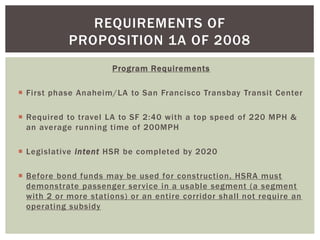
REQUIREMENTS OF
PROPOSITION 1A OF 2008
Program Requirements
 First phase Anaheim/LA to San Francisco Transbay Transit Center
 Required to travel LA to SF 2:40 with a top speed of 220 MPH &
an average running time of 200MPH
 Legislative intent HSR be completed by 2020
 Before bond funds may be used for construction, HSRA must
demonstrate passenger service in a usable segment (a segment
with 2 or more stations) or an entire corridor shall not require an
operating subsidy
REQUIREMENTS OF
PROPOSITION 1A OF 2008
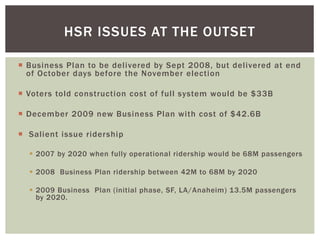
 Business Plan to be delivered by Sept 2008, but delivered at end
of October days before the November election
 Voters told construction cost of full system would be $33B
 December 2009 new Business Plan with cost of $42.6B
 Salient issue ridership
ď‚§ 2007 by 2020 when fully operational ridership would be 68M passengers
ď‚§ 2008 Business Plan ridership between 42M to 68M by 2020
ď‚§ 2009 Business Plan (initial phase, SF, LA/Anaheim) 13.5M passengers
by 2020.
HSR ISSUES AT THE OUTSET
 State Senate Transportation Committee asks ITS to review the
HSRA’s travel demand model
 HSRA paid for the review
 ITS reviewed the “Bay Area/California High-Speed Rail
Ridership and Revenue Forecasting Study”
RESOLVING RIDERSHIP ISSUES
ITS TO THE RESCUE
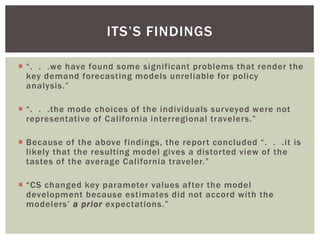
 “. . .we have found some significant problems that render the
key demand forecasting models unreliable for policy
analysis.”
 “. . .the mode choices of the individuals surveyed were not
representative of California interregional travelers.”
 Because of the above findings, the report concluded “. . .it is
likely that the resulting model gives a distorted view of the
tastes of the average California traveler.”
 “CS changed key parameter values after the model
development because estimates did not accord with the
modelers’ a prior expectations.”
ITS’S FINDINGS
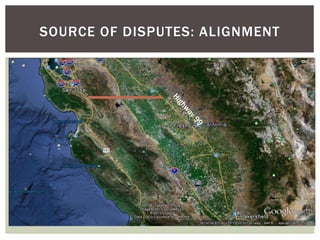
SOURCE OF DISPUTES: ALIGNMENT
 Agricultural an issue from day one
ď‚§ California largest ag state: $45.5B, Iowa is second $29.9B
ď‚§ Dairy $7.6B, Almonds $3.8B
ď‚§ Number 1 export ag product almonds--$2.4B
 Community issues on the San Francisco Peninsula
ď‚§ 30 minutes San Francisco to San Jose
 Community issues in East Los Angeles entrapped by highway
 Orange County opposed HSR because of community concerns
ISSUES
 Cost control is always an issue with megaprojects
 Time itself becomes an enemy of cost control
 Competency of project management and construction
management has an impact on cost
 Selection of alignment and more precise engineering can
influence cost in either direction
 Cost of property acquisition influences cost
 Politics may affect project cost
HSR COST ISSUES
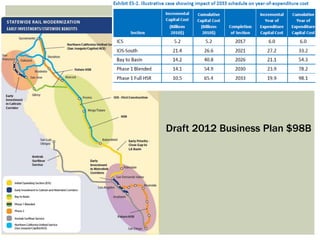
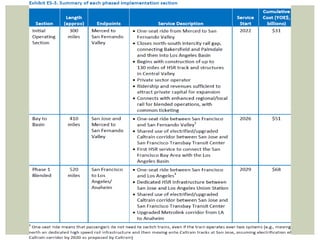
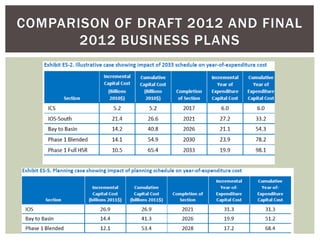
Draft 2012 Business Plan $98B
COMPARISON OF DRAFT 2012 AND FINAL
2012 BUSINESS PLANS
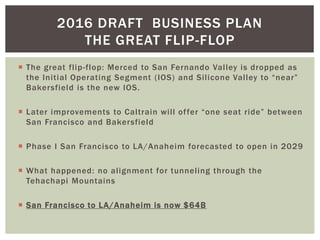
 The great flip-flop: Merced to San Fernando Valley is dropped as
the Initial Operating Segment (IOS) and Silicone Valley to “near”
Bakersfield is the new IOS.
 Later improvements to Caltrain will offer “one seat ride” between
San Francisco and Bakersfield
 Phase I San Francisco to LA/Anaheim forecasted to open in 2029
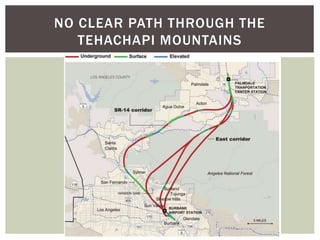
 What happened: no alignment for tunneling through the
Tehachapi Mountains
 San Francisco to LA/Anaheim is now $64B
2016 DRAFT BUSINESS PLAN
THE GREAT FLIP-FLOP
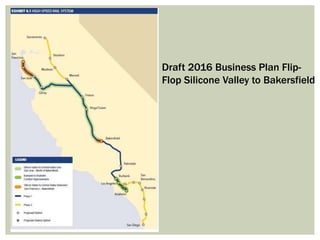
Draft 2016 Business Plan Flip-
Flop Silicone Valley to Bakersfield
NO CLEAR PATH THROUGH THE
TEHACHAPI MOUNTAINS
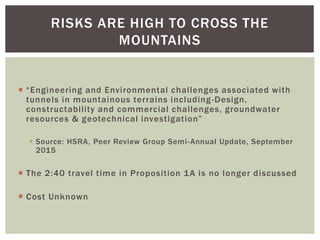
 “Engineering and Environmental challenges associated with
tunnels in mountainous terrains including-Design,
constructability and commercial challenges, groundwater
resources & geotechnical investigation”
ď‚§ Source: HSRA, Peer Review Group Semi-Annual Update, September
2015
 The 2:40 travel time in Proposition 1A is no longer discussed
 Cost Unknown
RISKS ARE HIGH TO CROSS THE
MOUNTAINS
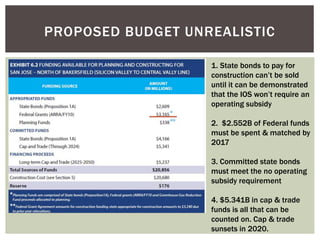
PROPOSED BUDGET UNREALISTIC
1. State bonds to pay for
construction can’t be sold
until it can be demonstrated
that the IOS won’t require an
operating subsidy
2. $2.552B of Federal funds
must be spent & matched by
2017
3. Committed state bonds
must meet the no operating
subsidy requirement
4. $5.341B in cap & trade
funds is all that can be
counted on. Cap & trade
sunsets in 2020.
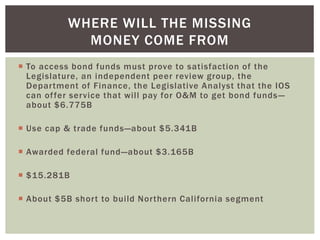
 To access bond funds must prove to satisfaction of the
Legislature, an independent peer review group, the
Department of Finance, the Legislative Analyst that the IOS
can offer service that will pay for O&M to get bond funds—
about $6.775B
 Use cap & trade funds—about $5.341B
 Awarded federal fund—about $3.165B
 $15.281B
 About $5B short to build Northern California segment
WHERE WILL THE MISSING
MONEY COME FROM
Thank you
Questions

FINAL CHSRP AND Megaproject Presentation

  • 1.
    Transportation Sustainability CE 256 Prof. Susan Shaheen MEGAPROJECTSAND THE CALIFORNIA HIGH-SPEED RAIL PROJECT UNIVERSITY OF CALIFORNIA BERKELEY PRESENTED BY ARTHUR BAUER MARCH 10, 2016
  • 2.
    USDOT: A projectcosting $1B or more Mega implies the size of the task involved in developing, planning, and managing projects are challenging Socio-economic impacts Engineering or construction innovation The risks are substantial WHAT IS A MEGAPROJECT?
  • 3.
     Today thefocus will be on public projects, especially the California high-Speed Rail Project  Because of the scale of megaprojects, the general public and public officials become enamored or disenchanted  A sense of mastering the universe  There is an awe quality surrounding megaprojects  Important Benefits may flow from Megaprojet WHAT IS A MEGAPROJECT?
  • 4.
    Technical  Complex designand engineering  Complex construction technology  Complex construction management  Difficult to manage cost to budget Social  Demand  Community impacts may be large  Bought into the “project”  Difficult to discuss the unknown or unexpected  Difficult to account for risk  Model of Megaprojects developed by Bent Flyvbjerg See: Megaprojects and Risk: an Anatomy of Ambition ELEMENTS OF A MEGAPROJECT Budget
  • 5.
    Big dreams Big dollars Bigrisks CORE ELEMENTS OF A MEGAPROJECT
  • 6.
     An analysisof 258 projects in 20 different countries found the following cost overruns by project category:  20% on road projects  34% on bridge and tunnel projects  45% on rail projects  Key to dealing with Megaprojects is identifying and managing RISK!!! MEGAPROJECT TRACK RECORD
  • 7.
     Built in2550BCE  Tallest structure until about 1300CE when the Lincoln Cathedral was built  Largest structure in the world for nearly 4,000 years  Special housing for workers  2.5 to 6 ton stone blocks some from Aswan about 450 miles away  Some blocks within 1/8”  Platform on which pyramid is build is within tolerances expected of a laser leveler MEGAPROJECTS AREN’T NEW GREAT PYRAMID OF GIZA
  • 8.
     Optimism Bias: Project promoters and planners spin scenarios of success and gloss over risks and possible failure  Strategic misrepresentation  Why?  Competition for funds  “The dream” or the character of the project  Commitments made to a particular stakeholders, project or project scope without understanding risks ,e.g.., financial, construction, patronage, managerial, other WHY DO MEGAPROJECTS EXCEED COST PROJECTIONS
  • 9.
     At thefront-end, planning stage identify comparable, high profile megaprojects and analyze drivers for costs increases, schedule delay, and scope changes. This is for reference  Ensure project decision-makers bare burden of financing  Ensure the skill mix of the planners, engineers, and contractors meet the demands of the project  Transparent decision-making  Honesty HOW TO CONTROL MEGAPROJECTS?
  • 10.
     Understanding demandis critical for transportation projects, including airports, highways, toll bridges and tunnels, and public mass transit projects  Financing is linked to demand forecast  Project scope and scale often linked to demand forecast  Manipulating demand infects the project with misplaced optimism  Understanding demand forecast is daunting and trust is usually assumed in formulating of the forecast DEMAND
  • 11.
     Megaprojects evolveovertime—”organic phenomena”  Megaprojects function as agents of change for society, e.g., Channel Tunnel between Britain and France or the HSR Project, Interstate Highway System, California Water Project  Impacts cannot be assessed at the front end  Projects can meet schedule and budget, but fail to meet current or future needs But:  Not easy to separate projects from scope, schedule, budget issues  Trade-offs abound. For example, more debt to pay for increasing costs takes funds for debt service that could be used in other projects Omega Centre at the Bartlett School of Planning, University of London ANOTHER POINT OF VIEW MEGAPROJECTS NEED A BROADER DEFINITION OF SUCCESS
  • 12.
     1981—Japanese-American groupproposes a HSR project between Los Angeles and San Diego  Project goes nowhere after legislative delegation visits Japan. Legislators found the technology incompatible with coastal communities because of noise  1990—Proposition 116 ($2B transit bond) authorizes $500,000 to identify a corridor for HSR to cross the Tehachapi Mountains  1996—Legislation establishes the HSR Authority  2008—Legislator places Proposition 1A on ballot to fund a HSR project  Prop 1A passes with 52.6 percent of the vote HIGH-SPEED RAIL COMES TO CALIFORNIA
  • 13.
    Funding Requirements  Authorizes$9.95B bond—$9B to HSR & .950B for local projects  Allows 0.900B for planning, engineering &up to 0.450B for admin  Bond funds used for construction must be matched dollar for dollar  Other sources of funding anticipated, including federal, local gov’t, & private REQUIREMENTS OF PROPOSITION 1A OF 2008
  • 14.
    Program Requirements  Firstphase Anaheim/LA to San Francisco Transbay Transit Center  Required to travel LA to SF 2:40 with a top speed of 220 MPH & an average running time of 200MPH  Legislative intent HSR be completed by 2020  Before bond funds may be used for construction, HSRA must demonstrate passenger service in a usable segment (a segment with 2 or more stations) or an entire corridor shall not require an operating subsidy REQUIREMENTS OF PROPOSITION 1A OF 2008
  • 15.
     Business Planto be delivered by Sept 2008, but delivered at end of October days before the November election  Voters told construction cost of full system would be $33B  December 2009 new Business Plan with cost of $42.6B  Salient issue ridership  2007 by 2020 when fully operational ridership would be 68M passengers  2008 Business Plan ridership between 42M to 68M by 2020  2009 Business Plan (initial phase, SF, LA/Anaheim) 13.5M passengers by 2020. HSR ISSUES AT THE OUTSET
  • 16.
     State SenateTransportation Committee asks ITS to review the HSRA’s travel demand model  HSRA paid for the review  ITS reviewed the “Bay Area/California High-Speed Rail Ridership and Revenue Forecasting Study” RESOLVING RIDERSHIP ISSUES ITS TO THE RESCUE
  • 17.
     “. ..we have found some significant problems that render the key demand forecasting models unreliable for policy analysis.”  “. . .the mode choices of the individuals surveyed were not representative of California interregional travelers.”  Because of the above findings, the report concluded “. . .it is likely that the resulting model gives a distorted view of the tastes of the average California traveler.”  “CS changed key parameter values after the model development because estimates did not accord with the modelers’ a prior expectations.” ITS’S FINDINGS
  • 18.
  • 19.
     Agricultural anissue from day one  California largest ag state: $45.5B, Iowa is second $29.9B  Dairy $7.6B, Almonds $3.8B  Number 1 export ag product almonds--$2.4B  Community issues on the San Francisco Peninsula  30 minutes San Francisco to San Jose  Community issues in East Los Angeles entrapped by highway  Orange County opposed HSR because of community concerns ISSUES
  • 20.
     Cost controlis always an issue with megaprojects  Time itself becomes an enemy of cost control  Competency of project management and construction management has an impact on cost  Selection of alignment and more precise engineering can influence cost in either direction  Cost of property acquisition influences cost  Politics may affect project cost HSR COST ISSUES
  • 21.
  • 23.
    COMPARISON OF DRAFT2012 AND FINAL 2012 BUSINESS PLANS
  • 24.
     The greatflip-flop: Merced to San Fernando Valley is dropped as the Initial Operating Segment (IOS) and Silicone Valley to “near” Bakersfield is the new IOS.  Later improvements to Caltrain will offer “one seat ride” between San Francisco and Bakersfield  Phase I San Francisco to LA/Anaheim forecasted to open in 2029  What happened: no alignment for tunneling through the Tehachapi Mountains  San Francisco to LA/Anaheim is now $64B 2016 DRAFT BUSINESS PLAN THE GREAT FLIP-FLOP
  • 25.
    Draft 2016 BusinessPlan Flip- Flop Silicone Valley to Bakersfield
  • 26.
    NO CLEAR PATHTHROUGH THE TEHACHAPI MOUNTAINS
  • 27.
     “Engineering andEnvironmental challenges associated with tunnels in mountainous terrains including-Design, constructability and commercial challenges, groundwater resources & geotechnical investigation”  Source: HSRA, Peer Review Group Semi-Annual Update, September 2015  The 2:40 travel time in Proposition 1A is no longer discussed  Cost Unknown RISKS ARE HIGH TO CROSS THE MOUNTAINS
  • 28.
    PROPOSED BUDGET UNREALISTIC 1.State bonds to pay for construction can’t be sold until it can be demonstrated that the IOS won’t require an operating subsidy 2. $2.552B of Federal funds must be spent & matched by 2017 3. Committed state bonds must meet the no operating subsidy requirement 4. $5.341B in cap & trade funds is all that can be counted on. Cap & trade sunsets in 2020.
  • 29.
     To accessbond funds must prove to satisfaction of the Legislature, an independent peer review group, the Department of Finance, the Legislative Analyst that the IOS can offer service that will pay for O&M to get bond funds— about $6.775B  Use cap & trade funds—about $5.341B  Awarded federal fund—about $3.165B  $15.281B  About $5B short to build Northern California segment WHERE WILL THE MISSING MONEY COME FROM
  • 30.