Through the eyes of an animal: how animals see Ishara Mills-Henry, Ph.D. Science of the Eye Program MIT


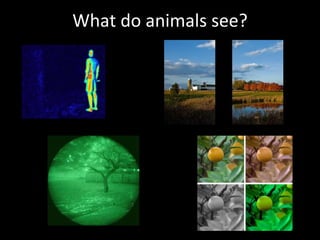
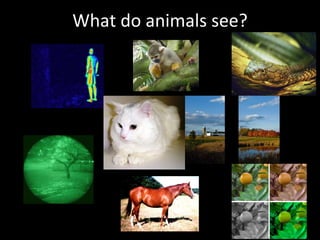
What do animals see?
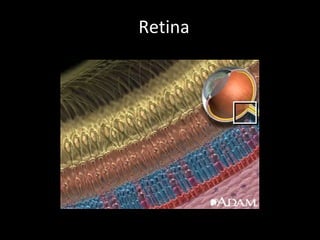
The Retina From www.howstuffworks.com Retina
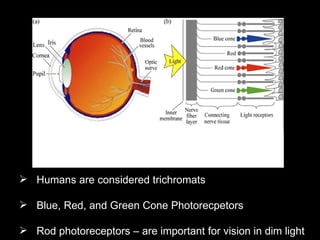
Retina Humans are considered trichromats  Blue, Red, and Green Cone Photorecpetors Rod photoreceptors – are important for vision in dim light
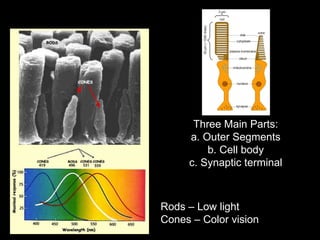
Rods – Low light  Cones – Color vision Three Main Parts: a. Outer Segments b. Cell body c. Synaptic terminal
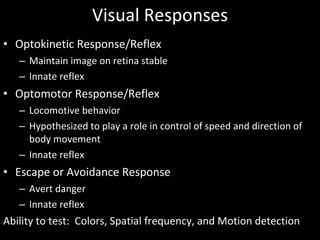
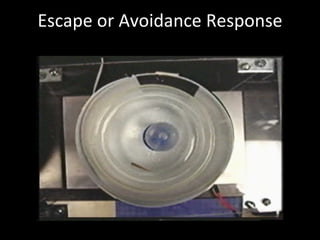
Visual Responses Optokinetic Response/Reflex Maintain image on retina stable Innate reflex Optomotor Response/Reflex Locomotive behavior Hypothesized to play a role in control of speed and direction of body movement Innate reflex Escape or Avoidance Response Avert danger Innate reflex Ability to test:  Colors, Spatial frequency, and Motion detection
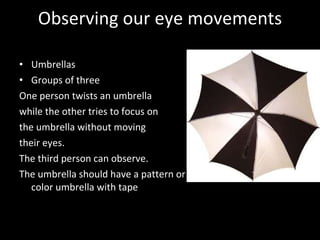
Observing our eye movements Umbrellas Groups of three One person twists an umbrella  while the other tries to focus on  the umbrella without moving  their eyes. The third person can observe.  The umbrella should have a pattern or make stripes on a solid color umbrella with tape
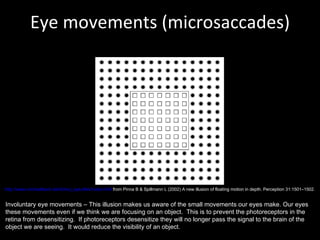
Eye movements (microsaccades) http://www.michaelbach.de/ot/mot_eyeJitter/index.html  from Pinna B & Spillmann L (2002) A new illusion of floating motion in depth. Perception 31:1501–1502. Involuntary eye movements – This illusion makes us aware of the small movements our eyes make. Our eyes these movements even if we think we are focusing on an object.  This is to prevent the photoreceptors in the retina from desensitizing.  If photoreceptors desensitize they will no longer pass the signal to the brain of the object we are seeing.  It would reduce the visibility of an object.
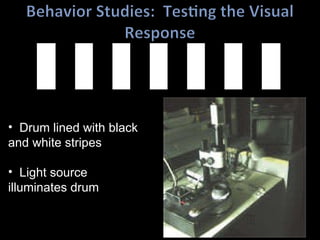
Drum lined with black and white stripes Light source illuminates drum
Optokinetic Response Vertebrates exhibit numerous reflex behaviors that are driven by visual stimuli.  The  OKR  response encompasses smooth eye rotations which track moving patterns followed by sharp movements called saccades.
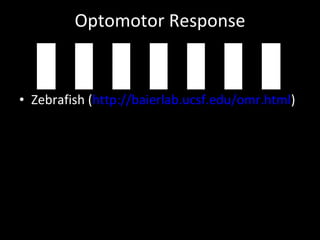
Optomotor Response Zebrafish ( http://baierlab.ucsf.edu/omr.html )
Escape or Avoidance Response
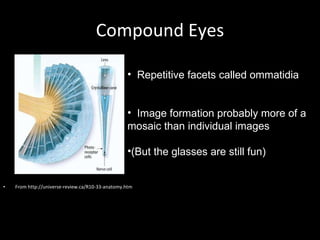
Compound Eyes From http://universe-review.ca/R10-33-anatomy.htm Repetitive facets called ommatidia Image formation probably more of a mosaic than individual images  (But the glasses are still fun)
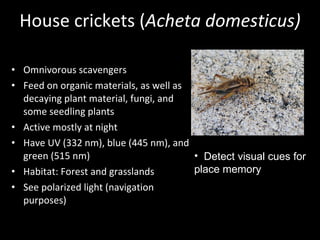
House crickets ( Acheta domesticus)   Omnivorous scavengers Feed on organic materials, as well as decaying plant material, fungi, and some seedling plants Active mostly at night Have UV (332 nm), blue (445 nm), and green (515 nm) Habitat: Forest and grasslands See polarized light (navigation purposes) Detect visual cues for place memory
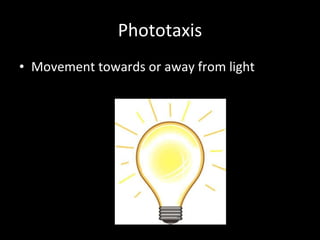
Phototaxis Movement towards or away from light
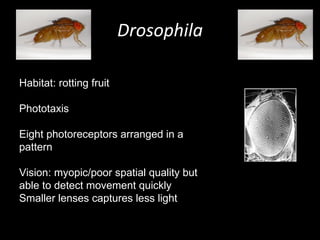
Drosophila Habitat: rotting fruit Phototaxis Eight photoreceptors arranged in a pattern Vision: myopic/poor spatial quality but able to detect movement quickly Smaller lenses captures less light
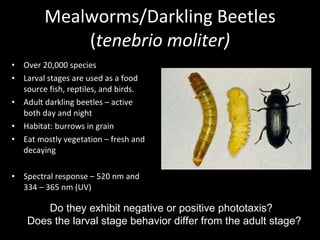
Mealworms/Darkling Beetles ( tenebrio moliter) Over 20,000 species  Larval stages are used as a food source fish, reptiles, and birds. Adult darkling beetles – active both day and night Habitat: burrows in grain Eat mostly vegetation – fresh and decaying Spectral response – 520 nm and 334 – 365 nm (UV) Do they exhibit negative or positive phototaxis?  Does the larval stage behavior differ from the adult stage?
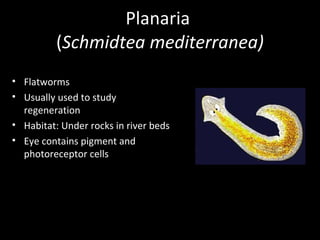
Planaria  ( Schmidtea mediterranea) Flatworms  Usually used to study regeneration Habitat: Under rocks in river beds Eye contains pigment and photoreceptor cells
Emperor Scorpions ( Pandinus imperator) Found in the tropical forests and savannas of Africa Docile, although can become territorial and cannibalistic Nocturnal –hunts for prey at night Habitat: under rocks, logs, and other forest debris
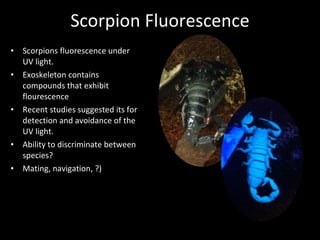
Scorpion Fluorescence Scorpions fluorescence under UV light. Exoskeleton contains compounds that exhibit flourescence Recent studies suggested its for detection and avoidance of the UV light.  Ability to discriminate between species? Mating, navigation, ?)
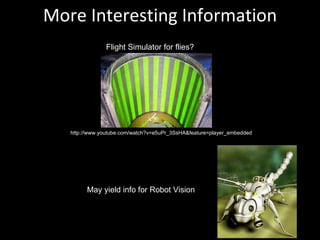
More Interesting Information Flight Simulator for flies? May yield info for Robot Vision http://www.youtube.com/watch?v=e5uPr_3SsHA&feature=player_embedded
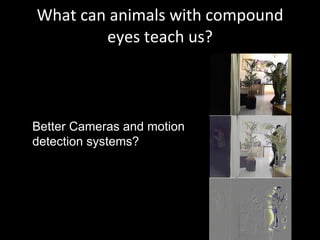
What can animals with compound eyes teach us? Better Cameras and motion detection systems?
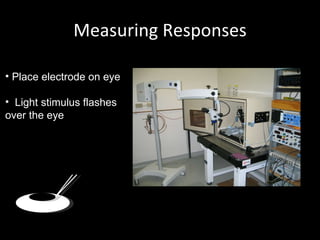
Measuring Responses Place electrode on eye  Light stimulus flashes over the eye
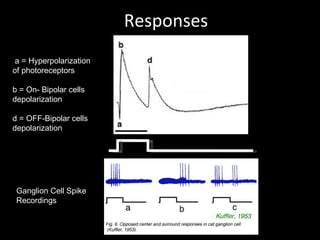
Responses Ganglion Cell Spike Recordings a = Hyperpolarization of photoreceptors b = On- Bipolar cells depolarization d = OFF-Bipolar cells depolarization

Animal vision nsta 102911

  • 1.
    Through the eyesof an animal: how animals see Ishara Mills-Henry, Ph.D. Science of the Eye Program MIT
  • 2.
  • 3.
  • 4.
  • 5.
  • 6.
  • 7.
  • 8.
  • 9.
    The Retina Fromwww.howstuffworks.com Retina
  • 10.
    Retina Humans areconsidered trichromats Blue, Red, and Green Cone Photorecpetors Rod photoreceptors – are important for vision in dim light
  • 11.
    Rods – Lowlight Cones – Color vision Three Main Parts: a. Outer Segments b. Cell body c. Synaptic terminal
  • 12.
    Visual Responses OptokineticResponse/Reflex Maintain image on retina stable Innate reflex Optomotor Response/Reflex Locomotive behavior Hypothesized to play a role in control of speed and direction of body movement Innate reflex Escape or Avoidance Response Avert danger Innate reflex Ability to test: Colors, Spatial frequency, and Motion detection
  • 13.
    Observing our eyemovements Umbrellas Groups of three One person twists an umbrella while the other tries to focus on the umbrella without moving their eyes. The third person can observe. The umbrella should have a pattern or make stripes on a solid color umbrella with tape
  • 14.
    Eye movements (microsaccades)http://www.michaelbach.de/ot/mot_eyeJitter/index.html from Pinna B & Spillmann L (2002) A new illusion of floating motion in depth. Perception 31:1501–1502. Involuntary eye movements – This illusion makes us aware of the small movements our eyes make. Our eyes these movements even if we think we are focusing on an object. This is to prevent the photoreceptors in the retina from desensitizing. If photoreceptors desensitize they will no longer pass the signal to the brain of the object we are seeing. It would reduce the visibility of an object.
  • 15.
    Drum lined withblack and white stripes Light source illuminates drum
  • 16.
    Optokinetic Response Vertebratesexhibit numerous reflex behaviors that are driven by visual stimuli. The OKR response encompasses smooth eye rotations which track moving patterns followed by sharp movements called saccades.
  • 17.
    Optomotor Response Zebrafish( http://baierlab.ucsf.edu/omr.html )
  • 18.
  • 19.
    Compound Eyes Fromhttp://universe-review.ca/R10-33-anatomy.htm Repetitive facets called ommatidia Image formation probably more of a mosaic than individual images (But the glasses are still fun)
  • 20.
    House crickets (Acheta domesticus) Omnivorous scavengers Feed on organic materials, as well as decaying plant material, fungi, and some seedling plants Active mostly at night Have UV (332 nm), blue (445 nm), and green (515 nm) Habitat: Forest and grasslands See polarized light (navigation purposes) Detect visual cues for place memory
  • 21.
    Phototaxis Movement towardsor away from light
  • 22.
    Drosophila Habitat: rottingfruit Phototaxis Eight photoreceptors arranged in a pattern Vision: myopic/poor spatial quality but able to detect movement quickly Smaller lenses captures less light
  • 23.
    Mealworms/Darkling Beetles (tenebrio moliter) Over 20,000 species Larval stages are used as a food source fish, reptiles, and birds. Adult darkling beetles – active both day and night Habitat: burrows in grain Eat mostly vegetation – fresh and decaying Spectral response – 520 nm and 334 – 365 nm (UV) Do they exhibit negative or positive phototaxis? Does the larval stage behavior differ from the adult stage?
  • 24.
    Planaria (Schmidtea mediterranea) Flatworms Usually used to study regeneration Habitat: Under rocks in river beds Eye contains pigment and photoreceptor cells
  • 25.
    Emperor Scorpions (Pandinus imperator) Found in the tropical forests and savannas of Africa Docile, although can become territorial and cannibalistic Nocturnal –hunts for prey at night Habitat: under rocks, logs, and other forest debris
  • 26.
    Scorpion Fluorescence Scorpionsfluorescence under UV light. Exoskeleton contains compounds that exhibit flourescence Recent studies suggested its for detection and avoidance of the UV light. Ability to discriminate between species? Mating, navigation, ?)
  • 27.
    More Interesting InformationFlight Simulator for flies? May yield info for Robot Vision http://www.youtube.com/watch?v=e5uPr_3SsHA&feature=player_embedded
  • 28.
    What can animalswith compound eyes teach us? Better Cameras and motion detection systems?
  • 29.
    Measuring Responses Placeelectrode on eye Light stimulus flashes over the eye
  • 30.
    Responses Ganglion CellSpike Recordings a = Hyperpolarization of photoreceptors b = On- Bipolar cells depolarization d = OFF-Bipolar cells depolarization