34 the American Gardener 35November / December 2014
LEFT:VIVEKANEVELN.RIGHT:BILLJOHNSON.
JESSIEKEITH
H
ONEY BEES (Apis mellifera)
may garner more of the lime-
light, but North America is al-
so home to approximately 4,000 known
native bee species that are just as agricul-
turally, horticulturally, and ecologically
important. While they don’t form large,
honey-making colonies like their better
known but non-native counterparts,
these indigenous bees are among the
most essential pollinators in our natural
areas, farm fields, and gardens.
SomeNorthAmericanspeciesevenap-
pear to do a better job of pollinating crops
than honey bees. For example, researchers
have found that blue orchard mason bees
(Osmia lignaria) are far more effective
pollinators of cherry orchards, resulting
in over twice the fruit yields of honey bee
pollinated orchards. This is not surpris-
ing given that many native bees are often
more tolerant of cool or moist conditions
and have longer foraging times—giving
them the pollination edge.
However, like honey bees, native bee
populations have been declining over the
last several years. This decline “speaks to-
wards land use and the lack of diversity of
our vegetation,” says Deborah Delaney,
bee specialist and assistant professor of en-
tomology at the University of Delaware in
Newark. Factors such as habitat loss, wide-
spread pesticide use, and climate change
all have an impact, but gardeners can help.
APPRECIATING DIVERSITY
American bee species “come in a jewel box
of different colors—from metallic green to
bottleblue,gold,brown,andglossyblack,”
says Scott Hoffman Black, the executive
director of the Xerces Society, an organiza-
tiondedicatedtoinvertebrateconservation.
Sizesvaryfromtheenormousone-inchval-
ley carpenter bee (Xylocopa varipuncta) to
one of the world’s smallest bees, Perdita
minima, which is under two millimeters
long. Throw in different shapes, hair types,
tongue lengths, and other characteristics,
and their diversity is staggering.
When it comes to nesting, about
90 percent of these species are solitary,
while the rest are social and hive-form-
ing. Nests may be underground or above
ground in cavities; depending on the
species, nests may be constructed from
mud (mason and plasterer bees), plants
(leafcutter bees), earth (mining bees), or
excavated wood (carpenter bees). Sol-
itary bees tend to produce few young
(often one to 10) in underground nests,
while some bumble bees and sweat bees
nest in aboveground crevices and pro-
duce small colonies.
Thereisadirectcorrelationbetweenbee
size and flight distances, larger species like
bumble bees can fly up to a mile or more
whenforaging,whilemediumtosmallbees
34 the American Gardener
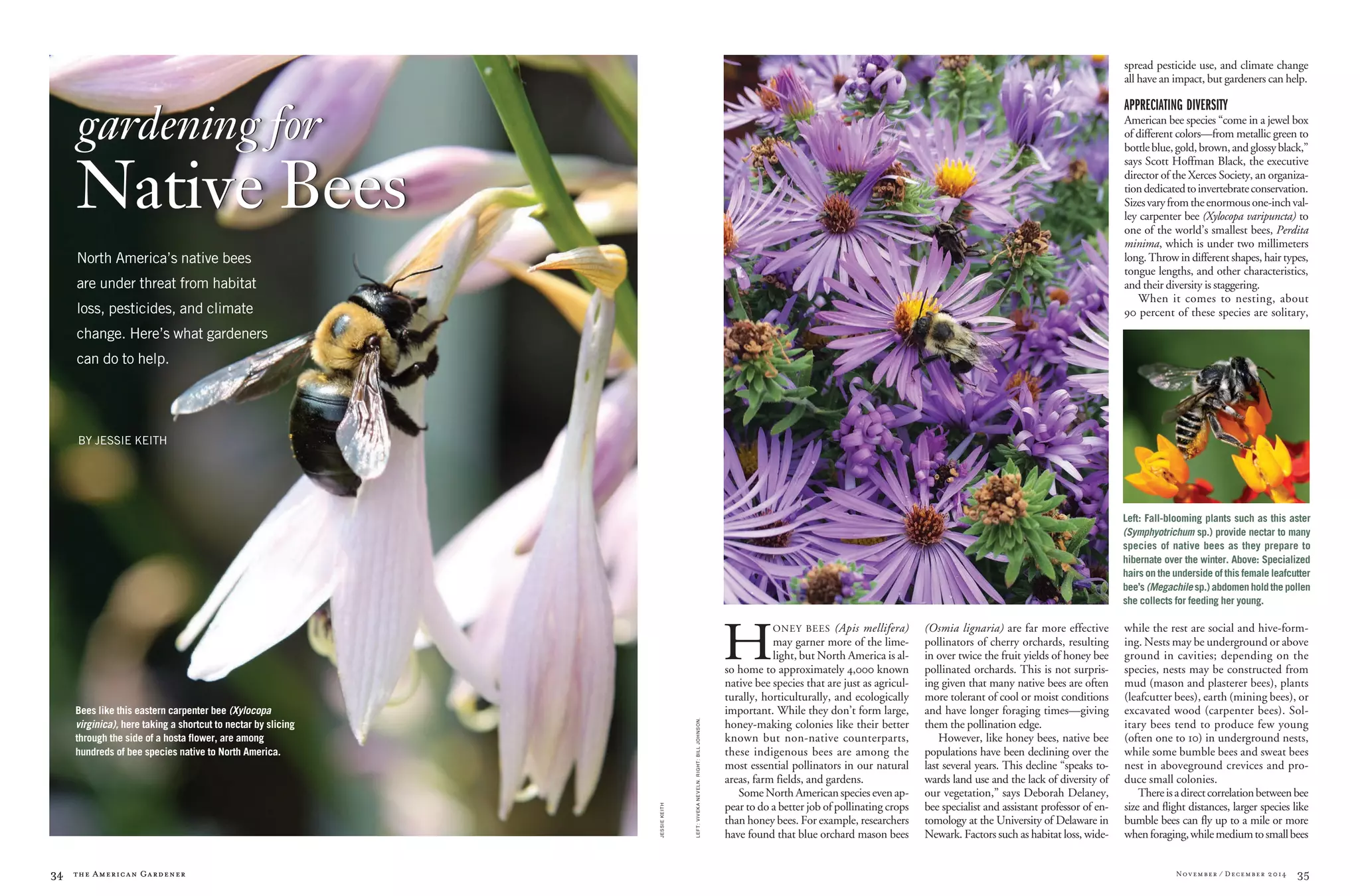
Left: Fall-blooming plants such as this aster
(Symphyotrichum sp.) provide nectar to many
species of native bees as they prepare to
hibernate over the winter. Above: Specialized
hairs on the underside of this female leafcutter
bee’s (Megachile sp.) abdomen hold the pollen
she collects for feeding her young.
gardening for
Native Bees
gardening for
Native Bees
BY JESSIE KEITH
North America’s native bees
are under threat from habitat
loss, pesticides, and climate
change. Here’s what gardeners
can do to help.
Bees like this eastern carpenter bee (Xylocopa
virginica), here taking a shortcut to nectar by slicing
through the side of a hosta flower, are among
hundreds of bee species native to North America.
36 the American Gardener 37November / December 2014
TOPLEFT:BILLJOHNSON.TOPRIGHT:COURTESYOFDAVIDCAPPAERT,MICHIGANSTATEUNIVERSITY,BUGWOOD.ORG.BOTTOM:COURTESYOFTIMSTANLEY,NATIVEBEEOLOGY.
LEFT:BILLJOHNSON.RIGHT:JUDYWHITE,GARDENPHOTOS.COM.
produceyoungatdifferenttimes,soideally
your planting scheme should ensure that
something is in bloom during all the sea-
sons, even winter.
“I recommend planting three good bee
plants for spring, three for summer, and
threeforfall,”saysBlack,“sothereisabuffet
of flowers throughout the growing season.”
Gordon Frankie, professor of urban
entomology at the University of Califor-
nia, Berkeley and director of the Urban
Bee Lab, concurs with this strategy. He
suggests that gardeners aim for at least 20
different plant species overall to bring the
bees, based on bee population sampling
he has conducted around California. No
matter the season, Frankie found the rich-
est diversity of bee species in Berkeley and
Santa Cruz. By contrast, he found “little
in the way of bees in San Diego,” he says.
He attributes the difference to the regional
plant palettes—landscapes featuring a few
plant species with limited wildlife value
correlated with very low bee diversity and
numbers in general. “The more bee-plant
biodiversity you have, the more diverse the
bees you will attract,” he notes.
PLANTS THAT ATTRACT BEES
As a general guideline for deciding which
plants to include in your garden to at-
tract native bees, it’s helpful to keep in
mind that flowering plants that depend
on bee pollinators to reproduce have
specific suites of floral traits adapted to
attract them. These traits include “land-
ing pads” for bees to rest upon while
collecting and feeding, sweet fragrance,
and sugary nectar. The flowers tend to be
shades of yellow, blue, or white with spe-
cial markings that guide bees to nectar.
Many are tubular with bilateral symme-
36 the American Gardener
mayonlyforageacouplehundredfeetfrom
their nests. Most native bees are polylectic,
which means they pollinate a wide variety
of plant species. Others may be oligolectic
(pollinating a few, closely-related plant
species) or specialized even further to be
monolectic (pollinating one plant species).
NURTURING NATIVES
With these basic facts in mind, there are
several things gardeners can do to sup-
port native bees. “If every gardener tried to
create a haven for bees, it would increase
habitat exponentially,” notes Black. Pro-
tecting and providing nesting areas and
food sources are key. Equally important
is safeguarding bees from pesticides. All
broad-spectrum pesticides can kill bees,
but research shows that neonicotinoid
pesticides used in agriculture and horti-
culture—such as clothianidin, thiame-
thoxam, and imidacloprid—are the most
harmful. Because neonicotinoids main-
tain residues in pollen, they can poison
pollinators long after application.
To encourage native ground-dwelling
bees to nest, avoid disturbing areas of bare,
friableeartharoundplantsasmuchaspossi-
ble,andavoidapplyingbarkmulch.Choose
compost or leaf mold instead. If this is not
feasible for you, try doing this in just a small
area of your yard that you leave “wild.”
For above-ground nesters, you can cre-
ate artificial nest sites. For example, layers
of clay-mud blocks may encourage certain
southwestern bee species adapted to arid
conditionstonestinthecoolcracksbetween
blocks. “Nest blocks,” either purchased or
homemade from wooden blocks drilled
with holes, appeal to tunnel-nesting species.
Bundles of hollow stems cut and positioned
cross-wise are also attractive to tunnel-nest-
ing bees; bamboo, teasel, and reeds all work
well for making these nest bundles.
Most essential to healthy bee habitat is
a variety of plants to ensure a steady sup-
ply of nectar and pollen. Nectar is a bee’s
mainenergysource.Nutritiouspollen,rich
in protein, nutrients, and oils, is primarily
used by bees to feed developing larvae. Sol-
itary females typically roll the pollen into
nectar-infused balls of “bee bread” and lay
a single egg on each ball. The pollen is all
the food larvae need to develop and ma-
ture into adult bees. Different bee species
BASIC BEE CHARACTERISTICS
Bees are closely related to wasps, so share several features
such as large compound eyes on the sides of their heads
and two pairs of wings.
However, a number of
characteristics distin-
guish the two insects.
Physically, the most
obvious difference be-
tween the two is that
bees tend to be much
hairier than wasps.
These soft hairs are
feathered or branched,
whereas any wasp hairs
are straight. While most
wasps are carnivorous,
all bees are vegetarians.
Wasps do not collect
pollen, and only female
bees collect and trans-
port pollen to nests to
feed their young. For this purpose, they often have specific
structures on their hind legs or abdomen adapted for carrying
pollen. These structures are either corbiculae (“pollen baskets”
consisting of a smooth concave area with fringes of curved long
hairs) that hold pollen,
or scopae (patches of
stiff hairs) to which pol-
len can adhere.
Some wasps—such
as yellow jackets or
bald-faced hornets—
can be aggressive when
defending themselves,
but there is little to
fear from native bees
in general. “Most soli-
tary bees don’t or can’t
sting,” says Scott Hoff-
man Black, executive
director of the Xerces
Society, a nonprofit or-
ganization dedicated to
invertebrate conserva-
tion. “Bumble bees can sting but they rarely do,” he adds.
Male bees do not have stingers at all. 	 —J.K.
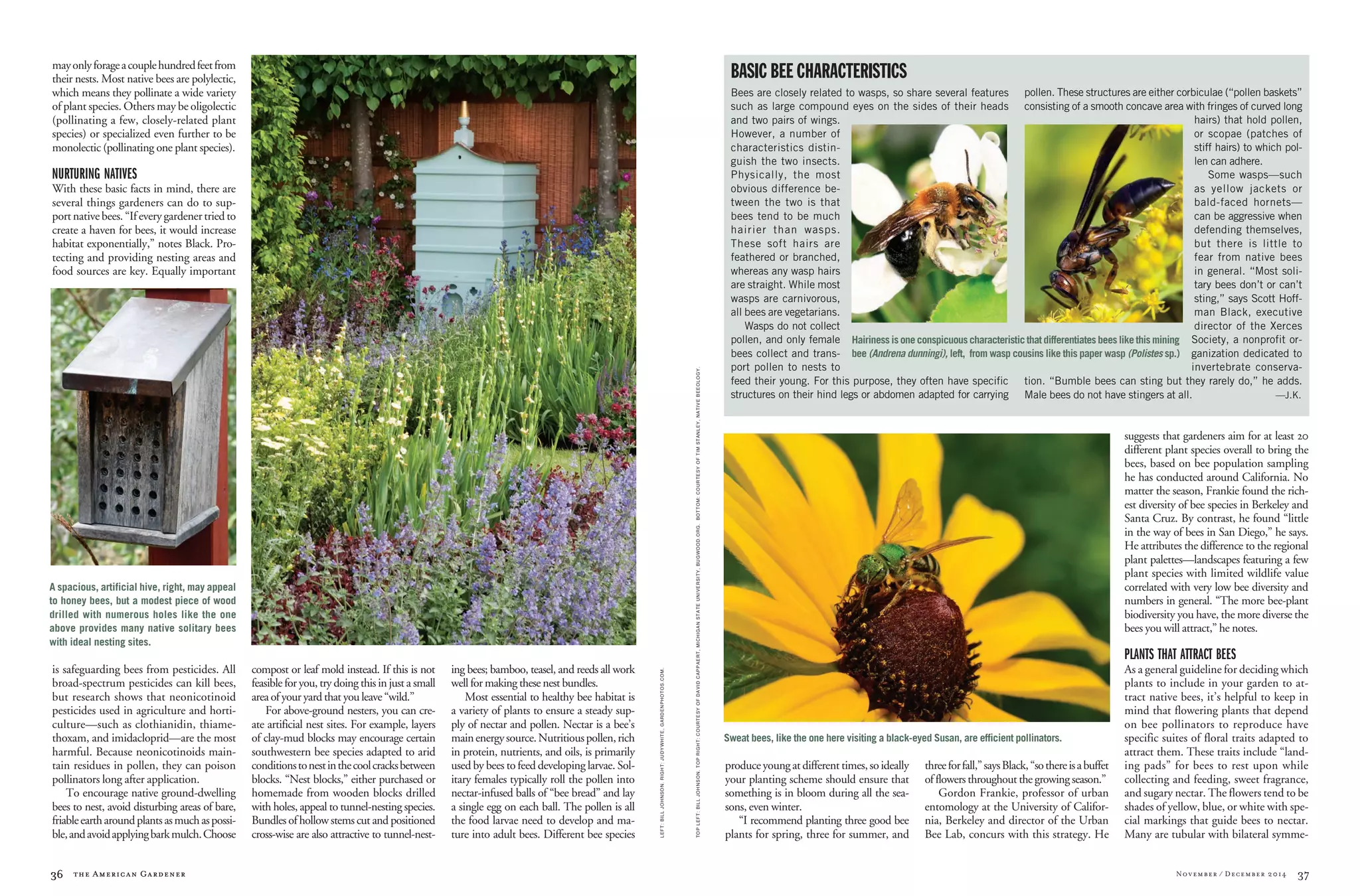
Hairinessisoneconspicuouscharacteristicthatdifferentiatesbeeslikethismining
bee (Andrena dunningi), left, from wasp cousins like this paper wasp (Polistes sp.)
Sweat bees, like the one here visiting a black-eyed Susan, are efficient pollinators.
A spacious, artificial hive, right, may appeal
to honey bees, but a modest piece of wood
drilled with numerous holes like the one
above provides many native solitary bees
with ideal nesting sites.
38 the American Gardener 39November / December 2014
COURTESYOFMATTHEWSHEPHERD,THEXERCESSOCIETY.
parks, school yards, and golf courses are
being converted into managed meadows
and savannahs rich in plants for bees and
other wildlife. Green roofs offer further
opportunities for flowers to blossom in
city spaces, as do “eco-lawns” planted
with low-growing flowering plants for
pollinators. And in rural areas, inten-
tionally planted nectar- and pollen-rich
wildflowers line a growing number of ag-
ricultural fields, old railways, highways,
and roadsides.
All are steps in the right direction,
but there’s still a lot to do, starting with
your home garden. As Black puts it,
“Plant a variety of native bee flowers,
heirlooms, and vegetables. Avoid insec-
ticides, cultivate your garden well, and
let the bees come.” 	 m
Jessie Keith is a horticulturist, writer, pho-
tographer, and garden designer. She lives in
Wilmington, Delaware, with her husband
and two daughters.
TOP:JOSHMCCULLOUGH.BOTTOM:MARKTURNER.
try, like salvia and snapdragon flowers, or
in heads, as with daisies and sunflowers.
Because native bee and plant species
evolved together, growing native flow-
ering plants is a good way to attract local
bee species to your garden. For exam-
ple, the scented, golden flowers of vernal
witchhazel (Hamamelis vernalis) will lure
early-emerging native bees as will pussy
willows (Salix discolor). Woodland wild-
flowers such as sharp-lobed hepatica (He-
patica acutiloba), violets (Viola spp.), and
rueanemone(Thalictrumthalictroides)also
draw spring-emerging solitary bees. Waves
of spring beauties (Claytonia virginica) that
appear in open woodlands and lawns are
favored by a diminutive andrenid bee (An-
drena erigeniae). The bright white flowers
of bloodroot (Sanguinaria canadensis) are
pollinated almost entirely by Carlin’s an-
drena bee (Andrena carlini).
Later in the spring, natives such as
false indigos (Baptisia spp.), lupines
(Lupinus spp.), and California poppies
(Eschscholzia spp.) attract a variety of bees.
Spring-blooming trees and shrubs, such
as American linden (Tilia americana),
serviceberries (Amelanchier spp.), eastern
redbud (Cercis canadensis), and haw-
thorns (Crataegus spp.), are also essential
nectar and pollen providers.
In summer, perennials such as blan-
ketflowers (Gaillardia spp.), penstemons
(Penstemon spp.), and coneflowers (Echi-
nacea spp.) attract all sorts of different
native bees. The violet-purple spikes of
giant blue hyssop (Agastache foeniculum)
are favored by bumble bees (Bombus
spp.), digger bees (Melissodes spp.), and
leaf-cutter bees (Megachile spp.). Summer
and winter squash are sure to attract tiny
squash bees (Peponapis spp.). Native roses
(Rosa spp.) are almost exclusively bee pol-
linated, and though milkweeds are often
associated with butterflies, several species
are important to native bees as well—par-
ticularly showy milkweed (Asclepias spe-
ciosa) and common milkweed (A. syriaca).
Fall-blooming asters (Symphyotrichum
spp.), perennial sunflowers (Helianthus
spp.), goldenrods (Solidago spp.), and Joe
Pye weeds (Eutrochium spp.) supply bees
withtherequisitefoodstorestooverwinter.
The flowers of many non-native plants
also can feed bees, including lavenders (La-
vandula spp.) and other aromatic herbs.
Fragrant, showy-flowered species that be-
long to the mint (Lamiaceae), composite
(Compositae),androse(Rosaceae)families
make good choices, too, and offer options
that can be grown in most regions of the
United States. If you opt to grow specific
cultivars in these families, avoid those with
doubleornon-fragrantflowers—theirsup-
plies of pollen and nectar have sometimes
been unintentionally bred out of them.
THE BIG PICTURE
Awareness of pollinators and their vital
agricultural and ecological roles is defi-
nitely increasing. As a result, more and
more over-manicured, urban and sub-
urban green spaces like parks, corporate
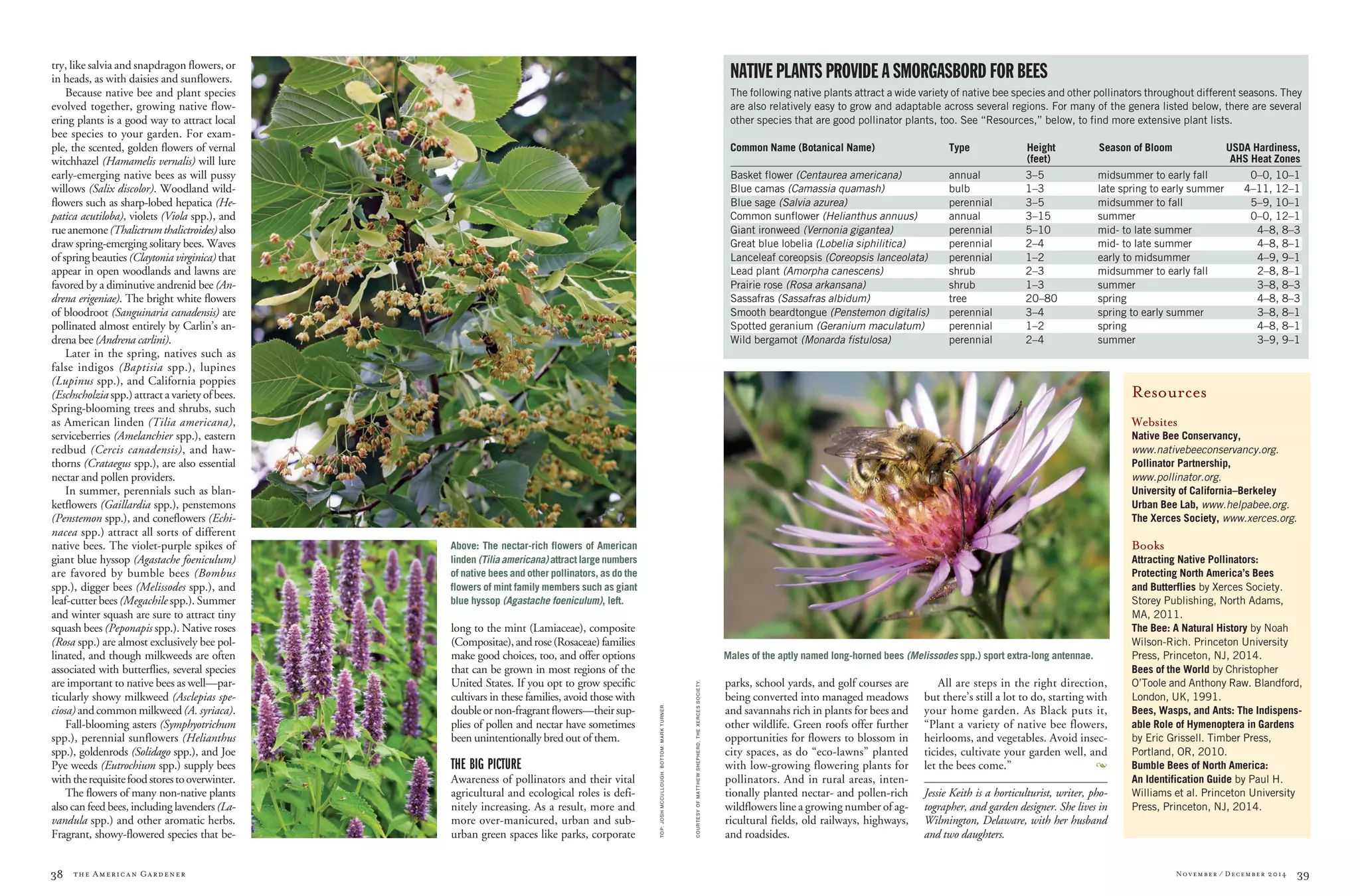
NATIVE PLANTS PROVIDE A SMORGASBORD FOR BEES
The following native plants attract a wide variety of native bee species and other pollinators throughout different seasons. They
are also relatively easy to grow and adaptable across several regions. For many of the genera listed below, there are several
other species that are good pollinator plants, too. See “Resources,” below, to find more extensive plant lists.
Common Name (Botanical Name)	 Type	 Height	 Season of Bloom	 USDA Hardiness,
		 (feet)		 AHS Heat Zones
Basket flower (Centaurea americana)	 annual	 3–5	 midsummer to early fall 	 0–0, 10–1
Blue camas (Camassia quamash)	 bulb	 1–3	 late spring to early summer	 4–11, 12–1
Blue sage (Salvia azurea)	 perennial	 3–5	 midsummer to fall	 5–9, 10–1
Common sunflower (Helianthus annuus)	 annual	 3–15	 summer	 0–0, 12–1
Giant ironweed (Vernonia gigantea)	 perennial	 5–10	 mid- to late summer	 4–8, 8–3
Great blue lobelia (Lobelia siphilitica)	 perennial	 2–4	 mid- to late summer	 4–8, 8–1
Lanceleaf coreopsis (Coreopsis lanceolata) 	 perennial	 1–2	 early to midsummer	 4–9, 9–1
Lead plant (Amorpha canescens)	 shrub	 2–3	 midsummer to early fall	 2–8, 8–1
Prairie rose (Rosa arkansana)	 shrub	 1–3	 summer	 3–8, 8–3
Sassafras (Sassafras albidum)	 tree	 20–80	 spring	 4–8, 8–3
Smooth beardtongue (Penstemon digitalis)	 perennial	 3–4	 spring to early summer	 3–8, 8–1
Spotted geranium (Geranium maculatum)	 perennial	 1–2	 spring	 4–8, 8–1
Wild bergamot (Monarda fistulosa) 	 perennial 	 2–4	 summer	 3–9, 9–1
Resources
Websites
Native Bee Conservancy,
www.nativebeeconservancy.org.
Pollinator Partnership,
www.pollinator.org.
University of California–Berkeley
Urban Bee Lab, www.helpabee.org.
The Xerces Society, www.xerces.org.
Books
Attracting Native Pollinators:
Protecting North America’s Bees
and Butterflies by Xerces Society.
Storey Publishing, North Adams,
MA, 2011.
The Bee: A Natural History by Noah
Wilson-Rich. Princeton University
Press, Princeton, NJ, 2014.
Bees of the World by Christopher
O’Toole and Anthony Raw. Blandford,
London, UK, 1991.
Bees, Wasps, and Ants: The Indispens-
able Role of Hymenoptera in Gardens
by Eric Grissell. Timber Press,
Portland, OR, 2010.
Bumble Bees of North America:
An Identification Guide by Paul H.
Williams et al. Princeton University
Press, Princeton, NJ, 2014.
Males of the aptly named long-horned bees (Melissodes spp.) sport extra-long antennae.
Above: The nectar-rich flowers of American
linden (Tilia americana) attract large numbers
of native bees and other pollinators, as do the
flowers of mint family members such as giant
blue hyssop (Agastache foeniculum), left.

Native Bees TAG ND14

  • 1.
    34 the AmericanGardener 35November / December 2014 LEFT:VIVEKANEVELN.RIGHT:BILLJOHNSON. JESSIEKEITH H ONEY BEES (Apis mellifera) may garner more of the lime- light, but North America is al- so home to approximately 4,000 known native bee species that are just as agricul- turally, horticulturally, and ecologically important. While they don’t form large, honey-making colonies like their better known but non-native counterparts, these indigenous bees are among the most essential pollinators in our natural areas, farm fields, and gardens. SomeNorthAmericanspeciesevenap- pear to do a better job of pollinating crops than honey bees. For example, researchers have found that blue orchard mason bees (Osmia lignaria) are far more effective pollinators of cherry orchards, resulting in over twice the fruit yields of honey bee pollinated orchards. This is not surpris- ing given that many native bees are often more tolerant of cool or moist conditions and have longer foraging times—giving them the pollination edge. However, like honey bees, native bee populations have been declining over the last several years. This decline “speaks to- wards land use and the lack of diversity of our vegetation,” says Deborah Delaney, bee specialist and assistant professor of en- tomology at the University of Delaware in Newark. Factors such as habitat loss, wide- spread pesticide use, and climate change all have an impact, but gardeners can help. APPRECIATING DIVERSITY American bee species “come in a jewel box of different colors—from metallic green to bottleblue,gold,brown,andglossyblack,” says Scott Hoffman Black, the executive director of the Xerces Society, an organiza- tiondedicatedtoinvertebrateconservation. Sizesvaryfromtheenormousone-inchval- ley carpenter bee (Xylocopa varipuncta) to one of the world’s smallest bees, Perdita minima, which is under two millimeters long. Throw in different shapes, hair types, tongue lengths, and other characteristics, and their diversity is staggering. When it comes to nesting, about 90 percent of these species are solitary, while the rest are social and hive-form- ing. Nests may be underground or above ground in cavities; depending on the species, nests may be constructed from mud (mason and plasterer bees), plants (leafcutter bees), earth (mining bees), or excavated wood (carpenter bees). Sol- itary bees tend to produce few young (often one to 10) in underground nests, while some bumble bees and sweat bees nest in aboveground crevices and pro- duce small colonies. Thereisadirectcorrelationbetweenbee size and flight distances, larger species like bumble bees can fly up to a mile or more whenforaging,whilemediumtosmallbees 34 the American Gardener Left: Fall-blooming plants such as this aster (Symphyotrichum sp.) provide nectar to many species of native bees as they prepare to hibernate over the winter. Above: Specialized hairs on the underside of this female leafcutter bee’s (Megachile sp.) abdomen hold the pollen she collects for feeding her young. gardening for Native Bees gardening for Native Bees BY JESSIE KEITH North America’s native bees are under threat from habitat loss, pesticides, and climate change. Here’s what gardeners can do to help. Bees like this eastern carpenter bee (Xylocopa virginica), here taking a shortcut to nectar by slicing through the side of a hosta flower, are among hundreds of bee species native to North America.
  • 2.
    36 the AmericanGardener 37November / December 2014 TOPLEFT:BILLJOHNSON.TOPRIGHT:COURTESYOFDAVIDCAPPAERT,MICHIGANSTATEUNIVERSITY,BUGWOOD.ORG.BOTTOM:COURTESYOFTIMSTANLEY,NATIVEBEEOLOGY. LEFT:BILLJOHNSON.RIGHT:JUDYWHITE,GARDENPHOTOS.COM. produceyoungatdifferenttimes,soideally your planting scheme should ensure that something is in bloom during all the sea- sons, even winter. “I recommend planting three good bee plants for spring, three for summer, and threeforfall,”saysBlack,“sothereisabuffet of flowers throughout the growing season.” Gordon Frankie, professor of urban entomology at the University of Califor- nia, Berkeley and director of the Urban Bee Lab, concurs with this strategy. He suggests that gardeners aim for at least 20 different plant species overall to bring the bees, based on bee population sampling he has conducted around California. No matter the season, Frankie found the rich- est diversity of bee species in Berkeley and Santa Cruz. By contrast, he found “little in the way of bees in San Diego,” he says. He attributes the difference to the regional plant palettes—landscapes featuring a few plant species with limited wildlife value correlated with very low bee diversity and numbers in general. “The more bee-plant biodiversity you have, the more diverse the bees you will attract,” he notes. PLANTS THAT ATTRACT BEES As a general guideline for deciding which plants to include in your garden to at- tract native bees, it’s helpful to keep in mind that flowering plants that depend on bee pollinators to reproduce have specific suites of floral traits adapted to attract them. These traits include “land- ing pads” for bees to rest upon while collecting and feeding, sweet fragrance, and sugary nectar. The flowers tend to be shades of yellow, blue, or white with spe- cial markings that guide bees to nectar. Many are tubular with bilateral symme- 36 the American Gardener mayonlyforageacouplehundredfeetfrom their nests. Most native bees are polylectic, which means they pollinate a wide variety of plant species. Others may be oligolectic (pollinating a few, closely-related plant species) or specialized even further to be monolectic (pollinating one plant species). NURTURING NATIVES With these basic facts in mind, there are several things gardeners can do to sup- port native bees. “If every gardener tried to create a haven for bees, it would increase habitat exponentially,” notes Black. Pro- tecting and providing nesting areas and food sources are key. Equally important is safeguarding bees from pesticides. All broad-spectrum pesticides can kill bees, but research shows that neonicotinoid pesticides used in agriculture and horti- culture—such as clothianidin, thiame- thoxam, and imidacloprid—are the most harmful. Because neonicotinoids main- tain residues in pollen, they can poison pollinators long after application. To encourage native ground-dwelling bees to nest, avoid disturbing areas of bare, friableeartharoundplantsasmuchaspossi- ble,andavoidapplyingbarkmulch.Choose compost or leaf mold instead. If this is not feasible for you, try doing this in just a small area of your yard that you leave “wild.” For above-ground nesters, you can cre- ate artificial nest sites. For example, layers of clay-mud blocks may encourage certain southwestern bee species adapted to arid conditionstonestinthecoolcracksbetween blocks. “Nest blocks,” either purchased or homemade from wooden blocks drilled with holes, appeal to tunnel-nesting species. Bundles of hollow stems cut and positioned cross-wise are also attractive to tunnel-nest- ing bees; bamboo, teasel, and reeds all work well for making these nest bundles. Most essential to healthy bee habitat is a variety of plants to ensure a steady sup- ply of nectar and pollen. Nectar is a bee’s mainenergysource.Nutritiouspollen,rich in protein, nutrients, and oils, is primarily used by bees to feed developing larvae. Sol- itary females typically roll the pollen into nectar-infused balls of “bee bread” and lay a single egg on each ball. The pollen is all the food larvae need to develop and ma- ture into adult bees. Different bee species BASIC BEE CHARACTERISTICS Bees are closely related to wasps, so share several features such as large compound eyes on the sides of their heads and two pairs of wings. However, a number of characteristics distin- guish the two insects. Physically, the most obvious difference be- tween the two is that bees tend to be much hairier than wasps. These soft hairs are feathered or branched, whereas any wasp hairs are straight. While most wasps are carnivorous, all bees are vegetarians. Wasps do not collect pollen, and only female bees collect and trans- port pollen to nests to feed their young. For this purpose, they often have specific structures on their hind legs or abdomen adapted for carrying pollen. These structures are either corbiculae (“pollen baskets” consisting of a smooth concave area with fringes of curved long hairs) that hold pollen, or scopae (patches of stiff hairs) to which pol- len can adhere. Some wasps—such as yellow jackets or bald-faced hornets— can be aggressive when defending themselves, but there is little to fear from native bees in general. “Most soli- tary bees don’t or can’t sting,” says Scott Hoff- man Black, executive director of the Xerces Society, a nonprofit or- ganization dedicated to invertebrate conserva- tion. “Bumble bees can sting but they rarely do,” he adds. Male bees do not have stingers at all. —J.K. Hairinessisoneconspicuouscharacteristicthatdifferentiatesbeeslikethismining bee (Andrena dunningi), left, from wasp cousins like this paper wasp (Polistes sp.) Sweat bees, like the one here visiting a black-eyed Susan, are efficient pollinators. A spacious, artificial hive, right, may appeal to honey bees, but a modest piece of wood drilled with numerous holes like the one above provides many native solitary bees with ideal nesting sites.
  • 3.
    38 the AmericanGardener 39November / December 2014 COURTESYOFMATTHEWSHEPHERD,THEXERCESSOCIETY. parks, school yards, and golf courses are being converted into managed meadows and savannahs rich in plants for bees and other wildlife. Green roofs offer further opportunities for flowers to blossom in city spaces, as do “eco-lawns” planted with low-growing flowering plants for pollinators. And in rural areas, inten- tionally planted nectar- and pollen-rich wildflowers line a growing number of ag- ricultural fields, old railways, highways, and roadsides. All are steps in the right direction, but there’s still a lot to do, starting with your home garden. As Black puts it, “Plant a variety of native bee flowers, heirlooms, and vegetables. Avoid insec- ticides, cultivate your garden well, and let the bees come.” m Jessie Keith is a horticulturist, writer, pho- tographer, and garden designer. She lives in Wilmington, Delaware, with her husband and two daughters. TOP:JOSHMCCULLOUGH.BOTTOM:MARKTURNER. try, like salvia and snapdragon flowers, or in heads, as with daisies and sunflowers. Because native bee and plant species evolved together, growing native flow- ering plants is a good way to attract local bee species to your garden. For exam- ple, the scented, golden flowers of vernal witchhazel (Hamamelis vernalis) will lure early-emerging native bees as will pussy willows (Salix discolor). Woodland wild- flowers such as sharp-lobed hepatica (He- patica acutiloba), violets (Viola spp.), and rueanemone(Thalictrumthalictroides)also draw spring-emerging solitary bees. Waves of spring beauties (Claytonia virginica) that appear in open woodlands and lawns are favored by a diminutive andrenid bee (An- drena erigeniae). The bright white flowers of bloodroot (Sanguinaria canadensis) are pollinated almost entirely by Carlin’s an- drena bee (Andrena carlini). Later in the spring, natives such as false indigos (Baptisia spp.), lupines (Lupinus spp.), and California poppies (Eschscholzia spp.) attract a variety of bees. Spring-blooming trees and shrubs, such as American linden (Tilia americana), serviceberries (Amelanchier spp.), eastern redbud (Cercis canadensis), and haw- thorns (Crataegus spp.), are also essential nectar and pollen providers. In summer, perennials such as blan- ketflowers (Gaillardia spp.), penstemons (Penstemon spp.), and coneflowers (Echi- nacea spp.) attract all sorts of different native bees. The violet-purple spikes of giant blue hyssop (Agastache foeniculum) are favored by bumble bees (Bombus spp.), digger bees (Melissodes spp.), and leaf-cutter bees (Megachile spp.). Summer and winter squash are sure to attract tiny squash bees (Peponapis spp.). Native roses (Rosa spp.) are almost exclusively bee pol- linated, and though milkweeds are often associated with butterflies, several species are important to native bees as well—par- ticularly showy milkweed (Asclepias spe- ciosa) and common milkweed (A. syriaca). Fall-blooming asters (Symphyotrichum spp.), perennial sunflowers (Helianthus spp.), goldenrods (Solidago spp.), and Joe Pye weeds (Eutrochium spp.) supply bees withtherequisitefoodstorestooverwinter. The flowers of many non-native plants also can feed bees, including lavenders (La- vandula spp.) and other aromatic herbs. Fragrant, showy-flowered species that be- long to the mint (Lamiaceae), composite (Compositae),androse(Rosaceae)families make good choices, too, and offer options that can be grown in most regions of the United States. If you opt to grow specific cultivars in these families, avoid those with doubleornon-fragrantflowers—theirsup- plies of pollen and nectar have sometimes been unintentionally bred out of them. THE BIG PICTURE Awareness of pollinators and their vital agricultural and ecological roles is defi- nitely increasing. As a result, more and more over-manicured, urban and sub- urban green spaces like parks, corporate NATIVE PLANTS PROVIDE A SMORGASBORD FOR BEES The following native plants attract a wide variety of native bee species and other pollinators throughout different seasons. They are also relatively easy to grow and adaptable across several regions. For many of the genera listed below, there are several other species that are good pollinator plants, too. See “Resources,” below, to find more extensive plant lists. Common Name (Botanical Name) Type Height Season of Bloom USDA Hardiness, (feet) AHS Heat Zones Basket flower (Centaurea americana) annual 3–5 midsummer to early fall 0–0, 10–1 Blue camas (Camassia quamash) bulb 1–3 late spring to early summer 4–11, 12–1 Blue sage (Salvia azurea) perennial 3–5 midsummer to fall 5–9, 10–1 Common sunflower (Helianthus annuus) annual 3–15 summer 0–0, 12–1 Giant ironweed (Vernonia gigantea) perennial 5–10 mid- to late summer 4–8, 8–3 Great blue lobelia (Lobelia siphilitica) perennial 2–4 mid- to late summer 4–8, 8–1 Lanceleaf coreopsis (Coreopsis lanceolata) perennial 1–2 early to midsummer 4–9, 9–1 Lead plant (Amorpha canescens) shrub 2–3 midsummer to early fall 2–8, 8–1 Prairie rose (Rosa arkansana) shrub 1–3 summer 3–8, 8–3 Sassafras (Sassafras albidum) tree 20–80 spring 4–8, 8–3 Smooth beardtongue (Penstemon digitalis) perennial 3–4 spring to early summer 3–8, 8–1 Spotted geranium (Geranium maculatum) perennial 1–2 spring 4–8, 8–1 Wild bergamot (Monarda fistulosa) perennial 2–4 summer 3–9, 9–1 Resources Websites Native Bee Conservancy, www.nativebeeconservancy.org. Pollinator Partnership, www.pollinator.org. University of California–Berkeley Urban Bee Lab, www.helpabee.org. The Xerces Society, www.xerces.org. Books Attracting Native Pollinators: Protecting North America’s Bees and Butterflies by Xerces Society. Storey Publishing, North Adams, MA, 2011. The Bee: A Natural History by Noah Wilson-Rich. Princeton University Press, Princeton, NJ, 2014. Bees of the World by Christopher O’Toole and Anthony Raw. Blandford, London, UK, 1991. Bees, Wasps, and Ants: The Indispens- able Role of Hymenoptera in Gardens by Eric Grissell. Timber Press, Portland, OR, 2010. Bumble Bees of North America: An Identification Guide by Paul H. Williams et al. Princeton University Press, Princeton, NJ, 2014. Males of the aptly named long-horned bees (Melissodes spp.) sport extra-long antennae. Above: The nectar-rich flowers of American linden (Tilia americana) attract large numbers of native bees and other pollinators, as do the flowers of mint family members such as giant blue hyssop (Agastache foeniculum), left.