

GOOD MANUFACTURING
PRACTICE

GUIDED BY:
Mr. Darshil Shah
Asst. PROFESSOR
QA DEPARTMENT
L.J.INSTITUTE OF PHARMACY
VISH

PREPARED BY:
Vishal H. Parikh
ROLL NO : 06
M.PHARM QARA
SEMESTER - II
8 February 2014

1
CONTENT
 INTERODUCTION
 DEFINITION
 HISTORY
 PRINCIPLE
 PROCESS OF GMP
 VALIDATION

VISH

8 February 2014

2
WHAT IS GMP?
 GMP regulations are promulgated and enforced by
the FDA and primarily housed within the Federal
Food, Drug, and Cosmetic Act
 GMPs are based on industry best practices that
continually evolve as science, technology, and
manufacturing techniques change
 Comprehensive system for ensuring products are
consistently produced and controlled according to
quality standards
 Designed to minimize risks involved in any
pharmaceutical production that cannot be eliminated
through testing of final product alone
VISH

8 February 2014

3
MAJOR RISKS IN
PHARMACEUTICAL PRODUCTION
 Contamination of products (microbial, particulate or other)
 Incorrect labels on containers
 Insufficient active ingredient

 Excess active ingredient
 Poor quality raw materials
 Poor formulation practices

VISH

8 February 2014

4
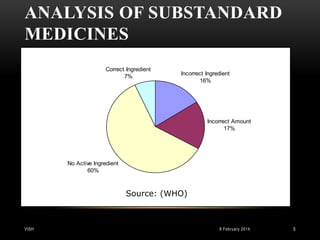
ANALYSIS OF SUBSTANDARD
MEDICINES
Correct Ingredient
7%

Incorrect Ingredient
16%

Incorrect Amount
17%

No Active Ingredient
60%

Source: (WHO)

VISH

8 February 2014

5
THE BREADTH OF GMP


Raw or starting materials



Finished products



Premises and environment



Equipment



Personnel
 Training
 Hygiene

VISH

8 February 2014

6
GMP PRINCIPLES
 Must be built into manufacturing process
 Prevents errors that cannot be eliminated through quality control of
finished product
 Ensures all units of a medicine are of the same (within specified
parameters) quality
 Poor medicines leads to loss of credibility for
manufacturers, health care workers and governments

VISH

8 February 2014

everyone:

7
GMP: 1972
 Davenport disaster
 Intravenous fluids were contaminated & killed 6 people.
 Prompted GMP regulations

 Sulphathiazole tablets contaminated with
phenobarbital (1941 - 300 people died/injured)
 Thalidomide tragedy
1976 Medical Device Amendments
 1972 and 1973 -Pacemaker failures reported
 1975 - hearing-Dalkon Shield intrauterine device
caused thousands of injuries
VISH

8 February 2014

8
CGMPS DEFINED

Methods, facilities, or controls used in
the
production
of
drugs, devices, foods, and biological.
These manufacturing practices are
designed
to
ensure
the
safety, identity, strength, quality, and
purity of such products.
VISH

8 February 2014

9
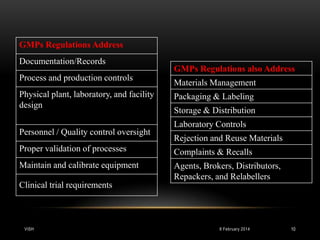
GMPs Regulations Address
Documentation/Records
Process and production controls
Physical plant, laboratory, and facility
design

Personnel / Quality control oversight

GMPs Regulations also Address
Materials Management
Packaging & Labeling
Storage & Distribution
Laboratory Controls
Rejection and Reuse Materials

Proper validation of processes

Complaints & Recalls

Maintain and calibrate equipment

Agents, Brokers, Distributors,
Repackers, and Relabellers

Clinical trial requirements

VISH

8 February 2014

10
VISH

8 February 2014

11
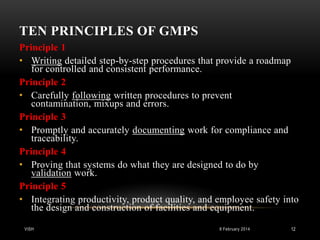
TEN PRINCIPLES OF GMPS
Principle 1
• Writing detailed step-by-step procedures that provide a roadmap
for controlled and consistent performance.
Principle 2
• Carefully following written procedures to prevent
contamination, mixups and errors.
Principle 3
• Promptly and accurately documenting work for compliance and
traceability.
Principle 4
• Proving that systems do what they are designed to do by
validation work.
Principle 5
• Integrating productivity, product quality, and employee safety into
the design and construction of facilities and equipment.
VISH

8 February 2014

12
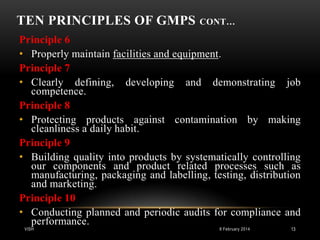
TEN PRINCIPLES OF GMPS

CONT…

Principle 6
• Properly maintain facilities and equipment.
Principle 7
• Clearly defining, developing and demonstrating job
competence.
Principle 8
• Protecting products against contamination by making
cleanliness a daily habit.
Principle 9
• Building quality into products by systematically controlling
our components and product related processes such as
manufacturing, packaging and labelling, testing, distribution
and marketing.
Principle 10
• Conducting planned and periodic audits for compliance and
performance.
VISH

8 February 2014

13
GMP – DOCUMENTATION &
RECORDS
 Maintain laboratory and production records notebooks, electronic files, etc.
 Track records through research and production
 Batch Package Records (BPR)
 Equipment usage, calibrating, cleaning, maintenance
 Laboratory control records
 Distribution records
 Records maintained
 Electronic signatures on documents are
acceptable, provided they are authenticated and secure

VISH

8 February 2014

14
GMP – PROCESS AND
PRODUCTION CONTROL
 Standards for weighing, measuring, storing,
controlled
 Time limits (if applicable and necessary)
 In-process assurance, sampling and controls

 Blending, mixing, diluting substances
 Contamination controls

VISH

8 February 2014

15
GMP – PHYSICAL
PLANT, LABORATORY FACILITIES
DESIGN
 Design and Construction
 Single use versus multiuse facility, proper separation

 Utilities
 Air quality - Filtered, recirculation, one-pass
 Natural Gas
 Dust, humidity, temperature

 Water
 Municipal versus well versus sterilized

 Lighting (placed to facilitate cleaning in all areas)
 Sewage and Refuse
 Sanitation and Maintenance
VISH

8 February 2014

16
GMP – PERSONNEL / QUALITY
CONTROL OVERSIGHT
 Quality should be the responsibility of all persons
involved in manufacturing

 Each manufacturer should establish, document, and
implement an effective system for managing quality
that involves the active participation of management
and appropriate manufacturing personnel
 All quality related activities should be recorded at
the time they are performed
 There should be a quality unit(s) which is
independent of production, and which fulfills both
quality assurance (QA) and quality control (QC)
responsibilities
VISH

8 February 2014

17
GMP – PERSONNEL / QUALITY
CONTROL OVERSIGHT CONT..
 In order to verify compliance with the principles of
GMP, regular internal audits should be performed in
accordance with an approved schedule
Audit findings and corrective actions should be
documented
 Here should be an adequate number of personnel
qualified by appropriate education, training and/or
experience to perform and supervise the processes
Responsibilities of all personnel engaged in the
manufacture should be documented in writing
Training should be regularly conducted by qualified
individuals
VISH

8 February 2014

18
GMP - VALIDATION
 Policies, intentions, approaches, systems, cleaning procedures, and
all other protocols should be validated/documented
 Critical parameters, limitations, ranges and standards should be
established
 A written validation protocol should be established that specifies
how validation of a particular process will be conducted

VISH

8 February 2014

19
GMP – VALIDATION CONT…
 Appropriate qualification of equipment and ancillary
systems should be completed
 Design qualification, Installation qualification, Operational
qualification, Performance qualification

 Validate processes to ensure protocols are being
followed
 Number of process validations depends on complexity of
the tasks

 Cleaning and maintenance validation should be
obtained

VISH

8 February 2014

20
GMP – EQUIPMENT
MAINTENANCE & CALIBRATION
 Equipment used should be of appropriate design
and adequate size, and suitably located for its
intended use, cleaning, sanitization (where
appropriate), and maintenance
Production equipment should only be used
within its qualified operating range
Closed or contained equipment should be
used whenever appropriate
Any substances necessary for the operation of
equipment, such as lubricants, heating fluids
or coolants, should not contact tested items so
as to alter their quality
VISH

8 February 2014

21
GMP – EQUIPMENT
MAINTENANCE & CALIBRATION
CONT…

 Schedules and procedures (including assignment
of responsibility) should be established for the
preventative maintenance of equipment
 Written procedures should be established for
cleaning of equipment and its subsequent release
for use in the manufacture
 Control, weighing, measuring, monitoring and test
equipment that is critical for assuring quality
should be calibrated according to written
procedures and an established schedule

VISH

8 February 2014

22
VISH

8 February 2014

23

Vish GMP Presentation

  • 1.
    GOOD MANUFACTURING PRACTICE GUIDED BY: Mr.Darshil Shah Asst. PROFESSOR QA DEPARTMENT L.J.INSTITUTE OF PHARMACY VISH PREPARED BY: Vishal H. Parikh ROLL NO : 06 M.PHARM QARA SEMESTER - II 8 February 2014 1
  • 2.
    CONTENT  INTERODUCTION  DEFINITION HISTORY  PRINCIPLE  PROCESS OF GMP  VALIDATION VISH 8 February 2014 2
  • 3.
    WHAT IS GMP? GMP regulations are promulgated and enforced by the FDA and primarily housed within the Federal Food, Drug, and Cosmetic Act  GMPs are based on industry best practices that continually evolve as science, technology, and manufacturing techniques change  Comprehensive system for ensuring products are consistently produced and controlled according to quality standards  Designed to minimize risks involved in any pharmaceutical production that cannot be eliminated through testing of final product alone VISH 8 February 2014 3
  • 4.
    MAJOR RISKS IN PHARMACEUTICALPRODUCTION  Contamination of products (microbial, particulate or other)  Incorrect labels on containers  Insufficient active ingredient  Excess active ingredient  Poor quality raw materials  Poor formulation practices VISH 8 February 2014 4
  • 5.
    ANALYSIS OF SUBSTANDARD MEDICINES CorrectIngredient 7% Incorrect Ingredient 16% Incorrect Amount 17% No Active Ingredient 60% Source: (WHO) VISH 8 February 2014 5
  • 6.
    THE BREADTH OFGMP  Raw or starting materials  Finished products  Premises and environment  Equipment  Personnel  Training  Hygiene VISH 8 February 2014 6
  • 7.
    GMP PRINCIPLES  Mustbe built into manufacturing process  Prevents errors that cannot be eliminated through quality control of finished product  Ensures all units of a medicine are of the same (within specified parameters) quality  Poor medicines leads to loss of credibility for manufacturers, health care workers and governments VISH 8 February 2014 everyone: 7
  • 8.
    GMP: 1972  Davenportdisaster  Intravenous fluids were contaminated & killed 6 people.  Prompted GMP regulations  Sulphathiazole tablets contaminated with phenobarbital (1941 - 300 people died/injured)  Thalidomide tragedy 1976 Medical Device Amendments  1972 and 1973 -Pacemaker failures reported  1975 - hearing-Dalkon Shield intrauterine device caused thousands of injuries VISH 8 February 2014 8
  • 9.
    CGMPS DEFINED Methods, facilities,or controls used in the production of drugs, devices, foods, and biological. These manufacturing practices are designed to ensure the safety, identity, strength, quality, and purity of such products. VISH 8 February 2014 9
  • 10.
    GMPs Regulations Address Documentation/Records Processand production controls Physical plant, laboratory, and facility design Personnel / Quality control oversight GMPs Regulations also Address Materials Management Packaging & Labeling Storage & Distribution Laboratory Controls Rejection and Reuse Materials Proper validation of processes Complaints & Recalls Maintain and calibrate equipment Agents, Brokers, Distributors, Repackers, and Relabellers Clinical trial requirements VISH 8 February 2014 10
  • 11.
  • 12.
    TEN PRINCIPLES OFGMPS Principle 1 • Writing detailed step-by-step procedures that provide a roadmap for controlled and consistent performance. Principle 2 • Carefully following written procedures to prevent contamination, mixups and errors. Principle 3 • Promptly and accurately documenting work for compliance and traceability. Principle 4 • Proving that systems do what they are designed to do by validation work. Principle 5 • Integrating productivity, product quality, and employee safety into the design and construction of facilities and equipment. VISH 8 February 2014 12
  • 13.
    TEN PRINCIPLES OFGMPS CONT… Principle 6 • Properly maintain facilities and equipment. Principle 7 • Clearly defining, developing and demonstrating job competence. Principle 8 • Protecting products against contamination by making cleanliness a daily habit. Principle 9 • Building quality into products by systematically controlling our components and product related processes such as manufacturing, packaging and labelling, testing, distribution and marketing. Principle 10 • Conducting planned and periodic audits for compliance and performance. VISH 8 February 2014 13
  • 14.
    GMP – DOCUMENTATION& RECORDS  Maintain laboratory and production records notebooks, electronic files, etc.  Track records through research and production  Batch Package Records (BPR)  Equipment usage, calibrating, cleaning, maintenance  Laboratory control records  Distribution records  Records maintained  Electronic signatures on documents are acceptable, provided they are authenticated and secure VISH 8 February 2014 14
  • 15.
    GMP – PROCESSAND PRODUCTION CONTROL  Standards for weighing, measuring, storing, controlled  Time limits (if applicable and necessary)  In-process assurance, sampling and controls  Blending, mixing, diluting substances  Contamination controls VISH 8 February 2014 15
  • 16.
    GMP – PHYSICAL PLANT,LABORATORY FACILITIES DESIGN  Design and Construction  Single use versus multiuse facility, proper separation  Utilities  Air quality - Filtered, recirculation, one-pass  Natural Gas  Dust, humidity, temperature  Water  Municipal versus well versus sterilized  Lighting (placed to facilitate cleaning in all areas)  Sewage and Refuse  Sanitation and Maintenance VISH 8 February 2014 16
  • 17.
    GMP – PERSONNEL/ QUALITY CONTROL OVERSIGHT  Quality should be the responsibility of all persons involved in manufacturing  Each manufacturer should establish, document, and implement an effective system for managing quality that involves the active participation of management and appropriate manufacturing personnel  All quality related activities should be recorded at the time they are performed  There should be a quality unit(s) which is independent of production, and which fulfills both quality assurance (QA) and quality control (QC) responsibilities VISH 8 February 2014 17
  • 18.
    GMP – PERSONNEL/ QUALITY CONTROL OVERSIGHT CONT..  In order to verify compliance with the principles of GMP, regular internal audits should be performed in accordance with an approved schedule Audit findings and corrective actions should be documented  Here should be an adequate number of personnel qualified by appropriate education, training and/or experience to perform and supervise the processes Responsibilities of all personnel engaged in the manufacture should be documented in writing Training should be regularly conducted by qualified individuals VISH 8 February 2014 18
  • 19.
    GMP - VALIDATION Policies, intentions, approaches, systems, cleaning procedures, and all other protocols should be validated/documented  Critical parameters, limitations, ranges and standards should be established  A written validation protocol should be established that specifies how validation of a particular process will be conducted VISH 8 February 2014 19
  • 20.
    GMP – VALIDATIONCONT…  Appropriate qualification of equipment and ancillary systems should be completed  Design qualification, Installation qualification, Operational qualification, Performance qualification  Validate processes to ensure protocols are being followed  Number of process validations depends on complexity of the tasks  Cleaning and maintenance validation should be obtained VISH 8 February 2014 20
  • 21.
    GMP – EQUIPMENT MAINTENANCE& CALIBRATION  Equipment used should be of appropriate design and adequate size, and suitably located for its intended use, cleaning, sanitization (where appropriate), and maintenance Production equipment should only be used within its qualified operating range Closed or contained equipment should be used whenever appropriate Any substances necessary for the operation of equipment, such as lubricants, heating fluids or coolants, should not contact tested items so as to alter their quality VISH 8 February 2014 21
  • 22.
    GMP – EQUIPMENT MAINTENANCE& CALIBRATION CONT…  Schedules and procedures (including assignment of responsibility) should be established for the preventative maintenance of equipment  Written procedures should be established for cleaning of equipment and its subsequent release for use in the manufacture  Control, weighing, measuring, monitoring and test equipment that is critical for assuring quality should be calibrated according to written procedures and an established schedule VISH 8 February 2014 22
  • 23.