What is ICT?
• ICT stands for Information and
Communication Technologies.
• It means ” diverse set of technologies
tools and resources used to
communicate and to create,
disseminate , store and manage
Information ”.
• It includes computers, the Internet,
telephone systems, radio television
and satellite communications.
Benefits Of ICT in Education
Helps to expand access to Education
• Powerful tool for extending educational
opportunities. Has ability to transcend time
and Space.

Helps To Prepare Individuals For The
Workspace
• Representing Competitive edge in an
increasingly globalizing job market.

Helps to Improve The quality of
Education
• Enhance the quality of education by increasing
learner Motivation and by enhancing teacher
training.
Benefits Of ICT In Health Care
• Computers and ICT technologies are making health
care for all patients more efficient and accurate.
• Improved health care is able to bring down the medical
costs by reducing the number of days, the patient has
to stay in hospital.
• It provides assistance to Medical surgeons during critical
operations.
• Clinics and hospitals use computers with standard
software packages to manage schedules for visiting
wards etc.
Benefits Of ICT In Governance
• Exchange of information with citizens and
businesses by various government departments
to provide rules and regulations.
• Re-structuring of administrative processes ,
making them more efficient.
• Reducing costs of public public works or
increasing revenue or improving taxes collection
or stamp duty collection.
• Speedier and more efficient delivery of citizen
services and review of development works being
Undertaken.
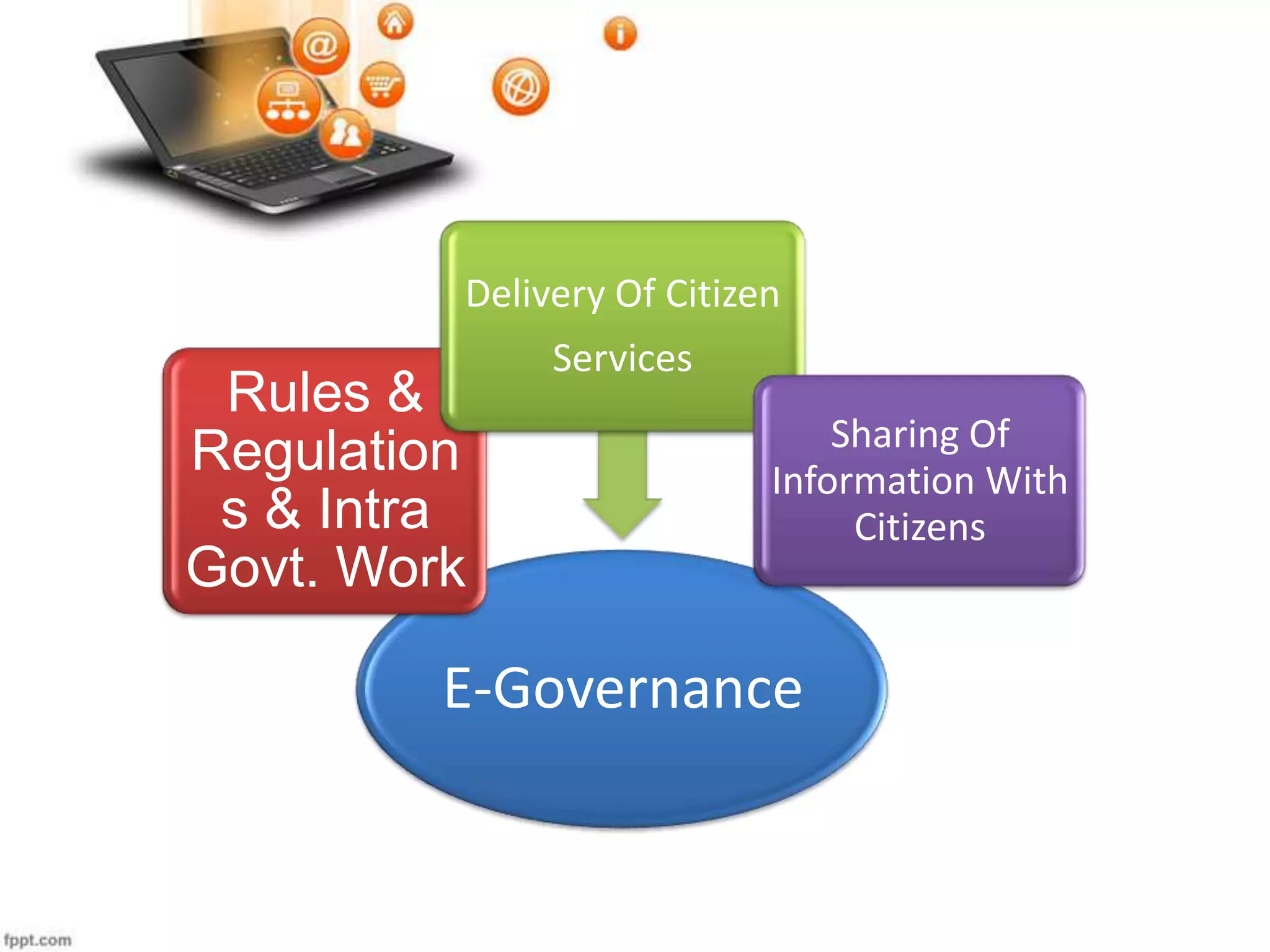
Delivery Of Citizen

Rules &
Regulation
s & Intra
Govt. Work

Services

Sharing Of
Information With
Citizens

E-Governance
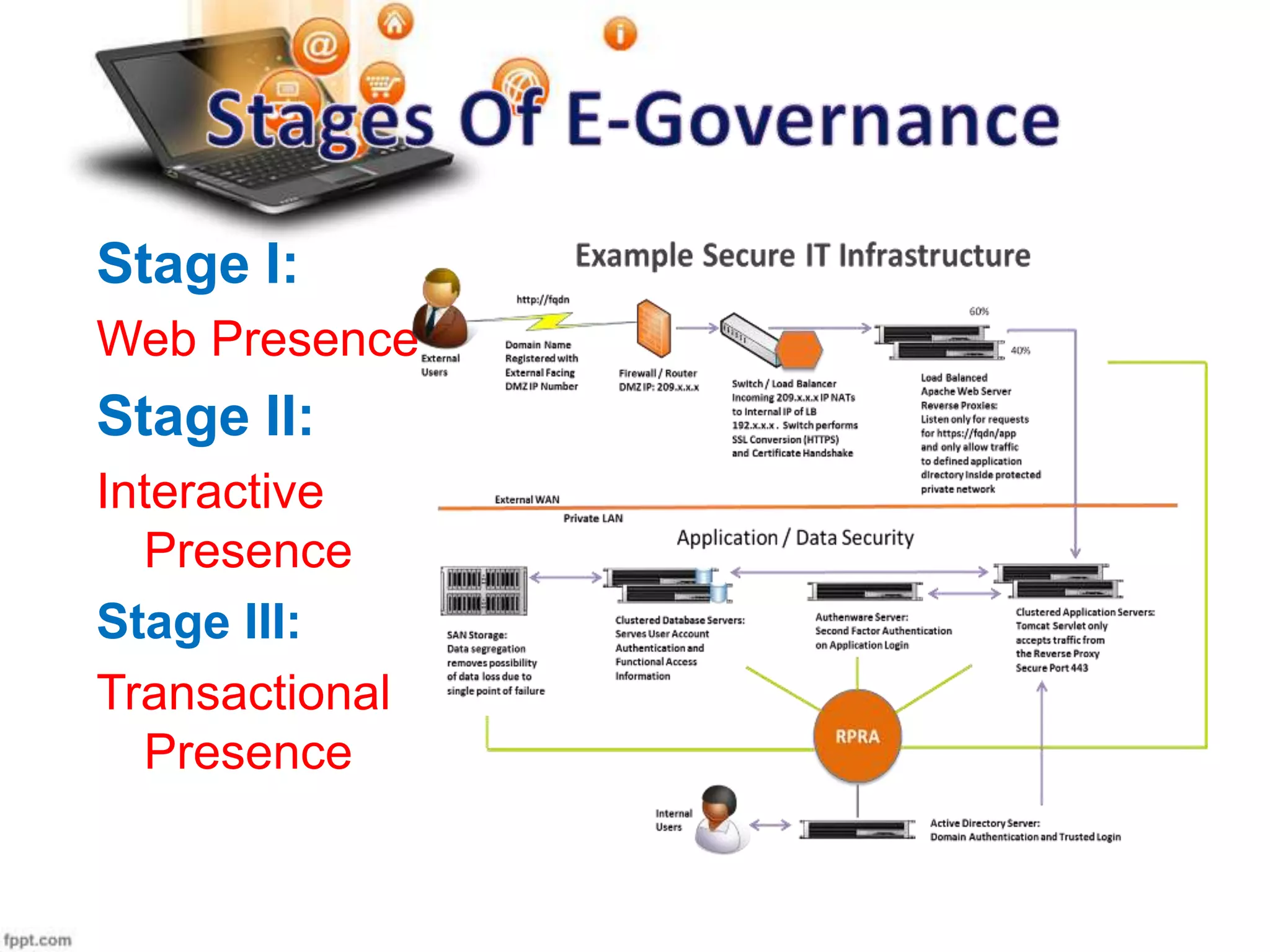
Stage I:
Web Presence

Stage II:
Interactive
Presence
Stage III:
Transactional
Presence
• Scientists and Engineers working in the
design department make very significant
usage of high speed computers and ICT
technologies.
• CAD allows engineers to design and test
new products.
• CAM helps in production packages.
• Thus , ICT technologies are playing a
tremendous role in these areas.
• Today many small and large
businesses have achieved their
success primarily due to usage of
ICT technologies.
• These days, computers and WWW
have become a powerful
advertising media for companies.
• Using ICT, advertisements can be
displayed on different websites.
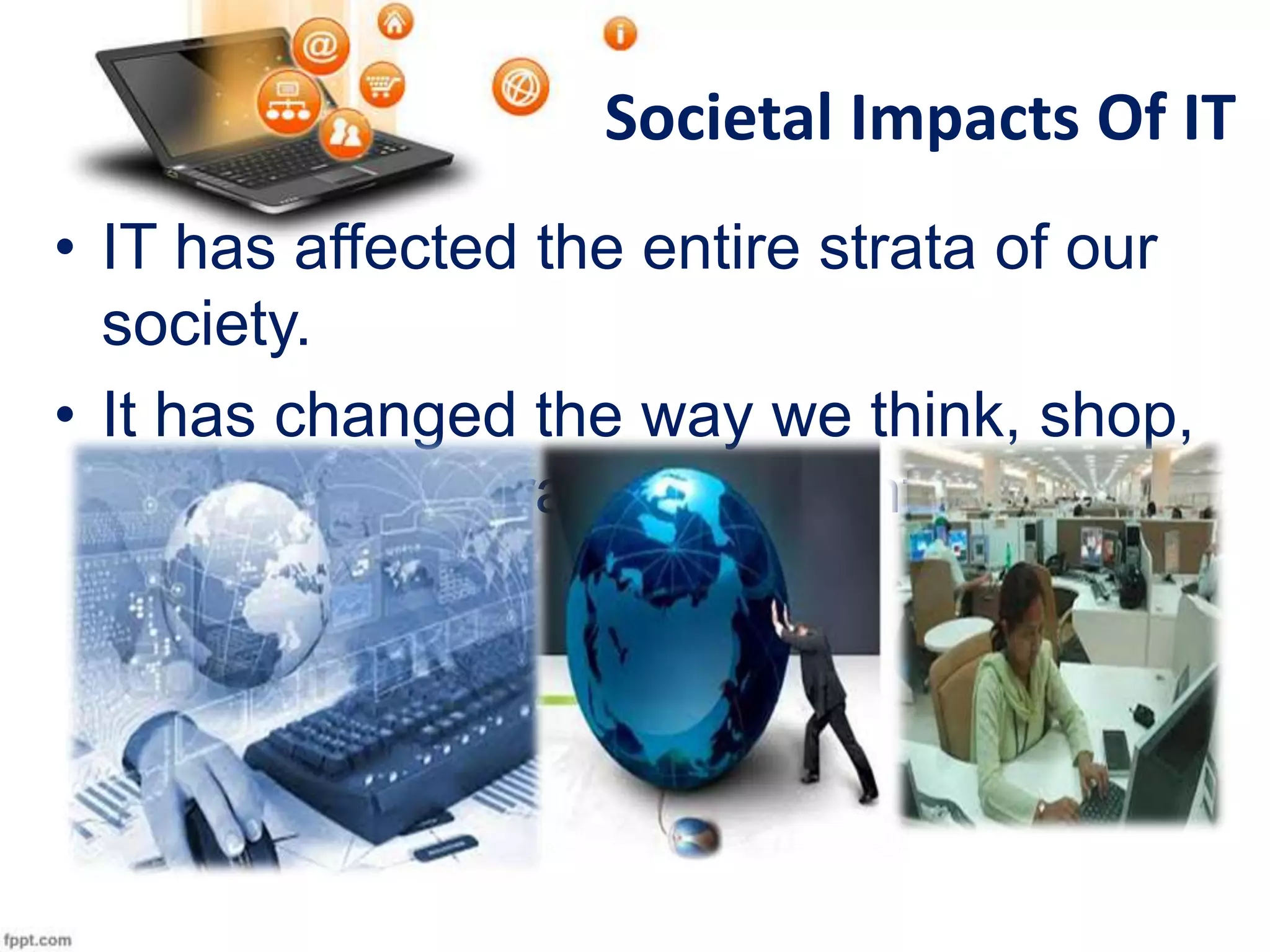
Societal Impacts Of IT
• IT has affected the entire strata of our
society.
• It has changed the way we think, shop,
get ourselves trained and entertained .
PLAGIARISM
• Plagiarism means “the use of close
replication of the language and
thoughts of another author in the
form as if one’s own original work”.
• It is stealing a person’s ideas or
writing.
• Plagiarism by students, professors
or researchers is considered
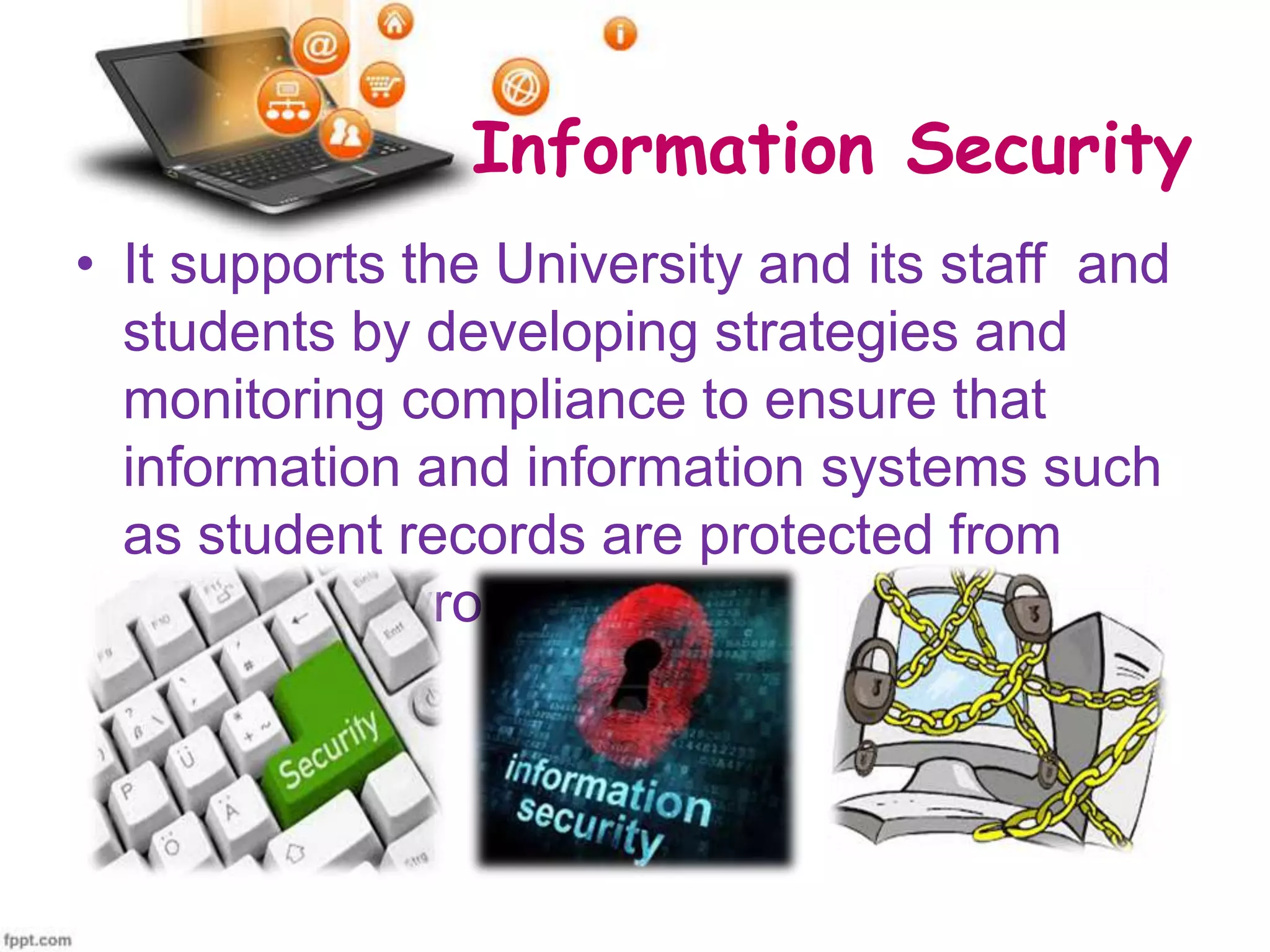
Information Security
• It supports the University and its staff and
students by developing strategies and
monitoring compliance to ensure that
information and information systems such
as student records are protected from
falling into wrong hands.
• It is business process needed to protect the
enormous amount of information , intellectual
property and business resources generated
or managed by researches , staff and
students.
• Staff and students rely on information being
available for work and study purposes. Loss
or Unavailability of information or information
systems could result in students being unable
to complete assignments.
• If systems are more up-to-date and secure
then they are also more likely to be
accurate and efficient.
• Security can be used to establish the
reputation of an entity. It helps to build
confidence with all users coming in contact
with it.
• With the emergence of computer hardware
and software industry and usage of ICT
mall walks of life , new avenues for careers
have opened up.
 Computer Programmer:
Bachelor’s or Honors' degree in
Computer Science Or IT.
 Software Engineer:
Bachelor’s or Honors' degree in Computer
Science Or IT.
 Technical Writers:
Graduation and Diploma Computer Science
or
Information Technology.
MADE BY-:
Vishwajeet
Aman

Societal Impact Of IT

  • 2.
    What is ICT? •ICT stands for Information and Communication Technologies. • It means ” diverse set of technologies tools and resources used to communicate and to create, disseminate , store and manage Information ”. • It includes computers, the Internet, telephone systems, radio television and satellite communications.
  • 3.
    Benefits Of ICTin Education Helps to expand access to Education • Powerful tool for extending educational opportunities. Has ability to transcend time and Space. Helps To Prepare Individuals For The Workspace • Representing Competitive edge in an increasingly globalizing job market. Helps to Improve The quality of Education • Enhance the quality of education by increasing learner Motivation and by enhancing teacher training.
  • 4.
    Benefits Of ICTIn Health Care • Computers and ICT technologies are making health care for all patients more efficient and accurate. • Improved health care is able to bring down the medical costs by reducing the number of days, the patient has to stay in hospital. • It provides assistance to Medical surgeons during critical operations. • Clinics and hospitals use computers with standard software packages to manage schedules for visiting wards etc.
  • 5.
    Benefits Of ICTIn Governance • Exchange of information with citizens and businesses by various government departments to provide rules and regulations. • Re-structuring of administrative processes , making them more efficient. • Reducing costs of public public works or increasing revenue or improving taxes collection or stamp duty collection. • Speedier and more efficient delivery of citizen services and review of development works being Undertaken.
  • 6.
    Delivery Of Citizen Rules& Regulation s & Intra Govt. Work Services Sharing Of Information With Citizens E-Governance
  • 7.
    Stage I: Web Presence StageII: Interactive Presence Stage III: Transactional Presence
  • 8.
    • Scientists andEngineers working in the design department make very significant usage of high speed computers and ICT technologies. • CAD allows engineers to design and test new products. • CAM helps in production packages. • Thus , ICT technologies are playing a tremendous role in these areas.
  • 9.
    • Today manysmall and large businesses have achieved their success primarily due to usage of ICT technologies. • These days, computers and WWW have become a powerful advertising media for companies. • Using ICT, advertisements can be displayed on different websites.
  • 10.
    Societal Impacts OfIT • IT has affected the entire strata of our society. • It has changed the way we think, shop, get ourselves trained and entertained .
  • 11.
    PLAGIARISM • Plagiarism means“the use of close replication of the language and thoughts of another author in the form as if one’s own original work”. • It is stealing a person’s ideas or writing. • Plagiarism by students, professors or researchers is considered
  • 12.
    Information Security • Itsupports the University and its staff and students by developing strategies and monitoring compliance to ensure that information and information systems such as student records are protected from falling into wrong hands.
  • 13.
    • It isbusiness process needed to protect the enormous amount of information , intellectual property and business resources generated or managed by researches , staff and students. • Staff and students rely on information being available for work and study purposes. Loss or Unavailability of information or information systems could result in students being unable to complete assignments.
  • 14.
    • If systemsare more up-to-date and secure then they are also more likely to be accurate and efficient. • Security can be used to establish the reputation of an entity. It helps to build confidence with all users coming in contact with it.
  • 15.
    • With theemergence of computer hardware and software industry and usage of ICT mall walks of life , new avenues for careers have opened up.  Computer Programmer: Bachelor’s or Honors' degree in Computer Science Or IT.  Software Engineer: Bachelor’s or Honors' degree in Computer Science Or IT.
  • 16.
     Technical Writers: Graduationand Diploma Computer Science or Information Technology.
  • 17.