VIRTUE ETHICS  Morality for Daily Life
INTRODUCTION There are two general types of ethics in moral theology:  VIRTUE ETHICS  and DILEMMA ETHICS VIRTUE ETHICS is the ordinary times of our lives when we face daily decisions of doing good and avoiding evil. DILEMMA ETHICS is for the extraordinary times when we face major ethical decision that involve conflict of values
Virtue Ethics Is concerned about how people express and form their character through their choices and action in everyday situations Sees the ordinary life as the place where most of moral life takes place
The task of being moral is to grow into perfection in imitation of Christ We do this by growing in the virtues
How do we develop virtues? By developing and regularly practicing good habits and avoiding vices
When we develop and maintain good habits/virtues we get used to doing good, and thus choosing and doing the good woud become easier and easier for us. Virtues and vices are dispositions of the will.  They are patterns of deciding and acting that draw us toward goodness or evil.
Traditional Virtues Divine or infused virtues :  Faith, Hope and Love Cardinal or acquired vitures:  Prudence, Justice, Fortitude and Temperance
Virtue ethics is a goal oriented ethics because we strive to live morally in order to move closer and closer to the perfection God desires for us and the perfect union with God that awaits us. The virtues are the means we use to achieve this goal of perfection and union with God.
Divine Virtues These virtues are received directly from God We cannot attain them on our own We receive them as gifts from God We receive them during Baptism
Cardinal Virtues These virtues are acquired which means that we can attain them and increase them by constant practice They are called cardinal from the Latin word  “cardo” meaning hinge Like the hinges that hold a door and allow it to swing, the cardinal virtues hold up our moral life They are like the skeleton on which our ordinary moral life hangs on
Prudence The virtue that enables us to make proper choices, avoiding extremes (too much or too little) Means being able to govern and discipline oneself with reason, in speech and in actions When you are a prudent person you know how to make good judgments and make balanced decisions
Justice The virtue that governs our relationships with others Enables us to decide and act in a way that gives to every person what is properly due each It means being impartial and exercising fair judgment' also conforming to truth You are a just person if you give to every one what they deserve
Fortitude The virtue that guides our response to difficulties in life Enables us to bravely and heroically face challenges in order to achieve what is good Moral courage – means to have courage and strength in mind, when faced with danger, adversity or pain A person who has fortitude is able to make sacrifices for what is good for himself or for others
Temperance The virtue that guides our response to pleasure Enables us to be disciplined in satisfying our human needs Means to moderate oneself in our thoughts, emotions, and our use and consumption of things To be a temperate person is to be able to practice self-control and restraint
Finding the Golden Mean Each virtue is attained by finding the golden mean in every activity There is an appropriate way to be just, tempered, prudent and courageous in every occasion One's character grows in perfection when one gradually learns to live according to the mean that is called for in every situation in daily life.
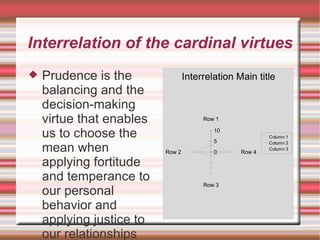
Interrelation of the cardinal virtues Prudence is the balancing and the decision-making virtue that enables us to choose the mean when applying fortitude and temperance to our personal behavior and applying justice to our relationships
Vices A vice is the opposite of virtue  It is either an excess or a deficiency in what a virtue should be
Vices Imprudence or negligence Injustice in doing too much or too little for others Intemperance, timidity Fear or too daring
Applying virtue ethics: Three basic questions we ask ourselves WHO AM I? WHAT KIND OF PERSON DO I WANT TO BECOME? HOW DO I ACHIEVE THIS GOAL?
CONTEMPORARY VIRTUES Benevolence Righteousness Propriety Wisdom Fidelity
Additional virtues Hospitality Gratitude Sympathy Humor Solidarity Transparency Care for the environment
Questions for Discussion As Filipinos, what virtues do we need to develop? As a Filipino youth, what vices do you have to correct/ What role models do we have who can help us follow Christ?

Virtue ethics

  • 1.
    VIRTUE ETHICS Morality for Daily Life
  • 2.
    INTRODUCTION There aretwo general types of ethics in moral theology: VIRTUE ETHICS and DILEMMA ETHICS VIRTUE ETHICS is the ordinary times of our lives when we face daily decisions of doing good and avoiding evil. DILEMMA ETHICS is for the extraordinary times when we face major ethical decision that involve conflict of values
  • 3.
    Virtue Ethics Isconcerned about how people express and form their character through their choices and action in everyday situations Sees the ordinary life as the place where most of moral life takes place
  • 4.
    The task ofbeing moral is to grow into perfection in imitation of Christ We do this by growing in the virtues
  • 5.
    How do wedevelop virtues? By developing and regularly practicing good habits and avoiding vices
  • 6.
    When we developand maintain good habits/virtues we get used to doing good, and thus choosing and doing the good woud become easier and easier for us. Virtues and vices are dispositions of the will. They are patterns of deciding and acting that draw us toward goodness or evil.
  • 7.
    Traditional Virtues Divineor infused virtues : Faith, Hope and Love Cardinal or acquired vitures: Prudence, Justice, Fortitude and Temperance
  • 8.
    Virtue ethics isa goal oriented ethics because we strive to live morally in order to move closer and closer to the perfection God desires for us and the perfect union with God that awaits us. The virtues are the means we use to achieve this goal of perfection and union with God.
  • 9.
    Divine Virtues Thesevirtues are received directly from God We cannot attain them on our own We receive them as gifts from God We receive them during Baptism
  • 10.
    Cardinal Virtues Thesevirtues are acquired which means that we can attain them and increase them by constant practice They are called cardinal from the Latin word “cardo” meaning hinge Like the hinges that hold a door and allow it to swing, the cardinal virtues hold up our moral life They are like the skeleton on which our ordinary moral life hangs on
  • 11.
    Prudence The virtuethat enables us to make proper choices, avoiding extremes (too much or too little) Means being able to govern and discipline oneself with reason, in speech and in actions When you are a prudent person you know how to make good judgments and make balanced decisions
  • 12.
    Justice The virtuethat governs our relationships with others Enables us to decide and act in a way that gives to every person what is properly due each It means being impartial and exercising fair judgment' also conforming to truth You are a just person if you give to every one what they deserve
  • 13.
    Fortitude The virtuethat guides our response to difficulties in life Enables us to bravely and heroically face challenges in order to achieve what is good Moral courage – means to have courage and strength in mind, when faced with danger, adversity or pain A person who has fortitude is able to make sacrifices for what is good for himself or for others
  • 14.
    Temperance The virtuethat guides our response to pleasure Enables us to be disciplined in satisfying our human needs Means to moderate oneself in our thoughts, emotions, and our use and consumption of things To be a temperate person is to be able to practice self-control and restraint
  • 15.
    Finding the GoldenMean Each virtue is attained by finding the golden mean in every activity There is an appropriate way to be just, tempered, prudent and courageous in every occasion One's character grows in perfection when one gradually learns to live according to the mean that is called for in every situation in daily life.
  • 16.
    Interrelation of thecardinal virtues Prudence is the balancing and the decision-making virtue that enables us to choose the mean when applying fortitude and temperance to our personal behavior and applying justice to our relationships
  • 17.
    Vices A viceis the opposite of virtue It is either an excess or a deficiency in what a virtue should be
  • 18.
    Vices Imprudence ornegligence Injustice in doing too much or too little for others Intemperance, timidity Fear or too daring
  • 19.
    Applying virtue ethics:Three basic questions we ask ourselves WHO AM I? WHAT KIND OF PERSON DO I WANT TO BECOME? HOW DO I ACHIEVE THIS GOAL?
  • 20.
    CONTEMPORARY VIRTUES BenevolenceRighteousness Propriety Wisdom Fidelity
  • 21.
    Additional virtues HospitalityGratitude Sympathy Humor Solidarity Transparency Care for the environment
  • 22.
    Questions for DiscussionAs Filipinos, what virtues do we need to develop? As a Filipino youth, what vices do you have to correct/ What role models do we have who can help us follow Christ?