Theological and CardinalVirtues
Virtues are gifts from God that lead us to live in a
close relationship with him.
Virtues are like habits. They need to be
practiced; they can be lost if they are
neglected.
The three most important virtues are called
theological virtues because they come from
God and lead to God.
The cardinal virtues are human virtues, acquired
by education and good actions.
4.
We believein God (faith).
We love God above all else, and
all things in God (charity or love).
We yearn for union with God,
experienced fully only in the next
life but tasted in this one (hope).
When one engages in such
activities well, one is said to have
these theological virtues. They are
obtained by grace and always
remain in the work of grace and we
perform them with God’s help.
5.
we love Godabove all things and our
neighbor as ourselves..
we believe in God and believe all that he
has revealed to us
we desire, eternal life and the graces to
merit it.
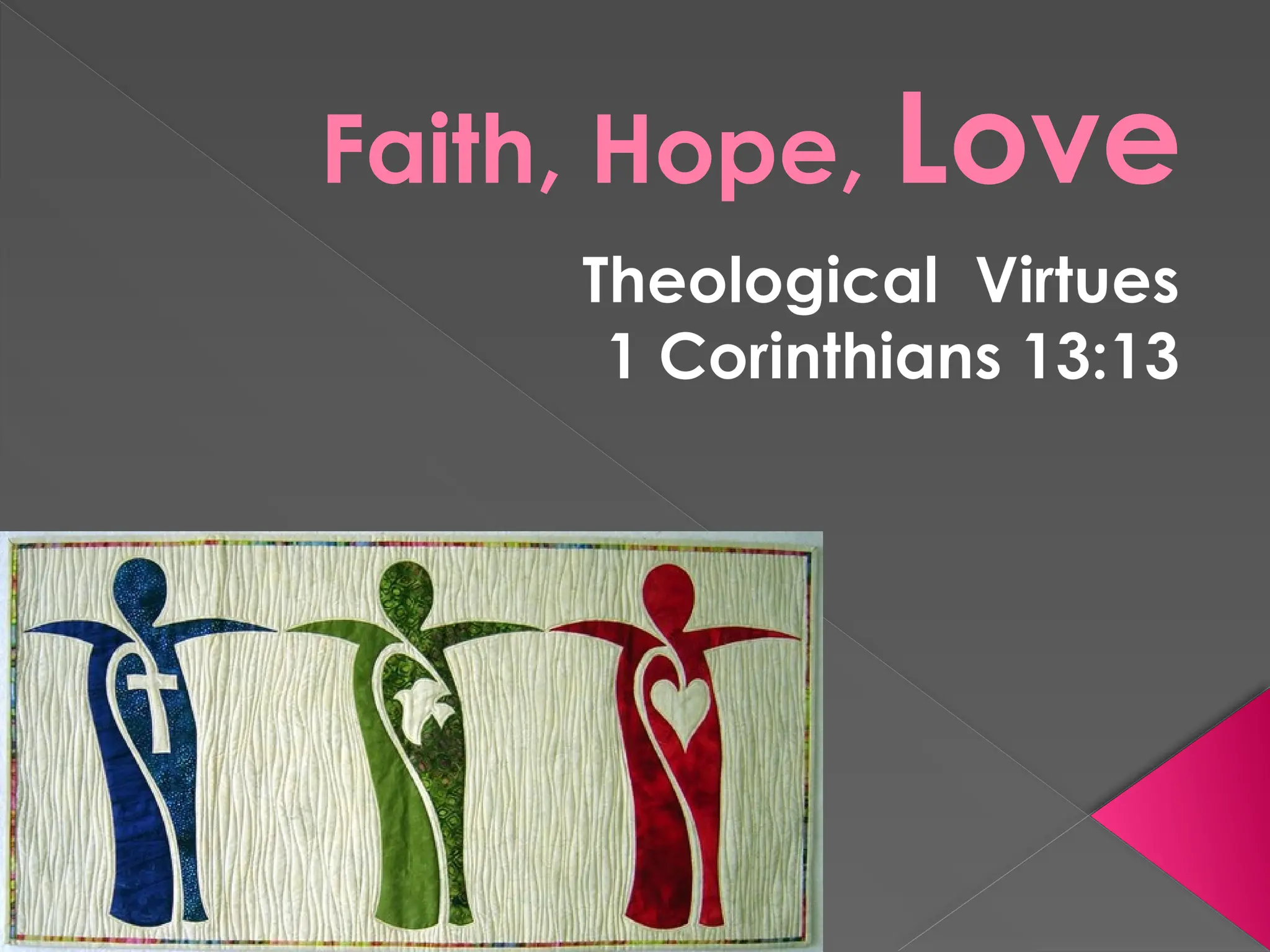
Love
Faith
Hope
Love
"binds everything
together in perfect
harmony" (Col
3:14).
6.
Three things willlast forever--
faith, hope, and love--and the
greatest of these is love.
7.
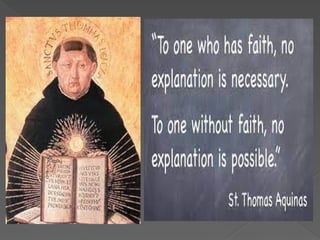
1. Faith
Faith accordingto Aquinas is
the virtue whereby we assent to
the truths about God, truths that
surpass our reason.
A person of faith does not
comprehend God, but he or she
is habitually disposed to accept
certain beliefs about God and to
discern what ought to be
believed and what ought not to
be believed about God.
9.
2. Hope
The virtueof hope focuses our lives on God, but
specifically on our future happiness with God.
Hope fixes our attention on God so that as we
move through life we do not turn away from God
to lesser goods but continually tend to God as our
greatest possible good. (Peiper, 1990).[ as cited by
Lamoureux and Wadell, 2010]
At this point in time, we should be hopeful and
passionate in the offering of prayer and service
especially for this pandemic to come to an end.
Then by our service, and by our love, the hope of
the Gospel – a hope that can counter fear and
isolation – will spread across our land.
10.
3. Charity orLove is the virtue whereby we love God for
His own sake and a state whereby our desires are
uniformly ordered to God. Charity directs everything we
do, and thus brings every other virtue to its utmost possible
perfection, so that all our actions, no matter how small,
have supernatural bearings.
11.
Love Is theGreatest
If I could speak all the languages of earth and of angels, but
didn’t love others, I would only be a noisy gong or a
clanging cymbal. If I had the gift of prophecy, and if I
understood all of God’s secret plans and possessed all
knowledge, and if I had such faith that I could move
mountains, but didn’t love others, I would be nothing. If I
gave everything I have to the poor and even sacrificed my
body, I could boast about it; but if I didn’t love others, I would
have gained nothing.
Love is patient and kind. Love is not jealous or boastful or
proud or rude. It does not demand its own way. It is not
irritable, and it keeps no record of being wronged. It does
not rejoice about injustice but rejoices whenever the truth
wins out. Love never gives up, never loses faith, is always
hopeful, and endures through every circumstance.
12.
All genuine lovecomes from God.
“God is love, and those who abide in love abide in God,
and God in them”
(1 John 4:16)
13.
Life is Sacred.
Godloved us first.
We are created in His image.
We must love ourselves in order to love others.
God gives us grace to reach out beyond ourselves.
14.
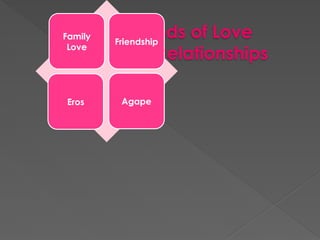
Different Kinds ofLove
for Different Relationships
Family
Love
Friendship
Eros Agape
15.
Family Love
Love ofa parent for a child, a child for a
parent, spouses for each other and
relatives for one another.
16.
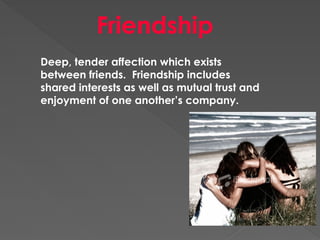
Friendship
Deep, tender affectionwhich exists
between friends. Friendship includes
shared interests as well as mutual trust and
enjoyment of one another’s company.
17.
Eros
Passionate human lovewhich can exist
between a man and a woman. Eros
always seeks union and thus includes
sexual love.
18.
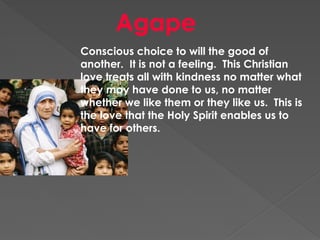
Agape
Conscious choice towill the good of
another. It is not a feeling. This Christian
love treats all with kindness no matter what
they may have done to us, no matter
whether we like them or they like us. This is
the love that the Holy Spirit enables us to
have for others.
19.
Read the followingscripture. Insert the
name of someone in place of the word
“love”.
Then read it again and replace the word
“love” with your own name.
20.
1 Corinthians 13
IfI speak in the tongues of men and of angels, but have not love, I
am only a resounding gong or a clanging cymbal. If I have the gift
of prophecy and can fathom all mysteries and all knowledge, and if
I have a faith that can move mountains, but have not love, I am
nothing. 3
If I give all I possess to the poor and surrender my body to
the flames, but have not love, I gain nothing.
Love is patient, love is kind. It does not envy, it does not boast, it is
not proud. It is not rude, it is not self-seeking, it is not easily angered,
it keeps no record of wrongs. Love does not delight in evil but
rejoices with the truth. It always protects, always trusts, always
hopes, always perseveres.
Love never fails.
21.
An expert inthe law tested Jesus with this question,
"Teacher, which is the greatest commandment in the law?“
Jesus replied, "Love the Lord your God with all your heart,
and with all your soul, and with all your mind. This is the first
and greatest commandment. “
And the second is like it:
'Love your neighbor as yourself.'
All the law and the prophets hang on these two
commandments.“
(Matthew 22:35-40)1
23.
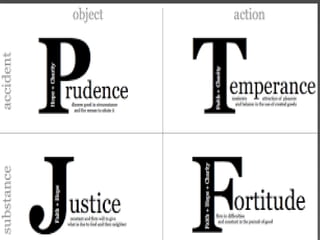
Prudence is aboutknowing how to make thoughtful and
wise decisions.
Josef Peiper defines it as “perfected ability to
make right decisions.” A virtuous person wants to do
the good; however, actually achieving the good in a
particular situation requires insight, thoughtfulness, a keen
assessment of circumstances, careful deliberation and
reflection, and a moral imagination healthy enough to
enable us to judge different possibilities for appropriate
action.
Prudence aims to make everything we do contribute to
what we take to be the ultimate good of our lives. The
immediate purpose of prudence is to show us how to act
today in order to attain “the final good for the whole of
human life” (Peiper, 1990).
26.
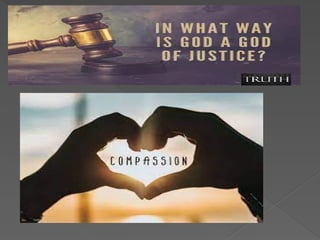
This virtue isthe habit of readiness which inclines one to
give others what is due to them (Maniwang, 2013).
This helps us to live together harmoniously when
exercised with respect to the rights of others. We depend
on and continuously benefit from the care, generosity,
and goodness of others, just as they continually depend
on and benefit from us.
Justice teaches us that the wellbeing of individuals and
community are interrelated in such a way that what
promotes one promotes the other, and whJustice also
enables us to assume our responsibilities and to give
others their due.
It disposes men to establish in human relationships the
harmony that promotes equity with regard to persons and
to the common good (Peiper, 1990).[ as cited by
Lamoureux and Wadell, 2010]
28.
Fortitude or courageis a virtue that
strengthens us so that we can overcome the
fears, difficulties, setbacks, and dangers that
challenge us in life and sometimes can
almost defeat us.
Without it, we will habitually sacrifice the
most important goods and aspirations of life
for the fears we cannot overcome. Life,
lacking courage, will become a chronicle of
regrets and missed opportunities.
29.
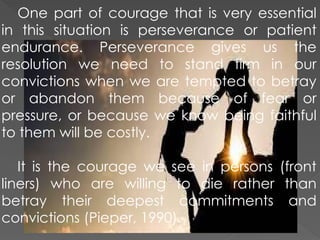
One part ofcourage that is very essential
in this situation is perseverance or patient
endurance. Perseverance gives us the
resolution we need to stand firm in our
convictions when we are tempted to betray
or abandon them because of fear or
pressure, or because we know being faithful
to them will be costly.
It is the courage we see in persons (front
liners) who are willing to die rather than
betray their deepest commitments and
convictions (Pieper, 1990).
32.
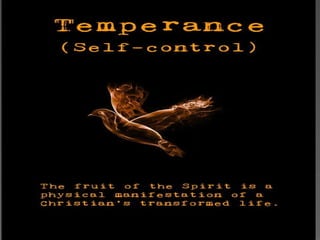
4. Temperance
Temperance isthe knowledge of how to balance
and integrate the various desires, appetites, and
attractions of life. Temperance is a virtue that governs
and directs our desires.
It does not fear or repress the desires, passions, and
hunger of our lives, but it does order, and regulate them
in case they begin to rule over us. It ensures the will’s
mastery over instincts and keeps desires within the light of
what is honorable.
Temperance is realizing when enough is enough of
any of the worldly goods God has given us (Peiper, 1990).
[ as cited by Lamoureux and Wadell, 2010]
36.
On the Necessityof Building the Various
Virtues
We grow in the distinctive potential and excellence of
human beings through the virtues, because “Virtues in
moral life refers to any developed capacity of mind or will
to accomplish moral good.”(CCC 1803).
Virtue is usually explained in terms of habits- learned
dispositions to act in a particular way. (CFC 979) According
to Patrick McCormick virtues are “those good moral
habits, affections, attitudes, and beliefs that lead
to genuine human fulfilment, even perfection, on
both personal and social levels.” In moral life there is
the crucial difference between “simply performing actions
and actually having a habit,” William Mattison explains.
“Habits are acquired qualities of character. Habits form us
in two ways:
37.
1. Habits formwho we are.
They give us character, our unique and
abiding moral identity habits form who we are
because the more we endorse certain attitudes,
and feelings, and the more often we act in
certain ways, the more deeply do those
attitudes, feelings, and actions become
genuine characteristics of ourselves.
38.
2. Habits formwhat we do.
This is because our actions flow from and
express our character. Ways of acting follow
upon ways of being.
Joseph Kotva captures well the relationship
between our character and our action when
he says, ”In simplest terms, being precedes
doing, but doing shapes being.
That is, who we have become, including our
states of character, precedes and informs our
choices and actions. But our choices and
actions help shape who we are and thus our
future choices and actions.” (Mattison, 2008).
39.
It is helpfulto think
of the virtues not only
as habits but also as
skills, especially skills
that enable us to
achieve excellence in
goodness in
whichever way it can
best be done.




![2. Hope
The virtue of hope focuses our lives on God, but
specifically on our future happiness with God.
Hope fixes our attention on God so that as we
move through life we do not turn away from God
to lesser goods but continually tend to God as our
greatest possible good. (Peiper, 1990).[ as cited by
Lamoureux and Wadell, 2010]
At this point in time, we should be hopeful and
passionate in the offering of prayer and service
especially for this pandemic to come to an end.
Then by our service, and by our love, the hope of
the Gospel – a hope that can counter fear and
isolation – will spread across our land.](https://image.slidesharecdn.com/theologicalvirtues-100609081157-phpapp02-250317234631-ea9fdf3b/85/theologicalvirtues-100609081157-phpapp02-pptx-9-320.jpg)






![This virtue is the habit of readiness which inclines one to
give others what is due to them (Maniwang, 2013).
This helps us to live together harmoniously when
exercised with respect to the rights of others. We depend
on and continuously benefit from the care, generosity,
and goodness of others, just as they continually depend
on and benefit from us.
Justice teaches us that the wellbeing of individuals and
community are interrelated in such a way that what
promotes one promotes the other, and whJustice also
enables us to assume our responsibilities and to give
others their due.
It disposes men to establish in human relationships the
harmony that promotes equity with regard to persons and
to the common good (Peiper, 1990).[ as cited by
Lamoureux and Wadell, 2010]](https://image.slidesharecdn.com/theologicalvirtues-100609081157-phpapp02-250317234631-ea9fdf3b/85/theologicalvirtues-100609081157-phpapp02-pptx-26-320.jpg)


![4. Temperance
Temperance is the knowledge of how to balance
and integrate the various desires, appetites, and
attractions of life. Temperance is a virtue that governs
and directs our desires.
It does not fear or repress the desires, passions, and
hunger of our lives, but it does order, and regulate them
in case they begin to rule over us. It ensures the will’s
mastery over instincts and keeps desires within the light of
what is honorable.
Temperance is realizing when enough is enough of
any of the worldly goods God has given us (Peiper, 1990).
[ as cited by Lamoureux and Wadell, 2010]](https://image.slidesharecdn.com/theologicalvirtues-100609081157-phpapp02-250317234631-ea9fdf3b/85/theologicalvirtues-100609081157-phpapp02-pptx-32-320.jpg)






![谷歌霸屏推广[ 𝙩𝙤𝙥 𝟮𝟯𝟯. 𝙘 𝙤𝙢 ]](https://cdn.slidesharecdn.com/ss_thumbnails/top233-260130171247-43791db0-thumbnail.jpg?width=640&height=640&fit=bounds)


