Lecturer 3: Virtualisation
Agenda
 Part 1: Virtualisation
 Concepts
 Server virtualisation
 Desktop virtualisation
 Network virtualisation
 Storage / memory virtualisation
 Part 2: Practice with Salesforce Cloud Platform
Learning Objectives
3
 Define and describe virtualisation.
 Discuss the history of virtualisation.
 Describe various types of virtualisation.
 List the pros and cons of virtualisation.
 Identify applications that are well suited, as well as
those that are not suited, for virtualisation.
 Describe why companies should employ
virtualisation.
Virtualisation Defined
4
 The use of hardware and software to create the
perception that one or more entities exist, although the
entities, in actuality, are not physically present.
 Using virtualisation, we can make one server appear to
be many, a desktop computer appear to be running
multiple operating systems simultaneously, a network
connection appear to exist, or a vast amount of disk
space or a vast number of drives to be available.
Server Virtualisation
5
 Making one server appear as many. Each virtual server
may run the same or different operating systems.
 Server virtualisation provides greater CPU utilisation, a
smaller equipment footprint, less power consumption,
and support for multiple operating systems.
Original Servers
 Server computers originally required their own chassis, disk,
power supply, and fan. Servers consumed considerable
power, took up considerable space, and generated
considerable heat within the data centre.
6
Green Computing
7
 Power off devices when they are not in use.
 Power up energy-intensive devices, such as laser printers,
only when needed.
 Use notebooks when possible instead of desktops.
 Use the computer’s built-in power management features.
 Minimise unnecessary printing.
 Dispose of e-waste (devices, ink cartridges, monitors, and
so on) in compliance with government regulations.
Blade Servers
 The blade server is designed to fit within a rack with other
blade servers. This reduces the server’s physical footprint,
makes the server easier to cool, and reduces the server’s
power consumption.
8
Microsoft Hyper-V
9
 Microsoft servers now utilise an underlying technology
called Hyper-V to allow administrators to create virtual
servers.
 Advantages:
 The ability to consolidate servers and increase CPU utilisation
 Enhanced business continuity and disaster recovery
 Ease of deploying testing and support environments
 Enhanced support for Windows-based client virtualisation
 Improved load balancing
 Ability to move live virtual machines from one physical server
to another on the fly for load balancing and scalability
VMware ESXi
10
 VMware is one of the best-known providers of virtualisation
solutions.
 ESXi provides the following:
 Support for multiple operating systems
 Server consolidation
 Automated resource management to drive disaster recovery
and service-level agreements
 Detail cost-reporting services
 Automated load balancing
 Centralised management and administration of virtual
servers and the underlying machines
Desktop Virtualisation
11
 Allows a user to switch between multiple operating systems
on the same computer. (An operating system that resides
within a virtualised environment is known as a guest
operating system.)
 Some desktop virtualisation techniques can provide an
operating system environment on demand.
 Desktop virtualisation provides support for multiple
operating systems, which is very convenient for software
developers, testers, and help desk support staff.
Virtual Desktop
12
 The term for a desktop computer that runs two or more
operating systems.
 Desktop virtualisation allows a desktop computer to run
two or more operating systems at the same time and allows
a user to quickly switch between the systems.
 Advantages:
 A single desktop computer can simultaneously run multiple
operating systems.
 There is reduced need for duplicate hardware.
 Less power is consumed.
VMware View
13
 A tool for providing virtual desktops on demand. Using
View, system administrators can centralise the on-demand
delivery of an operating system and user-assigned
applications.
 Advantages:
 Simplified desktop operating system and application
management
 Automated desktop provisioning (account generation)
 Virtual-desktop image management
 Support for a variety of client platforms
Virtual Networks
14
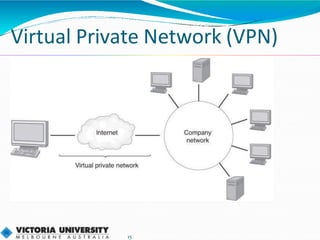
 Create the illusion that a user is connected directly to a
company network and resources, although no such physical
connection may exist.
 Virtual networks are sometimes called virtual private
networks or VPNs. Using a VPN, users can connect to a
network and access the network resources from any
Internet-connected computer.
 Virtual networks let network administrators to segment a
network, making different departments such as
management, development, and sales appear to have their
own separate networks.
Virtual Private Network (VPN)
15
Virtual Local-Area Network
 Virtual local-area network (VLAN), which uses special routers
to segment part of the physical network in such a way that
the group appears to have its own private network.
16
Virtual Storage
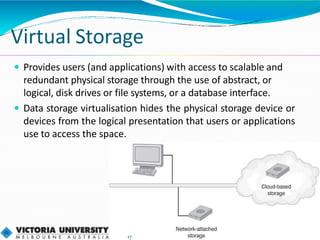
 Provides users (and applications) with access to scalable and
redundant physical storage through the use of abstract, or
logical, disk drives or file systems, or a database interface.
 Data storage virtualisation hides the physical storage device or
devices from the logical presentation that users or applications
use to access the space.
17
Virtual Memory
 Virtual memory combines RAM with a page file on disk to
create the illusion, to running programs, of the existenceof
a vast amount of RAM.
18
Advantages of Virtual Memory
19
 A running program (process) appears to have unlimited
memory.
 The operating system can easily manage several different
programs, running at the same time, and keep each
program’s data and instructions secure.
 The operating system can take advantage of disk storage,
which is considerably less expensive than RAM.
Disadvantages of Virtual Memory
20
 The disadvantage of virtual memory is that the paging
process (the process of moving instructions and data
between RAM and disk) adds overhead, mostly because
disk drives are much slower than RAM.
Not All Applications Are Appropriate
for Virtualisation
21
 Applications with unique hardware requirements: If an
application requires a unique device or hardware device
driver, the virtualisation software may be unable to
support the device.
 Graphics-intensive applications: If an application is
graphics intensive, such as a 3-D modeling program, the
virtual device drivers may slow down the I/O processing
to an unacceptable level.
Motivation to Virtualise
22
 Increased device utilisation (particularly CPU utilisation)
 Decreased device footprint
 Decreased power consumption
 Simplified operating system and application administration
 Ease of software provisioning and patch releases
 Device and storage scalability
 Increased user access to key resources
 Increased flexibility in supporting multiple operating system
environments
 Improved use and management of software licenses
 Improved utilisation reporting, which leads to improved capacity
planning
 Improved disaster recovery and business continuity
Disadvantages of Virtualisation
23
 New staff or staff training may be required to
understand the virtualisation process.
 Not all applications are well suited for virtualisation.
 The virtualisation process adds slight overhead, which
will make some applications run more slowly.

Virtualisation.pptx

  • 1.
  • 2.
    Agenda  Part 1:Virtualisation  Concepts  Server virtualisation  Desktop virtualisation  Network virtualisation  Storage / memory virtualisation  Part 2: Practice with Salesforce Cloud Platform
  • 3.
    Learning Objectives 3  Defineand describe virtualisation.  Discuss the history of virtualisation.  Describe various types of virtualisation.  List the pros and cons of virtualisation.  Identify applications that are well suited, as well as those that are not suited, for virtualisation.  Describe why companies should employ virtualisation.
  • 4.
    Virtualisation Defined 4  Theuse of hardware and software to create the perception that one or more entities exist, although the entities, in actuality, are not physically present.  Using virtualisation, we can make one server appear to be many, a desktop computer appear to be running multiple operating systems simultaneously, a network connection appear to exist, or a vast amount of disk space or a vast number of drives to be available.
  • 5.
    Server Virtualisation 5  Makingone server appear as many. Each virtual server may run the same or different operating systems.  Server virtualisation provides greater CPU utilisation, a smaller equipment footprint, less power consumption, and support for multiple operating systems.
  • 6.
    Original Servers  Servercomputers originally required their own chassis, disk, power supply, and fan. Servers consumed considerable power, took up considerable space, and generated considerable heat within the data centre. 6
  • 7.
    Green Computing 7  Poweroff devices when they are not in use.  Power up energy-intensive devices, such as laser printers, only when needed.  Use notebooks when possible instead of desktops.  Use the computer’s built-in power management features.  Minimise unnecessary printing.  Dispose of e-waste (devices, ink cartridges, monitors, and so on) in compliance with government regulations.
  • 8.
    Blade Servers  Theblade server is designed to fit within a rack with other blade servers. This reduces the server’s physical footprint, makes the server easier to cool, and reduces the server’s power consumption. 8
  • 9.
    Microsoft Hyper-V 9  Microsoftservers now utilise an underlying technology called Hyper-V to allow administrators to create virtual servers.  Advantages:  The ability to consolidate servers and increase CPU utilisation  Enhanced business continuity and disaster recovery  Ease of deploying testing and support environments  Enhanced support for Windows-based client virtualisation  Improved load balancing  Ability to move live virtual machines from one physical server to another on the fly for load balancing and scalability
  • 10.
    VMware ESXi 10  VMwareis one of the best-known providers of virtualisation solutions.  ESXi provides the following:  Support for multiple operating systems  Server consolidation  Automated resource management to drive disaster recovery and service-level agreements  Detail cost-reporting services  Automated load balancing  Centralised management and administration of virtual servers and the underlying machines
  • 11.
    Desktop Virtualisation 11  Allowsa user to switch between multiple operating systems on the same computer. (An operating system that resides within a virtualised environment is known as a guest operating system.)  Some desktop virtualisation techniques can provide an operating system environment on demand.  Desktop virtualisation provides support for multiple operating systems, which is very convenient for software developers, testers, and help desk support staff.
  • 12.
    Virtual Desktop 12  Theterm for a desktop computer that runs two or more operating systems.  Desktop virtualisation allows a desktop computer to run two or more operating systems at the same time and allows a user to quickly switch between the systems.  Advantages:  A single desktop computer can simultaneously run multiple operating systems.  There is reduced need for duplicate hardware.  Less power is consumed.
  • 13.
    VMware View 13  Atool for providing virtual desktops on demand. Using View, system administrators can centralise the on-demand delivery of an operating system and user-assigned applications.  Advantages:  Simplified desktop operating system and application management  Automated desktop provisioning (account generation)  Virtual-desktop image management  Support for a variety of client platforms
  • 14.
    Virtual Networks 14  Createthe illusion that a user is connected directly to a company network and resources, although no such physical connection may exist.  Virtual networks are sometimes called virtual private networks or VPNs. Using a VPN, users can connect to a network and access the network resources from any Internet-connected computer.  Virtual networks let network administrators to segment a network, making different departments such as management, development, and sales appear to have their own separate networks.
  • 15.
  • 16.
    Virtual Local-Area Network Virtual local-area network (VLAN), which uses special routers to segment part of the physical network in such a way that the group appears to have its own private network. 16
  • 17.
    Virtual Storage  Providesusers (and applications) with access to scalable and redundant physical storage through the use of abstract, or logical, disk drives or file systems, or a database interface.  Data storage virtualisation hides the physical storage device or devices from the logical presentation that users or applications use to access the space. 17
  • 18.
    Virtual Memory  Virtualmemory combines RAM with a page file on disk to create the illusion, to running programs, of the existenceof a vast amount of RAM. 18
  • 19.
    Advantages of VirtualMemory 19  A running program (process) appears to have unlimited memory.  The operating system can easily manage several different programs, running at the same time, and keep each program’s data and instructions secure.  The operating system can take advantage of disk storage, which is considerably less expensive than RAM.
  • 20.
    Disadvantages of VirtualMemory 20  The disadvantage of virtual memory is that the paging process (the process of moving instructions and data between RAM and disk) adds overhead, mostly because disk drives are much slower than RAM.
  • 21.
    Not All ApplicationsAre Appropriate for Virtualisation 21  Applications with unique hardware requirements: If an application requires a unique device or hardware device driver, the virtualisation software may be unable to support the device.  Graphics-intensive applications: If an application is graphics intensive, such as a 3-D modeling program, the virtual device drivers may slow down the I/O processing to an unacceptable level.
  • 22.
    Motivation to Virtualise 22 Increased device utilisation (particularly CPU utilisation)  Decreased device footprint  Decreased power consumption  Simplified operating system and application administration  Ease of software provisioning and patch releases  Device and storage scalability  Increased user access to key resources  Increased flexibility in supporting multiple operating system environments  Improved use and management of software licenses  Improved utilisation reporting, which leads to improved capacity planning  Improved disaster recovery and business continuity
  • 23.
    Disadvantages of Virtualisation 23 New staff or staff training may be required to understand the virtualisation process.  Not all applications are well suited for virtualisation.  The virtualisation process adds slight overhead, which will make some applications run more slowly.