VIRTUAL
WORLD
 A virtual world is a computer-based simulated
environment which may be populated by many users
who can create a personal avatar, and simultaneously
and independently explore the virtual world,
participate in its activities and communicate with
others.[2] These avatars can be textual, two or three-
dimensional graphical representations, or live video
avatars with auditory and touch sensations.[3][4] In
general, virtual worlds allow for multiple users but
single player computer games such Sky rim can also
be considered a type of virtual world.
ABOUT
 The concept of virtual worlds significantly predates
computers. The Roman naturalist, Pliny the Elder,
expressed an interest in perceptual illusion.[10][11] In
the twentieth century, the cinematographer Morton
Heilig explored the creation of the Sensorial, a
theatre experience designed to stimulate the senses
of the audience—vision, sound, balance, smell, even
touch (via wind)—and so draw them more
effectively into the productions .
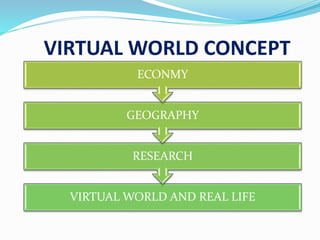
VIRTUAL WORLD CONCEPT
VIRTUAL WORLD AND REAL LIFE
RESEARCH
GEOGRAPHY
ECONMY
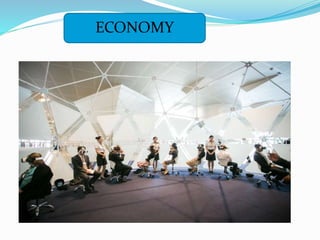
ECONOMY
 A virtual economy is the emergent property of the
interaction between participants in a virtual world.
While the designers have a great deal of control over the
economy by the encoded mechanics of trade, it is
nonetheless the actions of players that define the
economic conditions of a virtual world. The economy
arises as a result of the choices that players make under
the scarcity of real and virtual resources such as time or
currency . Participants have a limited time in the
virtual world, as in the real world, which they must
divide between task such as collecting resources,
practicing trade skills, or engaging in less productive
fun play.
GEOGRAPHY
The geography of virtual worlds can vary widely
because the role of geography and space is an
important design component over which the
developers of virtual worlds have control and may
choose to alter.[Virtual worlds are, at least
superficially, digital instantiations of three-
dimensional space. As a result, considerations of
geography in virtual worlds (such as World of War
craft) often revolve around “spatial narratives” in
which players act out a nomadic hero’s journey
along the lines of that present in The Odyssey.
RESEARCH
 Virtual spaces can serve a variety of research
and educational goals and may be useful for
examining human behavior. Offline- and virtual-
world personalities differ from each other but are
nevertheless significantly related which has a
number of implications for self-verification, self-
enhancement and other personality
theories.[36][37] Panic and agoraphobia have also
been studied in a virtual world.
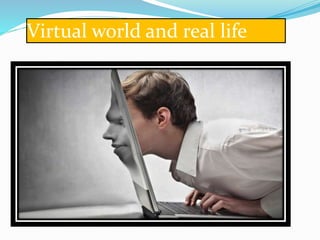
Virtual world and real life
APPLICATION
DOMAIN
SOCIAL
MEDICAL
COMMERCIAL
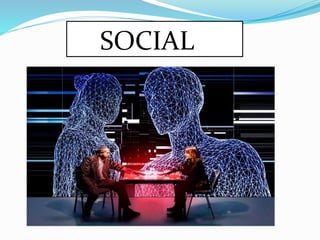
SOCIAL
 Although the social interactions of
participants in virtual worlds are often
viewed in the context of 3D Games, other
forms of interaction are common as well,
including forums, blogs, wikis,
chartrooms, instant messaging, and video-
conferences. Communities are born in
places which have their own rules, topics,
jokes, and even language. Members of
such communities can find like-minded
people to interact with, whether this be
through a shared passion, the wish to
share information, or a desire to meet new
people and experience new things. Users
may develop personalities within the
community adapted to the particular
world they are interacting with.
MEDICAL
 Disabled or chronically invalided people of any age can benefit
enormously from experiencing the mental and emotional
freedom gained by temporarily leaving their disabilities behind
and doing, through the medium of their avatars, things as
simple and potentially accessible to able, healthy people as
walking, running, dancing, sailing, fishing, swimming, surfing,
flying, skiing, gardening, exploring and other physical activities
which their illnesses or disabilities prevent them from doing in
real life. They may also be able to socialize, form friendships
and relationships much more easily and avoid the stigma and
other obstacles which would normally be attached to their
disabilities. This can be much more constructive, emotionally
satisfying and mentally fulfilling than passive pastimes such as
television watching, playing computer games, reading or more
conventional types of internet use.
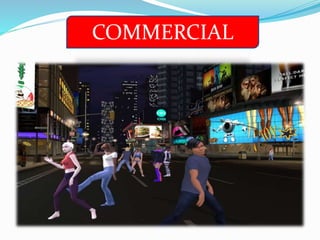
COMMERCIAL
 As businesses compete in the real world, they also compete in virtual
worlds. As there has been an increase in the buying and selling of
products online (e-commerce) this twinned with the rise in the
popularity of the internet, has forced businesses to adjust to
accommodate the new market.
 Many companies and organizations now incorporate virtual worlds as
a new form of advertising. There are many advantages to using these
methods of commercialization. An example of this would be Apple
creating an online store within Second Life. This allows the users to
browse the latest and innovative products. Players cannot actually
purchase a product but having these “virtual stores” is a way of
accessing a different clientele and customer demographic. The use of
advertising within "virtual worlds" is a relatively new idea. This is
because Virtual Worlds is a relatively new technology. Before
companies would use an advertising company to promote their
products. With the introduction of the prospect of commercial
success within a Virtual World, companies can reduce cost and time
constraints by keeping this "in-house". An obvious advantage is that
it will reduce any costs and restrictions that could come into play in
the real world.
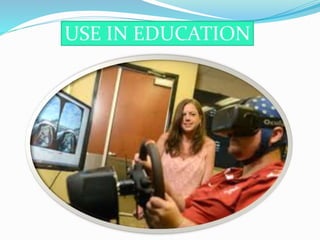
 Language learning is the most widespread type of
education in virtual worlds.Online training overcomes constraints such as
distance, infrastructure, accommodation costs and
tight scheduling. Although video conferencing may be
the most common tool, virtual worlds have been
adopted by the business environment for training
employees.[73] For example, Second Life has been used
in business schools.[74]
IN FICTION
Virtual worlds, virtual reality, and cyberspace are popular
fictional motifs. A prominent example is the work
of William Gibson. The first was probably John M. Ford's
1980 novel Web of Angels. Virtual worlds are integral
to Torn, Necromancer, Ghost in the Shell, Snow Crash, The
Lawnmower Man, Lawnmower Man
2, Reboot, Diriment, The Matrix, Mega Man NT
Warrior, Epic, Code Lyoko, Real Drive, and Ready Player
One.
THANK YOU
BY NITYANAND

VIRTUAL WORLD

  • 1.
  • 2.
     A virtualworld is a computer-based simulated environment which may be populated by many users who can create a personal avatar, and simultaneously and independently explore the virtual world, participate in its activities and communicate with others.[2] These avatars can be textual, two or three- dimensional graphical representations, or live video avatars with auditory and touch sensations.[3][4] In general, virtual worlds allow for multiple users but single player computer games such Sky rim can also be considered a type of virtual world.
  • 3.
    ABOUT  The conceptof virtual worlds significantly predates computers. The Roman naturalist, Pliny the Elder, expressed an interest in perceptual illusion.[10][11] In the twentieth century, the cinematographer Morton Heilig explored the creation of the Sensorial, a theatre experience designed to stimulate the senses of the audience—vision, sound, balance, smell, even touch (via wind)—and so draw them more effectively into the productions .
  • 4.
    VIRTUAL WORLD CONCEPT VIRTUALWORLD AND REAL LIFE RESEARCH GEOGRAPHY ECONMY
  • 5.
  • 6.
     A virtualeconomy is the emergent property of the interaction between participants in a virtual world. While the designers have a great deal of control over the economy by the encoded mechanics of trade, it is nonetheless the actions of players that define the economic conditions of a virtual world. The economy arises as a result of the choices that players make under the scarcity of real and virtual resources such as time or currency . Participants have a limited time in the virtual world, as in the real world, which they must divide between task such as collecting resources, practicing trade skills, or engaging in less productive fun play.
  • 7.
  • 8.
    The geography ofvirtual worlds can vary widely because the role of geography and space is an important design component over which the developers of virtual worlds have control and may choose to alter.[Virtual worlds are, at least superficially, digital instantiations of three- dimensional space. As a result, considerations of geography in virtual worlds (such as World of War craft) often revolve around “spatial narratives” in which players act out a nomadic hero’s journey along the lines of that present in The Odyssey.
  • 9.
  • 10.
     Virtual spacescan serve a variety of research and educational goals and may be useful for examining human behavior. Offline- and virtual- world personalities differ from each other but are nevertheless significantly related which has a number of implications for self-verification, self- enhancement and other personality theories.[36][37] Panic and agoraphobia have also been studied in a virtual world.
  • 11.
  • 12.
  • 13.
  • 14.
     Although thesocial interactions of participants in virtual worlds are often viewed in the context of 3D Games, other forms of interaction are common as well, including forums, blogs, wikis, chartrooms, instant messaging, and video- conferences. Communities are born in places which have their own rules, topics, jokes, and even language. Members of such communities can find like-minded people to interact with, whether this be through a shared passion, the wish to share information, or a desire to meet new people and experience new things. Users may develop personalities within the community adapted to the particular world they are interacting with.
  • 15.
  • 16.
     Disabled orchronically invalided people of any age can benefit enormously from experiencing the mental and emotional freedom gained by temporarily leaving their disabilities behind and doing, through the medium of their avatars, things as simple and potentially accessible to able, healthy people as walking, running, dancing, sailing, fishing, swimming, surfing, flying, skiing, gardening, exploring and other physical activities which their illnesses or disabilities prevent them from doing in real life. They may also be able to socialize, form friendships and relationships much more easily and avoid the stigma and other obstacles which would normally be attached to their disabilities. This can be much more constructive, emotionally satisfying and mentally fulfilling than passive pastimes such as television watching, playing computer games, reading or more conventional types of internet use.
  • 17.
  • 18.
     As businessescompete in the real world, they also compete in virtual worlds. As there has been an increase in the buying and selling of products online (e-commerce) this twinned with the rise in the popularity of the internet, has forced businesses to adjust to accommodate the new market.  Many companies and organizations now incorporate virtual worlds as a new form of advertising. There are many advantages to using these methods of commercialization. An example of this would be Apple creating an online store within Second Life. This allows the users to browse the latest and innovative products. Players cannot actually purchase a product but having these “virtual stores” is a way of accessing a different clientele and customer demographic. The use of advertising within "virtual worlds" is a relatively new idea. This is because Virtual Worlds is a relatively new technology. Before companies would use an advertising company to promote their products. With the introduction of the prospect of commercial success within a Virtual World, companies can reduce cost and time constraints by keeping this "in-house". An obvious advantage is that it will reduce any costs and restrictions that could come into play in the real world.
  • 20.
     Language learningis the most widespread type of education in virtual worlds.Online training overcomes constraints such as distance, infrastructure, accommodation costs and tight scheduling. Although video conferencing may be the most common tool, virtual worlds have been adopted by the business environment for training employees.[73] For example, Second Life has been used in business schools.[74]
  • 21.
    IN FICTION Virtual worlds,virtual reality, and cyberspace are popular fictional motifs. A prominent example is the work of William Gibson. The first was probably John M. Ford's 1980 novel Web of Angels. Virtual worlds are integral to Torn, Necromancer, Ghost in the Shell, Snow Crash, The Lawnmower Man, Lawnmower Man 2, Reboot, Diriment, The Matrix, Mega Man NT Warrior, Epic, Code Lyoko, Real Drive, and Ready Player One.
  • 22.