VIRTUAL REALITY
INNOVATIVE THINKING
SUBMITTED BY:
AQUIB KHAN
0873CS151020
SUBMITTED TO:
MR. SANDEEP MATHARIA
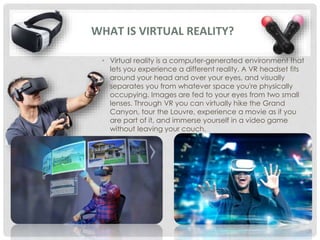
• Virtual reality is a computer-generated environment that
lets you experience a different reality. A VR headset fits
around your head and over your eyes, and visually
separates you from whatever space you're physically
occupying. Images are fed to your eyes from two small
lenses. Through VR you can virtually hike the Grand
Canyon, tour the Louvre, experience a movie as if you
are part of it, and immerse yourself in a video game
without leaving your couch.
WHAT IS VIRTUAL REALITY?
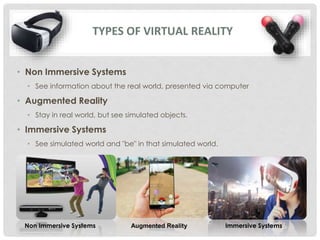
• Non Immersive Systems
• See information about the real world, presented via computer
• Augmented Reality
• Stay in real world, but see simulated objects.
• Immersive Systems
• See simulated world and "be" in that simulated world.
TYPES OF VIRTUAL REALITY
Non Immersive Systems Augmented Reality Immersive Systems
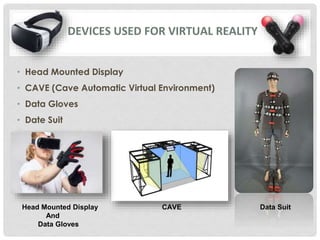
• Head Mounted Display
• CAVE (Cave Automatic Virtual Environment)
• Data Gloves
• Date Suit
DEVICES USED FOR VIRTUAL REALITY
Head Mounted Display CAVE Data Suit
And
Data Gloves
DEVICES USED FOR VIRTUAL REALITY
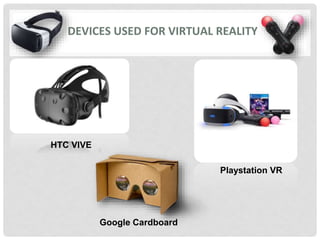
HTC VIVE
Playstation VR
Google Cardboard
PROBLEMS FACED BY VIRTUAL REALITY
• Technical matters and Simulation sickness due to virtual reality
• Users might become disoriented in a purely 'virtual' environment, causing
balance issues
• Computer latency might affect the simulation, providing a less than
satisfactory end-user experience
• The complicated nature of head-mounted displays and input systems such
as specialized gloves and boots may require specialized training to operate
• Navigating the 'real' environment might prove dangerous without 'external'
sensory information.
PROBLEMS FACED BY VIRTUAL REALITY
• Technical matters and Simulation sickness due to virtual reality
• Users might become disoriented in a purely 'virtual' environment, causing
balance issues
• Computer latency might affect the simulation, providing a less than
satisfactory end-user experience
• The complicated nature of head-mounted displays and input systems such
as specialized gloves and boots may require specialized training to operate
• Navigating the 'real' environment might prove dangerous without 'external'
sensory information.
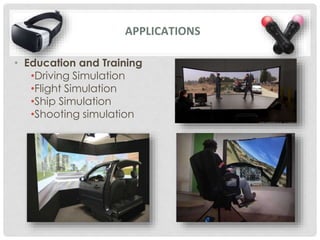
• Education and Training
•Driving Simulation
•Flight Simulation
•Ship Simulation
•Shooting simulation
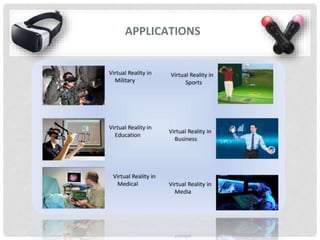
APPLICATIONS
APPLICATIONS
CONCLUSION
• Virtual Reality is the fastest growing industry and if paid attention to
properly, it can prove to lead to a very promising future
• PC and specialized hardware are getting better, faster and cheaper
because of development in VR
• Developers and Designers of the next generation will have a lot of
scope in the coming years in the VR industry.
THAT’S EVERYTHING YOU NEED TO KNOW
AND
HAPPY VIRTUALIZING
REALITY

Virtual Reality

  • 1.
    VIRTUAL REALITY INNOVATIVE THINKING SUBMITTEDBY: AQUIB KHAN 0873CS151020 SUBMITTED TO: MR. SANDEEP MATHARIA
  • 2.
    • Virtual realityis a computer-generated environment that lets you experience a different reality. A VR headset fits around your head and over your eyes, and visually separates you from whatever space you're physically occupying. Images are fed to your eyes from two small lenses. Through VR you can virtually hike the Grand Canyon, tour the Louvre, experience a movie as if you are part of it, and immerse yourself in a video game without leaving your couch. WHAT IS VIRTUAL REALITY?
  • 3.
    • Non ImmersiveSystems • See information about the real world, presented via computer • Augmented Reality • Stay in real world, but see simulated objects. • Immersive Systems • See simulated world and "be" in that simulated world. TYPES OF VIRTUAL REALITY Non Immersive Systems Augmented Reality Immersive Systems
  • 4.
    • Head MountedDisplay • CAVE (Cave Automatic Virtual Environment) • Data Gloves • Date Suit DEVICES USED FOR VIRTUAL REALITY Head Mounted Display CAVE Data Suit And Data Gloves
  • 5.
    DEVICES USED FORVIRTUAL REALITY HTC VIVE Playstation VR Google Cardboard
  • 6.
    PROBLEMS FACED BYVIRTUAL REALITY • Technical matters and Simulation sickness due to virtual reality • Users might become disoriented in a purely 'virtual' environment, causing balance issues • Computer latency might affect the simulation, providing a less than satisfactory end-user experience • The complicated nature of head-mounted displays and input systems such as specialized gloves and boots may require specialized training to operate • Navigating the 'real' environment might prove dangerous without 'external' sensory information.
  • 7.
    PROBLEMS FACED BYVIRTUAL REALITY • Technical matters and Simulation sickness due to virtual reality • Users might become disoriented in a purely 'virtual' environment, causing balance issues • Computer latency might affect the simulation, providing a less than satisfactory end-user experience • The complicated nature of head-mounted displays and input systems such as specialized gloves and boots may require specialized training to operate • Navigating the 'real' environment might prove dangerous without 'external' sensory information.
  • 8.
    • Education andTraining •Driving Simulation •Flight Simulation •Ship Simulation •Shooting simulation APPLICATIONS
  • 9.
  • 10.
    CONCLUSION • Virtual Realityis the fastest growing industry and if paid attention to properly, it can prove to lead to a very promising future • PC and specialized hardware are getting better, faster and cheaper because of development in VR • Developers and Designers of the next generation will have a lot of scope in the coming years in the VR industry.
  • 11.
    THAT’S EVERYTHING YOUNEED TO KNOW AND HAPPY VIRTUALIZING REALITY