
A Whitepaper by RapidValue Solutions
Virtual Reality in E-Learning
Redefining the Learning Experience
02©RapidValue Solutions
Contents
Executive Summary....................................................................................................................................
Use Cases and Benefits of Virtual Reality in eLearning.............................................................................
Use Cases............................................................................................................................................
Benefits................................................................................................................................................
How VR integrates with Learning Systems.................................................................................................
Basic Features of Gear VR Framework......................................................................................................
Conclusion...................................................................................................................................................
03
05
05
06
07
08
09
Executive Summary
03©RapidValue Solutions
With the advent of technology, the education sector has revolutionized. From print media to the web, we
have seen information getting richer and easily accessible. Thus, it has always made sense to bring
web-based learning systems that is inundated with information.
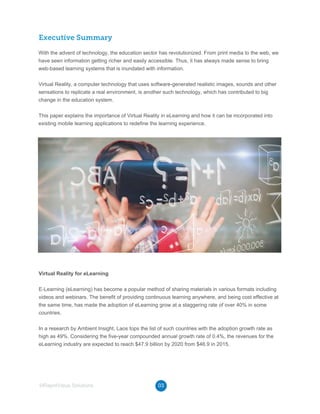
Virtual Reality, a computer technology that uses software-generated realistic images, sounds and other
sensations to replicate a real environment, is another such technology, which has contributed to big
change in the education system.
This paper explains the importance of Virtual Reality in eLearning and how it can be incorporated into
existing mobile learning applications to redefine the learning experience.
Virtual Reality for eLearning
E-Learning (eLearning) has become a popular method of sharing materials in various formats including
videos and webinars. The benefit of providing continuous learning anywhere, and being cost effective at
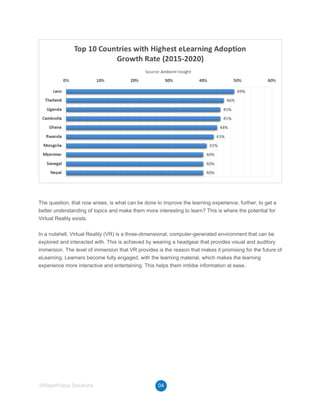
the same time, has made the adoption of eLearning grow at a staggering rate of over 40% in some
countries.
In a research by Ambient Insight, Laos tops the list of such countries with the adoption growth rate as
high as 49%. Considering the five-year compounded annual growth rate of 0.4%, the revenues for the
eLearning industry are expected to reach $47.9 billion by 2020 from $46.9 in 2015.
04©RapidValue Solutions
The question, that now arises, is what can be done to improve the learning experience, further, to get a
better understanding of topics and make them more interesting to learn? This is where the potential for
Virtual Reality exists.
In a nutshell, Virtual Reality (VR) is a three-dimensional, computer-generated environment that can be
explored and interacted with. This is achieved by wearing a headgear that provides visual and auditory
immersion. The level of immersion that VR provides is the reason that makes it promising for the future of
eLearning. Learners become fully engaged, with the learning material, which makes the learning
experience more interactive and entertaining. This helps them imbibe information at ease.
Use Cases and Benefits of Virtual Reality in eLearning
The first mobile virtual reality came in the form of head-mounted devices known for their specific use.
However, they were not within the reach of the common man, until recently, with the availability of more
affordable mobile Virtual Reality headsets like Samsung Gear VR, Oculus Rift, HTC Vive etc., which can
be integrated with mobile devices like smartphones. These gadgets can prove promising in the field of
training and learning systems with the proliferation of dedicated mobile applications.
Some of the scenarios, in which VR plays a vital role to enable easy learning, are:
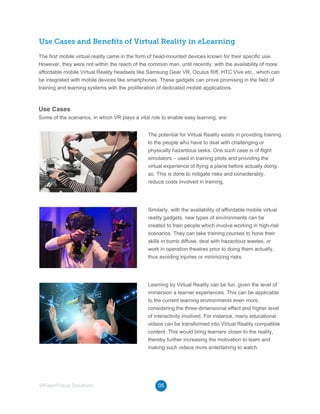
The potential for Virtual Reality exists in providing training
to the people who have to deal with challenging or
physically hazardous tasks. One such case is of flight
simulators – used in training pilots and providing the
virtual experience of flying a plane before actually doing
so. This is done to mitigate risks and considerably,
reduce costs involved in training.
Similarly, with the availability of affordable mobile virtual
reality gadgets, new types of environments can be
created to train people which involve working in high-risk
scenarios. They can take training courses to hone their
skills in bomb diffuse, deal with hazardous wastes, or
work in operation theatres prior to doing them actually,
thus avoiding injuries or minimizing risks.
Learning by Virtual Reality can be fun, given the level of
immersion a learner experiences. This can be applicable
to the current learning environments even more,
considering the three-dimensional effect and higher level
of interactivity involved. For instance, many educational
videos can be transformed into Virtual Reality compatible
content. This would bring learners closer to the reality,
thereby further increasing the motivation to learn and
making such videos more entertaining to watch.
05©RapidValue Solutions
Use Cases
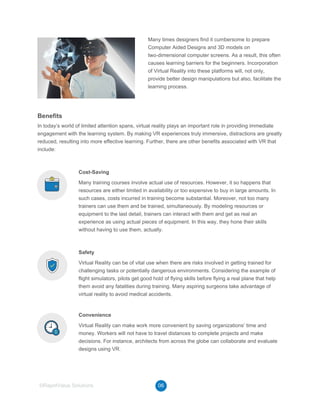
Many times designers find it cumbersome to prepare
Computer Aided Designs and 3D models on
two-dimensional computer screens. As a result, this often
causes learning barriers for the beginners. Incorporation
of Virtual Reality into these platforms will, not only,
provide better design manipulations but also, facilitate the
learning process.
06©RapidValue Solutions
Benefits
In today’s world of limited attention spans, virtual reality plays an important role in providing immediate
engagement with the learning system. By making VR experiences truly immersive, distractions are greatly
reduced, resulting into more effective learning. Further, there are other benefits associated with VR that
include:
Cost-Saving
Many training courses involve actual use of resources. However, it so happens that
resources are either limited in availability or too expensive to buy in large amounts. In
such cases, costs incurred in training become substantial. Moreover, not too many
trainers can use them and be trained, simultaneously. By modeling resources or
equipment to the last detail, trainers can interact with them and get as real an
experience as using actual pieces of equipment. In this way, they hone their skills
without having to use them, actually.
Safety
Virtual Reality can be of vital use when there are risks involved in getting trained for
challenging tasks or potentially dangerous environments. Considering the example of
flight simulators, pilots get good hold of flying skills before flying a real plane that help
them avoid any fatalities during training. Many aspiring surgeons take advantage of
virtual reality to avoid medical accidents.
Convenience
Virtual Reality can make work more convenient by saving organizations’ time and
money. Workers will not have to travel distances to complete projects and make
decisions. For instance, architects from across the globe can collaborate and evaluate
designs using VR.
07©RapidValue Solutions
How VR integrates with Learning Systems
There are many mobile VR headsets available in the market today which aim to provide an experience of
complete immersion. However, a truly immersive experience comes in when there is an element of
interaction. A mobile VR system comprises a device (smartphone) to run the application, a VR headset,
and an input controller for interaction with the virtual environment, done through gesture control (HTC
touch), head tracking, or on-device buttons (or trackpads).
One of the common features of a Learning Management System (LMS) is a virtual classroom. The
ambience of a virtual classroom can, very well, be designed by extending the capabilities of the Gear VR
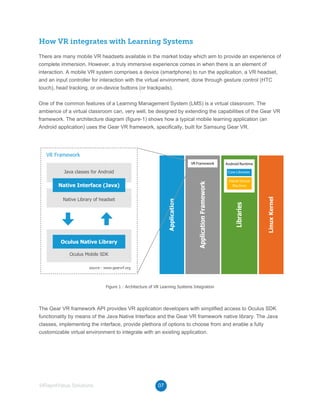
framework. The architecture diagram (figure-1) shows how a typical mobile learning application (an
Android application) uses the Gear VR framework, specifically, built for Samsung Gear VR.
The Gear VR framework API provides VR application developers with simplified access to Oculus SDK
functionality by means of the Java Native Interface and the Gear VR framework native library. The Java
classes, implementing the interface, provide plethora of options to choose from and enable a fully
customizable virtual environment to integrate with an existing application.
Oculus Mobile SDK
Figure 1 : Architecture of VR Learning Systems Integration
source : www.gearvrf.org
Native Library of headset
Java classes for Android
Oculus Native Library
Native Interface (Java)
VR Framework
Application
LinuxKernel
ApplicationFramework
VR Framework
Libraries
Android Runtime
Core Libraries
Dalvik Virtual
Machine
Sample Activity
onCreate
onKeyXXX
GVR Activity
application
Keyboard setup
GVR View Manager
Drawing Animation
camera control
scene management
GVR Content
scheduling
asset loading
GVR Scene
scene management
camera
GVR Scene Object
3D transform
level of detail
hierarchyGVR Scene Object
GVR Scene Object
Sample View Manager
onlnit: create scene
onStep: per frame
GVR Main
source : www.gearvrf.org
Basic Features of Gear VR Framework
The Gear VR framework can be, easily, incorporated into an Android application framework. This enables
developers to add the VR component to an existing application without having to restructure it.
Fundamentally, incorporating VR into an Android application involves:
1. Defining the Activity by sub classing GVRActivity
Overriding the onInit method to start the application.
Overriding the onTouch method to capture touch events.
Supplying XML settings file.
2. Implementing the VR World by sub classing GVRMain
Overriding the onInit method to construct 3D scene.
3. Implementing onStep for each frame
Adjusting the SceneObject for each frame.
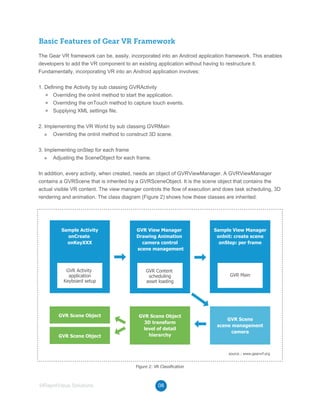
In addition, every activity, when created, needs an object of GVRViewManager. A GVRViewManager
contains a GVRScene that is inherited by a GVRSceneObject. It is the scene object that contains the
actual visible VR content. The view manager controls the flow of execution and does task scheduling, 3D
rendering and animation. The class diagram (Figure 2) shows how these classes are inherited.
08©RapidValue Solutions
Figure 2: VR Classification
Conclusion
For mobile VR, to drive mass consumer adoption, it is imperative that not only gadgets be more
comfortable and lightweight to use but also, more VR compatible high quality applications be available in
universal stores. Additionally, transforming existing content (videos on YouTube™, say) into VR
compatible content will provide users with a huge set of options to choose from.
We have discussed the benefits of Virtual Reality in the current and potential learning environments.
Combining affordable mobile VR gadgets with eLearning applications, the way of learning can be brought
to the next level by having active rather than passive interaction. Making VR experiences truly immersive
opens up avenues for understanding complex subjects and theories. This requires, simultaneously,
meeting extreme requirements like visual quality, sound quality, and intuitive interactions.
This paper is written by Nachiketa Kulkarni, Project Manager, RapidValue Solutions.
If you’d like to learn more about VR and mobility solutions, please write to us at
contactus@rapidvaluesolutions.com. We’d be happy to hear from you.
09©RapidValue Solutions
About RapidValue
A global leader in digital transformation for enterprise providing end-to-end mobility,
omni-channel, IoT and cloud solutions. Armed with a large team of experts in
consulting, UX design, application development, integration and testing, along with
experience delivering projects worldwide, in mobility and cloud, we offer a wide range
of services across industry verticals. We deliver services to the world’s top brands,
fortune 1000 companies, Multinational companies and emerging start-ups. We have
www.rapidvaluesolutions.com www.rapidvaluesolutions.com/blog
+1 877.643.1850 contactus@rapidvaluesolutions.com
September 2016
offices in the United States, the United Kingdom and India.

Virtual reality in e learning – redefining the learning experience

  • 1.
    A Whitepaper byRapidValue Solutions Virtual Reality in E-Learning Redefining the Learning Experience
  • 2.
    02©RapidValue Solutions Contents Executive Summary.................................................................................................................................... UseCases and Benefits of Virtual Reality in eLearning............................................................................. Use Cases............................................................................................................................................ Benefits................................................................................................................................................ How VR integrates with Learning Systems................................................................................................. Basic Features of Gear VR Framework...................................................................................................... Conclusion................................................................................................................................................... 03 05 05 06 07 08 09
  • 3.
    Executive Summary 03©RapidValue Solutions Withthe advent of technology, the education sector has revolutionized. From print media to the web, we have seen information getting richer and easily accessible. Thus, it has always made sense to bring web-based learning systems that is inundated with information. Virtual Reality, a computer technology that uses software-generated realistic images, sounds and other sensations to replicate a real environment, is another such technology, which has contributed to big change in the education system. This paper explains the importance of Virtual Reality in eLearning and how it can be incorporated into existing mobile learning applications to redefine the learning experience. Virtual Reality for eLearning E-Learning (eLearning) has become a popular method of sharing materials in various formats including videos and webinars. The benefit of providing continuous learning anywhere, and being cost effective at the same time, has made the adoption of eLearning grow at a staggering rate of over 40% in some countries. In a research by Ambient Insight, Laos tops the list of such countries with the adoption growth rate as high as 49%. Considering the five-year compounded annual growth rate of 0.4%, the revenues for the eLearning industry are expected to reach $47.9 billion by 2020 from $46.9 in 2015.
  • 4.
    04©RapidValue Solutions The question,that now arises, is what can be done to improve the learning experience, further, to get a better understanding of topics and make them more interesting to learn? This is where the potential for Virtual Reality exists. In a nutshell, Virtual Reality (VR) is a three-dimensional, computer-generated environment that can be explored and interacted with. This is achieved by wearing a headgear that provides visual and auditory immersion. The level of immersion that VR provides is the reason that makes it promising for the future of eLearning. Learners become fully engaged, with the learning material, which makes the learning experience more interactive and entertaining. This helps them imbibe information at ease.
  • 5.
    Use Cases andBenefits of Virtual Reality in eLearning The first mobile virtual reality came in the form of head-mounted devices known for their specific use. However, they were not within the reach of the common man, until recently, with the availability of more affordable mobile Virtual Reality headsets like Samsung Gear VR, Oculus Rift, HTC Vive etc., which can be integrated with mobile devices like smartphones. These gadgets can prove promising in the field of training and learning systems with the proliferation of dedicated mobile applications. Some of the scenarios, in which VR plays a vital role to enable easy learning, are: The potential for Virtual Reality exists in providing training to the people who have to deal with challenging or physically hazardous tasks. One such case is of flight simulators – used in training pilots and providing the virtual experience of flying a plane before actually doing so. This is done to mitigate risks and considerably, reduce costs involved in training. Similarly, with the availability of affordable mobile virtual reality gadgets, new types of environments can be created to train people which involve working in high-risk scenarios. They can take training courses to hone their skills in bomb diffuse, deal with hazardous wastes, or work in operation theatres prior to doing them actually, thus avoiding injuries or minimizing risks. Learning by Virtual Reality can be fun, given the level of immersion a learner experiences. This can be applicable to the current learning environments even more, considering the three-dimensional effect and higher level of interactivity involved. For instance, many educational videos can be transformed into Virtual Reality compatible content. This would bring learners closer to the reality, thereby further increasing the motivation to learn and making such videos more entertaining to watch. 05©RapidValue Solutions Use Cases
  • 6.
    Many times designersfind it cumbersome to prepare Computer Aided Designs and 3D models on two-dimensional computer screens. As a result, this often causes learning barriers for the beginners. Incorporation of Virtual Reality into these platforms will, not only, provide better design manipulations but also, facilitate the learning process. 06©RapidValue Solutions Benefits In today’s world of limited attention spans, virtual reality plays an important role in providing immediate engagement with the learning system. By making VR experiences truly immersive, distractions are greatly reduced, resulting into more effective learning. Further, there are other benefits associated with VR that include: Cost-Saving Many training courses involve actual use of resources. However, it so happens that resources are either limited in availability or too expensive to buy in large amounts. In such cases, costs incurred in training become substantial. Moreover, not too many trainers can use them and be trained, simultaneously. By modeling resources or equipment to the last detail, trainers can interact with them and get as real an experience as using actual pieces of equipment. In this way, they hone their skills without having to use them, actually. Safety Virtual Reality can be of vital use when there are risks involved in getting trained for challenging tasks or potentially dangerous environments. Considering the example of flight simulators, pilots get good hold of flying skills before flying a real plane that help them avoid any fatalities during training. Many aspiring surgeons take advantage of virtual reality to avoid medical accidents. Convenience Virtual Reality can make work more convenient by saving organizations’ time and money. Workers will not have to travel distances to complete projects and make decisions. For instance, architects from across the globe can collaborate and evaluate designs using VR.
  • 7.
    07©RapidValue Solutions How VRintegrates with Learning Systems There are many mobile VR headsets available in the market today which aim to provide an experience of complete immersion. However, a truly immersive experience comes in when there is an element of interaction. A mobile VR system comprises a device (smartphone) to run the application, a VR headset, and an input controller for interaction with the virtual environment, done through gesture control (HTC touch), head tracking, or on-device buttons (or trackpads). One of the common features of a Learning Management System (LMS) is a virtual classroom. The ambience of a virtual classroom can, very well, be designed by extending the capabilities of the Gear VR framework. The architecture diagram (figure-1) shows how a typical mobile learning application (an Android application) uses the Gear VR framework, specifically, built for Samsung Gear VR. The Gear VR framework API provides VR application developers with simplified access to Oculus SDK functionality by means of the Java Native Interface and the Gear VR framework native library. The Java classes, implementing the interface, provide plethora of options to choose from and enable a fully customizable virtual environment to integrate with an existing application. Oculus Mobile SDK Figure 1 : Architecture of VR Learning Systems Integration source : www.gearvrf.org Native Library of headset Java classes for Android Oculus Native Library Native Interface (Java) VR Framework Application LinuxKernel ApplicationFramework VR Framework Libraries Android Runtime Core Libraries Dalvik Virtual Machine
  • 8.
    Sample Activity onCreate onKeyXXX GVR Activity application Keyboardsetup GVR View Manager Drawing Animation camera control scene management GVR Content scheduling asset loading GVR Scene scene management camera GVR Scene Object 3D transform level of detail hierarchyGVR Scene Object GVR Scene Object Sample View Manager onlnit: create scene onStep: per frame GVR Main source : www.gearvrf.org Basic Features of Gear VR Framework The Gear VR framework can be, easily, incorporated into an Android application framework. This enables developers to add the VR component to an existing application without having to restructure it. Fundamentally, incorporating VR into an Android application involves: 1. Defining the Activity by sub classing GVRActivity Overriding the onInit method to start the application. Overriding the onTouch method to capture touch events. Supplying XML settings file. 2. Implementing the VR World by sub classing GVRMain Overriding the onInit method to construct 3D scene. 3. Implementing onStep for each frame Adjusting the SceneObject for each frame. In addition, every activity, when created, needs an object of GVRViewManager. A GVRViewManager contains a GVRScene that is inherited by a GVRSceneObject. It is the scene object that contains the actual visible VR content. The view manager controls the flow of execution and does task scheduling, 3D rendering and animation. The class diagram (Figure 2) shows how these classes are inherited. 08©RapidValue Solutions Figure 2: VR Classification
  • 9.
    Conclusion For mobile VR,to drive mass consumer adoption, it is imperative that not only gadgets be more comfortable and lightweight to use but also, more VR compatible high quality applications be available in universal stores. Additionally, transforming existing content (videos on YouTube™, say) into VR compatible content will provide users with a huge set of options to choose from. We have discussed the benefits of Virtual Reality in the current and potential learning environments. Combining affordable mobile VR gadgets with eLearning applications, the way of learning can be brought to the next level by having active rather than passive interaction. Making VR experiences truly immersive opens up avenues for understanding complex subjects and theories. This requires, simultaneously, meeting extreme requirements like visual quality, sound quality, and intuitive interactions. This paper is written by Nachiketa Kulkarni, Project Manager, RapidValue Solutions. If you’d like to learn more about VR and mobility solutions, please write to us at contactus@rapidvaluesolutions.com. We’d be happy to hear from you. 09©RapidValue Solutions
  • 10.
    About RapidValue A globalleader in digital transformation for enterprise providing end-to-end mobility, omni-channel, IoT and cloud solutions. Armed with a large team of experts in consulting, UX design, application development, integration and testing, along with experience delivering projects worldwide, in mobility and cloud, we offer a wide range of services across industry verticals. We deliver services to the world’s top brands, fortune 1000 companies, Multinational companies and emerging start-ups. We have www.rapidvaluesolutions.com www.rapidvaluesolutions.com/blog +1 877.643.1850 contactus@rapidvaluesolutions.com September 2016 offices in the United States, the United Kingdom and India.