

Virtual Reality
Fake worlds for real adventure to increase student engagement.
Introduction
 Charles Palmer
 Harrisburg University
 Program lead and Professor of Interactive Media
 Executive Director, Center for Advanced
Entertainment and Learning Technologies
 Gamification author
 Game developer
 3d Printing enthusiast
 Budding data scientist
 Social
@charlespalmer (Twitter)
http://www.slideshare.net/charlespalmerhu
https://www.linkedin.com/in/charleslpalmer
Harrisburg University
 Only non-profit science and technology-focused comprehensive
non-profit university between Philadelphia and Pittsburgh
 Urban campus in the heart of the State Capitol
 Supports the academic success of members of groups historically
under-represented in applied science and technology fields
 Private not-for-profit 501(c)(3) university
 Accredited by the Middle States Commission on Higher Education
June 22, 2009
 14-story $73-million state-of-the-art Academic Center
 Wireless, laptop campus
 Student/Faculty Ratio: 13 to 1
 HU has NOT raised tuition in the last 4 years
Undergraduate Programs
 Analytics
 Biotechnology
 Computer and Information Science
 Geospatial Technology
 Integrative Sciences
 Interactive Media
 Management & eBusiness
Graduate Programs
 Analytics
 Computer Information Sciences
 Information Systems Engineering & Management
 Learning Technologies & Media Systems
 Project Management
Overview
 What is VR?
 A little bit of history
 Current technology
 How it works
 Examples
 What’s next…
What is virtual reality
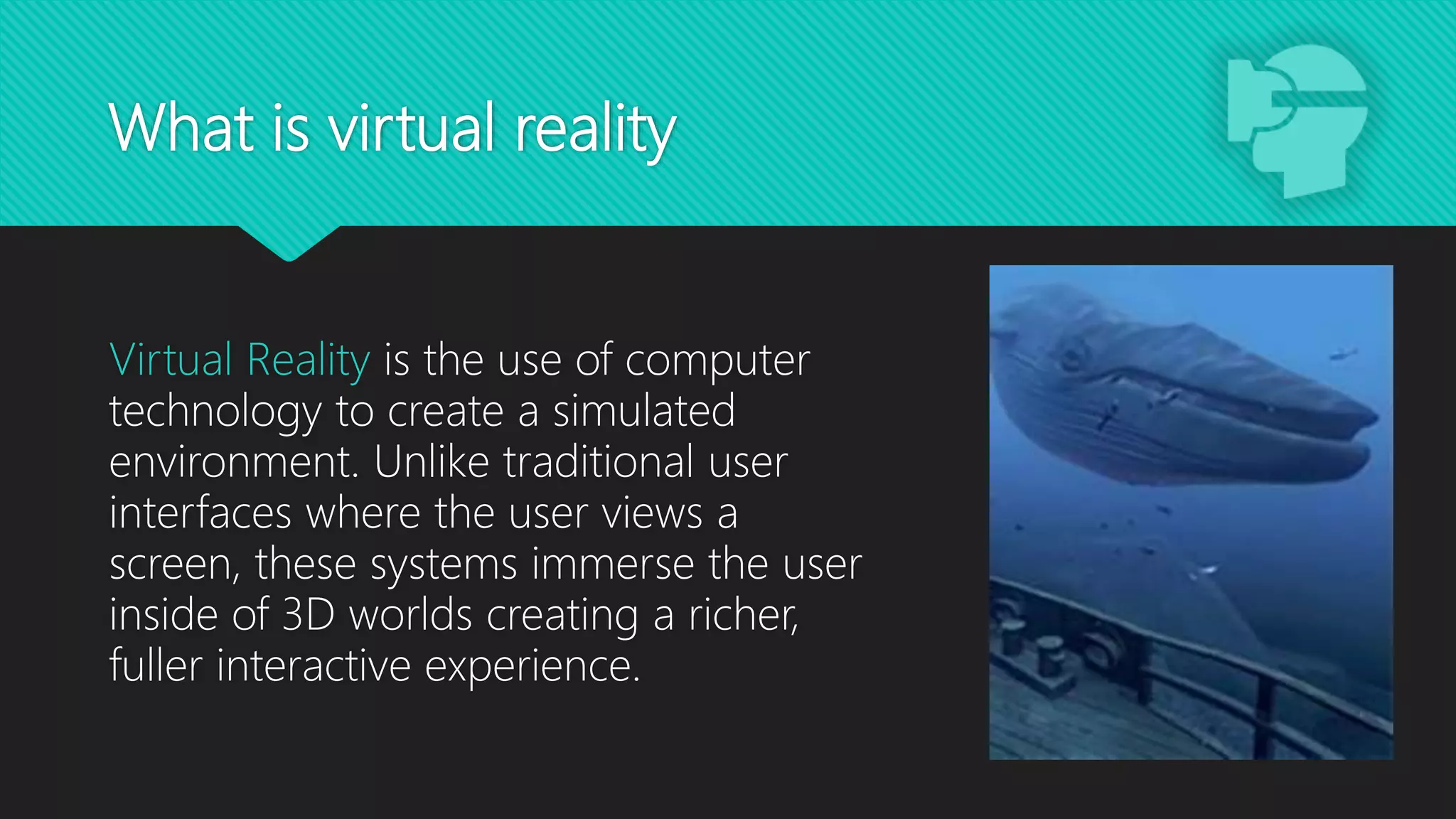
Virtual Reality is the use of computer
technology to create a simulated
environment. Unlike traditional user
interfaces where the user views a
screen, these systems immerse the user
inside of 3D worlds creating a richer,
fuller interactive experience.
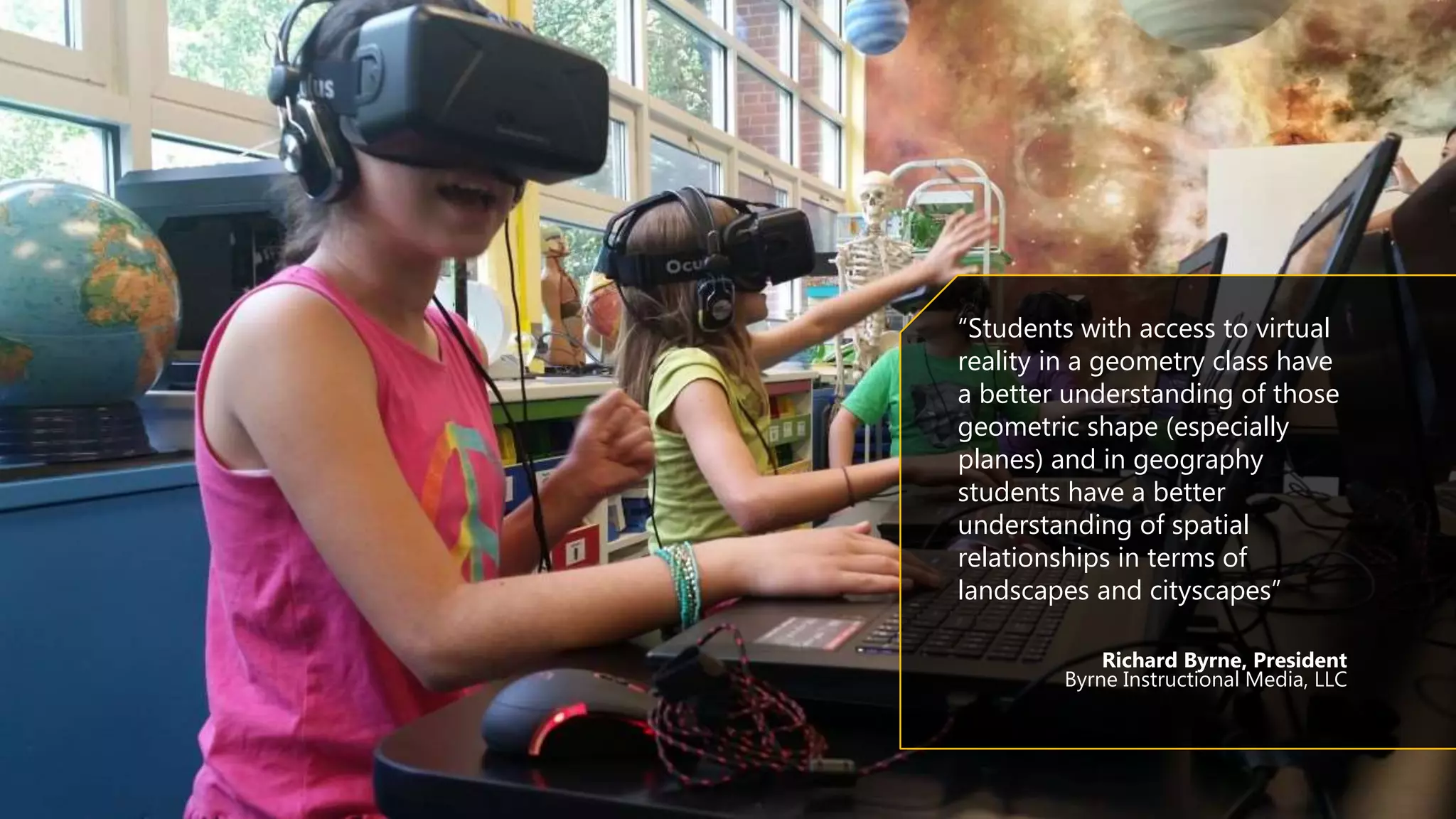
“Students with access to virtual
reality in a geometry class have
a better understanding of those
geometric shape (especially
planes) and in geography
students have a better
understanding of spatial
relationships in terms of
landscapes and cityscapes”
Richard Byrne, President
Byrne Instructional Media, LLC
https://touchstoneresearch.com/infographic-virtual-reality-in-the-classroom/
A little bit of history.
How did we get here?
Hugo Gernsback
(August 16, 1884 – August 19, 1967)
Born Hugo Gernsbacher, was a
Luxembourgish-American inventor,
writer, editor, and magazine publisher,
best known for publications including
first science fiction magazine. His
contributions to the genre as publisher
were so significant that, along with the
novelists H. G. Wells and Jules Verne, he
is sometimes called "The Father of
Science Fiction”. In his honor, annual
awards presented at the World Science
Fiction Convention are named the
“Hugo”.
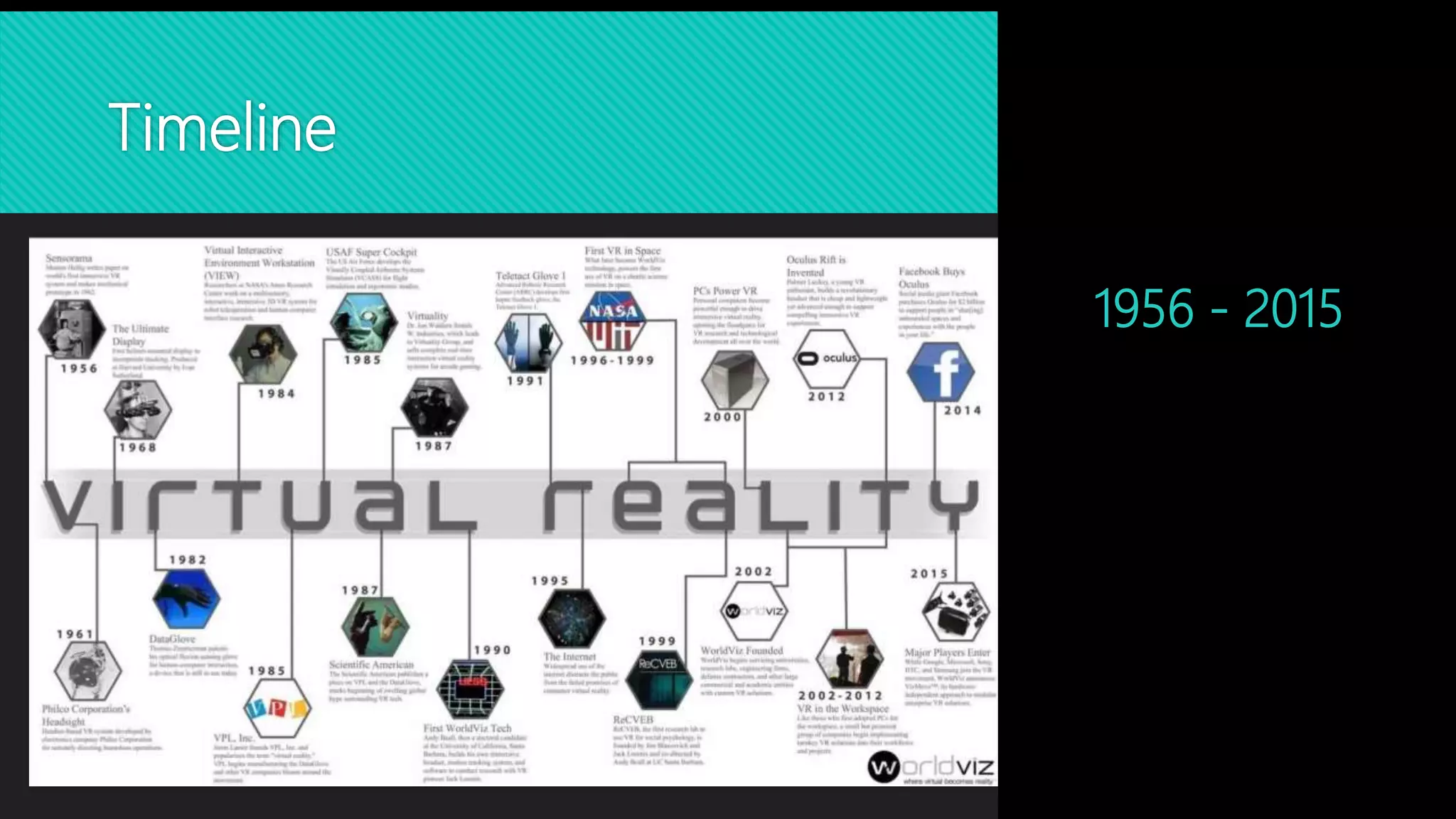
Timeline
1956 - 2015
Timeline
Morton Heilig
Sensorama – 1956-1962
The Sensorama was able to display
stereoscopic 3-D images in a wide-angle
view, provide body tilting, supply stereo
sound, and also had tracks for wind and
aromas to be triggered during the film.
Timeline
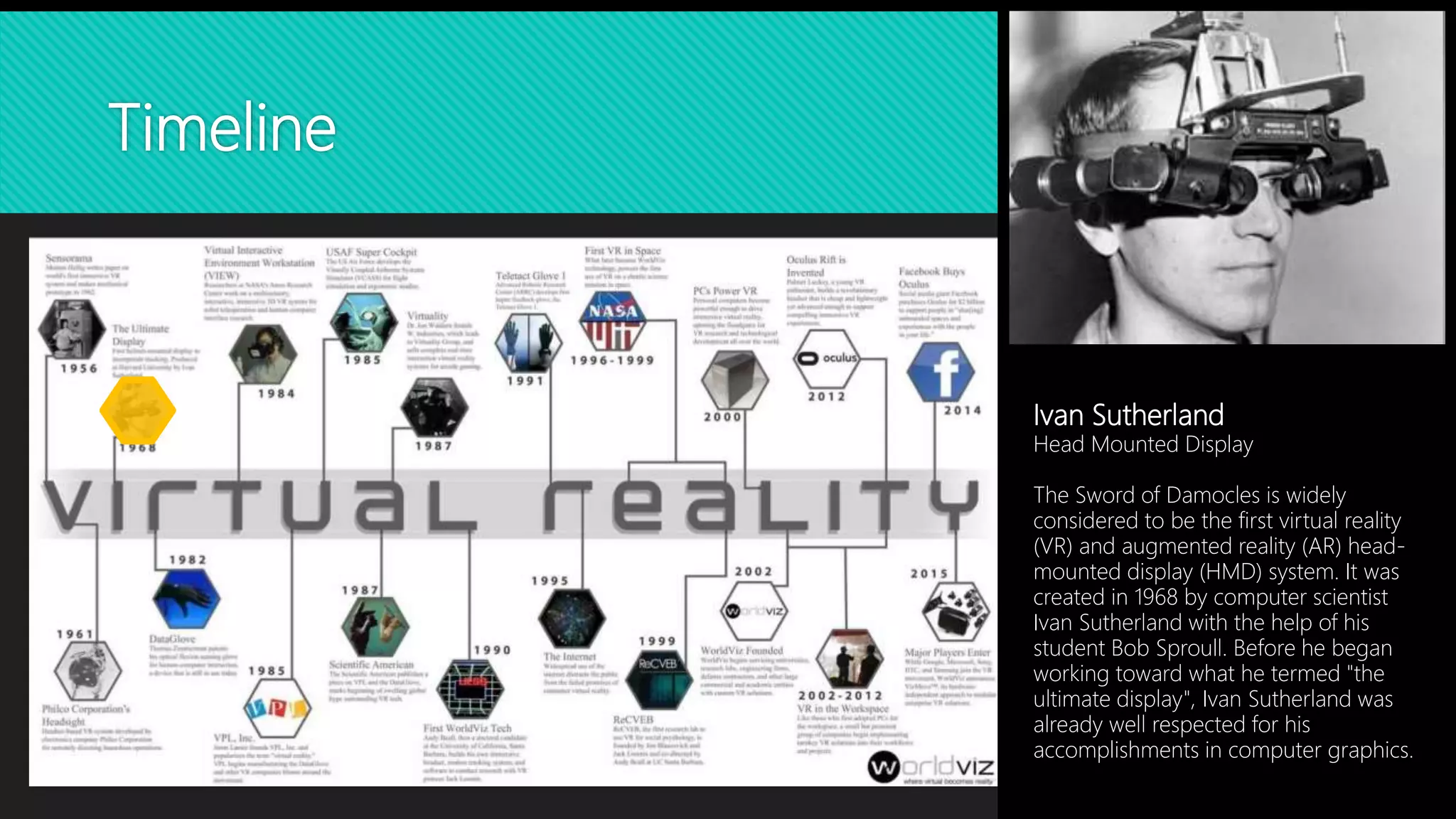
Ivan Sutherland
Head Mounted Display
The Sword of Damocles is widely
considered to be the first virtual reality
(VR) and augmented reality (AR) head-
mounted display (HMD) system. It was
created in 1968 by computer scientist
Ivan Sutherland with the help of his
student Bob Sproull. Before he began
working toward what he termed "the
ultimate display", Ivan Sutherland was
already well respected for his
accomplishments in computer graphics.
Timeline
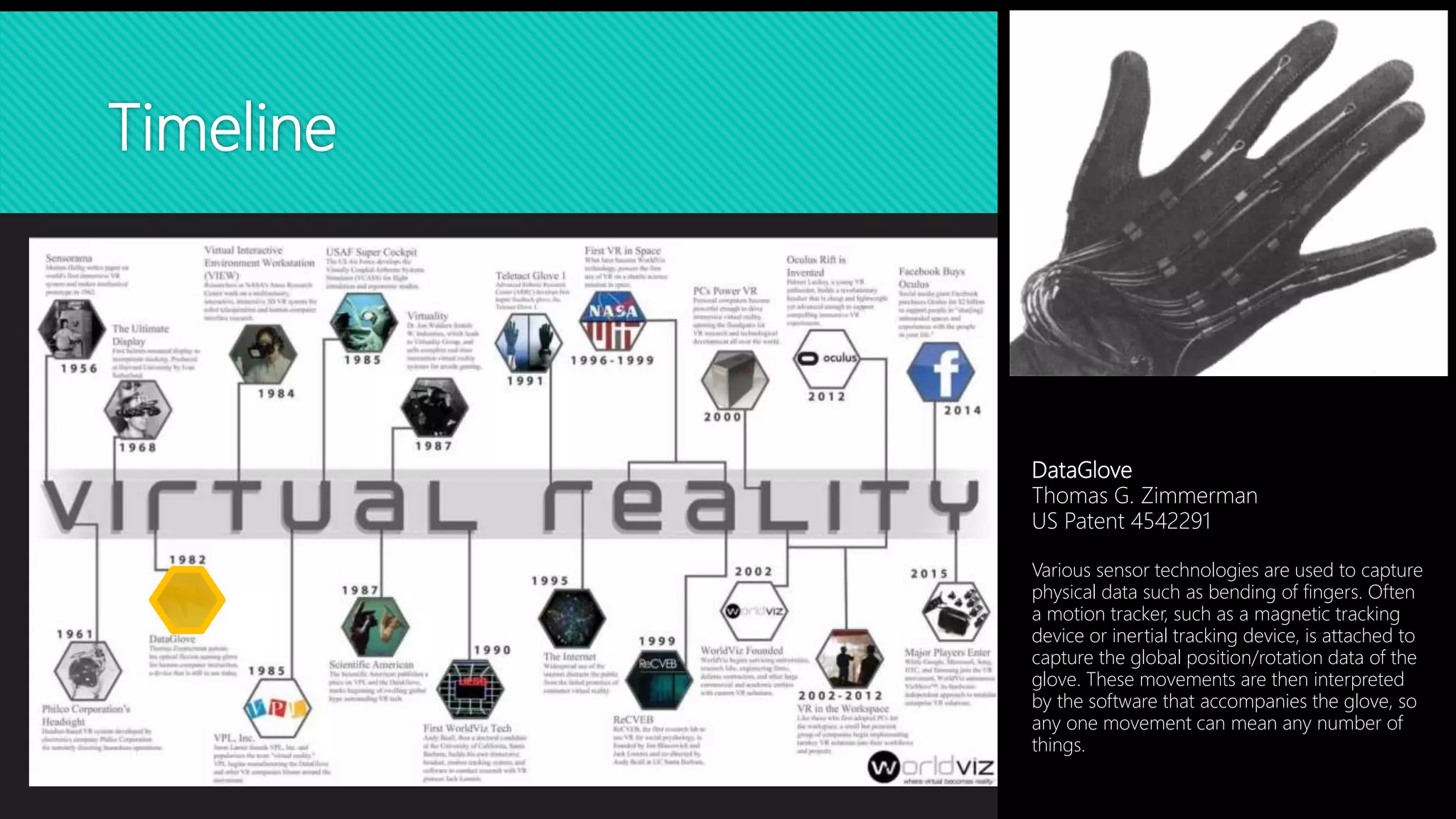
DataGlove
Thomas G. Zimmerman
US Patent 4542291
Various sensor technologies are used to capture
physical data such as bending of fingers. Often
a motion tracker, such as a magnetic tracking
device or inertial tracking device, is attached to
capture the global position/rotation data of the
glove. These movements are then interpreted
by the software that accompanies the glove, so
any one movement can mean any number of
things.
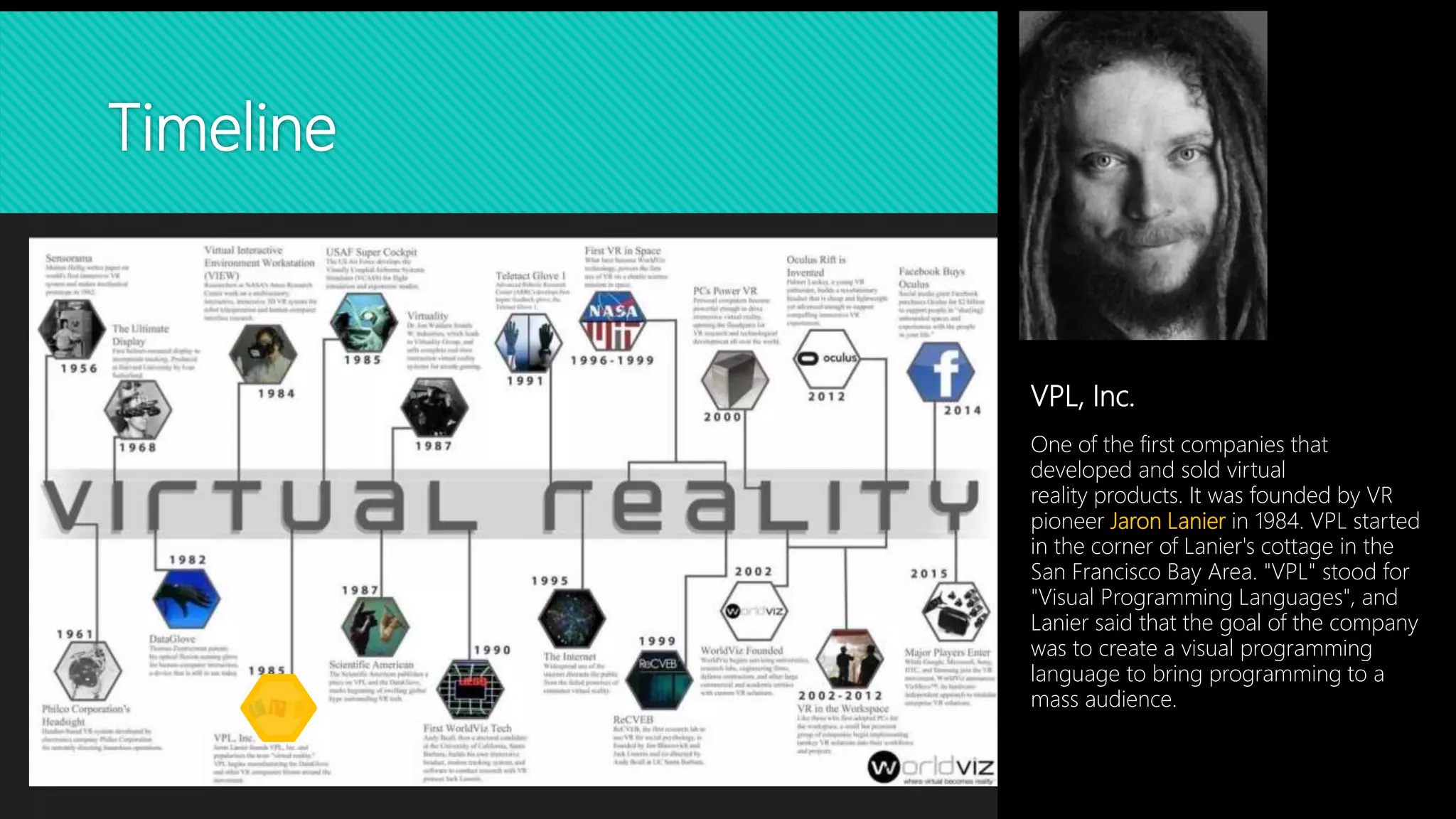
VPL, Inc.
One of the first companies that
developed and sold virtual
reality products. It was founded by VR
pioneer Jaron Lanier in 1984. VPL started
in the corner of Lanier's cottage in the
San Francisco Bay Area. "VPL" stood for
"Visual Programming Languages", and
Lanier said that the goal of the company
was to create a visual programming
language to bring programming to a
mass audience.
Timeline
Timeline
USAF Super Cockpit Program
1986-1989
Dr. Thomas Furness is a pioneer in the
development of interfaces between
humans and complex machines. Most of
his work has centered on the concept of
virtual interface technologies which
prove a circumambience of three
dimensional spatial information to the
human using the visual, auditory and
tactile sensory modalities.
Timeline
PC Power VR
1998-2000
The first personal computers capable of
running virtual reality came onto the
market in the late 90s. But the head-
mounted displays were cumbersome
and of lower resolution.
Timeline
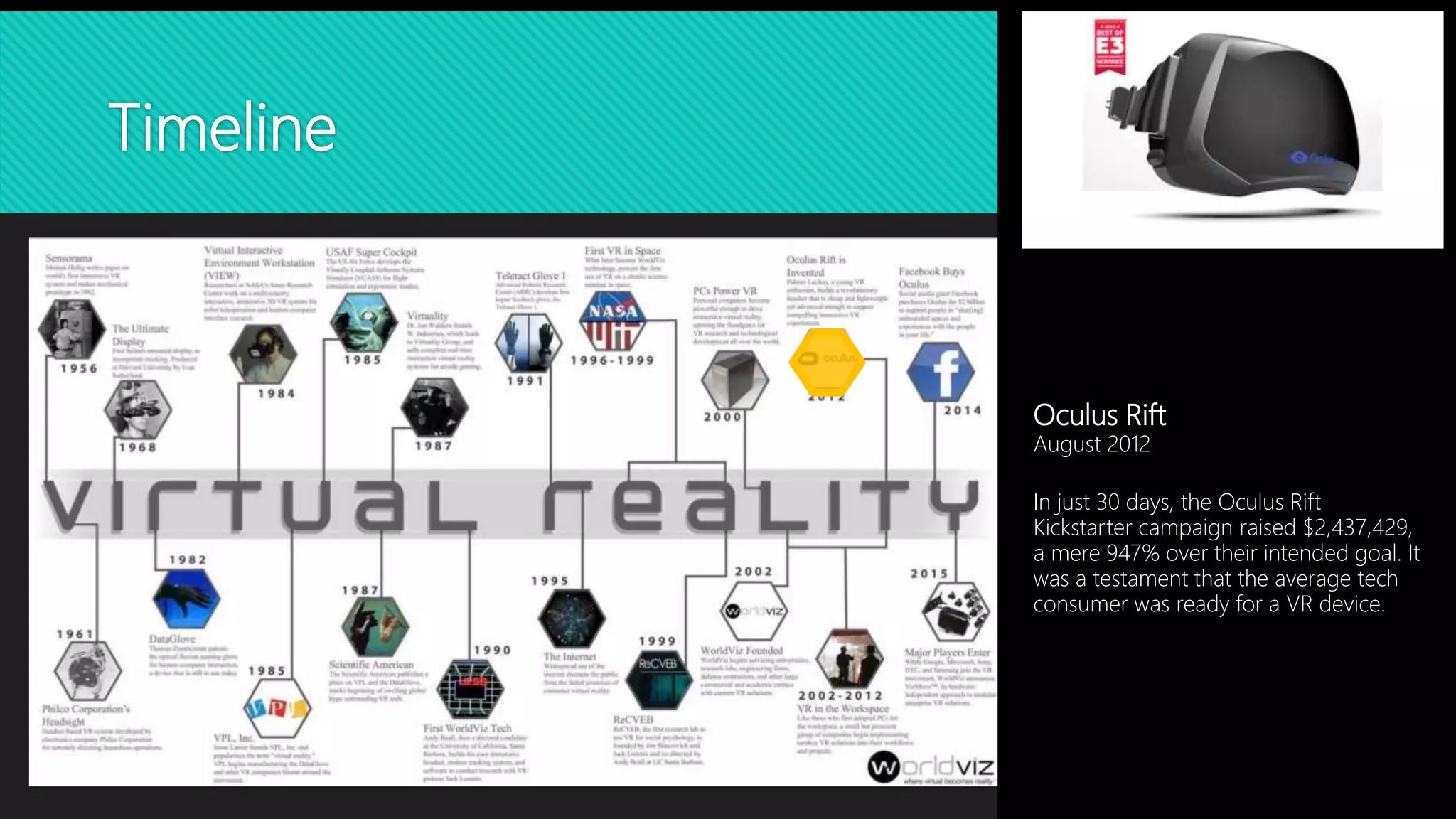
Oculus Rift
August 2012
In just 30 days, the Oculus Rift
Kickstarter campaign raised $2,437,429,
a mere 947% over their intended goal. It
was a testament that the average tech
consumer was ready for a VR device.
Timeline
Facebook Buys Oculus
April 2014
The $2 billion acquisition deal of the
virtual reality pioneer becomes official.
The exact price of the acquisition came
out to $2,001,985,000. The VR startup
will operate somewhat independently
and maintain its main offices in the Irvine
and Los Angeles areas.
Timeline
Major Players enter the VR
Market
Aside from Facebook, 10 other
companies were added to the VR
Watchlist: Amazon, Google, Virtuix,
AMD, Qualcomm, Samsung, Nvidia,
Microsoft, Sony, and Valve.
How did we get here …
$750,000 $700g1985 2015
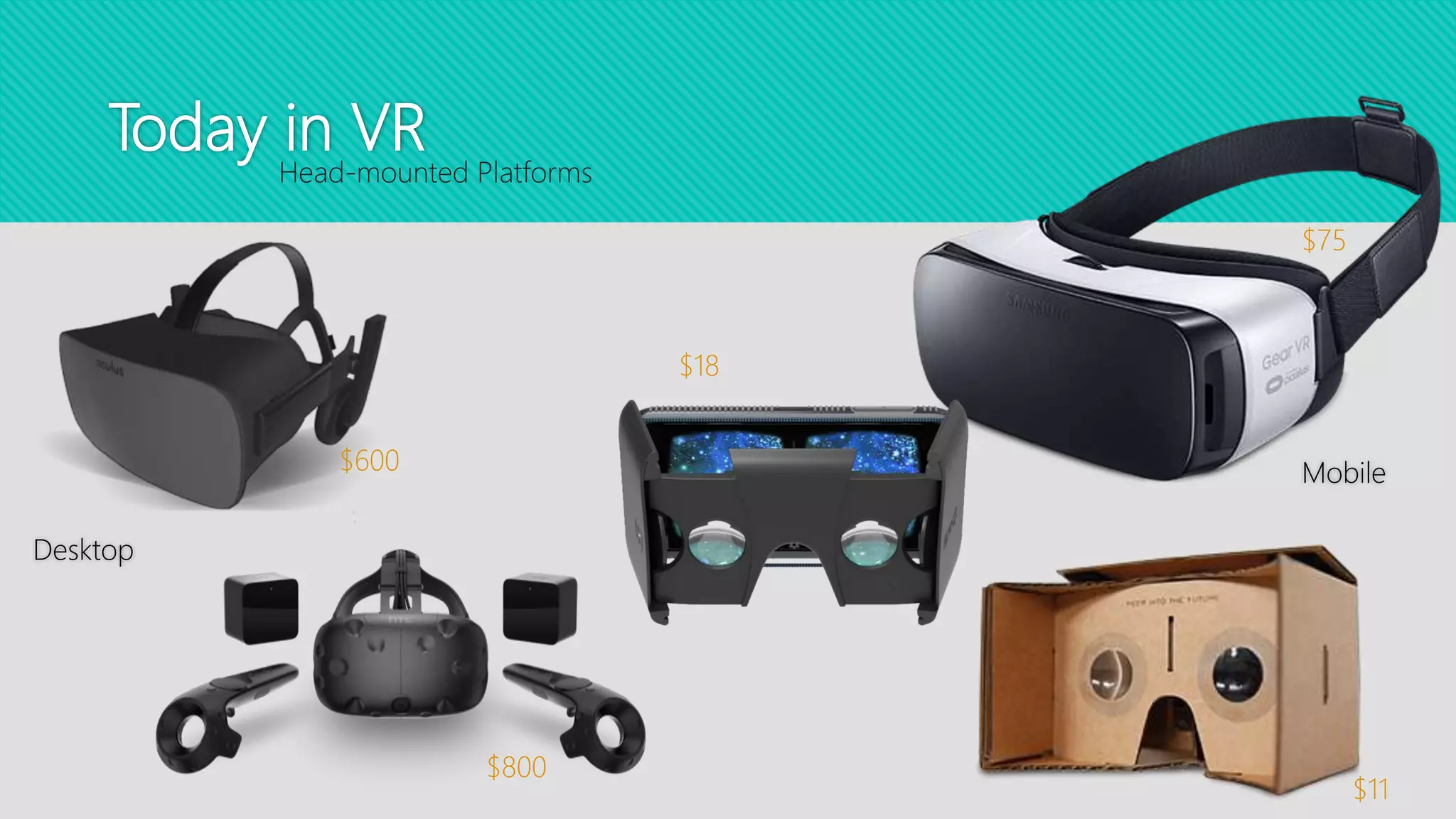
Today in VR
Desktop
Mobile
Head-mounted Platforms
$600
$800
$11
$18
$75
Poll Question
Describe a VR title or demonstration
you’ve seen or experienced.
Visit www.slido.com with #2085 to participate
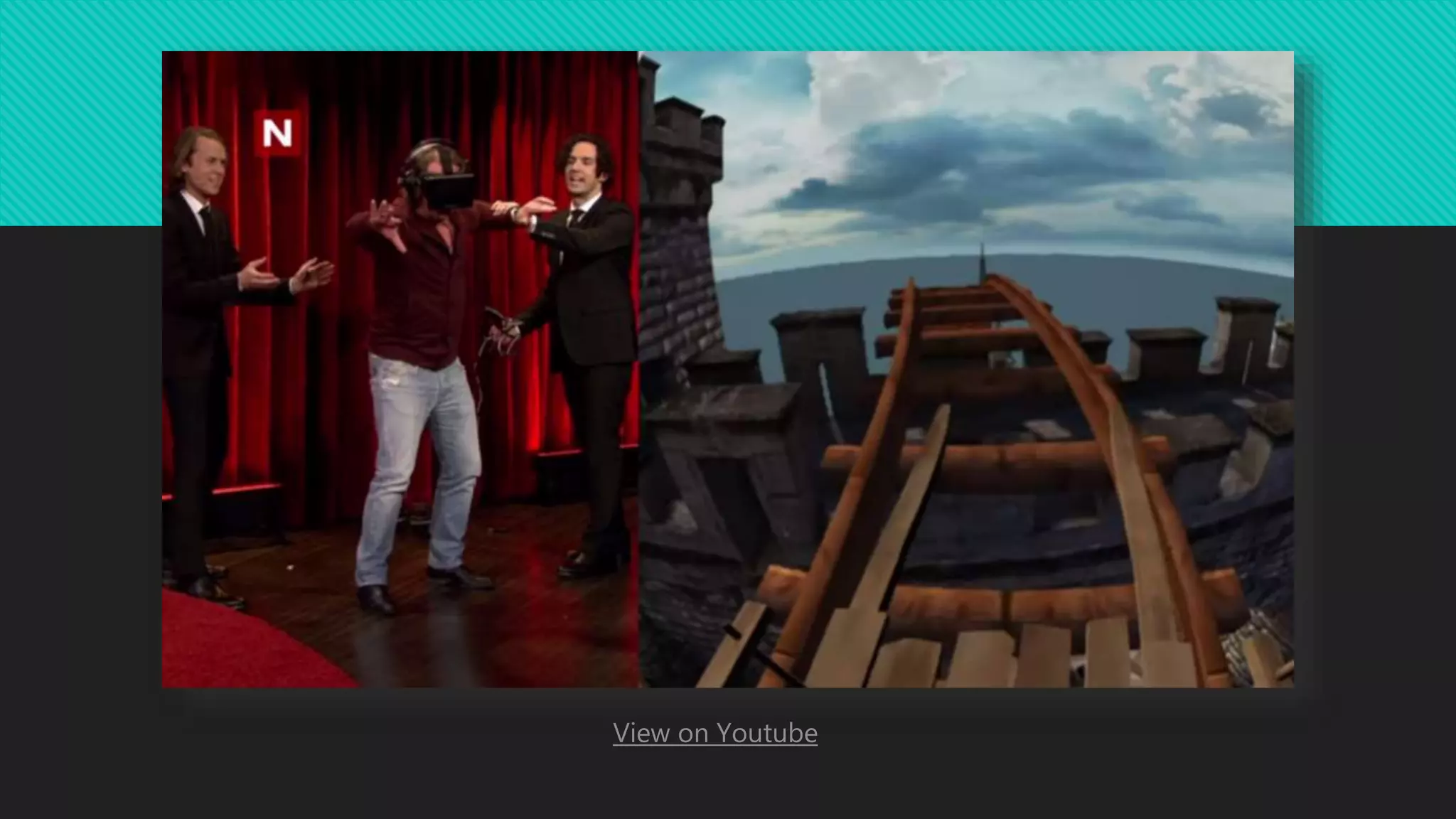
View on Youtube
View on Youtube
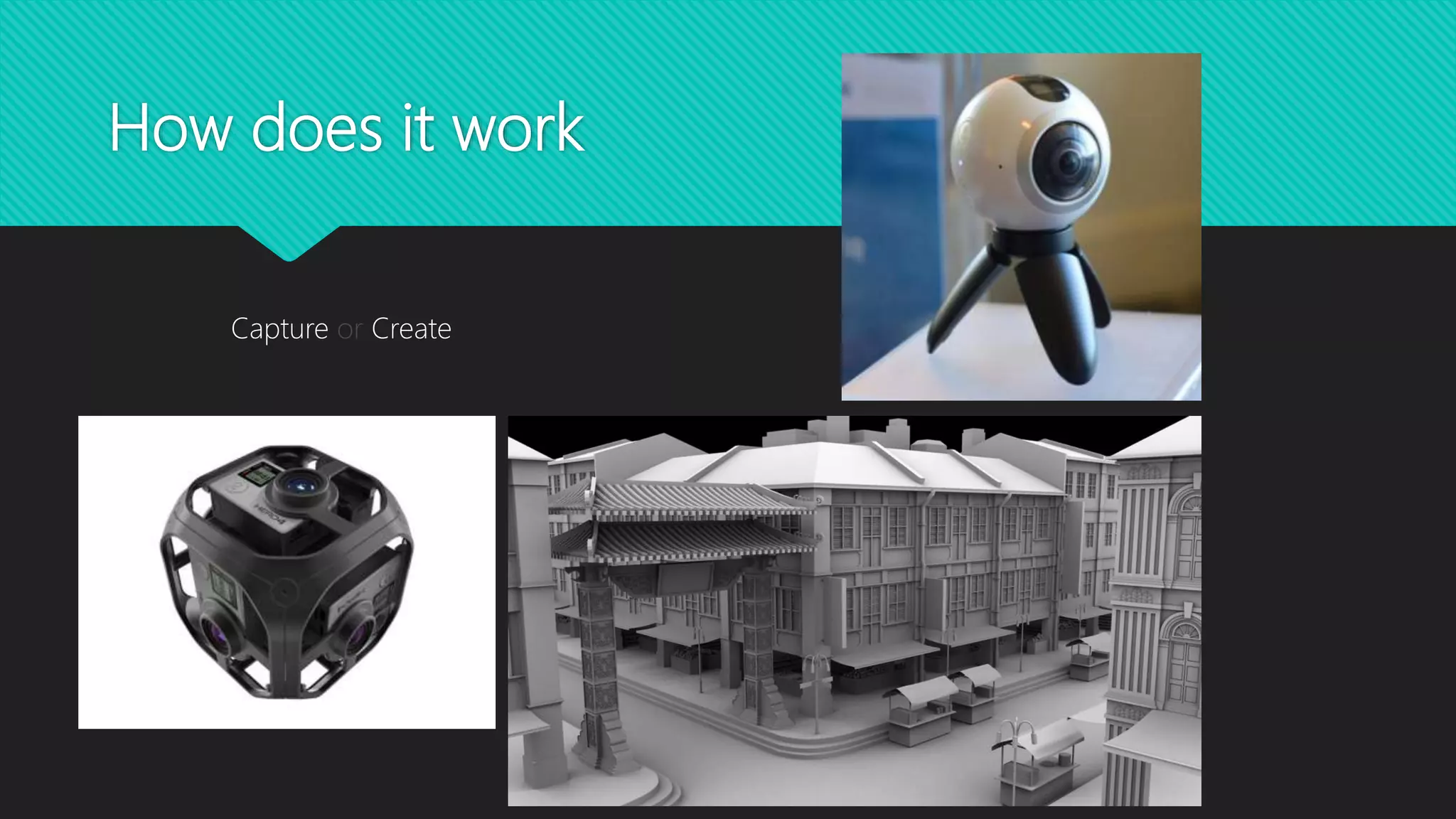
How does it work
Capture or Create
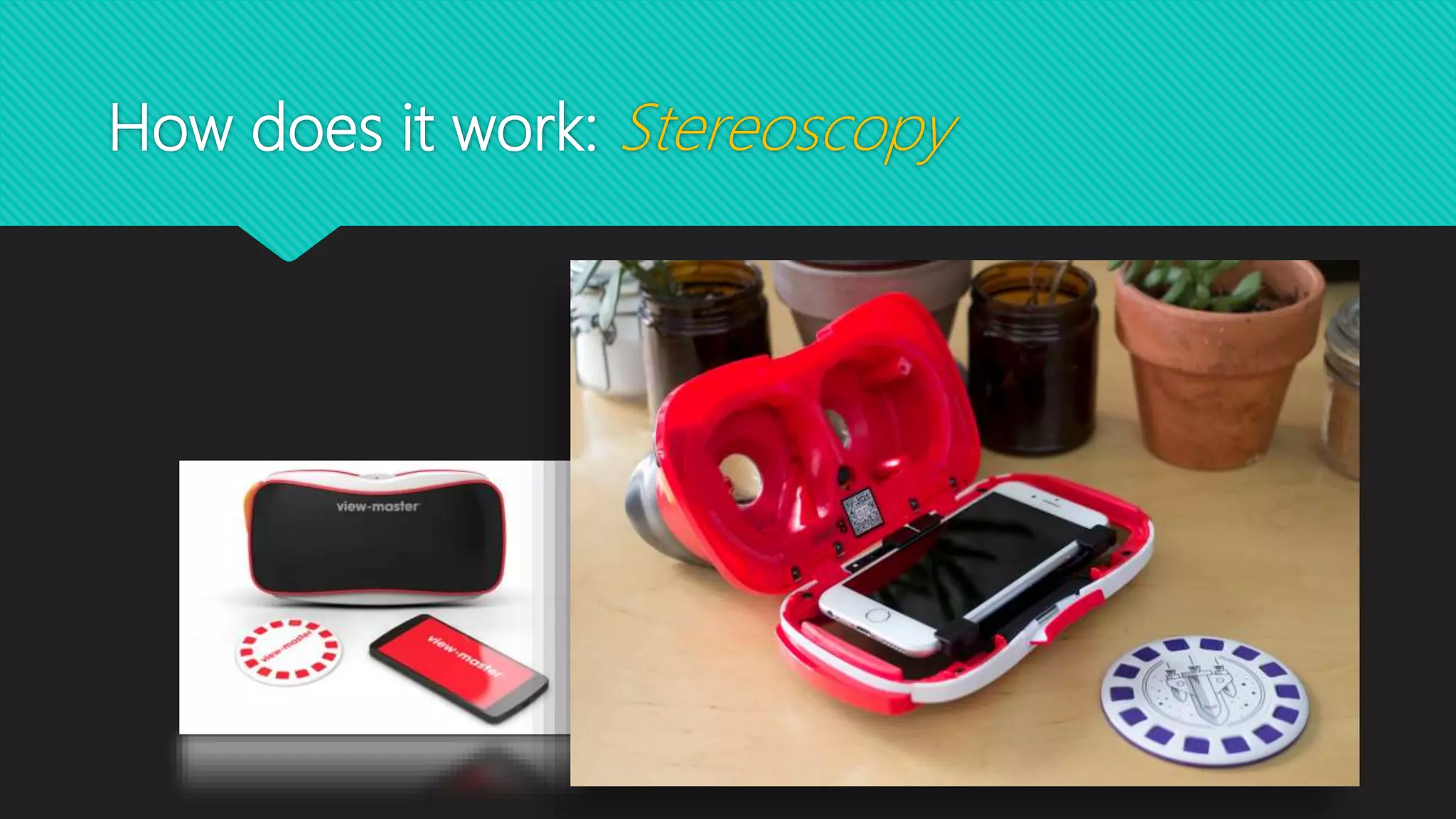
How does it work: Stereoscopy
The technological development of
three-dimensional photography was
also a social innovation. The new ability
to share visual experiences gave rise to
mid-19th-century viewing parties.
Guests at these social gatherings would
pass around individual stereo viewers,
which permitted them to gaze at
distant lands, unique botany, or even
art.
http://exhibitions.kelsey.lsa.umich.edu/fwk/stereo.html
Usage: 1850-1920Stereoscopic viewer 1970s Stereoscopic viewer marketed to kids and families
Stereoscopy via
Head Mounted
Display (HMD)
How does it work
How does it work: Stereoscopy
How does it work
Display
Room system
Demos
Education
 The Body VR
 Fight for Falluja
 Shark Shipwreck
 Elephants on the Brink
 Google Expeditions
 Safety in a Box
 Google VR in the Classroom
 VR in Education (AMD)
Entertainment
 I Expect You to Die
 Trials on Tatooine
 Snow World
 RCSI Medical Training Simulator
 The Presence
 The Void
 What is the Void
 Ghostbusters
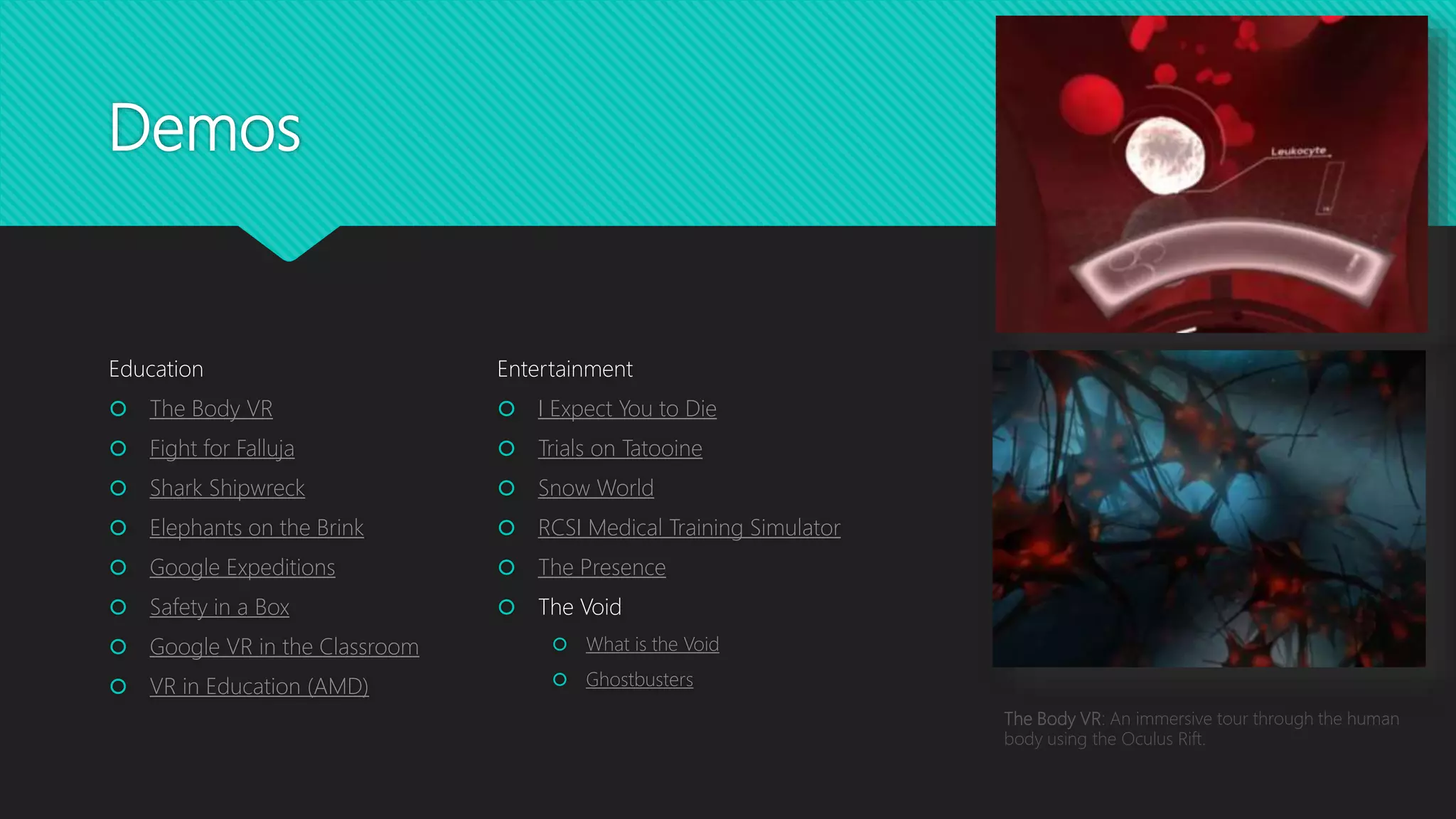
The Body VR: An immersive tour through the human
body using the Oculus Rift.
VR & AR @ HU
VR & AR @ HU
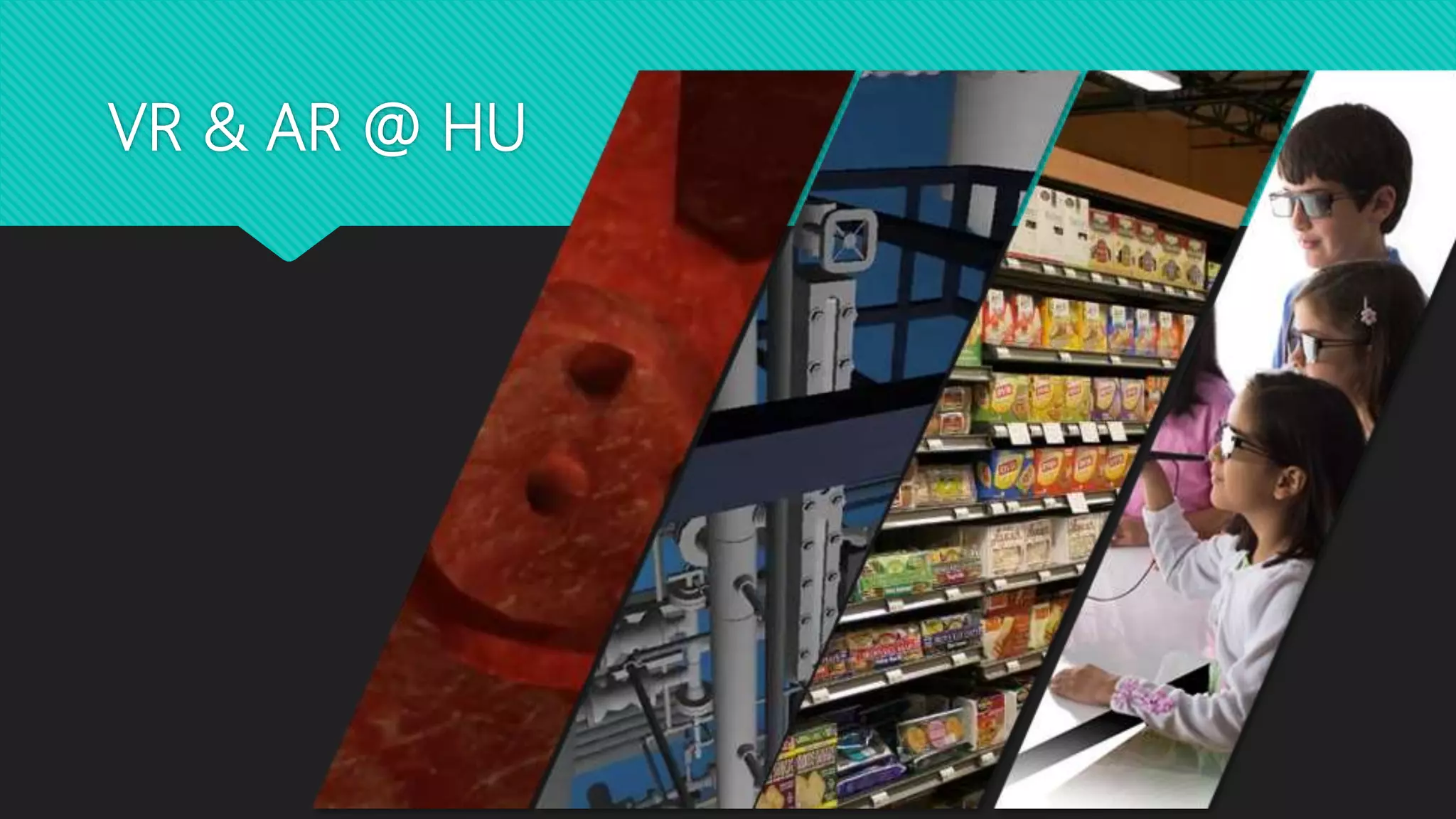
Plasma Racer
Interactive game for anatomy
and physiology students
Race against time through the
circulatory system
Virtusphere
Title
Description
Goal
Platform
View on Youtube
VR & AR @ HU
Plant Safety
Training simulation for industrial
plant employees
Complete a series of orientation
“shifts” to illustrate facility
knowledge and organization
competencies.
Virtusphere
Title
Description
Goal
Platform
View on Youtube
VR & AR @ HU
Gaze Analytics
Recreate grocery shopping
experience in VR.
Track shopper’s gaze path to see
which packages and locations
attract the most attention.
Oculus
Title
Description
Goal
Platform
VR & AR @ HU
AR Exploration
Explore usages of AR
technologies in STEM education
Work with zSpace and Aayuna to
develop the next generation of
AR applications and
technologies.
zSpace
Title
Description
Goal
Platform
ways virtual reality could change
education
1. Collaboration in virtual reality classroom fosters social integration of learners
Dr. Conor Galvin, University College Dublin School of Education and Lifelong Learning
2. Not possible in reality is possible in virtual reality
Inge Knudsen, Learnmark Business College (Central Denmark)
3. Virtual game-based experience increases students’ motivation
Jane Wilde, Instructional Designer at Linfield College (Mcminnville, Oregon)
4. Virtual reality introduces new approach to rewards
5. Virtual platforms and headsets are the new tools for inspiring creative learning
Tom Chatfield, Author, Broadcaster, Tech Theorist
5
http://www.hypergridbusiness.com/2014/09/5-ways-virtual-reality-will-change-education/
Slido Survey Results
Visit http://bit.ly/slidoVR-HL for the results
Thank you
 Thanks for your time
 Contact me via
 Twitter @charlespalmer
 LinkedIn https://www.linkedin.com/in/charleslpalmer
 Download this presentation from
http://www.slideshare.net/charlespalmerhu
Alternate Reality Games: Gamification for Performance leads us
through the advantages of applying ARGs to the workplace and
the classroom, revealing how businesses and schools are using
them to shift their focus from efficiency to an ability to learn and
respond rapidly to external changes.
http://bit.ly/GfP-AMZN

Virtual Reality Presentation at #HybridLive

  • 1.
    Virtual Reality Fake worldsfor real adventure to increase student engagement.
  • 2.
    Introduction  Charles Palmer Harrisburg University  Program lead and Professor of Interactive Media  Executive Director, Center for Advanced Entertainment and Learning Technologies  Gamification author  Game developer  3d Printing enthusiast  Budding data scientist  Social @charlespalmer (Twitter) http://www.slideshare.net/charlespalmerhu https://www.linkedin.com/in/charleslpalmer
  • 3.
    Harrisburg University  Onlynon-profit science and technology-focused comprehensive non-profit university between Philadelphia and Pittsburgh  Urban campus in the heart of the State Capitol  Supports the academic success of members of groups historically under-represented in applied science and technology fields  Private not-for-profit 501(c)(3) university  Accredited by the Middle States Commission on Higher Education June 22, 2009  14-story $73-million state-of-the-art Academic Center  Wireless, laptop campus  Student/Faculty Ratio: 13 to 1  HU has NOT raised tuition in the last 4 years Undergraduate Programs  Analytics  Biotechnology  Computer and Information Science  Geospatial Technology  Integrative Sciences  Interactive Media  Management & eBusiness Graduate Programs  Analytics  Computer Information Sciences  Information Systems Engineering & Management  Learning Technologies & Media Systems  Project Management
  • 4.
    Overview  What isVR?  A little bit of history  Current technology  How it works  Examples  What’s next…
  • 5.
    What is virtualreality Virtual Reality is the use of computer technology to create a simulated environment. Unlike traditional user interfaces where the user views a screen, these systems immerse the user inside of 3D worlds creating a richer, fuller interactive experience.
  • 6.
    “Students with accessto virtual reality in a geometry class have a better understanding of those geometric shape (especially planes) and in geography students have a better understanding of spatial relationships in terms of landscapes and cityscapes” Richard Byrne, President Byrne Instructional Media, LLC
  • 7.
  • 9.
    A little bitof history. How did we get here?
  • 10.
    Hugo Gernsback (August 16,1884 – August 19, 1967) Born Hugo Gernsbacher, was a Luxembourgish-American inventor, writer, editor, and magazine publisher, best known for publications including first science fiction magazine. His contributions to the genre as publisher were so significant that, along with the novelists H. G. Wells and Jules Verne, he is sometimes called "The Father of Science Fiction”. In his honor, annual awards presented at the World Science Fiction Convention are named the “Hugo”.
  • 11.
  • 12.
    Timeline Morton Heilig Sensorama –1956-1962 The Sensorama was able to display stereoscopic 3-D images in a wide-angle view, provide body tilting, supply stereo sound, and also had tracks for wind and aromas to be triggered during the film.
  • 13.
    Timeline Ivan Sutherland Head MountedDisplay The Sword of Damocles is widely considered to be the first virtual reality (VR) and augmented reality (AR) head- mounted display (HMD) system. It was created in 1968 by computer scientist Ivan Sutherland with the help of his student Bob Sproull. Before he began working toward what he termed "the ultimate display", Ivan Sutherland was already well respected for his accomplishments in computer graphics.
  • 14.
    Timeline DataGlove Thomas G. Zimmerman USPatent 4542291 Various sensor technologies are used to capture physical data such as bending of fingers. Often a motion tracker, such as a magnetic tracking device or inertial tracking device, is attached to capture the global position/rotation data of the glove. These movements are then interpreted by the software that accompanies the glove, so any one movement can mean any number of things.
  • 15.
    VPL, Inc. One ofthe first companies that developed and sold virtual reality products. It was founded by VR pioneer Jaron Lanier in 1984. VPL started in the corner of Lanier's cottage in the San Francisco Bay Area. "VPL" stood for "Visual Programming Languages", and Lanier said that the goal of the company was to create a visual programming language to bring programming to a mass audience. Timeline
  • 16.
    Timeline USAF Super CockpitProgram 1986-1989 Dr. Thomas Furness is a pioneer in the development of interfaces between humans and complex machines. Most of his work has centered on the concept of virtual interface technologies which prove a circumambience of three dimensional spatial information to the human using the visual, auditory and tactile sensory modalities.
  • 17.
    Timeline PC Power VR 1998-2000 Thefirst personal computers capable of running virtual reality came onto the market in the late 90s. But the head- mounted displays were cumbersome and of lower resolution.
  • 18.
    Timeline Oculus Rift August 2012 Injust 30 days, the Oculus Rift Kickstarter campaign raised $2,437,429, a mere 947% over their intended goal. It was a testament that the average tech consumer was ready for a VR device.
  • 19.
    Timeline Facebook Buys Oculus April2014 The $2 billion acquisition deal of the virtual reality pioneer becomes official. The exact price of the acquisition came out to $2,001,985,000. The VR startup will operate somewhat independently and maintain its main offices in the Irvine and Los Angeles areas.
  • 20.
    Timeline Major Players enterthe VR Market Aside from Facebook, 10 other companies were added to the VR Watchlist: Amazon, Google, Virtuix, AMD, Qualcomm, Samsung, Nvidia, Microsoft, Sony, and Valve.
  • 21.
    How did weget here … $750,000 $700g1985 2015
  • 22.
    Today in VR Desktop Mobile Head-mountedPlatforms $600 $800 $11 $18 $75
  • 23.
    Poll Question Describe aVR title or demonstration you’ve seen or experienced. Visit www.slido.com with #2085 to participate
  • 24.
  • 25.
  • 26.
    How does itwork Capture or Create
  • 27.
    How does itwork: Stereoscopy The technological development of three-dimensional photography was also a social innovation. The new ability to share visual experiences gave rise to mid-19th-century viewing parties. Guests at these social gatherings would pass around individual stereo viewers, which permitted them to gaze at distant lands, unique botany, or even art. http://exhibitions.kelsey.lsa.umich.edu/fwk/stereo.html Usage: 1850-1920Stereoscopic viewer 1970s Stereoscopic viewer marketed to kids and families
  • 28.
  • 29.
    How does itwork: Stereoscopy
  • 30.
    How does itwork Display Room system
  • 31.
    Demos Education  The BodyVR  Fight for Falluja  Shark Shipwreck  Elephants on the Brink  Google Expeditions  Safety in a Box  Google VR in the Classroom  VR in Education (AMD) Entertainment  I Expect You to Die  Trials on Tatooine  Snow World  RCSI Medical Training Simulator  The Presence  The Void  What is the Void  Ghostbusters The Body VR: An immersive tour through the human body using the Oculus Rift.
  • 32.
    VR & AR@ HU
  • 33.
    VR & AR@ HU Plasma Racer Interactive game for anatomy and physiology students Race against time through the circulatory system Virtusphere Title Description Goal Platform View on Youtube
  • 34.
    VR & AR@ HU Plant Safety Training simulation for industrial plant employees Complete a series of orientation “shifts” to illustrate facility knowledge and organization competencies. Virtusphere Title Description Goal Platform View on Youtube
  • 35.
    VR & AR@ HU Gaze Analytics Recreate grocery shopping experience in VR. Track shopper’s gaze path to see which packages and locations attract the most attention. Oculus Title Description Goal Platform
  • 36.
    VR & AR@ HU AR Exploration Explore usages of AR technologies in STEM education Work with zSpace and Aayuna to develop the next generation of AR applications and technologies. zSpace Title Description Goal Platform
  • 37.
    ways virtual realitycould change education 1. Collaboration in virtual reality classroom fosters social integration of learners Dr. Conor Galvin, University College Dublin School of Education and Lifelong Learning 2. Not possible in reality is possible in virtual reality Inge Knudsen, Learnmark Business College (Central Denmark) 3. Virtual game-based experience increases students’ motivation Jane Wilde, Instructional Designer at Linfield College (Mcminnville, Oregon) 4. Virtual reality introduces new approach to rewards 5. Virtual platforms and headsets are the new tools for inspiring creative learning Tom Chatfield, Author, Broadcaster, Tech Theorist 5 http://www.hypergridbusiness.com/2014/09/5-ways-virtual-reality-will-change-education/
  • 38.
    Slido Survey Results Visithttp://bit.ly/slidoVR-HL for the results
  • 39.
    Thank you  Thanksfor your time  Contact me via  Twitter @charlespalmer  LinkedIn https://www.linkedin.com/in/charleslpalmer  Download this presentation from http://www.slideshare.net/charlespalmerhu
  • 40.
    Alternate Reality Games:Gamification for Performance leads us through the advantages of applying ARGs to the workplace and the classroom, revealing how businesses and schools are using them to shift their focus from efficiency to an ability to learn and respond rapidly to external changes. http://bit.ly/GfP-AMZN

Editor's Notes

  • #13 recreate an emotional experience
  • #16 VR headset, with gloves cost about $750,000.
  • #17 skill transfer expensive
  • #18 within about 20 years, the computing power for vr was available in consumer computers but cumbersome induced nausea and had poor graphic capabilities
  • #22 the technologies used in VR became accessible because of this VR was brought from the research lab, to our pockets
  • #25 he had an emotional and physical reaction to the experience
  • #28 Before the advent of cinema and Thomas Edison's 35 mm film camera, many people experimented with creating illusions through images and photography. Pre-cinematic equipment included stereoscopic viewers and views, which took two simultaneous images of a subject from slightly different angles. When viewed through a stereoscopic viewer, the image appeared three-dimensional.
  • #32 we won't spend a lot of time on these because I don't want any of you getting sick. I suffer from motion sickness, which makes grading student work pretty difficult.
  • #37 Looking to partner with teachers on app development
  • #38 1- Dr. Galvin reported that students struggling to become part of the class group, were able to become accepted by their peers because of their technology skills. Shy students ‘come out of their shells’ and the kids, previously lacking in confidence in their math skills, became self-assured technology experts. 2 - children learn best by doing or by being - The ability to introduce practical knowledge to the classroom without actually leaving it, makes educational experience invaluable. 3 - “Conducting game-based learning experiences in a virtual environment is enhanced by the following factors,” said Wilde. “The player is immersed in the game world – an ‘authentic context’ for the activities. The playing field is leveled – a player’s gender, weight, race don’t have to interfere with their acceptance by other players. You are judged by your actions. A lot can be accomplished in a virtual environment that would not be possible in real life. Also it is memorable – the visual and kinesthetic experiences in virtual worlds contribute to our ability to learn.” 4 - “Success is acknowledged,” said Wilde. “There are rewards for achievements. Failures are generally ignored. This is the opposite of much education — where success is neutral and failure is punished.” 5 - “I’m actually slightly cynical about using virtual reality in education, in that I think people often get too excited at gadgets instead of thinking fully about what a great educational experience looks like,” Tom Chatfield, an author of a number of books on digital culture and a gaming theorist, whose appearances include TED Global, told Hypergrid Business. “For me, perhaps the most exciting thing that could come of this type of technology is students themselves getting excited about, and using it to create things – and learn via the act of creating.”