Nanotechnology
ABSTRACT:
Imagine the chips embedded in the human body
reporting every body movement and just waiting to strike at those nasty
bacterial invaders, clothing smart enough to monitor out health and save
us from environmental hazards, huge buildings and machines having the
capability to repair and adjust themselves to the vagaries of the
environment, or a regular wristwatch doubling up as a supercomputer.
Thanks to nanotechnology, all of these wonders, and many more, are
possible. Scientific discoveries and inventions have in fact propelled
man to challenge new frontiers. And with his superior brain, man has
been able to deliver most of these goodies. Nanotechnology is one such
technological wonders that we are experiencing now. Scientists and
engineers are working round the clock to achieve breakthroughs that
could possible be the answer to human misery.
This paper mainly contains about Nanotechnology and its ‘various’
applications. And this tells about the history of Nanotechnology and its
necessity. This also discusses how it will improve our lives and about the
applications in wide range.
Introduction:
Scientists have been trying to understand the nature and through
research in various disciplines such as physics, chemistry, Botany,
Zoology etc. deciphering the secrets to evolve appropriate technologies
to improve the quality of life. For most the 20th century, scientists have
practised what can be called “top-down science”. The goal has been to
simplify our understanding of matter by breaking it in to its basic building
blocks ranging from atom, nuclei, nucleons, quarks and beyond. Starting
from the understanding of the basic interactions in elementary particles,
attempt is made to explain the structure and properties of materials and
all possible phenomena. Scientists will now like to understand how
simple atoms and molecules come together and arrange themselves to
form complex systems, such as living cells that make life possible on
earth. This “bottom-up” approach deals with how complex systems are
built from simple atomic-level constituents which has opened up new
horizons of research in the area of Nanoscience and Nanotechnology.
It is the study of properties of a few tens of atoms in a space of less than
say 50 nm. “It is amazing what one can do by just putting atoms where
you want them” says Richard Smalley, co-discoverer of Buck ball in
1985 winner of a Nobel Prize. It has revolutionized the basic sciences
and has given rise to a new discipline, called Nanoscience, which is
gradually proving to be the nucleus around which all existing sciences
will prosper. Nanotechnology is the study and use of materials, devices
and systems on the scale of a nanometer. If we can learn to manipulate
the characteristics of individual atoms we can revolutionize the fields of
utter importance.
Today, thanks to nanotechnology, we can buy tennis racquets that are
stronger, sunscreen creams that are more transparent, paints that are
brighter and longer-lasting, and socks that don’t smell. Behind the
scenes, nanotechnology is also used in chemical processing techniques,
such as filtration and catalysis.
“The value of nanotechnology is almost everywhere. The challenge, is to
ensure that we use nanotechnology to become the architects of a better
life, not the architects of our own destruction.” Deputy Minister of
Science and Technology Derek Hanekom. “Nanotechnology gives an
opportunity to South Africa to be the best in the world in multiple fields of
research” – Professor Marcel Van de Voorde, Science Adviser to
European Union.
Nanotechnology is already with us … but its impact on our daily lives is
set to grow at a phenomenal rate...
In 2002, the number of nanoproducts in the global market was estimated
to be around 200. In 2008, that number had increased to over 800 – an
increase of 600% over a relatively short period.1 Independent research
firm, Lux Research has indicated that by 2014, $2,6 trillion in
manufactured goods will incorporate nanotechnology2.
In South Africa, many of the potential applications of nanotechnology are
still in the research and development stage, but results thus far point to
incredible potential benefits – not only for the country’s economic and
industrial development, but for the lives of ordinary people, many of
whom still struggle to access basic services such as clean water,
electricity and effective health care.
Many industries are working with government and academia to unlock
this industrial and social potential. In 2005, the Department of Science
and Technology launched the National Nanotechnology Strategy, which
aims to co-ordinate nano research and development at a national level
around six focus areas: water, energy, health, chemical and bio-
processing, mining and minerals and advanced materials and
manufacturing.
Two Nanotechnology Innovation Centres have been opened – one at the
Council for Scientific and Industrial Research (CSIR) and the other at
Mintek. In partnership with industry and many of South Africa’s
universities and bodies such as the Water Research Commission and
the Medical Research Council, the centres are conducting cutting-edge
research into nanotechnology in order to unlock its full potential.
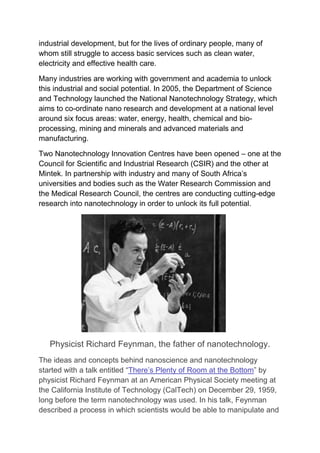
Physicist Richard Feynman, the father of nanotechnology.
The ideas and concepts behind nanoscience and nanotechnology
started with a talk entitled “There’s Plenty of Room at the Bottom” by
physicist Richard Feynman at an American Physical Society meeting at
the California Institute of Technology (CalTech) on December 29, 1959,
long before the term nanotechnology was used. In his talk, Feynman
described a process in which scientists would be able to manipulate and
control individual atoms and molecules. Over a decade later, in his
explorations of ultraprecision machining, Professor Norio Taniguchi
coined the term nanotechnology. It wasn't until 1981, with the
development of the scanning tunneling microscope that could "see"
individual atoms, that modern nanotechnology began.
One nanometer is a billionth of a meter, or 10-9
of a meter. Here are a
few illustrative examples:
 There are 25,400,000 nanometers in an inch
 A sheet of newspaper is about 100,000 nanometers thick
 On a comparative scale, if a marble were a nanometer, then one
meter would be the size of the Earth
Nanoscience and Nanotechnology :
Nanoscience is concerned with nanomaterials, i.e. materials that are at
least one of the dimensions of about 1 to 10 nanometers. The word
‘nano’ comes from the Greek word “nanos” meaning dwarf. The term
nano is the factor 10-9 or one billionth. Just to get a feeling of the size,
we note that the diameter of one hydrogen atom is 0.1 nm. Five atoms of
carbon would occupy a space about 1 nanometer wide. It would take 5
million carbon atoms to make a dot as big as the period at the end of this
sentence. The width of a DNA molecule is 2.5 nm. These reduced
dimensional systems have novel electronic, chemical, mechanical and
optical properties.
What is nanotechnology?
Nanotechnology is the act of manipulating materials
at very tiny scales – at the level of atoms and molecules. With materials
under 100 nanometres, the normal rules of physics and chemistry no
longer apply and many materials start to display unique and, sometimes,
surprising properties. They may become very much stronger, more
conductive or reactive.
For example, solids like gold turn into liquids at room temperature, silver
takes on anti-microbial properties, inert materials like platinum and gold
become catalysts, stable materials like aluminium become combustible.
These new properties have opened up exciting fields of study and
application.
NANOSCIENCE is the study and discovery of these new properties.
NANOTECHNOLOGY is the use of these new properties in special
products and applications.
Nanomaterials – the building blocks of nanoscience – and their
range of applications.
In relation to their size, nanoparticles have huge surface areas, a
characteristic that makes them very effective in catalysis, absorption and
other processes.
FULLERENES:
Fullerenes are carbon nanostructures which include
nanotubes and bucky balls (more properly known as
buckminsterfullerene, are spherical molecules composed entirely of
carbon atoms). Synthesised by the condensation of high-temperature
carbon vapour, they have diameters ranging from a fraction of a
nanometre to 100 nm. This is the material of the future with
extraordinary properties to match. Carb on nanotubes, for example,
conduct much better than copper and are 100 times stronger than steel,
but one-sixth of the weight.
Applications: electronics, energy devices, highstrength materials,
super-sensitive nano-sensors and ideal for catalyst support.
NANO DRUG ENCAPSULATION:
Using a chemical process, drugs are encapsulated in
biodegradable-polymer capsules 100 to 500 nm in diameter. Due to their
small size the capsules are taken up by cells. The benefit is a reduction
in dose frequency of medication due to the slow release of the drug.
Applications: delivery of TB, HIV/Aids and malaria drugs.
QUANTUM DOTS: A quantum dot is a semi-conductor (between
conductor and insulator) with nano-dimensions. Quantum dots and nano
phosphors exhibit unique optical, magnetic and electronic properties,
due to the quantum confinement effect. Depending on their size, they
absorb and emit different colours when irradiated with photons or
electrons.
Applications: used in biosensors this can be used to pinpoint disease
in the body, solar cells and flat panel displays and special coatings.
NANO COMPOSITES: By adding nanoparticles and nanostructures to a
polymer, a nanocomposite is formed. These materials of the future can
be super-strong, light, conducting and transparent. A nanocomposite
can be much more transparent than a polymer containing micron
particles, which is opaque.
Applications: aeronautic and automobile industries scratch-resistant
coatings; self-cleaning windows, fuel cells.
NANOPARTICLES: Nanoparticles can be produced chemically in high
temperature reactors or through mechanical milling. They are mostly 10
to 100 nm in diameter and often agglomerated.
Applications: coatings, composites, solar cells and medicine. Silicon
nanoparticles can be used for printed electronics.
WATER PURIFICATION: Nanotechnology offers a low-cost and
effective solution to the challenge of access to clean and safe water for
millions of people in South Africa and the developing world. The
technology holds the potential to radically reduce the number of steps,
materials and energy needed to purify water. Depending on the kind of
water to be purified – ground, surface or waste water – nanomaterials
can be tailor-made with specific pore sizes and large enhanced surface
areas to filter out certain unwanted pollutants, such as heavy metals or
biological toxins. For example, titanium oxide at nanoscale can be used
to degrade organic pollutants. And silver nanoparticles have the ability to
degrade biological pollutants such as bacteria.
South African scientists are testing different kinds of membranes and
filters based on carbon nanotubes, nanoporous ceramics, magnetic
nanoparticles and other nanomaterials which could be used to remove
water-borne diseases such as typhoid and cholera, as well as toxic
metal ions, organic and inorganic solutes.
Nanotechnology applications include:
Nanofiltration membranes – These are already being applied for
removal of dissolved salts from salty water, removal of micro pollutants,
water softening, and wastewater treatment. Nanofiltration membranes
selectively reject substances, which enables the removal of harmful
pollutants and retention of nutrients present in water that are required for
the normal functioning of the body. Attapulgite clay, zeolite, and polymer
filters are source materials for nanofilters and can now be manipulated
on the nanoscale to allow for greater control over pore size of filter
membranes. Researchers are also developing new classes of
nanoporous polymeric materials that are more effective than
conventional polymer filters.
NB: In South Africa, a water purification system using nano-filtration
techniques has already been implemented at pilot stage.
Nanocatalysts and magnetic nanoparticles – Using catalytic
particles could chemically degrade pollutants instead of simply moving
them somewhere else, including pollutants for which existing
technologies are inefficient or cost prohibitive. Magnetic
nanoparticleswhen coated with different compounds could be used to
remove pollutants, including arsenic, from water.
Nanosensors - Researchers are developing new sensor technologies
that combine micro- and nanofabrication technology to create small,
portable, and highly accurate sensors to detect chemical and
biochemical parameters in water. Several research consortia are field
testing devices that incorporate nanosensor technology to detect
pollutants in water, and some expect to commercialise these devises.
HEALTH: In both diagnosis and treatment, nanotechnology holds the
key to revolutionise health care, particularly in developing countries
where access to effective health care is still a challenge for millions of
people living in remote areas.
In the field of diagnostics, nanotechnology promises quick, early and
accurate detection of diseases.
 Portable, but highly sensitive point-of-care test kits are under
development which will offer all the diagnostic functions of a
medical laboratory.
Depending on how they are designed and the intended application, the
hand held kits could be used to test for viruses, bacteria or hormones.
Thus they will be able to test – simply and quickly – for infectious
diseases such as malaria, cholera, HIV/Aids and other sexually-
transmitted infections, and even cancer. Also known as the “lab-on-a-
chip” because of their ability to emulate the services of a complete
medical laboratory, these inexpensive, hand-held diagnostic kits can
pick up the presence of several pathogens at once and could be used
for wide-ranging screening in remote clinics.
According to Robert Tshikudo, head of nanotechnology at Mintek,
research on using the kits for infectious diseases is in the “final stages”
and the ultimate goal is to make the kits available to government
hospitals and clinics where they can “reach those who need it”.
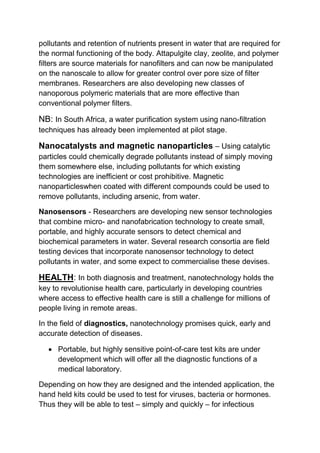
Quantum Dots are metal nanoparticles that fluoresce in a variety of
colors determined by their size. They are used in biomedical imaging.
Ultrafine gold particles also have application in water treatment. Image:
NASA.
 Biomedical imaging – Nanotechnology applications are in
development that will radically improve medical imaging
techniques. For example, gold and silver nanoparticles have
optical properties which make them extremely effective as contrast
agents. Quantum dots which are brighter than organic dyes and
need only one light source for excitation, when used in conjunction
with magnetic resonance imaging, can produce exceptional
images of tumour sites.
Nanomaterials are also used in therapeutics or treatment:
 Targeted drug delivery systems – Nanostructures can be used to
recognise diseased cells and to deliver drugs to the affected areas
to combat cancerous tumours, for example, without harming
healthy cells. In obesity, nanoparticles can target and inhibit the
growth of fat deposits.
 Slow-release drug therapy – Research shows that nano-sized
biodegradable polymer capsules containing drugs for tuberculosis
treatment are effectively taken up by the body’s cells. The effect is
a slower release of the drug into the body and a reduction in the
frequency with which TB patients need to take his or her
medication. In countries where drugs are not readily available and
compliance is generally low due to a number of reasons, the
technology holds great potential for increased drug compliance
and less chance of the development of drug resistance.
Photothermal and hypothermal destruction of cancer – Some
nanoparticles, such as gold, possess therapeutic properties based on
their magnetic wavelength or optical properties. They absorb light and
heat up the surrounding area, killing the cancer cells.
ENERGY:
Another impressive application for nanotechnology is energy
production, conversion and storage. Research is well advanced
enough to establish that nanotechnology offers a viable alternative to
non-renewable fossil-fuel consumption and gives us the means to
achieve a “hydrogen economy”. Nano-applications in this area
include: solar cells; fuel cells and new energy production, conversion
and storage processes. In all cases, the results are energy that is
cheaper, cleaner, more efficient and renewable. In future, nano holds
the potential to produce hybrid vehicles with reduced fuel
consumption and a lighter motor weight.
INDUSTRIAL APPLICATIONS:
 Nanotechnology is set to add value to South Africa’s raw
mineral resources through beneficiation of gold, platinum group
metals and otherminerals which are used as high performance
catalysts, absorbents in polymer nanocomposites and in
energy-saving materials.
 Nanotechnology can produce cleaner process engineering
which will in turn produce value-added chemicals and speciality
products, including bio catalytic systems and novel
heterogeneous catalysts. Nanotechnology can make catalytic
converters more efficient, cheaper and more accurately
controlled.
 Nanotechnology-based innovations can be designed that will
combat air pollution remediation, detect toxic materials and
leaks, reduce fossil fuel emissions and separate gases
Advanced materials and manufacturing applications :
Nanotechnology can produce smart, functional materials, including
lubricants and barrier coatings, ultra-hard and super-strong materials,
electro and photo-chromic materials with applications in all
manufacturing sectors, industry, medical and domestic markets.
Nanoparticles can also improve a wide range of properties shown by
engineering plastics, such as bio-degradability and improved thermal,
mechanical and electrical properties. Thus, plastic bags can be made to
bio-degrade and plastic car parts or building materials can be made
more fire-resistant. Other areas include the development of
nanoparticles for applications in phosphorous paints, printable
electronics, inexpensive solar cells and nanotube synthesis for
application in sensors and as catalyst support structures.
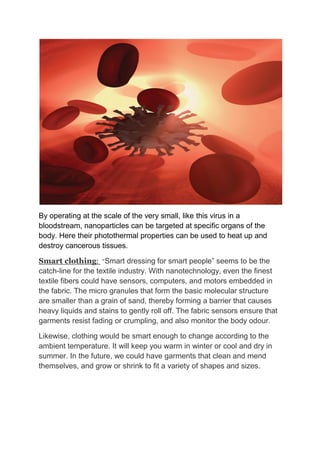
By operating at the scale of the very small, like this virus in a
bloodstream, nanoparticles can be targeted at specific organs of the
body. Here their photothermal properties can be used to heat up and
destroy cancerous tissues.
Smart clothing: “Smart dressing for smart people” seems to be the
catch-line for the textile industry. With nanotechnology, even the finest
textile fibers could have sensors, computers, and motors embedded in
the fabric. The micro granules that form the basic molecular structure
are smaller than a grain of sand, thereby forming a barrier that causes
heavy liquids and stains to gently roll off. The fabric sensors ensure that
garments resist fading or crumpling, and also monitor the body odour.
Likewise, clothing would be smart enough to change according to the
ambient temperature. It will keep you warm in winter or cool and dry in
summer. In the future, we could have garments that clean and mend
themselves, and grow or shrink to fit a variety of shapes and sizes.
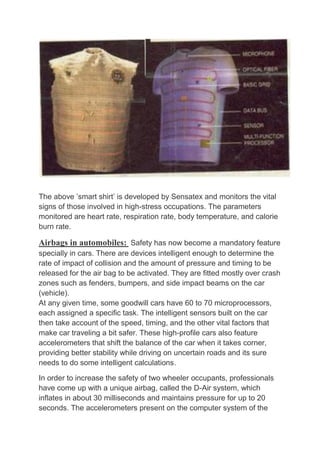
The above ’smart shirt’ is developed by Sensatex and monitors the vital
signs of those involved in high-stress occupations. The parameters
monitored are heart rate, respiration rate, body temperature, and calorie
burn rate.
Airbags in automobiles: Safety has now become a mandatory feature
specially in cars. There are devices intelligent enough to determine the
rate of impact of collision and the amount of pressure and timing to be
released for the air bag to be activated. They are fitted mostly over crash
zones such as fenders, bumpers, and side impact beams on the car
(vehicle).
At any given time, some goodwill cars have 60 to 70 microprocessors,
each assigned a specific task. The intelligent sensors built on the car
then take account of the speed, timing, and the other vital factors that
make car traveling a bit safer. These high-profile cars also feature
accelerometers that shift the balance of the car when it takes corner,
providing better stability while driving on uncertain roads and its sure
needs to do some intelligent calculations.
In order to increase the safety of two wheeler occupants, professionals
have come up with a unique airbag, called the D-Air system, which
inflates in about 30 milliseconds and maintains pressure for up to 20
seconds. The accelerometers present on the computer system of the
airbag and on the bikes register the amount of impact and then swing
into action. Another system called STM (sensing, triggering, and
memory) contains an electronic control unit that continuously monitors
accelerations and decelerations of the motorcycle. It sends this
information to a microprocessor, where an algorithm analyses the
‘impact pulse’. A further analysis recognizes the pulse and sends an
electrical current to the inflator initiator.
Screening at airports: After the 9/11 disaster, airports all over the world
have gone for the highest security check-ins. The Regional Airport
Authority of Louisville is banking on nanotechnology to counter any
external terrorist strike. According to them new devices for baggage
screening will be tiny enough to be wells between ticket counter
positions to scan each bag as the passenger checks it in.
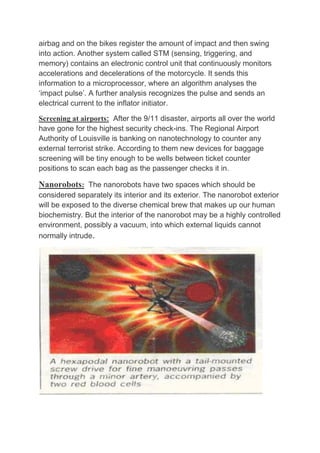
Nanorobots: The nanorobots have two spaces which should be
considered separately its interior and its exterior. The nanorobot exterior
will be exposed to the diverse chemical brew that makes up our human
biochemistry. But the interior of the nanorobot may be a highly controlled
environment, possibly a vacuum, into which external liquids cannot
normally intrude.
Each species of medical nanorobot will be designed to accomplish a
specific task. The machines, or ‘nanorobots’, would have onboard
sensors and computers. Before being sent into the body, they would
have to be programmed with a set of characteristics that lets them
clearly distinguish their targets from everything else.
Nanorobots will be designed with a high level of redundancy to ensure
fail-operational and fail-safe performance, further reducing the medical
risk. Some nano robots will be able to effuse themselves from the body
via the usual human excretory channels.
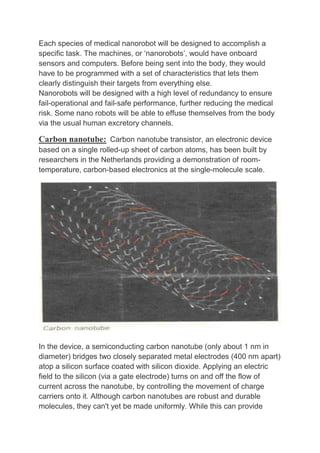
Carbon nanotube: Carbon nanotube transistor, an electronic device
based on a single rolled-up sheet of carbon atoms, has been built by
researchers in the Netherlands providing a demonstration of room-
temperature, carbon-based electronics at the single-molecule scale.
In the device, a semiconducting carbon nanotube (only about 1 nm in
diameter) bridges two closely separated metal electrodes (400 nm apart)
atop a silicon surface coated with silicon dioxide. Applying an electric
field to the silicon (via a gate electrode) turns on and off the flow of
current across the nanotube, by controlling the movement of charge
carriers onto it. Although carbon nanotubes are robust and durable
molecules, they can't yet be made uniformly. While this can provide
disadvantages, it can also bring about advantages such as the
possibility of a metal-semiconductor junction made completely of carbon
nanotubes.
Smart Medicines: However science has progressed through course
of time, it has still not found a cure for common cold. With this in mind,
doctors, scientists, and researchers all over the world are looking at
nanotechnology for finding the necessary breakthroughs.
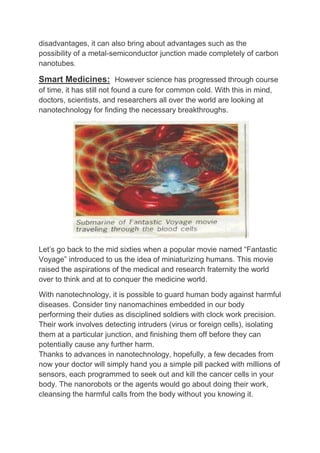
Let’s go back to the mid sixties when a popular movie named “Fantastic
Voyage” introduced to us the idea of miniaturizing humans. This movie
raised the aspirations of the medical and research fraternity the world
over to think and at to conquer the medicine world.
With nanotechnology, it is possible to guard human body against harmful
diseases. Consider tiny nanomachines embedded in our body
performing their duties as disciplined soldiers with clock work precision.
Their work involves detecting intruders (virus or foreign cells), isolating
them at a particular junction, and finishing them off before they can
potentially cause any further harm.
Thanks to advances in nanotechnology, hopefully, a few decades from
now your doctor will simply hand you a simple pill packed with millions of
sensors, each programmed to seek out and kill the cancer cells in your
body. The nanorobots or the agents would go about doing their work,
cleansing the harmful calls from the body without you knowing it.
The Indian Scenario: “The convergence of ICT, nanotechnology, and
biological sciences is in the horizon. India is even better placed to exploit
this revolution than any other nation,” said President of India A.P.J.
Abdul Kalam while addressing the nation on the eve of Republic Day of
2003.
The scope of nanotechnology is quite evident as our country has
another incubator in the form of IndiaNano (www.indiaco.com). The firm
has tied up with several US companies that are predominantly working
on nanotech products.
IndiaNano is an initiative supported by the US and Indian research
organizations, investment firms, and corporations, aimed at developing a
platform for collaboration between academia, corporates, government,
private labs, entrepreneurs, investors, and service providers in order to
harness the benefits of advances in materials and manufacturing,
electronics, medicine and healthcare, environment and energy
management, chemicals, biotechnology, agriculture, information
technology, and national security that have been enabled by the
breakthroughs in nanotechnology.
A question of ethics: Realising the importance of nanotechnology, Japan,
Korea, and China have adopted cording offices at the national level
similar to the United States National Sciences & Technology Council.
Of course, nanotechnology is a wonderful tool, but what would happen if
this technology fell into the wrong hands? One might ask about the legal
implications of self-replicating nanotechnology or even the harmful
effects of bioterrorism.
Some people claim the nanotechnology has severe implications: smart
dust would invade our privacy and be as lethal, disruptive, and
dangerous as nuclear weapons! So should the sciences stop researching
nanotechnology simply because of uncertainties as to where it might
lead?
The truth is that we simply don’t know where new technologies would
lead, and we can never be fully secure against scientific error or scientific
terror. Remember how a small and simple idea has revolutionized our
lives, be it the telephone or washing machine. Initially people were
skeptical about man’s landing on the moon, but today we see the
usefulness of this wonderful technology in the form of satellite
communications.

nanotechnologyprojectwork-190924023425 (1).pdf

  • 1.
    Nanotechnology ABSTRACT: Imagine the chipsembedded in the human body reporting every body movement and just waiting to strike at those nasty bacterial invaders, clothing smart enough to monitor out health and save us from environmental hazards, huge buildings and machines having the capability to repair and adjust themselves to the vagaries of the environment, or a regular wristwatch doubling up as a supercomputer. Thanks to nanotechnology, all of these wonders, and many more, are possible. Scientific discoveries and inventions have in fact propelled man to challenge new frontiers. And with his superior brain, man has been able to deliver most of these goodies. Nanotechnology is one such technological wonders that we are experiencing now. Scientists and engineers are working round the clock to achieve breakthroughs that could possible be the answer to human misery. This paper mainly contains about Nanotechnology and its ‘various’ applications. And this tells about the history of Nanotechnology and its necessity. This also discusses how it will improve our lives and about the applications in wide range. Introduction: Scientists have been trying to understand the nature and through research in various disciplines such as physics, chemistry, Botany, Zoology etc. deciphering the secrets to evolve appropriate technologies to improve the quality of life. For most the 20th century, scientists have practised what can be called “top-down science”. The goal has been to simplify our understanding of matter by breaking it in to its basic building blocks ranging from atom, nuclei, nucleons, quarks and beyond. Starting from the understanding of the basic interactions in elementary particles, attempt is made to explain the structure and properties of materials and all possible phenomena. Scientists will now like to understand how simple atoms and molecules come together and arrange themselves to form complex systems, such as living cells that make life possible on
  • 2.
    earth. This “bottom-up”approach deals with how complex systems are built from simple atomic-level constituents which has opened up new horizons of research in the area of Nanoscience and Nanotechnology. It is the study of properties of a few tens of atoms in a space of less than say 50 nm. “It is amazing what one can do by just putting atoms where you want them” says Richard Smalley, co-discoverer of Buck ball in 1985 winner of a Nobel Prize. It has revolutionized the basic sciences and has given rise to a new discipline, called Nanoscience, which is gradually proving to be the nucleus around which all existing sciences will prosper. Nanotechnology is the study and use of materials, devices and systems on the scale of a nanometer. If we can learn to manipulate the characteristics of individual atoms we can revolutionize the fields of utter importance. Today, thanks to nanotechnology, we can buy tennis racquets that are stronger, sunscreen creams that are more transparent, paints that are brighter and longer-lasting, and socks that don’t smell. Behind the scenes, nanotechnology is also used in chemical processing techniques, such as filtration and catalysis. “The value of nanotechnology is almost everywhere. The challenge, is to ensure that we use nanotechnology to become the architects of a better life, not the architects of our own destruction.” Deputy Minister of Science and Technology Derek Hanekom. “Nanotechnology gives an opportunity to South Africa to be the best in the world in multiple fields of research” – Professor Marcel Van de Voorde, Science Adviser to European Union. Nanotechnology is already with us … but its impact on our daily lives is set to grow at a phenomenal rate... In 2002, the number of nanoproducts in the global market was estimated to be around 200. In 2008, that number had increased to over 800 – an increase of 600% over a relatively short period.1 Independent research firm, Lux Research has indicated that by 2014, $2,6 trillion in manufactured goods will incorporate nanotechnology2. In South Africa, many of the potential applications of nanotechnology are still in the research and development stage, but results thus far point to incredible potential benefits – not only for the country’s economic and
  • 3.
    industrial development, butfor the lives of ordinary people, many of whom still struggle to access basic services such as clean water, electricity and effective health care. Many industries are working with government and academia to unlock this industrial and social potential. In 2005, the Department of Science and Technology launched the National Nanotechnology Strategy, which aims to co-ordinate nano research and development at a national level around six focus areas: water, energy, health, chemical and bio- processing, mining and minerals and advanced materials and manufacturing. Two Nanotechnology Innovation Centres have been opened – one at the Council for Scientific and Industrial Research (CSIR) and the other at Mintek. In partnership with industry and many of South Africa’s universities and bodies such as the Water Research Commission and the Medical Research Council, the centres are conducting cutting-edge research into nanotechnology in order to unlock its full potential. Physicist Richard Feynman, the father of nanotechnology. The ideas and concepts behind nanoscience and nanotechnology started with a talk entitled “There’s Plenty of Room at the Bottom” by physicist Richard Feynman at an American Physical Society meeting at the California Institute of Technology (CalTech) on December 29, 1959, long before the term nanotechnology was used. In his talk, Feynman described a process in which scientists would be able to manipulate and
  • 4.
    control individual atomsand molecules. Over a decade later, in his explorations of ultraprecision machining, Professor Norio Taniguchi coined the term nanotechnology. It wasn't until 1981, with the development of the scanning tunneling microscope that could "see" individual atoms, that modern nanotechnology began. One nanometer is a billionth of a meter, or 10-9 of a meter. Here are a few illustrative examples:  There are 25,400,000 nanometers in an inch  A sheet of newspaper is about 100,000 nanometers thick  On a comparative scale, if a marble were a nanometer, then one meter would be the size of the Earth Nanoscience and Nanotechnology : Nanoscience is concerned with nanomaterials, i.e. materials that are at least one of the dimensions of about 1 to 10 nanometers. The word ‘nano’ comes from the Greek word “nanos” meaning dwarf. The term nano is the factor 10-9 or one billionth. Just to get a feeling of the size, we note that the diameter of one hydrogen atom is 0.1 nm. Five atoms of carbon would occupy a space about 1 nanometer wide. It would take 5 million carbon atoms to make a dot as big as the period at the end of this sentence. The width of a DNA molecule is 2.5 nm. These reduced dimensional systems have novel electronic, chemical, mechanical and optical properties. What is nanotechnology? Nanotechnology is the act of manipulating materials at very tiny scales – at the level of atoms and molecules. With materials under 100 nanometres, the normal rules of physics and chemistry no longer apply and many materials start to display unique and, sometimes, surprising properties. They may become very much stronger, more conductive or reactive. For example, solids like gold turn into liquids at room temperature, silver takes on anti-microbial properties, inert materials like platinum and gold become catalysts, stable materials like aluminium become combustible.
  • 5.
    These new propertieshave opened up exciting fields of study and application. NANOSCIENCE is the study and discovery of these new properties. NANOTECHNOLOGY is the use of these new properties in special products and applications. Nanomaterials – the building blocks of nanoscience – and their range of applications. In relation to their size, nanoparticles have huge surface areas, a characteristic that makes them very effective in catalysis, absorption and other processes. FULLERENES: Fullerenes are carbon nanostructures which include nanotubes and bucky balls (more properly known as buckminsterfullerene, are spherical molecules composed entirely of carbon atoms). Synthesised by the condensation of high-temperature carbon vapour, they have diameters ranging from a fraction of a nanometre to 100 nm. This is the material of the future with
  • 6.
    extraordinary properties tomatch. Carb on nanotubes, for example, conduct much better than copper and are 100 times stronger than steel, but one-sixth of the weight. Applications: electronics, energy devices, highstrength materials, super-sensitive nano-sensors and ideal for catalyst support. NANO DRUG ENCAPSULATION: Using a chemical process, drugs are encapsulated in biodegradable-polymer capsules 100 to 500 nm in diameter. Due to their small size the capsules are taken up by cells. The benefit is a reduction in dose frequency of medication due to the slow release of the drug. Applications: delivery of TB, HIV/Aids and malaria drugs. QUANTUM DOTS: A quantum dot is a semi-conductor (between conductor and insulator) with nano-dimensions. Quantum dots and nano phosphors exhibit unique optical, magnetic and electronic properties, due to the quantum confinement effect. Depending on their size, they absorb and emit different colours when irradiated with photons or electrons. Applications: used in biosensors this can be used to pinpoint disease in the body, solar cells and flat panel displays and special coatings. NANO COMPOSITES: By adding nanoparticles and nanostructures to a polymer, a nanocomposite is formed. These materials of the future can be super-strong, light, conducting and transparent. A nanocomposite can be much more transparent than a polymer containing micron particles, which is opaque. Applications: aeronautic and automobile industries scratch-resistant coatings; self-cleaning windows, fuel cells. NANOPARTICLES: Nanoparticles can be produced chemically in high temperature reactors or through mechanical milling. They are mostly 10 to 100 nm in diameter and often agglomerated. Applications: coatings, composites, solar cells and medicine. Silicon nanoparticles can be used for printed electronics.
  • 7.
    WATER PURIFICATION: Nanotechnologyoffers a low-cost and effective solution to the challenge of access to clean and safe water for millions of people in South Africa and the developing world. The technology holds the potential to radically reduce the number of steps, materials and energy needed to purify water. Depending on the kind of water to be purified – ground, surface or waste water – nanomaterials can be tailor-made with specific pore sizes and large enhanced surface areas to filter out certain unwanted pollutants, such as heavy metals or biological toxins. For example, titanium oxide at nanoscale can be used to degrade organic pollutants. And silver nanoparticles have the ability to degrade biological pollutants such as bacteria. South African scientists are testing different kinds of membranes and filters based on carbon nanotubes, nanoporous ceramics, magnetic nanoparticles and other nanomaterials which could be used to remove water-borne diseases such as typhoid and cholera, as well as toxic metal ions, organic and inorganic solutes. Nanotechnology applications include: Nanofiltration membranes – These are already being applied for removal of dissolved salts from salty water, removal of micro pollutants, water softening, and wastewater treatment. Nanofiltration membranes selectively reject substances, which enables the removal of harmful
  • 8.
    pollutants and retentionof nutrients present in water that are required for the normal functioning of the body. Attapulgite clay, zeolite, and polymer filters are source materials for nanofilters and can now be manipulated on the nanoscale to allow for greater control over pore size of filter membranes. Researchers are also developing new classes of nanoporous polymeric materials that are more effective than conventional polymer filters. NB: In South Africa, a water purification system using nano-filtration techniques has already been implemented at pilot stage. Nanocatalysts and magnetic nanoparticles – Using catalytic particles could chemically degrade pollutants instead of simply moving them somewhere else, including pollutants for which existing technologies are inefficient or cost prohibitive. Magnetic nanoparticleswhen coated with different compounds could be used to remove pollutants, including arsenic, from water. Nanosensors - Researchers are developing new sensor technologies that combine micro- and nanofabrication technology to create small, portable, and highly accurate sensors to detect chemical and biochemical parameters in water. Several research consortia are field testing devices that incorporate nanosensor technology to detect pollutants in water, and some expect to commercialise these devises. HEALTH: In both diagnosis and treatment, nanotechnology holds the key to revolutionise health care, particularly in developing countries where access to effective health care is still a challenge for millions of people living in remote areas. In the field of diagnostics, nanotechnology promises quick, early and accurate detection of diseases.  Portable, but highly sensitive point-of-care test kits are under development which will offer all the diagnostic functions of a medical laboratory. Depending on how they are designed and the intended application, the hand held kits could be used to test for viruses, bacteria or hormones. Thus they will be able to test – simply and quickly – for infectious
  • 9.
    diseases such asmalaria, cholera, HIV/Aids and other sexually- transmitted infections, and even cancer. Also known as the “lab-on-a- chip” because of their ability to emulate the services of a complete medical laboratory, these inexpensive, hand-held diagnostic kits can pick up the presence of several pathogens at once and could be used for wide-ranging screening in remote clinics. According to Robert Tshikudo, head of nanotechnology at Mintek, research on using the kits for infectious diseases is in the “final stages” and the ultimate goal is to make the kits available to government hospitals and clinics where they can “reach those who need it”. Quantum Dots are metal nanoparticles that fluoresce in a variety of colors determined by their size. They are used in biomedical imaging. Ultrafine gold particles also have application in water treatment. Image: NASA.  Biomedical imaging – Nanotechnology applications are in development that will radically improve medical imaging techniques. For example, gold and silver nanoparticles have optical properties which make them extremely effective as contrast agents. Quantum dots which are brighter than organic dyes and need only one light source for excitation, when used in conjunction with magnetic resonance imaging, can produce exceptional images of tumour sites.
  • 10.
    Nanomaterials are alsoused in therapeutics or treatment:  Targeted drug delivery systems – Nanostructures can be used to recognise diseased cells and to deliver drugs to the affected areas to combat cancerous tumours, for example, without harming healthy cells. In obesity, nanoparticles can target and inhibit the growth of fat deposits.  Slow-release drug therapy – Research shows that nano-sized biodegradable polymer capsules containing drugs for tuberculosis treatment are effectively taken up by the body’s cells. The effect is a slower release of the drug into the body and a reduction in the frequency with which TB patients need to take his or her medication. In countries where drugs are not readily available and compliance is generally low due to a number of reasons, the technology holds great potential for increased drug compliance and less chance of the development of drug resistance. Photothermal and hypothermal destruction of cancer – Some nanoparticles, such as gold, possess therapeutic properties based on their magnetic wavelength or optical properties. They absorb light and heat up the surrounding area, killing the cancer cells. ENERGY: Another impressive application for nanotechnology is energy production, conversion and storage. Research is well advanced enough to establish that nanotechnology offers a viable alternative to non-renewable fossil-fuel consumption and gives us the means to achieve a “hydrogen economy”. Nano-applications in this area include: solar cells; fuel cells and new energy production, conversion and storage processes. In all cases, the results are energy that is cheaper, cleaner, more efficient and renewable. In future, nano holds the potential to produce hybrid vehicles with reduced fuel consumption and a lighter motor weight. INDUSTRIAL APPLICATIONS:  Nanotechnology is set to add value to South Africa’s raw mineral resources through beneficiation of gold, platinum group metals and otherminerals which are used as high performance
  • 11.
    catalysts, absorbents inpolymer nanocomposites and in energy-saving materials.  Nanotechnology can produce cleaner process engineering which will in turn produce value-added chemicals and speciality products, including bio catalytic systems and novel heterogeneous catalysts. Nanotechnology can make catalytic converters more efficient, cheaper and more accurately controlled.  Nanotechnology-based innovations can be designed that will combat air pollution remediation, detect toxic materials and leaks, reduce fossil fuel emissions and separate gases Advanced materials and manufacturing applications : Nanotechnology can produce smart, functional materials, including lubricants and barrier coatings, ultra-hard and super-strong materials, electro and photo-chromic materials with applications in all manufacturing sectors, industry, medical and domestic markets. Nanoparticles can also improve a wide range of properties shown by engineering plastics, such as bio-degradability and improved thermal, mechanical and electrical properties. Thus, plastic bags can be made to bio-degrade and plastic car parts or building materials can be made more fire-resistant. Other areas include the development of nanoparticles for applications in phosphorous paints, printable electronics, inexpensive solar cells and nanotube synthesis for application in sensors and as catalyst support structures.
  • 12.
    By operating atthe scale of the very small, like this virus in a bloodstream, nanoparticles can be targeted at specific organs of the body. Here their photothermal properties can be used to heat up and destroy cancerous tissues. Smart clothing: “Smart dressing for smart people” seems to be the catch-line for the textile industry. With nanotechnology, even the finest textile fibers could have sensors, computers, and motors embedded in the fabric. The micro granules that form the basic molecular structure are smaller than a grain of sand, thereby forming a barrier that causes heavy liquids and stains to gently roll off. The fabric sensors ensure that garments resist fading or crumpling, and also monitor the body odour. Likewise, clothing would be smart enough to change according to the ambient temperature. It will keep you warm in winter or cool and dry in summer. In the future, we could have garments that clean and mend themselves, and grow or shrink to fit a variety of shapes and sizes.
  • 13.
    The above ’smartshirt’ is developed by Sensatex and monitors the vital signs of those involved in high-stress occupations. The parameters monitored are heart rate, respiration rate, body temperature, and calorie burn rate. Airbags in automobiles: Safety has now become a mandatory feature specially in cars. There are devices intelligent enough to determine the rate of impact of collision and the amount of pressure and timing to be released for the air bag to be activated. They are fitted mostly over crash zones such as fenders, bumpers, and side impact beams on the car (vehicle). At any given time, some goodwill cars have 60 to 70 microprocessors, each assigned a specific task. The intelligent sensors built on the car then take account of the speed, timing, and the other vital factors that make car traveling a bit safer. These high-profile cars also feature accelerometers that shift the balance of the car when it takes corner, providing better stability while driving on uncertain roads and its sure needs to do some intelligent calculations. In order to increase the safety of two wheeler occupants, professionals have come up with a unique airbag, called the D-Air system, which inflates in about 30 milliseconds and maintains pressure for up to 20 seconds. The accelerometers present on the computer system of the
  • 14.
    airbag and onthe bikes register the amount of impact and then swing into action. Another system called STM (sensing, triggering, and memory) contains an electronic control unit that continuously monitors accelerations and decelerations of the motorcycle. It sends this information to a microprocessor, where an algorithm analyses the ‘impact pulse’. A further analysis recognizes the pulse and sends an electrical current to the inflator initiator. Screening at airports: After the 9/11 disaster, airports all over the world have gone for the highest security check-ins. The Regional Airport Authority of Louisville is banking on nanotechnology to counter any external terrorist strike. According to them new devices for baggage screening will be tiny enough to be wells between ticket counter positions to scan each bag as the passenger checks it in. Nanorobots: The nanorobots have two spaces which should be considered separately its interior and its exterior. The nanorobot exterior will be exposed to the diverse chemical brew that makes up our human biochemistry. But the interior of the nanorobot may be a highly controlled environment, possibly a vacuum, into which external liquids cannot normally intrude.
  • 15.
    Each species ofmedical nanorobot will be designed to accomplish a specific task. The machines, or ‘nanorobots’, would have onboard sensors and computers. Before being sent into the body, they would have to be programmed with a set of characteristics that lets them clearly distinguish their targets from everything else. Nanorobots will be designed with a high level of redundancy to ensure fail-operational and fail-safe performance, further reducing the medical risk. Some nano robots will be able to effuse themselves from the body via the usual human excretory channels. Carbon nanotube: Carbon nanotube transistor, an electronic device based on a single rolled-up sheet of carbon atoms, has been built by researchers in the Netherlands providing a demonstration of room- temperature, carbon-based electronics at the single-molecule scale. In the device, a semiconducting carbon nanotube (only about 1 nm in diameter) bridges two closely separated metal electrodes (400 nm apart) atop a silicon surface coated with silicon dioxide. Applying an electric field to the silicon (via a gate electrode) turns on and off the flow of current across the nanotube, by controlling the movement of charge carriers onto it. Although carbon nanotubes are robust and durable molecules, they can't yet be made uniformly. While this can provide
  • 16.
    disadvantages, it canalso bring about advantages such as the possibility of a metal-semiconductor junction made completely of carbon nanotubes. Smart Medicines: However science has progressed through course of time, it has still not found a cure for common cold. With this in mind, doctors, scientists, and researchers all over the world are looking at nanotechnology for finding the necessary breakthroughs. Let’s go back to the mid sixties when a popular movie named “Fantastic Voyage” introduced to us the idea of miniaturizing humans. This movie raised the aspirations of the medical and research fraternity the world over to think and at to conquer the medicine world. With nanotechnology, it is possible to guard human body against harmful diseases. Consider tiny nanomachines embedded in our body performing their duties as disciplined soldiers with clock work precision. Their work involves detecting intruders (virus or foreign cells), isolating them at a particular junction, and finishing them off before they can potentially cause any further harm. Thanks to advances in nanotechnology, hopefully, a few decades from now your doctor will simply hand you a simple pill packed with millions of sensors, each programmed to seek out and kill the cancer cells in your body. The nanorobots or the agents would go about doing their work, cleansing the harmful calls from the body without you knowing it.
  • 17.
    The Indian Scenario:“The convergence of ICT, nanotechnology, and biological sciences is in the horizon. India is even better placed to exploit this revolution than any other nation,” said President of India A.P.J. Abdul Kalam while addressing the nation on the eve of Republic Day of 2003. The scope of nanotechnology is quite evident as our country has another incubator in the form of IndiaNano (www.indiaco.com). The firm has tied up with several US companies that are predominantly working on nanotech products. IndiaNano is an initiative supported by the US and Indian research organizations, investment firms, and corporations, aimed at developing a platform for collaboration between academia, corporates, government, private labs, entrepreneurs, investors, and service providers in order to harness the benefits of advances in materials and manufacturing, electronics, medicine and healthcare, environment and energy management, chemicals, biotechnology, agriculture, information technology, and national security that have been enabled by the breakthroughs in nanotechnology. A question of ethics: Realising the importance of nanotechnology, Japan, Korea, and China have adopted cording offices at the national level similar to the United States National Sciences & Technology Council. Of course, nanotechnology is a wonderful tool, but what would happen if this technology fell into the wrong hands? One might ask about the legal implications of self-replicating nanotechnology or even the harmful effects of bioterrorism. Some people claim the nanotechnology has severe implications: smart dust would invade our privacy and be as lethal, disruptive, and dangerous as nuclear weapons! So should the sciences stop researching nanotechnology simply because of uncertainties as to where it might lead? The truth is that we simply don’t know where new technologies would lead, and we can never be fully secure against scientific error or scientific terror. Remember how a small and simple idea has revolutionized our lives, be it the telephone or washing machine. Initially people were skeptical about man’s landing on the moon, but today we see the
  • 18.
    usefulness of thiswonderful technology in the form of satellite communications.