VP, Corporate Strategy, 10gen
Matt Asay (@mjasay)
NoSQL: The New Normal
2
10gen Overview
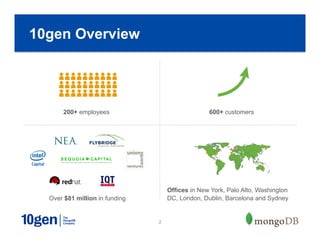
200+ employees 600+ customers
Over $81 million in funding
Offices in New York, Palo Alto, Washington
DC, London, Dublin, Barcelona and Sydney
3
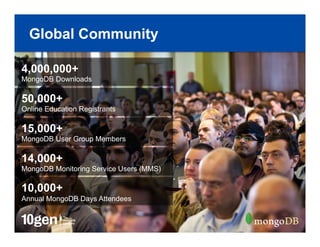
4,000,000+
MongoDB Downloads
50,000+
Online Education Registrants
15,000+
MongoDB User Group Members
14,000+
MongoDB Monitoring Service Users (MMS)
10,000+
Annual MongoDB Days Attendees
Global Community
4
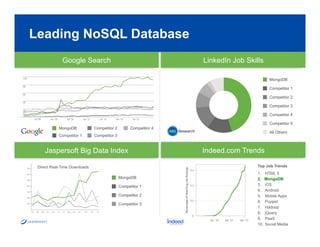
Indeed.com Trends
Top Job Trends
1.  HTML 5
2.  MongoDB
3.  iOS
4.  Android
5.  Mobile Apps
6.  Puppet
7.  Hadoop
8.  jQuery
9.  PaaS
10.  Social Media
Leading NoSQL Database
LinkedIn Job Skills
MongoDB
Competitor 1
Competitor 2
Competitor 3
Competitor 4
Competitor 5
All Others
Google Search
MongoDB
Competitor 1
Competitor 2
Competitor 3
Competitor 4
Jaspersoft Big Data Index
Direct Real-Time Downloads
MongoDB
Competitor 1
Competitor 2
Competitor 3
The Past…
Is Prologue?
6
Back to the Future?
What has been will be again,
what has been done will be done again;
there is nothing new under the sun.
(Ecclesiastes 1:9, NIV)
7
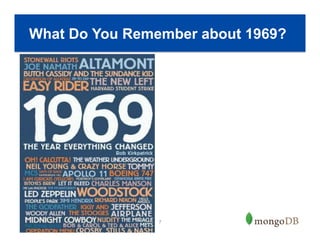
What Do You Remember about 1969?
8
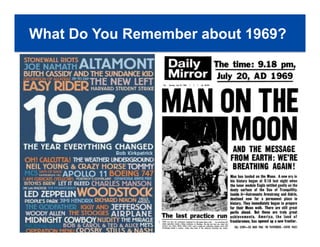
What Do You Remember about 1969?
9
nothing? hold that thought
10
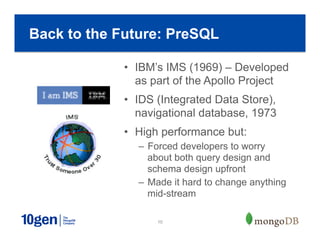
•  IBM’s IMS (1969) – Developed
as part of the Apollo Project
•  IDS (Integrated Data Store),
navigational database, 1973
•  High performance but:
–  Forced developers to worry
about both query design and
schema design upfront
–  Made it hard to change anything
mid-stream
Back to the Future: PreSQL
11
•  Designed to overcome “PreSQL” deficiencies
–  Decoupled query design from schema design
–  Allowed developers to focus on schema design
–  Could be confident that you could query the data as
you wanted later
•  30 years of dominance later…
Enter SQL
…The Present…
13
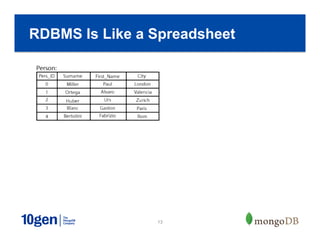
RDBMS Is Like a Spreadsheet
14
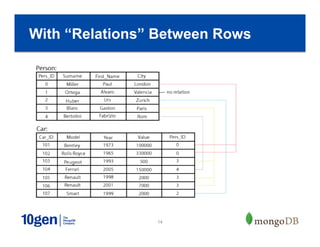
With “Relations” Between Rows
15
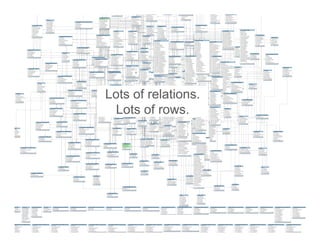
Lots of relations.
Lots of rows.
16
It Hides What You’re Really Doing
17
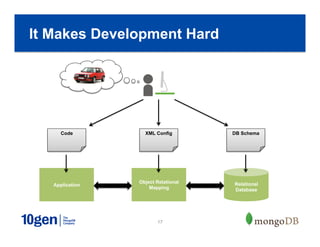
It Makes Development Hard
Relational
Database
Object Relational
Mapping
Application
Code XML Config DB Schema
18
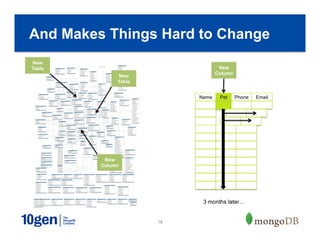
And Makes Things Hard to Change
New
Table
New
Table
New
Column
Name Pet Phone Email
New
Column
3 months later…
19
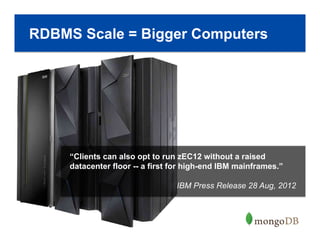
RDBMS Scale = Bigger Computers
“Clients can also opt to run zEC12 without a raised
datacenter floor -- a first for high-end IBM mainframes.”
IBM Press Release 28 Aug, 2012
20
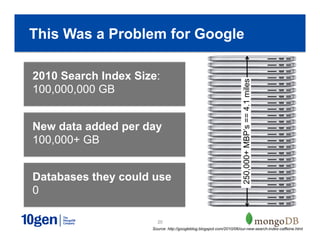
This Was a Problem for Google
Source: http://googleblog.blogspot.com/2010/06/our-new-search-index-caffeine.html
250,000+MBP’s==4.1miles
2010 Search Index Size:
100,000,000 GB
New data added per day
100,000+ GB
Databases they could use
0
21
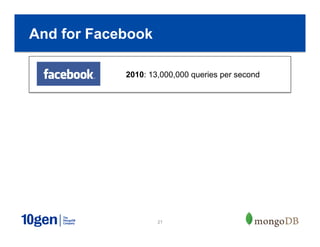
And for Facebook
2010: 13,000,000 queries per second
22
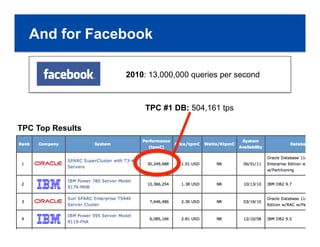
And for Facebook
2010: 13,000,000 queries per second
TPC Top Results
TPC #1 DB: 504,161 tps
23
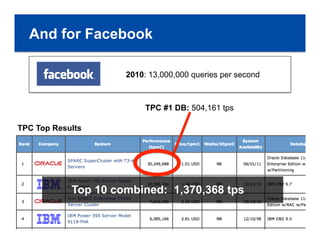
And for Facebook
2010: 13,000,000 queries per second
TPC Top Results
TPC #1 DB: 504,161 tps
Top 10 combined: 1,370,368 tps
24
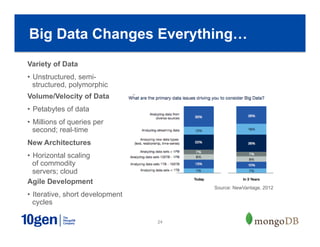
Big Data Changes Everything…
Variety of Data
•  Unstructured, semi-
structured, polymorphic
Volume/Velocity of Data
•  Petabytes of data
•  Millions of queries per
second; real-time
Agile Development
•  Iterative, short development
cycles
New Architectures
•  Horizontal scaling
of commodity
servers; cloud
Source: NewVantage, 2012
25
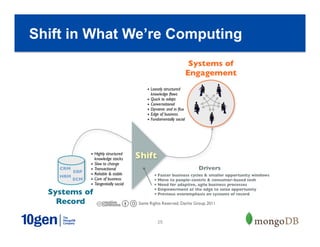
Shift in What We’re Computing
26
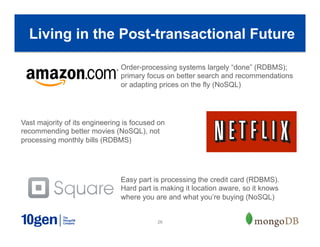
Living in the Post-transactional Future
Order-processing systems largely “done” (RDBMS);
primary focus on better search and recommendations
or adapting prices on the fly (NoSQL)
Vast majority of its engineering is focused on
recommending better movies (NoSQL), not
processing monthly bills (RDBMS)
Easy part is processing the credit card (RDBMS).
Hard part is making it location aware, so it knows
where you are and what you’re buying (NoSQL)
27
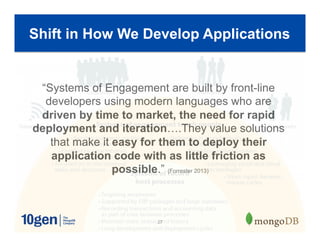
“Systems of Engagement are built by front-line
developers using modern languages who are
driven by time to market, the need for rapid
deployment and iteration….They value solutions
that make it easy for them to deploy their
application code with as little friction as
possible.” (Forrester 2013)
Shift in How We Develop Applications
29
Agile
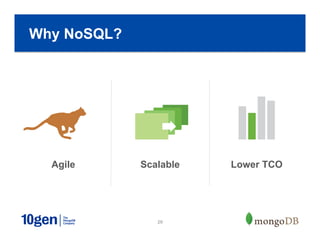
Why NoSQL?
Scalable Lower TCO
30
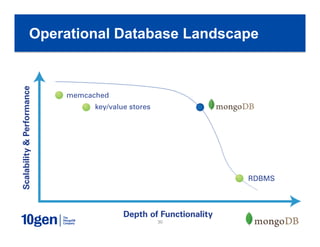
Operational Database Landscape
What Does This Mean?
32
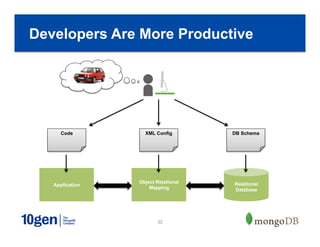
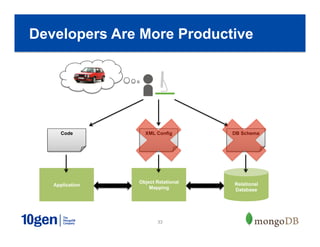
Developers Are More Productive
Application
Code
Relational
Database
Object Relational
Mapping
XML Config DB Schema
33
Developers Are More Productive
Application
Code
Relational
Database
Object Relational
Mapping
XML Config DB Schema
34
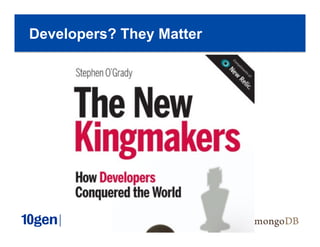
Developers? They Matter
Some MongoDB Examples
36
RDBMS
Agility
MongoDB
{
_id : ObjectId("4c4ba5e5e8aabf3"),
employee_name: "Dunham, Justin",
department : "Marketing",
title : "Product Manager, Web",
report_up: "Neray, Graham",
pay_band: “C",
benefits : [
{ type : "Health",
plan : "PPO Plus" },
{ type : "Dental",
plan : "Standard" }
]
}
37
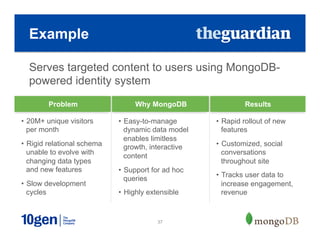
Serves targeted content to users using MongoDB-
powered identity system
Example
Problem Why MongoDB Results
•  20M+ unique visitors
per month
•  Rigid relational schema
unable to evolve with
changing data types
and new features
•  Slow development
cycles
•  Easy-to-manage
dynamic data model
enables limitless
growth, interactive
content
•  Support for ad hoc
queries
•  Highly extensible
•  Rapid rollout of new
features
•  Customized, social
conversations
throughout site
•  Tracks user data to
increase engagement,
revenue
38
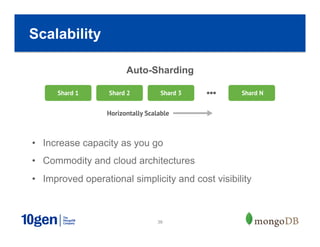
Scalability
Auto-Sharding
•  Increase capacity as you go
•  Commodity and cloud architectures
•  Improved operational simplicity and cost visibility
39
Manages a wide range of content and services
for its web properties using MongoDB
Case Study
Problem Why MongoDB Results
•  Trouble dealing with a
huge variety of content
•  Open-source RDBMS
unable to keep up with
performance and
scalability requirements
•  Problems compounded
by integrating
information from T-
Mobile joint venture
•  Move from 6 billion rows
in RDBMS to simplicity
of 1 document
•  Automated failover and
ability to add nodes
without downtime
•  “Blazingly fast” query
performance: “blown
away by [MongoDB’s]
performance”
•  Significant performance
gains despite big
increase in volume and
variety of data
•  Greater agility, faster
development iteration
•  Saved £2m in licenses
and hardware
40
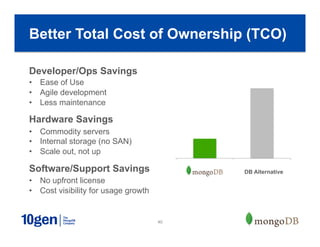
Developer/Ops Savings
•  Ease of Use
•  Agile development
•  Less maintenance
Hardware Savings
•  Commodity servers
•  Internal storage (no SAN)
•  Scale out, not up
Software/Support Savings
•  No upfront license
•  Cost visibility for usage growth
Better Total Cost of Ownership (TCO)
DB Alternative
41
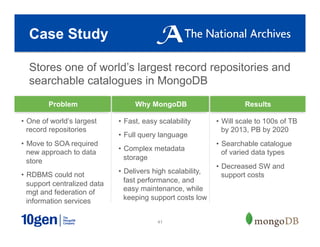
Stores one of world’s largest record repositories and
searchable catalogues in MongoDB
Case Study
Problem Why MongoDB Results
•  One of world’s largest
record repositories
•  Move to SOA required
new approach to data
store
•  RDBMS could not
support centralized data
mgt and federation of
information services
•  Fast, easy scalability
•  Full query language
•  Complex metadata
storage
•  Delivers high scalability,
fast performance, and
easy maintenance, while
keeping support costs low
•  Will scale to 100s of TB
by 2013, PB by 2020
•  Searchable catalogue
of varied data types
•  Decreased SW and
support costs
42
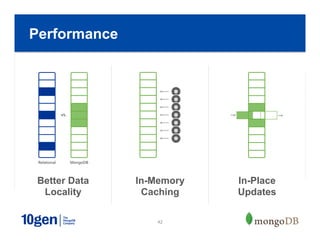
Better Data
Locality
Performance
In-Memory
Caching
In-Place
Updates
43
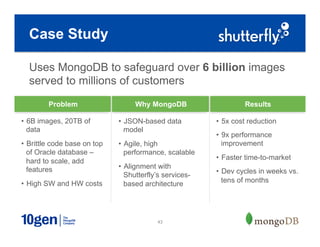
Uses MongoDB to safeguard over 6 billion images
served to millions of customers
Case Study
Problem Why MongoDB Results
•  6B images, 20TB of
data
•  Brittle code base on top
of Oracle database –
hard to scale, add
features
•  High SW and HW costs
•  JSON-based data
model
•  Agile, high
performance, scalable
•  Alignment with
Shutterfly’s services-
based architecture
•  5x cost reduction
•  9x performance
improvement
•  Faster time-to-market
•  Dev cycles in weeks vs.
tens of months
…The Future
45
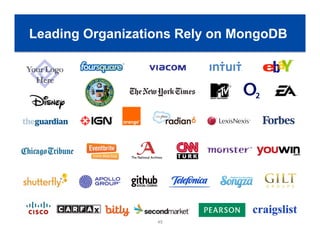
Leading Organizations Rely on MongoDB
46
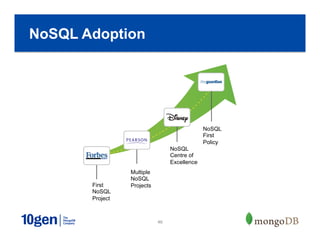
NoSQL Adoption
First
NoSQL
Project
Multiple
NoSQL
Projects
Multiple
NoSQL
Projects
NoSQL
Centre of
Excellence
NoSQL
First
Policy
47
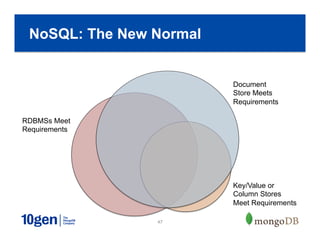
NoSQL: The New Normal
RDBMSs Meet
Requirements
Key/Value or
Column Stores
Meet Requirements
Document
Store Meets
Requirements
48
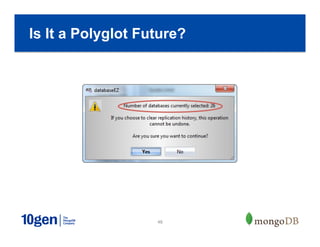
Is It a Polyglot Future?
49
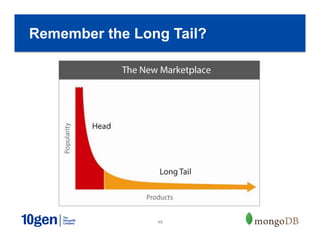
Remember the Long Tail?
50
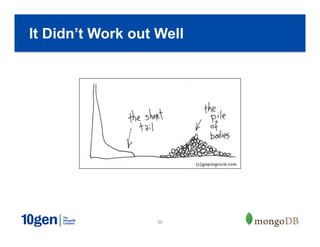
It Didn’t Work out Well
51
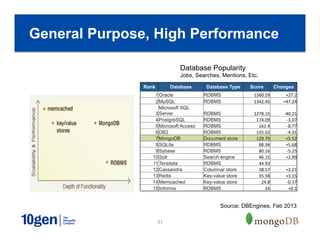
General Purpose, High Performance
Rank Database Database Type Score Changes
1Oracle RDBMS 1560.59	
   +27.2	
  
2MySQL RDBMS 1342.45	
   +47.24	
  
3
Microsoft SQL
Server RDBMS 1278.15	
   -­‐40.21	
  
4PostgreSQL RDBMS 174.09	
   -­‐3.07	
  
5Microsoft Access RDBMS 161.4	
   -­‐8.77	
  
6DB2 RDBMS 155.02	
   -­‐4.31	
  
7MongoDB Document store 129.75	
   +5.52	
  
8SQLite RDBMS 88.94	
   +5.68	
  
9Sybase RDBMS 80.16	
   -­‐5.25	
  
10Solr Search engine 46.15	
   +2.99	
  
11Teradata RDBMS 44.93	
  
12Cassandra Columnar store 38.57	
   +2.21	
  
13Redis Key-value store 35.58	
   +3.15	
  
14Memcached Key-value store 24.8	
   -­‐0.17	
  
15Informix RDBMS 24	
   +0.1	
  
Source: DBEngines, Feb 2013
Database Popularity
Jobs, Searches, Mentions, Etc.
52
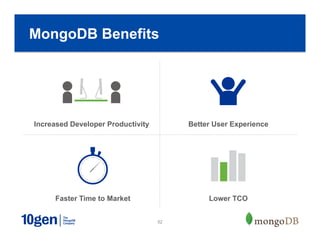
MongoDB Benefits
Increased Developer Productivity Better User Experience
Faster Time to Market Lower TCO
Webinar: NoSQL as the New Normal

Webinar: NoSQL as the New Normal

  • 1.
    VP, Corporate Strategy,10gen Matt Asay (@mjasay) NoSQL: The New Normal
  • 2.
    2 10gen Overview 200+ employees600+ customers Over $81 million in funding Offices in New York, Palo Alto, Washington DC, London, Dublin, Barcelona and Sydney
  • 3.
    3 4,000,000+ MongoDB Downloads 50,000+ Online EducationRegistrants 15,000+ MongoDB User Group Members 14,000+ MongoDB Monitoring Service Users (MMS) 10,000+ Annual MongoDB Days Attendees Global Community
  • 4.
    4 Indeed.com Trends Top JobTrends 1.  HTML 5 2.  MongoDB 3.  iOS 4.  Android 5.  Mobile Apps 6.  Puppet 7.  Hadoop 8.  jQuery 9.  PaaS 10.  Social Media Leading NoSQL Database LinkedIn Job Skills MongoDB Competitor 1 Competitor 2 Competitor 3 Competitor 4 Competitor 5 All Others Google Search MongoDB Competitor 1 Competitor 2 Competitor 3 Competitor 4 Jaspersoft Big Data Index Direct Real-Time Downloads MongoDB Competitor 1 Competitor 2 Competitor 3
  • 5.
  • 6.
    6 Back to theFuture? What has been will be again, what has been done will be done again; there is nothing new under the sun. (Ecclesiastes 1:9, NIV)
  • 7.
    7 What Do YouRemember about 1969?
  • 8.
    8 What Do YouRemember about 1969?
  • 9.
  • 10.
    10 •  IBM’s IMS(1969) – Developed as part of the Apollo Project •  IDS (Integrated Data Store), navigational database, 1973 •  High performance but: –  Forced developers to worry about both query design and schema design upfront –  Made it hard to change anything mid-stream Back to the Future: PreSQL
  • 11.
    11 •  Designed toovercome “PreSQL” deficiencies –  Decoupled query design from schema design –  Allowed developers to focus on schema design –  Could be confident that you could query the data as you wanted later •  30 years of dominance later… Enter SQL
  • 12.
  • 13.
    13 RDBMS Is Likea Spreadsheet
  • 14.
  • 15.
  • 16.
    16 It Hides WhatYou’re Really Doing
  • 17.
    17 It Makes DevelopmentHard Relational Database Object Relational Mapping Application Code XML Config DB Schema
  • 18.
    18 And Makes ThingsHard to Change New Table New Table New Column Name Pet Phone Email New Column 3 months later…
  • 19.
    19 RDBMS Scale =Bigger Computers “Clients can also opt to run zEC12 without a raised datacenter floor -- a first for high-end IBM mainframes.” IBM Press Release 28 Aug, 2012
  • 20.
    20 This Was aProblem for Google Source: http://googleblog.blogspot.com/2010/06/our-new-search-index-caffeine.html 250,000+MBP’s==4.1miles 2010 Search Index Size: 100,000,000 GB New data added per day 100,000+ GB Databases they could use 0
  • 21.
    21 And for Facebook 2010:13,000,000 queries per second
  • 22.
    22 And for Facebook 2010:13,000,000 queries per second TPC Top Results TPC #1 DB: 504,161 tps
  • 23.
    23 And for Facebook 2010:13,000,000 queries per second TPC Top Results TPC #1 DB: 504,161 tps Top 10 combined: 1,370,368 tps
  • 24.
    24 Big Data ChangesEverything… Variety of Data •  Unstructured, semi- structured, polymorphic Volume/Velocity of Data •  Petabytes of data •  Millions of queries per second; real-time Agile Development •  Iterative, short development cycles New Architectures •  Horizontal scaling of commodity servers; cloud Source: NewVantage, 2012
  • 25.
    25 Shift in WhatWe’re Computing
  • 26.
    26 Living in thePost-transactional Future Order-processing systems largely “done” (RDBMS); primary focus on better search and recommendations or adapting prices on the fly (NoSQL) Vast majority of its engineering is focused on recommending better movies (NoSQL), not processing monthly bills (RDBMS) Easy part is processing the credit card (RDBMS). Hard part is making it location aware, so it knows where you are and what you’re buying (NoSQL)
  • 27.
    27 “Systems of Engagementare built by front-line developers using modern languages who are driven by time to market, the need for rapid deployment and iteration….They value solutions that make it easy for them to deploy their application code with as little friction as possible.” (Forrester 2013) Shift in How We Develop Applications
  • 29.
  • 30.
  • 31.
  • 32.
    32 Developers Are MoreProductive Application Code Relational Database Object Relational Mapping XML Config DB Schema
  • 33.
    33 Developers Are MoreProductive Application Code Relational Database Object Relational Mapping XML Config DB Schema
  • 34.
  • 35.
  • 36.
    36 RDBMS Agility MongoDB { _id : ObjectId("4c4ba5e5e8aabf3"), employee_name:"Dunham, Justin", department : "Marketing", title : "Product Manager, Web", report_up: "Neray, Graham", pay_band: “C", benefits : [ { type : "Health", plan : "PPO Plus" }, { type : "Dental", plan : "Standard" } ] }
  • 37.
    37 Serves targeted contentto users using MongoDB- powered identity system Example Problem Why MongoDB Results •  20M+ unique visitors per month •  Rigid relational schema unable to evolve with changing data types and new features •  Slow development cycles •  Easy-to-manage dynamic data model enables limitless growth, interactive content •  Support for ad hoc queries •  Highly extensible •  Rapid rollout of new features •  Customized, social conversations throughout site •  Tracks user data to increase engagement, revenue
  • 38.
    38 Scalability Auto-Sharding •  Increase capacityas you go •  Commodity and cloud architectures •  Improved operational simplicity and cost visibility
  • 39.
    39 Manages a widerange of content and services for its web properties using MongoDB Case Study Problem Why MongoDB Results •  Trouble dealing with a huge variety of content •  Open-source RDBMS unable to keep up with performance and scalability requirements •  Problems compounded by integrating information from T- Mobile joint venture •  Move from 6 billion rows in RDBMS to simplicity of 1 document •  Automated failover and ability to add nodes without downtime •  “Blazingly fast” query performance: “blown away by [MongoDB’s] performance” •  Significant performance gains despite big increase in volume and variety of data •  Greater agility, faster development iteration •  Saved £2m in licenses and hardware
  • 40.
    40 Developer/Ops Savings •  Easeof Use •  Agile development •  Less maintenance Hardware Savings •  Commodity servers •  Internal storage (no SAN) •  Scale out, not up Software/Support Savings •  No upfront license •  Cost visibility for usage growth Better Total Cost of Ownership (TCO) DB Alternative
  • 41.
    41 Stores one ofworld’s largest record repositories and searchable catalogues in MongoDB Case Study Problem Why MongoDB Results •  One of world’s largest record repositories •  Move to SOA required new approach to data store •  RDBMS could not support centralized data mgt and federation of information services •  Fast, easy scalability •  Full query language •  Complex metadata storage •  Delivers high scalability, fast performance, and easy maintenance, while keeping support costs low •  Will scale to 100s of TB by 2013, PB by 2020 •  Searchable catalogue of varied data types •  Decreased SW and support costs
  • 42.
  • 43.
    43 Uses MongoDB tosafeguard over 6 billion images served to millions of customers Case Study Problem Why MongoDB Results •  6B images, 20TB of data •  Brittle code base on top of Oracle database – hard to scale, add features •  High SW and HW costs •  JSON-based data model •  Agile, high performance, scalable •  Alignment with Shutterfly’s services- based architecture •  5x cost reduction •  9x performance improvement •  Faster time-to-market •  Dev cycles in weeks vs. tens of months
  • 44.
  • 45.
  • 46.
  • 47.
    47 NoSQL: The NewNormal RDBMSs Meet Requirements Key/Value or Column Stores Meet Requirements Document Store Meets Requirements
  • 48.
    48 Is It aPolyglot Future?
  • 49.
  • 50.
  • 51.
    51 General Purpose, HighPerformance Rank Database Database Type Score Changes 1Oracle RDBMS 1560.59   +27.2   2MySQL RDBMS 1342.45   +47.24   3 Microsoft SQL Server RDBMS 1278.15   -­‐40.21   4PostgreSQL RDBMS 174.09   -­‐3.07   5Microsoft Access RDBMS 161.4   -­‐8.77   6DB2 RDBMS 155.02   -­‐4.31   7MongoDB Document store 129.75   +5.52   8SQLite RDBMS 88.94   +5.68   9Sybase RDBMS 80.16   -­‐5.25   10Solr Search engine 46.15   +2.99   11Teradata RDBMS 44.93   12Cassandra Columnar store 38.57   +2.21   13Redis Key-value store 35.58   +3.15   14Memcached Key-value store 24.8   -­‐0.17   15Informix RDBMS 24   +0.1   Source: DBEngines, Feb 2013 Database Popularity Jobs, Searches, Mentions, Etc.
  • 52.
    52 MongoDB Benefits Increased DeveloperProductivity Better User Experience Faster Time to Market Lower TCO