Kurukshetra University, Kurukshetra
Department of Environment Science
Submitted BY :-
Name : Vikrant saini
Class : MSC(P)
Roll no . 4
Submitted To :-
Prof. Smita chaudhary
Director of Department
Environment science
Contents
• Definition
• Cause
• Indian Monsoons
• Types of Monsoons
• El Nino and Effects
• La Nina and Effects
• Conclusion
Monsoons
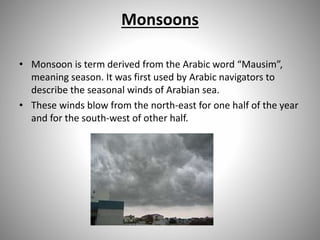
• Monsoon is term derived from the Arabic word “Mausim”,
meaning season. It was first used by Arabic navigators to
describe the seasonal winds of Arabian sea.
• These winds blow from the north-east for one half of the year
and for the south-west of other half.
Cause
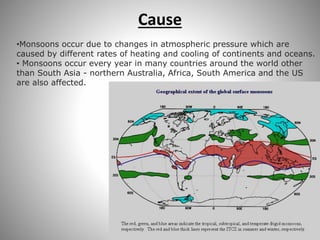
•Monsoons occur due to changes in atmospheric pressure which are
caused by different rates of heating and cooling of continents and oceans.
• Monsoons occur every year in many countries around the world other
than South Asia - northern Australia, Africa, South America and the US
are also affected.
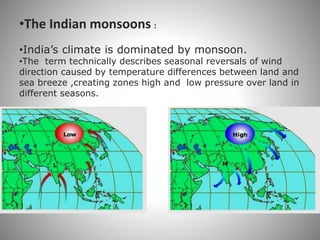
•The Indian monsoons :
•India’s climate is dominated by monsoon.
•The term technically describes seasonal reversals of wind
direction caused by temperature differences between land and
sea breeze ,creating zones high and low pressure over land in
different seasons.
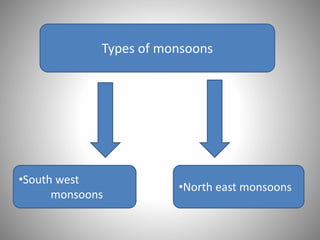
Types of monsoons :Types of monsoons
•South west
monsoons
•North east monsoons
South west monsoons :-
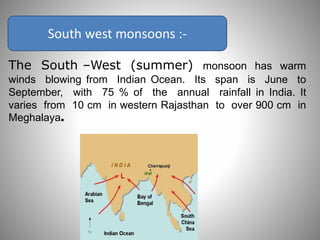
The South –West (summer) monsoon has warm
winds blowing from Indian Ocean. Its span is June to
September, with 75 % of the annual rainfall in India. It
varies from 10 cm in western Rajasthan to over 900 cm in
Meghalaya.
North east monsoons :-
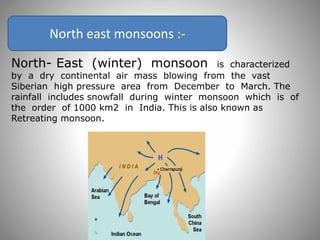
North- East (winter) monsoon is characterized
by a dry continental air mass blowing from the vast
Siberian high pressure area from December to March. The
rainfall includes snowfall during winter monsoon which is of
the order of 1000 km2 in India. This is also known as
Retreating monsoon.
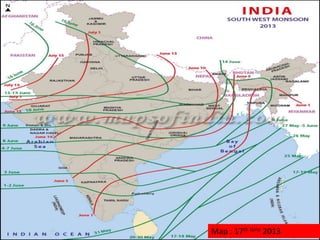
Map : 17th June 2013
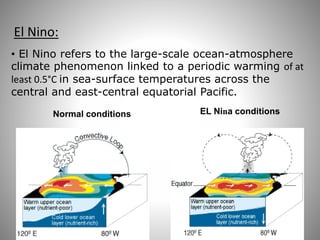
• El Nino refers to the large-scale ocean-atmosphere
climate phenomenon linked to a periodic warming of at
least 0.5°C in sea-surface temperatures across the
central and east-central equatorial Pacific.
El Nino:
Normal conditions EL Nina conditions
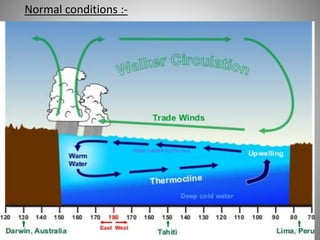
Normal conditions :-
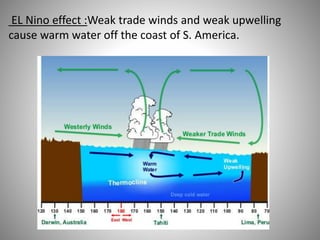
EL Nino effect :Weak trade winds and weak upwelling
cause warm water off the coast of S. America.
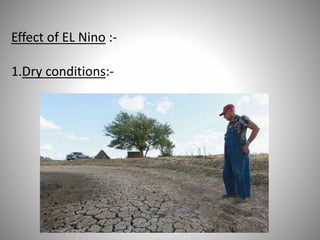
Effect of EL Nino :-
1.Dry conditions:-
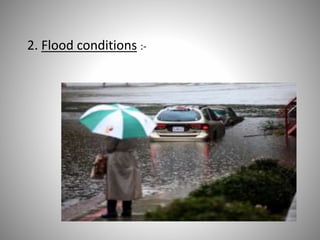
2. Flood conditions :-
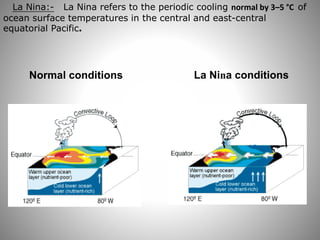
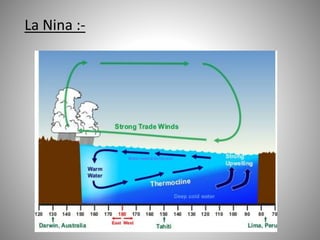
La Nina:- La Nina refers to the periodic cooling normal by 3–5 °C of
ocean surface temperatures in the central and east-central
equatorial Pacific.
Normal conditions La Nina conditions
La Nina :-
Conclusion
• A monsoon is a seasonal shift in the prevailing wind
direction, that usually brings with it a different kind
of weather.
• Monsoons are large-scale sea breezes .
• El Niño and La Niña are naturally occurring
phenomena that result from interactions between
the ocean surface and the atmosphere over the
tropical Pacific.
References
 Contents – Monsoons
http://www.monsoons.com
 Contents - El Niño
http://www.msc-smc.ec.gc.ca/education/elnino/index
 El Niño/La Niña Update
http://www.wmo.ch/nino/updat.html#intro
Any Question ?

Vikrant. ppt

  • 1.
    Kurukshetra University, Kurukshetra Departmentof Environment Science Submitted BY :- Name : Vikrant saini Class : MSC(P) Roll no . 4 Submitted To :- Prof. Smita chaudhary Director of Department Environment science
  • 3.
    Contents • Definition • Cause •Indian Monsoons • Types of Monsoons • El Nino and Effects • La Nina and Effects • Conclusion
  • 4.
    Monsoons • Monsoon isterm derived from the Arabic word “Mausim”, meaning season. It was first used by Arabic navigators to describe the seasonal winds of Arabian sea. • These winds blow from the north-east for one half of the year and for the south-west of other half.
  • 5.
    Cause •Monsoons occur dueto changes in atmospheric pressure which are caused by different rates of heating and cooling of continents and oceans. • Monsoons occur every year in many countries around the world other than South Asia - northern Australia, Africa, South America and the US are also affected.
  • 6.
    •The Indian monsoons: •India’s climate is dominated by monsoon. •The term technically describes seasonal reversals of wind direction caused by temperature differences between land and sea breeze ,creating zones high and low pressure over land in different seasons.
  • 7.
    Types of monsoons:Types of monsoons •South west monsoons •North east monsoons
  • 8.
    South west monsoons:- The South –West (summer) monsoon has warm winds blowing from Indian Ocean. Its span is June to September, with 75 % of the annual rainfall in India. It varies from 10 cm in western Rajasthan to over 900 cm in Meghalaya.
  • 9.
    North east monsoons:- North- East (winter) monsoon is characterized by a dry continental air mass blowing from the vast Siberian high pressure area from December to March. The rainfall includes snowfall during winter monsoon which is of the order of 1000 km2 in India. This is also known as Retreating monsoon.
  • 10.
    Map : 17thJune 2013
  • 11.
    • El Ninorefers to the large-scale ocean-atmosphere climate phenomenon linked to a periodic warming of at least 0.5°C in sea-surface temperatures across the central and east-central equatorial Pacific. El Nino: Normal conditions EL Nina conditions
  • 12.
  • 13.
    EL Nino effect:Weak trade winds and weak upwelling cause warm water off the coast of S. America.
  • 14.
    Effect of ELNino :- 1.Dry conditions:-
  • 15.
  • 16.
    La Nina:- LaNina refers to the periodic cooling normal by 3–5 °C of ocean surface temperatures in the central and east-central equatorial Pacific. Normal conditions La Nina conditions
  • 17.
  • 18.
    Conclusion • A monsoonis a seasonal shift in the prevailing wind direction, that usually brings with it a different kind of weather. • Monsoons are large-scale sea breezes . • El Niño and La Niña are naturally occurring phenomena that result from interactions between the ocean surface and the atmosphere over the tropical Pacific.
  • 19.
    References  Contents –Monsoons http://www.monsoons.com  Contents - El Niño http://www.msc-smc.ec.gc.ca/education/elnino/index  El Niño/La Niña Update http://www.wmo.ch/nino/updat.html#intro
  • 20.