 Total Area : 32,87,263 Sq. km
 Latitude : 8o 4’ N to 37o 6’ N
 Longitude : 68o 7’ E to 97o 25’ E
 North to South : 3,214 km
 East to West : 2,933 km
 Main land Coastline : 6,100 km
 Total Coastline : 7,516 km
 Land Frontier : 15,200 km
 Northern-most Point : Indira Col near Karakoram Pass
 Southern-most Point : Indira point, (Great Nicobar ,
Andaman and Nicobar Island)
 Western-most Point : West of Ghuav Mota Gujarat
 Eastern-most Point : Kibithu (Arunachal Pradesh)
 Highest Altitude: Kanchenjunga
 Lowest Altitude : Kuttanand (Kerala)
 Territorial Sea : 12 nm
 Contiguous Zone : 24 nm
 Exclusive Economic Zone : 200 nm
INDIA : GEOGRAPHICAL FACTS
10 FACTORS THAT AFFECT THE
. CLIMATE
 Location and Latitudinal Extent
 Distance from the Sea
 The Northern Mountain Ranges
 Physiography
 Monsoon Winds
 Upper Air Circulation
 Tropical Cyclones and Western Disturbances
 El-Nino
 La Nina
 Southern Oscillation
 Location and Latitudinal Extent
 Areas south of the Tropic of Cancer
are closer to the equator and
experience high temperature
throughout the year .The northern
parts on the other hand lie in the
warm temperature zone. Hence
they experience comparatively low
temperatures. Some places record
considerably low temperatures
particularly in winter. Water bodies
comprising the Arabian Sea and the
Bay of Bengal surround the
peninsular India and make climatic
conditions mild along the coastal
areas.
 Distance from the Sea
 The sea affects the climate of a
place. Areas near the coast have
equable or marline climate
Coastal areas are cooler and
wetter than inland areas. Clouds
form when warm air from inland
areas meets cool air from the sea.
The center of continents are
subject to a large range of
temperatures. In the summer,
temperatures can be very hot and
dry as moisture from the sea
evaporates before it reaches the
center of the land mass.
 The Northern Mountain Ranges
 India is separated from the rest
of Asia by the impenetrable wall
of the Himalayan mountain
ranges. These ranges protect
India from the bitterly cold and
dry winds of Central Asia during
winter. Further, these mountain
ranges act as an effective
physical barrier for rain bearing
south-west monsoon winds to
cross the northern frontiers of
India. Thus, the Himalayan
mountain ranges act as a
climatic divide between the
Indian Sub-continent and
Central Asia.
 Physiography
 Physiography of India has a great bearing
on major elements of climate such as
temperature, atmospheric pressure,
direction of winds and the amount of
rainfall. In fact, physical map of India is
very closely related to the climatic
conditions of the country. Places located at
higher altitude have cool climate even
though they are located in the peninsular
India,eg.Ooty. The greatest control of
physiography in the peninsular India is seen
in the distribution of rainfall. The south-
west monsoon winds from the Arabian sea
strike almost perpendicular at the Western
Ghats and cause copious rainfall in the
Western Coastal plain and the western
slopes of the Western Ghats.
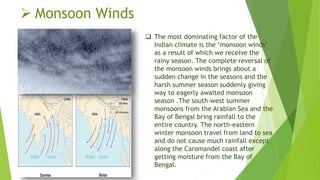
 Monsoon Winds
 The most dominating factor of the
Indian climate is the ‘monsoon winds’
as a result of which we receive the
rainy season. The complete reversal of
the monsoon winds brings about a
sudden change in the seasons and the
harsh summer season suddenly giving
way to eagerly awaited monsoon
season .The south-west summer
monsoons from the Arabian Sea and the
Bay of Bengal bring rainfall to the
entire country. The north-eastern
winter monsoon travel from land to sea
and do not cause much rainfall except
along the Caromandel coast after
getting moisture from the Bay of
Bengal.
 Upper Air Circulation
 The changes in the upper air circulation over Indian
landmass influence the climate of India to a great
extent. Jet streams in the upper air system influence
the Indian climate in the following ways:
 Westerly Jet Stream:
Westerly jet stream blows at a very high speed during
winter over the sub-tropical zone. This jet stream is
bifurcated by the Himalayan ranges. The northern branch
of this jet stream blows along the northern edge of this
barrier. The southern branch blows eastwards south of the
Himalayan ranges along 25° north latitude. This help in the
sudden onset of the south-west monsoons.
 Easterly Jet:
Reversal in upper air circulation takes place in summer
due to the apparent shift of the sun’s vertical rays in the
northern hemisphere. The westerly jet stream as replaced
by the easterly jet stream which owes its origin to the
heating of the Tibet plateau. This leads to the
development of an easterly cold jet stream centered
around 15°N latitude and blowing over peninsular India.
This help in the sudden onset of the retreating monsoons.
 Tropical Cyclones and Western
Disturbances
 Tropical cyclones originate in the Bay of Bengal and Arabian
Sea and the influence large parts of the peninsular India.
Majority of the cyclones originate in the Bay of Bengal and
influence the weather conditions during the south-west
monsoon season. Some cyclones are born during the
retreating monsoon season(in October and November) and
influence the weather conditions along the eastern coast of
India.
 A Western Disturbance is an extra tropical storm originating in
the Mediterranean region that brings sudden winter rain to
the northwestern parts of the Indian subcontinent. It is a non-
monsoonal precipitation pattern driven by the westerlies. The
moisture in these storms usually originates over the
Mediterranean Sea and the Atlantic Ocean. Extra tropical
storms are a global phenomena with moisture usually carried
in the upper atmosphere, unlike their tropical counterparts
where the moisture is carried in the lower atmosphere. In the
case of the subcontinent, moisture is sometimes shed as rain
when the storm system encounters the Himalayas.
 El-Nino Effect
 El Niño is the warm phase of the El Niño Southern
Oscillation (commonly called ENSO) and is
associated with a band of warm ocean water that
develops in the central and east-central equatorial
Pacific (between approximately the International
Date Line and 120°W), including off the Pacific
coast of South America. El Niño Southern
Oscillation refers to the cycle of warm and cold
temperatures, as measured by sea surface
temperature, SST, of the tropical central and
eastern Pacific Ocean. El Niño is accompanied by
high air pressure in the western Pacific and low air
pressure in the eastern Pacific. Developing
countries dependent upon agriculture and fishing,
particularly those bordering the Pacific Ocean, are
the most affected. In American Spanish, the
capitalized term "El Niño" refers to "the little boy",
so named because the pool of warm water in the
Pacific near South America is often at its warmest
around Christmas.
 La Nina Effect
 La Niña is a coupled ocean-atmosphere
phenomenon that is the counterpart of El
Niño as part of the broader El Niño–
Southern Oscillation climate pattern.
The name La Niña originates from
Spanish, meaning "the little girl",
analogous to El Niño meaning "the little
boy". It has also in the past been called
anti-El Niño. During a period of La Niña,
the sea surface temperature across the
equatorial Eastern Central Pacific Ocean
will be lower than normal by 3 to 5 °C. A
La Niña often, though not always, follows
an El Niño. A La Nina also marks an
active hurricane season. But in India, the
presence of La Nina portends
exceptionally good news. It is the
harbinger of heavy monsoon showers in
India.
 Southern Oscillation
 There is a strange linkage of
meteorological changes often observed
between the Indian and the Pacific
Oceans. It has been noticed that
whenever the surface level pressure is
high over the Indian Ocean, there is
low pressure over the Pacific Ocean
and vice-versa .This interrelation of
high and low pressure over the Pacific
and the Indian Ocean is called
Southern Oscillation. When the winter
pressure is high over the Pacific Ocean
and low over the Indian Ocean, the
south-west monsoons in India tend to
be stronger. In the reverse case, the
monsoons are most likely to be
weaker.
Climate

Climate

  • 2.
     Total Area: 32,87,263 Sq. km  Latitude : 8o 4’ N to 37o 6’ N  Longitude : 68o 7’ E to 97o 25’ E  North to South : 3,214 km  East to West : 2,933 km  Main land Coastline : 6,100 km  Total Coastline : 7,516 km  Land Frontier : 15,200 km  Northern-most Point : Indira Col near Karakoram Pass  Southern-most Point : Indira point, (Great Nicobar , Andaman and Nicobar Island)  Western-most Point : West of Ghuav Mota Gujarat  Eastern-most Point : Kibithu (Arunachal Pradesh)  Highest Altitude: Kanchenjunga  Lowest Altitude : Kuttanand (Kerala)  Territorial Sea : 12 nm  Contiguous Zone : 24 nm  Exclusive Economic Zone : 200 nm INDIA : GEOGRAPHICAL FACTS
  • 3.
    10 FACTORS THATAFFECT THE . CLIMATE  Location and Latitudinal Extent  Distance from the Sea  The Northern Mountain Ranges  Physiography  Monsoon Winds  Upper Air Circulation  Tropical Cyclones and Western Disturbances  El-Nino  La Nina  Southern Oscillation
  • 4.
     Location andLatitudinal Extent  Areas south of the Tropic of Cancer are closer to the equator and experience high temperature throughout the year .The northern parts on the other hand lie in the warm temperature zone. Hence they experience comparatively low temperatures. Some places record considerably low temperatures particularly in winter. Water bodies comprising the Arabian Sea and the Bay of Bengal surround the peninsular India and make climatic conditions mild along the coastal areas.
  • 5.
     Distance fromthe Sea  The sea affects the climate of a place. Areas near the coast have equable or marline climate Coastal areas are cooler and wetter than inland areas. Clouds form when warm air from inland areas meets cool air from the sea. The center of continents are subject to a large range of temperatures. In the summer, temperatures can be very hot and dry as moisture from the sea evaporates before it reaches the center of the land mass.
  • 6.
     The NorthernMountain Ranges  India is separated from the rest of Asia by the impenetrable wall of the Himalayan mountain ranges. These ranges protect India from the bitterly cold and dry winds of Central Asia during winter. Further, these mountain ranges act as an effective physical barrier for rain bearing south-west monsoon winds to cross the northern frontiers of India. Thus, the Himalayan mountain ranges act as a climatic divide between the Indian Sub-continent and Central Asia.
  • 7.
     Physiography  Physiographyof India has a great bearing on major elements of climate such as temperature, atmospheric pressure, direction of winds and the amount of rainfall. In fact, physical map of India is very closely related to the climatic conditions of the country. Places located at higher altitude have cool climate even though they are located in the peninsular India,eg.Ooty. The greatest control of physiography in the peninsular India is seen in the distribution of rainfall. The south- west monsoon winds from the Arabian sea strike almost perpendicular at the Western Ghats and cause copious rainfall in the Western Coastal plain and the western slopes of the Western Ghats.
  • 8.
     Monsoon Winds The most dominating factor of the Indian climate is the ‘monsoon winds’ as a result of which we receive the rainy season. The complete reversal of the monsoon winds brings about a sudden change in the seasons and the harsh summer season suddenly giving way to eagerly awaited monsoon season .The south-west summer monsoons from the Arabian Sea and the Bay of Bengal bring rainfall to the entire country. The north-eastern winter monsoon travel from land to sea and do not cause much rainfall except along the Caromandel coast after getting moisture from the Bay of Bengal.
  • 9.
     Upper AirCirculation  The changes in the upper air circulation over Indian landmass influence the climate of India to a great extent. Jet streams in the upper air system influence the Indian climate in the following ways:  Westerly Jet Stream: Westerly jet stream blows at a very high speed during winter over the sub-tropical zone. This jet stream is bifurcated by the Himalayan ranges. The northern branch of this jet stream blows along the northern edge of this barrier. The southern branch blows eastwards south of the Himalayan ranges along 25° north latitude. This help in the sudden onset of the south-west monsoons.  Easterly Jet: Reversal in upper air circulation takes place in summer due to the apparent shift of the sun’s vertical rays in the northern hemisphere. The westerly jet stream as replaced by the easterly jet stream which owes its origin to the heating of the Tibet plateau. This leads to the development of an easterly cold jet stream centered around 15°N latitude and blowing over peninsular India. This help in the sudden onset of the retreating monsoons.
  • 10.
     Tropical Cyclonesand Western Disturbances  Tropical cyclones originate in the Bay of Bengal and Arabian Sea and the influence large parts of the peninsular India. Majority of the cyclones originate in the Bay of Bengal and influence the weather conditions during the south-west monsoon season. Some cyclones are born during the retreating monsoon season(in October and November) and influence the weather conditions along the eastern coast of India.  A Western Disturbance is an extra tropical storm originating in the Mediterranean region that brings sudden winter rain to the northwestern parts of the Indian subcontinent. It is a non- monsoonal precipitation pattern driven by the westerlies. The moisture in these storms usually originates over the Mediterranean Sea and the Atlantic Ocean. Extra tropical storms are a global phenomena with moisture usually carried in the upper atmosphere, unlike their tropical counterparts where the moisture is carried in the lower atmosphere. In the case of the subcontinent, moisture is sometimes shed as rain when the storm system encounters the Himalayas.
  • 11.
     El-Nino Effect El Niño is the warm phase of the El Niño Southern Oscillation (commonly called ENSO) and is associated with a band of warm ocean water that develops in the central and east-central equatorial Pacific (between approximately the International Date Line and 120°W), including off the Pacific coast of South America. El Niño Southern Oscillation refers to the cycle of warm and cold temperatures, as measured by sea surface temperature, SST, of the tropical central and eastern Pacific Ocean. El Niño is accompanied by high air pressure in the western Pacific and low air pressure in the eastern Pacific. Developing countries dependent upon agriculture and fishing, particularly those bordering the Pacific Ocean, are the most affected. In American Spanish, the capitalized term "El Niño" refers to "the little boy", so named because the pool of warm water in the Pacific near South America is often at its warmest around Christmas.
  • 12.
     La NinaEffect  La Niña is a coupled ocean-atmosphere phenomenon that is the counterpart of El Niño as part of the broader El Niño– Southern Oscillation climate pattern. The name La Niña originates from Spanish, meaning "the little girl", analogous to El Niño meaning "the little boy". It has also in the past been called anti-El Niño. During a period of La Niña, the sea surface temperature across the equatorial Eastern Central Pacific Ocean will be lower than normal by 3 to 5 °C. A La Niña often, though not always, follows an El Niño. A La Nina also marks an active hurricane season. But in India, the presence of La Nina portends exceptionally good news. It is the harbinger of heavy monsoon showers in India.
  • 13.
     Southern Oscillation There is a strange linkage of meteorological changes often observed between the Indian and the Pacific Oceans. It has been noticed that whenever the surface level pressure is high over the Indian Ocean, there is low pressure over the Pacific Ocean and vice-versa .This interrelation of high and low pressure over the Pacific and the Indian Ocean is called Southern Oscillation. When the winter pressure is high over the Pacific Ocean and low over the Indian Ocean, the south-west monsoons in India tend to be stronger. In the reverse case, the monsoons are most likely to be weaker.